Feeds:
Posts
Comments

Posts Tagged ‘Richard Widerkehr’

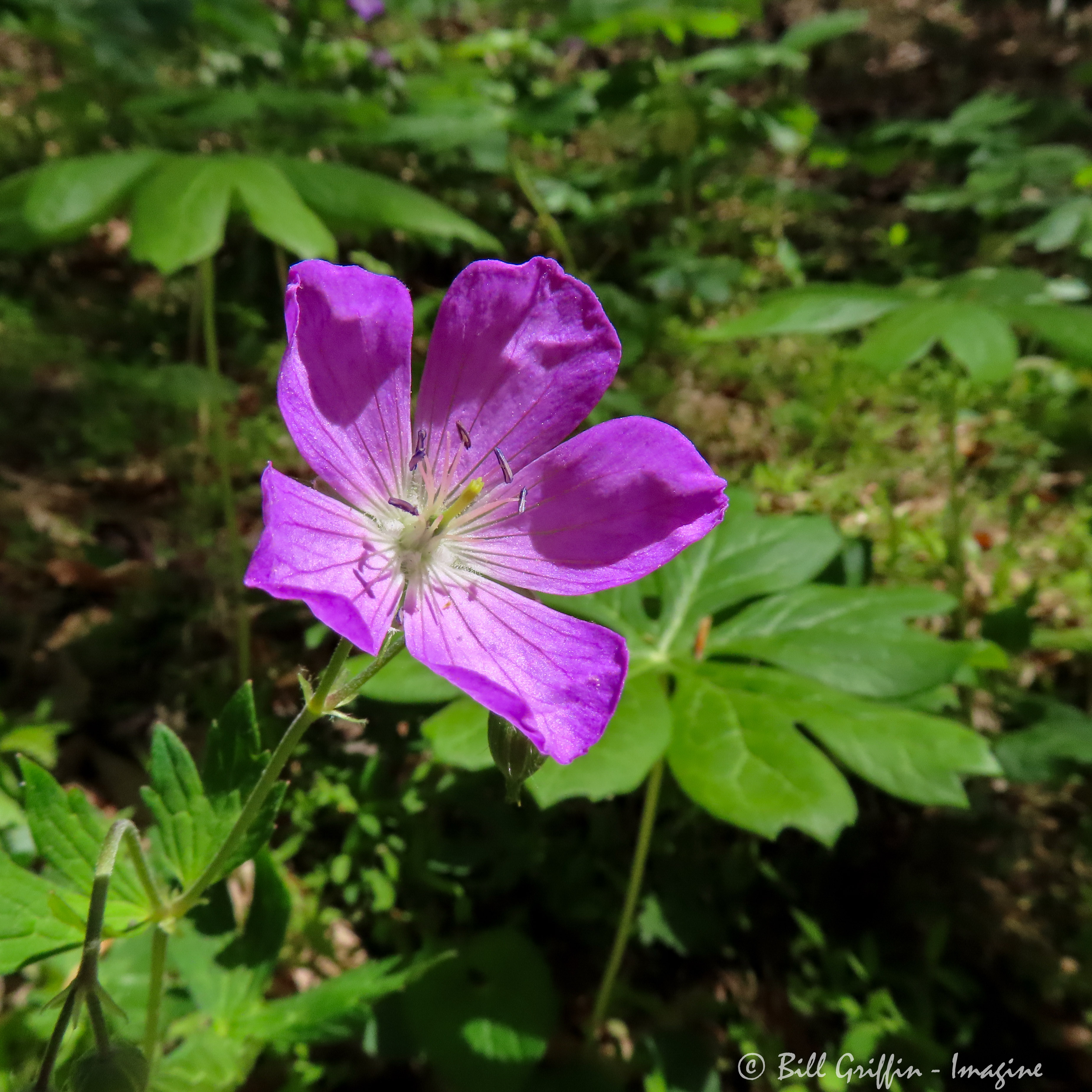
Native Southern Wildflower – Geranium maculatum

 . 
[ poems by Fred Chappell, Patricia Crittenden, Patricia Hooper, Richard Widerkehr,
Ann Deagon, Peter Makuck, David Manning ]
 . 
Forever Mountain
 . 
J.T.Chappell, 1912-1978
 . 
Now a lofty smoke has cleansed my vision.
 . 
I see my father has gone to climb
Lightly the Pisgah slope, taking the time
He’s got a world of, making spry headway
In the fresh green mornings, stretching out
Noontimes in the groves of beech and maple.
He has cut a walking stick of second-growth hickory
And through the amber afternoon he measures
Its shadow and his own shadow on a sunny rock.
Not marking the hour, but observing
The quality of light come over him.
He is alone, except what voices out of time
Swarm to his head like bees to the bee-tree crown,
The voices of former life as indistinct as heat.
By the clear trout pool he builds his fire at twilight,
And in the night a granary of stars
Rises in the water and spreads from edge to edge.
He sleeps, to dream the tossing dream
Of the horses of pine trees, their shoulders
Twisting like silk ribbon in the breeze.
 . 
He rises glad and early and goes his way,
Taking by plateaus the mountain that possesses him.
 . 
My vision blurs blue with distance,
I see no more.
Forever Mountain has become a cloud
That light turns gold, that wind dislimns.
 . 
This is continually a prayer.
 . 
Fred Chappell (1936-2024)
from Source, LSU Press (1985), and collected in The Fred Chappell Reader, St. Martin’s Press (1987)
selected by Bill Griffin
 . 
This was the first contemporary poem I read as I returned to poetry in my forties. I have read it again and again since then, as well as most everything else Fred has written. This, along with the poem Hymn by A R Ammons, was also the inspiration for me to imagine I might take up the pen and write as well. Even more today than all those decades ago, I am captured by this vision of heaven, the afterlife, as a campfire at night with a granary of stars, rising trout, and a new mountain to climb each morning. May it be so.
— Bill
 . 
❀ ✿ ✾ ❁
 . 
We Set Out Together
 . 
My daughter and me,
up an old mountain road through the late autumn trees.
We’d agreed she’d climb to the peak on her own and, on her way back,
find me where I’d wait among bright colored leaves.
 . 
But the leaves are gone, fallen back to the earth.
We’ve come too late.
 . 
We pause near the last of the asters; that lets me keep up.
But soon I begin to tire.
As we pass the first bench, I’m still with her.
Then, before the second, I say, “You go on ahead,”
as we had agreed.
She walks up the mountain, as I rest on the downside,
glad not to be chasing life’s peaks anymore.
 . 
This is how it goes, isn’t it?
You carry your children until they can toddle.
But, when you finally could walk together, they’re too busy.
Now, as you grow old, they walk ahead
and you see them receding as they round the bend.
 . 
I reach the second bench alone and walk on
to an opening in the woods with a long view across a deep stream-cut hollow.
I stand and look.
The ravine is too deep to cross; can three decades be bridged?
Will she pass or has she gone so far ahead that I won’t see her?
Her footsteps die out, replaced by a faint breeze whispering among the dry leaves,
then the buzz of a bee on a few faded flowers,
then nothing.
 . 
I wait.
I wait some more.
I wait as long as hope can hold on and then a bit longer,
then I turn back to the second bench.
 . 
It’s all agreed; she will come back
and I will be here – for a while.
Life’s path is universal, but uniquely trod
rising briefly from earth, then disappearing whence it came.
Is it better to live and die, as the forest does, without foresight?
She thinks the future is long and she knows she will return.
But I know time is short and fickle – like the first hard frost.
Will she come back in time?
 . 
Patricia Crittenden
 . 
Thank you, Pat, for sharing this lovely poem. It weaves between observation and musing, between presence and anticipation, even between joy and grief, just like a mountain path weaves up the ridge and down again. We may say we are glad that we no longer have to chase life’s peaks, but then regret swells as we watch life’s treasure recede. There are so many endings here, and so many hopes that what we hold dear may not end altogether. May each of us discover that it is never too late.
— Bill
 . 
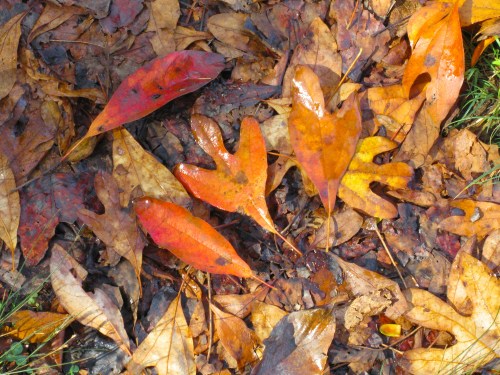
Autumn Sasssafras

 . 
❀ ✿ ✾ ❁
 . 
Sightings
 . 
The world leafs out again, the willow first
and then the river birches near the road
we’re driving down, you in your car seat watching,
for hawks or smaller birds returning home.
Two years have passed since you could walk or stand
alone.  The winter-damaged fields are sown,
and there, along the ridge, unraveling,
spirals of song birds, drifts of dogwood trees,
restored to blossom, beauty that breaks the heart.
And you whose spinal cord could not be healed:
you’re lowering the window, looking up
at miles of wings, your face alive with joy.
 . 
Patricia Hooper
from her fifth book, A Necessary Persistence
selected by Richard Widerkehr
 . 
Hooper makes us feel connected to this “annual miracle” of April, as E. Dickinson called it.  Clear images, strong feeling—a grandson’s wonder, the speaker’s joy and gratitude—this poem is a gift to the reader.  (I wrote a review of A Necessary Persistence for Aquifer a few years ago.)
— Richard
 . 
 . 
In The Forest, There Are Stars
 . 
Thick green-black branches can’t hide them,
whistling through cedar and fir trees.  You’ve seen
one star drop as if torn from the forest.
 . 
Here stars jostle each other, falling toward you—
you forget what you were and how you came here.
Maybe, by day on the road to islands,
 . 
can you remember the white edges
of rooftops, how the forest rose to meet you?
Here sword ferns jut from the hillsides.
 . 
High fern-like branches fan themselves downward,
and stars soak you with their cold radiance.
The stars that were small and cold
 . 
in the sky are still small and cold.  The branches
lift about them, hissing lightly.
 . 
Richard Widerkehr
from Missing The Owl (Shanti Arts Publications), first published in Sweet Tree Review and then reprinted in Adventures Northwest
 . 
 . 
❀ ✿ ✾ ❁
 .  . 
Augury
 . 
Tonight my father cupped his hands and blew
into their hollow sphere and brought to life
the long wild resonant cry
of country boyhood, owl-haunted evenings
and the dark modulations of distant hounds,
fluttered his fingers throbbing into memory
those sobbing whistles hunting down the rails
my childhood dreaming in the restless city.
 . 
And as my children wondered cupping their hands
to capture that primeval mimicry
of all that haunts and heightens our precarious sense
of living rooted in immemorial time,
I saw my father new, and shared his knowing
the secret of our give and take of breath:
live long enough to know that we are dying,
hand on with tenderness and dignity
our resonant art
the long learned call
of trumpeter man.
 . 
Ann Deagon (1930-2024)
collected in Word and Witness: 100 years of North Carolina Poetry, Carolina Academic Press, Durham NC (1999)
selected by Bill Griffin
 . 
“The secret of our give and take of breath:” the mimicry of primeval haunts whispers that secret into our soul, that we share these short lives with every creature that snuffles, caws, and swims, with every waving tree and scented flower. What call, what whistle will we hear that can draw us back together into one circle?
 . 
In her bio, Ann Deagon once remarked that she didn’t begin writing until she was forty, “when that three-headed dog love death and poetry took me in its teeth and shook me.” She taught Classics at Guilford College and was the recipient of a National Endowment for the Arts Literary Fellowship, among many other honors during her life.
— Bill
 . 
❀ ✿ ✾ ❁
 . 
My Son Draws an Apple Tree
 . 
I watch it grow
at the end of his dimpled hand
rooted in white paper.
 . 
The strokes are fast
and careless, as if the hand
has little time.
 . 
Quick black trunk,
a green crown and in the white
air all by itself
 . 
a red splotch,
an apple face with a frown
that is his
 . 
he gravely says
looking up at me — the stiffening
branch he falls from.
 . 
Peter Makuck (1940-1923)
from Long Lens, New & Selected Poems, © 2010 by Peter Makuck, Boa Editions, Ltd.; American Poets Continuum Series, No. 121
selected by Bill Griffin
 . 
Some poems we return to only to discover that at each visit they bestow upon us a different benediction. Which simply makes sense, since we are a different person each time we read the lines. I am the tree bent and stiffening. I pray only this, that for those I love and for all the earth as well that not all innocence and purity may be lost. Thank you, Peter, for continuing to inspire.
— Bill
 . 
❀ ✿ ✾ ❁
 . 
The Dance
 . 
I say yes to the tulip tree
dropping its cups of flowers,
golden and green
and to the derelict ailanthus
breaker of concrete sidewalks
and to the sumac with its cones of fire.
 . 
Yes to the white-tails that float
their magic, then vanish
far into the woods’ deep green
and to the mallard pair, duck and drake
that waddle up from Crabtree Creek
and to the earthworms
they clear from our driveway.
 . 
Yes to the turtle, the red slider
that spring calls from the creek
to wandering, the one I rescued
from a storm-drain and gave my blessing to.
And yes to that damn beaver
that cut down the giant beech
near the stream, my favorite tree
in the wetland, and to the trees
he left behind.
 . 
Yes to the night’s extravagance of stars,
to Vega’s frozen light, the lyre of the stars
and to the southern cross
and multitudes of strange lights
I cannot see, much less name, so far below
the horizon over Patagonia
all the way down to the pole.
 . 
And yes to the blessing of day and night,
mates following each other
and to the contentment each brings
in its own way, bright, then silent dark.
 . 
Because none of these I can keep.
They are not mine, and I cannot stop
the music in the middle of the dance.
 . 
So yes to this morning rain carrying
yesterday away.
 . 
David Treadway Manning (1928-2021)
from Sailing the Bright Stream: New & Selected Poems, Press 53, Winston-Salem NC (2020)
selected by Bill Griffin
 . 
Thank you, Dave for years of friendship. For minds that open and expand, always. For a thousand true laughs, the bright and knowing ones and the wicked ones. For this poem, its music in which you and I will continue to live.
— Bill
 . 
 . 
❀ ✿ ✾ ❁
 . 
Life is not so much a matter of discovering something new as it is a matter of rediscovering what has always been present.
— W. Ralph Ward, Jr.
 . 
There is always Music amongst the trees in the Garden, but our hearts must be very quiet to hear it.
— Minnie Aumonier
 . 
Thank you for celebrating the month of April with International Earth Day (April 22) and National Poetry Month, and for continuing the celebration. And thank you, Readers, who have selected poems to share that connect us to our planet and each other. EVERY DAY is EARTH DAY!
And thanks always to camping buddy Mike Barnett, who keeps me supplied with the unending delights of quotations from the spirit of Nature.
 . 
 . 
Thank you for visiting Verse and Image: If you would like to receive an email each time a post appears, please SUBSCRIBE to Verse and Image using the button on the Home Page.
 . 
If you have a hard time finding the SUBSCRIBE button on this WordPress site, you can send me your email address and I will add you to the subscriber list. Send your request to
 . 
COMMENTS@GRIFFINPOETRY.COM
 . 
Thanks again for joining the conversation. . 
— Bill
 . 
❀ ✿ ✾ ❁
 . 
2016-10-17b Doughton Park Tree

2016-10-17 Doughton Park Tree

 . 

Read Full Post »
 . 
[with 4 poems from I-70 Review]
 . 
Bears Active in This Area
 . 
++++ warning sign in my mountain cabin
 . 
This time, others have seen you,
treading circles on the gravel drive,
shouldering through grapevine tangles.
The possibility of you was always here,
in the night-mouth of the cave that gapes
below my porch, in dark boulders
hulking along the trail.
 . 
Your presence countermands silence –
I chatter and sing as I walk the open road,
snatches of carols, toddler songs –
and shy from the path that meanders
to a sunlit filed strewn with windfalls
from long-neglected trees. I imagine
you keeping pace, just out of sight,
your huffs mocking my jabber,
your heavy steps a counterpoint
as I scurry past thickets, scan uneasily
the curving trail ahead, intruder
in a world that was never mine,
though you are the first to insist
that I acknowledge it.
 . 
Rebecca Baggett
from I-70 Review, Eighteenth Edition, 2024
 . 
❦ ❦ ❦
 . 
What would a toddler remember about moving away? The apartment in Niagara Falls is a dream of stairwells and windows and darkness outside; the new house in the new subdivision with no grass at all is a neighbor’s dog named Bishy. Or was Bishy the neighbor’s toddler I played with?
 . 
I am four when we move away again, from New York to Tennessee, and I remember plenty about Marion Road: Bob and I watching Little Rascals until Mom declares, “You’re going to turn into rascals!”; our little sun room Aunt Ellen fitted up as a bed-sit while she attended Memphis State, and we kids hiding giggling under her covers until she came home each afternoon; the neighbor boy who introduced us to the word butt and we thought we were the first humans ever to utter something so outrageous. Memories of the neighborhood, yes, but memories of moving there? Packing and unpacking? Worrying that Puppy would get lost in the shuffle or that somehow Mom wouldn’t be there when we arrived? None of that remains.
 . 
Our family makes one more inconsequential move just blocks away when I am six, but then when I’m twelve the Big Away arrives. Up until this what a tranquil 1950’s childhood: I walk to Colonial Elementary every morning with my friends and play with the same friends every evening until the streetlights come on. Serene. Now I’m midway through sixth grade, still coasting, when the bomb drops. Did I protest when Dad announced in January we were leaving Memphis to move to Delaware? Maybe, I don’t recall; that memory is muddy, but this one is sharp as crystal – I walk into class in my new school and my new classmates all turn to look. My clothes aren’t right, my accent is a joke (literally – within about sixty seconds I will have the nickname “Memphis,” which sticks), and I have a different teacher for every subject. And then in just six more months we will move to Michigan. Just over a year beyond that, two months into eighth grade, we move to Ohio.
 . 
So, my friend, is it any wonder that some sixty years later I have trouble remembering your name until the fourth or fifth time we meet? That as we converse in a group you notice me smiling and nodding and slowly drifting off into space? That I would rather write this blog into the wee hours than drop by your house for coffee? I want to be a good friend to you, and in fact I like you and this hug from me to you is real, but ah, it’s risky. There’s always that possibility, without warning and with no desire on my part, that someday soon I might be moving away.
 . 
 . 
It never occurred to me to wonder how Dad felt about all those moves. The moving was his fault, after all, necessary for his promotions and advancement with DuPont, for whom he worked all his life. I can scarcely imagine the million details he had to sift through to put his family into boxes and take them out again hundreds of miles away. I’m not surprised that as I clean out his house I find drawers full of lists on yellow pads, on the backs of junk mail, on bills and receipts. Half the time when he calls me, it’s to add something to the shopping list. And then there are still those boxes in the attic labeled Allied Van Lines.
 . 
But what about the rest of us? Did Dad wake sweating in the middle of the night worrying how moving away would affect his family? Just one time he blinked: after I was married and gone but Mary Ellen was still at home, a junior in high school, Dad turned down a promotion so she could graduate with her class. A sacrifice that stalled his career for a decade.
 . 
Tomorrow is Dad’s last moving day. Since Mom died in July, Dad has agreed to move closer to us. For a week I’ve ferried boxes and duffels, checked off my lists and then made new ones, and tomorrow after lunch I’ll drive Dad to a nursing center just two miles from our house. He says he’s willing to move as long as the food is good (it is). We’ve hung portraits of the grandkids, pastels by Mom. His Duke pillow is on the recliner and his new Duke banner hangs on the door of room 507 to welcome him. God knows I’ve been waking in the middle of the night sweating the million details. Let us hope that after 98 years of moving, Dad will discover in this new and final home a place to rest.
 . 
 . 
❦ ❦ ❦
 . 
Porta Nigra   *
 . 
++++ Trier, Germany
 . 
The breath of sun and rain
only darkens on my face.
The cat-claws of millennia,
the graffiti of tourists,
fade into my walls.
 . 
I, who guarded this city so long,
sit truncated now.
My frieze the sweaty flesh
of lovers on cool bare stones.
 . 
Catch me in another thousand years,
your eyes as hard and dark as mine.
See if these holes will match
the mysteries of death
and flesh on blackened stone.
 . 
Bradley Strahan
from I-70 Review, Eighteenth Edition, 2024
 . 
* a gate in the remaining piece of Trier’s old Roman wall
 . 
❦ ❦ ❦
 . 
The 2024 issue of I-70 Review arrived in last week’s post. Besides many wonderful voices new to me, I discovered within its pages several old friends who’ve agreed to let me reprint their poems.
 . 
I-70 Review, Writing and Art from the Middle and Beyond is based in Kansas, USA, but publishes poetry, short fiction, and art from around the world. They also sponsor the annual Bill Hickok Humor award for poetry.
 . 
Submission guidelines HERE
Purchase a copy HERE
 . 
 . 
❦ ❦ ❦
 . 
Messenger in Early November
 . 
++++++ – in memory of Jay Klokker
 . 
Driving past Agate Bay, I catch a glimpse
of this deer in a splotch of sun and shadow –
the brown-tail’s flanks on the edge of the road
in yellow leaves, thin branches. Las May
after your death, a bear cub loped beside my car
like a lost Labrador, seemed to disappear
under my front bumper. Slamming on the brakes,
I felt no thud, heard nothing. Amazing, the cub
as if uninjured, clambered up the ditch-bank.
Only later, after your memorial, did I reread
your last poems, that black bear nosing
at your sleeping bag in the camp site
in Arizona; recalled marmots whistling
in the pillow basalt near Mt. Baker; the grouse
thumping its tail near our driveway,
feasting on red hawthorn berries.
You noticed. I cannot believe you said no
to another go-round on the cancer wish machine,
you called it, completed your book First Stars.
On you last hike, you raced downhill
in your wheelchair, shouting. You must
be in these sun spots, mottled shadows.
Too excellent a camouflage, my friend –
thin, flickering branches, a few gold leaves,
before all the color goes away.
 . 
Richard Widerkehr
from I-70 Review, Eighteenth Edition, 2024
this poem will appear in Richard’s new book, Missing The Owl (Shanti Arts Press)
 . 
❦ ❦ ❦
 . 
The Other
 . 
Last night coyotes laughed
at the neighbor’s bulked-up lab restrained
behind his chain-link, his fearful bark,
their yips of liberty and mild derision;
 . 
are coyotes such demons, or just particular
about whom they allow to know them?
Or are they perhaps spirits of the other,
avatar of all we hominids in our marrow
 . 
know to fear? How to live beside that feeling?
Afraid of attack I stab; afraid of pain I cause it.
 . 
In the woods before daylight willingly lost,
soft tread, a twist in the trail then face to face –
perhaps she and I look into each other’s eyes
for two seconds, perhaps the rest
 . 
of my life; coyote impassive,
considerate, measures our distance,
our closeness, then softly pivots
and pads away, prudent, fearless,
 . 
willing to allow the two of us
to share the universe.
 . 
Bill Griffin
from I-70 Review, Eighteenth Edition, 2024
 . 
❦ ❦ ❦
 . 
 . 
❦ ❦ ❦
Doughton Park Tree 2020-09-08b

Read Full Post »

[with 3 poems by Richard Widerkehr]

Cold March drizzle makes Hepatica nod and droop. Nevertheless, the twelve accompany me undaunted on a naturalist hike along Elkin Creek. What will we discover? Here are the last few Hepatica blossoms of the year; their sister plant opened her first bloom along this trail on February 7, five weeks earlier. Now a single flower on each silky hairy scape looks down at its feet, the winter-pocked liverleaves also fading ahead of summer’s foliage. It’s cold this morning and the vernal equinox is still three days off.

But cheek by jowl with old Hepatica are fresh patches of its second cousin, Rue Anemone. No drooping at all! Both from the same family (Buttercup, Ranunculaceae), the two flowers share many features and from a distance look similar – our crew’s task is to learn to tell them apart. Both are easily overlooked, pale blooms only a cm. or so in diameter, with 6-10 petals and a jostle of stamens crowding multiple pistils clumped in the center. Even color is not a reliable clue: the pale Hepatica in this neutral soil is only one shade of lavender removed from Anemone’s white. Rue Anemone’s smooth slender flower stem is one giveaway, and then of course the leaves, Anemone’s fine clusters like little paws climbing toward the bloom, contrasted with Hepatica’s broad, basal, waxy lobes, each like a liver. What some might casually mistake for a clump of sameness, in haste undifferentiated, what we ourselves might at first glance have misidentified have now become familiar, individual: each uniquely itself.

❦ ❦ ❦

A Sabbath of Complete Rest

I’ve been thinking what that might mean, so I listen
to the wind in the fir trees outside our red house –
how the trees stand almost like horses asleep on their feet,

how their roots touch crevices in soil, how at night
their branches, blacker than the sky, must not forget
yellow forsythias, summer, their own dark needles,

how they wait, how they’ve waited. This is no psalm
of light, Chloe, no song of white horses in the sun.
The root of the word Shalom means complete.

Richard Widerkehr
from At the Grace Café, Main Street Rag Publishing, Charlotte, NC, © 2021

❦ ❦ ❦

How does a poem draw you in? How does it invite you to live in the world it creates? Place must be one way. Just a few pages into At the Grace Café, I realize I’m damp and about to shiver in the Pacific Northwest. Not that it’s raining absolutely all the time – the great dark firs lifting their heavy sleeves also propel me into the landscape. A trail through clouds and mist leads me. A swirling lake shore is mysterious and at once consoling.

Personality is another thread that weaves through these poems and entangles me: the writer’s sister, her mental illness an elusive and threatening animal that speaks wild into every situation; his mother, reminding us that each of us must live a portion of our lives in denial; and the personality of the writer himself, illuminated by recurring heartbreak in his work as counselor and by longing for stability and resolution. Personalities approach and retreat, promise to reveal just as they again withhold – all I can do is hold on and join the dance.

Finally there is joy. Not waiting beyond all conflict or at the conclusion of all sorrows, rather joy that emerges from and lives within these troubles that we all, confess it, share. A fleeting moment with one’s beloved, a brief lifting of fog, moon on snow – a simple singular presence can form us into fellow sojourners. The poem can make us family. The poem may grant us grace.

❦ ❦ ❦

Pay Attention, You Say

No, I haven’t read updates about the orca
+++ nursing her dead calf. I try not to get
upset about too many things. Lately,

I write these poems for my sister –
+++ I can’t spare the least insect or angel,
she says. Yes, plankton lined with oil

covers some sea beds. I’ve seen orcas
+++ breach the surface, black and white,
their bodies like mountain sides

sliding under. When we were kids,
+++ my sister and I caught a tiny fish –
she cried, and our mother threw it back.

Yes, there’s the sadness of plankton,
+++ the orcas, snow fields at night.
Last evening on this mental health unit

where I work, a patient I’ll call Carla –
+++ she’d cut her left wrist – she said,
Some scars are mercy and justice.

I let out my breath. At least my sister
+++ no longer sleeps with the moon
in her cardboard box. Now

you point out two otters on the bank
+++ of No Name Slough, how they
their small black eyes on us.

Richard Widerkehr
from At the Grace Café, Main Street Rag Publishing, Charlotte, NC, © 2021

❦ ❦ ❦

Crane Flies
O for a Life of Sensations rather than of Thoughts! – John Keats

In late August, the crane flies
come back, nervously feeling their way
up windows, trying to get out. They flutter
like huge, scatter-brained mosquitoes,
scraping this way and that, sometimes just
hanging as they flex their long
front legs like feelers, emitting
a dull, frustrated buzz.
++++++++++++++++++ Is it light
they want, the world outside?
They can’t get used to glass, its cool
way of whispering about the uselessness
of struggle, also its dry comments
on their death flights.

Each time I sweep these nutty insects
out the window, more fly in, as if
I were the absence they brush against,
their life of sensations
come to an end.

Richard Widerkehr
from Disappearances, The Wind Room Series #4, Radiolarian Press, © 1996, 2003

rue anemone

❦ ❦ ❦

Richard Widerkehr has a new book from Shanti Arts Press, Night Journey. Richard has taught writing in the Upward Bound Program at Western Washington University and has worked as a case manager for the mentally ill.

❦ ❦ ❦

IMG_0880, tree

Read Full Post »