Feeds:
Posts
Comments

Posts Tagged ‘Earth Day 2026’

 . 
[ poems by William Stafford, David Radavich, Robert Morgan, 
Lenard Moore, Robert Frost, Tori Reynolds ]
 . 
Ask Me
 . 
Some time when the river is ice ask me
mistakes I have made.  Ask me whether
what I have done is my life.  Others
have come in their slow way into
my thought, and some have tried to help
or to hurt—ask me what difference
their strongest love or hate has made.
 . 
I will listen to what you say.
You and I can turn and look
at the silent river and wait.  We know
the current is there, hidden; and there
are comings and goings from miles away
that hold the stillness exactly before us.
What the river says, that is what I say.
 . 
William Stafford
selected by David Radavich
 . 
“Ask Me” by William Stafford is one of my all-time favorites.  It is profound in thought and feeling, but I also admire the great artistry of how Stafford employs sound, line breaks, punctuation, and rhetorical balance to achieve what for me is a masterpiece.  If I could ever write a poem this good, I should die happy!
— David
 . 
 . 
February
 . 
They call this apple tree “wild.”
And so it bends over the road
like an umbrella or saint
beginning to pray.  Always
 . 
among the first to bloom—
no fruit, it is wild, remember?—
reminding others of their coming
obligations, soon or later
 . 
and then maybe more
glorious for the waiting.
 . 
Every year it is a surprise
beside the road, every year
a bit taller, more redolent
 . 
so even a cynic tired of cold
cocks an eye and writes
a poem about being ready.
     . 
David Radavich     
first published in The Raven’s Perch
 . 
❀ ✿ ✾ ❁
 . 
Ironweed
 . 
There is a shade of purple in
this flower near summer’s end that makes
you proud to be alive in such
a world, and thrilled to know the gift
of sight. It seems a color sent
from memory or dream. In fields,
along old trails, at pasture edge,
the ironweed bares its vivid tint,
profoundest violet, a note
from farthest star and deepest time,
the glow of sacred royalty
and timbre of eternity
right here beside a dried-up stream.
 . 
Robert Morgan
from Terroir, Penguin (2011)
 . 
I’ve always been in awe of the dark purple flower often found along the edges of fields and woods. When we lived near Hendersonville in 1970-71 there was a meadow along a branch where many ironweeds thrived. In late summer I walked out there almost every day to enjoy the temporary presence of those special flowers. In many ways that was a tough time of unemployment, but those flowers made a day seem better.
— Robert
 . 
 . 
❀ ✿ ✾ ❁
 . 
Resurrection Sunday, Early Dinner
April 5, 2026
 . 
We sit at the long table,
anticipating the spicy broth
where we place bok choy,
broccoli, mala, cauliflower, sliced potatoes,
barramundi fish, shaved chicken, fresh eggs,
king trumpet mushrooms, water crest,
La Mian noodles.
All the while I look into my date’s
pearly eyes and imagine our future.
I love that she’s God-fearing
and glimpse the crucifix glinting gold
and gathering silence like an Easter lily.
How I glance at her peach-tinted lips.
Did I tell you that I know their softness,
their sweetness that keeps me longing her
like a sparrow longs for a mate
on a powerline? Did I tell you
that she’s more beautiful than a mimosa,
dogwood, Bradford pear, or cherry blossoms?
We dab our lips with napkins as white
as the cloud-puffs lingering like light.
We leave like lovers that we are,
hungrily holding hands.
 . 
Lenard D. Moore
 . 
I love nature so much. As you know, I have written haiku, tanka, and other Japanese short-form poetry for decades. Haiku especially lead me on a ginko (haiku walk). In short, I love nature walks. In fact, I have also written free verse poems about the natural work, such as the one I am sending, due to the invitation. My Easter Sunday date also loves nature. Thus, I hope the poem speaks for itself. With gratitude!
Blessings — L
 . 
❀ ✿ ✾ ❁
 . 
Two Look at Two
 . 
Love and forgetting might have carried them
A little farther up the mountain side
With night so near, but not much further up.
They must have halted soon in any case
With thoughts of the path back, how rough it was
With rock and washout, and unsafe in darkness;
When they were halted by a tumbled wall
With barbed-wire binding. They stood facing this,
Spending what onward impulse they still had
In one last look the way they must not go,
On up the failing path, where, if a stone
Or earthslide moved at night, it moved itself;
No footstep moved it. “This is all,” they sighed,
“Good-night to woods.” But not so; there was more.
A doe from round a spruce stood looking at them
Across the wall, as near the wall as they.
She saw them in their field, they in hers.
The difficult of seeing what stood still,
Like some up-ended boulder split in two,
Was in her clouded eyes: they saw no fear there.
She seemed to think that, two thus, they were safe.
Then, as if they were something that, though strange,
She could not trouble her mind with too long,
She sighed and passed unscared along the wall.
“This, then, is all. What more is there to ask?”
But no, not yet. A snort to bid them wait.
A buck from round the spruce stood looking at them
Across the wall as near the wall as they.
This was an antlered buck of lusty nostril,
Not the same doe come back into her place.
He viewed them quizzically with jerks of head,
As if to ask, “Why don’t you make some motion?
Or give some sign of life? Because you can’t.
I doubt if you’re as living as you look.”
Thus till he had them almost feeling dared
To stretch a proffering hand –– and a spell-breaking.
Then too passed unscared along the wall.
Two had seen two, whichever side you spoke from.
“This must be all.’” It was all. Still, they stood,
A great wave of it going over them,
As if the earth, in one unlooked-for favor
Had made them certain earth returned their love.
 . 
Robert Frost
selected by Tori Reynolds
 . 
I first encountered Robert Frost’s “Two Look at Two”  as a teenager. I lived in Frost’s New England and was an avid horseback rider who spent hours roaming the fields and orchards. I was truly, for the hours I was on my horse, not a single being but a “two” — connected to another being with all the intimacy and fraught tensions of any couple. So, I felt a visceral connection to the idea of “two” proceeding through the landscape that Frost was describing. Wherever I went, I, too, had seen the mark of humans (..,a tumbled wall/With barbed-wire binding) and the mysterious movements of nature (…if a stone/Or earthslide moved at night, it moved itself;). I always felt it a privilege to move among and within such mysteries.  
 . 
As a young person more comfortable communicating with horses then with words, I had not yet understood the power of language.  Until I read this poem, I hadn’t known that someone else understood the experience of seeing and being seen by nature the way I felt I was when I was out riding my horse.   Two had seen two, whichever side you spoke from, perfectly describes how it felt to have Frost stretch a proffering hand  –– to me. His “spell breaking”  became a sudden apprehension:  poetry could be as powerful a connection to nature as nature itself. 
— Tori
 . 
 . 
 . 
Dear Tulip Tree Silk Moth 
 . 
Dear tulip tree silk moth,
dear skunk cabbage,
trout lily, beaver, and
pure green sweat bee,
dear white pine, dear white tail
and yellow-rumped warbler,
dear red clay, granite,
Neuse and Swift Creek,
dear silent breath of the Tuscarora,
 . 
you live and die at the confluence
of human and bulldozer,
humans with our cars and pesticides,
our maps and fences, our wars,
and our crushing booted steps.
 . 
At the confluence of the Deep and Rocky rivers,
you show us how to live
by floating, flying, sprouting, swimming–
you sprout, swim, rest, dash, nest,
pool, chirp, screech, stand tall,
rot, collapse and fall –
 . 
while we tromp, we bike and scramble
over rocky scree, put binoculars to our eyes,
ooh and ah – do you see the green heron
at the edge of Brumley pond?
place a finger to our lips, shush –
can you hear the peepers’ chorus
in the Horton Grove lowlands?
 . 
So, may we steward
by raising our picks, chop and clip
the kudzu vines and stilt-grass invasives,
then gather the welcome walnuts,
and drink its bittersweet beer together.
 . 
May we learn to re-wild
our science, our understanding
and even our minds.
 . 
May we name
all that’s lost, cleared, disappeared –
then walk to the center of the labyrinth
and look beyond its borders –
 . 
as we unwind our worries
with committed steps,
dogged daily steps,
 . 
towards the morning
when we raise our eyes
to search for the downy woodpecker
in the loblolly, listen to the tap tap tap
of its persistent question,
how? how? how?
 . 
and answer with the YES
of the spring winds bending the little bluestem
in the meadows.
 . 
Dear people,
dear scientists
dear creators and clerks
workhorses and mourners,
neighbors, friends, benefactors
–  stewards all –
of this copious, generous, generative,
disappearing land –
 . 
We find ourselves here
on the bridge between
storm and flood,
in the promise
of blue skies and drought,
 . 
to safeguard the fragile hives we tend,
to celebrate the honeyed-habitats we defend.
 . 
Tori Reynolds
 . 
I was asked to write a poem for the Triangle Land Conservancy gala this past February. This poem was the result.  Since it was originally written for a specific audience and to be read aloud, I’ve revised it somewhat make it readable on the page. My hope is that it still rings with my reverence for the Piedmont area of NC and calls us to look closely and love the places we live.
— Tori
 . 
E&A flora hydrangea bee
 . 
❀ ✿ ✾ ❁
 . 
There are only two ways to live your life: as though nothing is a miracle, or as though everything is a miracle.
— Albert Einstein
 
I had been fooling myself that I was the only teacher. The land is the real teacher. All we need as students is mindfulness. Paying attention is a form of reciprocity with the living world, receiving the gifts with open eyes and open heart.
— Robin Wall Kimmerer, Braiding Sweetgrass
 . 
Thank you for celebrating the month of April with International Earth Day (April 22) and National Poetry Month. And thank you, Readers, who have shared poems that connect us to our planet and each other. We will continue posting EARTH POETRY throughout the month of April – and beyond, of course, since EVERY DAY is EARTH DAY!
 . 
 . 
Thank you for visiting Verse and Image: If you would like to receive an email each time a post appears, please SUBSCRIBE to Verse and Image using the button on the Home Page.
 . 
If you have a hard time finding the SUBSCRIBE button on this WordPress site, you can send me your email address and I will add you to the subscriber list. Send your request to
 . 
COMMENTS@GRIFFINPOETRY.COM
 . 
Thanks again for joining the conversation.
 . — Bill
 . 
❀ ✿ ✾ ❁
 . 
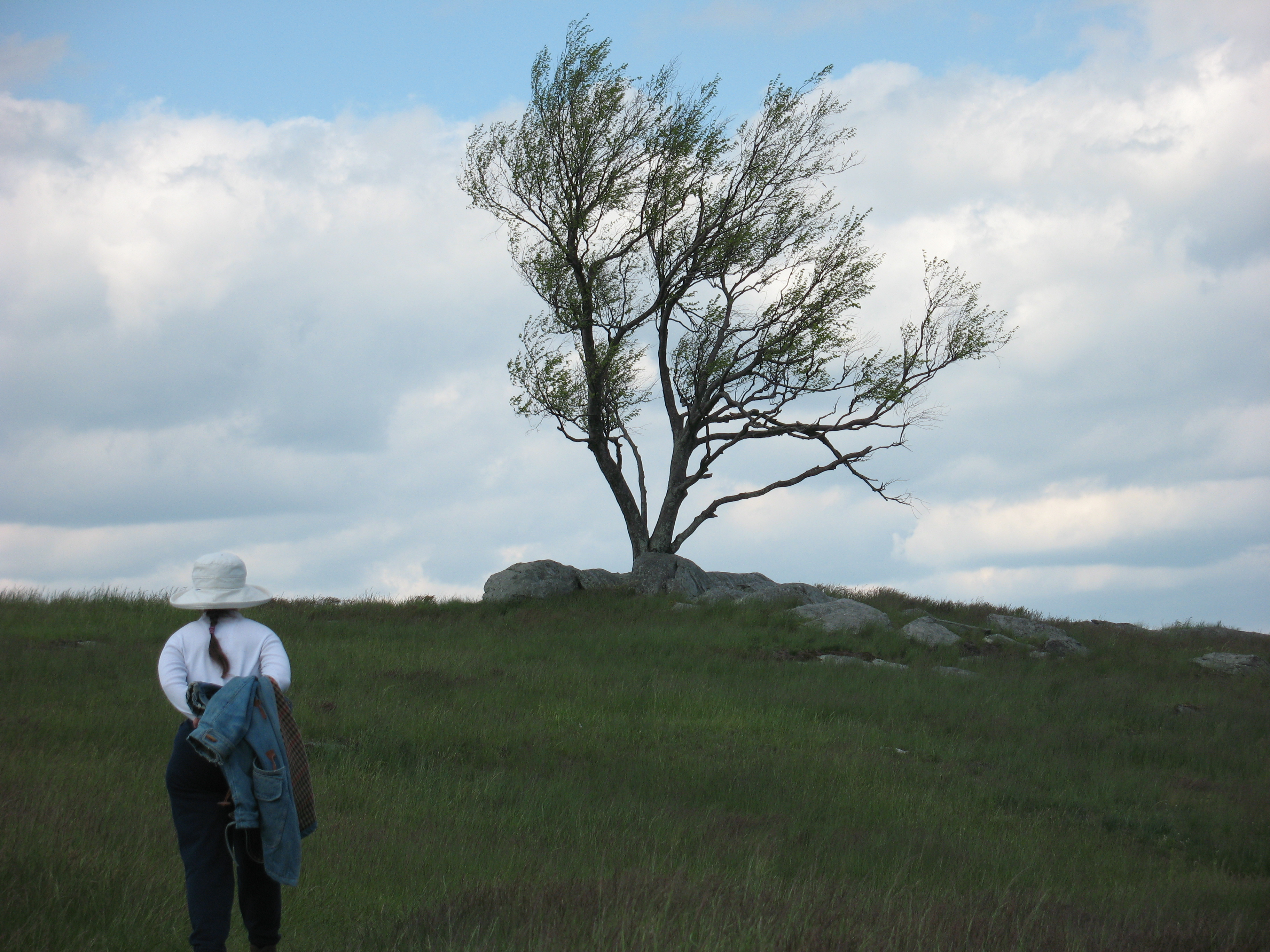
Doughton Park Tree -- 5/1/2021
 . 

Read Full Post »

 . 
[ poems by Mary Oliver, Scott Owens, Clint Bowman,
Jenny Bates, Michael Hettich ]
 . 
from Little Alleluias
 . 
This is the poem of goodbye.
And this is the poem of don’t know.
 …
My hands touch the lilies
then withdraw;
 …
my hands touch the blue iris
then withdraw;
 …
and I say, not easily but carefully-
the words round in the mouth, crisp on the tongue-
 …
dirt, mud, stars, water-
I know you as if you were myself.
How could I be afraid?
 . 
Mary Oliver
selected by Scott Owens
 . 
Commenting on anything written by Mary Oliver seems presumptuous and superfluous. How could anything I could imagine saying make what she writes clearer? Here, and in poems like, “Wild Geese,” and “The Summer Day,” Oliver seems to reach beyond my consciousness and grab hold of what resides even deeper and then say it in a way that I could never say as clearly, precisely, exactly. “as if you were myself. / How could I be afraid?”
— Scott
 . 
 . 
Night in the Forest
 . 
You hear every twig snap,
every leaf flutter, every
strange unknowable animal sound.
Looking, your eyes widen,
find bits of light to hold onto,
see shadows grow from shadows
separate in slightest breath of wind.
 . 
You smell animal musk,
taste it in the air,
feel the hair on your arms,
the back of your neck, rise
as you’re certain something
comes closer. Every sense
is filled to overflowing.
 . 
And yet, amidst the unease,
the urge to panic,
there is also in moments of stillness
a calm, a sense of peace,
of no obligation, no schedule to attend,
you only ever feel here
in the still, in the quiet, in the dark.
 . 
Scott Owens
 . 
I started this poem more than 20 years ago when I went camping a lot, usually alone. I was teaching middle school at the time, and when I left the house Friday mornings I would throw my backpack, camping pad, sleeping bag, lighter, flashlight, sawback knife, and a change of clothes into the back of my car. And when school let out, I headed to the mountains and hiked at least 3 miles into the woods before setting up “camp.” It could be scary out there alone, but it was also the closest thing to serenity I had ever felt. The duality of the experience is what kept me doing it again and again, so of course I tried to write about it. I was never satisfied with the end of the poem until 2 decades later when I used 3 consecutive prepositional phrases as the conclusion of a poem about burial, and intuitively this old, unfinished poem sprang back into my consciousness because I somehow knew that was how I wanted to conclude this one too. Fortunately, I’m very stubborn about throwing attempted poems away, and although it took me a while to find the last failed draft, I eventually did.
— Scott
 . 
 . 
Unleashed
 . 
Lately, it’s like I can feel myself aging.
I arrive home and immediately
look for my slippers, slip on a sweater,
put my feet up, close my eyes.
I remember once in the last year
of his life I took my old dog Huck
for a walk in the park. After rain.
The soccer fields were flooded, glistening
with sunlight in shallow pools of water,
and the robins had gathered in huge flocks
to take advantage of rain worms coming up
everywhere. I let Huck off the leash
and for a moment memories of youth
flashed in his eyes once again and he ran
all over chasing the birds up first
in one spot and then in another.
He carried on for longer
than I had seen him run in years.
I hope somehow I know
when I am close to death
and I, too, can have
a last moment of memory like that.
Maybe climb a tree to the top,
round the bases at a ball field,
walk out with no destination
in mind, no concept of how far
I might go before turning back.
 . 
Scott Owens
 . 
Time in nature and time with poetry often achieve the same effects for me: renewal, catharsis, perspective, clarity. I tell my students the most important habit in writing, maybe in life, is paying attention. I teach them how to make it a habit: schedule it 7 days in a row; commit to it; follow through. If at the end of those 7 days you’re not consciously noticing more things. Do it another 7 days. Then I give them a few more pointed assignments to help broaden the habit. I tell them ask yourself every day, What am I doing right now? Write down your answer and everything else it makes you think of. I get a never-ending stream of poems beginning with interesting participial phrases. Lastly, I tell them pay attention to the stories you tell people, especially the ones you tell over and over again. If you want to tell the story, especially if you want to continue telling it, then clearly there is something interesting about it. Why haven’t you written it down yet? I usually try to listen to my own lessons, and one story I’ve told over and over is the story of Huck, at 15, chasing the robins. It always felt like such a poignant moment for me, but I only thought to write it down recently when a co-worker told me a story they had already told me before about how they feel “older,” and at the same time I was putting the finishing touches on a manuscript about aging.
— Scott
 . 
 . 
❀ ✿ ✾ ❁
 . 
Threads
 . 
Sometimes
I want to go back
 . 
to where the deer
don’t run in my presence,
 . 
and the frogs keep singing
as I stomp through the creek.
 . 
Back to where
closets are full
 . 
of shotguns-
locked and loaded,
 . 
and the old gas station
is run by a woman
who calls me baby
and takes the tax
off my bottles.
 . 
Where farmers
offer me cigarettes,
and even though
I don’t smoke,
I entertain the idea
over ramblings
 . 
about local roads
that stitch together
our kin —
 . 
threads so tightly knit,
all the heat stays in.
so those frogs
can’t stop singing,
and the deer have learned —
there’s nowhere to run.
 . 
Clint Bowman
from If Lost (Loblolly Press, Asheville, NC) 2024
selected by Jenny Bates
 . 
I have chosen to send the poem “Threads” by Black Mountain poet Clint Bowman not only because he is my friend but because he embodies in his words the simplest of truths as it can be towards the natural world. There is no teasing or fakery in his poetry and he is as honest as a walk in the woods with all its variance and subtle candor.
My own poem “Artifice Thoughts” is more whimsical but true!
— Jenny
 . 
 . 
Artifice thoughts as I look out the window
see a Deer casually strolling by and I read
it my favorite childhood book
 . 
I think we envy animals of the wild
what do you say?
 . 
living by the dark of night the light
of day
pressing into the earth or winging above
they truly know how it works, my love
distilling every moment of time not by
clock or watch or phone line
but by the sky and trees and hollows
surrounding them, their home
they don’t seize up with rain or snow
an occasional sound is how they drop
in to dreams of warm days, cold nights
when swirling stars come out
you can hear them whispering as they
touch the ground
don’t close the gate, our entry point
only wait till the Moon is full.
 . 
Jenny Bates
 . 
Thank you for this opportunity Bill to help celebrate and educate on Earth Day 2026. – J
 . 
 . 
❀ ✿ ✾ ❁
 . 
Something Else
 . 
Suppose, one spring, the birds decided
not to fly north, and the animals
sleeping in the woods decided this year
they’d rather not wake, and turned over instead
for another dream.
 . 
Imagine one summer the butterflies decided
to stay in their cocoons, or the caterpillars forgot
to wrap themselves up inside themselves
and simply gorged themselves instead
until their season passed. One day the tide forgot to rise.
This is only one way of speaking for the world.
 . 
Suppose the spiders stopped weaving, mosquitoes
forgot how to suck our blood, bees
decided not to pollinate flowers.
Suppose the sea turtles never returned
to the beaches that bore them, to lay their moon-drawn eggs.
Or suppose for a moment the rivers held still
and the leaping salmon held still in mid-air.
 . 
Imagine fire stopped burning things to ash
although it still burned. It was no longer hot.
Of course that couldn’t happen. So think of something else.
 . 
Michael Hettich
 . 
from The Halo of Bees: New and Selected Poems, 1990-2022; Press 53, Winston-Salem NC (2023)
 . 
“Something Else” was first published in my 2010 book titled Like Happiness, and though sixteen years have passed since then, it seems to me, looking at the poem now, that the concerns that brought me to write the piece are, if anything, more urgent now than they were then. In asking us to imagine non-human animals and rhythms of nature deciding not to participate in the eternal rhythms of life—a kind of ultimate end-world scenario precipitated in response to human-wrought degradation—the poem (I hope) challenges our complacency. The two italicized lines attempt to articulate a perhaps extreme version of the kind of thinking we all do to deny our complicity. And I think the final line also intends a double reading: we can “think of something else” as a form of denial, or we can do so as a way of imagining a different sort of future.
— Michael
 . 
 . 
❀ ✿ ✾ ❁
 . 
Let us probe the silent places. Let us seek what luck betides us. There’s a whisper on the night-wind, there’s a star agleam too. And the Wild is calling, calling – let us go.
— Robert Service, Call of the Wild
 . 
We lose our souls if we lose the experience of the forest, the butterflies, the song of the birds, if we can’t see the stars at night.
— Thomas Berry
 . 
Thank you for celebrating the month of April with International Earth Day (April 22) and National Poetry Month. And thank you, Readers, who have shared poems that connect us to our planet and each other. We will continue posting EARTH POETRY throughout the month of April – and beyond April as well, of course, since EVERY DAY is EARTH DAY!
 . 
 . 
Thank you for visiting Verse and Image: If you would like to receive an email each time a post appears, please SUBSCRIBE to Verse and Image using the button on the Home Page.
 . 
If you have a hard time finding the SUBSCRIBE button on this WordPress site, you can send me your email address and I will add you to the subscriber list. Send your request to
 . 
COMMENTS@GRIFFINPOETRY.COM
 . 
Thanks again for joining the conversation.
 . 
And thank you again and forever, Mike Barnett, for filling the cool deep well of nature quotations which will never ever run dry.
— Bill
 . 
❀ ✿ ✾ ❁
 . 
Doughton Park Tree 2021-03-23
 . 

Read Full Post »

 . 
[ poems by Dana Levin, Christina Baumis, Janice F. Booth,
Natalie Canavor, David Winship, Sherry Siddall ]
 . 
Watching the Sea Go
 . 
               Thirty seconds of yellow lichen.
 . 
Thirty seconds of coil and surge,
               fern and froth, thirty seconds
                                of salt, rock, fog, spray.
 . 
                                                                           Clouds
 . 
moving slowly to the left—
 . 
               A door in a rock through which you could see
 . 
                                            __
 . 
another rock,
                                laved by the weedy tide.
 . 
               Like filming breathing—thirty seconds
 . 
of tidal drag, fingering
               the smaller stones
                                down the black beach—what color
 . 
               was that, aquamarine?
Starfish spread
 . 
                                their salmon-colored hands.
 . 
                                            __
 . 
               I stood and I shot them.
 . 
I stood and I watched them
               right after I shot them: thirty seconds of smashed sea
                                while the real sea
 . 
                                thrashed and heaved—
 . 
               They were the most boring movies ever made.
I wanted
 . 
                                to mount them together and press Play.
 . 
                                            __
 . 
               Thirty seconds of waves colliding.
Kelp
 . 
               with its open attitudes, seals
                                riding the swells, curved in a row
 . 
                                just under the water—
 . 
                                                 the sea,
 . 
               over and over.
                                                 Before it’s over.
 . 
Dana Levin
from Banana Palace. Copyright © 2016 by Dana Levin and Copper Canyon Press, http://www.coppercanyonpress.org. At The Poetry Foundation.
selected by Tina Baumis
 . 
 . 
Ms. Levin’s poem evokes sadness each time I read it. Her image of the vast empty ocean is aimed to convey loss with minimal words. The title is perfect as she ebbs and flows leading our thoughts along with hers. Ms. Levin’s poem brings the encroaching shadow while I reflected on nature’s generous glow.
  — Tina
 . 
IMG_3599
 . 
❀ ✿ ✾ ❁ ❀
 . 
Lake Freeman
 . 
Curled against the nestling seat curve,
strands of hair blowing like dandelion seeds.
Dipping fingers in clear lake water
impermanent patterns sparkle,
 . 
break and dance in the sun’s bountiful balm.
Crisp water loosens pent up tension
eases into soothing meandering thoughts
as those densities are flung turbulently behind
 . 
in the boat’s churning frothy wake.
I am young, once again.
 . 
Tina Baumis
 . 
❀ ✿ ✾ ❁ ❀
 . 
Blue Spaces Elegy     *
 . 
Anchored by a wide, lazy creek, the street I live on
climbs to a four-square farmhouse on the bluff
with its dilapidated carriage stable standing sentry;
the old barn collapsed years ago.
The land along our street— clay now,
once pristine blue space.
 . 
Long ago, the farmer grew corn and tobacco on this land.
A lane, rutted and raw descended from barn
 to creek through blue space.
The plow, farmhands, and wagons piled with the harvests
moved down to the creek and up the lane,
and the farmer’s family prospered.
 . 
Skiffs plied the creek and brought their catch
to the farmer’s dock at the end of the lane.
The creek’s rich stock of Bay crabs and fish
surpassed the land’s bounty.
And the lane morphed into a gravel road
where rusty pickups ladened with
bushels of crabs and shellfish came and went.
And the farmer’s family prospered.
 . 
When the depleted land failed,
the farmer sold it as lots to watermen
and small clapboard cottages popped up beside the creek.
But the watermen’s catch dwindled;
and town folks bought the plots, tore down the cottages
and built sturdy ranchers and split-levels with driveways.
Curbs were added, and the gravel road was paved,
burying three small tributaries beneath the street,
cutting off the spring water that fed the old creek.
When the rains came, soil and lawn fertilizer
washed down the paved street, over the
buried springs, into the tired creek,
but the farmer’s family prospered.
 . 
The old farmhouse watched;
the carriage stable and barn emptied.
The farmer and the farmer’s wife died.
The neighborhood grew.
Builders came and went.
People prospered,
homes expanded.
The creek bed clogged with silt and runoff.
The farm was gone, the watermen were gone
from the now brown and turgid creek,
 . 
and the farmer’s family lives
somewhere else.
 . 
Janice F. Booth
*    Blue spaces are environments with prominent water features known to improve our well-being, similar to “green spaces.”
 . 
 . 
Thank you, Bill, for this opportunity to let my work speak, in my own small way, of the earth’s suffering. Having lived on my creek-side street for over 40 years, I have watched changes both micro and macro in the tiny part of the planet I inhabit.  I was moved to write this poem as our creek turned brown and thick with algae from the winter run-off and spring rains. 
— Janice
 . 
❀ ✿ ✾ ❁ ❀
 . 
City Trees
 . 
Back then it was safe for a 5-year old
to elevator down to the street and jump rope
or play potsy with other kids on the block,
hopping between chalked boxes on the sidewalk.
No mothers hovering to watch.
A safe world if not a pretty one,
hundreds of such blocks with
precisely aligned 6-story buildings:
a bleak ocean of brick in shades of muddy brown.
 . 
But East 177th Street harbored something alien.
Lining the street for exactly one block,
Grand Concourse to Morris Avenue,
a row of  majestic, giant trees endured.
Huge dark trunks rising way past the flat rooftops,
branches arcing over the six stories.
Like no other street I’d seen.
 . 
I never knew why they grew in such unwelcoming habitat.
Nor what kind of trees they were,
the shape of their leaves, their color in autumn.
In truth my young self hardly noticed the trees.
Yet these icons of nature hovered over my childhood.
Made my drab street unique and colorful,
gave me something to look up to-literally.
 . 
Hinted at vistas way beyond my limited view.
I did not understand those trees, but loved them.
 . 
Natalie Canavor
from The Song in the Room
 . 
 . 
Growing up in a New York City neighborhood gave me little early exposure to nature beyond trips to a few parks and an occasional picnic to the Westchester “countryside.” Animal life meant squirrels. Pigeons and sparrows were the birds we knew. And if anything green graced the immediate environment, I can’t recall it. Except for the trees. I had a chance to revisit the Bronx recently and found that my trees had vanished from the street. I feel sorry for the new crops of kids living on this not-so-special-anymore city block.
— Natalie
 . 
 . 
❀ ✿ ✾ ❁ ❀
 . 
Watershed Community
 . 
We live in a Watershed Community.
Water here since the dawn of time
will be here after the sunset of time
same water, going round and round
circulating by our solar pump engine
a closed cycle circling our Earth
coursing through our hills
our bodies, our communities
connecting through our water
around us, in the air, in the ground
flowing in the streams, rising in the air
falling in the rain
 . 
over and over.
 . 
Water is our source, our soul
keeping us growing by its flowing
through our watershed
sustaining us, nourishing us, enlivening us.
We are baptized into life on Earth
through this ancient water
tumbling through these hills
dripping through our watershed
down the mountains to the sea
nurturing our fellow life forms
eroding surfaces, changing form
shaping our lives.
 . 
Do for others downstream
as you would have
others upstream
do for you.
 . 
David Winship
Bristol, Tennessee
 . 
❀ ✿ ✾ ❁ ❀
 . 
October Tide
 . 
A nor’easter dabbles off the coast
raising the water to whiteness,
the wind to forgetting itself
in gusts and lurches.
 . 
Back canals are sober enough
for cormorants to lounge
wings stretched in worship
as deep cicadas drone in the cedars.
 . 
The tide escapes as it always does
twice a day, responding to the
slippery Moon, pulling the blood
in flood time, neaps and springs.
 . 
Gravities align, Sun and Moon
dance out of habit,
the perfect mathematics
just enough to keep us here.
 . 
Sherry Siddall
 . 
 . 
October Tide appears in my first full length book, Transformed and Singing, recently published by Main Street Rag.  If you stop to think about the almost impossible coming together of life on our planet, you have to sit down and take a breath. This idea occupies a lot of my time as a poet, and in Transformed and Singing (hint: cicadas abound). 
— Sherry Siddall
 . 
 . 
❀ ✿ ✾ ❁ ❀
 . 
I am sure it is a great mistake always to know enough to go in when it rains. One may keep snug and dry by such knowledge, but one misses a world of loveliness.
— Adeline Knapp
A rainy day is the perfect time for a walk in the woods.
— Rachel Carson
 . 
Thank you for celebrating the month of April with International Earth Day (April 22) and National Poetry Month. Readers have selected poems that connect us to our planet and each other. If you have a poem that has rooted you to the earth and spread your branches into bright sky, please share! It can be a poem by your favorite writer, living or dead, a poem of your own, or both. We will continue sharing Earth poems as long as you send them.
 . 
Send a your poem(s) in the body of the email or as .DOC or .RTF to:
ecopoetry@griffinpoetry.com 
 . 
Please include your comments or reaction to the poem. And publication acknowledgments if previously published.
 . 
Feel free to invite others to send their favorite Earth Day poems. Please refer them to this link for instructions: EARTH DAY EVERY DAY. Perhaps some day we will be able to say we live in the Age of Connection.
 . 
 . 
Thank you for visiting Verse and Image: If you would like to receive an email each time a post appears, please SUBSCRIBE to Verse and Image using the button on the Home Page.
 . 
If you have a hard time finding the SUBSCRIBE button on this WordPress site, you can send me your email address and I will add you to the subscriber list. Send your request to
 . 
COMMENTS@GRIFFINPOETRY.COM
 . 
Thanks again for joining the conversation.
 . 
— Bill
 . 
❀ ✿ ✾ ❁ ❀
 . 
2017-02-11 Doughton Park Tree
 . 

Read Full Post »

Older Posts »