Feeds:
Posts
Comments

Posts Tagged ‘Fred Chappell’

 . 
[ poems by Gary Snyder, Diana Dinverno, Terry Bornhorst Blackhawk, 
Gina M. Streaty, Elizabeth H. Lara, Fred Chappell ]
 . 
Prayer For The Great Family
 . 
Gratitude to Mother Earth, sailing through night and day—
  and to her soil: rich, rare, and sweet
      in our minds so be it
 . 
Gratitude to Plants, the sun-facing light-changing leaf
  and fine root-hairs; standing still through wind
  and rain; their dance is in the flowing spiral grain
      in our minds so be it
 . 
Gratitude to Air, bearing the soaring Swift and the silent
  Owl at dawn. Breath of our song
  clear spirit breeze
      in our minds so be it
 . 
Gratitude to Wild Beings, our brothers, teaching secrets,
  freedoms, and ways, who share with us their milk;
  self-complete, brave, and aware
      in our minds so be it
 . 
Gratitude to Water: clouds, lakes, rivers, glaciers;
  holding or releasing; streaming through all
  our bodies salty seas
      in our minds so be it
 . 
Gratitude to the Sun: blinding pulsing light through
  trunks of trees, through mists, warming caves where
  bears and snakes sleep—he who wakes us—
      in our minds so be it
 . 
Gratitude to the Great Sky
  who holds billions of stars—and goes yet beyond that—
  beyond all powers, and thoughts
  and yet is within us—
  Grandfather Space.
  The Mind is his Wife.
 . 
      so be it.
 . 
Gary Snyder (after a Mohawk prayer)
from EARTH PRAYERS, edited by Elizabeth Roberts and Elias Amidon
selected by Bill Griffin
 . 
 . 
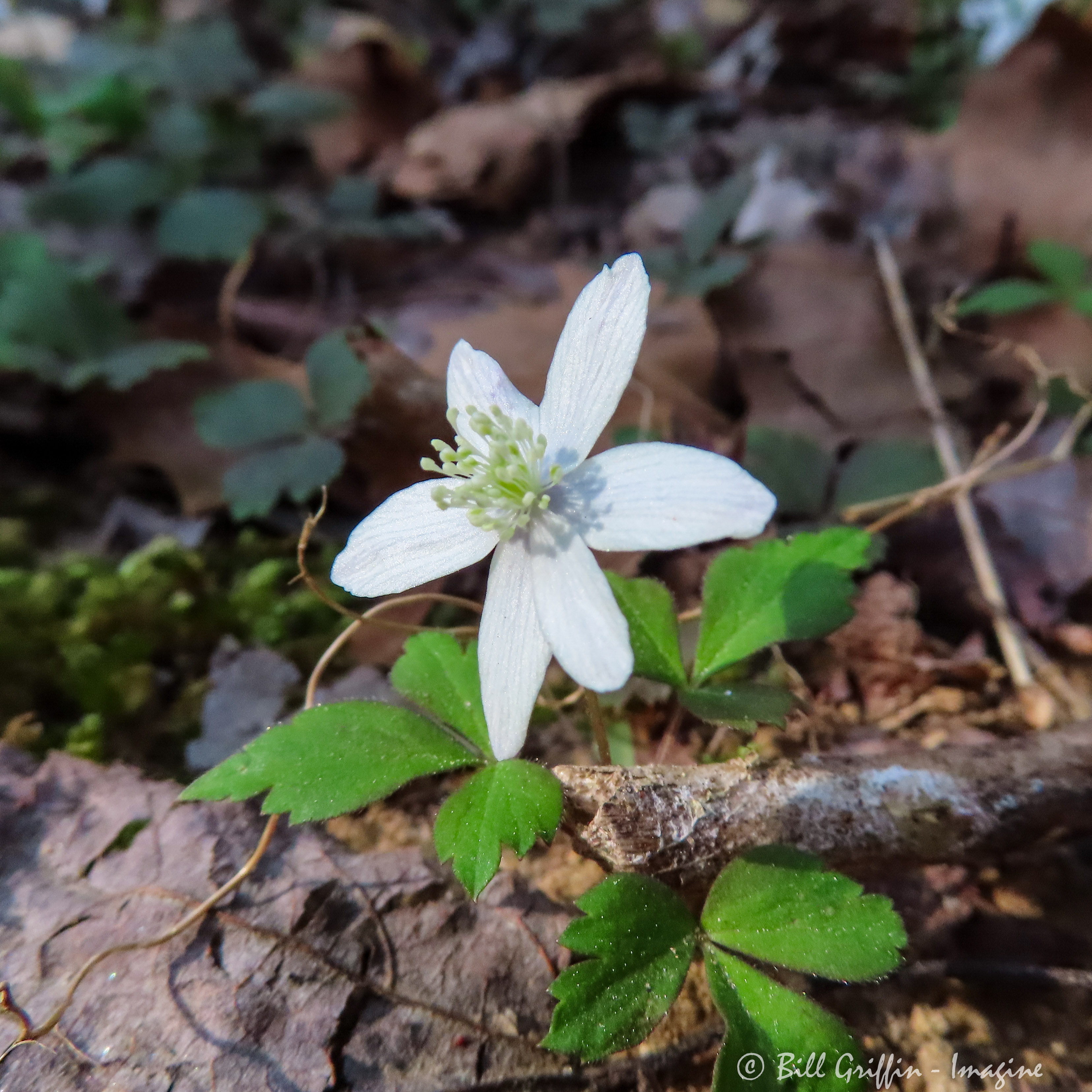
I am excited to see so many wood anemone blooming this April. A galaxy where I noticed only a few lonely stars last year. Joyful in the discovery, excited to share – let those feelings speak their name, Gratitude. And let gratitude grow into the love that inspires to me to hold all living things safe and sacred, this great family of life with which I share our planet.
— Bill
 . 
 . 
❀ ✿ ✾ ❁ ❀
 . 
We Visit the Tomales Point Trailhead 
as Congress Continues to Threaten the Sale of Federal Land 
 . 
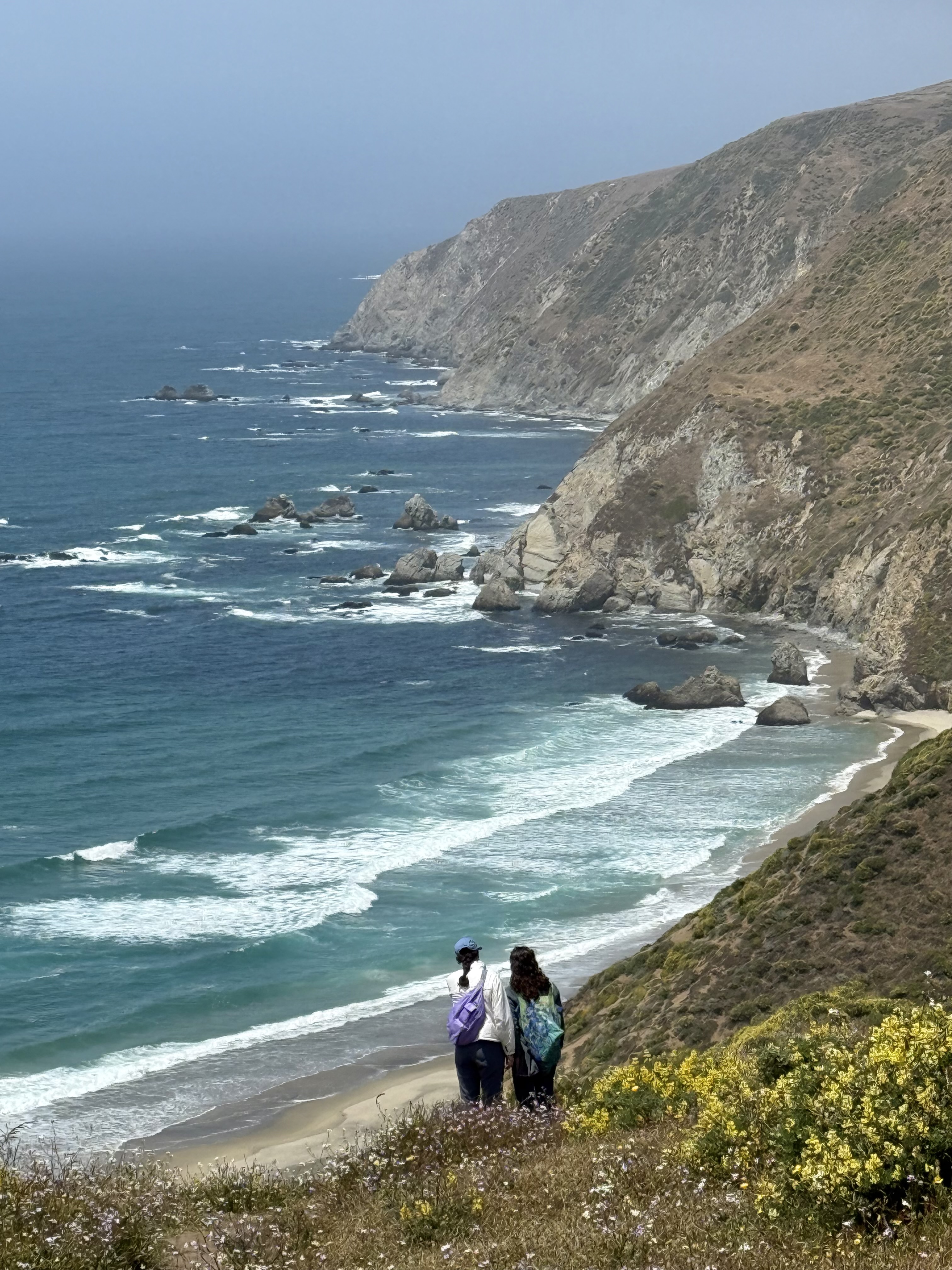
My daughters and I park beneath a canopy of old trees,
a windbreak when this land was a working dairy ranch.
Beyond the once-whitewashed barn, bunkhouses,
and sheds, the trail leads us onto sand
winding through lemon-hued lupines
so tall they sway above our heads.
 . 
We ooh and aah at the vast exuberance—
California poppies, thistles with lush purple fringe,
and, after a gentle climb, we look west,
 catch sight
of the Pacific’s immense blue, its rippled light,
a spectacular cinematic sky. To the east,
gold and green meadows rise.
 . 
We walk across the peninsula’s clavicle,
its tender ridge dips into hollows,
monarchs flutter, tend to blooms.
 . 
I follow the lift of my girl’s arm
pointing to the summer-saturated hills.
Grazing tule elk, once thought extinct,
somehow still here, keep their distance,
raise their massive heads.
 . 
A Cooper’s Hawk circles the grassland.
Far below, birds we can’t identify glide
in formation just beyond the ocean’s reach.
Trills and whistles fill the scented air—
faintly honeysuckle, intoxicating, wild.
 . 
My younger daughter notices tiny orange petals—
scarlet pimpernel clings to the path’s edge, firmly rooted,
part of the shoreline’s crown.
 . 
As the land bends, we pause
high above a cove, a stretch of surf-ruffled beach
dotted with rock—scan for sea-lions, listen
for their barks before we move on—
the bluff too fragile to descend.
 . 
Diana Dinverno
 . 

[photo by Diana Dinverno]

 . 
 . 
In the Spring of 2025, my daughters and I visited the Point Reyes National Shoreline and walked the Tomales Point Trail, owned and managed on our behalf by the U.S. government. It is one of the most wondrous and beauty-filled places I’ve seen. Leading up to the visit, we’d heard reports of proposals in the “One Big Beautiful Bill Act” to sell 2-3 million acres of public lands—and authorize the sale of many more. It was heartbreaking to think this public place, available to anyone to explore, could be sold to the highest private bidder for its stunning ocean views. Due to immense public opposition, the provisions were removed from the bill, but in the face of continued pressure by some members of Congress and our current Administration’s quiet dismantling of the U.S. Forest Service, our National Parks, with their still-wild places, remain at risk. 
 . 
Although I’ve spent most of my life in the Midwest, I currently live in Texas, trying to learn the names of trees, flowers, and birds. 
— Diana
 . 
❀ ✿ ✾ ❁ ❀
 . 
Calling the Owl
Audubon Christmas Bird Count, 
Oakland County, MI, 1995
 . 
This time the owl eludes us
where we stand, trying to call him in
with his own voice
 . 
which we’ve captured on tape
to release to the predawn woods.
Press a button. The air flutters,
rushing from our black box
 . 
what is hidden from us—
 . 
wing-like quaverings—
 . 
soft bursts of song.
If light mutes him, shadows offer hope,
and we listen so intently into them
the snowy meadow
suddenly seems wider, brighter
with news from beyond its perimeter.
Don’t lift, I almost pray,
 . 
don’t disappear.
Day will break soon enough.
Let us hear your faint vibrato and absorb
what is invisible, wild and nearly gone.
Mist thickens the silence, promises
patience, echo, sound not sight.
I will let that fluty tremolo find,
fill me, give voice
to emptiness. I hold my breath to sustain
the long vowel of night.
 . 
Terry Bohnhorst Blackhawk
first appeared in Yankee (Jean Burden, editor); collected in body & field (Michigan State U. Press, 1999) and the chapbook of bird poems,  The Whisk & Whir of Wings (Ridegway Press, 2015). Margaret Gibson included it in Waking Up to the Earth: Connecticut Poets in a Time of Global Climate Crisis (Grayson Books, 2021), an anthology she produced as CT Poet Laureate.
 . 
 . 
This is one of my earlier poems, written from my love of birds and birding — a love that Jan Booth introduced to me early in our friendship which goes back over 55 years (!) to our days as first-year teachers in Detroit.
— Terry
 . 
❀ ✿ ✾ ❁ ❀
 . 
M. Wright Fishing at Lake Jordan
(3/27/05)
 . 
I sit, wait,
watch him
cast his long line—
orange cork breaks water,
shatters oak trees. Mirror images
shift, shimmy, merge in symmetrical circles
in water, murky gray
like the slate-blue sky that slumps to meet it.
 . 
A red-tailed hawk sprawls on evening air,
hovers overhead, its wings slice
fast-approaching night.
A crappie, jerked to the surface,
fights against the line,
treads gelatinous green moss
with its silver head
before breaking free
I pray like Jonah.
Pray for two fish to feed the multitude.
 . 
To the evensong of crickets,
twilight weeps a misty rain
for me embraced by cold
as the man in gray dungarees
becomes his own shadow,
a tree like willow oaks coddling him,
head lowered, shoulders
descending with darkness.
 . 
As the pale green bucket
rings out emptiness,
minnows are turned loose.
A spring moon clings to sky,
reels me into myself…
 . 
Gina M. Streaty
 . 
 . 
I drafted this poem several years ago during a fishing outing with a friend. He tried to catch fish; I sat at a picnic table penning poems for hours. Nature always quickens my spirit. I am more connected to the natural world than I am people. Truth. Nature with its vibrant colors, textures, scents, sounds/music, secrets, mysteries, motion, moods, and magic is spectacular. It captivates me. My bucket list lengthens with each new nature screensaver on my computer. We are blessed to have earth’s infinite exquisiteness and the innumerable ways nature inspires, consoles, protects, heals, sustains, and forgives us. How can God not be the creator? Earth is our Eden, a spectacular, invaluable gift to us. We certainly don’t deserve it, but earth deserves our protection, our love, and bare minimum, our respect.
 . 
My poet friend Lenard D. Moore told me about your call for Earth Day themed poems. He and I share an intense love for the natural world and poetry.
— Gina
 . 
 , 
❀ ✿ ✾ ❁ ❀
 . 
Part-Way Down the Mountain Path
 . 
Late morning, the air clings
despite the sheltering trees.
High-stepping over weeds
and scattered gravel, we come to
a hollow rotting log, so long fallen
the soil has packed itself
against one side, a sort of ledge,
and there, a hen with three chicks.
Mama hen hops onto the ledge,
pirouettes slowly on scaly yellow
legs to watch her chicks scramble
and bumble and hop and
slide back and get up again.
She clucks and struts, goes
back around to the low side
of the log, hops over once more,
waits while her chicks
try out the game. We watch
for a long time – over and over
she jumps / waits / circles back –
until chickafterchickafterchick
they follow her over that log.
 . 
Elizabeth H. Lara
Silver Springs, Maryland
 . 
 . 
I wrote this very plain and simple poem while at our farm in the mountains of San Cristobal, Dominican Republic.
— Liz
 . 
❀ ✿ ✾ ❁ ❀
 . 
A Prayer for the Mountains
 . 
Let these peaks have happened
 . 
The hawk-haunted knobs and hollers,
The blind coves dense as meditation,
The white rock-face, the laurel hells,
The terraced pasture ridge
With its broom sedge combed back by wind:
Let these have taken place, let them be place.
 . 
And where Harmon Fork piles unrushing
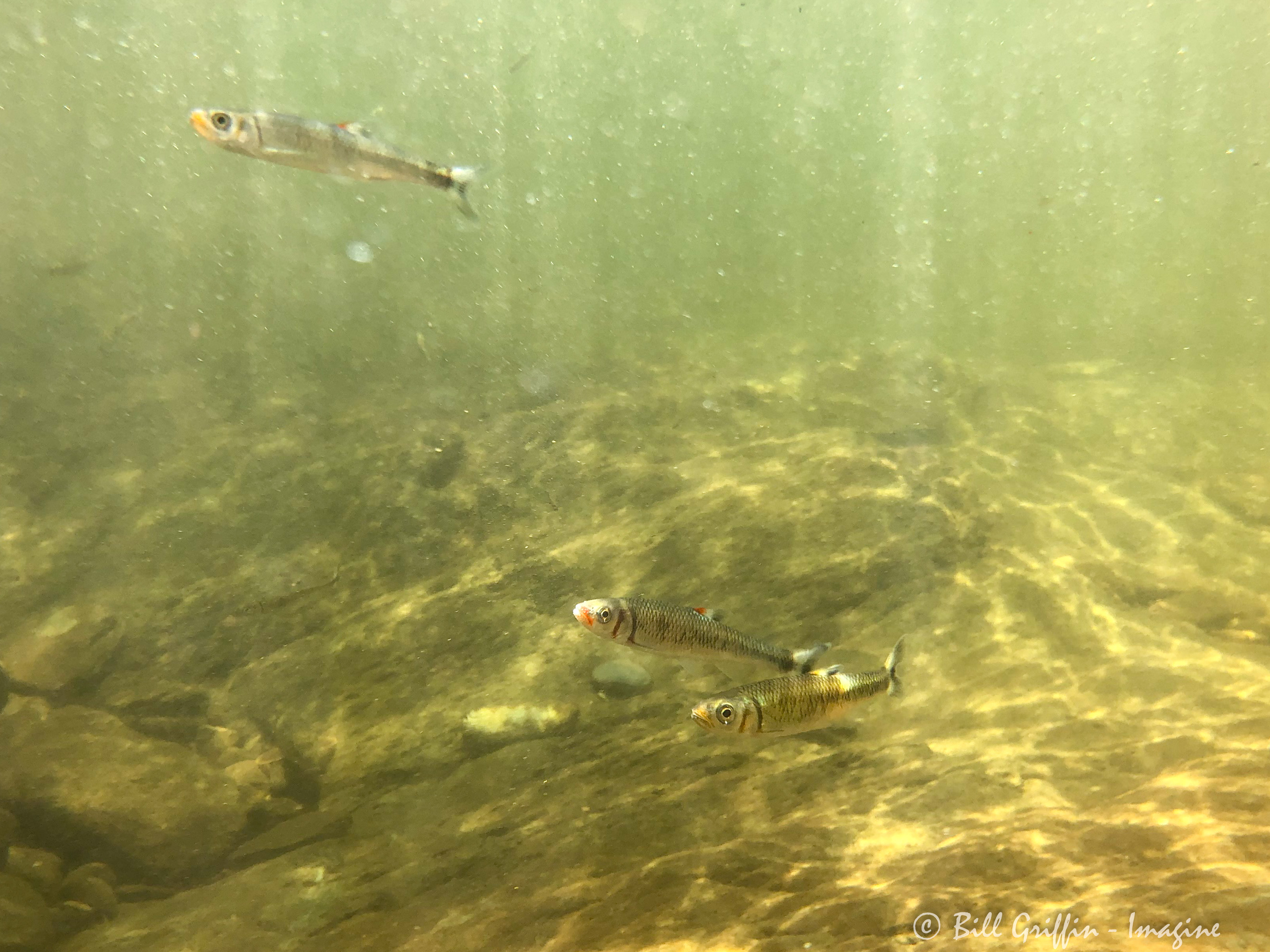
Against its tabled stones, let the gray trout
Idle below, its dim plectrum a shadow
That marks the stone’s clear shadow.
 . 
In the slow glade where sunlight comes through
In circlets and moves from leaf to fallen leaf
Like a tribe of shining bees,
Let the milk-flecked fawn lie unseen, unseing.
 . 
Let me lie there too
And share the sleep
Of the cool ground’s mildest children.
 . 
Fred Chappell
from Spring Garden, © 1995 by Fred Chappell, Lousiana State University Press.
selected by Bill Griffin
 . 
 . 
❀ ✿ ✾ ❁ ❀
 . 
The more clearly we can focus our attention on the wonders and realities of the universe about us, the less taste we shall have for destruction.
– Rachel Carson (1907-1964)
 . 
Thank you for celebrating the month of April with International Earth Day (April 22) and National Poetry Month. Readers have selected poems that connect us to our planet and each other. If you have a poem that has rooted you to the earth and spread your branches into bright sky, please share! It can be a poem by your favorite writer, living or dead, a poem of your own, or both. We will continue sharing Earth poems as long as you send them.
 . 
Send a your poem(s) in the body of the email or as .DOC or .RTF to:
ecopoetry@griffinpoetry.com 
 . 
Please include your comments or reaction to the poem. And publication acknowledgments if previously published.
 . 
Feel free to invite others to send their favorite Earth Day poems. Please refer them to this link for instructions: EARTH DAY EVERY DAY. Perhaps some day we will be able to say we live in the Age of Connection.
 . 
 . 
Thank you for visiting Verse and Image: If you would like to receive an email each time a post appears, please SUBSCRIBE to Verse and Image using the button on the Home Page.
 . 
If you have a hard time finding the SUBSCRIBE button on this WordPress site, you can send me your email address and I will add you to the subscriber list. Send your request to
 . 
COMMENTS@GRIFFINPOETRY.COM
 . 
Thanks again for joining the conversation.
 . 
— Bill
 . 
❀ ✿ ✾ ❁ ❀
 . 
2020-09-08b Doughton Park Tree
 . 

Read Full Post »

 . 
[with poems from Shelby Stephenson’s PRAISES]
 . 
The World Leads Us to the Arts and Back
+++ for Sam Ragan (December 31, 1915 – May 11, 1996)
 . 
How glad I am that my school helped move your hand toward journalism
and poetry and democracy with a little “d.” Cleveland High School:
This land of ours if full of schools, schools both great and
 . 
small; when it comes to praising them, why my school beats them all.
I’m proud you graduated from my Johnston County alma mater. I’m
sorry your family lost the farm in Granville, around Berea, Shake Rag,
 . 
Stem. You came to Bailey’s Crossroads, lived near Ebenezer Church,
among the Ogburns; your love of words showered acres, snuffling the
burning crosses. Hope was your story, lyric, svelte. Poverty? You
 . 
wrote in “That Summer”: “a wild turkey flew out of the woods / And
even if it was out of season, He fed a family for two days. / And it was
better than that mud turtle / That looked like mud and tasted
 . 
like mud.” I loved to walk into your office piled high with papers.
You’d peer over them, rise, jingle some change in your pocket and say,
“Well, what do you know?” “On a scale of one to five, Sam, about
 . 
minus two,” I’d say. Your vacations you took in your office, mostly.
Sunday mornings? When I’d drive by, I’d see your Buick parked beside
The Pilot.
 . 
Shelby Stephenson
from PRAISES, Main Street Rag Publishing Company, Charlotte, North Carolina. © 2021.
 . 
❦ ❦ ❦
 . 
Can a poem which is simply a list mean anything? Can a list of place names – counties and towns and neighborhoods and destinations – catch in the throat and widen the eyes? What are all these words if not the name someone has found for home?
 . 
Canton, Carolina, Carrollton, Carpinteria, Cary, Chapel Hill,
 . 
Driving south from Ohio, we exit I-77 at Pearisburg (the four-lane still under construction up the escarpment), careen switchbacks from Fancy Gap to Mount Airy, then cross the state line into North Carolina: at their first glimpse of Pilot Mountain, my parents break out in unison every time, “Here’s to the Land of the Longleaf Pine, a summer land where the sun doth shine . . . .”
 . 
Cleveland, Columbia, Dan, Dauphin, Durham, Edenton,
 . 
But I wasn’t born here. I didn’t grow up here. A couple of summer weeks in Morehead with Nana, Bogue Sound funk and fig preserves; in Hamlet, the iron bed in the back bedroom with Grandaddy’s snores, his Old Spice and gun oil; a swing past the house on Runymede near Old Salem where Mom grew up – phantoms, atavisms, only glimpses and dreams, none of them really my home. So why do the names in Shelby Stephenson’s Precedence, the introductory poem in his book PRAISES, why do they have the power to squeeze my heart?
 . 
Hamlet, Harnett, Highlands, Hillsborough, Huntersville,
 . 
Five days after we married Linda and I moved to Durham: June 20, 1974. That’s hot breath on the neck of fifty years in North Carolina and Lord how I have wanted to call this place my home! The generations of Griffins plowing fields in Union County, can they bring me home? Great-grandmother Griffin holding me on her knee in that old photo in Mt. Gilead above the dam, can she? Two kids born in Durham County General, two grandkids at Hugh Chatham in Elkin, surely they must be able. There must be something that can heal me of the apprehension that in any conversation someone may at any moment accuse, “You’re not from around here, are you?”
 . 
Nashville, New Bern, New Hope, Neuse, Northampton, North Wilkesboro
 . 
This book of Shelby’s has come as close as anything. His long and careful listing A to Z – I read and recall all the clay and sand and sod Linda and I have trod. That summer we lived in Clinton and she learned to drive. The sweet corn from his garden Dr. Murphy bestowed when I externed with him in Hillsborough. Two little kids with us on those rotations in Fayetteville, Goldsboro, Mt. Olive. Every detail of all the lighthouses climbed, of Tryon Palace, of the Town Creek Mounds, of our little patch of Blue Ridge. Hiking the state parks and greenways and nature trails in all seasons and all weathers, even Nags Head Woods in February and Roanoke Sound beginning to freeze. Years and changes and the earth moving beneath our feet.
 . 
Wake Forest, Waxhaw, Weaverville, Weymouth, Winston-Salem
 . 
Dang, I guess we are from around here. Thank you, Shelby, you who still live on Paul’s Hill in the house where you were born, thank you for opening the door that invites us all inside to discover that we’re home.
 . 
 . 
After that one prefatory poem, each page of Shelby Stephenson’s PRAISES is just that – praise and homage for those who have created literature and art in North Carolina for 300 years. He begins with John Lawson (b. 1674) and George Moses Horton (b. ~1798) and ends a hundred pages later with Jill McCorkle (b. 1958) and Randall Kenan (b. 1963). Many of the poems are rooted in anecdote and personal friendship but they reach into the heart of everything that makes the writing vital. Perhaps there is no North Carolinian past or present who could have created such a treasure. As Ron Smith writes on the cover, “Shelby Stephenson does not offer lyric effusion in a neutral space; he demonstrates that Emerson’s “the mind of the Past” is best encountered through the generous sensibility of a grounded poet. . . . This volume should be in every collection devoted to Southern Studies.”
 . 
. . . Every form grows beauty 
and impermanence, layers of voices, precise as one head, hand, face,
 . 
page, pen.
 . 
 . 
❦ ❦ ❦
 . 
Making Words Breathe Conscience
+++ for Jaki Shelton Green (June 19, 1953 – )
 . 
One day I went to her poetry reading.
I stole tones and breaths of her poet’s song.
I could hear Billie Holliday singing “Strange Fruit.”
I wanted to ask for mercy,
 . 
Undo history’s botched economics,
when the mercury’s 103 and there is
more to do with heat than trees.
 . 
I stubbed my toe in the room,
to doubt the river branching
blossoms, watery,
 . 
in Efland
running
with wild deer and rabbits,
Carolina wrens turning
oceans to hope,
a thing with hymns
and children whiling
desire, their shoes digging
ruts a flagpole schools.
 . 
Possums wobbled
cobbled swamps,
home of the blue-tailed hare.
 . 
Listen, she hears this.
 . 
Shelby Stephenson
from PRAISES, Main Street Rag Publishing Company, Charlotte, North Carolina. © 2021.
 . 
❦ ❦ ❦
 . 
 . 
❦ ❦ ❦
 . 
Looking for the Apple Tree
 . +++ for Fred Chappell (May 28, 1936 – )
 . 
+++ HIS NAME that was ever used was Stovebolt Johnson and he was a short
+++ black man, heavily muscled, a chunk of a man.” (The opening sentence in
+++ the story “Blue Dive” in Moments of Light)
 . 
++++++++++ I
 . 
He loves to salute with a drink
And raise a wrinkling thumb
Towards intellection, think,
I mean, then throw all thought to some
Seeming lore a shortstop
Might snag, talking up baseball.
He can carry on about a hog-box
And make you see the hog, a Farmall
In the mix, and Pope, too,
Alexander, I mean: never would he
Name a poem for any part of the pope, though.
His work’s morality plays the wee
Canton, his stomping ground, though he left
It here and there,
For occasional sightings as allegory.
 . 
++++++++++ II
 . 
I’ve seen Lee Jones ride a bucket down
To clean out our lot-well
And to retrieve my mother’s doggie, brownie.
I read River to a bunch of students
Once and they sprouted shoots and shouts
When I danced in front of them,
Letting Virgil Campbell swear he could
Shoot the god-raging Pigeon swurging
In his pants, the yard, the rose
Garden gate, open, debris watering fast
Familiar voices gushing from a cathedral funeral,
Yet common as a mule drinking water from a trough,
 . 
And, lo, Fred came out with three more volumes,
Bloodfire, Wind Mountain, Earthsleep,
And I was sore surprised the tenor
Of the faces of parents and grandparents,
The children passing by, the cornered bull
 . 
In the pasture, all lounged animals and human flesh
In lineages for miles to keep away
The drinking Virgil put into words,
The fish slapping and sliding for lures
Snagging murmurs of drifting glasses
Shot-filled and choked with gregarious whiffs
Undoing his own talking.
 . 
++++++++++ III
 . 
In prose, essays, fiction,
Short stories, forms diction,
Multi-told tales along
Side villanelles, sestinas, you name it, Infinity, Plus One,
The scattered debris of chewed billy goat wads,
the cuds of cows on the Blue Ridge, the lows
Murmuring indolence dependent
On freedom he lends
To every piece, hails,
Then takes on the world again and nails
A greeting the page spans – he makes me laugh right out and smile
Aslant at rhythms working syllables mile by mile
Until haints themselves
 . 
wallow down beside me, as if to say,
Goodnight, Somewhere, there’s a beyond
The world’s engine dawdles:
The raised fist for freedom
Shines humor for consolation;
Wanting not to be bored, the Muse of Music
Surprises him with more news,
A book of verse, collection of stories, another novel.
Universes, constellations, – lower
Shoals for minnows fanning
Swirling apple blossoms bedding
 . 
Shelby Stephenson
from PRAISES, Main Street Rag Publishing Company, Charlotte, North Carolina. © 2021.
 . 
❦ ❦ ❦
 . 
Shelby Stephenson earned many awards for teaching during his long tenure at UNC Pembroke, where he also edited Pembroke Magazine and raised it to national prominence. He served as Poet Laureate of North Carolina 2015-2018. Recent books: Possum (Bright Hill Press), winner of Brockman-Campbell Award; Elegies for Small Game (Press 53), winner of Roanoke-Chowan Award; Family Matters: Homage to July, the Slave Girl (Bellday Books), the Bellday Prize; Paul’s Hill: Homage to Whitman (Sir Walter Press); Our World (Press 53); Fiddledeedee (The Bunny and the Crocodile Press; reprinted by Press 53); Nin’s Poem (St. Andrews University Press); Slavery and Freedom on Paul’s Hill (Press 53); Shelby’s Lady: The Hog Poems (Fernwood Press). He lives at the homeplace on Paul’s Hill, where he was born.
 . 
Author Clyde Edgerton says of Shelby: “He writes poems that skin raccoons, sweeten the pot-likker, shine through the window, and sing like a gold and silver bird. I’m lucky to know the boy.”
 . 
 . 
❦ ❦ ❦
 . 
Doughton Park Tree -- 5/1/2021

Read Full Post »

NCPS Chappell Stephenson


C ++++ THE EPIGRAMMATIST

Mankind perishes. The world goes dark.
He racks his brain for a tart remark.

Fred Chappell

.     .     .     .     .     .     .

Poets are a sober and studious lot. Profoundly introspective, respectably staid. Their rhymes are the quintessence of conservatism and decorum, their meter most martial. Their lines are ever crafted and solid as Cold War architecture, their images invariably  illuminate and never titillate. Their thoughts are only a little lower than the angels’.

No poet and no poet’s poetry better represent these fundamental verities than Fred Chappell and Fred Chappell’s. For today’s APRIL FIRST missive we have selected the utmost in staid, respectable, and illuminating offerings from a book by Old Fred (as he has called himself) titled simply C (Roman numeral “100,” designating the exact number of poems in the book as well as Dr. Chappell’s initial, which this writer had not actually remarked upon for the first 29 years that he owned this book until today over lunch while he was reading aloud and his wife commented on the typeface, then pointed out the connection to the author’s last name). Illuminatio Lector.

.     .     .     .     .     .     .

V ++++ HOW TO DO IT

“Chappell – you who love to jest –
Hear the things that make life blest:
Family money not got by earning;
A fertile farm, a hearthfire burning;
No lawsuits and no formal dress;
A healthy body and a mind at peace;
Friends whom tactful frankness pleases;
Good meals without exotic sauces;
Sober nights that still spark life;
A faithful yet a sexy wife;
Sleep that makes the darkness brief;
Contentment with what you plainly need;
A death not longed for, but without dread.”
++++ ++++ ++++ ++++ – Martial

VI ++++ REJOINDER

Now let’s even up the score
And tell what things make life a bore:
Sappy girls who kiss and tell;
Televangelists’ threats of hell;
Whining chain saws, mating cats;
Republicans; and Democrats;
Expertly tearful on their knees,
Plushlined senators copping pleas,
Swearing by the Rock of Ages
That they did not molest their pages;
Insurance forms and tax reports;
Flabby jokes and lame retorts;
Do-gooders, jocks, and feminists;
Poems that are merely lists.

.     .     .     .     .     .     .

All of today’s poems, epigrams, epitaphs, enlightenment, and erudition are from C, by Fred Chappell, Louisiana State University Press, Baton Rouge & London, © 1993.

Fred Chappell is the author of more than thirty volumes of poetry and prose. He has received the Bollingen Prize, the T. S. Eliot Award, and the Thomas Wolfe Prize. His fiction has been translated into more than a dozen languages and received the Best Foreign Book Award from the Académie Française. He was the poet laureate of North Carolina from 1997 to 2002. [bio from LSU PRESS]

NCPS

.     .     .     .     .     .     .

XV ++++ UPON A CONFESSIONAL POET

You’ve shown us all in stark undress
The sins you needed to confess.
If my peccadilloes were so small
I never would undress at all.


XXIII ++++ LITERARY CRITIC

Blandword died, and now his ghost
Drifts gray through lobby, office, hall.
Some mourn diminished presence; most
Can see no difference at all.

XXVI ++++ ANOTHER

Blossom’s footnotes never shirk
The task of touting his own work.


NCPSNCPS


LIII ++++ EL PERFECTO

Senator No sets up as referee
Of everything we read and think and see.
His justification for such stiff decreeing
Is being born a perfect human being
Without a jot of blemish, taint, or flaw,
The Dixie embodiment of Moral Law,
Quite fit and eager to pursue the quarrel
With God Whose handiwork he finds immoral.

.     .     .     .     .     .     .


NCPS


LXXIX ++++ UPON AN AMOROUS OLD COUPLE

This coltish April weather
Has caused them to aspire
to rub dry sticks together
In hopes that they’ll catch fire.


XLI ++++ RX

Dr. Rigsbee
Drank all my whiskey.
He said, when I objected, “Hell,
Fred, you’re paying me to make you well.”
++++ ++++ ++++ ++++ – Martial


LXVIII ++++ EPITAPH: PREVARICATION

A lonely sorrow
This monument tells:
Here lies one
Who did nothing else.

NCPS Laughter

.     .     .     .     .     .     .

And the penultimate:

XCIX ++++ APOLOGY

If any line I’ve scribbled here
Has caused a politician shame
Or brought a quack a troubled night
Or given a critic a twinge of fear
Or made a poet’s fame appear
Transitory as candleflame,
Why then, I gladly sign my name:
Maybe I did something right.

.     .     .     .     .     .     .

And one last item, and about this there is no fooling:
HAPPY ANNIVERSARY MARGARET AND JOSH!


Margaret & Josh , April 1, 2016


LXII ++++ WEDDING ANNIVERSARY

Gale winds tore this tree
And drought and frost came near
To killing it. But see:
In its thirtieth year
It blooms like a candleflame,
And puts its youth to shame.

.     .     .     .     .     .     .


NCPS


.     .     .     .     .     .     .


2020-11-03b Doughton Park Tree

Read Full Post »

Older Posts »