Feeds:
Posts
Comments

Posts Tagged ‘poetry’

 . 
[with 3 poems by Joy Harjo]
 . 
And the blessing began a graceful moving through the grasses of time, from the beginning, to the circling around place of time, always moving, always
++++++++ from Bless This Land, Joy Harjo
 . 
 . 
The Story Wheel
 . 
I leave you to your ceremony of grieving
Which is also of celebration
Given when an honored humble one
Leaves behind a trail of happiness
In the dark of human tribulation.
None of us is above the other
In this story of forever.
Though we follow that red road home,
one behind another.
There is a light breaking through the storm
And it is buffalo hunting weather.
There you can see your mother.
She is bus as she was ever –
She holds up a new jingle dress, for her youngest beloved daughter.
And fo her special son, a set of finely beaded gear.
All for that welcome home dance,
The most favorite of all –
when everyone finds their way back together
to dance, eat and celebrate.
And tell story after story
of how they fought and played
in the story wheel
and how no one
was every really lost at all.
 . 
Joy Harjo
from An American Sunrise, W. W. Norton, New York NY, © 2019
 . 
❦ ❦ ❦
 . 
Last night I sat silent on stage waiting as a few early arrivals took their seats in the audience. We singers had a few more selections to rehearse before filing out to prepare our official entrance, and for now we waited. Shouldn’t I have been anxious in anticipation of the harmonies we would soon raise together? Shouldn’t I have been thrilled as the strings took their places and began to tune their instruments? Shouldn’t joy live here?
 . 
No, something dark nagged me. My heart was stone. I felt suspicious of these watchers, listeners. I was afraid of their grand and thriving church. I distrusted what they would think of me if they in turn suspected I didn’t think or believe precisely as they did. I told myself I was already rejected, on the outside. I didn’t belong here.
 . 
Joy Harjo writes, The old Mvskoke laws outlawed the Christian religion / Because it divided the people. / . . . But Mvskoke ways are to make relatives. Where is the religion that makes relatives? People, plants, creatures, everything together as family? A religion that turns all people to face each other within the circle rather than turning them out? Linda and I had been thrashing with recent revelations that people were leaving our son’s church because one of the ministers has come out as gay. These people leaving – we thought we knew them, we considered them neighbors. We don’t understand the rejection, the turning apart. How can we understand?
 . 
When our chorus returns to our places before a full house, I don’t recognize many faces. But I do know a few, some from years in the past, and I remember I love them. Now lift our voices together and sing of a Creator who is always with us. We sing longing and loss, humor and fullness, songs like rivers that course and meander a long journey, that carry all the weight of time and earth. I sing. And at the end of the singing we have become one family.
 . 
The heart of stone has only hardened itself. Everything that lives wants to soften that heart. Everything that lives wants to open each heart to beauty and truth.
 . 
 . 
❦ ❦ ❦
 . 
from Exile of Memory
.    .    .
In the complex here there is a singing tree.
It sings of the history of the trees here.
It sings of Monahwee who stood with his warrior friends
On the overlook staring into the new town erected
By illegal residents.
It sings of the Civil War camp, the bloodied
The self-righteous, and the forsaken.
It sings of atomic power and the rise
Of banks whose spires mark
The worship places.
The final verse is always the trees.
They will remain.
.    .    .
When it is time to leave this place of return,
What will I say that I found here?
 . 
From out of the mist, a form wrestled to come forth –
It was many legged, of many arms, and sent forth thoughts of many colors.
There were deer standing near us under the parted, misted sky
As we watched, the smelled for water
Green light entered their bodies
From all leaved things they ate –
.    .    .
The Mvskoke laws outlawed the Christian religion
Because it divided the people.
We who are relatives of Panther, Racoon, Deer, and the other animals and winds were soon divided.
But Mvskoke ways are to make relatives.
We made a relative of Jesus, gave him a Mvskoke name
.    .    .
We could not see our ancestors as we climbed up
To the edge of destruction
But from the dark we felt their soft presences at the edge of our mind
And we hear their singing.
 . 
There is no word in this trade language, no words with enough power to hold all this we have become –
 . 
Joy Harjo
from An American Sunrise, W. W. Norton, New York NY, © 2019
 . 
❦ ❦ ❦
 . 

IMG_0262

 . 
❦ ❦ ❦
 . 
An American Sunrise opens with a map of a trail of tears, that of the Muscogee Creek Nation’s forced displacement to Oklahoma from their native homelands near Talladega, Georgia in the 1830’s. One of many trails of tears. In Joy Harjo’s preface she includes this plea and blessing: May we all find the way home.
 . 
Toward the close of the book, Joy Harjo describes how her Great-Grandfather Monahwee could bend time. The entire book is an experience of time and place bending, fluid, circular, all connected. We hear the voices of ancestors and offspring. We hear the voices of creatures on earth and of Earth herself. We are torn by hatred and injustice – we bleed. We smell the smoke of cook fires at dawn and feel the sun on our face – we are fed. We are challenged and re-challenged to connect ourselves to the thread of life that weaves through all people and all creation and leaves nothing out. As the poet says, Nobody goes anywhere / though we are always leaving and returning. And her experiences are, as for all of us . . . the giving away to history which in no means meant giving up. For a warrior it is not possible to give up. 
 . 
For any of us to find home, we must all find home. We must all witness cruelty and kindness in this land. From the book’s final poem, Bless This Land: Bless us, these lands, said the rememberer. These land aren’t our / lands. These lands aren’t your lands. We are this land. May the poems and the songs bring all things into our memory and show us the way.
 . 
 . 
An American Sunrise, Joy Harjo; W. W. Norton & Company, New York NY © 2019. Joy Harjo served as Poet Laureate of the United States for three terms, 2019 through 2021.
 . 
❦ ❦ ❦
 . 
Beyond
 . 
Beyond sunrise, there is a song we follow
Beyond clouds traveling with rain humped
On their backs, lightning in their fists
Beyond the blue horizon where our ancestors
Appear bearing gifts, wrapped in blankets woven
With sun and strands of scarlet time
 . 
Beyond the footpaths we walk every day
From sunrise to kitchen, to work, to garden, to play
To sunset, to dark, and back
 . 
Beyond where the baby sleeps, her breath
A light mist of happiness making
A fine rainbow of becoming knowledgeable around us.
 . 
Beyond the children learning alphabets
And numbers, bent over their sticks and dolls
As they play war and family, grow human paths
 . 
Beyond the grandmothers and grand fathers
Their mothers and fathers, and in the marrow of their bones
To when that song was furs sung we traveled on
 . 
Beyond sunset, can you hear it?
The shaking of shells, the drumming of feet, the singers
Singing, all of us, all at once?
 . 
In the song of beyond, how deep we are –
 . 
Joy Harjo
from An American Sunrise, W. W. Norton, New York NY, © 2019
 .  
 . 
❦ ❦ ❦
 . 
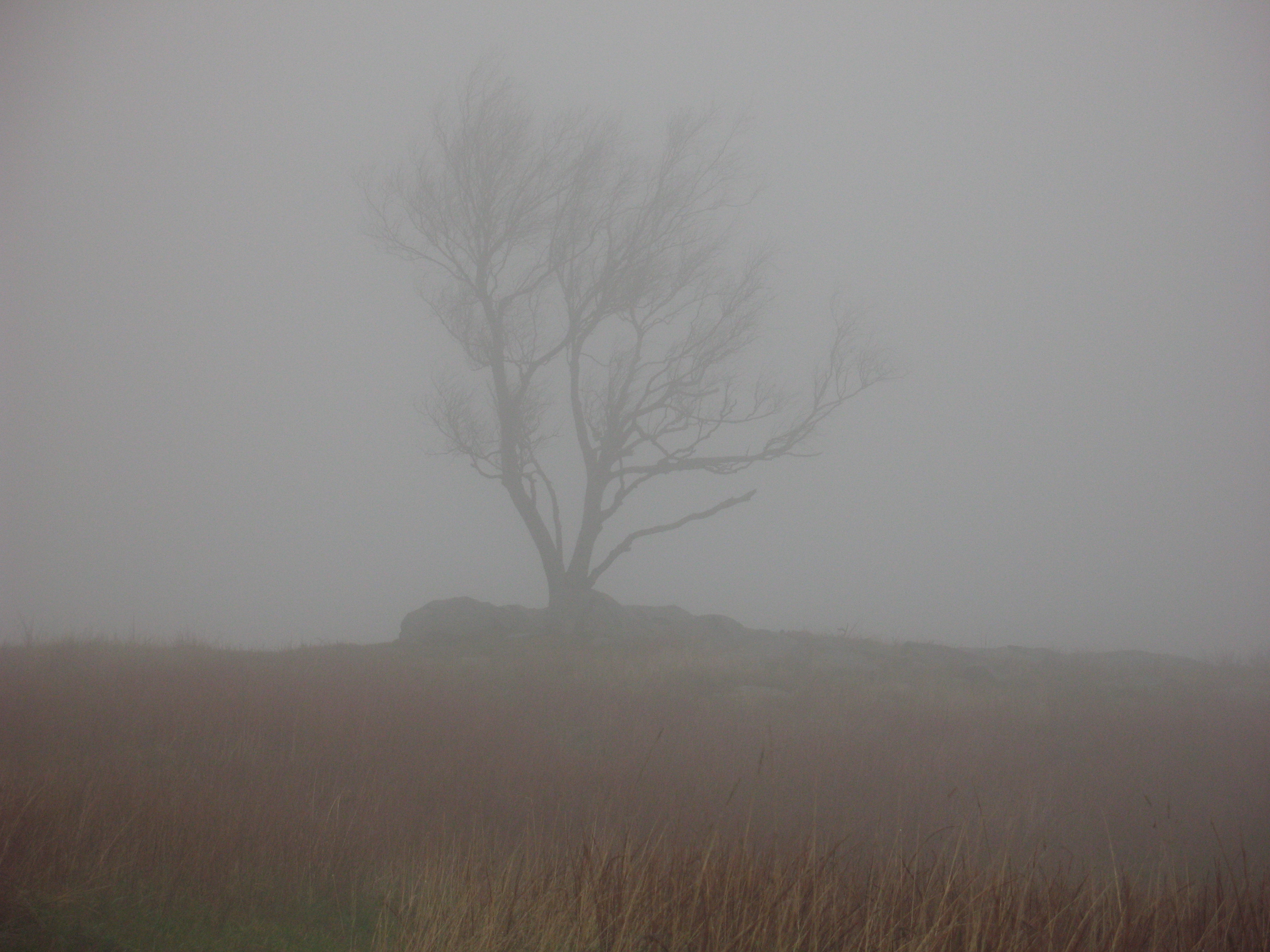
Doughton Park Tree 2020-06-11a
 . 

Read Full Post »

 . 
April 26, 2024
 . 
In order to see birds it is necessary to become a part of the silence.
++++++ Robert Lynd (1879-1949) – naturalist
 . 
To see a wren in a bush, call it a wren and go on walking is to have seen nothing. To see a bird and stop, watch, feel, forget yourself for a moment, to be in the bushy shadows, maybe then feel wren – that is to have joined in a larger moment with the world.
++++++ Gary Snyder
 . 
Keep a green tree in your heart and perhaps a song bird will come.
++++++ Chinese proverb
 . 
❦ ❦ ❦
 . 
November
 . 
It is an old drama
this disappearance of the leaves,
this seeming death
of the landscape.
In a later scene,
or earlier,
the trees like gnarled magicians
produce handkerchiefs
of leaves
out of empty branches.
 . 
And we watch.
We are like children
at this spectacle
of leaves,
as if one day we too
will open the wooden doors
of our coffins
and come out smiling
and bowing
all over again.
 . 
Linda Pastan (1932-2023)
from Carnival Evening: New and Selected Poems 1968–1998, W W Norton & Co, © 1999
 . 
Shared by Bradley Samore, Plano TX, who writes:
 . 
This poem by Linda Pastan reminds me of our hushed wonder toward the non-human and our tendency to imagine ourselves in relation to what we see. Perhaps there is no objective way to view something as each species, each person, has their own limitations and reference point. Like Gerard Manley Hopkins’ “Spring and Fall”, Pastan makes the connection between the leaves falling and our own human death but also hints at the possibility/impossibility of our rebirth, another budding.
 . 
++++++ Bradley
 . 
 . 
Revelation
 . 
Nothing compares to exploring the land
++++++ but what of becoming part of it
 . 
to sit so still that lizards
++++++ mate by my sandaled feet
 . 
to kneel at the grave where from shadows
++++++ a fox approaches unafraid
 . 
to lie on the grass as daylight fades
++++++ and birds feather the branches above
 . 
Bradley Samore
first appeared in Hoot
 . 
 . 
❦ ❦ ❦
 . 
The charm which Henry [David Thoreau] uses for bird and frog and mink, is patience. They will not come to him, or show him aright, until he becomes a log among logs, sitting still for hours in the same place; then they come around him and to him, and show themselves at home.
++++++ Ralph Waldo Emerson, from his journal, May 11, 1858.
 . 
I hope you love birds, too.  It is economical.  It saves going to Heaven.
++++++ Emily Dickinson
 . 
❦ ❦ ❦
 . 
Kinship
Rootless and restless and
warmblooded, we
blaze in the flare that
blinds us to that slow,
tall, fraternal fire of life
as strong
now as in the seedling
two centuries ago.
 . 
Ursula K LeGuin
 . 
❦ ❦ ❦
 . 
The cockroach and the birds were both here long before we were. Both could get along very well without us, although it is perhaps significant that of the two the cockroach would miss us more.
++++++ Joseph Wood Krutch, from The Twelve Seasons (1949)
 . 
More than at any other time, we feel the strangeness of birds when we stop and pick up a feather in our path. There is nothing on Earth to compare it to; there is no material like it, no form, nothing that functions quite the same way.
++++++ Bruce Brooks, from On the Wing
 . 
 . 
❦ ❦ ❦
 . 
Landscape with Jeffers and the Connecticut River
 . 
Oat stalks hang their oat-heavy heads.
Panic grass shakes in the wind
off a goldfinch’s wing. Cause,
++++ ++++ ++++ ++++ effect, and cause.
 . 
Drone, like the bee, of goldenrod and aster,
tool of the stick-tight and cockleburr,
I park and wade into high riverside grasses.
 . 
A dog gnaws on a box turtle, a spider rides
a floating log, straining the air of its midges and leafbits.
A fisherman lazy as late summer current,
++++ ++++ ++++ ++++ ++++ casts, reels, and casts.
 . 
It occurs to me I am alive, which is to say
I won’t be soon. Robinson Jeffers
from Carmel Point, in “an unbroken field of poppy and lupin”
 . 
ashamed of us all (of himself ), took solace in time,
in salt, water, and rock, in knowing
all things human “will ebb, and all/
++++ ++++ ++++ ++++ Their works dissolve.”
 . 
Me, too. And I’m not always so patient. I’ve caught myself
wishing our spoiler species gone, just swept away,
returned to rust and compost for more deserving earthly forms.
 . 
Meanwhile, flint arrowheads turn up among the plastic
picnic sporks, the glacial crags and bottom silt.
Hawks roost across the river on the now defunct
++++ ++++ ++++ ++++ ++++ nuclear power plant cooling tower,
 . 
flotsam left at the human high water mark.
Like mussel shells, like driftwood or seedpod,
like the current’s corrugations in the sand.
 . 
Here, on this side, a woodchuck sits up, lustrous,
fat on her chestnut haunches, (she thinks herself
queen of her narrow realm) and munches
++++ ++++ ++++ ++++ the fisherman’s crust.
 . 
Who wouldn’t smile? Who doesn’t pity—and love—
the woodchuck not only despite but for her like-human smugness?
How can I not through her intercession forgive
++++ ++++ ++++ ++++ ++++ for now a few things human.
 . 
Jennifer Atkinson
from The Thinking Eye, Parlor Press, © 2016
 . 
Jennifer Atkinson writes in Poems.com:
 . 
But how do we live with our knowledge and the emotional cloud of fear, guilt, anger, grief, and helplessness, a cloud that surrounds us, each of us alone, and all of us together? That cloud has become intrinsic to my ecopoetical work. Burdened with the beauty and loss and malicious awfulness ahead, weighted with the anxiety that hits whenever a winter day dawns without frost on the ground or another ‘unprecedented’ downpour rings in the gutter, how do I live?
 . 
 . 
❦ ❦ ❦
 . 
The bluebird carries the sky on his back.
++++++ Henry David Thoreau
 . 
We lose our souls if we lose the experience of the forest, the butterflies, the song of the birds, if we can’t see the stars at night.
++++++ Thomas Berry
 . 
It is the ancient wisdom of birds that battles are best fought with song.
++++++Richard Nelson
 . 
❦ ❦ ❦
 . 
Rain Light
 . 
All day the stars watch from long ago
my mother said I am going now
when you are alone you will be all right
whether or not you know you will know
look at the old house in the dawn rain
all the flowers are forms of water
the sun reminds them through a white cloud
touches the patchwork spread on the hill
the washed colors of the afterlife
that lived there long before you were born
see how they wake without a question
even though the whole world is burning.
 . 
W.S. Merwin (1927-2019)
from The Shadow of Sirius, Copper Canyon Press, © 2009
 . 
 . 
❦ ❦ ❦
 . 
My favorite weather is bird-chirping weather.
++++++ Terri Guillemets
 . 
You can observe a lot by just watching.
++++++ Yogi Berra
 . 
Look at everything as though you were seeing it either for the first or last time. Then your time on earth will be filled with glory.
++++++ Betty Smith, from A Tree Grows in Brooklyn
 . 
❦ ❦ ❦
 . 
 . 
Special thanks throughout these Earth Day celebrations to my hiking buddy and nature guide Mike Barnett, who has let me into the wilderness and won’t let me leave. Most of the quotations included in these sections are compiled in Mike’s Medicine Bag, which he carries with him into every new adventure
 . 
And EXTRA SPECIAL THANKS to my companion in the universe, Linda, who allows the cosmos to flow through her pen onto paper. She has given permission for me to use a few of her drawings throughout these Earth Day celebrations.
 . 
++++++  Bill
 . 
 . 

Read Full Post »

 . 
April 24, 2024
 . 
Our true home lies outside, deep in the wilderness of forest and mountain, river and desert and sea, the source of our being and the destiny of our great meandering blundering dreaming journey through time. Like Odysseus in his wanderings, we are homeward bound whether we know it or not.
++++++ Edward Abbey
 . 
Wilderness has drawn humans closer to God throughout history. Why should we, in the twentieth century, believe this is suddenly no longer true? Long after the Exodus, in a time of recurring apostasy, Hosea spoke of God wishing to ‘allure’ the people back into the wilderness yet again — this time to the parched hills beyond Jericho. There, wrote the prophet, God would ‘speak tenderly’ to them.
++++++ David Douglas
 . 
The clearest way into the Universe is through a forest wilderness.
++++++ John Muir
 . 
❦ ❦ ❦
 . 
[Come wilderness into our homes]
 . 
Come wilderness into our homes
break the windows come
with your roots and your worms
spread yourself over our wishes
our waste-sorting systems our prostheses
and outstanding payments
cover us with your rustling greenery
and your spores cover us that we may
become green: green and reverent
green and manifest green and replaceable
come weather with your storms
and sweep the slates off the roofs come
with snow and hail smash
through the collective sleep
we are all enjoying in our beds
our worn rationalizations come ice
and form glaciers over the shadow banks
and our drive for liquidity
come through the cracks under the doors
you desert with your sands fill
our desolation up until it forms into a solid mass
rise up over the search-and-rescue teams
and our growth compulsion trickle into
the control panels of the missiles
and the missile defense systems into
the think tanks and the hearts of internet trolls
just leave the hedgehogs with their
snuffling so that it may calm us
come rising sea levels
up over our shorelines both the developed
and the undeveloped the homey
lowland areas wash
jellyfish into our soup bowls
and ramshorn snails into our hair
as we swim in each other’s direction panicked
with our yearning for one another
because almost nothing is left because it’s all gone
and thoroughly soaked through with regrets
finger-pointing and tranquilizers
come earthquakes shatter the apartments
which we built on the foundations
of how we always did everything
come tremors fill the mine shafts
the end of work and
the literature of redemption bury anger
and affection and all manner of added values
swallow up the memories come tremors
hurry so that the bedrock covers us
so we are covered with water desert weather
and over everything that which covers all the wilderness
 . 
Daniela Danz
Translated from the German by Monika Cassel
[Komm Wildnis in unsere Häuser] from the journal POETRY,December 2023
 . 
Shared by Bill Griffin, Elkin NC, who writes:
 . 
To the ancient mind, wilderness was dangerous, something to be feared and held at bay even while mysterious and fascinating. In recent times, as we’ve come to consider ourselves ‘modern’, wilderness has been conquered – we control it, we rule it, we exploit and use wilderness. Indigenous voices tell us we are one with the wild and can only be fully ourselves when we know and respect wildness. Romantic voices long to return to Eden and live in harmony with wilderness. The voices of mystics and spiritual seekers remind us that wildness is in us and part of us, that all things are one and that we have cut off a vital part of ourselves when we separate ourselves from the wild.
 . 
This poem by Daniela Danz brings us full circle to our 21st century shuddering realization – wild nature is back and beyond our control. For a few centuries we’ve kept wilderness at arm’s length, just outside the widening circle of our campfires, but now the seas rise and the storms mount. All of our consumption economies and gods of growth and development will not keep us safe. In the literal sense, wilderness comes into our homes, welcome or not. In the metaphorical sense, perhaps it is not too late indeed to invite it in, ‘come’. Perhaps we are on the threshold of a new age in which we admit our part in wild nature and its part in us. Or perhaps we shall be covered.
 . 
++++++ Bill
 . 
 . 
 . 
My own poem, Spent, begins with fatalism and regret but discovers, I hope, some communion with wild nature to end on a note of connection. – Bill
 . 
Spent
 . 
Coreopsis spent, limp rays curling,
curdled disk and one lone fly like aster’s
dry winged seed perched on delusion
that the head still holds some promise:
I turn away from everything sere
and brown – where else would I turn
this sullen afternoon? until
 . 
she calls me to join her, leaf strewn trail
beside Grassy Creek where it sings
to itself oblivious, two soft pairs
of footfalls among fern and shadow,
partridge berry makes its own warm light
and ground cedar runs rings around us:
 . 
I crouch before a cranefly orchid, determined
buds dainty as dewclaws still unopened
mid-July (and absent basal winter leaves
pocked olive but upturn them for satin
underleaf maroon), yet while she reminds me
 . 
about co-evolution, blossoms that couple
with their pollinators, I can’t stop seeing
that useless fly, bulging maroon ommatidia,
wings’ blush iridescence, proboscis needle
dripping one sour jewel spent, until
 . 
for just this moment the world opens itself
around us and I open to its secrets, kingfisher
rattle from another planet, fecund dank
of moss and fungus, every vireo our familiar,
swelling benediction breeze that gossips
among beech and laurel and promises
 . 
always, always something new.
 . 
Bill Griffin
finalist for the James Applewhite Poetry Prize of North Carolina Literary Review, 2023
 . 
❦ ❦ ❦
 . 
Nature is trying very hard to make us succeed, but nature does not depend on us.  We are not the only experiment.
++++++ R. Buckminster Fuller
 . 
We cannot be truly ourselves in any adequate manner without all our companion beings throughout the earth.
++++++ Thomas Berry
 . 
 . 
❦ ❦ ❦
 . 
The Tyger
 . 
Tyger! Tyger! burning bright
In the forests of the night,
What immortal hand or eye
Could frame thy fearful symmetry?
 . 
In what distant deeps or skies
Burnt the fire of thine eyes?
On what wings dare he aspire?
What the hand, dare sieze the fire?
 . 
And what shoulder, & what art,
Could twist the sinews of thy heart?
And when thy heart began to beat,
What dread hand? & what dread feet?
 . 
What the hammer? what the chain?
In what furnace was thy brain?
What the anvil? what dread grasp
Dare its deadly terrors clasp?
 . 
When the stars threw down their spears,
And water’d heaven with their tears,
Did he smile his work to see?
Did he who made the Lamb make thee?
 . 
Tyger! Tyger! burning bright
In the forests of the night,
What immortal hand or eye
Dare frame thy fearful symmetry?
 . 
William Blake (1757-1827)
https://poets.org/poem/tyger ; this poem is in the public domain
 . 
Shared by Les Brown, Troutman NC, who writes:
 . 
I love Blake’s Tyger not only because of its incredible poetic craft and rhythm, but for its recognition of the beauty and duality of the tiger as a creature of strength and beauty but also an instrument involved in the balance of nature.
 . 
++++++ Les
 . 
 .
❦ ❦ ❦
 . 
The brawling of a sparrow in the eaves,
The brilliant moon and all the milky sky,
And all that famous harmony of leaves,
Has blotted out man’s image and his cry.
++++++ William Butler Yeats
 . 
It seems clear, as I’ve argued, that the humanities can be broadened enough to make the connection [with science] in three ways. First, escape the bubble in which the unaided human sensory world remains unnecessarily trapped. Second, sink roots by connecting the deep history of genetic evolution to the history of cultural evolution. And third, diminish the extreme anthropocentrism that hobbles the bulk of humanistic endeavors.
++++++ Edward O. Wilson, The Origins of Creativity (2017)
 . 
❦ ❦ ❦
 . 
Bread and Roses
 . 
When the big sea has stopped rising
and the maps we’re through revising
and I can think of storms as friends,
I’ll go down to the beach again.
 . 
I’ll stand still there in that bright surf
and sing a song to this dear Earth.
I’ll sing for climate change to end.
I’ll sing tears for where we have been.
 . 
I’ll sing to things that we have learned –
the fossils we should not have burned
releasing the power of former suns,
bringing losses that cannot be undone.
 . 
Sad losses the children will inherit.
Species gone without much credit,
thanks to the piles of money earned
and all the corners left unturned.
 . 
I’ll sing to anger rising still.
Our leaders let firms do their will.
The people did assert control
but not before the barons stole.
 . 
Our job is now to make the best,
finding purpose in what is left.
It is a joy to live to fight
and on that beach to fly two kites.
 . 
Gus Speth
from Let Your Tears Water the Earth, Watershed Publications © 2023
 . 
Shared by Sam Love, New Bern NC, who writes:
 . 
I love the lyrical nature of this poem using the “songs” as a way to tie assaults on our planet’s web together. Also the transition from songs for the abuses to singing “to anger rising still”. A call to action. And here is one of my poems that is more literal with the theme of Earth Day and all things being connected.
 . 
++++++ Sam
 . 
 . 
 . 
The Web
 . 
No one is alone
We are all part
of life’s web
 . 
In each breath we inhale
remnants of star dust
and exhale nourishment
for the Earth’s plants
 . 
Each action we take
to support our bloated
lifestyle tugs on a strand
of the planet’s web
 . 
To understand our impact
visualize a spider’s web where
pulling on one strand
alters the whole
 . 
Sam Love
from Earth Resonance, The Poetry Box ©  2022
 .
Shared by Gus Speth, South Carolina, who writes:
 . 
The following poem by Sam Love is lovely but cautionary. It reminds us that we humans are part of an interconnected web of life here on Earth and part also of the journey of the universe. And gently it says we should act like it.
 . 
++++++ Gus
 . 
 . 
❦ ❦ ❦
 . 
We need the tonic of wilderness… the silence, the cold and solitude… to be refreshed by the sight of inexhaustible vigor… pasturing freely where we never wander.
++++++ Henry David Thoreau
 . 
Wildness made man but man cannot make wildness. He can only spare it.
++++++ David Brower
 . 
Wilderness is two things — fact and feeling. It is a fund of knowledge and a spring of influence. It is the ultimate source of health — terrestrial and human.
++++++ Benton MacKaye, the man who planned and conceived the Appalachian Trail
 . 
Any creative deed at the human level is a continuation of the creativity of the universe.
++++++ Thomas Berry
 . 
Life is a chemical system able to replicate itself through autocatalysis and to make mistakes that gradually increase the efficiency of autocatalysis.
++++++ National Geographic, Jan. ‘03
 . 
❦ ❦ ❦
 . 
 . 
Special thanks throughout these Earth Day celebrations to my hiking buddy and nature guide Mike Barnett, who has let me into the wilderness and won’t let me leave. Most of the quotations included in these sections are compiled in Mike’s Medicine Bag, which he carries with him into every new adventure
 . 
And EXTRA SPECIAL THANKS to my companion in the universe, Linda French Griffin, who allows the cosmos to flow through her pen onto paper. She has given permission for me to use a few of her drawings throughout these Earth Day celebrations.
 .  
++++++  Bill . 
Doughton Park Tree -- 5/1/2021
 . 

Read Full Post »

« Newer Posts - Older Posts »