Feeds:
Posts
Comments

Posts Tagged ‘Main Street Rag Publishing’

 . 
[with 3 poems by Claudine R. Moreau]
 . 
Lesson on Cryovolcanism
 .  . 
How can a moon cry?
I wonder as I display the face
of Enceladus, the Saturnalian moon,
to students pecking on cell phones.
Their saltwater brains
enmeshed in everything
but this moon dressed
in bright fresh eruptions
of sow fall, pockmarked
craters, and frozen blue
rivers of tears.
 . 
It is January, my season
for venting and remembering –
the snow packed mountain
road which winded up
to the Flat Rock Church
that my father rebuilt,
post and beam. Every nail
hand-hammered,
every cement block place
and trialed with his patience
in finding God in hard work.
 . 
I want to tell the class
that humans are the only
species known to cry
from emotion.
Instead, I get locked
inside my mind’s
digital inventory –
to see a wooden pin
box engraved
with his name next
to the pulpit, wreathed
with baby’s breath, steam
and smoke escapes every seam.
 . 
Claudine R. Moreau
from Demise of Pangaea, Main Street Rag Publishing, Charlotte NC, © 2024
 . 
❦ ❦ ❦
 . 
Here’s how science works: observation – hypothesis – test – revise – test again – etc. Even gravity, which so far has bruised me every single time I’ve fallen, has chinks in its unassailable wall of theory. Revise – test – revise again. Science is less about nailing down and more about thrusting open.
 . 
What would happen if a scientist were to investigate love? A review of the literature would be in order, but the theories of Masters & Johnson and the Kinsey Report are to love as Newton is to Heisenberg. Perhaps the poetry of love would be more helpful, but wouldn’t that be like trying to map the cosmos without a standard candle, no reference point from which all other distances can be calculated? Uncertainty indeed!
 . 
And yet poets just can’t quit writing love poems. (And death poems. I argue that without an awareness of mortality there would be no poets and no poems at all. Perhaps knowing that all of this that is me will one day cease makes me even more desperate for love.) How would a science of love work? Is it a two body problem? Where each body’s mass and velocity keep changing and changing without pattern or predictability? A recipe for crashing or flying apart. Or, on some more beneficent cosmos, might each body practice its love science – observe, contemplate, revise – and at least on some days experience a stable orbit?
 . 
Clearly the chance for a unified theory of love is pretty slim. And yet, in the cold and darkness of space, how can we not be drawn to warmth and light? Each love poem is another data point. Each fond glance is a photon arriving from the void. I will allow myself to be encouraged and not afraid of infinite complexity in this expanding universe.
 . 
 . 
❦ ❦ ❦
 . 
Red Nebula
 . 
The doctor examines
every inch of me, every defect
I’ve collected on this skin.
When she gets to my breasts
she sees it –
a spoonful of jam dropped
by mother at birth,
beacon of wonder or disgust.
 . 
All my life I”ve wanted it gone.
I lied about it like a bad tattoo.
The doctor measures,
collects data on her notepad –
radius and diameter,
sketches its blurred perimeter.
 . 
Her eyes are cosmic cameras
lit even now by the big bang
of my birth. They rove the dried
alluvium of hips, descend
into the canyon of my C-section.
 . 
She zeroes in with calipers
to the belt’s middle more – my Alnilam.
Without warning,
she scoops it out,
as if it were a black hole
and would consume me
atom by atom.
 . 
This is when I am certain
that I love my mark of Cain –
imagine the nebula
going into a lover’s mouth.
Its sweetness, red
texture like cotton candy,
its wholesome intention
swelling the brain.
 . 
Claudine R. Moreau
from Demise of Pangaea, Main Street Rag Publishing, Charlotte NC, © 2024
 . 
❦ ❦ ❦
 . 
I recall my one conversation with Claudine Moreau some twenty years ago, learning she teaches physics and astronomy at Elon University, and saying to myself, “Hell, Yes!” Poetry is required to grasp modern physics; physics requires a poet to convey it. A beautiful equation is a crystal of metaphor; reality is no click of billiard balls but a cloud of imaginings. Every decade or two I re-read The Dancing Wu Li Masters to marinate myself again in what cannot be touched but only felt.
 . 
Like these poems. Demise of Pangaea – Moreau’s lines contain hard images which one might collect like fragments of iron in permafrost after a meteorite explodes, but the collection, the whole, is the flash and steam and momentary brilliance of matter and atmosphere colliding. Halfway through the book I grumbled, “These are not at all chronological. How am I to connect these poems and make them make sense?” Exactly, exactly. Whose life makes any sense at all as it unspools? Contemplating my life is like looking through a telescope – the moments that seem separated by only a fraction of an arc-second are actually years apart, light-years distant. These poems are raisins in a pudding: as it cooks and expands, they separate so that when we open it, each sweet, pungent moment stands out by itself. Galaxies in an expanding universe.
 . 
And so I return to the title poem for my reference point, my Alnilam in the center of Orion’s belt. Once the earth was whole, a single land mass, and seemed surely destined to remain so forever. But deep forces and dark machines work on us and our desires, and no one can bridge every chasm and rift as the continent splits in two. Hold on to the bright moments. Seek a high point from which you can embrace the Milky Way. Every star burns out, as it must. Fix it in your memory. Perhaps in the glimmer of a star, in a poem about love, you may for a moment forget how heavy / Earth makes all of this.
 . 
 . 
Sample additional poems and purchase Demise of Pangaea at Main Street Rag, HERE
 . 
 . ❦ ❦ ❦
 . 
Demise of Pangaea
 . 
It’s June and the sky never goes dark –
the solstice sun entombing night.
 . 
An endless red dusk
seeps like a wound,
 . 
bleeds through Oslo’s
barcode skyline.
 . 
Harbor fjords become gnomons,
track the day’s slow radioactive decay.
 . 
We are in bed, midnight sun exposes
the long ridge between our bodies.
 . 
I watch your chest rise,
a hundred tiny moles move outward –
 . 
the continents pull apart by slow churn,
some invisible thing rising through rock.
 . 
Claudine R. Moreau
from Demise of Pangaea, Main Street Rag Publishing, Charlotte NC, © 2024
 . 
❦ ❦ ❦
 . 
IMG_0880, tree
 . 

Read Full Post »

 . 
[with 3 poems by Richard Allen Taylor]
 . 
What’s Happening?
+++ after Choices, a watercolor by Catherine Mainous
 . 
Of course, I recognize it right away,
this landscape where past and present
bleed into future, as I have bled,
as we all do. I start green and work
my way up, grasping at blue. Earth
always reaches for sky, the tiniest seed
pokes through saltmarsh and sawgrass,
green fingers periscopes looking for light.
I always look for dawn. No, that’s wrong.
Sometimes, I search for dark and find it.
The light comes later, after regret, guilt.
See how that diffused orange glare
in the corner blurs into a bridge
to nowhere, skeletal structure
never completed. That’s what
you get with unrequited ambition.
Beginning, middle, no end.
A purple cloud in the distance.
A crane untethered.
An unexpected answer
to an unexpected question.
 . 
Richard Allen Taylor
from Letters to Karen Carpenter, Main Street Rag Publishing, Charlotte NC; © 2023
 . 
❦ ❦ ❦
 . 
She doesn’t believe in inertia. If I take both hands off the wheel for a femtosecond, she’s convinced we will instantly swerve into the embankment.
 . 
She does believe in gravity. Since my last birthday she has forbidden me from using the stepladder to hang Christmas lights on the dwarf spruce in our front yard, much less reach to get the star on top.
 . 
She absolutely rejects Heisenberg’s principal of uncertainty. Whether I can detect them or not, my keys are fixed in place right where I left them.
 . 
She’s a little iffy on the conservation of angular momentum. If I accelerate into a curve to maintain a constant forward velocity, she wants to know why I’m speeding.
 . 
She accepts evolutionary biology without complaint but wanders from the straight and narrow of taxonomic hierarchy. Lizards and toads she seeks out as cute; snakes are OK only behind glass; spiders and gigantic roaches, even millipedes, she captures under a paper cup, slides a birthday card beneath, and relocates into the yard; fruit flies and ants must die.
 . 
And the law of love? It is, of course, not exclusively physics and biology. It also includes the law of culture and connection, of which she is founder and curator. When a particular issue of National Geographic reaches its twentieth birthday, she tears out each article worth saving and files it, astrophysics to zoology. She will let me re-read them if I but ask.
 . 
One more thing about the law of love: it seems to disobey Newton’s third law of motion. For each of my own actions – and how often they do violate something – there is a reaction, but thank God not opposite and equal. However sharp her initial glance and inflection, the ultimate consequence so far has been forgiveness. This is one universe I am happy to live in.
 . 
 . 
❦ ❦ ❦
 . 
The Second Law of the Apple
 . 
If the first law was not to take
the first bite, lest you be banished
from the garden, the second law
ought to be to finish what you start,
 . 
meaning the first bite obligates you
to a second, and a third, and so on
until the apple is eaten, except
for the core, which contains
 . 
the seeds, and sine you will be
traveling anyway, away from
the garden that spit you out,
you might as well learn
 . 
banishment from one place is not
the end, but merely another beginning,
and what you do with the seeds
is everything.
 . 
Richard Allen Taylor
from Letters to Karen Carpenter, Main Street Rag Publishing, Charlotte NC; © 2023
 . 
❦ ❦ ❦
 . 
Richard Allen Taylor is part of the holy jangle of things / fastened to the belt loop of a forgetful world. The poems in Letters to Karen Carpenter and Other Poems are able to weave from the commonplace and humbly wonderful things of this world a sweet sadness . . . droll observations . . . life-giving joy. And some good jokes.
 . 
We knew this first collection since Richard’s wife’s death from leukemia would build a house for grief and healing. Who knew that Karen Carpenter would lend such a hand, but Richard weaves remembrance and biography together into powerful metaphors for attachment and loss. These poems speak to grieving with the whispered voice of his late wife, Julie – a mellow bell rings in the canyon. / And the canyon is me – as well as in Richard’s own sure voice of seeking, his wisdom steadily revealed as one that doesn’t cry for answers but is happy to linger with the important questions. All the old questions / that rise in the wake of storms: each of us must confront and accept these questions if we are to be fully alive. Autumn fades, winter enfolds us, but the seasons continue to turn. At the end of everything is not sadness but wonder, friendship, and love.
 . 
 . 
Letters to Karen Carpenter and Other Poems is available from Main Street Rag HERE
 . 
 . 
❦ ❦ ❦
 . 
I Write to You About Julie, My Wife
 . 
I named a star after her. Astronomers call it
HD 10180. Both Julies—the woman I remember
 . 
and her eponymous star—emit a kind and generous
light. The star deserves a name that twinkles, and she
 . 
deserves the star. I never called her HD 10180,
but often call the star Julie. I chose it out of billions
 . 
because, like you, Julie got along so well with others—
none of that blasting the neighbors with deadly gamma
 . 
ray bursts, the way some pulsars do. And like the star,
my wife, when she was alive, had a family that orbited
 . 
her adoringly. Astronomers have identified a possible
gas giant, designated HD 10180g, residing comfortably
 . 
in Julie’s habitable zone, and—though the giant’s crushing
gravity could never support planetary life, they may find
 . 
moons that do. Suspected of strong winds and colorful
bands, without Julie’s life-giving warmth and shine,
 . 
HD 10180g would be little more than a vast frozen cloud,
a derelict adrift in deep space. I wish I could point out Julie
 . 
to you, but it’s in the constellation Hydrus, which is only
observed from the Southern Hemisphere, and, though
 . 
brighter than our own sun, Julie resides one hundred and
twenty-seven light-years away. We’d need a telescope.
 . 
I understand your concern that the striking similarity
between the designations HD 10180 and HD 10180g
 . 
might confuse some observers. Don’t worry.
To anyone who ever saw us together, it’s obvious
 . 
I am the gas giant, and she is the star.
 . 
Richard Allen Taylor
from Letters to Karen Carpenter, Main Street Rag Publishing, Charlotte NC; © 2023
 . 
❦ ❦ ❦
 . 
 . 
❦ ❦ ❦
 . 
ECOPOETRY FOR EARTH DAY 2024
 . 
When we try to pick out anything by itself, we find it hitched to everything else in the Universe.
  +++ — John Muir
 . 
VERSE & IMAGE is seeking poetry to celebrate Earth Day, April 22, throughout National Poetry Month. Do you have a favorite poem that speaks to universal interconnectedness, as in the above quotation? Send it to ecopoetry@griffinpoetry.com by April 10 and we may share it in one of several posts dedicated to living together on our living planet.
 . 
Please read these guidelines:
 . 
Deadline April 10, 2024, midnight Eastern Daylight Time USA
 . 
Send ONE poem by any author except yourself addressing the theme of connections.
 . 
Include the full text of the poem in the body of an email or as a .DOC or .RTF attachment to ecopoetry@griffinpoetry.com. Please add info about where the poem is published.
 . 
Also include a personal statement – how do you feel connected to this poem? What does it mean to you? How has it connected you to the earth? [suggest 100 words or so; may be edited for length]
 . 
Visit GriffinPoetry.com between April 15 and April 30 to see if your poem has been selected for presentation.
 . 
Optional: if you submit one poem by an author other than yourself, you may also submit one poem on the same theme that you have written. We prefer previously published – include acknowledgments.
 . 
❦ ❦ ❦
 . 
Doughton Park Tree 2021-03-23

Read Full Post »

[with 3 poems by Richard Widerkehr]

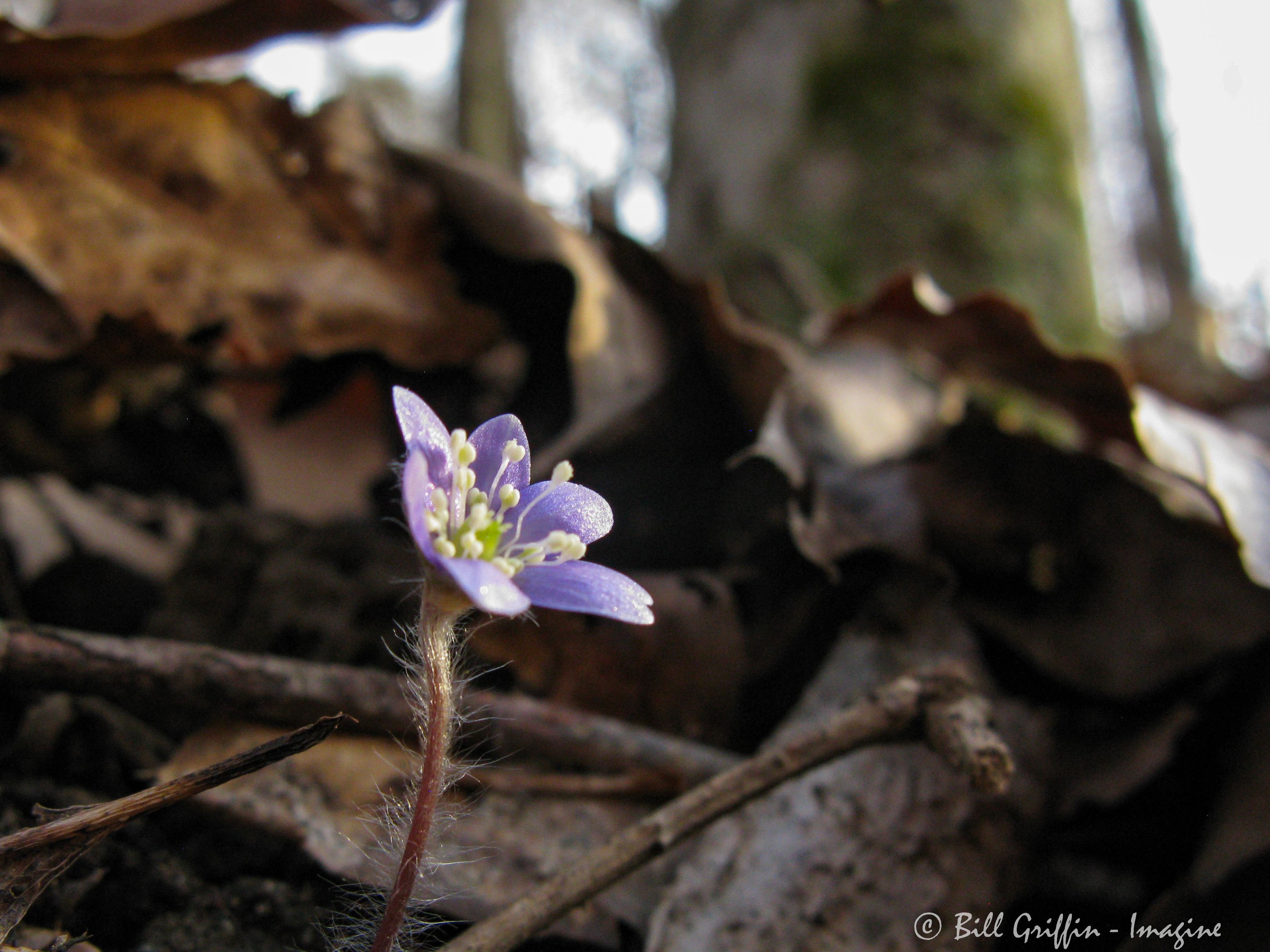
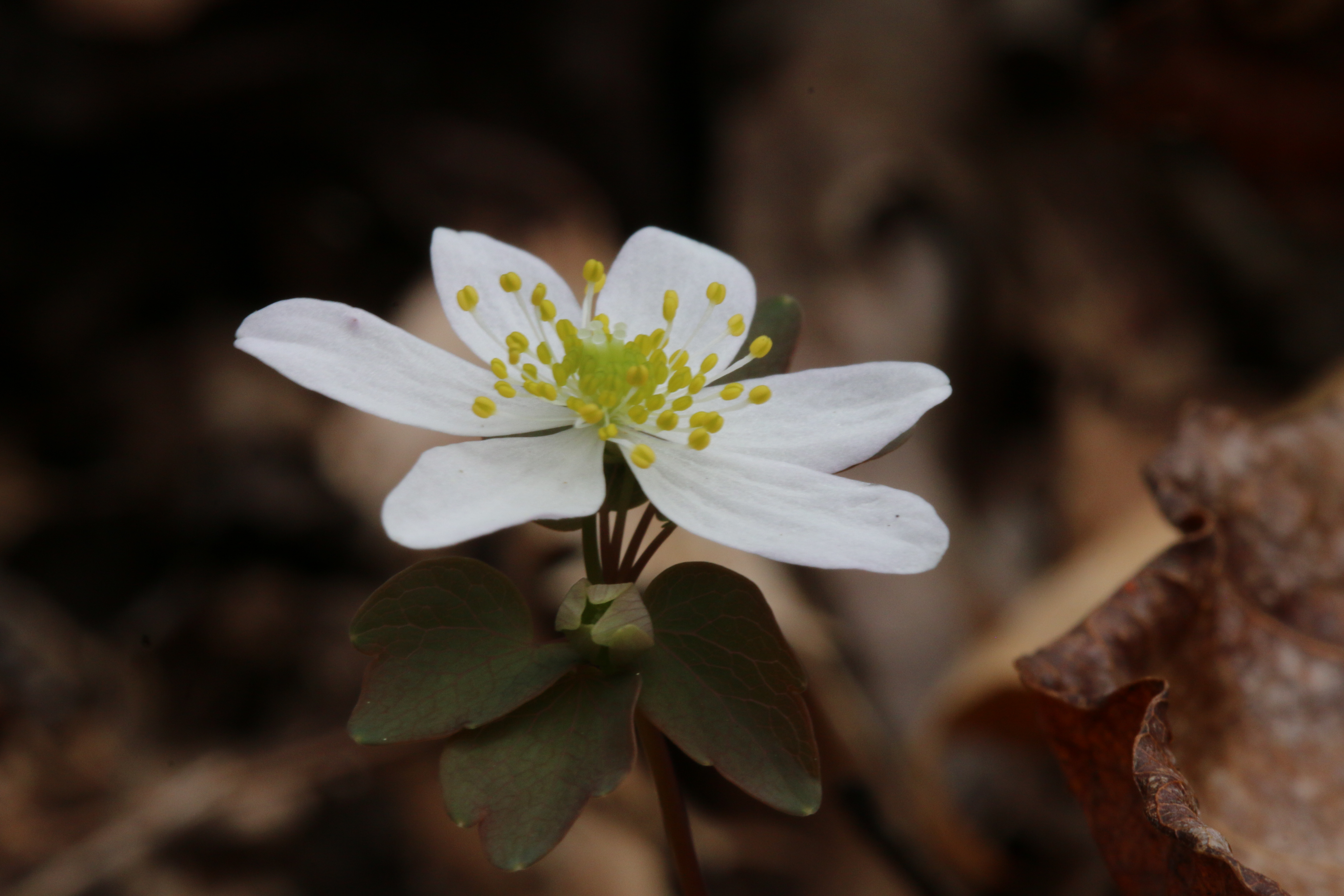
Cold March drizzle makes Hepatica nod and droop. Nevertheless, the twelve accompany me undaunted on a naturalist hike along Elkin Creek. What will we discover? Here are the last few Hepatica blossoms of the year; their sister plant opened her first bloom along this trail on February 7, five weeks earlier. Now a single flower on each silky hairy scape looks down at its feet, the winter-pocked liverleaves also fading ahead of summer’s foliage. It’s cold this morning and the vernal equinox is still three days off.

But cheek by jowl with old Hepatica are fresh patches of its second cousin, Rue Anemone. No drooping at all! Both from the same family (Buttercup, Ranunculaceae), the two flowers share many features and from a distance look similar – our crew’s task is to learn to tell them apart. Both are easily overlooked, pale blooms only a cm. or so in diameter, with 6-10 petals and a jostle of stamens crowding multiple pistils clumped in the center. Even color is not a reliable clue: the pale Hepatica in this neutral soil is only one shade of lavender removed from Anemone’s white. Rue Anemone’s smooth slender flower stem is one giveaway, and then of course the leaves, Anemone’s fine clusters like little paws climbing toward the bloom, contrasted with Hepatica’s broad, basal, waxy lobes, each like a liver. What some might casually mistake for a clump of sameness, in haste undifferentiated, what we ourselves might at first glance have misidentified have now become familiar, individual: each uniquely itself.

❦ ❦ ❦

A Sabbath of Complete Rest

I’ve been thinking what that might mean, so I listen
to the wind in the fir trees outside our red house –
how the trees stand almost like horses asleep on their feet,

how their roots touch crevices in soil, how at night
their branches, blacker than the sky, must not forget
yellow forsythias, summer, their own dark needles,

how they wait, how they’ve waited. This is no psalm
of light, Chloe, no song of white horses in the sun.
The root of the word Shalom means complete.

Richard Widerkehr
from At the Grace Café, Main Street Rag Publishing, Charlotte, NC, © 2021

❦ ❦ ❦

How does a poem draw you in? How does it invite you to live in the world it creates? Place must be one way. Just a few pages into At the Grace Café, I realize I’m damp and about to shiver in the Pacific Northwest. Not that it’s raining absolutely all the time – the great dark firs lifting their heavy sleeves also propel me into the landscape. A trail through clouds and mist leads me. A swirling lake shore is mysterious and at once consoling.

Personality is another thread that weaves through these poems and entangles me: the writer’s sister, her mental illness an elusive and threatening animal that speaks wild into every situation; his mother, reminding us that each of us must live a portion of our lives in denial; and the personality of the writer himself, illuminated by recurring heartbreak in his work as counselor and by longing for stability and resolution. Personalities approach and retreat, promise to reveal just as they again withhold – all I can do is hold on and join the dance.

Finally there is joy. Not waiting beyond all conflict or at the conclusion of all sorrows, rather joy that emerges from and lives within these troubles that we all, confess it, share. A fleeting moment with one’s beloved, a brief lifting of fog, moon on snow – a simple singular presence can form us into fellow sojourners. The poem can make us family. The poem may grant us grace.

❦ ❦ ❦

Pay Attention, You Say

No, I haven’t read updates about the orca
+++ nursing her dead calf. I try not to get
upset about too many things. Lately,

I write these poems for my sister –
+++ I can’t spare the least insect or angel,
she says. Yes, plankton lined with oil

covers some sea beds. I’ve seen orcas
+++ breach the surface, black and white,
their bodies like mountain sides

sliding under. When we were kids,
+++ my sister and I caught a tiny fish –
she cried, and our mother threw it back.

Yes, there’s the sadness of plankton,
+++ the orcas, snow fields at night.
Last evening on this mental health unit

where I work, a patient I’ll call Carla –
+++ she’d cut her left wrist – she said,
Some scars are mercy and justice.

I let out my breath. At least my sister
+++ no longer sleeps with the moon
in her cardboard box. Now

you point out two otters on the bank
+++ of No Name Slough, how they
their small black eyes on us.

Richard Widerkehr
from At the Grace Café, Main Street Rag Publishing, Charlotte, NC, © 2021

❦ ❦ ❦

Crane Flies
O for a Life of Sensations rather than of Thoughts! – John Keats

In late August, the crane flies
come back, nervously feeling their way
up windows, trying to get out. They flutter
like huge, scatter-brained mosquitoes,
scraping this way and that, sometimes just
hanging as they flex their long
front legs like feelers, emitting
a dull, frustrated buzz.
++++++++++++++++++ Is it light
they want, the world outside?
They can’t get used to glass, its cool
way of whispering about the uselessness
of struggle, also its dry comments
on their death flights.

Each time I sweep these nutty insects
out the window, more fly in, as if
I were the absence they brush against,
their life of sensations
come to an end.

Richard Widerkehr
from Disappearances, The Wind Room Series #4, Radiolarian Press, © 1996, 2003

rue anemone

❦ ❦ ❦

Richard Widerkehr has a new book from Shanti Arts Press, Night Journey. Richard has taught writing in the Upward Bound Program at Western Washington University and has worked as a case manager for the mentally ill.

❦ ❦ ❦

IMG_0880, tree

Read Full Post »

« Newer Posts - Older Posts »