Feeds:
Posts
Comments

Posts Tagged ‘Main Street Rag Publishing’

[with 3 poems by Richard Widerkehr]

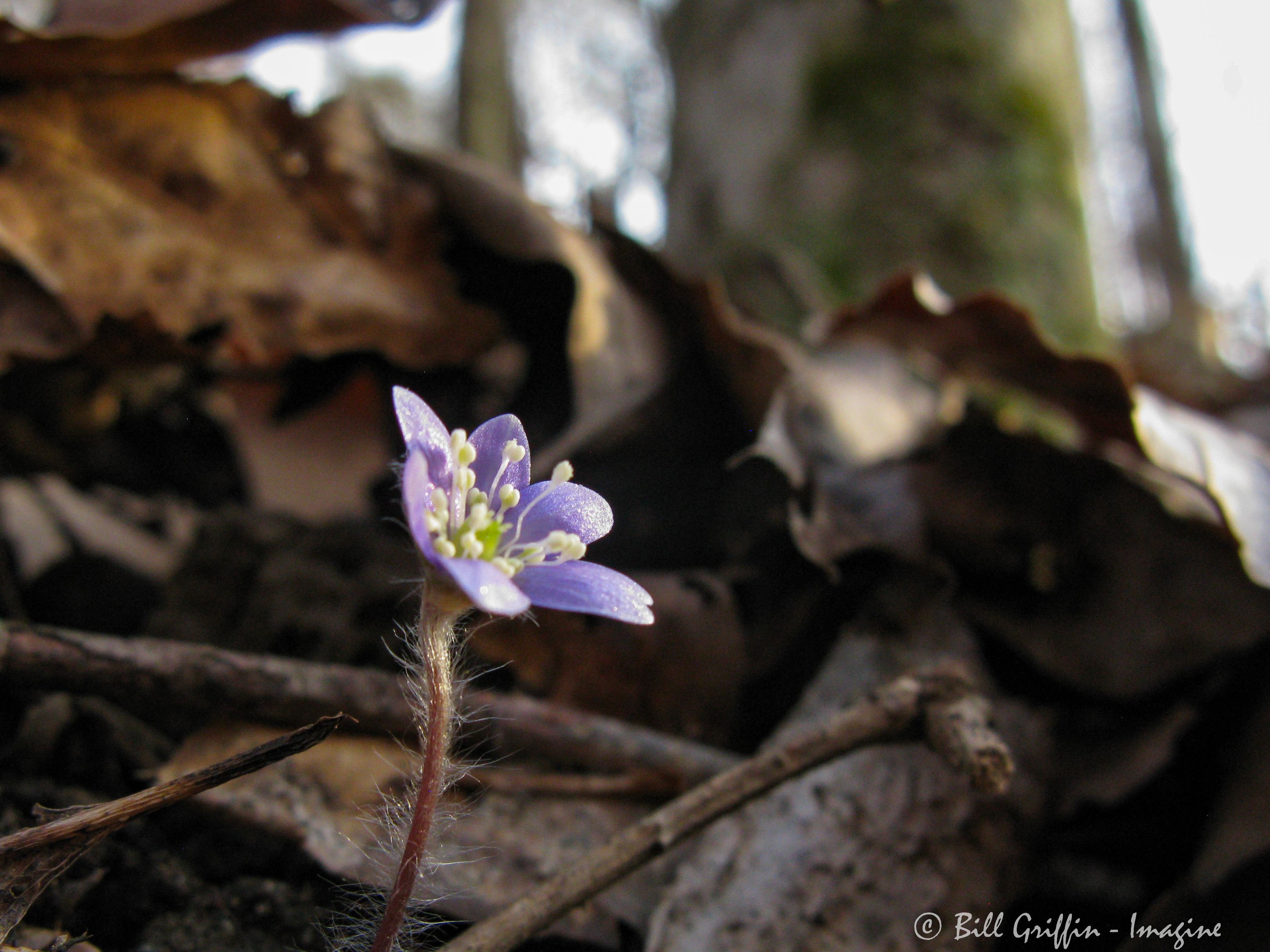
Cold March drizzle makes Hepatica nod and droop. Nevertheless, the twelve accompany me undaunted on a naturalist hike along Elkin Creek. What will we discover? Here are the last few Hepatica blossoms of the year; their sister plant opened her first bloom along this trail on February 7, five weeks earlier. Now a single flower on each silky hairy scape looks down at its feet, the winter-pocked liverleaves also fading ahead of summer’s foliage. It’s cold this morning and the vernal equinox is still three days off.

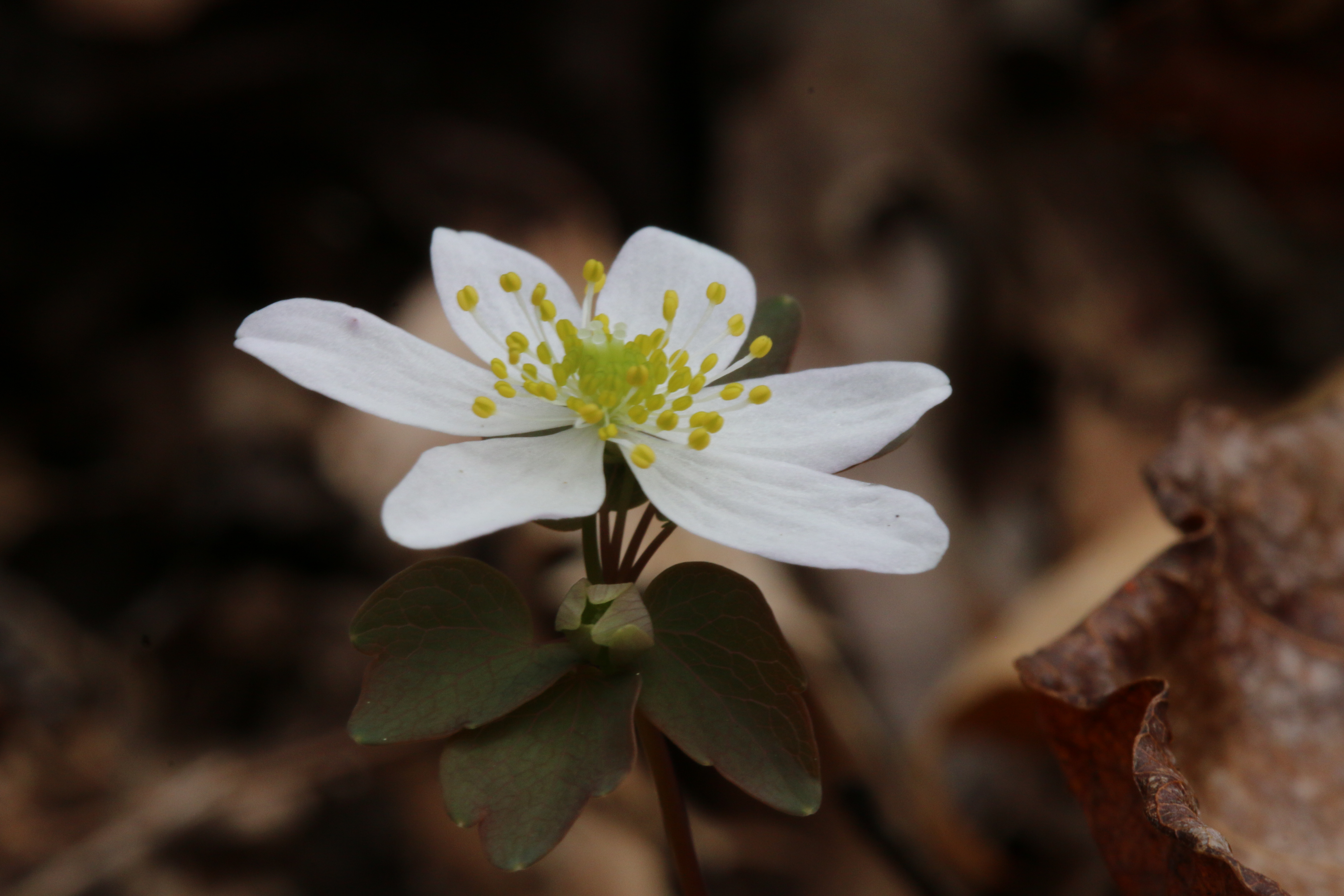
But cheek by jowl with old Hepatica are fresh patches of its second cousin, Rue Anemone. No drooping at all! Both from the same family (Buttercup, Ranunculaceae), the two flowers share many features and from a distance look similar – our crew’s task is to learn to tell them apart. Both are easily overlooked, pale blooms only a cm. or so in diameter, with 6-10 petals and a jostle of stamens crowding multiple pistils clumped in the center. Even color is not a reliable clue: the pale Hepatica in this neutral soil is only one shade of lavender removed from Anemone’s white. Rue Anemone’s smooth slender flower stem is one giveaway, and then of course the leaves, Anemone’s fine clusters like little paws climbing toward the bloom, contrasted with Hepatica’s broad, basal, waxy lobes, each like a liver. What some might casually mistake for a clump of sameness, in haste undifferentiated, what we ourselves might at first glance have misidentified have now become familiar, individual: each uniquely itself.

❦ ❦ ❦

A Sabbath of Complete Rest

I’ve been thinking what that might mean, so I listen
to the wind in the fir trees outside our red house –
how the trees stand almost like horses asleep on their feet,

how their roots touch crevices in soil, how at night
their branches, blacker than the sky, must not forget
yellow forsythias, summer, their own dark needles,

how they wait, how they’ve waited. This is no psalm
of light, Chloe, no song of white horses in the sun.
The root of the word Shalom means complete.

Richard Widerkehr
from At the Grace Café, Main Street Rag Publishing, Charlotte, NC, © 2021

❦ ❦ ❦

How does a poem draw you in? How does it invite you to live in the world it creates? Place must be one way. Just a few pages into At the Grace Café, I realize I’m damp and about to shiver in the Pacific Northwest. Not that it’s raining absolutely all the time – the great dark firs lifting their heavy sleeves also propel me into the landscape. A trail through clouds and mist leads me. A swirling lake shore is mysterious and at once consoling.

Personality is another thread that weaves through these poems and entangles me: the writer’s sister, her mental illness an elusive and threatening animal that speaks wild into every situation; his mother, reminding us that each of us must live a portion of our lives in denial; and the personality of the writer himself, illuminated by recurring heartbreak in his work as counselor and by longing for stability and resolution. Personalities approach and retreat, promise to reveal just as they again withhold – all I can do is hold on and join the dance.

Finally there is joy. Not waiting beyond all conflict or at the conclusion of all sorrows, rather joy that emerges from and lives within these troubles that we all, confess it, share. A fleeting moment with one’s beloved, a brief lifting of fog, moon on snow – a simple singular presence can form us into fellow sojourners. The poem can make us family. The poem may grant us grace.

❦ ❦ ❦

Pay Attention, You Say

No, I haven’t read updates about the orca
+++ nursing her dead calf. I try not to get
upset about too many things. Lately,

I write these poems for my sister –
+++ I can’t spare the least insect or angel,
she says. Yes, plankton lined with oil

covers some sea beds. I’ve seen orcas
+++ breach the surface, black and white,
their bodies like mountain sides

sliding under. When we were kids,
+++ my sister and I caught a tiny fish –
she cried, and our mother threw it back.

Yes, there’s the sadness of plankton,
+++ the orcas, snow fields at night.
Last evening on this mental health unit

where I work, a patient I’ll call Carla –
+++ she’d cut her left wrist – she said,
Some scars are mercy and justice.

I let out my breath. At least my sister
+++ no longer sleeps with the moon
in her cardboard box. Now

you point out two otters on the bank
+++ of No Name Slough, how they
their small black eyes on us.

Richard Widerkehr
from At the Grace Café, Main Street Rag Publishing, Charlotte, NC, © 2021

❦ ❦ ❦

Crane Flies
O for a Life of Sensations rather than of Thoughts! – John Keats

In late August, the crane flies
come back, nervously feeling their way
up windows, trying to get out. They flutter
like huge, scatter-brained mosquitoes,
scraping this way and that, sometimes just
hanging as they flex their long
front legs like feelers, emitting
a dull, frustrated buzz.
++++++++++++++++++ Is it light
they want, the world outside?
They can’t get used to glass, its cool
way of whispering about the uselessness
of struggle, also its dry comments
on their death flights.

Each time I sweep these nutty insects
out the window, more fly in, as if
I were the absence they brush against,
their life of sensations
come to an end.

Richard Widerkehr
from Disappearances, The Wind Room Series #4, Radiolarian Press, © 1996, 2003
rue anemone

❦ ❦ ❦

Richard Widerkehr has a new book from Shanti Arts Press, Night Journey. Richard has taught writing in the Upward Bound Program at Western Washington University and has worked as a case manager for the mentally ill.

❦ ❦ ❦

IMG_0880, tree

Read Full Post »

[with 3 poems by Diana Pinkney]

Oh, I couldn’t possibly eat all that. Thank Heavens I haven’t heard Mom utter those words for quite a while now. For the fifty years prior I believe we heard that phrase with each plate set before her. Some impulse ingrained in the 30’s in the genteel South? A mantra for all the new college girls in the 40’s? How, we would ask ourselves behind her back, could someone forever twig slender so fear gaining a pound?

This week at the doctor’s office I watch the nurse enter Mom’s vitals in the computer to make sure she hasn’t lost a pound. Dad admits he hates to nag her to eat her breakfast – too engaged with the paper or too forgetful to take a bite? Yesterday I cooked them both lunch – calm down, it was just 10 minutes in the skillet from Trader Joe’s – and served the plates. It’s no trick, really, just sit across the table from Mom for long enough and she will finally finish what you’ve given her. Don’t forget the milk! The doctor says you need more fluids.

Grandmother, Dad’s Mom, had her own mantra for us grandkids in the 50’s and 60’s: Children are starving in Europe. Yes, swear to God, she actually said that more than once. Chubby me was more than happy to clean his plate, but one breakfast I recall her disapproval. I had scooped up the last Cheerio but there was still milk in the bowl overlying its substratum of teaspoons of sugar. That evening I washed down my cornbread with a big gulp of sudden sickening sweetness Grandmother had rescued from that bowl.

Now I’m clearing the table while Mom stares at the last of her milk, a layer of ice melt above the 2%. In a few minutes, though, as I stand at the sink rinsing, she walks in carrying the empty. I have to say it. Good job, Mom!

❦ ❦ ❦

Super Cuts, Six Months after My Daughter’s Death

The stylist snips, snips my hair, shorter
and shorter. As she works, we talk.

You have children, she asks. Yes,
I answer. Do you? Oh, I have two girls.

How about you? Three, I say, my voice
tight, clipped as the gray strands covering

the floor. My daughter’s hair was long
and red, until it was blonde. She loved

the sun. A little less on the sides, please.
Why didn’t I say I have two children, sons,

and that would have been that. Except that
will never be that. I will always have three

children. Do they live here, she asks?
The sons do. My daughter lives nowhere

and everywhere. It’s good, she says, you
have a girl, too. Yes, I answer, it is good.

Diana Pinckney
from Hummingbirds & Wine, Main Street Rag Publishing, Charlotte, NC, © 2022

❦ ❦ ❦

How impossible to bear, losing a child to death. How much more impossible to write about it. Diana Pinckney in Hummingbirds and Wine overcomes the paralysis of grief, but not as chronicle or biography or personal therapy. Although she confesses I live / behind a veil, these poems are the bridge that leads her and us beyond the Valei of Teeris. These lines are twisting tracks that connect past and present, parent and child, and that connect poet and reader.

On the tree of suffering there is a twig of joy that grows up from dark earth. The root of happiness is the same / as perhaps, both descendants / / of hap – hazard or chance. Diana’s poetry is not rationalization, not sentimentality, not desperate. These are poems that share one moment, then another and another, along the path she has had to walk and which we can now walk together.

❦ ❦ ❦

Sea Turtles

Loggerhead, Leatherback, Ridley or Green, they all drag
themselves onto a beach. Alone under the same moon
on different shores, in their struggle to lay eggs.
Volunteers like Elizabeth spent hours at dawn

searching for the side, clawed tracks, uncovering
and moving the eggs to sand dunes, staking orange
mesh over the nest. Protection, maybe, she said,
from dogs, crabs, lots of things. Oh, my girl, I couldn’t

protect you, holed up in your house in the company
of bottles. Still, in your best years, you waited weeks
for dozens of thin-shelled eggs to split as the tiny feet
tore an opening, and under nodding sea oats, started

their spill up and out. Each one, no bigger than a silver dollar,
struggling to climb into moonlight, and down to the sea’s white foam.

Diana Pinckney
from Hummingbirds & Wine, Main Street Rag Publishing, Charlotte, NC, © 2022

❦ ❦ ❦

Beach Walker

I can still see her stretching in the hazy sun
each morning, strolling the surf, breathing salt

and the musky scent of creatures curled inside
shells – whelks, clams, conchs – once alive.

She so many miles from y city home.
So many Hey Mom’s when I’d lift the phone.

How is it that a heart so loved could weaken
through the days and weeks, and I never knew.

A heart that beat with the rhythm of the sea
and one bright morning would fail her and me.

Diana Pinckney
from Hummingbirds & Wine, Main Street Rag Publishing, Charlotte, NC, © 2022

❦ ❦ ❦


❦ ❦ ❦


Read Full Post »

[with poems by Helen Losse]

Until we find the communal meaning and significance of the suffering of all life, we will continue to retreat into our individual, small worlds in our misguided quest for personal safety and sanity. – fr. Richard Rohr, Center for Action and Contemplation

Follow a six-year old around the yard when flowers are blooming. Most enticing, of course, is the dandelion puffball. Got to pick that one! It takes several tries for her to blow those little dancing featherettes into the breeze – a few seedlets stick to her unicorn t-shirt, a few in her hair. Will they grow there?

Next comes anything purple or pink. She must add a few grape hyacinths on their too-short stems to the bouquet of daffodils we’re cutting for Grandmommy. And some pink azalea, cut that one, Pappy. Oh my, and look what has opened since the sun came out yesterday! She pulls a single bleeding heart and holds it in her palm. We’ll float it in a paper cup of water so she can take it to Mom this evening.

Finally return to the everywhere-flowers, yellow in everyone’s lawn. Walking around the block it’s Truth or Dare – will they paint your fingers if you pick them? Tooth of the Lion, look at the notched incisored leaves. She chooses the brightest flower. Nothing is a weed if someone loves it.

Which is the theme of Easter and of Helen Losse’s book, A Flower More Enduring: Love redeems. God is God of life.

Yellow Blossoms

populate the uncut yard.
Weeds with purple blooms

create asphalt cracks.
Hardy wildflower,

tall blades of Bermuda grass
widen others. I fall to my knees

on the lawn near a budding
thistle. Saints and angels

present but silent, I pray
for a dandelion heart.

Helen Losse

IMG_2931


.     .     .     .     .     .     .

The poems in Helen Losse’s A Flower More Enduring are intensely personal but enticingly universal. Her conversion to the Roman Catholic Church has brought her assurance but also challenge. She finds herself in the company of Mary and the Saints yet still she seeks and seeks . . . what? Perhaps to discover what she had never expected to find.

And Helen’s readers who come from different faith traditions, I being one, or from no tradition at all, may still discover with her an experience which we never expected: the universe reaching toward us in unconditional love. The outstretched hand of human commonality that might unite us in our suffering. The hand we ourselves lift to return that touch, the reaching which is called hope.

.     .     .     .     .     .     .

I cry out to God

on the night of the knife-wind.
Thoughts rise, incense
under waning moon blows with fog.
Phlox darkens the soggy prairie:
downy phlox, moss pink,
phlox the color of lavender.

O, how I cherish God’s creation:
flora, small rocks, tall hills, mountains,
feral beasts, domesticated pets,
each human soul, the Savior
on the Cross: Eucharistic Morsel:
Source of Grace I can’t store
in a lidded basket.

I am a rabbit returning
each night to a summer garden.
I must eat again & again.

Helen Losse
A Flower More Enduring, Main Street Rag Publishing, © 2021 Helen Losse

.     .     .     .     .     .     .


I stand in the shaded bathroom

with it high useless mirrors
into which I cannot see,
asking, “Are we rich?”

Daddy holds me on his knee
but would never tell me (or
any innocent child)

he doesn’t know how he’ll pat the thirty-seven fifty
house payment due on Friday.

Instead, he explains,
“We are rich in love.”

Helen Losse


.     .     .     .     .     .     .

In the Christian liturgical calendar today, 15 April 2022, is known as Good Friday, three days before Easter. On Sunday morning our little congregation will adorn a rough wooden cross with flowers – death conquered by life. Perhaps there’s a subconscious bit of pagan homage to the vernal equinox, but to my mind the message of new life is our foundation. Consider: no person and no thing exists outside the sphere of God’s universal love of life. In the cosmological sense there is no outside; in the spiritual sense no outsider.

A Crucified God is the dramatic symbol of the one suffering that God fully enters into with us — not just for us, as we were mostly taught to think, but in solidarity with us. The Good News is we do not have to hold that suffering alone. In fact, we cannot hold it alone. As we approach Easter, let us remember that we too can follow this path, actively joining God’s loving solidarity with all. What starts in God ends in God. All of reality is moving toward resurrection.

fr. Richard Rohr, Center for Action and Contemplation: Transformed people working together for a more just and connected world.

.     .     .     .     .     .     .

Dandelion on green lawn

A girl bends low, picks a flower
to give to her mother.

The child loves the flower,
a weed adults tend to favor less.

The child blows seeds from the puffball,
whit feathery globe of potential.

The seed is the heart of the flower:
tiny perhaps but profoundly fecund.

Each seed floats with the wind, grows
where it lands, blossoms in sunshine and rain.

Helen Losse

.     .     .     .     .     .     .

.     .     .     .     .     .     .


2020-03-07 Doughton Park Tree

Read Full Post »

« Newer Posts - Older Posts »