Feeds:
Posts
Comments

Posts Tagged ‘ecology’

[with poems by Ursula K. LeGuin, Sandra Dreis,
Jenny Bates, Galway Kinnell]

After a recent post which featured poems from the journal ecotone, Bradley Strahan commented, “Thanks. We need constantly to be reminded of how much we are dependent and damaging.” It made me think: it must be no coincidence that Poetry Month and Earth Day are both in April. This is the month of convergences, when we are truly grateful that the last frost is past and beastly summer has not yet smothered us. We watch new shoots erupt and bloom, but we worry that some will arrive too early and get nipped, and that blossoms and pollinators may emerge out of sync. We’re grateful for the songs of neotropical migrants, but we notice their diminished numbers and worry about desecrated wintering grounds and fragmented breeding grounds. We head out for a hike or a bird count and find the woodlots leveled, the streams silted up, and new homes and trailers in every cornfield.

We are surrounded by the reality of relentless human impact on the planet. We are living smack dab in the middle of the Anthropocene epoch.

It is difficult
to get the news from poems
yet men die miserably every day
for lack
of what is found there.
+++++++ William Carlos Williams, from Asphodel, That Greeny Flower

Poetry is able to speak the news we need to hear for Earth Day. Poetry may crystallize a truth we can grab and hold on to when bad news threatens to overwhelm us. Poetry may grab us by the lapels and jerk us to our feet when our motivation has drained away. Poetry may shed light on despair and offer some path into hope.

Thank you to the readers of these pages
who have responded to my call for poems this Earth Day.
Watch for new posts on April 21, April 22, and April 23.

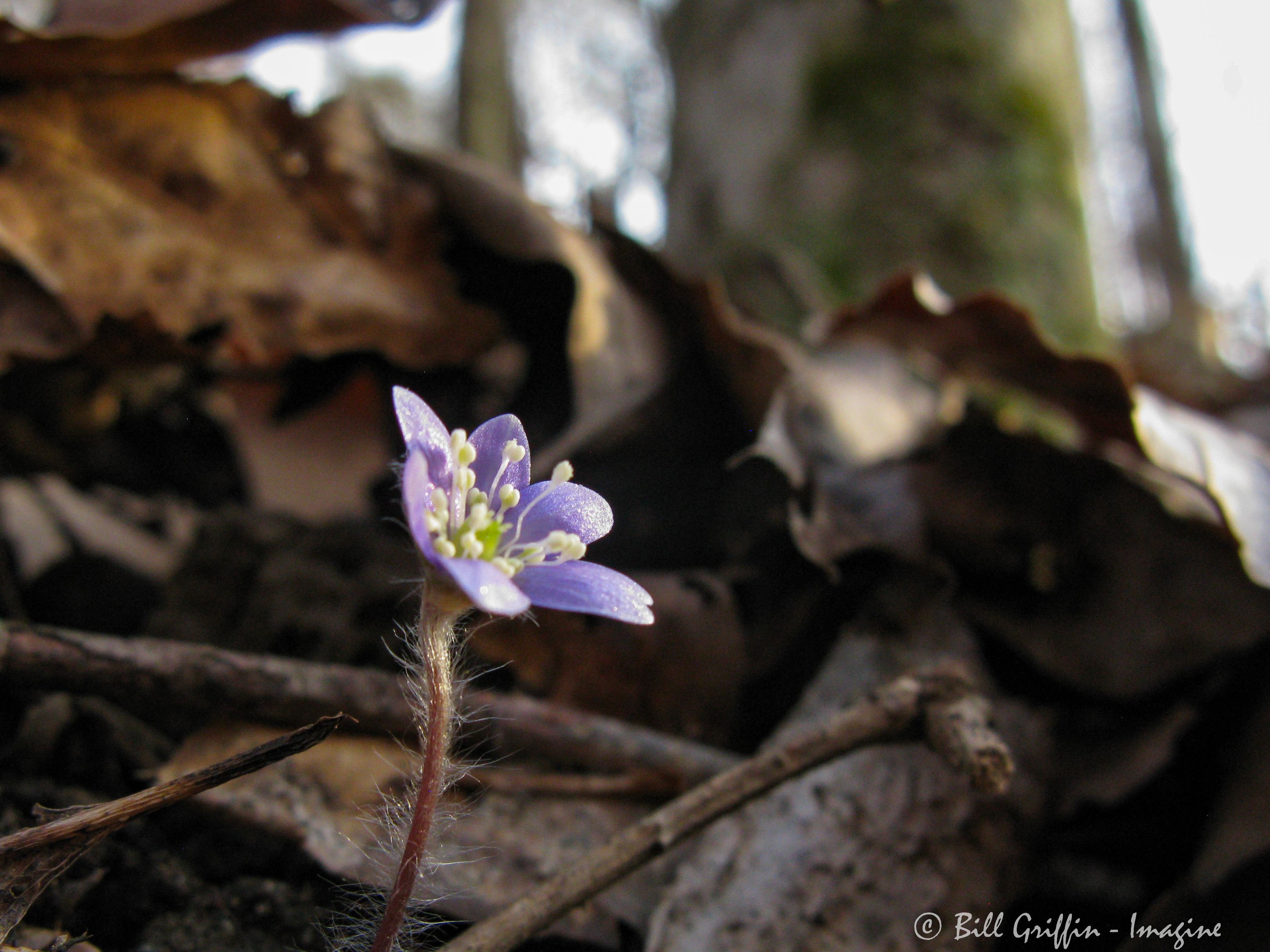
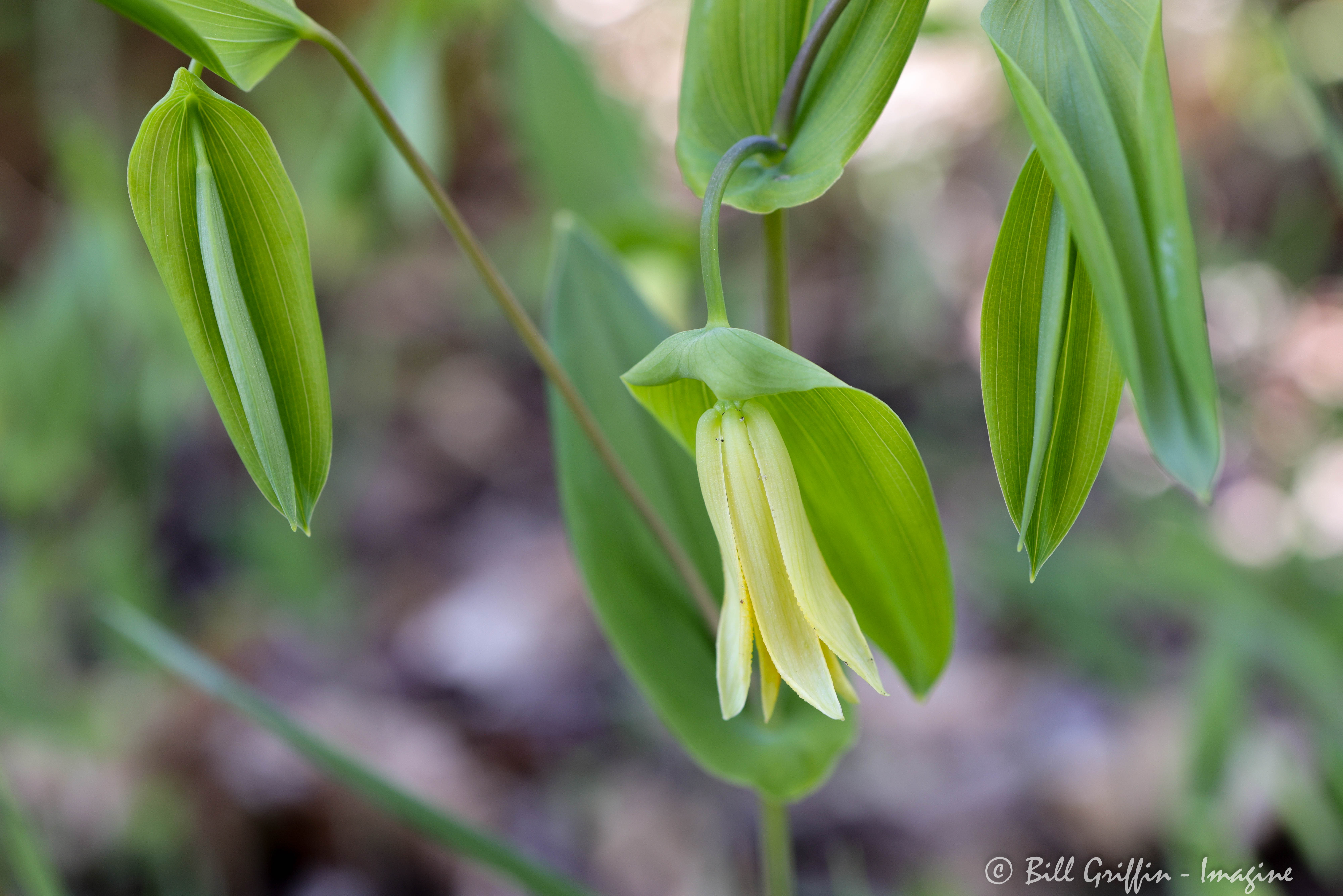
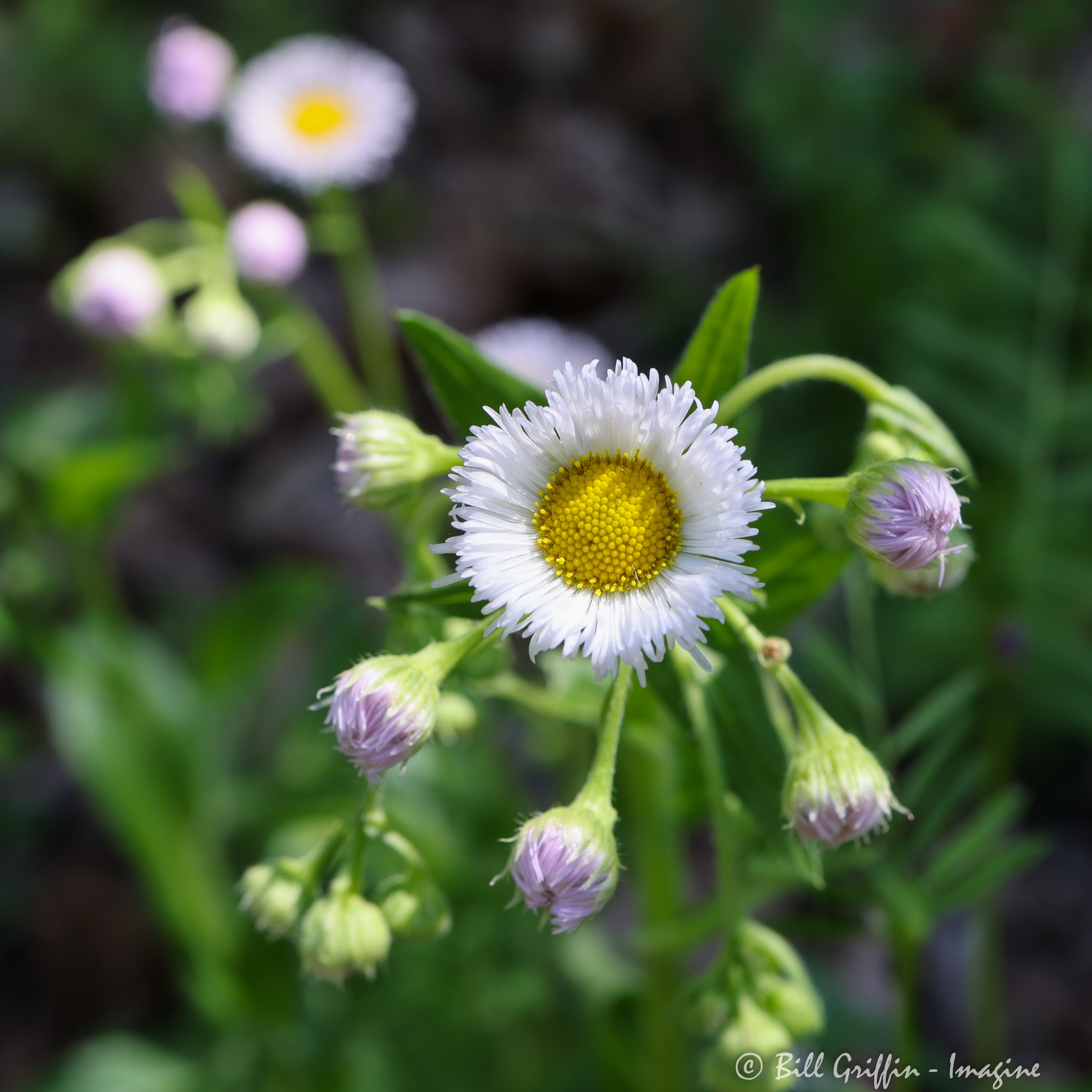
All photographs were taken April 11-17, 2023,
along the Elkin & Allegheny Nature Trail,
part of the Mountains-to-Sea Trail in North Carolina, USA.

Earth Day 2023 art by Linda French Griffin.

❦ ❦ ❦

Kinship

Rootless and restless and
warmblooded, we
blaze in the flare that
blinds us to that slow,
tall, fraternal fire of life
as strong
now as in the seedling
two centuries ago.

Ursula K LeGuin
Selected by Bill Griffin; appeared online in The Dewdrop, March 26, 2022

What truth is more profound, more amazing, more assuring, more urgent than our kinship? That Ur-puddle’s restless swirl of nucleotides and amino acids, way back in time before there was ever a cell, is still reflected in the minutest truth of our bodies, every glint and dark crevice of them. All of us are neighbors.

– Bill Griffin / Elkin, North Carolina

❦ ❦ ❦

Raven’s Beak

But you’d have to understand
Raven’s beak,
drive that comes before
all else,
plunges for praying mantis,
plucks, disbands dirt,
stabs a wrangled tuft of weed.

And you’d have to
be
the bird, inhabit
black eyes that beam location,
yes, stealing sweetness
even
from the cocky cat,

feasting on envy.
This hunger lives beyond prey
I tell you, a wild want
not to be tamed
by blood, sinew or travail.
In dreams I gather others.
I grow feathers and wait.

Sandra Dreis
originally published in CREOSOTE, Spring 2021. (East Arizona)

This, my first published poem, was inspired by a walk with my two small dogs, stopping by a grassy ultra-green, pampered lawn. There, under a pin oak, was a sizable raven, beak inserted into the earth. In that moment, while I held my leashed dogs, a cat on a nearby stoop kept the raven in her sights. My dogs begged after the cat. I felt the perfect continuum. The balance. The tame. The wild.

– Sandra Dreis / Winston-Salem, North Carolina

❦ ❦ ❦

Otherworldly

Odd trick of the wind in leaves,
water flowing over stones.

You don’t have a mouth, said Fox.

Moth never blinked, rippling its crescent
tail wings.

You only live for a week, said Fox.

Moth lifted its wings, flew the moon up
to meet the night.

You and I are daydreams, soughed Fawn.

It’s been a long time. Think back and listen.
Voices in the woods. Angelic, untarnished.

Articulate, I can hear words rising

then falling,

a benediction.

Jenny Bates
originally published in Dark Forest, Planisphere Q, 2021

I want to bring the kindness and wonder I have found in wild creatures as well as their courage and pragmatic truth. I want my voice to be their voice as I believe they will teach us appropriate ways to heal the wild land. The wild is mysterious but also thrilling, nostalgic, liquid, musical when we listen.

– Jenny Bates / Germanton, North Carolina
❦ ❦ ❦

The Bear

+++++ 1
In late winter
I sometimes glimpse bits of steam
coming up from
some fault in the old snow
and bend close and see it is lung-colored
and put down my nose
and know
the chilly, enduring odor of bear.

+++++ 2
I take a wolf’s rib and whittle
it sharp at both ends
and coil it up
and freeze it in blubber and place it out
on the fairway of the bears.

And when it has vanished
I move out on the bear tracks,
roaming in circles
until I come to the first, tentative, dark
splash on the earth.

And I set out
running, following the splashes
of blood wandering over the world.
At the cut, gashed resting places
I stop and rest,
at the crawl-marks
where he lay out on his belly
to overpass some stretch of bauchy ice
I lie out
dragging myself forward with bear-knives in my fists.

+++++ 3
On the third day I begin to starve,
at nightfall I bend down as I knew I would
at a turd sopped in blood,
and hesitate, and pick it up,
and thrust it in my mouth, and gnash it down,
and rise
and go on running.

+++++ 4
On the seventh day,
living by now on bear blood alone,
I can see his upturned carcass far out ahead, a scraggled,
steamy hulk,
the heavy fur riffling in the wind.

I come up to him
and stare at the narrow-spaced, petty eyes,
the dismayed
face laid back on the shoulder, the nostrils
flared, catching
perhaps the first taint of me as he
died.

I hack
a ravine in his thigh, and eat and drink,
and tear him down his whole length
and open him and climb in
and close him up after me, against the wind,
and sleep.

+++++ 5
And dream
of lumbering flatfooted
over the tundra,
stabbed twice from within,
splattering a trail behind me,
splattering it out no matter which way I lurch,
no matter which parabola of bear-transcendence,
which dance of solitude I attempt,
which gravity-clutched leap,
which trudge, which groan.

+++++ 6
Until one day I totter and fall-
fall on this
stomach that has tried so hard to keep up,
to digest the blood as it leaked in,
to break up
and digest the bone itself: and now the breeze
blows over me, blows off
the hideous belches of ill-digested bear blood
and rotted stomach
and the ordinary, wretched odor of bear,

blows across
my sore, lolled tongue a song
or screech, until I think I must rise up
and dance. And I lie still.

+++++ 7
I awaken I think. Marshlights
reappear, geese
come trailing again up the flyway.
In her ravine under old snow the dam-bear
lies, licking
lumps of smeared fur
and drizzly eyes into shapes
with her tongue. And one
hairy-soled trudge stuck out before me,
the next groaned out,
the next,
the next,
the rest of my days I spend
wandering: wondering
what, anyway,
was that sticky infusion, that rank flavor of blood, that poetry, by which I lived?

Galway Kinnell
Selected by Paul Jones; appears in Three Books (Houghton-Mifflin, 2002)

Galway Kinnell speaking for himself about himself: “I don’t recognize the distinction between nature poetry and, what would be the other thing? Human civilization poetry? We are creatures of the earth who build our elaborate cities and beavers are creatures of the earth who build their elaborate lodges and canal operations and dams, just as we do … Poems about other creatures may have political and social implications for us.”

I first heard Kinnell read this poem in maybe 1977 at the UNC English Department. I was thinking of taking a job at UNC. I did and The Bear has been with me ever since.

– Paul Jones / Chapel Hill, NC
 

❦ ❦ ❦


Read Full Post »

[with 3 poems by Richard Widerkehr]

Cold March drizzle makes Hepatica nod and droop. Nevertheless, the twelve accompany me undaunted on a naturalist hike along Elkin Creek. What will we discover? Here are the last few Hepatica blossoms of the year; their sister plant opened her first bloom along this trail on February 7, five weeks earlier. Now a single flower on each silky hairy scape looks down at its feet, the winter-pocked liverleaves also fading ahead of summer’s foliage. It’s cold this morning and the vernal equinox is still three days off.

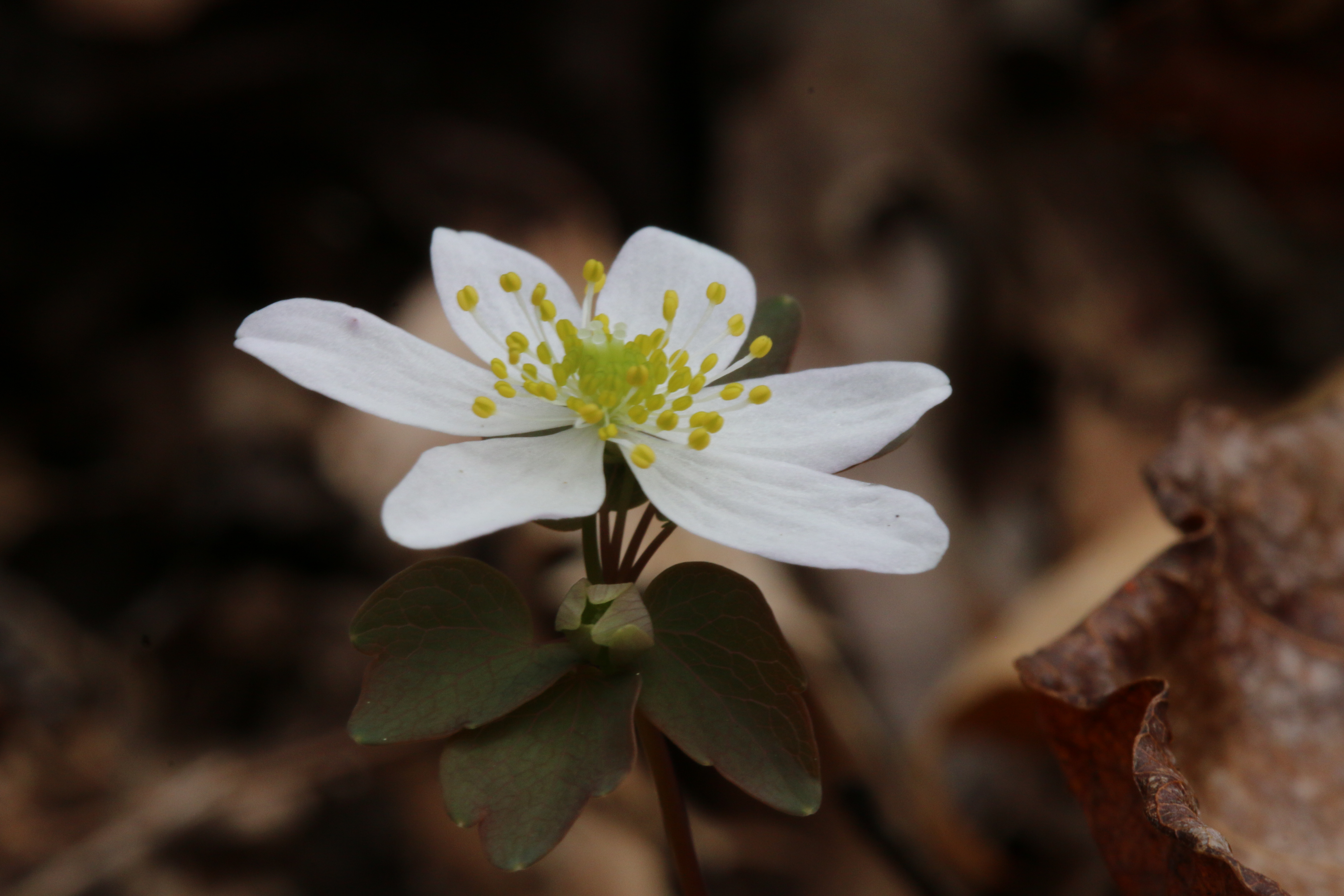
But cheek by jowl with old Hepatica are fresh patches of its second cousin, Rue Anemone. No drooping at all! Both from the same family (Buttercup, Ranunculaceae), the two flowers share many features and from a distance look similar – our crew’s task is to learn to tell them apart. Both are easily overlooked, pale blooms only a cm. or so in diameter, with 6-10 petals and a jostle of stamens crowding multiple pistils clumped in the center. Even color is not a reliable clue: the pale Hepatica in this neutral soil is only one shade of lavender removed from Anemone’s white. Rue Anemone’s smooth slender flower stem is one giveaway, and then of course the leaves, Anemone’s fine clusters like little paws climbing toward the bloom, contrasted with Hepatica’s broad, basal, waxy lobes, each like a liver. What some might casually mistake for a clump of sameness, in haste undifferentiated, what we ourselves might at first glance have misidentified have now become familiar, individual: each uniquely itself.

❦ ❦ ❦

A Sabbath of Complete Rest

I’ve been thinking what that might mean, so I listen
to the wind in the fir trees outside our red house –
how the trees stand almost like horses asleep on their feet,

how their roots touch crevices in soil, how at night
their branches, blacker than the sky, must not forget
yellow forsythias, summer, their own dark needles,

how they wait, how they’ve waited. This is no psalm
of light, Chloe, no song of white horses in the sun.
The root of the word Shalom means complete.

Richard Widerkehr
from At the Grace Café, Main Street Rag Publishing, Charlotte, NC, © 2021

❦ ❦ ❦

How does a poem draw you in? How does it invite you to live in the world it creates? Place must be one way. Just a few pages into At the Grace Café, I realize I’m damp and about to shiver in the Pacific Northwest. Not that it’s raining absolutely all the time – the great dark firs lifting their heavy sleeves also propel me into the landscape. A trail through clouds and mist leads me. A swirling lake shore is mysterious and at once consoling.

Personality is another thread that weaves through these poems and entangles me: the writer’s sister, her mental illness an elusive and threatening animal that speaks wild into every situation; his mother, reminding us that each of us must live a portion of our lives in denial; and the personality of the writer himself, illuminated by recurring heartbreak in his work as counselor and by longing for stability and resolution. Personalities approach and retreat, promise to reveal just as they again withhold – all I can do is hold on and join the dance.

Finally there is joy. Not waiting beyond all conflict or at the conclusion of all sorrows, rather joy that emerges from and lives within these troubles that we all, confess it, share. A fleeting moment with one’s beloved, a brief lifting of fog, moon on snow – a simple singular presence can form us into fellow sojourners. The poem can make us family. The poem may grant us grace.

❦ ❦ ❦

Pay Attention, You Say

No, I haven’t read updates about the orca
+++ nursing her dead calf. I try not to get
upset about too many things. Lately,

I write these poems for my sister –
+++ I can’t spare the least insect or angel,
she says. Yes, plankton lined with oil

covers some sea beds. I’ve seen orcas
+++ breach the surface, black and white,
their bodies like mountain sides

sliding under. When we were kids,
+++ my sister and I caught a tiny fish –
she cried, and our mother threw it back.

Yes, there’s the sadness of plankton,
+++ the orcas, snow fields at night.
Last evening on this mental health unit

where I work, a patient I’ll call Carla –
+++ she’d cut her left wrist – she said,
Some scars are mercy and justice.

I let out my breath. At least my sister
+++ no longer sleeps with the moon
in her cardboard box. Now

you point out two otters on the bank
+++ of No Name Slough, how they
their small black eyes on us.

Richard Widerkehr
from At the Grace Café, Main Street Rag Publishing, Charlotte, NC, © 2021

❦ ❦ ❦

Crane Flies
O for a Life of Sensations rather than of Thoughts! – John Keats

In late August, the crane flies
come back, nervously feeling their way
up windows, trying to get out. They flutter
like huge, scatter-brained mosquitoes,
scraping this way and that, sometimes just
hanging as they flex their long
front legs like feelers, emitting
a dull, frustrated buzz.
++++++++++++++++++ Is it light
they want, the world outside?
They can’t get used to glass, its cool
way of whispering about the uselessness
of struggle, also its dry comments
on their death flights.

Each time I sweep these nutty insects
out the window, more fly in, as if
I were the absence they brush against,
their life of sensations
come to an end.

Richard Widerkehr
from Disappearances, The Wind Room Series #4, Radiolarian Press, © 1996, 2003

rue anemone

❦ ❦ ❦

Richard Widerkehr has a new book from Shanti Arts Press, Night Journey. Richard has taught writing in the Upward Bound Program at Western Washington University and has worked as a case manager for the mentally ill.

❦ ❦ ❦

IMG_0880, tree

Read Full Post »

[poems from Word and Witness: A. R. Ammons, Julie Suk, Peter Makuck]

Carnage ensues at the table while I make coffee. As all the other animals look on in abject silence, large plush Starfish (carnivore, you know) has captured Baby Chick and is eating him with authentic suck-the-juice-right-out-of-you sound effects.

I remark that I’m going to be sad to miss little yellow Chicky. My grandson looks up, all innocence, and simply reminds me, “That’s just the way the food chain works.”

So it must be. Nine years before the publication of Darwin’s The Origin of Species, Alfred Lord Tennyson had already warned us (“she” being Nature, “types” being species):

. . .
She cries, ‘A thousand types are gone:
I care for nothing, all shall go.

‘Thou makest thine appeal to me:
I bring to life, I bring to death:
The spirit does but mean the breath:
I know no more.’ And he, shall he,

Man, her last work, who seem’d so fair,
Such splendid purpose in his eyes,
Who roll’d the psalm to wintry skies,
Who built him fanes of fruitless prayer,

Who trusted God was love indeed
And love Creation’s final law–
Tho’ Nature, red in tooth and claw
With ravine, shriek’d against his creed –

Who loved, who suffer’d countless ills,
Who battled for the True, the Just,
Be blown about the desert dust,
Or seal’d within the iron hills?

+++++ from In Memoriam A. H. H. (1850)

Shall we weep for Baby Chick? For the extinctions accelerating around us? For ourselves, our loss? A few years back I was leading a group of Junior Highs on a nature walk when we spotted a marvelously large spider shuffling along the path ahead of us. When we reached it, though, we found it was not the legs of the spider that were walking but the legs of the pint-sized wasp that had stung and paralyzed it and now dragged it to a favorable spot for egg laying. In an instant the spider transformed from an object of fear and loathing to a spike of compassion in our hearts.

This week a very talkative red shouldered hawk is haunting the woods out back. No coincidence: that’s where the bird feeders hang. We hope he’s eyeing the squirrels – there are more than enough squirrels, eat all you want Sir Hawk. And the mice that come for the seeds dropped to the ground from the feeders, and then store them in our basement, yes, eat them, too. But please, not the cute chipmunk who hides in the ivy or the finches we love. Alas, I guess we don’t get to choose. That’s just how the food chain works.

But wait – do all our choices come to nothing? Our love, our suffering of countless ills, our battles for the True and Just – is the end of all these to be blown to desert dust? Can’t we choose to engage with embattled Nature? Can we reduce our relentless consumption of the planet, choose leaders of vision and intelligence, make peace with our brothers and sisters? How lengthy shall I extend this list? Shall we abandon hope and just accept our place in the food chain while the warming earth devours us?

If a spider can inspire a moment of compassion in a 13-year old, I will have to accede that there may yet be hope for our species.

❦ ❦ ❦

The Yucca Moth

++ The yucca clump
is blooming,
++ tall sturdy spears
spangling into bells of light,
++ green
in the white blooms
++ faint as a memory of mint.

I raid
++ a bloom,
spread the hung petals out,
++ and, surprised he is not
a bloom-part, find
++ a moth inside, the exact color,
the bloom his daylight port or cove:

though time comes
++ and goes and troubles
are unlessened,
++ the yucca is lifting temples
of bloom: from the night
++ of our dark flights, can
we go in to heal, live
++ out in white-green shade
the radiant, white, hanging day?

A. R. Ammons
collected in Word and Witness: 100 years of North Carolina Poetry, Carolina Academic Press, © 1999 North Carolina Poetry Society

❦ ❦ ❦

This week a friend asked me to send him the table of contents of Word and Witness for a project on biodiversity he’s considering The book was published by the North Carolina Poetry Society in 1999 and edited by Sally Buckner with an afterword by Fred Chappell, who was NC Poet Laureate at the time. It spans the full 20th Century of North Carolina poetry and poets, and as I was scanning the TOC to email my friend a PDF, I re-discovered the names of so many folks who have inspired and befriended me over the last two decades.

Poetry continues to thrive in “the writingest state.” Word and Witness is 261 pages; it would be a real challenge to prepare Volume II for just the first quarter of the 21st Century and limit it to that length. I believe it is still possible to purchase a copy from Carolina Academic Press. You need to get yourself one.

❦ ❦ ❦

Waiting for the Storyteller

Once more we wait for the storyteller
to step into the margin and reveal intentions:
why the first letter flowered,
spiraling down the page with intricate designs,
the hand translating what the tongue began.

Clues drop, mostly forgotten,
so on and so on stacked like bricks,
crumbling when we look back,
a voice once close now a stranger.

All through the book we wild-guess the villain,
so deceived by this one or that
we look for reprieve, a surprise ending,
the page turning to a house in the woods,
dogs locked up, gun put a way.

In the still forest of words,
where the hidden appears in its season,
hills darken and move in.
Like lean horses that have rocked a long way home,
they circle the pool of our hands.
A deer riffles through leaves, then a bird
sings begin again, begin again.

Julie Suk
collected in Word and Witness: 100 years of North Carolina Poetry, Carolina Academic Press, © 1999 North Carolina Poetry Society

❦ ❦ ❦

Dogwood Again

Home from college, I’d leave my reading,
climb the hill through trees behind the house,
listen to a rough wind suffer through
new leaves and, too aware of myself, ask why?

The answer could have been stone wall,
wind or some other words. In April, our house
lived in the light of those first white petals
and now I think more about hows than whys –

How, whenever we fished at Pond Meadow,
my father dug a small one up, carefully
wrapped the rootball in burlap, and trucked it
home until our hard blazed white all around,

and how, at Easter, those nighttime blossoms
seemed like hundred of fluttering white wings.
Again that tree goes into the dark loaded
with envy, those leaves full of light not fading.

And this morning, a fogbright air presses
against the blank white pane and would have us
see the way mist burns from within, shimmers,
slowly parts, and flares upon an even whiter tree,

tinged now with orange, and how a soft fire
runs to the farthest cluster of cross-like petals,
each haloed with clear air, finely revealed.

Peter Makuck
collected in Word and Witness: 100 years of North Carolina Poetry, Carolina Academic Press, © 1999 North Carolina Poetry Society

❦ ❦ ❦

Bios adapted in part from Word and Witness:

After growing up on a tobacco farm near Whiteville, A. R. Ammons (1926-2001) received a degree from Wake Forest College, and served as an elementary school principal, but he lived most of his adult life outside his native state. His interest in writing developed during long hours aboard ship when he served a term of duty with the Navy. In 1964 he joined the faculty at Cornell University, where he was ultimately Goldwin Smith Professor of English. Among his many honors are the Bollingen Prize, the national Book award (twice), the MacArthur Fellowship, and the 1998 Tanning Prize from the Academy of American Poets.

A native of Alabama, Julie Suk (b. 1924) has lived for many years in Charlotte, where she worked in a nature museum. In addition to authoring six volumes of her own poetry, she has co-edited (with Anne Newman) Bear Crossings: An Anthology of North American Poets. Her collection The Angel of Obsession won the 1991 University of Arkansas national poetry competition, and in 1993 she won the Bess Hokin Prize given by Poetry magazine. In 2004 Julie received the Irene Blair Honeycutt Lifetime Achievement Award from Central Piedmont Community College; her book The Dark Takes Aim won the 2003 North Carolina Poetry Society’s Brockman-Campbell Book Award and The Oscar Arnold Young Award from The Poetry Council of North Carolina.

Among previous occupations, Peter Makuck (b. 1940) lists, “truck driver, painter, mechanic,” but he is best known as writer and as Distinguished Professor of Arts and Sciences at East Carolina University. Pilgrims won the Zoe Kincaid Brockman Award for the best book of poems by a North Carolinian in 1989. In 2010 Long Lens: New & Selected Poems was nominated for a Pulitzer Prize. In addition to his eight collections of poetry, he has published numerous short stories and essays. Peter has received the International Poetry Forum’s Charity Randall Citation; a Connecticut native, he has been a Fulbright Lecturer at the Universite de Soavoie, Chambery, France. He founded Tar River Poetry in 1978 and served as editor until 2006.

❦ ❦ ❦

Doughton Park Tree 2021-10-23

Read Full Post »

« Newer Posts - Older Posts »