Feeds:
Posts
Comments

Posts Tagged ‘Sandra Dreis’

 . 
[ poems by Amy Tilly, Joel Solonche, Suzie Taylor, Kathleen Rowell, 
Esther Mfonyam, Sandra Dreis  ]
 . 
Vernal
 . 
greening of spring onions
fermenting of fall apples
scent orchard air
buds ruffle bare branches
home hemisphere hankers
toward the sun
still-slanted light suffuses gold
in the old dog’s fur
she turns to check my loitering
in the green, gold, and still winter blue
 . 
Amy Copley Tilly
 . 
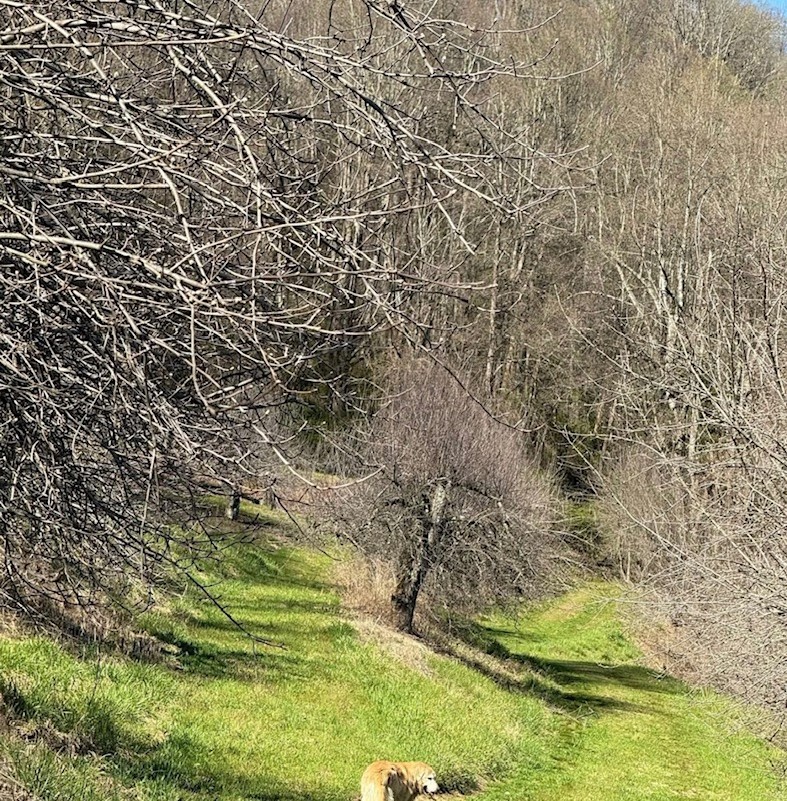
I wrote this on the vernal equinox, feeling the connections to the seasons and to my old dog. I was just caught up in the swirl of it all! I was down in the 100 year old plus orchard on the Blue Ridge Parkway below my house. I’ve run thousands of miles in that orchard and learned something there in all seasons.
— Amy
 . 

photo by Amy Tilly

 . 
❀ ✿ ✾ ❁❀
 . 
Skunk Cabbage
 . 
A spear that breaks the half-frozen
mud, it does not wait for the permission
of the sun, for it carries a small furnace
in its purple hood. Lured by the smell
like a cellar that never dries, the flies
arrive while the bees are still asleep.
Thick and veined, the leaves unfold like
the ears of a green dog. It’s a stubborn
tenant of the low ground where it drinks
the black water of the winter's end and
turns the rot of the year into a lung.
By summer it will be a ghost of melted
lace, but now it is the only thing with
a pulse in the muck, a beautiful ugliness
that stays its ground. Listen, the earth
is speaking, and this is its first word.
 . 
Joel Solonche
 . 

photo by Emily Solonche

 . 
❀ ✿ ✾ ❁❀
 . 
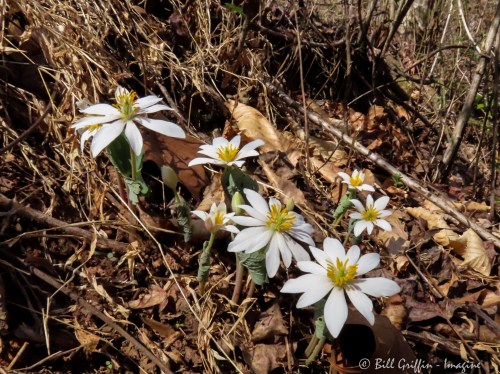
Bloodroot
 . 
Blessed be the white bloodroot blooms,
the first ephemerals to herald spring
singing the sleeping earth awake
their faces shine open,
greeting the morning sun
as it warms the slumbering dirt
later folding closed against the darkness and
the black night air
that still shows the does’ breath as
she ambles by.
A dozen petals fall like confetti,
spilling after just a day or so of bloom.
 . 
Suzie Taylor
 . 
Outside has been my refuge and my home. I brought my children there and now my daughter is in Nashville, TN, completing her PhD studying salamanders. Anna and I stay in touch sharing untitled images of magic we find during our days. She, being at lower elevation than I, sent her spring ephemeral images weeks before mine appeared. I participate in Joseph Bathanti’s wonderful poetry workshops on Tuesday nights at FARM CAFÉ, and I wrote this a weeks ago. Nature is such a lovely muse!
— Suzie
 . 
 . 
❀ ✿ ✾ ❁
 . 
Garden Meditation
 . 
Growing in my garden, beneath the maple trees
Are Foxgloves by the dozens- purple, pink and dusty green.
They grow like weeds, bold, wild and free.
Never where you plant them- obviously.
 . 
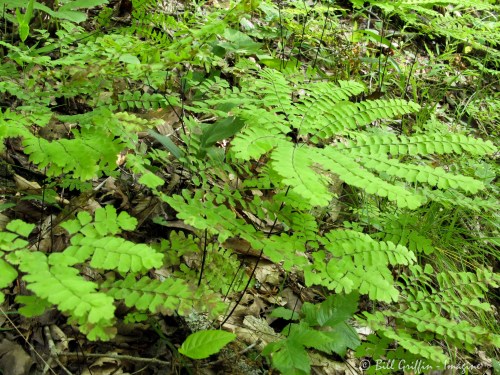
My favorite fern, the Maidenhair, has stems of  rich deep black,
They are fragile, native, delicate, but grace they never lack.
 . 
The shocking fireworks of red are all the Beebalm blooms.
Their minty scent when cut will nicely fill a room.
 . 
Lady’s Mantle catch the dew, like diamonds that will not last.
The  tiny yellow fluffy flowers reach out as I walk past.
 . 
Then there are the lilies, Turk’s Cap, Stella and roadside Day.
Bright orange, white and golden color as in the breeze they sway.
 . 
Hellebore – a hell of a name for such a sturdy flower.
The only one who dares to bloom in Winter’s cold dark hour.
 . 
Sweet William red, begonia pink, some random purple plants,
send rainbows of the spectrum amongst the slugs and ants.
 . 
My garden is my meditation, to tend and wander through.
Always needing, never boring
when you find there’s something new.
 . 
Kathleen Rowell
 . 
I was inspired by a high school horticulture teacher to pursue a degree in horticulture.  I have always found the quiet of a garden makes me smile.  I talk to the plants, scold the deer and sing with the birds. My heart rests when I can smell rain coming as the evening cools.  I know then all is well. This poem written at the Joseph Bathanti’s Tuesday writer’s workshop at FARM Café.
— Kathleen
 . 
 . 
❀ ✿ ✾ ❁✾
 . 
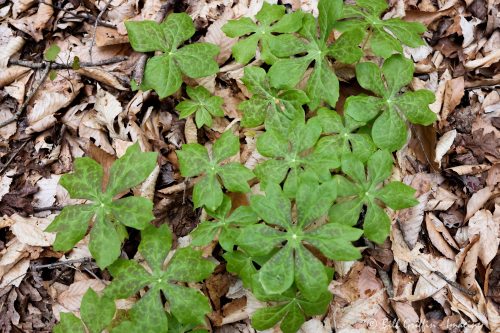
A Poem
(Mayapple)
 . 
Hiding underneath
a beautiful green leaf,
lusciously growing beside the creek,
was the sight of a delicate white flower.
 . 
If you were not looking
beneath the green leaves
stretching above it,
you would miss its beauty.
 . 
Hiding underneath—
from the harsh sun,
from the strong wind,
from animals in the wild—
was this quiet treasure.
 . 
If you were standing far off,
you would miss it…
underneath.
 . 
Esther Mfonyam
 . 
One beautiful evening after dinner, I received a clear message from nature. While taking my evening walk along the creek at Well of Mercy, I noticed a wildflower that immediately drew my attention. Its leaves looked like an umbrella, and underneath it was a delicate white flower. It struck me in a quiet but powerful way—this flower’s beauty was being preserved by the very thing that also kept it hidden. I only noticed it because a dear friend told me to look along the creek for wildflowers. Otherwise, I might have walked right past it. The word that came to mind as I stood there was umbrella. And I began to think about the times in my life when I have needed the “shade” of others. I thought of my family—how they have made sacrifices to protect and support me through different seasons. They have given their time—offering wisdom, encouragement, and guidance. They have given their resources—helping in moments of real need. They have given their prayers—holding me when my heart felt discouraged and exhausted. But most of all, they have given of themselves. Like the leaves over that flower, their presence has provided covering—not to diminish me, but to preserve me. May this simple image from nature remind you of the times you have provided shade for others, the times shade has been provided for you.
— Esther
 . 
 . 
❀ ✿ ✾ ❁✾
 . 
Silly Daffodilly
 . 
Add solar juices,
and the cheddar bulbs open
wearing tiny Victrola noses
promising March melodies,
tunes uploaded to a puffy cloud
then VRUMM, drowned
by a gas mower’s throbbing drone.
 . 
The landscaper rides a John Deere
wearing a Dash baseball cap
and reappears back and forth behind
a fat forsythia a mere ten yards away,
neighbor’s steady Friday-guy who forces
me to reconsider deck enjoyment.
 . 
Solar juices. Victrola noses.
Miraculous quiet.
Wait. A poof. A trill.
Flowerpot to ear, my mood rekindles
as stems bow, tickle my cheek.
I listen as daffodils sing the simple
flourish, TRA-LA-LA-LA-LA,
a fine, spring madrigal.
 . 
Sandra Brodkin Dreis
first appeared in Ravensperch. To be published this summer, 2026, in Good Dirt by Kelsay Books.
 . 
In my mind, I could see an old ad for RCA Victor with a small dog like my Jack Russell, Jillie, listening to the daffodil shaped speaker. Sitting on the deck with my yellow daffodil, I imagined music coming from the flower like an early version of a record player. It would have to be a madrigal, but a happy one, of course. “Now is the month of Maying, when merry lads are playing…..tra la la…
— Sandra
 . 
❀ ✿ ✾ ❁
 . 
The healing potential of flowering plants is an integral part of the deep bond that exists between humans and nature. That flowers have the ability to heal us, not only physically but also emotionally and spiritually, is something that has been recognized and utilized as far back as we know.
— Anne McIntyre, from Flower Power
 . 
In the beauty of nature lies the spirit of hope.
— Author unknown.
 . 
Thank you for celebrating the month of April with International Earth Day (April 22) and National Poetry Month. And thank you, Readers, who have selected poems to share that connect us to our planet and each other. We will continue posting EARTH POETRY throughout the month of April – and beyond April as well, of course, since EVERY DAY is EARTH DAY!
 . 
 . 
Thank you for visiting Verse and Image: If you would like to receive an email each time a post appears, please SUBSCRIBE to Verse and Image using the button on the Home Page.
 . 
If you have a hard time finding the SUBSCRIBE button on this WordPress site, you can send me your email address and I will add you to the subscriber list. Send your request to
 . 
COMMENTS@GRIFFINPOETRY.COM
 . 
Thanks again for joining the conversation.
 . 
— Bill
 . 
❀ ✿ ✾ ❁
 . 
IMG_0877
 . 

Read Full Post »

 . 
[with 3 poems by Sandra Dreis]
 . 
The Vestibule
 . 
I fear the snake plant
crouching on the coffee table,
crackled celadon planter
a get-well gift for Grandma
Gertie from distant cousin Fay.
 . 
It arrived yesterday, cat-beast
with bulging eyes that will prowl
room to room while Grandma,
small and fragile in her big chair,
sleeps. Stark plant, no leaves,
only sharp swords unsheathed.
 . 
I stall. Linger in light, the sunny
vestibule my barrier island,
face pressed into lace curtains
stretched tight over glass double doors.
I’m six. Safe. Separate from the mainland
of scary things. Cancer.
 . 
My blond frizz catches elastic, necklace
strung last summer from odd seashells
as we hummed together in the kitchen.
How Grandma dipped the fountain pen’s
gold tip in a bottle of dark blue ink,
 . 
etching columns in a heavy ledger,
numbers and letter so curly and pretty,
scratch-scratch-blot-blot-blot,
her easy script clear as the crystal
doorknob I dare not turn.
 . 
Sandra Brodkin Dreis
from Cultured Pearls, Kelsay Books, American Fork, UT; © 2024
 . 
❦ ❦ ❦
 . 
How safe is safe enough, and how safe too safe? Third day of backpacking, Mike and I arrive at a clearing and scout for a good tent site. Not too much slope, head higher than heels, no roots or stones, at least none too big. Ah, here it is, the perfect spot. Per our usual routine we lie down in the leaves to test the lay, and then Mike looks up. Nope. Thirty feet above our heads is a dead branch big around as your thigh. If that thing cracks free in a midnight gust, our wives will be cashing in the policies. Find a different site.
 . 
Fifteen years later Linda is still not a widow and I should be grateful that she seems to intend to keep it that way for a while yet. Last Thursday I was hoping to hike up the Mountains-to-Sea Trail for a work day above Stone Mountain State Park, but a front moved in and lashed the house all night. The morning forecast still warned of gusts up to 35 mph. Lots of dead branches in all those trees. Did I decide to stay home for me or for Linda?
 . 
Looking at the photos of my braver friends who did spend the day on the trail, I wish I’d gone with them. Yes, I do. Which regret is more bitter, doing the thing that gets you into a mess of trouble or not doing the thing that only might have? I suppose if a tree falls on you, your regret is swift and sharp but it isn’t going last very long (nor are you), whereas I’ve been moping for a week that I didn’t give those trees a chance to get me.
 . 
Which just proves . . . nothing. The tree that gets me will be the one I didn’t see coming. Rue and remorse and the road not taken are great for writing a poem but not particularly useful for getting out of bed each morning. I’ll stir up a tasty stew of the past and savor it when a good meal of recollection is called for, but I’ll do my best not to choke on it.
 . 
On the other hand, nothing is altogether sorry or useless if it reminds you occasionally to look up.
 . 
 .
❦ ❦ ❦
 . 
Charles, Triple Pirouette – 1983
 . 
They share spartan diets, actor’s nightmares,
sore feet. Meet in a Hell’s Kitchen laundry room.
He’s drying, reading a Bible, waiting.
She’s washing a basket of dance clothes
and sweats. He hands her a needed quarter.
 . 
Turns out, she’s directing and casting
a twenty-city tour, so they chat away.
Excellent pay. He light ups, demonstrates
a triple pirouette in sneakers – on carpet.
His easy-going pizzazz, an instant hire.
 . 
Bright-eyed even for early morning rehearsals,
he’s warmed-up and ready. During breaks, a loner,
he reads the Bible. In hotel lobbies, on plane rides.
To sassy cast members, he winks, “I’ll pray for you.”
 . 
Performances end by Christmas, yet nobody hears
from Charles. The gossip train – Radio City nabbed him,
for sure. But his roommate calls her from St. Vincent’s.
Charles is gone. A rare pneumonia. Enough said.
 . 
Bath towels thud, dryer drum pounds. Her face flushes
pink as she opens to door to bereft. Puff of heat.
Steam dissipates, clothes churn and settle with a sigh.
Oh, Charles.
Bible in hand, he gently spins to a stop.
 . 
Sandra Brodkin Dreis
from Cultured Pearls, Kelsay Books, American Fork, UT; © 2024
 . 
❦ ❦ ❦
 . 
The three steps required to create a poetry book, perhaps in decreasing order of difficulty, are choosing which poems to include, deciding how to order and arrange them, and picking a title. None of the three are easy but creating a title is the most mysterious. Many poets cop out and just use the title of one of the poems in the collection – but how do you decide which one is THE poem? Someday soon I’m going to create a found poem using only the titles of the hundreds of poetry books lurking in every corner of my house. I think I’ll title it, “New and Selected.”
 . 
Cultured Pearls by Sandra Brodkin Dreis – where does that title come from and what is its deeper meaning? The only reference to pearls among the poetry is spotless white sandals, silky pearl-button cardigan in Kingdom of Immaculate, which lingers with the poet’s mother in her last days of dementia. A cultured pearl is a beautiful artifact, a human effort to replicate and even improve upon nature. It is a commonplace bit of shell formed by machining into a sphere but then over the course of a year or longer within the mantle of a living mollusk layered with exquisite nacre.
 . 
Perhaps every one of us is a cultured pearl. Throughout our lives we struggle to create the artifact of our persona, but our life itself creates the strange chemistry that makes us who we are. Inventory our insides and you get a fairly boring list: carbon, calcium, nitrogen, oxygen; sugar, protein, necklaces of nucleotide; bone, fat, gristle. But the sac which holds these elements and molecules and tissues, the mantle that continuously forms and reforms us, is wit, humor, curiosity, love.
 . 
These poems by Sandra Dreis are indeed such a nacreous mantle. So many pearls inhabit her lines – cherished friends lost to AIDS, family members scarred by prejudice and displacement, loved ones fading and dying. She holds their luster up to us. She reminds us how they have shone. She may admit the grit and schmutz that make up the heart of persons, but she also opens the shell and reveals each one’s unique beauty. So, Sandra . . . nice title!
 . 
 . 
Cultured Pearls is available from Kelsay Books. Sandra Dreis lives in Winston-Salem and has had a long career as dancer, educator, novelist, and poet.
Read Raven’s Beak by Sandra at this previous intallment of VERSE & IMAGE.
 . 
 . 
❦ ❦ ❦
 . 
Early Grey
 . 
Mom does not remember
Earl Grey tea. That she prefers it.
That she loves it. No sugar. Just plain
No lemon. God forbid – milk.
 . 
For all she knows, Earl Grey is a fine gentleman
riding from his castle in the English countryside,
galloping on his well-groomed steed. He halts
by the rocky brook to adjust his fine felt hat.
 . 
Mom, at 93. My reminders, steady fuel,
stoke the furnace of her runaway locomotive.
But Mom, you love Earl Grey, your favorite!
Really? I do? Well, okay. If you say so.
 . 
Consider young Earl – Mom’s former sixth-grader
who threatened to kill himself. New York City
Police apprehended him on the 59th St. Bridge.
That Earl, she claims, took years off her life.
 . 
Perhaps Earl Grey – could he be an uncle?
A Jewish uncle named, Harry Grey, emigrated
as Harry Greenberg from a shtetl in Russia.
Maybe Ellis Island saw fit to shorten his name.
 . 
The copper kettle shrieks, Mom unaware.
I pour steaming tea and fill our porcelain cups
with disbelief. Small kitchen table. We sit before
a plate of scones. Mom smiles. We steep.
 . 
Sandra Brodkin Dreis
from Cultured Pearls, Kelsay Books, American Fork, UT; © 2024
 . 
❦ ❦ ❦
 . 
IMG_1948
 . 

Read Full Post »

[with poems by Ursula K. LeGuin, Sandra Dreis,
Jenny Bates, Galway Kinnell]

After a recent post which featured poems from the journal ecotone, Bradley Strahan commented, “Thanks. We need constantly to be reminded of how much we are dependent and damaging.” It made me think: it must be no coincidence that Poetry Month and Earth Day are both in April. This is the month of convergences, when we are truly grateful that the last frost is past and beastly summer has not yet smothered us. We watch new shoots erupt and bloom, but we worry that some will arrive too early and get nipped, and that blossoms and pollinators may emerge out of sync. We’re grateful for the songs of neotropical migrants, but we notice their diminished numbers and worry about desecrated wintering grounds and fragmented breeding grounds. We head out for a hike or a bird count and find the woodlots leveled, the streams silted up, and new homes and trailers in every cornfield.

We are surrounded by the reality of relentless human impact on the planet. We are living smack dab in the middle of the Anthropocene epoch.

It is difficult
to get the news from poems
yet men die miserably every day
for lack
of what is found there.
+++++++ William Carlos Williams, from Asphodel, That Greeny Flower

Poetry is able to speak the news we need to hear for Earth Day. Poetry may crystallize a truth we can grab and hold on to when bad news threatens to overwhelm us. Poetry may grab us by the lapels and jerk us to our feet when our motivation has drained away. Poetry may shed light on despair and offer some path into hope.

Thank you to the readers of these pages
who have responded to my call for poems this Earth Day.
Watch for new posts on April 21, April 22, and April 23.

All photographs were taken April 11-17, 2023,
along the Elkin & Allegheny Nature Trail,
part of the Mountains-to-Sea Trail in North Carolina, USA.

Earth Day 2023 art by Linda French Griffin.

❦ ❦ ❦

Kinship

Rootless and restless and
warmblooded, we
blaze in the flare that
blinds us to that slow,
tall, fraternal fire of life
as strong
now as in the seedling
two centuries ago.

Ursula K LeGuin
Selected by Bill Griffin; appeared online in The Dewdrop, March 26, 2022

What truth is more profound, more amazing, more assuring, more urgent than our kinship? That Ur-puddle’s restless swirl of nucleotides and amino acids, way back in time before there was ever a cell, is still reflected in the minutest truth of our bodies, every glint and dark crevice of them. All of us are neighbors.

– Bill Griffin / Elkin, North Carolina

❦ ❦ ❦

Raven’s Beak

But you’d have to understand
Raven’s beak,
drive that comes before
all else,
plunges for praying mantis,
plucks, disbands dirt,
stabs a wrangled tuft of weed.

And you’d have to
be
the bird, inhabit
black eyes that beam location,
yes, stealing sweetness
even
from the cocky cat,

feasting on envy.
This hunger lives beyond prey
I tell you, a wild want
not to be tamed
by blood, sinew or travail.
In dreams I gather others.
I grow feathers and wait.

Sandra Dreis
originally published in CREOSOTE, Spring 2021. (East Arizona)

This, my first published poem, was inspired by a walk with my two small dogs, stopping by a grassy ultra-green, pampered lawn. There, under a pin oak, was a sizable raven, beak inserted into the earth. In that moment, while I held my leashed dogs, a cat on a nearby stoop kept the raven in her sights. My dogs begged after the cat. I felt the perfect continuum. The balance. The tame. The wild.

– Sandra Dreis / Winston-Salem, North Carolina

❦ ❦ ❦

Otherworldly

Odd trick of the wind in leaves,
water flowing over stones.

You don’t have a mouth, said Fox.

Moth never blinked, rippling its crescent
tail wings.

You only live for a week, said Fox.

Moth lifted its wings, flew the moon up
to meet the night.

You and I are daydreams, soughed Fawn.

It’s been a long time. Think back and listen.
Voices in the woods. Angelic, untarnished.

Articulate, I can hear words rising

then falling,

a benediction.

Jenny Bates
originally published in Dark Forest, Planisphere Q, 2021

I want to bring the kindness and wonder I have found in wild creatures as well as their courage and pragmatic truth. I want my voice to be their voice as I believe they will teach us appropriate ways to heal the wild land. The wild is mysterious but also thrilling, nostalgic, liquid, musical when we listen.

– Jenny Bates / Germanton, North Carolina

❦ ❦ ❦

The Bear

+++++ 1
In late winter
I sometimes glimpse bits of steam
coming up from
some fault in the old snow
and bend close and see it is lung-colored
and put down my nose
and know
the chilly, enduring odor of bear.

+++++ 2
I take a wolf’s rib and whittle
it sharp at both ends
and coil it up
and freeze it in blubber and place it out
on the fairway of the bears.

And when it has vanished
I move out on the bear tracks,
roaming in circles
until I come to the first, tentative, dark
splash on the earth.

And I set out
running, following the splashes
of blood wandering over the world.
At the cut, gashed resting places
I stop and rest,
at the crawl-marks
where he lay out on his belly
to overpass some stretch of bauchy ice
I lie out
dragging myself forward with bear-knives in my fists.

+++++ 3
On the third day I begin to starve,
at nightfall I bend down as I knew I would
at a turd sopped in blood,
and hesitate, and pick it up,
and thrust it in my mouth, and gnash it down,
and rise
and go on running.

+++++ 4
On the seventh day,
living by now on bear blood alone,
I can see his upturned carcass far out ahead, a scraggled,
steamy hulk,
the heavy fur riffling in the wind.

I come up to him
and stare at the narrow-spaced, petty eyes,
the dismayed
face laid back on the shoulder, the nostrils
flared, catching
perhaps the first taint of me as he
died.

I hack
a ravine in his thigh, and eat and drink,
and tear him down his whole length
and open him and climb in
and close him up after me, against the wind,
and sleep.

+++++ 5
And dream
of lumbering flatfooted
over the tundra,
stabbed twice from within,
splattering a trail behind me,
splattering it out no matter which way I lurch,
no matter which parabola of bear-transcendence,
which dance of solitude I attempt,
which gravity-clutched leap,
which trudge, which groan.

+++++ 6
Until one day I totter and fall-
fall on this
stomach that has tried so hard to keep up,
to digest the blood as it leaked in,
to break up
and digest the bone itself: and now the breeze
blows over me, blows off
the hideous belches of ill-digested bear blood
and rotted stomach
and the ordinary, wretched odor of bear,

blows across
my sore, lolled tongue a song
or screech, until I think I must rise up
and dance. And I lie still.

+++++ 7
I awaken I think. Marshlights
reappear, geese
come trailing again up the flyway.
In her ravine under old snow the dam-bear
lies, licking
lumps of smeared fur
and drizzly eyes into shapes
with her tongue. And one
hairy-soled trudge stuck out before me,
the next groaned out,
the next,
the next,
the rest of my days I spend
wandering: wondering
what, anyway,
was that sticky infusion, that rank flavor of blood, that poetry, by which I lived?

Galway Kinnell
Selected by Paul Jones; appears in Three Books (Houghton-Mifflin, 2002)

Galway Kinnell speaking for himself about himself: “I don’t recognize the distinction between nature poetry and, what would be the other thing? Human civilization poetry? We are creatures of the earth who build our elaborate cities and beavers are creatures of the earth who build their elaborate lodges and canal operations and dams, just as we do … Poems about other creatures may have political and social implications for us.”

I first heard Kinnell read this poem in maybe 1977 at the UNC English Department. I was thinking of taking a job at UNC. I did and The Bear has been with me ever since.

– Paul Jones / Chapel Hill, NC


❦ ❦ ❦


Read Full Post »