Feeds:
Posts
Comments

Posts Tagged ‘Main Street Rag Publishing’

 . 
[with 3 poems by Les Brown]
 . 
Pause
 . 
I placed my hand on the moon
++++ to keep it from its course,
to stop time in the comfort of night
++++ when sleep subdues sounds
of machines and urgent voices.
++++ Starlight and still moon
are enough to guide my stroll.
++++ I cross the meadow
among sparse trees,
++++ where snowy crickets cry fast
with time kept by heat
++++ of past day’s searing sun.
I lie down and listen
++++ for the whippoorwill
whose call is rare now,
++++ watch fireflies wink love calls.
I will hold the moon until
++++ the world stirs and wonders
why the night endures,
++++ with dreams of Earth
where fires do not rage,
++++ floods do not drown,
spiraling winds cease,
++++ oceans retreat from shores
and the cricket cries slow
++++ once again.
 . 
Les M. Brown
from A Coming of Storms, Main Street Rag Publishing, Charlotte, NC; © 2024
 . 
❦ ❦ ❦
 . 
Light rain in the woods, droplets coalesce and cascade through the upper canopy, tuliptree, oak, & hickory, until they freefall onto our heads and shoulders. A fat drop flicks a browned leaf or blinks in the duff. We imagine small creatures leaping up from the earth and then they do! Angel-winged insects are bobbing up and down to touch the fresh damp with the tips of their abdomens, animated by moisture. Linda watches one female Cranefly, notices nearby a delicate floral spike with angel-winged florets, and says,  “Look, it’s planting orchids!”
 . 
Cranefly Orchid and Cranefly, so like each other, elongated nectar tube of the flower resembling the long abdomen of the insect ending in its ovipositor, but so unlike! Except in our visual imagination they’re not related at all . . . or are they? Both favor moist woodlands with a nice layer of decomposing vegetation. Both reproduce in midsummer, by bloom and seed or egg and larvae. Both look a little creepy if you’re not fond of long spindly legs.
 . 
Altogether unrelated, entirely different Kingdoms – Animalia and Plantae – and yet these two are related ecologically, if simply by the places in which they thrive and by the company they keep. They live in community. But mightn’t  the relationship go deeper? All living creatures on this planet are genetically related; we share many of the same genes for  basic functions like metabolism, DNA replication, and protein synthesis, share them with every bacteria, archaea, fungus, protist, and plant. Compare the genome of any plant – Cranefly Orchid – and any animal – Cranefly – and you’ll discover hundreds of identical genes. It’s one big family tree, this Kingdom Earth, with some pretty twisted and winding branches, and yet all connected to the same trunk.
 . 
 . 
Alas, the Cranefly is not planting orchids. She’s laying eggs in the moist duff; they’ll hatch into larvae called leatherjackets. She doesn’t care a whit for her namesake orchid, which is pollinated by Owlet Moths (Noctuidae). The Cranefly Orchid’s tiny flowers twist either left or right as they progress up the stalk (raceme), so that as the moth’s long proboscis probes the nectar tube she gets a dusting of pollen on one or the other of her large compound eyes. And carries it with her to the next flower.
 . 
 . 
 . 
❦ ❦ ❦
 . 
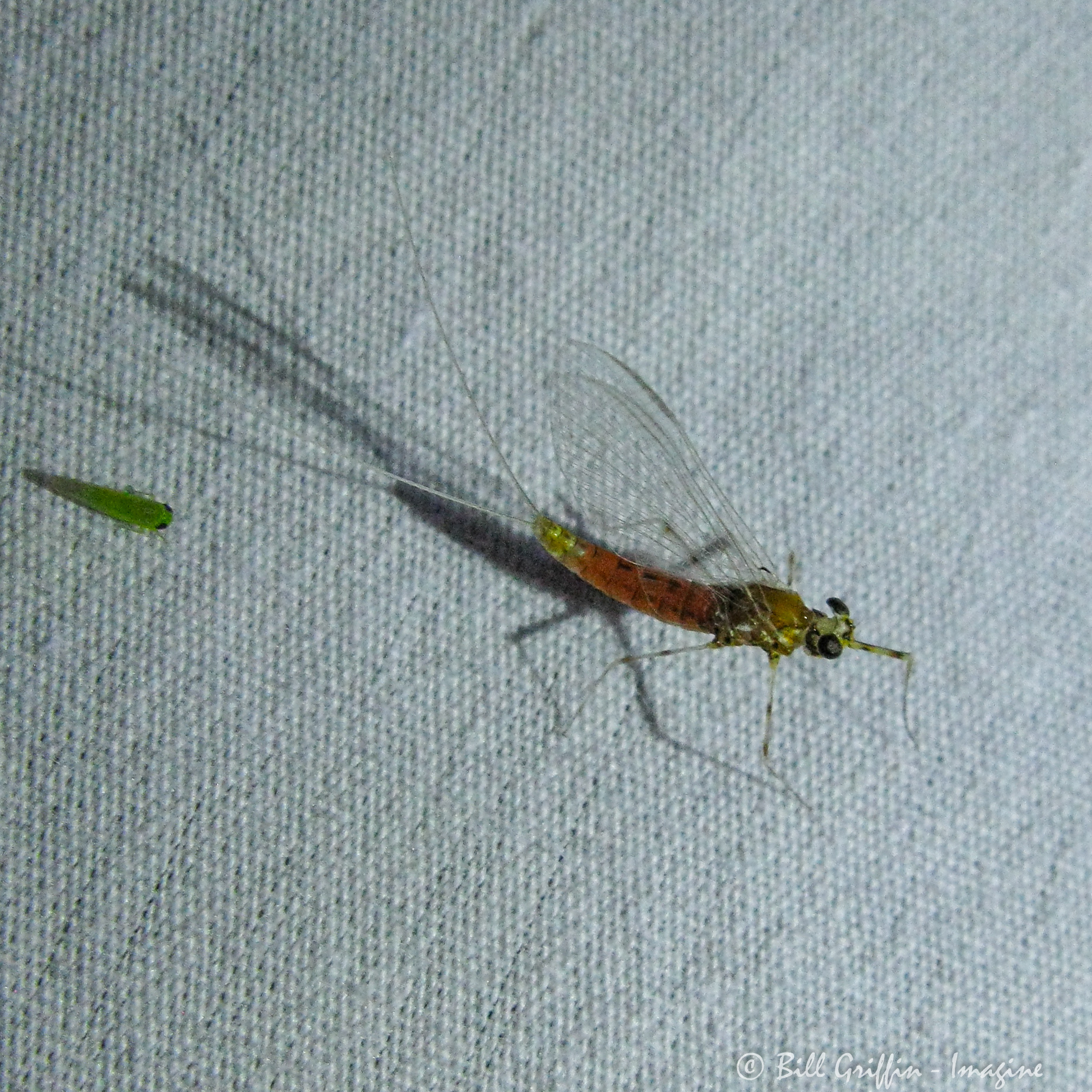
Mayfly Swarm
 . 
Night on the Pearl River, steaming warm –
our small boat pierces the tunnel of blackness.
Beams of head-bound lights play
across the dark slow current.
 . 
We tease out an occasional moccasin,
quiescent in boughs of bald cypress.
Lock on bright-lit eyes of river frogs,
the hungry raccoon eating a mussel.
 . 
The motor pusher our johnboat upstream –
Suddenly, a blinding blizzard
of white-winged snow rises.
Shimmering mayflies fill the blackness.
 . 
They are in our eyes, nostrils, mouths, ears,
and hair, an erupting silent lace-winged storm.
Millions rise in singular ecstasy, then die.
Their gossamer bodies blanket the river.
 . 
Fertile eggs drift into black depths.
Frog, fish, and bird devour the dead,
a one-night feast, a gift, a magic cycle
of lovers, death, and satiated flesh.
 . 
Les M. Brown
from A Coming of Storms, Main Street Rag Publishing, Charlotte, NC; © 2024
 . 
 . 
❦ ❦ ❦
 . 
Les Brown’s new book, A Coming of Storms, has plenty of vivid and hair-raising (literally) descriptions of black cumulonimbus monsters plowing down the mountainside to batter us with hail and impale us with jagged barbs of lightning. The storm he’s really warning us of, however, is metaphorical and of our own making: the devastation of Planet Earth by that most destructive invasive species, Us. Among these poems are Lamentations for the now diminished towns and farms where our lives were once so rich, Jeremiads proclaiming the dire future we’re creating for ourselves, and the Psalmist’s tender recollection of family homestead, tender sojourns in nature, and all the smells and tastes and feel of our fertile world at its best.
 . 
Les has all the necessary credentials of a prophet. He grew up in the rural mountainscape of North Carolina; his poetry is most poignant when populated by his grandparents, uncles, neighbors. He earned a Ph.D. in Biology and taught ecology to college students all his working life. He himself feels most personally and pointedly our loss of unspoiled fields and forests, our disconnection from the earth that sustains us. I wish he were here beside me this afternoon so we could both get our knees dirty investigating Cranefly Orchids and Rattlesnake Plantain. I’ll be looking forward to his next observation, and holding my breath for a cooling breeze of hope.
 . 
 . 
A Coming of Storms is available from Main Street Rag Publishing.
 . 
❦ ❦ ❦
 . 
Think seeds, not bullets
 . 
++++ melons instead of bombs.
Drink wine, rest a while
++++ instead of scorching earth.
Rip off epaulets
++++ and but on bedroom shoes.
Call mothers. Tell them
++++ their children are safe
Revere the earth,
++++ cool it.
Grow chanterelles,
++++ not mushroom clouds.
Bend barrels
++++ and weld triggers
into metallic art.
++++ Read a different Good Book.
Let only birds tweet.
++++ Read only magazines
instead of loading them.
++++ What is beneath the skin
of an apple?
++++ It is a simple question.
 . 
Les M. Brown
from A Coming of Storms, Main Street Rag Publishing, Charlotte, NC; © 2024
 . 
❦ ❦ ❦
 . 
 . 
Doughton Park Tree 2014-07-13

Read Full Post »

 . 
[with 3 poems by Claudine R. Moreau]
 . 
Lesson on Cryovolcanism
 .  . 
How can a moon cry?
I wonder as I display the face
of Enceladus, the Saturnalian moon,
to students pecking on cell phones.
Their saltwater brains
enmeshed in everything
but this moon dressed
in bright fresh eruptions
of sow fall, pockmarked
craters, and frozen blue
rivers of tears.
 . 
It is January, my season
for venting and remembering –
the snow packed mountain
road which winded up
to the Flat Rock Church
that my father rebuilt,
post and beam. Every nail
hand-hammered,
every cement block place
and trialed with his patience
in finding God in hard work.
 . 
I want to tell the class
that humans are the only
species known to cry
from emotion.
Instead, I get locked
inside my mind’s
digital inventory –
to see a wooden pin
box engraved
with his name next
to the pulpit, wreathed
with baby’s breath, steam
and smoke escapes every seam.
 . 
Claudine R. Moreau
from Demise of Pangaea, Main Street Rag Publishing, Charlotte NC, © 2024
 . 
❦ ❦ ❦
 . 
Here’s how science works: observation – hypothesis – test – revise – test again – etc. Even gravity, which so far has bruised me every single time I’ve fallen, has chinks in its unassailable wall of theory. Revise – test – revise again. Science is less about nailing down and more about thrusting open.
 . 
What would happen if a scientist were to investigate love? A review of the literature would be in order, but the theories of Masters & Johnson and the Kinsey Report are to love as Newton is to Heisenberg. Perhaps the poetry of love would be more helpful, but wouldn’t that be like trying to map the cosmos without a standard candle, no reference point from which all other distances can be calculated? Uncertainty indeed!
 . 
And yet poets just can’t quit writing love poems. (And death poems. I argue that without an awareness of mortality there would be no poets and no poems at all. Perhaps knowing that all of this that is me will one day cease makes me even more desperate for love.) How would a science of love work? Is it a two body problem? Where each body’s mass and velocity keep changing and changing without pattern or predictability? A recipe for crashing or flying apart. Or, on some more beneficent cosmos, might each body practice its love science – observe, contemplate, revise – and at least on some days experience a stable orbit?
 . 
Clearly the chance for a unified theory of love is pretty slim. And yet, in the cold and darkness of space, how can we not be drawn to warmth and light? Each love poem is another data point. Each fond glance is a photon arriving from the void. I will allow myself to be encouraged and not afraid of infinite complexity in this expanding universe.
 . 
 . 
❦ ❦ ❦
 . 
Red Nebula
 . 
The doctor examines
every inch of me, every defect
I’ve collected on this skin.
When she gets to my breasts
she sees it –
a spoonful of jam dropped
by mother at birth,
beacon of wonder or disgust.
 . 
All my life I”ve wanted it gone.
I lied about it like a bad tattoo.
The doctor measures,
collects data on her notepad –
radius and diameter,
sketches its blurred perimeter.
 . 
Her eyes are cosmic cameras
lit even now by the big bang
of my birth. They rove the dried
alluvium of hips, descend
into the canyon of my C-section.
 . 
She zeroes in with calipers
to the belt’s middle more – my Alnilam.
Without warning,
she scoops it out,
as if it were a black hole
and would consume me
atom by atom.
 . 
This is when I am certain
that I love my mark of Cain –
imagine the nebula
going into a lover’s mouth.
Its sweetness, red
texture like cotton candy,
its wholesome intention
swelling the brain.
 . 
Claudine R. Moreau
from Demise of Pangaea, Main Street Rag Publishing, Charlotte NC, © 2024
 . 
❦ ❦ ❦
 . 
I recall my one conversation with Claudine Moreau some twenty years ago, learning she teaches physics and astronomy at Elon University, and saying to myself, “Hell, Yes!” Poetry is required to grasp modern physics; physics requires a poet to convey it. A beautiful equation is a crystal of metaphor; reality is no click of billiard balls but a cloud of imaginings. Every decade or two I re-read The Dancing Wu Li Masters to marinate myself again in what cannot be touched but only felt.
 . 
Like these poems. Demise of Pangaea – Moreau’s lines contain hard images which one might collect like fragments of iron in permafrost after a meteorite explodes, but the collection, the whole, is the flash and steam and momentary brilliance of matter and atmosphere colliding. Halfway through the book I grumbled, “These are not at all chronological. How am I to connect these poems and make them make sense?” Exactly, exactly. Whose life makes any sense at all as it unspools? Contemplating my life is like looking through a telescope – the moments that seem separated by only a fraction of an arc-second are actually years apart, light-years distant. These poems are raisins in a pudding: as it cooks and expands, they separate so that when we open it, each sweet, pungent moment stands out by itself. Galaxies in an expanding universe.
 . 
And so I return to the title poem for my reference point, my Alnilam in the center of Orion’s belt. Once the earth was whole, a single land mass, and seemed surely destined to remain so forever. But deep forces and dark machines work on us and our desires, and no one can bridge every chasm and rift as the continent splits in two. Hold on to the bright moments. Seek a high point from which you can embrace the Milky Way. Every star burns out, as it must. Fix it in your memory. Perhaps in the glimmer of a star, in a poem about love, you may for a moment forget how heavy / Earth makes all of this.
 . 
 . 
Sample additional poems and purchase Demise of Pangaea at Main Street Rag, HERE
 . 
 . ❦ ❦ ❦
 . 
Demise of Pangaea
 . 
It’s June and the sky never goes dark –
the solstice sun entombing night.
 . 
An endless red dusk
seeps like a wound,
 . 
bleeds through Oslo’s
barcode skyline.
 . 
Harbor fjords become gnomons,
track the day’s slow radioactive decay.
 . 
We are in bed, midnight sun exposes
the long ridge between our bodies.
 . 
I watch your chest rise,
a hundred tiny moles move outward –
 . 
the continents pull apart by slow churn,
some invisible thing rising through rock.
 . 
Claudine R. Moreau
from Demise of Pangaea, Main Street Rag Publishing, Charlotte NC, © 2024
 . 
❦ ❦ ❦
 . 
IMG_0880, tree
 . 

Read Full Post »

 . 
[with 3 poems by Richard Allen Taylor]
 . 
What’s Happening?
+++ after Choices, a watercolor by Catherine Mainous
 . 
Of course, I recognize it right away,
this landscape where past and present
bleed into future, as I have bled,
as we all do. I start green and work
my way up, grasping at blue. Earth
always reaches for sky, the tiniest seed
pokes through saltmarsh and sawgrass,
green fingers periscopes looking for light.
I always look for dawn. No, that’s wrong.
Sometimes, I search for dark and find it.
The light comes later, after regret, guilt.
See how that diffused orange glare
in the corner blurs into a bridge
to nowhere, skeletal structure
never completed. That’s what
you get with unrequited ambition.
Beginning, middle, no end.
A purple cloud in the distance.
A crane untethered.
An unexpected answer
to an unexpected question.
 . 
Richard Allen Taylor
from Letters to Karen Carpenter, Main Street Rag Publishing, Charlotte NC; © 2023
 . 
❦ ❦ ❦
 . 
She doesn’t believe in inertia. If I take both hands off the wheel for a femtosecond, she’s convinced we will instantly swerve into the embankment.
 . 
She does believe in gravity. Since my last birthday she has forbidden me from using the stepladder to hang Christmas lights on the dwarf spruce in our front yard, much less reach to get the star on top.
 . 
She absolutely rejects Heisenberg’s principal of uncertainty. Whether I can detect them or not, my keys are fixed in place right where I left them.
 . 
She’s a little iffy on the conservation of angular momentum. If I accelerate into a curve to maintain a constant forward velocity, she wants to know why I’m speeding.
 . 
She accepts evolutionary biology without complaint but wanders from the straight and narrow of taxonomic hierarchy. Lizards and toads she seeks out as cute; snakes are OK only behind glass; spiders and gigantic roaches, even millipedes, she captures under a paper cup, slides a birthday card beneath, and relocates into the yard; fruit flies and ants must die.
 . 
And the law of love? It is, of course, not exclusively physics and biology. It also includes the law of culture and connection, of which she is founder and curator. When a particular issue of National Geographic reaches its twentieth birthday, she tears out each article worth saving and files it, astrophysics to zoology. She will let me re-read them if I but ask.
 . 
One more thing about the law of love: it seems to disobey Newton’s third law of motion. For each of my own actions – and how often they do violate something – there is a reaction, but thank God not opposite and equal. However sharp her initial glance and inflection, the ultimate consequence so far has been forgiveness. This is one universe I am happy to live in.
 . 
 . 
❦ ❦ ❦
 . 
The Second Law of the Apple
 . 
If the first law was not to take
the first bite, lest you be banished
from the garden, the second law
ought to be to finish what you start,
 . 
meaning the first bite obligates you
to a second, and a third, and so on
until the apple is eaten, except
for the core, which contains
 . 
the seeds, and sine you will be
traveling anyway, away from
the garden that spit you out,
you might as well learn
 . 
banishment from one place is not
the end, but merely another beginning,
and what you do with the seeds
is everything.
 . 
Richard Allen Taylor
from Letters to Karen Carpenter, Main Street Rag Publishing, Charlotte NC; © 2023
 . 
❦ ❦ ❦
 . 
Richard Allen Taylor is part of the holy jangle of things / fastened to the belt loop of a forgetful world. The poems in Letters to Karen Carpenter and Other Poems are able to weave from the commonplace and humbly wonderful things of this world a sweet sadness . . . droll observations . . . life-giving joy. And some good jokes.
 . 
We knew this first collection since Richard’s wife’s death from leukemia would build a house for grief and healing. Who knew that Karen Carpenter would lend such a hand, but Richard weaves remembrance and biography together into powerful metaphors for attachment and loss. These poems speak to grieving with the whispered voice of his late wife, Julie – a mellow bell rings in the canyon. / And the canyon is me – as well as in Richard’s own sure voice of seeking, his wisdom steadily revealed as one that doesn’t cry for answers but is happy to linger with the important questions. All the old questions / that rise in the wake of storms: each of us must confront and accept these questions if we are to be fully alive. Autumn fades, winter enfolds us, but the seasons continue to turn. At the end of everything is not sadness but wonder, friendship, and love.
 . 
 . 
Letters to Karen Carpenter and Other Poems is available from Main Street Rag HERE
 . 
 . 
❦ ❦ ❦
 . 
I Write to You About Julie, My Wife
 . 
I named a star after her. Astronomers call it
HD 10180. Both Julies—the woman I remember
 . 
and her eponymous star—emit a kind and generous
light. The star deserves a name that twinkles, and she
 . 
deserves the star. I never called her HD 10180,
but often call the star Julie. I chose it out of billions
 . 
because, like you, Julie got along so well with others—
none of that blasting the neighbors with deadly gamma
 . 
ray bursts, the way some pulsars do. And like the star,
my wife, when she was alive, had a family that orbited
 . 
her adoringly. Astronomers have identified a possible
gas giant, designated HD 10180g, residing comfortably
 . 
in Julie’s habitable zone, and—though the giant’s crushing
gravity could never support planetary life, they may find
 . 
moons that do. Suspected of strong winds and colorful
bands, without Julie’s life-giving warmth and shine,
 . 
HD 10180g would be little more than a vast frozen cloud,
a derelict adrift in deep space. I wish I could point out Julie
 . 
to you, but it’s in the constellation Hydrus, which is only
observed from the Southern Hemisphere, and, though
 . 
brighter than our own sun, Julie resides one hundred and
twenty-seven light-years away. We’d need a telescope.
 . 
I understand your concern that the striking similarity
between the designations HD 10180 and HD 10180g
 . 
might confuse some observers. Don’t worry.
To anyone who ever saw us together, it’s obvious
 . 
I am the gas giant, and she is the star.
 . 
Richard Allen Taylor
from Letters to Karen Carpenter, Main Street Rag Publishing, Charlotte NC; © 2023
 . 
❦ ❦ ❦
 . 
 . 
❦ ❦ ❦
 . 
ECOPOETRY FOR EARTH DAY 2024
 . 
When we try to pick out anything by itself, we find it hitched to everything else in the Universe.
  +++ — John Muir
 . 
VERSE & IMAGE is seeking poetry to celebrate Earth Day, April 22, throughout National Poetry Month. Do you have a favorite poem that speaks to universal interconnectedness, as in the above quotation? Send it to ecopoetry@griffinpoetry.com by April 10 and we may share it in one of several posts dedicated to living together on our living planet.
 . 
Please read these guidelines:
 . 
Deadline April 10, 2024, midnight Eastern Daylight Time USA
 . 
Send ONE poem by any author except yourself addressing the theme of connections.
 . 
Include the full text of the poem in the body of an email or as a .DOC or .RTF attachment to ecopoetry@griffinpoetry.com. Please add info about where the poem is published.
 . 
Also include a personal statement – how do you feel connected to this poem? What does it mean to you? How has it connected you to the earth? [suggest 100 words or so; may be edited for length]
 . 
Visit GriffinPoetry.com between April 15 and April 30 to see if your poem has been selected for presentation.
 . 
Optional: if you submit one poem by an author other than yourself, you may also submit one poem on the same theme that you have written. We prefer previously published – include acknowledgments.
 . 
❦ ❦ ❦
 . 
Doughton Park Tree 2021-03-23

Read Full Post »

« Newer Posts - Older Posts »