Feeds:
Posts
Comments

Archive for the ‘Photography’ Category

“Black Vulture” – Clayton Joe Young – http://www.joeyoungphoto.com

 . 
[poems by Scott Owens, photos by Clayton Joe Young]
 . 
Buzzard
 . 
Always
when you look up
at white clouds, blue sky,
 . 
you see
that hyphen of a bird,
not flying but floating,
 . 
silently
keeping two worlds
you imagine apart, together,
 . 
connecting
earth to sky,
life to death.
 . 
Closer,
we see the hunched neck,
bald head, vulture stoop
 . 
as something that gives us
chills.
 . 
Scott Owens
from An Augury of Birds, forthcoming from Redhawk Publications; poems by Scott Owens, photography by Clayton Joe Young
 . 
❦ ❦ ❦
 . 
The naturalist Robert Lynd is quoted as saying, “In order to see birds it is necessary to become a part of the silence.” How often do we actually pause and participate in silence? Become part of it? Sunday afternoon Linda and I had hiked a couple of miles along the Mountains-to-Sea Trail when we came face to face with friends we hadn’t seen since before COVID. They were hiking in from the opposite direction but our destination was the same: the Forest Bathing trail along Grassy Creek.
 . 
We continued on together. We outpaced noisier hikers; they turned back and left us in solitude. The thrum of voices at the winery and of pickups on Route 21 receded. We stopped – a gentle murmur of water flowing over the new beaver dam. Stopped again – breezes swishing through fresh Joe Pye Weed along the creek. As the trail led us up and away from the water, we left the laurel and holly and entered a glade of slender young tuliptree still recovering from logging. Our friend stopped us once more. She had taken off her sandals to feel the earth. Late afternoon sunlight streamed slant among the saplings and we were part of the silence. A vireo sang. She raised her arms and said, “This is what I came here for.”
 . 
 . 
If we create silence, within us and around us, air and earth will magnify the silence with beauty. Birds will complete the silence with wing whirr and song. Here’s an invitation to silence, offered to us in the poems and photographs of An Augury of Birds. Scott Owens and Clayton Joe Young reward our held breath and contemplative approach with their avian celebration. They make these feathered creatures our companions – individual, distinctive, ripe with purpose. And Augury is such an apt title. Wasn’t Rachel Carson’s prophecy of a silent spring the spark that ignited our current fire of conservation and environmentalism? Noticing birds is a gateway to noticing the universe. Lift the latch, enter these pages, become part of these lives – If you close your eyes / you can hear the cosmos opening.
 . 
❦ ❦ ❦
 . 

“Northern Mockingbird” – Clayton Joe Young – http://www.joeyoungphoto.com

 . 
All There Is to Say
 . 
If it happens that you find yourself
at the front of a room full of people
listening to all you have to say
about what you think you know
and suddenly you hear
from an open window
you hadn’t even noticed was open
the voice of a mockingbird
as clear as the voice of God
singing in every language at once
you owe it to yourself
and all with the possibility of hearing
to stop in the almost silence
and say out loud, Listen
 . 
Scott Owens
from An Augury of Birds, forthcoming from Redhawk Publications; poems by Scott Owens, photography by Clayton Joe Young
 . 
❦ ❦ ❦
 . 
Hiwassee
 . 
Long fingers of catalpa trees,
Green globes of apples
Hang low over Licklog Road.
 . 
White crowns of Queen Anne’s lace,
Orange umbels of butterfly weed
Fill a field where flycatchers
 . 
Dart from limb to grass
and back, consuming
Whatever rises. Swallows
 . 
Carve endless angles across
The tops of weeds let go.
Brown headed cowbirds
 . 
Follow white-faced cows
Near a lake surrounded
By mountains in a place
 . 
Where everyone waves
And everyone remembers
What it means to live.
 . 
Scott Owens
from An Augury of Birds, forthcoming from Redhawk Publications; poems by Scott Owens, photography by Clayton Joe Young
 . 
❦ ❦ ❦
 . 
An Augury of Birds will be published by Redhawk Press in 2024. Check HERE for ordering information.
Scott Owens enlarges the community of creativity. He is professor of Poetry at Lenoir Rhyne University, former editor of Wild Goose Poetry Review and Southern Poetry Review, and he owns and operates Taste Full Beans Coffeehouse and Gallery where he coordinates innumerable readings and open mics, including POETRY HICKORY.
Clayton Joe Young is the Director and Senior Professor for the Photographic Technology Program at Catawba Valley Community College in Hickory, NC. He has won numerous awards for his photography and has published several books, including other collaborations with Scott Owens and with poet Tim Peeler, featuring rural North Carolina, especially Catawba County.
 . 
❦ ❦ ❦
 . 
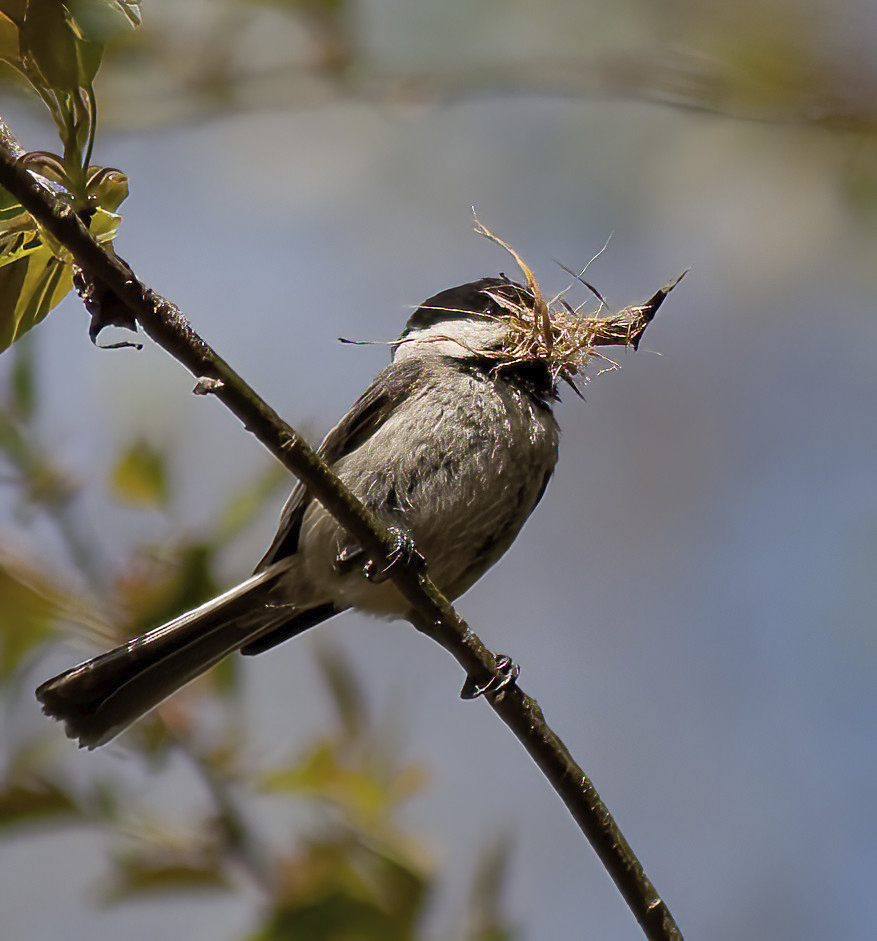
“Chickadee” – Clayton Joe Young – http://www.joeyoungphoto.com

 . 
All the Meaningful Noise
 . 
How can you be on this earth
and not close your eyes on occasion
and listen to leaves give voice to wind,
hear the laugh of crow,
annunciation of blue jay,
moan of mourning dove,
all the meaningful noise
of another spring day?
 . 
Behind the finishing plant
just off the run-down road
between failing furniture towns,
a field is bursting with purple flowers.
If you close your eyes
you can hear the cosmos opening.
 . 
Scott Owens
from An Augury of Birds, forthcoming from Redhawk Publications; poems by Scott Owens, photography by Clayton Joe Young
 . 
❦ ❦ ❦
 . 
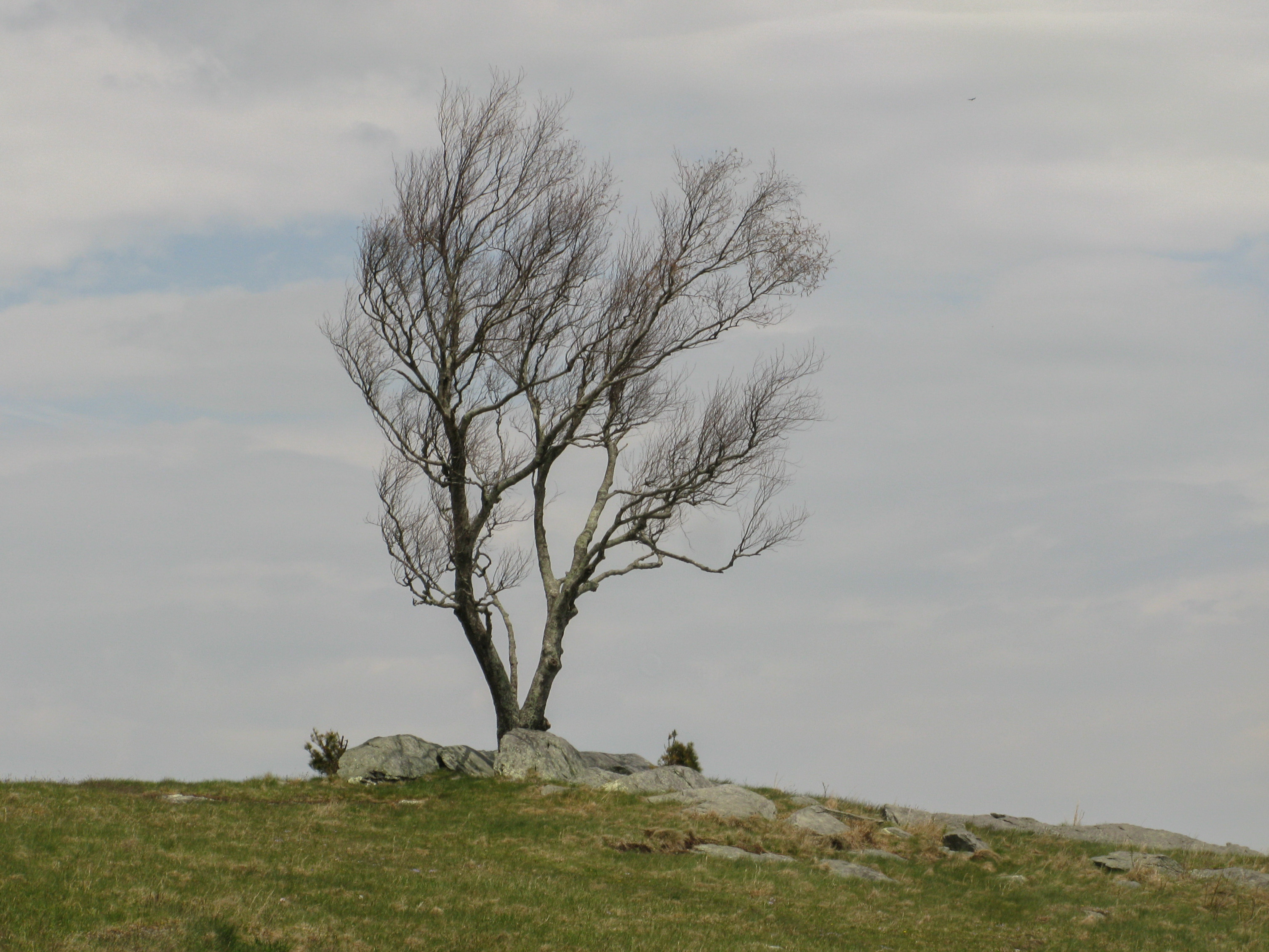
2020-06-11a Doughton Park Tree
 . 

Read Full Post »

 . 
[with 3 poems by Joy Harjo]
 . 
And the blessing began a graceful moving through the grasses of time, from the beginning, to the circling around place of time, always moving, always
++++++++ from Bless This Land, Joy Harjo
 . 
 . 
The Story Wheel
 . 
I leave you to your ceremony of grieving
Which is also of celebration
Given when an honored humble one
Leaves behind a trail of happiness
In the dark of human tribulation.
None of us is above the other
In this story of forever.
Though we follow that red road home,
one behind another.
There is a light breaking through the storm
And it is buffalo hunting weather.
There you can see your mother.
She is bus as she was ever –
She holds up a new jingle dress, for her youngest beloved daughter.
And fo her special son, a set of finely beaded gear.
All for that welcome home dance,
The most favorite of all –
when everyone finds their way back together
to dance, eat and celebrate.
And tell story after story
of how they fought and played
in the story wheel
and how no one
was every really lost at all.
 . 
Joy Harjo
from An American Sunrise, W. W. Norton, New York NY, © 2019
 . 
❦ ❦ ❦
 . 
Last night I sat silent on stage waiting as a few early arrivals took their seats in the audience. We singers had a few more selections to rehearse before filing out to prepare our official entrance, and for now we waited. Shouldn’t I have been anxious in anticipation of the harmonies we would soon raise together? Shouldn’t I have been thrilled as the strings took their places and began to tune their instruments? Shouldn’t joy live here?
 . 
No, something dark nagged me. My heart was stone. I felt suspicious of these watchers, listeners. I was afraid of their grand and thriving church. I distrusted what they would think of me if they in turn suspected I didn’t think or believe precisely as they did. I told myself I was already rejected, on the outside. I didn’t belong here.
 . 
Joy Harjo writes, The old Mvskoke laws outlawed the Christian religion / Because it divided the people. / . . . But Mvskoke ways are to make relatives. Where is the religion that makes relatives? People, plants, creatures, everything together as family? A religion that turns all people to face each other within the circle rather than turning them out? Linda and I had been thrashing with recent revelations that people were leaving our son’s church because one of the ministers has come out as gay. These people leaving – we thought we knew them, we considered them neighbors. We don’t understand the rejection, the turning apart. How can we understand?
 . 
When our chorus returns to our places before a full house, I don’t recognize many faces. But I do know a few, some from years in the past, and I remember I love them. Now lift our voices together and sing of a Creator who is always with us. We sing longing and loss, humor and fullness, songs like rivers that course and meander a long journey, that carry all the weight of time and earth. I sing. And at the end of the singing we have become one family.
 . 
The heart of stone has only hardened itself. Everything that lives wants to soften that heart. Everything that lives wants to open each heart to beauty and truth.
 . 
 . 
❦ ❦ ❦
 . 
from Exile of Memory
.    .    .
In the complex here there is a singing tree.
It sings of the history of the trees here.
It sings of Monahwee who stood with his warrior friends
On the overlook staring into the new town erected
By illegal residents.
It sings of the Civil War camp, the bloodied
The self-righteous, and the forsaken.
It sings of atomic power and the rise
Of banks whose spires mark
The worship places.
The final verse is always the trees.
They will remain.
.    .    .
When it is time to leave this place of return,
What will I say that I found here?
 . 
From out of the mist, a form wrestled to come forth –
It was many legged, of many arms, and sent forth thoughts of many colors.
There were deer standing near us under the parted, misted sky
As we watched, the smelled for water
Green light entered their bodies
From all leaved things they ate –
.    .    .
The Mvskoke laws outlawed the Christian religion
Because it divided the people.
We who are relatives of Panther, Racoon, Deer, and the other animals and winds were soon divided.
But Mvskoke ways are to make relatives.
We made a relative of Jesus, gave him a Mvskoke name
.    .    .
We could not see our ancestors as we climbed up
To the edge of destruction
But from the dark we felt their soft presences at the edge of our mind
And we hear their singing.
 . 
There is no word in this trade language, no words with enough power to hold all this we have become –
 . 
Joy Harjo
from An American Sunrise, W. W. Norton, New York NY, © 2019
 . 
❦ ❦ ❦
 . 

IMG_0262

 . 
❦ ❦ ❦
 . 
An American Sunrise opens with a map of a trail of tears, that of the Muscogee Creek Nation’s forced displacement to Oklahoma from their native homelands near Talladega, Georgia in the 1830’s. One of many trails of tears. In Joy Harjo’s preface she includes this plea and blessing: May we all find the way home.
 . 
Toward the close of the book, Joy Harjo describes how her Great-Grandfather Monahwee could bend time. The entire book is an experience of time and place bending, fluid, circular, all connected. We hear the voices of ancestors and offspring. We hear the voices of creatures on earth and of Earth herself. We are torn by hatred and injustice – we bleed. We smell the smoke of cook fires at dawn and feel the sun on our face – we are fed. We are challenged and re-challenged to connect ourselves to the thread of life that weaves through all people and all creation and leaves nothing out. As the poet says, Nobody goes anywhere / though we are always leaving and returning. And her experiences are, as for all of us . . . the giving away to history which in no means meant giving up. For a warrior it is not possible to give up. 
 . 
For any of us to find home, we must all find home. We must all witness cruelty and kindness in this land. From the book’s final poem, Bless This Land: Bless us, these lands, said the rememberer. These land aren’t our / lands. These lands aren’t your lands. We are this land. May the poems and the songs bring all things into our memory and show us the way.
 . 
 . 
An American Sunrise, Joy Harjo; W. W. Norton & Company, New York NY © 2019. Joy Harjo served as Poet Laureate of the United States for three terms, 2019 through 2021.
 . 
❦ ❦ ❦
 . 
Beyond
 . 
Beyond sunrise, there is a song we follow
Beyond clouds traveling with rain humped
On their backs, lightning in their fists
Beyond the blue horizon where our ancestors
Appear bearing gifts, wrapped in blankets woven
With sun and strands of scarlet time
 . 
Beyond the footpaths we walk every day
From sunrise to kitchen, to work, to garden, to play
To sunset, to dark, and back
 . 
Beyond where the baby sleeps, her breath
A light mist of happiness making
A fine rainbow of becoming knowledgeable around us.
 . 
Beyond the children learning alphabets
And numbers, bent over their sticks and dolls
As they play war and family, grow human paths
 . 
Beyond the grandmothers and grand fathers
Their mothers and fathers, and in the marrow of their bones
To when that song was furs sung we traveled on
 . 
Beyond sunset, can you hear it?
The shaking of shells, the drumming of feet, the singers
Singing, all of us, all at once?
 . 
In the song of beyond, how deep we are –
 . 
Joy Harjo
from An American Sunrise, W. W. Norton, New York NY, © 2019
 .  
 . 
❦ ❦ ❦
 . 
Doughton Park Tree 2020-06-11a
 . 

Read Full Post »

 . 
April 15, 2024
 . 
In the end we will conserve only what we love.  
+++ We love only what we understand. 
++++++ We will understand only what we are taught.
+++++++++ Baba Dioum, Senegalese environmentalist
 . 
Everyone enjoys the smell of earth after rain. No one wants to cough every breath.
Everyone thirsts for a drink of cool water. No one wants to sicken from drinking it.
Everyone needs bread. No one wants to go hungry.
 . 
On April 22, 2024 every human being will wake up on the only planet where humans can live (well, not counting a handful of folks waking up on the International Space Station). Seems like cause enough to celebrate! To be honest, though, the threat of what we have lost and are losing so often seems much greater than the joy of what we have saved and are preserving.
 . 
How far have we come since the first Earth Day in 1970? It was just eight years earlier that Rachel Carson published Silent Spring, the wake up call to industrial pollution and the poisoning of the earth. In 1970 there was no Environmental Protection Agency, no Occupational Health and Safety Administration, no Clean Air Act or Clean Water Act. When we protested air and water pollution, we had little inkling of the even greater threat; we couldn’t imagine needing an Intergovernmental Panel on Climate Change.
 . 
Twenty million Americans marched, demonstrated, and celebrated that first Earth Day. Ten percent of the nation’s population. I was a junior in high school photographing our events for the year book: carrying a coffin through the parking lot to signify the dying planet. Earth Day is now celebrated in 193 countries; one billion people are expected to commemorate Earth Day 2024. That still leaves some eight billion to get on board. Legislation and politics won’t take us there. In the end we will conserve only what we love.
 . 
❦ ❦ ❦
 . 
I think it pisses God off if you walk by the color purple in a field somewhere and don’t notice it. People think pleasing God is all God cares about. But any fool living in the world can see it always trying to please us back. . 
+++++++++ Alice Walker, The Color Purple
 . 
 . 
❦ ❦ ❦
 . 
The Field Index
Abandoned field, Orange County, North Carolina
 . 
Asters: lesser stars in these constellations, for the native bees, late-summer smatterings of a color I might call blue, blue petals and fireworks along the margins of the track, and
 . 
broomsedge, bluestems: stooped in the fall and shimmering, shivering in the wind, spinning out seed, bird fodder, tangled (insert here) into brambles, blackberries, this year’s, last year’s canes knotting and weaving, and
 . 
crabgrass: crabby claw and crab leg of a herb: edges into the wilding mint and onion grass, the tall stands of raggedy, wing-stemmed (my favorite) crownbeard gone to seed, where I am with my small dog, and
 . 
dogwood: not here yet, but it will come; also redbud (q.v.) and holly; the birds will bring it, in their guts, its white bracts and inconspicuous flowers, its small understory leaves will open and turn into the sunlight, before the canopy leafs out and shades
 . 
exotics: migrants, stowaways and hitchhikers, too much at home; see invasives, stiff-stemmed privet with its small dark leaves, and the clustered graceful arcs of autumn olive, honeysuckle vines, dead stiltgrass flopped into heaps, good for nothing except time
 . 
ferns: rise and unfurl like our letter f, old as fossils, here before letters and fiddles and bows and Michaux and his acrostics, first and last green under the trees, with
 . 
ghost plants: the ancestors, clusters rising from damp, unsunned patches of leaves along the margins of wood;  also: smatterings of green-and-gold, the droop-headed goldenrod
 . 
honeysuckle: announcing itself in scent on the wind and winding up and around the living and the dead: colors coral (see natives), creamy white curling to yellow (see exotics)
 . 
invasives, see exotics; index of vexed and vicious cycles; see also, kill
 . 
jaywalkers: I, alive, among others, on and off the old farm road, on pirate paths, seed-spreader, compacting soil, alarming insects and deer, stealing berries and sprigs and twigs and clumps of lichen or moss, colored leaves, I
 . 
kill: by ice and drought, sapsuckers, larvae, blight, competition, succession (it happens, why do I grieve?), deer rub and browse, humans; see jaywalkers
 . 
loblolly pine: its spiny cones and bundles of three long needles green, or fallen and draped in the shrubberies; aka oldfield pine, straight up, above all, old-meadow native homesteader in the lobby-lolly soil of this wide floodplain
 . 
milkweed: var. swamp milkweed, its pink inflorescence and faint scent, drawing monarchs among butterflies and pollinators, queen of weeds, fecund, its large brittle-dry pods burst and spewing cloudy seed over the bewilding meadow
 . 
 . 
natives: as in, before our time here, before this language and its metaphors and usages, before people, and which we watch with sorrow as they fall back and dwindle, are cut down; see exotics, see
 . 
oaks, passim, and Osage orange, spiny along the branch bank, its large green nobble-skinned fruit fallen in the path and long grass, bitter, slow to blacken and rot, unscavenged by all but small seed-eaters
 . 
persimmon (native), privet (not; see exotics): one, provender for all comers, all creatures, i.e., small bell-shaped flowers, small sweet ripe fruits; the other just minding its own business, i.e., to thrive
 . 
Queen Anne’s lace: umbels and fine-cut leaves, branching stems, aka wild carrot and medicine, queen unknown and from elsewhere, and the lace medallions for her bodice and gown, for her headdress, her cuff, all scattered to the people (winged and crawling insects), self-seeding
 . 
red cedar: modest, upright, native, pioneer in this process of succession, spindle of evergreen and scent rolled between the fingers (here I am again, breaking the rule of no taking and leaving of souvenirs); and redbud: see understory, flights of pink-purple blossom in the spring woods, pleiades, announcing light and wings again, after all that
 . 
stiltgrass: Japanese, Microstegium vimineum, in summer blithe, feathery and green under the trees over creeper and grass, but poor food, tick haven (see exotics; see also  jaywalkers); and sweetgum: all over this old field, native and opportunistic, prolific and prodigal, Liquidambar of the spiny round seedhead and star-shaped, lobed leaves, their margins calling to mind (my mind) calligraphy or the gestures of dance, delight of form that is mutable and has prickly edges, deliquescence, decadence, a nuisance, really
 . 
tulip tree: tulipifera, the saplings standing here and there, innocuous, like any other small tree, but give them time, they’ll rise; the yellow-and-pale green petals of their flowers say in English “tulip,” the Tutelo-Saponi name lost, yellow-green the heartwood, yellow the leaves in fall, and early to fall
 . 
azalea
 . 
understory: native holly and redbud and dogwood, parsimonious and irregular in habit, sparse fruit, sparse flower; now also autumn olive, privet, and exotic forbs and grasses, the introduced and naturalized, myself and dog under the canopy
 . 
vines: Virginia creeper, close-to-ground native; grape vine, gangly fox grape, looping and loping up branch and stem, dbh often equal to small trees; poison ivy, not the inconspicuous three-leaved forb of the northlands, but (learn this, human) rampant, thick-stemmed, hairy vine, stuck fast to the trunks of trees
 . 
winged elm: small tree of delicate, dry stem, and long, corky flanges along its branches; old (to my eye) before it’s old, strange (to my eye); unknowable why those wings
 . 
x: Xanthium through Xyris in Radford’s Manual, as in chicory and the yellow-eyed grass; also, a sign for canceling and for marking you are here, this is the place, this, my mark, my thumbprint
 . 
yellow poplar: see tulip tree and weep
 . 
zigzag: of silk in the web of the orb-weaving spider, homespun look-at-me and distraction, quirk among zoologies of abandoned gardens and meadows; zee, zed, the end of bee flights and alphabets
 . 
Maura High
 .
 . 
Notes:
Acrostic: Med. Lat. acrostichis, from Gk. akrostikhis, from akros“at the end, outermost” (from PIE root *ak– “be sharp, rise (out) to a point, pierce”) + stikhos “line of verse,” literally “row, line,” from PIE root *steigh- “to stride, step, rise” [Online Etymological Dictionary]. The Christmas fern’s botanical name is Plystichum acrostichoides (Michaux) Schott.
André Michaux (1746 –1802), French botanist, author of Flora Boreali-Americana (1803; “The Flora of North America”), made at least five visits to North Carolina.
Loblolly: Pinus taeda, From Wikipedia: The word “loblolly” is a combination of “lob,” referring to the thick, heavy bubbling of cooking porridge, and “lolly,” an old British dialect word for broth, soup, or any other food boiled in a pot. In the southern United States, the word is used to mean “a mudhole; a mire,” a sense derived from an allusion to the consistency of porridge. The pine is generally found in lowlands and swampy areas.
Manual of the Vascular Flora of the Carolinas, by Albert E. Radford, Harry E. Ahles, and C. Ritchie Bell (Chapel Hill: University of North Carolina Press, 1968). Commonly known as Radford.
Pleiades, Gk., perhaps literally “constellation of doves” from a shortened form of peleiades, plural of peleias“dove” (from PIE root *pel-“dark-colored, gray”) [Online Etymological Dictionary].
 . 
Shared by Paul Jones, Chapel Hill NC, who writes:
 . 
Maura High knows her field from A to Z. She sings individual songs of the particularity of the place so clearly and precisely that we learn and love the place as she does. Field Index is an ideal field guide to place and the places of nature that compose this quilted lively patch of our earth.
 . 
Every day as I walk my own favorite patch of the planet, Merritt’s Pasture and Morgan Creek, I keep Field Index in mind as a guide that shows how to attend to this world and to prepare for the next.
 , 
+++++++ Paul
 . 
 . 
On an Okra Flower
 . 
A pollinating wasp sliding
from white lip to purple darkness,
the shadow-heart so deep inside,
the plant, itself, tall African
in the kitchen garden’s last row,
speaks of passage and endurance,
those far too common abstractions,
made real here in the summer heat.
 . 
Let it lead us, serve as a guide,
tell how each struggle leads to bliss
and what to bless when we decide
to see the past and present blend
into what we need to know
– a mind aware or in a trance? –
what to keep close, what to shun
made real hear in the summer heat.
 . 
What song can a wasp sing gliding
the flower’s dark throat? A long kiss
like winged tongues tangled deep inside –
a blind passion, an obsession.
I hear it as a prayer now,
music for the world’s whirling dance.
Sound, sight and scent. An orison
made real here in the summer heat
 . 
Paul Jones
from Something Wonderful, Redhawk Publications, Hickory NC, © 2021
 . 
❦ ❦ ❦
 . 
A man’s feet must be planted in his country, but his eyes should survey the world.
++++++++ George Santayana
 . 
To celebrate EARTH DAY 2024 we are featuring seven posts of poems submitted by readers – poems by William Blake to Walt Whitman, Robinson Jeffers to A.R.Ammons to Linda Pastan, and a number of contemporary poets. Check in every day or two – connect to the earth and to each other!
 . 
 . 
Doughton Park Tree 4/30/2022

Read Full Post »

« Newer Posts - Older Posts »