Feeds:
Posts
Comments

Posts Tagged ‘wild flowers’

[with 3 poems by Richard Widerkehr]

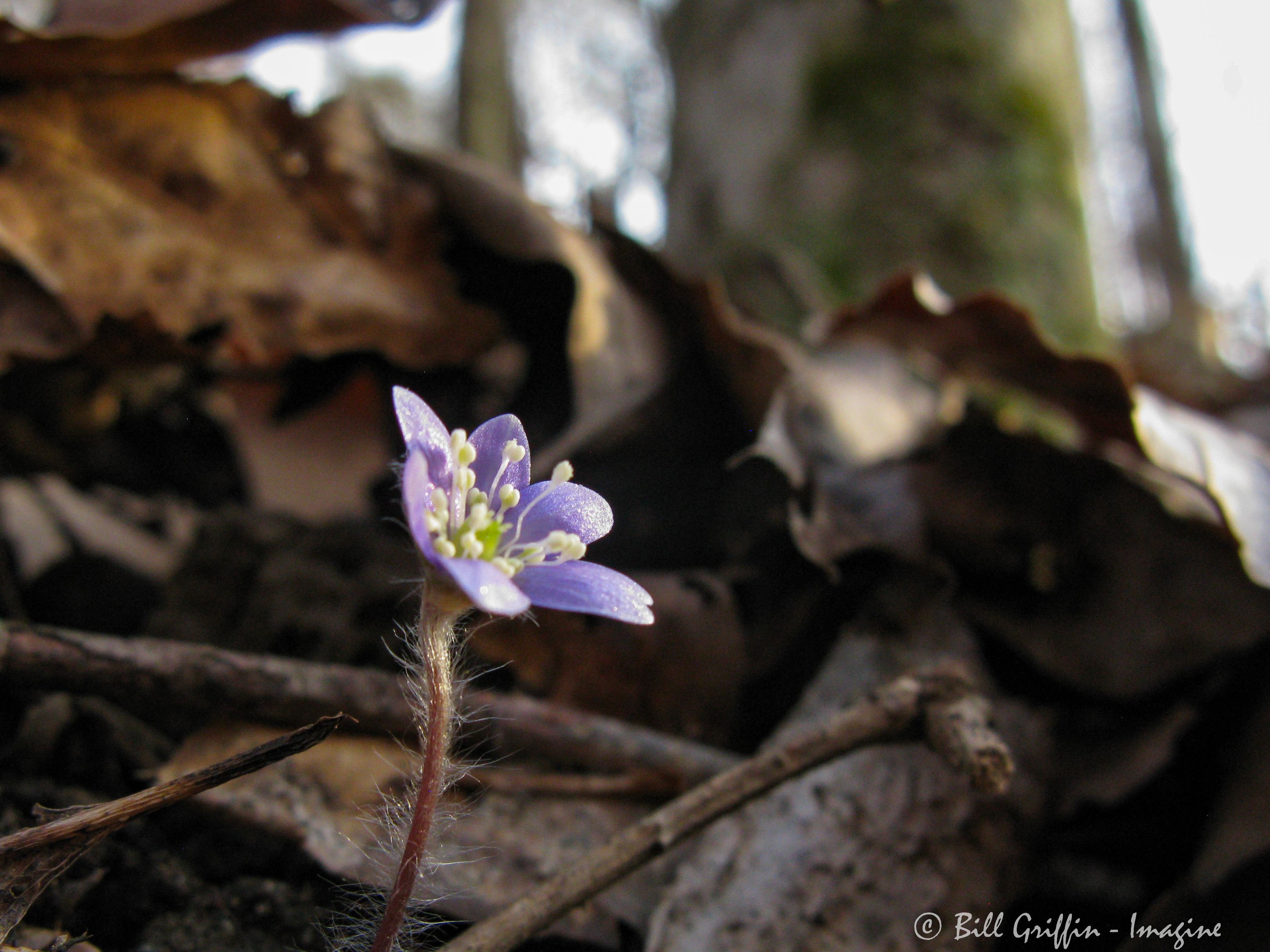
Cold March drizzle makes Hepatica nod and droop. Nevertheless, the twelve accompany me undaunted on a naturalist hike along Elkin Creek. What will we discover? Here are the last few Hepatica blossoms of the year; their sister plant opened her first bloom along this trail on February 7, five weeks earlier. Now a single flower on each silky hairy scape looks down at its feet, the winter-pocked liverleaves also fading ahead of summer’s foliage. It’s cold this morning and the vernal equinox is still three days off.

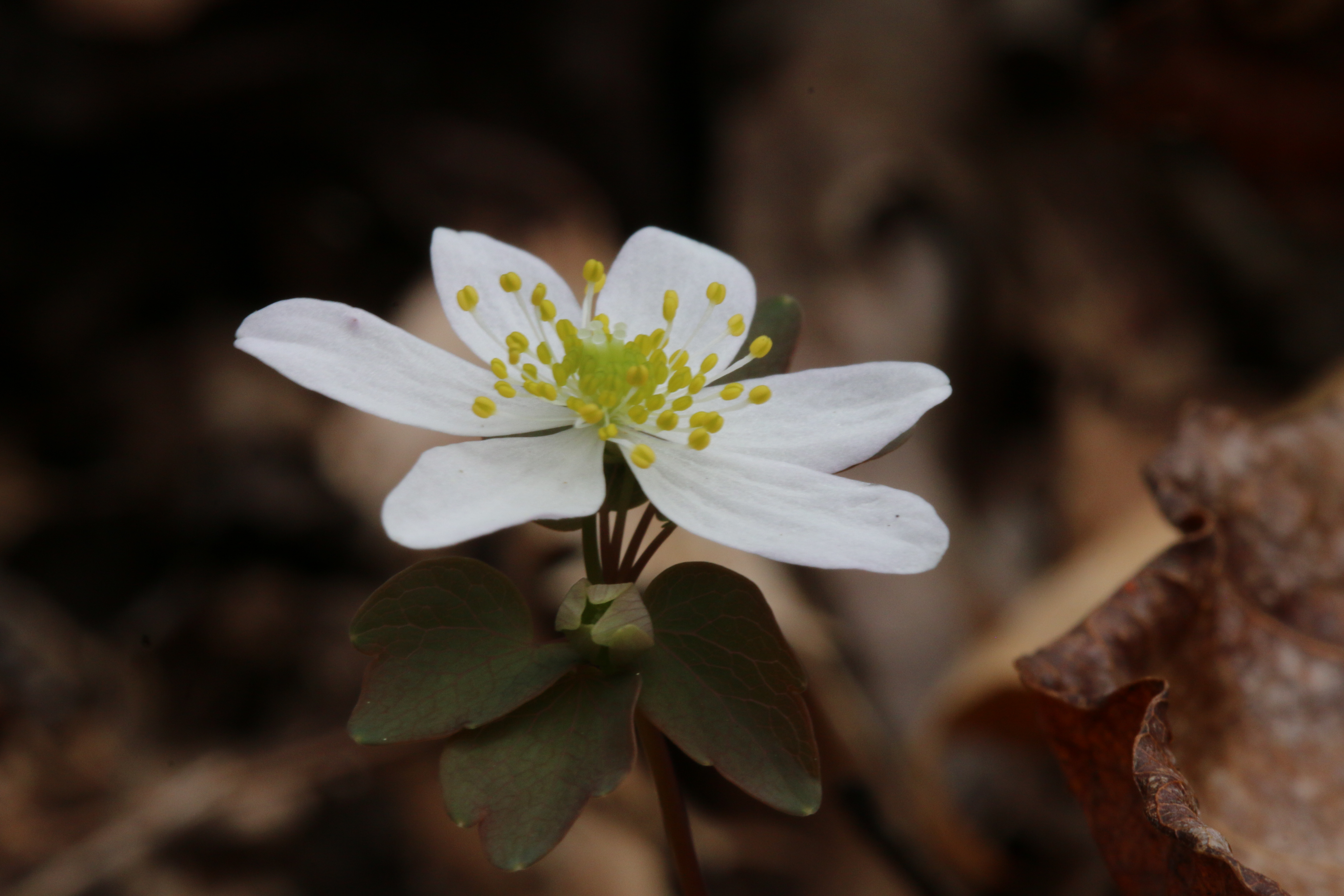
But cheek by jowl with old Hepatica are fresh patches of its second cousin, Rue Anemone. No drooping at all! Both from the same family (Buttercup, Ranunculaceae), the two flowers share many features and from a distance look similar – our crew’s task is to learn to tell them apart. Both are easily overlooked, pale blooms only a cm. or so in diameter, with 6-10 petals and a jostle of stamens crowding multiple pistils clumped in the center. Even color is not a reliable clue: the pale Hepatica in this neutral soil is only one shade of lavender removed from Anemone’s white. Rue Anemone’s smooth slender flower stem is one giveaway, and then of course the leaves, Anemone’s fine clusters like little paws climbing toward the bloom, contrasted with Hepatica’s broad, basal, waxy lobes, each like a liver. What some might casually mistake for a clump of sameness, in haste undifferentiated, what we ourselves might at first glance have misidentified have now become familiar, individual: each uniquely itself.

❦ ❦ ❦

A Sabbath of Complete Rest

I’ve been thinking what that might mean, so I listen
to the wind in the fir trees outside our red house –
how the trees stand almost like horses asleep on their feet,

how their roots touch crevices in soil, how at night
their branches, blacker than the sky, must not forget
yellow forsythias, summer, their own dark needles,

how they wait, how they’ve waited. This is no psalm
of light, Chloe, no song of white horses in the sun.
The root of the word Shalom means complete.

Richard Widerkehr
from At the Grace Café, Main Street Rag Publishing, Charlotte, NC, © 2021

❦ ❦ ❦

How does a poem draw you in? How does it invite you to live in the world it creates? Place must be one way. Just a few pages into At the Grace Café, I realize I’m damp and about to shiver in the Pacific Northwest. Not that it’s raining absolutely all the time – the great dark firs lifting their heavy sleeves also propel me into the landscape. A trail through clouds and mist leads me. A swirling lake shore is mysterious and at once consoling.

Personality is another thread that weaves through these poems and entangles me: the writer’s sister, her mental illness an elusive and threatening animal that speaks wild into every situation; his mother, reminding us that each of us must live a portion of our lives in denial; and the personality of the writer himself, illuminated by recurring heartbreak in his work as counselor and by longing for stability and resolution. Personalities approach and retreat, promise to reveal just as they again withhold – all I can do is hold on and join the dance.

Finally there is joy. Not waiting beyond all conflict or at the conclusion of all sorrows, rather joy that emerges from and lives within these troubles that we all, confess it, share. A fleeting moment with one’s beloved, a brief lifting of fog, moon on snow – a simple singular presence can form us into fellow sojourners. The poem can make us family. The poem may grant us grace.

❦ ❦ ❦

Pay Attention, You Say

No, I haven’t read updates about the orca
+++ nursing her dead calf. I try not to get
upset about too many things. Lately,

I write these poems for my sister –
+++ I can’t spare the least insect or angel,
she says. Yes, plankton lined with oil

covers some sea beds. I’ve seen orcas
+++ breach the surface, black and white,
their bodies like mountain sides

sliding under. When we were kids,
+++ my sister and I caught a tiny fish –
she cried, and our mother threw it back.

Yes, there’s the sadness of plankton,
+++ the orcas, snow fields at night.
Last evening on this mental health unit

where I work, a patient I’ll call Carla –
+++ she’d cut her left wrist – she said,
Some scars are mercy and justice.

I let out my breath. At least my sister
+++ no longer sleeps with the moon
in her cardboard box. Now

you point out two otters on the bank
+++ of No Name Slough, how they
their small black eyes on us.

Richard Widerkehr
from At the Grace Café, Main Street Rag Publishing, Charlotte, NC, © 2021

❦ ❦ ❦

Crane Flies
O for a Life of Sensations rather than of Thoughts! – John Keats

In late August, the crane flies
come back, nervously feeling their way
up windows, trying to get out. They flutter
like huge, scatter-brained mosquitoes,
scraping this way and that, sometimes just
hanging as they flex their long
front legs like feelers, emitting
a dull, frustrated buzz.
++++++++++++++++++ Is it light
they want, the world outside?
They can’t get used to glass, its cool
way of whispering about the uselessness
of struggle, also its dry comments
on their death flights.

Each time I sweep these nutty insects
out the window, more fly in, as if
I were the absence they brush against,
their life of sensations
come to an end.

Richard Widerkehr
from Disappearances, The Wind Room Series #4, Radiolarian Press, © 1996, 2003
rue anemone

❦ ❦ ❦

Richard Widerkehr has a new book from Shanti Arts Press, Night Journey. Richard has taught writing in the Upward Bound Program at Western Washington University and has worked as a case manager for the mentally ill.

❦ ❦ ❦

IMG_0880, tree

Read Full Post »

[an essayette by poet Ross Gay and a poem by Bill Griffin]

Joy is Such a Human Madness: The Duff Between Us

Or, like this: in healthy forests, which we might imagine to exist mostly above ground, and be wrong in our imagining, given as the bulk of the tree, the roots, are reaching through the earth below, there exists a constant communication between those roots and mycelium, where often the ill or weak or stressed are supported by the strong and surplused.

By which I mean a tree over there needs nitrogen, and a nearby tree has extra, so the hyphae (so close to hyphen, the handshake of the punctuation world), the fungal ambulances, ferry it over. Constantly. This tree to that. That to this. And that in a tablespoon of rich fungal duff (a delight: the phrase fungal duff, meaning a healthy forest soil, swirling with the living the dead make) are miles and miles of hyphae, handshakes, who get a little sugar for their work. The pronoun who turned the mushrooms into people, yes it did. Evolved the people into mushrooms.

Because in trying to articulate what, perhaps, joy is, it has occurred to me that among other things–the trees and the mushrooms have shown me this–joy is the mostly invisible, the underground union between us, you and me, which is, among other things, the great fact of our life and the lives of everyone and thing we love going away. If we sink a spoon into that fact, into the duff between us, we will find it teeming. It will look like all the books ever written. It will look like all the nerves in a body. We might call it sorrow, but we might call it a union, one that, once we notice it, once we bring it into the light, might become flower and food. Might be joy.

from The Book of Delights, Ross Gay, Algonquin books of Chapel Hill, © 2019

.     .     .     .     .     .     .

My daughter Margaret gave me this book by Ross Gay for my birthday in 2020 and it’s been waiting patiently with its companions on the to-be-read-someday shelf until this month. I flipped it open and read a couple of the daily musings on delight (a page or two, observations and reflections that Ross decided half-way through the project to call essayettes). They are like a Whitman’s Sampler – once you’ve opened the box you know you’re going to eat every one.

So I’ve left the book beside the couch and picked it up when random minutes offered themselves unfilled. It’s hard to read just one or two, though – coffee has cooled and soup has threatened to boil over.

This particular entry, though, stopped me in my tracks. I read it over and over. Not only because it followed the amazing interview with Merlin Sheldrake I had just discovered in the May issue of The Sun, all about mycorrhizal networks and sentient fungi and the meaning of life and everything, but because of the way Ross Gay interweaves joy and sorrow and delight and death. Maybe he is right, as many of his essayettes seem to suggest – if we face the one thing we all share in common, which is death, and even God forbid talk about it, maybe we can discover that it is possible to step past the fear into a space that reveals joy – delight – every day.

Which is to say: Hey, life is suffering – along the way let’s you and I share a little delight.

.     .     .     .     .     .     .


Rule #1 No Hurting

I tell you this while you whack me
with your little plastic hammer: what I mean
is no hurting other people, not that you
could really damage me
with those little boy hands I love
but sometimes it does sting. Maybe I’m worried
about your buddies at playschool: hitting
begets automatic time out. Or do I mean
your Mom and Dad: see their tears
when you fall? When you are bruised?
And pain you can’t see: someday
you are bound to bruise their hearts.

How we do hurt each other, and how
could it be otherwise, two souls
all entangled while we stumble,
lash out, grab for help, and I
won’t tell you now but I know this:
you will hurt me too, although I
will have handed you the knife
of loving you and hoping
life won’t leave its scars.
But this is what Rule #1 doesn’t mean:
No hurting inside. I’m sorry, Grandson,
no platitudes about for your own good
you will suffer because you too
are human and our world makes no
distinction. Just remember Rule #2:
I will cry with you.

Bill Griffin

from Tar River Poetry, Vol. 55, Nr. 2; Spring, 2015

.     .     .     .     .     .     .

Additional links for Ross Gay:

Review of The Book of Delights

Books

The On Being Project


.     .     .     .     .     .     .

Read Full Post »

[with poems by Joan Barasovska and Kathy Ackerman]

Everything or nothing. The radio is off. The screen is frozen. The refrigerator snores. The clock won’t tick any faster, any slower. In an hour we leave for Raleigh to see our grandson (backyard, distanced, masked) but right now nothing is happening

I’m no good at nothing. If I wake in the dark my brain whirls venom trying to bite its tail. Where is dawn’s blessed peace? If I take deep breaths, watch the feeder, daily agendas begin to scroll down the back of my cornea. How many seconds after emptying myself before I fill back up with everything?

We are entering the season of nothing. The azalea may feint a few off-season blossoms but will we ever bloom again? We are in the season of waiting. Where is the so fragrant earth we lost so long ago? Where is the muscle and spunk of summer that convinced us we might carry through? The season of turning. What justice like waters, what righteousness like an ever-flowing stream? When? How do these shortened days stretch so long?

In the woods, something is happening. Orchids are making sugar. How have I missed that? One species will bloom in May, the second in August, but their leaves are now. Their delicate little tenacious tough-ass corms swell all winter waiting to rocket up a spike of summer flowers into a leafed-out overshaded world.

Something is always happening. Something is deeper than those scrolling agendas. Something in the world and something behind my optic chiasm in deep matter. Something that maybe wants me to be still and notice. Something to hope for, to wait for, to go forth and meet.

There is no nothing. It’s all everything.

.     .     .     .     .     .

These two poems are from Kakalak 2020, the annual anthology of Carolina poets. It is an eclectic volume – conversational, confessional, contemplative. Not as many COVID poems as I expected but wait until 2021.

The poems by Joan Barasovska and Kathy Ackerman speak to me of the winding thread that connects our past to our present. Knots and tangles, yes, but also a lashing to secure us in the lashing storm. The something that is happening every day is us becoming human.

.     .     .     .     .     .

Cranefly Orchid, Tipularia discolor

.     .     .     .     .     .

Her Breath

Mike and I exchange a glance
over her cooling body.
Our eyes are dry.
Elsie wears a faded housedress
with a pattern of flowers.
Thirty minutes ago
an aide crossed
her swollen hands.

All morning we sat waiting
while Death rattled her.
She died in the afternoon
while we were out walking.
Our mother took a slow
rollercoaster ride to this day,
dragging us with her on
every shivery dip and climb.

Back from the dead,
Mike said when she woke
from a coma, angry to find herself
in a clean hospice room.
She raged until he put her back home.
Frail, sick, ninety-three, hanging on
ten hears after Dad’s death.
She scolded me yesterday.
I was late for lunch.
I had forgotten to pick up her mail.

Their old bed had been replaced
by a narrow hospital bed
rolled in the hospice workers
while she fumed in the living room
and I boiled water for tea.
Now her jaw is slack,
her last silent treatment.
Above her head hangs
a sad-eyed portrait of me at nine,
painted in blues and grays.

Mike and I are limp with relief.
the secret of Elsie’s anger died with her,
but it was probably sadness.
We are second-generation Americans,
inheritors of the sadness seed.

This mother
lying flat between us
birthed me sixty years ago.
With her last breath,
She’s in a better place
and so am I.

Joan Barasovsaka, Kakalak 2020, Main Street Rag Publishing Company

.     .     .     .     .     .

Adam-and-Eve Orchid, “Puttyroot,” Aplectrum hyemale

.     .     .     .     .     .

Misnomer
for Goliath, my father

i.
This story begins when I believed every word my daddy said.
Honeysuckle, he called them, tending the cuttings
that go all the way back to Rock Creek 50 years,
Aunt Gracie’s yard in the hills where I never lived.

Honeysuckle was all I had to root me to that ancient soil,
so every home I bought I planted some
from Daddy’s supply, rooted in plain clear water.
I wondered why it had no scent, was not a vine,
was pink, for crying out loud.

Now shopping for plants for house #5,
I see the truth in 5-gallon pots before me:
Weigela.

I imagine old Aunt Gracie shooing my father away
from her quilting or canning or sitting alone.
Go cut back that honeysuckle
before it swallows up the outhouse.

Later, seeing his mistake, she didn’t correct him –
a name is just a name –
Grace just glared at tiny Goliath
so proud of his mound of pink and green
already wilting

while the roof of the outhouse
still plushed with yellow sweetness
he’d confuse for 80 years
with a plant that belongs
to the same family, after all,
but so much harder to say.

ii.
Start me some honeysuckle, Daddy, I blurt out
in one of awkward lulls.
I want to imagine his hands on the branch,
the snip of sprigs of coal country
where Gracie’s old feist
barked me all the way to the outhouse and back
when I was too small to know
how hard it is
to keep what lives alive.

Kathy Ackerman, Kakalak 2020, Main Street Rag Publishing Company

.     .     .     .     .     .

.     .     .     .     .     .

Let justice roll down like waters, and righteousness like an ever flowing stream.
Amos 5:24

.     .     .     .     .     .

2019-02-09 Doughton Park Tree

Read Full Post »

Older Posts »