Feeds:
Posts
Comments

Posts Tagged ‘NC Poets’

[with poems by Joan Barasovska and Kathy Ackerman]

Everything or nothing. The radio is off. The screen is frozen. The refrigerator snores. The clock won’t tick any faster, any slower. In an hour we leave for Raleigh to see our grandson (backyard, distanced, masked) but right now nothing is happening

I’m no good at nothing. If I wake in the dark my brain whirls venom trying to bite its tail. Where is dawn’s blessed peace? If I take deep breaths, watch the feeder, daily agendas begin to scroll down the back of my cornea. How many seconds after emptying myself before I fill back up with everything?

We are entering the season of nothing. The azalea may feint a few off-season blossoms but will we ever bloom again? We are in the season of waiting. Where is the so fragrant earth we lost so long ago? Where is the muscle and spunk of summer that convinced us we might carry through? The season of turning. What justice like waters, what righteousness like an ever-flowing stream? When? How do these shortened days stretch so long?

In the woods, something is happening. Orchids are making sugar. How have I missed that? One species will bloom in May, the second in August, but their leaves are now. Their delicate little tenacious tough-ass corms swell all winter waiting to rocket up a spike of summer flowers into a leafed-out overshaded world.

Something is always happening. Something is deeper than those scrolling agendas. Something in the world and something behind my optic chiasm in deep matter. Something that maybe wants me to be still and notice. Something to hope for, to wait for, to go forth and meet.

There is no nothing. It’s all everything.

.     .     .     .     .     .

These two poems are from Kakalak 2020, the annual anthology of Carolina poets. It is an eclectic volume – conversational, confessional, contemplative. Not as many COVID poems as I expected but wait until 2021.

The poems by Joan Barasovska and Kathy Ackerman speak to me of the winding thread that connects our past to our present. Knots and tangles, yes, but also a lashing to secure us in the lashing storm. The something that is happening every day is us becoming human.

.     .     .     .     .     .

Cranefly Orchid, Tipularia discolor

.     .     .     .     .     .

Her Breath

Mike and I exchange a glance
over her cooling body.
Our eyes are dry.
Elsie wears a faded housedress
with a pattern of flowers.
Thirty minutes ago
an aide crossed
her swollen hands.

All morning we sat waiting
while Death rattled her.
She died in the afternoon
while we were out walking.
Our mother took a slow
rollercoaster ride to this day,
dragging us with her on
every shivery dip and climb.

Back from the dead,
Mike said when she woke
from a coma, angry to find herself
in a clean hospice room.
She raged until he put her back home.
Frail, sick, ninety-three, hanging on
ten hears after Dad’s death.
She scolded me yesterday.
I was late for lunch.
I had forgotten to pick up her mail.

Their old bed had been replaced
by a narrow hospital bed
rolled in the hospice workers
while she fumed in the living room
and I boiled water for tea.
Now her jaw is slack,
her last silent treatment.
Above her head hangs
a sad-eyed portrait of me at nine,
painted in blues and grays.

Mike and I are limp with relief.
the secret of Elsie’s anger died with her,
but it was probably sadness.
We are second-generation Americans,
inheritors of the sadness seed.

This mother
lying flat between us
birthed me sixty years ago.
With her last breath,
She’s in a better place
and so am I.

Joan Barasovsaka, Kakalak 2020, Main Street Rag Publishing Company

.     .     .     .     .     .

Adam-and-Eve Orchid, “Puttyroot,” Aplectrum hyemale

.     .     .     .     .     .

Misnomer
for Goliath, my father

i.
This story begins when I believed every word my daddy said.
Honeysuckle, he called them, tending the cuttings
that go all the way back to Rock Creek 50 years,
Aunt Gracie’s yard in the hills where I never lived.

Honeysuckle was all I had to root me to that ancient soil,
so every home I bought I planted some
from Daddy’s supply, rooted in plain clear water.
I wondered why it had no scent, was not a vine,
was pink, for crying out loud.

Now shopping for plants for house #5,
I see the truth in 5-gallon pots before me:
Weigela.

I imagine old Aunt Gracie shooing my father away
from her quilting or canning or sitting alone.
Go cut back that honeysuckle
before it swallows up the outhouse.

Later, seeing his mistake, she didn’t correct him –
a name is just a name –
Grace just glared at tiny Goliath
so proud of his mound of pink and green
already wilting

while the roof of the outhouse
still plushed with yellow sweetness
he’d confuse for 80 years
with a plant that belongs
to the same family, after all,
but so much harder to say.

ii.
Start me some honeysuckle, Daddy, I blurt out
in one of awkward lulls.
I want to imagine his hands on the branch,
the snip of sprigs of coal country
where Gracie’s old feist
barked me all the way to the outhouse and back
when I was too small to know
how hard it is
to keep what lives alive.

Kathy Ackerman, Kakalak 2020, Main Street Rag Publishing Company

.     .     .     .     .     .

.     .     .     .     .     .

Let justice roll down like waters, and righteousness like an ever flowing stream.
Amos 5:24

.     .     .     .     .     .

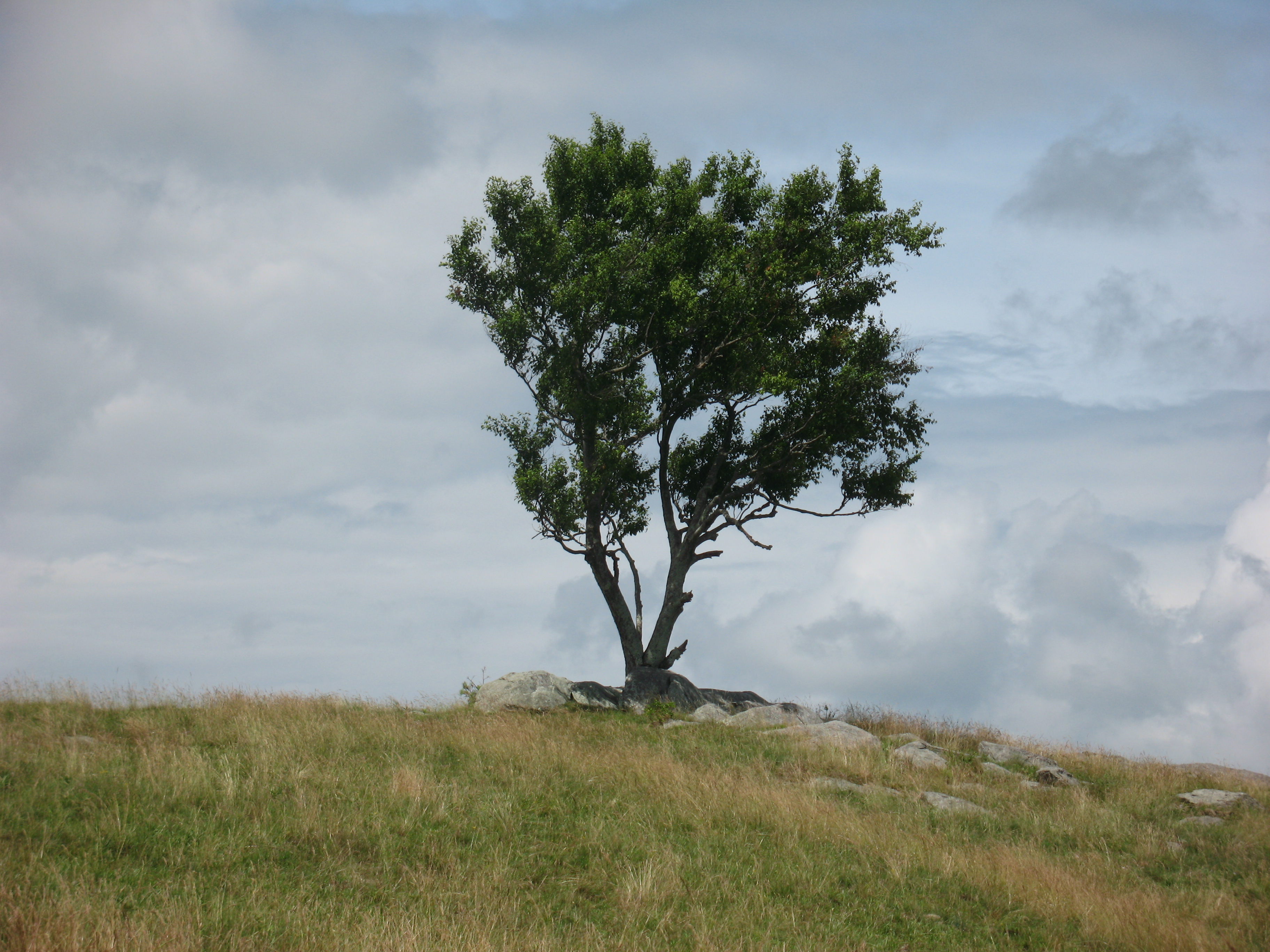
2019-02-09 Doughton Park Tree

Read Full Post »

[with poems by Ryan Wilson and A. R. Ammons]

I didn’t intend to count birds when I set out Tuesday morning. Just a nice weekly hike to Carter Falls and back, a weekday’s solitude – I’m not sure I intended anything more than cooling my brain and heating my muscles. Tamping down the trail maintenance we completed last Saturday. Following the season’s advance into winter.

But then a heron flew out from under the footbridge as I crossed Grassy Creek. Whoever coined the phrase a force of nature was probably in the presence of a Great Blue Heron. Up close they are mute and fearsome. Flying they arouse precognitive awe. When Linda and I encounter one feeding we address it by its nickname: “Hello, Spike.” When one passes overhead we think, “Pterodactyl.” Great Blue demands that one notice.

After gasping at the heron’s sudden flight, I began noticing birds. If they had been calling and singing during the preceding mile my striding deliberation had shut them out. Now they were continuous and various. Counting, I recede and the birds advance.

.     .     .     .     .     .     .

Below are two favorite poems which I return to regularly. They strike me as creating a continuum – the advance of a life toward discovering its meaning, the advance of a life toward its end. I read these and I recede into the lines, but as I read them I expand into my self.

.     .     .     .     .     .     .

At Carter Falls trailhead a Black Vulture perched overlooking; I scanned up past the parking area and saw the roadkill possum the vulture was waiting to ripen. At the Powerhouse (the riverstone foundation, all that’s left of the old generating plant) a Kingfisher daggered up the river and disappeared above the spray. I pulled an index card and a pen out of my pack. Here’s what I came home with:

Great Blue Heron / Belted Kingfisher / Northern Flicker / Red-Bellied Woodpecker / Black Vulture / Turkey Vulture / Carolina Wren / Carolina Chickadee / Tufted Titmouse / Golden-Crowned Kinglet / Eastern Phoebe / White-Breasted Nuthatch / Blue Jay / Eastern Bluebird / Cedar Waxwing / Pileated Woodpecker / Red-Shouldered Hawk / Chipping Sparrow / Northern Mockingbird / American Crow / Common Raven

And since I wasn’t carrying binoculars I’ll just include the numerous chippers and chirpers in the thickets as LGB’s (little gray birds, also sometimes known as LBJ’s, little brown jobs).

.     .     .     .     .     .     .

Face It

A silence, bodied like wing-beaten air,
Perturbs your face sometimes when parties end
And, half-drunk, you stand looking at some star
That flickers like a coin wished doen a weill,
Or when you hear a voice behind you whisper
Your name, and turn around, and no one’s there.
You’re in it the, once more, the stranger’s house
Perched in the mountain woods, the rot-sweet smell
Of fall, the maples’ millions, tongues of fire,
And there, whirl harrowing the gap, squint-far,
Than unidentified fleck, approaching and
Receding at once, rapt in the wind’s spell –
Pulse, throb, winged dark thar haunts the clean light’s glare –
That thin that you’re becoming, that your are.

Ryan Wilson
from The Best American Poetry 2018, first published in The New Criterion

Ryan Wilson was born in Griffin, Georgia and resides in Maryland. Of this poem he writes, “Face It was written in West Virginia at a mountaintop cabin belonging to my great friend, Ernest Suarez. During a break near dusk, I stepped out onto the porch, from which one can see more than fifty miles on a clear day. I was tantalized by a hawk hovering in the western gap, how it seemed to approach and to recede at once on the wind, never near enough for me to identify its species, or even its genus.”

.     .     .     .     .     .     .

Finishing Up

I wonder if I know enough to know what it’s really like
to have been here: have I seen sights enough to give
seeing over: the clouds, I’ve waited with white
October clouds like these this afternoon often before and

taken them in, but white clouds shade other white
ones gray, had I noticed that: and though I’ve
followed the leaves of many falls, have I spent time with
the wire vines left when frost’s red dyes strip the leaves

away: is more missing that was never enough: I’m sure
many of love’s kinds absolve and heal, but were they passing
rapids or welling stirs: I suppose I haven’t done and seen
enough yet to go, and anyway, it may be way on on the way

before one picks up the track of the sufficient, the
world-round reach, spirit deep, easing and all, not just mind
answering itself but mind and things apprehended at once
as one, all giving all way, not a scrap or question holding back.

A. R. Ammons
from The Best American Poetry 2018, first published in Poetry

Archie Ammons was born outside Whiteville, NC in 1926, attended college in Wake Forest, NC, and taught at Cornell for over 34 years. He was guest editor of The Best American Poetry 1994. He died February 25, 2001. A two-volume set of his collected poems was published by W. W. Norton in 2017.

.     .     .     .     .     .     .

.     .     .     .     .     .     .

2014-07-13 Doughton Park Tree

Read Full Post »

[with three poems by Glenis Redmond]

She wanted you to have this to remember her by. Callie’s niece hands me a simple paper gift bag, pink with a heart, like you’d give your sweetie on Valentine’s. It’s heavy. I lift the thick book from inside carefully because the front cover has already fallen away. Onionskin leaves are curling. A Holy Bible.

During my forty years as a small town family doctor my patients occasionally gave me little gifts and mementos. The tomatoes and squash and sacks of Brushy Mountain apples I shared with the staff then took the rest home, but the knickknacks piled up on my desk and bookshelves. Handcrafts and little painted figurines, usually of an old time doctor. Inspirational plaques. Paperweights and ornaments. Bric-a-brac.

I retired September, 2020. What to do with all this stuff? If it’s flat I file it in a scrapbook: crayon drawings kids made while they waited, photos, thank-you’s (and a few angry letters – I saved those, too). The most interesting, which I remove from its frame, is the February 20, 1927 Honorable Discharge from the Army of Ellis, who died November 20, 2005, age 100. His niece thought I should have it.

Callie’s niece enclosed a sweet card with the well-read Bible. It sat under my desk at the office in its pink bag for years and now it’s nudging my right foot under my desk at home. All my shelves are packed, stacked, stratified. Most of that other bric-a-brac, after girding my loins, I threw away. How do you throw out a Bible? I certainly don’t need another one – I’m not going to try to count all the versions and editions on my shelf (and there are eleven Bibles in an app on my iPhone). Callie’s Bible doesn’t include any inscription, not even her name, no family births and deaths recorded, nothing personal. Except that from Genesis to Revelation there are small x’s penciled along the beginning of each chapter, maybe to mark how far she’d read that day. And the pencil is still there, stuck between the pages.

Is it even possible to throw away a Bible? Not today. Back under the desk you go.

.     .     .     .     .     .     .

I’ve just read Glenis Redmond’s book, What My Hand Say (Press 53, 2016). Its eighty-some poems seem like a lifetime’s work, a generation’s, a civilization’s. She picks, plows, pushes and pulls memory, history, lore, wisdom until they glow with heat, danger, pain, joy. She doesn’t hold back. To read these poems is to walk in the dust with the little black girl from Fountain Inn, South Carolina. To read these is to have a grandmother who teaches you hard, hard lessons. To read is to open your heart to the suffering we all share as humans but also to be welcomed into the circle that offers each of us human family, community, inspiration, love.

.     .     .     .     .     .     .

From What My Hand Say, Glenis Redmond, Press 53 © 2016

Benediction

We took back roads cutting cross-country
traveling from one small road to another
snaking from Moonville to Mauldin.
My big brother Willie and I rode
while the blue Duster began stuttering a dubious rattle,
sputtering to a stop on a small rural track of road called Conastee,
a quarter-mile stretch riddled with seven steeples,
each pointing a path to God:
First Baptist, Church of God, Deliverance of God,
United Methodist, Reedy River Presbyterian,
Conastee fellowship Hall and McBee United Methodist.
Sure we were cloaked in the protection of the Lord
as we knocked on the first door we saw,
a sweet grandma-looking lady
opening her door like a smile
granting us a Samaritan’s Act
by letting us use her phone.
Her words spilling over us like gospel,
we heed even today.
Hurry, night’s about to fall. You two
are not safe around here.

.     .     .     .     .     .     .

Bruised
For Middlesex County Academy in New Brunswick, NJ – Alternative School
and Damon House – Alcohol & Drug Treatment Facility

They banter back and forth like boys do:
You charcoal, son. you so black you purple.
I tell them, hol’up in defense of my mahogany skin
and the boy they’re putting down. I say,
You know that they say? In cue as if we rehearsed it,
we both chime, the darker the berry, the sweeter the juice.
We flash twin smiles. There’s a moment when the air
gets less complicated in the room. The space is large enough
for me to ask, why y’all hate on each other so hard?

Oh, he? He my boy. See, that’s how we show love.
They crush so hard I want to weep –
I’m so tired of everybody being gangsta hard,
but they are being real. I know ‘cause I got three brothers
and growin up I never saw them show love,
except in that one on one – man on man dunk in you face.
Call you ignant ten times a day kind of way.
Their talk swags like their walk.
I follow the conversation as it dips and drags.
We end up talking about how we were punished as kids.

I lead with, I’m from the South and y’all don’t know
nothin about a switch – havin to go ‘round back
fetch your own hickory, the same stick use to beat you.
I say these words and I still feel the sting of the switch.
See welts raising into an angry language of graffiti on my skin.
One says, don’t bring back no skinny one neither.
I shake my head in solidarity – the blood we’ve spilled makes us kin.
Another boy says, what about those belts?
I hear my mama’s beating cadence,
a belt whip with every word, I-told-you-not-to . . .

Another says, extension cord.
I’m brought fully awake, ‘cause
I don’t know nothing ‘bout that kind of whippin.
We only heard of Cedric down the street gettin beat like that.
Then, we did not know the word, Abuse,
or the phrase Child Protective Services.
We just said his mama was MEAN.

Jicante, another says, I say huh? Rice.
You kneel on raw rice for hours.
We walk down alleys; I listen as they go deeper
into the shadows farther than I have ever been,
but we don’t skip a beat. We laugh –
joke about our beatings and nobody mentions
the pain, but it’s all understood – we are all battered.
We bump up against each other’s wounds before we brainstorm.
I pick up the marker and they bicker blue versus red.
I read between the gang signs. It is not lost on me,
that when these colors mingle, they make purple.
I muse in my mind how violence for them still continues.
I come back to the poem, that we are here to write;
the ones that saved my life. I know this detour we took
down old roads is a place we had to go,
places where we have been loved so hard it hurts,
so hard we are still bruised.
We bear our scars,
then we pick our pens
and write.

.     .     .     .     .     .     .

My First Poetry Teacher
for Carrie McCray

Teach like the congregation
at Bethlehem Baptist Church yells Preach
and she did. Said, Poets look back.
Mine the memory.
Find the journey work taking.
Don’t dismiss the coal.
Go down the dark shaft.
Go down into the danger.
Go down into the lives lost.
Plummet. Clear the smoke.
Wipe your eyes and the grime.
Write.
Polish the rock
that made the past
till all facets
come to light
shine


.     .     .     .     .     .     .

[author bio from Press 53]

Glenis Redmond travels nationally and internationally reading and teaching poetry so much that she has earned the title, Road Warrior Poet. She has posts as the Poet-in-Residence at The Peace Center for the Performing Arts in Greenville, South Carolina, and also at the State Theatre in New Brunswick, New Jersey. During February 2016, at the request of U.S. State Department for their Speaker’s Bureau, Glenis traveled to Muscat, Oman, to teach a series of poetry workshops and perform poetry for Black History Month.

In 2014-16, Glenis served as the Mentor Poet for the National Student Poet’s Program to prepare students to read at the Library of Congress, the Department of Education, and for First Lady Michelle Obama at The White House. Glenis is a Cave Canem Fellow, a North Carolina Literary Fellowship Recipient, and a Kennedy Center Teaching Artist. She also helped create the first Writer-in-Residence at the Carl Sandburg Home National Historic Site in Flat Rock, North Carolina.

Glenis believes that poetry is a healer, and she can be found in the trenches across the world applying pressure to those in need, one poem at a time.

.     .     .     .     .     .     .

2016-10-17b Doughton Park Tree

Read Full Post »

« Newer Posts - Older Posts »