Feeds:
Posts
Comments

Posts Tagged ‘nature poetry’

Wilderness Advent
(Pisgah Stranger)
Lyrics: Bill Griffin . . . . . . . . . . Music: David L. McCollum


Elkin Community Chorus 58th Annual Concert
December 2nd, 2018 – First Baptist Church, Elkin, North Carolina

.     .     .     .     .     .     .

This year (2020) would have been the 60th annual concert of the Elkin Community Chorus. The ensemble draws singers from towns and counties across northwest NC, rehearses for seven weeks, and gives two free concerts to the public on the 2nd Sunday in Advent. Linda and I have sung with the group for more than 30 years. We miss it. We’re listening to our stack of recordings from previous years and holding onto the hope that we’ll all be vaccinated and singing together again next fall.

David McCollum has been one of the group’s directors for more than 20 years. Several years back he asked me to write a Christmas poem for which he would compose the music. ECC debuted Wilderness Advent in 2018. Thank you, David, thank you Amy Johnson and Amy Tayloe for your accompaniment, thank you Tonya Smith, co-director, and thanks to the 90 or more of our neighbors whose voices make the waiting, the yearning, the anticipation of Christmas a sacrament.

.     .     .     .     .     .     .

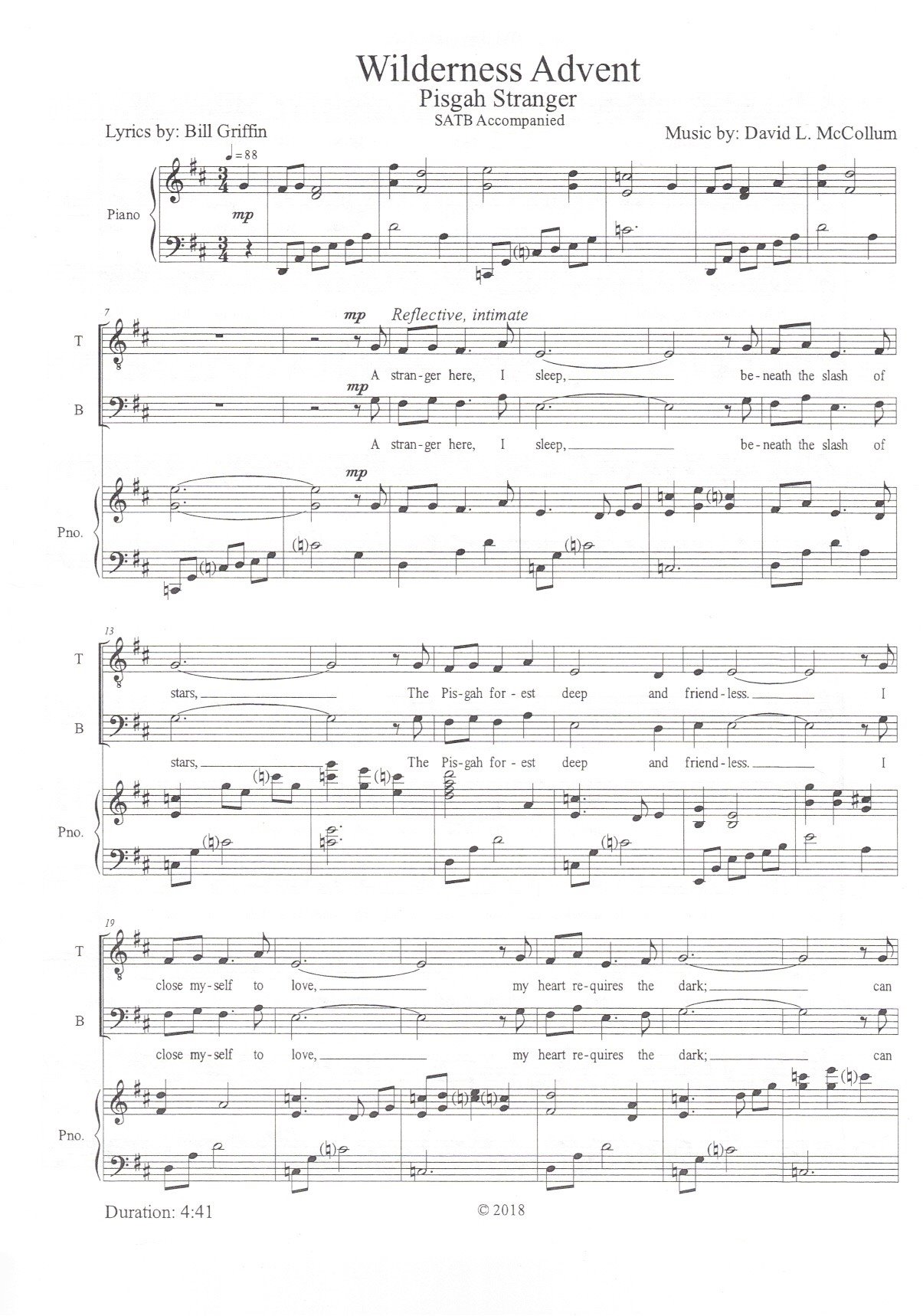
Wilderness Advent
(Pisgah Stranger)

A stranger here, I sleep beneath the slash of stars,
The Pisgah forest deep and friendless.
I close myself to love, my heart requires the dark;
Can night within this cove be endless?

Come, you’ve slept too long
And love grows dim.
Awaken to a song – Can it be Him?

Is it madness or a dream that seems to whisper here?
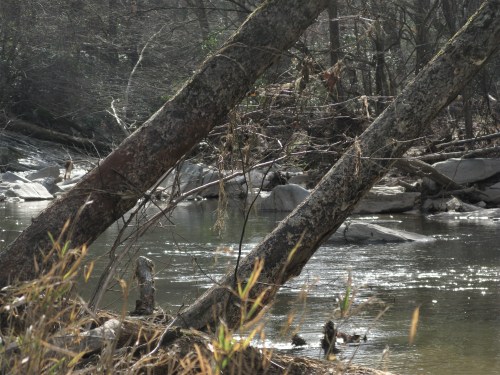
The murmur of a stream or singing?
It chants, a still small voice, I’ve nothing now to fear
For tidings of great joy it’s bringing.

Come, you’ve slept too long
And love grows dim.
Awaken to a song and welcome Him!

And now the music swells as every fir and spruce
Unloose their boughs to tell the story:
May all God’s creatures wake, hearts quickened by the truth,
Invited to partake of mercy.

Come, we’ve slept so long
That love grows dim.
Awaken that our song may worship Him.

Come sing it with the wind and all the Pisgah throng:
The Child reclines within the manger!
With owl and bear and deer my soul’s reborn in song
For none of us is here a stranger.

Come, you’ve slept too long;
If love grows dim
Awaken to a song for it is Him!

Waken . . . welcome . . . worship . . . it is Him!

IMG_7974

.     .     .     .     .     .     .

MERRY CHRISTMAS!

.     .     .     .     .     .     .


IMG_1948

Read Full Post »

[with poems by Ryan Wilson and A. R. Ammons]

I didn’t intend to count birds when I set out Tuesday morning. Just a nice weekly hike to Carter Falls and back, a weekday’s solitude – I’m not sure I intended anything more than cooling my brain and heating my muscles. Tamping down the trail maintenance we completed last Saturday. Following the season’s advance into winter.

But then a heron flew out from under the footbridge as I crossed Grassy Creek. Whoever coined the phrase a force of nature was probably in the presence of a Great Blue Heron. Up close they are mute and fearsome. Flying they arouse precognitive awe. When Linda and I encounter one feeding we address it by its nickname: “Hello, Spike.” When one passes overhead we think, “Pterodactyl.” Great Blue demands that one notice.

After gasping at the heron’s sudden flight, I began noticing birds. If they had been calling and singing during the preceding mile my striding deliberation had shut them out. Now they were continuous and various. Counting, I recede and the birds advance.

.     .     .     .     .     .     .

Below are two favorite poems which I return to regularly. They strike me as creating a continuum – the advance of a life toward discovering its meaning, the advance of a life toward its end. I read these and I recede into the lines, but as I read them I expand into my self.

.     .     .     .     .     .     .

At Carter Falls trailhead a Black Vulture perched overlooking; I scanned up past the parking area and saw the roadkill possum the vulture was waiting to ripen. At the Powerhouse (the riverstone foundation, all that’s left of the old generating plant) a Kingfisher daggered up the river and disappeared above the spray. I pulled an index card and a pen out of my pack. Here’s what I came home with:

Great Blue Heron / Belted Kingfisher / Northern Flicker / Red-Bellied Woodpecker / Black Vulture / Turkey Vulture / Carolina Wren / Carolina Chickadee / Tufted Titmouse / Golden-Crowned Kinglet / Eastern Phoebe / White-Breasted Nuthatch / Blue Jay / Eastern Bluebird / Cedar Waxwing / Pileated Woodpecker / Red-Shouldered Hawk / Chipping Sparrow / Northern Mockingbird / American Crow / Common Raven

And since I wasn’t carrying binoculars I’ll just include the numerous chippers and chirpers in the thickets as LGB’s (little gray birds, also sometimes known as LBJ’s, little brown jobs).

.     .     .     .     .     .     .

Face It

A silence, bodied like wing-beaten air,
Perturbs your face sometimes when parties end
And, half-drunk, you stand looking at some star
That flickers like a coin wished doen a weill,
Or when you hear a voice behind you whisper
Your name, and turn around, and no one’s there.
You’re in it the, once more, the stranger’s house
Perched in the mountain woods, the rot-sweet smell
Of fall, the maples’ millions, tongues of fire,
And there, whirl harrowing the gap, squint-far,
Than unidentified fleck, approaching and
Receding at once, rapt in the wind’s spell –
Pulse, throb, winged dark thar haunts the clean light’s glare –
That thin that you’re becoming, that your are.

Ryan Wilson
from The Best American Poetry 2018, first published in The New Criterion

Ryan Wilson was born in Griffin, Georgia and resides in Maryland. Of this poem he writes, “Face It was written in West Virginia at a mountaintop cabin belonging to my great friend, Ernest Suarez. During a break near dusk, I stepped out onto the porch, from which one can see more than fifty miles on a clear day. I was tantalized by a hawk hovering in the western gap, how it seemed to approach and to recede at once on the wind, never near enough for me to identify its species, or even its genus.”

.     .     .     .     .     .     .

Finishing Up

I wonder if I know enough to know what it’s really like
to have been here: have I seen sights enough to give
seeing over: the clouds, I’ve waited with white
October clouds like these this afternoon often before and

taken them in, but white clouds shade other white
ones gray, had I noticed that: and though I’ve
followed the leaves of many falls, have I spent time with
the wire vines left when frost’s red dyes strip the leaves

away: is more missing that was never enough: I’m sure
many of love’s kinds absolve and heal, but were they passing
rapids or welling stirs: I suppose I haven’t done and seen
enough yet to go, and anyway, it may be way on on the way

before one picks up the track of the sufficient, the
world-round reach, spirit deep, easing and all, not just mind
answering itself but mind and things apprehended at once
as one, all giving all way, not a scrap or question holding back.

A. R. Ammons
from The Best American Poetry 2018, first published in Poetry

Archie Ammons was born outside Whiteville, NC in 1926, attended college in Wake Forest, NC, and taught at Cornell for over 34 years. He was guest editor of The Best American Poetry 1994. He died February 25, 2001. A two-volume set of his collected poems was published by W. W. Norton in 2017.

.     .     .     .     .     .     .

.     .     .     .     .     .     .

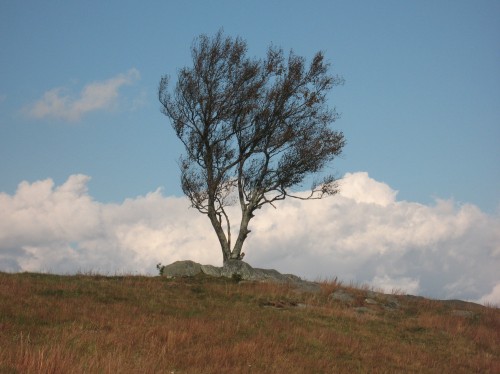
2014-07-13 Doughton Park Tree

Read Full Post »

Upload Burrowing Crayfish, Cambarus dubius

[with poems by Lesley Wheeler and Bill Griffin]

How? Crayfish taste with their skin. Well, not skin precisely: cuticle is what their carapace is called, their shell, made of chitin. (Read to the end for a science geek discussion of chitin vs. keratin.) It’s hard and it’s tough but it has chemoreceptors that detect dissolved molecules. With their skin, crayfish taste the water. Or smell it.

Taste and smell, inseparable as yeast and flour. Apart only mildly interesting, but mix them together and suddenly it’s 1979, Durham, that little red house on Green Street, waiting at the table with your toddler for hot bread from the oven. Or if you’re Crayfish maybe a tasty caddisfly larva. Or perhaps that taste/smell is Otter on the prowl and it’s time to find a rock.

This big guy (guy: we have our ways of knowing these things, though we don’t like to pry when those pincers are cocked) is possibly an Upland Burrowing Crayfish, Cambarus dubius. Yes, he really is blue; I swear I didn’t touch the hue sliders. (Read to the end for a science geek discussion of crustacean blueness). He was tooling across the level patch near the creek below our house where the Sewer Authority crews clear a path to check their access ports. Lovely spot for a walk, although you might catch the occasional whiff of fabric softener lightly swirled with hydrogen sulfide and anaerobic bacteria. Poop perfume.

Ah, ineffable links, scent and memory. Strolling down the aisle at Food Lion I pass the Downy and my olfactory bulb & hippocampus spark to tell me I’m hiking beside the autumn creek. And look! A Crayfish!

Mountains-to-Sea Trail with Sassafras; near Elkin, NC and Isaac's trailhead

.     .     .     .     .     .

I don’t believe I’ve missed reading an issue of Cave Wall since its inception. Editors Rhett Iseman Trull and Jeff Trull never fail to craft a collection that sparks neurons I’ve been neglecting. In the same way that a forgotten aroma can open a memory door into all the senses, a poem can flash and growl and shudder the reader with sudden insight. Circles, ripples, connections. My college English prof taught a whole semester on it: epiphany. Or an even better word (thank you Caren Stuart for this indispensable addition to the lexicon) – the gasp-sigh.

Invocation by Lesley Wheeler appears in Cave Wall Number 16 (Spring 2020). Something here is thirsty . . . something is called to wake up! How much of each of us is mud, condensation? Shall we pause a moment for spore and mire to convene again within us?

Worship begins with invocation, a call to the divine presence to enter this place. But since divine mystery comprises the entire universe, every boson and lepton, where can we sojourn where the divine is not? Perhaps practicing invocation we are really calling ourselves. Enter this moment. Reside here. Abide with the mystery. Wake up!

.     .     .     .     .     .

Invocation

Bottomland: rouse. Sedge, knotweed:
time to rally. You’ve been lost
in thought, ebb and fuming flood,
since the glacier, thin winters
digging for turtles in cold mud.
Valley was tundra. Elk and moose
drank at water’s brink while firs
invented shade. Panthers melted

into the dark, but spore and mire could
convene again. Softness feed us
and eat our footholds away. Something
here is thirst for living’s every
rivulet, hospitable and
treacherous in her oblivion.
Misty divots. Condensation
beads on the throat, where pulses drum.

What kind of god is this? Her name
just a hieroglyph drawn in muck
by a tentative finger. No
answer but a hissing river.
Drowsy spirit, I’m pleading. Take
this blood shed unseasonably,
mineral gift. Be comfort. Be
danger. Of sleep, of trough. Wake up.

Lesley Wheeler, in Cave Wall Number 16, Spring 2020

Lesley Wheeler is a poet, novelist, scholar, and blogger. She is the poetry editor of Shenandoah.

Sassafras, Sassafras albidum, illustrating the three lobe types

.     .     .     .     .     .

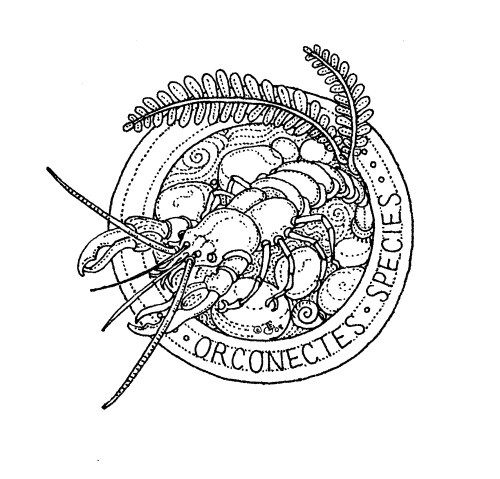
The following poem appears in Snake Den Ridge: a Bestiary (2008, March Street Press). Linda and I collaborated on the book and her illustration appears below (at the time she agreed to interrupt her many other projects because I promised to dedicate the book to my friend Mike Barnett – I can’t even calculate the hours she spent drawing or the height of the field guides and science books piled beside her on her desk).

Crayfish

Just wiggle this rock
and the stream
hums a whole new flavor –
in the turbulence I taste
last night’s shower
on the Ridge
and this morning’s stirring
of awakened larvae.
Tailflap, legtips,
cuticle,
all of me every moment
strummed by roil and eddy,
random caress
of molecules,
divine order of chaos.

I’ll tell you a secret –
God is deliciousness!,

the constant inconstancy
of current
that reveals my breakfast
or Otter on the prowl,
and just maybe
the passing of a lovely
arthropod I long to meet.

Join me! Immerse yourself,
not in Inadu Creek
but in your own lifestream.
Savor it, sense it as I do
in every part of you.

Bill Griffin, in Snake Den Ridge: a Bestiary (2008, March Street Press)

Illustrations by Linda French Griffin.
 

.     .     .     .     .     .

Chitin is the hard part of invertebrates: cicada exoskeleton, crayfish and lobster shell, squid beaks (and vertebrate fish scales). Keratin is the hard outer part of vertebrates: bird feathers, tiger claws, what little hair I have left. The two are chemically completely different but function in the same way, for protection and structure.

Chitin is a polymer of sugars, glucose with added nitrogen = glucosamine (a polysaccharide), the stuff I take for my bad knee. Keratin is a polymer of amino acids, namely a protein (polypeptide). Here are two more factoids you can’t possibly live without: Keratin resists digestion, which is why cats hark up hairballs. Spider silk is classified as keratin, although production of the protein probably evolved independently of the process in vertebrates.

Crustacyanin is not a Spongebob character. It’s what makes this crayfish blue. Crustacyanin is a carotenoid, which are pigment proteins found in everything from tomatoes to pink flamingos. The crustacyanin is made from stacks of another carotenoid protein (astaxanthin), which itself is red, but depending how many and how it’s stacked can actually reflect the blue portion of the spectrum. Blue crayfish (also look up Blue Lobsters) have a genetic variation in their stacking. If you steam them (perish the thought!!!) the astaxanthin comes unstacked and that’s why cooked crabs, lobsters, and crayfish are bright red.

Brushy mountains reflected in compound eye

.     .     .     .     .     .


2016-10-17b Doughton Park Tree

Read Full Post »

« Newer Posts - Older Posts »