Feeds:
Posts
Comments

Posts Tagged ‘Jenny Bates’

 . 
[with 3 poems by Jenny Bates]
 . 
Essential
 . 
Trees are a gathering of circles.
 . 
If I touch this tree
say your name,
 . 
Light from the moon, the stars
will burn inside it.
 . 
Frost kindles its leaves to flame,
Spills them on to yellowing grass.
 . 
Unchanged.
 . 
From prehistoric times the ages
are inconsolable, so they turn.
Mantle shadows by truly seeing them.
I tell you this as I touch the tree,
circle this tree, say your name.
 . 
The tree and its golden mean listen
without an ear to hear.
 . 
As you wear yourself out
with a single essential thought.
 . 
Give.
 . 
Jenny Bates
from Essential, Redhawk Publications, Hickory, NC; © 2023
 . 
❦ ❦ ❦
 . 
Ah, February – enter the season of Romance! Naturalists will mark its approach with sightings of large red heart-shaped boxes lining the entrance to Food Lion. Outdoors we notice that, yes indeed, that gray squirrel robbing the feeder looks nicely plump: she will deliver her puplets in a high leafy nest on Saint V’s Day. Wood frogs and peepers, surprise!, have already begun to sing their amorous invitations to amplexus. Owls have a jump on the festivities, already nesting, while there is a general restiveness and revving among the yard birds.
 . 
For Linda and me, the end of winter and first blood flow of Spring are marked by a plaintive two note whistle issuing from the rhododendron. There it is again! A rising minor third, clear and bright, the introduction to a joyful motet, the Oh My! of Oh my Canada, Canada, Canada. The White-Throated Sparrow is tuning up.
 . 
Why do birds sing? All winter the white-throat has minded his own business, hopping in the litter beneath the feeders or posing quite sage in the azalea. Now he sings his first couple of notes, but within a few weeks he will have flown far from here to breed in Maine or Michigan or the infinite boreal forests of Canada. Why sing now? Obviously his whistling can’t be to establish a territory in our back yard. And it defies imagination to think he’d hope to attract a mate here in North Carolina and keep her by his side all the way to Quebec. Today’s song, to judge from the snippets and fragments he’s practicing, sounds like he’s just warming up tor the big date.
 . 
Here’s how I see him – my little White-Throated Sparrow is Jeremy Brett in My Fair Lady, walking down the street where she lives. He’s passed this way before, but today the pavement simply refuses to stay beneath his feet. Days lengthen and love fills his breast until it is impossible any longer to resist – it must overflow in song. And so although the street where she really lives is 1,000 miles from here, White Throat graces Linda and me here in the NC foothills with his opening aria of Romance. Ah, February!
 . 
 . 
* The song of the White-Throated Sparrow (Zonotrichia albicollia) comprises a couplet of long clear ascending whistles followed by three more rapid triplets, and can also be recalled by the mnemonic, Old Sam Peabody, Peabody, Peabody.
 . 
** On the Street Where You Live, 1956, Lerner & Lowe, from the musical My Fair Lady starring Audrey Hepburn & Rex Harrison, with Jeremy Brett as Freddy singing: “I have often walked down this street before / but the pavement always stayed beneath my feet before. / All at once am I several stories high, / knowing I’m on the street where you live . . . .”
 . 
 . 
❦ ❦ ❦
 . 
Red and Green
 . 
where the surface of one thing meets the surface of another . . .
— William Bridges
 . 
You were twisting and turning
leaping and swerving a flame
 . 
on each foot, on a field so green
so green – so gorgeously
 . 
green, the earth’s addiction.
 . 
And you, warrior Fox as you fought
you fought off the mysterious foe, rattled like
 . 
a shaman losing part of his soul.
 . 
You danced between spirit and spirit and matter
danced all parts of your body a spontaneous me!
 . 
When you finally stopped puffing
from chaos, from chaos and glee you flowed
 . 
a rhythm of stillness – so still
 . 
you stood as if in meditation
and mantra on what you created.
 . 
Jenny Bates
from Essential, Redhawk Publications, Hickory, NC; © 2023
 . 
❦ ❦ ❦
 . 
I have never met Jenny Bates but I imagine a visit to her home in the woods. Afternoon sun through west-facing panes is captured by glass in the colors of earth, sky, pasture, summer asters. We don’t remain indoors but take our mugs of oswego tea with local honey out beneath the pines. Dusk creeps in and we allow it to fill us with its silence. Creatures creep closer as well, wild but curious. If we were to threaten them, they would flee or turn and slash, but we and they simply remark each other’s presence and respect our distance. They go about their crepuscular business and grant us leave to be part of their universe. Being part of. Communion. Creating wholeness. The highest call and at once the most confounding task of the rational being.
 . 
This is also a visit to Jenny’s poetry in the woods. The universe Jenny Bates creates through words is one of deep acceptance and communion. Essential, from Redhawk Publications, continues her series of books which create a sort of natural theology. The You whom Jenny addresses in so many of her poems – is it God? A spirit familiar? A ghostly memory? Or is it the fox who stares cautiously from the edge of night? You might be a source of answers but more often is simply one with whom to share the questions. In this universe, there is no supernatural, only the fundamental reality that we are all one. One, that is, if we are able to open ourselves that much.
 . 
 . 
Visit Redhawk Publications and purchase Essentials HERE
 . 
❦ ❦ ❦
 . 
 . 
 . 
Be Bold
 . 
I said to the Woodpecker
as I lifted it off the ground
cradled it for a half an hour, this
second Woodpecker to break its neck.
 . 
I’m no angel I said to him, though I’ve
been called it many times
a few drops of Be Bold I tell myself
when there is a need, but sometimes
those drops don’t soak in and I’m left
buckling to my knees.
 . 
The body will be gone by morning
and sure enough it was, yet still I
struggle How can one keep up with
death stare it in the face? Or program our
unconscious to react in certain ways?
 . 
Sweet smelling or dour unpleasant odors
are all we instinctively know, and here,
I’m not too Bold.
I placed the bird on one big leaf, hearing
another drum away
laid his head on dry curled grass
a pine bough for a wreath
both of us changed and changing
the pattern of our resonance.
 . 
Jenny Bates
from Essential, Redhawk Publications, Hickory, NC; © 2023
 . 
❦ ❦ ❦
 . 
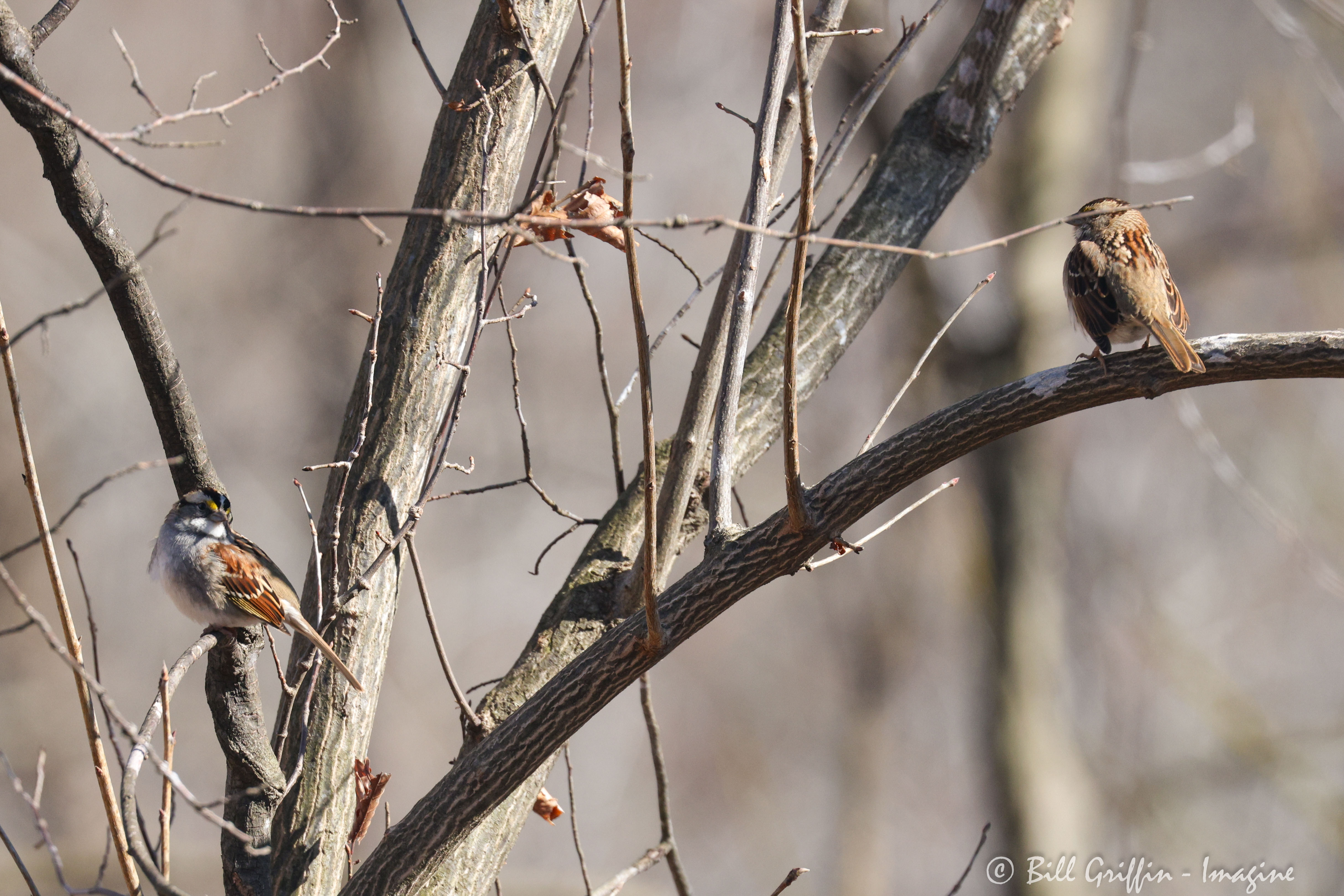
But soft! What light through yonder window breaks? This morning I discover Romeo Sparrow perched in the Silverbell. He turns to gaze fondly at Juliet, perched one branch higher. Perhaps they have booked adjoining seats for the flight to their Canada!!
 . 
 . 
❦ ❦ ❦
 .

Read Full Post »

[with poems by Ursula K. LeGuin, Sandra Dreis,
Jenny Bates, Galway Kinnell]

After a recent post which featured poems from the journal ecotone, Bradley Strahan commented, “Thanks. We need constantly to be reminded of how much we are dependent and damaging.” It made me think: it must be no coincidence that Poetry Month and Earth Day are both in April. This is the month of convergences, when we are truly grateful that the last frost is past and beastly summer has not yet smothered us. We watch new shoots erupt and bloom, but we worry that some will arrive too early and get nipped, and that blossoms and pollinators may emerge out of sync. We’re grateful for the songs of neotropical migrants, but we notice their diminished numbers and worry about desecrated wintering grounds and fragmented breeding grounds. We head out for a hike or a bird count and find the woodlots leveled, the streams silted up, and new homes and trailers in every cornfield.

We are surrounded by the reality of relentless human impact on the planet. We are living smack dab in the middle of the Anthropocene epoch.

It is difficult
to get the news from poems
yet men die miserably every day
for lack
of what is found there.
+++++++ William Carlos Williams, from Asphodel, That Greeny Flower

Poetry is able to speak the news we need to hear for Earth Day. Poetry may crystallize a truth we can grab and hold on to when bad news threatens to overwhelm us. Poetry may grab us by the lapels and jerk us to our feet when our motivation has drained away. Poetry may shed light on despair and offer some path into hope.

Thank you to the readers of these pages
who have responded to my call for poems this Earth Day.
Watch for new posts on April 21, April 22, and April 23.

All photographs were taken April 11-17, 2023,
along the Elkin & Allegheny Nature Trail,
part of the Mountains-to-Sea Trail in North Carolina, USA.

Earth Day 2023 art by Linda French Griffin.

❦ ❦ ❦

Kinship

Rootless and restless and
warmblooded, we
blaze in the flare that
blinds us to that slow,
tall, fraternal fire of life
as strong
now as in the seedling
two centuries ago.

Ursula K LeGuin
Selected by Bill Griffin; appeared online in The Dewdrop, March 26, 2022

What truth is more profound, more amazing, more assuring, more urgent than our kinship? That Ur-puddle’s restless swirl of nucleotides and amino acids, way back in time before there was ever a cell, is still reflected in the minutest truth of our bodies, every glint and dark crevice of them. All of us are neighbors.

– Bill Griffin / Elkin, North Carolina

❦ ❦ ❦

Raven’s Beak

But you’d have to understand
Raven’s beak,
drive that comes before
all else,
plunges for praying mantis,
plucks, disbands dirt,
stabs a wrangled tuft of weed.

And you’d have to
be
the bird, inhabit
black eyes that beam location,
yes, stealing sweetness
even
from the cocky cat,

feasting on envy.
This hunger lives beyond prey
I tell you, a wild want
not to be tamed
by blood, sinew or travail.
In dreams I gather others.
I grow feathers and wait.

Sandra Dreis
originally published in CREOSOTE, Spring 2021. (East Arizona)

This, my first published poem, was inspired by a walk with my two small dogs, stopping by a grassy ultra-green, pampered lawn. There, under a pin oak, was a sizable raven, beak inserted into the earth. In that moment, while I held my leashed dogs, a cat on a nearby stoop kept the raven in her sights. My dogs begged after the cat. I felt the perfect continuum. The balance. The tame. The wild.

– Sandra Dreis / Winston-Salem, North Carolina

❦ ❦ ❦

Otherworldly

Odd trick of the wind in leaves,
water flowing over stones.

You don’t have a mouth, said Fox.

Moth never blinked, rippling its crescent
tail wings.

You only live for a week, said Fox.

Moth lifted its wings, flew the moon up
to meet the night.

You and I are daydreams, soughed Fawn.

It’s been a long time. Think back and listen.
Voices in the woods. Angelic, untarnished.

Articulate, I can hear words rising

then falling,

a benediction.

Jenny Bates
originally published in Dark Forest, Planisphere Q, 2021

I want to bring the kindness and wonder I have found in wild creatures as well as their courage and pragmatic truth. I want my voice to be their voice as I believe they will teach us appropriate ways to heal the wild land. The wild is mysterious but also thrilling, nostalgic, liquid, musical when we listen.

– Jenny Bates / Germanton, North Carolina

❦ ❦ ❦

The Bear

+++++ 1
In late winter
I sometimes glimpse bits of steam
coming up from
some fault in the old snow
and bend close and see it is lung-colored
and put down my nose
and know
the chilly, enduring odor of bear.

+++++ 2
I take a wolf’s rib and whittle
it sharp at both ends
and coil it up
and freeze it in blubber and place it out
on the fairway of the bears.

And when it has vanished
I move out on the bear tracks,
roaming in circles
until I come to the first, tentative, dark
splash on the earth.

And I set out
running, following the splashes
of blood wandering over the world.
At the cut, gashed resting places
I stop and rest,
at the crawl-marks
where he lay out on his belly
to overpass some stretch of bauchy ice
I lie out
dragging myself forward with bear-knives in my fists.

+++++ 3
On the third day I begin to starve,
at nightfall I bend down as I knew I would
at a turd sopped in blood,
and hesitate, and pick it up,
and thrust it in my mouth, and gnash it down,
and rise
and go on running.

+++++ 4
On the seventh day,
living by now on bear blood alone,
I can see his upturned carcass far out ahead, a scraggled,
steamy hulk,
the heavy fur riffling in the wind.

I come up to him
and stare at the narrow-spaced, petty eyes,
the dismayed
face laid back on the shoulder, the nostrils
flared, catching
perhaps the first taint of me as he
died.

I hack
a ravine in his thigh, and eat and drink,
and tear him down his whole length
and open him and climb in
and close him up after me, against the wind,
and sleep.

+++++ 5
And dream
of lumbering flatfooted
over the tundra,
stabbed twice from within,
splattering a trail behind me,
splattering it out no matter which way I lurch,
no matter which parabola of bear-transcendence,
which dance of solitude I attempt,
which gravity-clutched leap,
which trudge, which groan.

+++++ 6
Until one day I totter and fall-
fall on this
stomach that has tried so hard to keep up,
to digest the blood as it leaked in,
to break up
and digest the bone itself: and now the breeze
blows over me, blows off
the hideous belches of ill-digested bear blood
and rotted stomach
and the ordinary, wretched odor of bear,

blows across
my sore, lolled tongue a song
or screech, until I think I must rise up
and dance. And I lie still.

+++++ 7
I awaken I think. Marshlights
reappear, geese
come trailing again up the flyway.
In her ravine under old snow the dam-bear
lies, licking
lumps of smeared fur
and drizzly eyes into shapes
with her tongue. And one
hairy-soled trudge stuck out before me,
the next groaned out,
the next,
the next,
the rest of my days I spend
wandering: wondering
what, anyway,
was that sticky infusion, that rank flavor of blood, that poetry, by which I lived?

Galway Kinnell
Selected by Paul Jones; appears in Three Books (Houghton-Mifflin, 2002)

Galway Kinnell speaking for himself about himself: “I don’t recognize the distinction between nature poetry and, what would be the other thing? Human civilization poetry? We are creatures of the earth who build our elaborate cities and beavers are creatures of the earth who build their elaborate lodges and canal operations and dams, just as we do … Poems about other creatures may have political and social implications for us.”

I first heard Kinnell read this poem in maybe 1977 at the UNC English Department. I was thinking of taking a job at UNC. I did and The Bear has been with me ever since.

– Paul Jones / Chapel Hill, NC


❦ ❦ ❦


Read Full Post »

[with 3 poems by Jenny Bates]

Yellowthroats sing from three compass points. Who triangulates whom? One sings, flits, sings and a farther one answers, flits, answers. I stand motionless in the mud beside the lake’s lazy inflow. I want a bright bird to fly from his thicket and show himself to me.

As I stare into the leaves, still no success with my x-ray vision, something moves beside me. Down low. A muskrat six feet away is swimming upstream utterly unconcerned. I turn only my head. It reaches up the bank for a tasty green, swims some more, jeweldrops of water on its whiskers. It stops to scratch its nose. It swims on.

I look up and a yellowthroat is watching me.

.     .     .     .     .     .     .

Triangulate: to discern your true position within the vital features that surround you.

After a couple of weeks with Jenny Bates’s books I learned not to read her poems to ferret out their meaning but to read to enter the poetry. Stare at the Pleiades in the night sky and they slip away from you; look slant and the Seven Sisters reach to you from the darkness. Let a line of Jenny’s verse slip into your awareness with eyes half closed, fortuitous inadvertency.

An intimate acquaintance / that leaves nothing but / earth.

I learned not to read Jenny like a field guide but like I read the breeze greeting sweat on my back when the trail stretches uphill, like I read the sun’s flagrant liason with blackberry blossoms.

Bent twig alphabet, language mist-twist
revises with no sequels, no chapters that leave-off.

I learned to read Jenny not like a genealogy of contracts and progeny but exactly like a genealogy of creatures and connections and the family of the one.

The bee does not claim originality as it takes
something from every flower.

.     .     .     .     .     .     .

3 poems by Jenny Bates

.     .     .     .     .     .     .

Merlot and Thyme
++++ with a Hummingbird Chaser

I uncork old resting places, no maps needed.
Just strange-tongued travelers of
++++ bird, wine and spice.
I sip Merlot, write in cloud-light
++++ missing mother’s voice
Conversations become riddles, coaxing the truth
out of her children, eventually.
Thyme and tarragon fill the clear jar
in front of me: I smell her there
++++ in herbal comfort.
No still dark corners to hide in her memory,
she emptied her children like clearing a table
set by despair, without lingering.
With an edge that never dropped off.

Hummingbirds have no brink to pass to their young.
Wisps of winding birds tousle leaves, jiggle air under
++++ diving, dancing, levitating.
Homing devices, trade routes birthed into them.
Swift and common lessons to grow by. Shade brings
++++ less frantic maneuvers.

I wear pink and grey – the first colors I liked
++++ as a child.
My grandparents farmhouse in Northern Michigan
was grey with pale pink shutters.
Dove colors for a delicate landing grandmother
would say. I hear mom in the background talking to
bees, kittens, mule, land. For a city girl, she could
ambush nature, then heal its wounds.
++++ No time was distant then.


.     .     .     .     .     .     .

Engagement Rings

Morning insect yoga.
Grasshopper extends himself
in heat-stretching air.
Jumps into space, disappears.
No fossil fuels, no footprint.
Fly stuck to a metal merry-go-round,
a centrifuge so man can stick to
ceilings in his quest for flight.
Prometheus moth wings dismantled,
grounded, still-payment for
bringing man fire.

I walk earthling steps, marker-less,
circling your grave.
Mob of ants scurry in loops,
larvae in pincers turn you from
solid to liquid to solid again.
Jealous in my exile,
++++ lucky ants get to spend time with you
you continue in unending generosity.

The angel tree had sung a copperhead
right out of his skin.
I bring it, fresh and warm to my
neighbor who sculpts it into
suspended twists.
Hung it through a metal ring
at the studio door.
Bow Tie markings coiled to dry,
venom empty, benign husk.

Heat draws new flycatcher parents
to drink from your round water bowl
filled each day to the brim.
Parched squirrel’s half cry bubbles out,
scampers then hangs in shade relief.
Skinks run full speed in swirling chase
across the deck.
++++ don’t come out of the nest too soon . . .
++++ ++++ don’t fall . . .
the newly hatched chick yawns,
bellyful of ground up ants.


.     .     .     .     .     .     .

How to Spell Sorrow

It’s beautiful, your words,
but I’ve read better in the eyes of my dog.

In spider webs and spider spaces.
When hummingbirds leave, you feel it –
empty air without fashion.

You put more sweet water out anyway,
wait for Buddhas and fools.

You wonder about ellipsis of Truth
wrapped in coyote calls.

You watch a groundhog prostrate like a saint
on the gravel drive – surrender play or
cooling his belly on the stones.

you see a murder of crows line their toes
straight and tight along the split rail fence.

Gripping the wood like text on your arms
becoming the word on your hand.

You curl your fingers into your palm
twist and spell – Sorrow.

.     .     .     .     .     .     .

“Merlot and Thyme,” “Engagement Rings,” “How to Spell Sorrow” by Jenny Bates from her book Slip, Hermit Feathers Press, September, 2020

Jenny lives in the North Carolina foothills and is an animal whisperer and helping hand at Plum Granny Farm, an organic local farm in Stokes County, North Carolina.

.     .     .     .     .     .     .

Header Artwork © Linda French Griffin

2016-10-17a Doughton Park Tree

Read Full Post »

« Newer Posts - Older Posts »