Feeds:
Posts
Comments

Posts Tagged ‘birds’

White-throated Sparrow, Zonotrichia albicollis, ELKIN NC


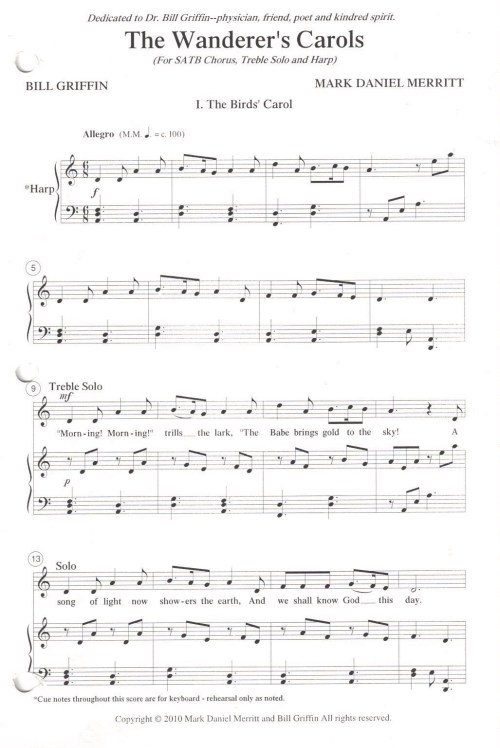
The Birds’ Carol
Lyrics: Bill Griffin . . . . . . . . . . Music: Mark Daniel Merritt

Elkin Community Chorus
51st Annual Christ Concert / December 4, 2011
Director: David L. McCollum / Piano and Organ: Amy Tayloe and Amy Johnson

.     .     .     .     .     .     .

By 2010 Linda and I had been singing for several years with VOCE, Surry County’s invitational chorale, directed by Sandy Beam and assisted later by Mark Merritt. Mark is a talented composer and had asked me before for lyrics. That spring VOCE had been invited to perform at Bilmore House in Asheville, NC, during the Christmas season and Mark wanted to create a suite we could debut there. The Birds’ Carol is the first of three movements in The Wanderer’s Carols. The following year David McCollum selected The Bird’s Carol for Elkin Community Chorus’s 51st Annual Christmas Concert.

.     .     .     .     .     .     .

The Birds’ Carol

“Morning! Morning!” trills the lark, “The Babe brings gold to the sky!
A song of light now showers the earth, And we shall know God this day.

Now is the dawn of our new life,
And we shall know God this day.”

“This coat I wear,” caws the rook, “So black, so heavy, so grim.
Only One knows the way to make it bright – The Child who reclaims us from sin.

He lifts our burden upon himself,
The Child who reclaims us from sin.”

“Come rest with me,” coos the dove, “In this humble stable take ease.
Kings and shepherds together embrace The Prince who unites us in peace.

You make us one in all the earth,
O Prince who unites us in peace!”

“I . . . Thou, I . . . Thou,” vow the geese From dark earth to heaven above –
“May we join with Thee in a world made new; May we fly forever in love.

Give us wings of Your perfect light,
And we’ll fly forever in love.”


.     .     .     .     .     .     .

.     .     .     .     .     .     .

VOCE of Mount Airy performing The Birds’ Carol, November 14, 2010, Winston-Salem First Presbyterian Church:
http://www.youtube.com/watch?v=JDPm6MYvacA&feature=related

Discussion of the symbolism of Lark, Rook, Dove, Goose:
https://griffinpoetry.com/2011/12/17/joy-hope-peace-love/

.     .     .     .     .     .     .


.     .     .     .     .     .     .

2020-09-08b Doughton Park Tree

Read Full Post »

[with poems by Ryan Wilson and A. R. Ammons]

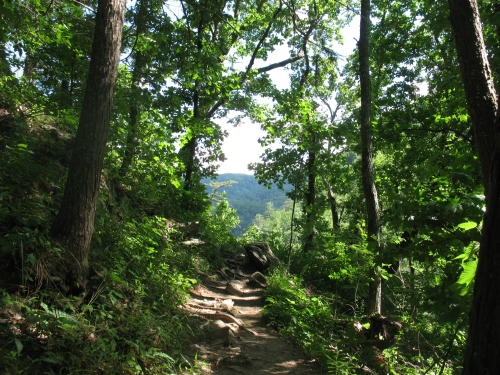
I didn’t intend to count birds when I set out Tuesday morning. Just a nice weekly hike to Carter Falls and back, a weekday’s solitude – I’m not sure I intended anything more than cooling my brain and heating my muscles. Tamping down the trail maintenance we completed last Saturday. Following the season’s advance into winter.

But then a heron flew out from under the footbridge as I crossed Grassy Creek. Whoever coined the phrase a force of nature was probably in the presence of a Great Blue Heron. Up close they are mute and fearsome. Flying they arouse precognitive awe. When Linda and I encounter one feeding we address it by its nickname: “Hello, Spike.” When one passes overhead we think, “Pterodactyl.” Great Blue demands that one notice.

After gasping at the heron’s sudden flight, I began noticing birds. If they had been calling and singing during the preceding mile my striding deliberation had shut them out. Now they were continuous and various. Counting, I recede and the birds advance.

.     .     .     .     .     .     .

Below are two favorite poems which I return to regularly. They strike me as creating a continuum – the advance of a life toward discovering its meaning, the advance of a life toward its end. I read these and I recede into the lines, but as I read them I expand into my self.

.     .     .     .     .     .     .

At Carter Falls trailhead a Black Vulture perched overlooking; I scanned up past the parking area and saw the roadkill possum the vulture was waiting to ripen. At the Powerhouse (the riverstone foundation, all that’s left of the old generating plant) a Kingfisher daggered up the river and disappeared above the spray. I pulled an index card and a pen out of my pack. Here’s what I came home with:

Great Blue Heron / Belted Kingfisher / Northern Flicker / Red-Bellied Woodpecker / Black Vulture / Turkey Vulture / Carolina Wren / Carolina Chickadee / Tufted Titmouse / Golden-Crowned Kinglet / Eastern Phoebe / White-Breasted Nuthatch / Blue Jay / Eastern Bluebird / Cedar Waxwing / Pileated Woodpecker / Red-Shouldered Hawk / Chipping Sparrow / Northern Mockingbird / American Crow / Common Raven

And since I wasn’t carrying binoculars I’ll just include the numerous chippers and chirpers in the thickets as LGB’s (little gray birds, also sometimes known as LBJ’s, little brown jobs).

.     .     .     .     .     .     .
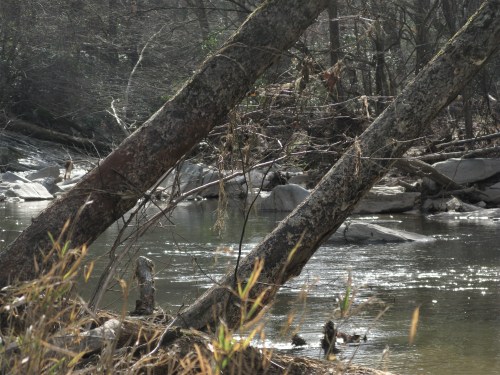
Face It

A silence, bodied like wing-beaten air,
Perturbs your face sometimes when parties end
And, half-drunk, you stand looking at some star
That flickers like a coin wished doen a weill,
Or when you hear a voice behind you whisper
Your name, and turn around, and no one’s there.
You’re in it the, once more, the stranger’s house
Perched in the mountain woods, the rot-sweet smell
Of fall, the maples’ millions, tongues of fire,
And there, whirl harrowing the gap, squint-far,
Than unidentified fleck, approaching and
Receding at once, rapt in the wind’s spell –
Pulse, throb, winged dark thar haunts the clean light’s glare –
That thin that you’re becoming, that your are.

Ryan Wilson
from The Best American Poetry 2018, first published in The New Criterion

Ryan Wilson was born in Griffin, Georgia and resides in Maryland. Of this poem he writes, “Face It was written in West Virginia at a mountaintop cabin belonging to my great friend, Ernest Suarez. During a break near dusk, I stepped out onto the porch, from which one can see more than fifty miles on a clear day. I was tantalized by a hawk hovering in the western gap, how it seemed to approach and to recede at once on the wind, never near enough for me to identify its species, or even its genus.”

.     .     .     .     .     .     .
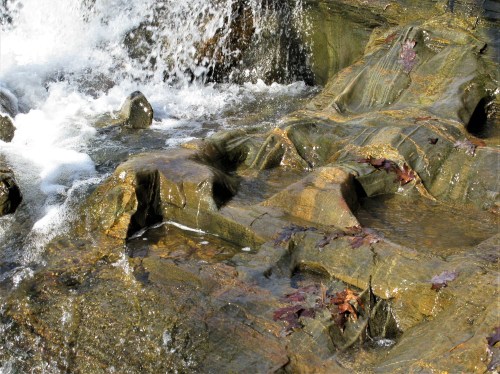
Finishing Up

I wonder if I know enough to know what it’s really like
to have been here: have I seen sights enough to give
seeing over: the clouds, I’ve waited with white
October clouds like these this afternoon often before and

taken them in, but white clouds shade other white
ones gray, had I noticed that: and though I’ve
followed the leaves of many falls, have I spent time with
the wire vines left when frost’s red dyes strip the leaves

away: is more missing that was never enough: I’m sure
many of love’s kinds absolve and heal, but were they passing
rapids or welling stirs: I suppose I haven’t done and seen
enough yet to go, and anyway, it may be way on on the way

before one picks up the track of the sufficient, the
world-round reach, spirit deep, easing and all, not just mind
answering itself but mind and things apprehended at once
as one, all giving all way, not a scrap or question holding back.

A. R. Ammons
from The Best American Poetry 2018, first published in Poetry

Archie Ammons was born outside Whiteville, NC in 1926, attended college in Wake Forest, NC, and taught at Cornell for over 34 years. He was guest editor of The Best American Poetry 1994. He died February 25, 2001. A two-volume set of his collected poems was published by W. W. Norton in 2017.

.     .     .     .     .     .     .
.     .     .     .     .     .     .
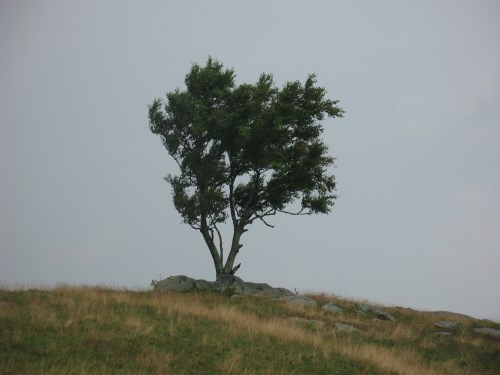
2014-07-13 Doughton Park Tree

Read Full Post »

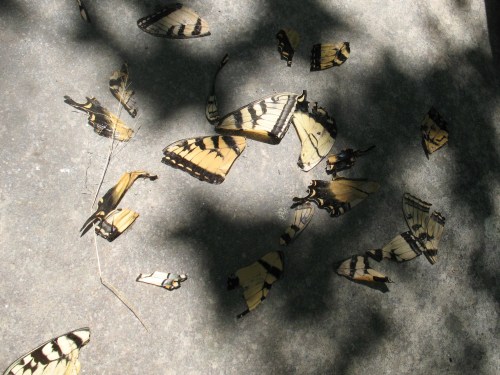
Tonya and Roseann found them: wings scattered beside the river bank. Dozens and dozens of wings, bright yellow with stark black bars and fingerprints of orange and blue along the margins. Where had they come from?

Our entire class trooped over to observe. Leaf sized wings strewn on boulders at the north point of Girl Scout Island, Middle Prong of Little River, weekend naturalist skills course, Great Smoky Mountains Institute at Tremont, perfect setting for our mission: not to know an answer but to learn to question. “Pay attention. Be astonished. Tell about it.” Why were they here?

Only wings, no butterfly bodies. Had they congregated here to die? No dark females’ wings — were the males puddling, gleaning minerals for their spermatophores, and then attacked? Or had some devious predator collected the wings and brought them here to mystify us?

We crouched beneath the sycamore and hemlock while the mountain stream raced and chattered beside us. We parted the grasses, looked under rocks, collected a few wings and peered with our hand lenses. We paid attention. We were astonished.

Swallowtail wings

–      –      –      –      –      –      –

The naturalist method and poetry have something in common. We want truth but we want to experience it directly. We make connections. We let light shine in dark places. And if we discover an answer it will likely bring with it not only a dollop of new knowledge but more than a dollop of wonder.

Susan Laughter Meyers has been a person and poet who has filled me with wonder. When her ultimate collection, Self-Portrait in the River of Deja Vu, was published this year, two years after her untimely death, its poetry opened my heart and my mind again to the mystery and power of words. She was a fierce observer of the earth and all that is in it, the heron’s plume, the subtle change of hour, of season. And she was an uncompromising naturalist of the soul. In subtle phrase and in lancing stab she uncovers the dark places within us.

And lets in the light.

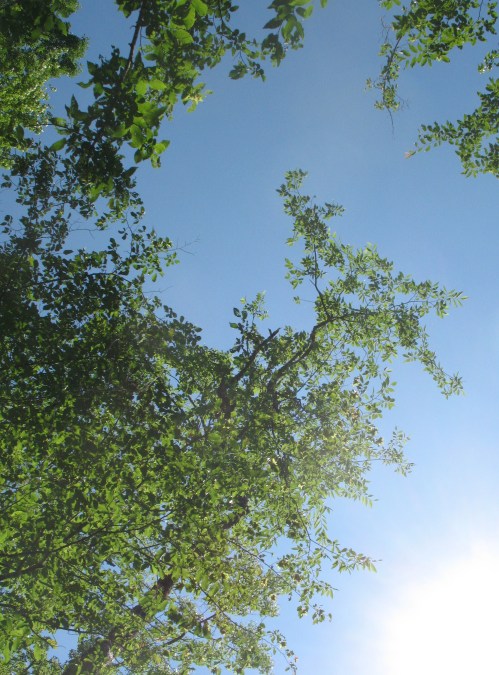
Oh, and as she reminds us, and as we beside the river finally remembered, besides looking back we must not forget to look up.

look-up.jpg

–      –      –      –      –      –      –

If Not Birds Dodging Loneliness

The bluest ones in an open sky
fan reveries with their wings.
Dream time, that’s what they inhabit —
fabulous as the past and its dingy veils

I wore in a favorite childhood game:
dress-up with the girl whose father
ran a funeral home. The newest shroud
had no holes to trip us, one a princess

the other a bride. The least breeze
and the shroud would ripple, barely
kissing the skin. Wasn’t that a dalliance
to wish for? On days when birds soar

toward light, when they tip and wheel
and turn until they silhouette,
you’d think they’re being chased.
Or if not birds dodging loneliness,

then memories loosed into view.
Like the ones of a blindfolded
child with stick or pin-and-tail in hand,
steering toward a prize, when to win

the game is to break something
or make something whole again.
Fringed and fleeting, such remnants,
though the world is full of them.

There are moments in my life
when gravitating toward feels the same
as ducking from. Moments when,
for recompense, I look back. Or up.


Susan Laughter Meyers
from Self-Portrait in the River of Deja Vu, Press 53, 2019

Smokies - Tremont

–      –      –      –      –      –      –

The quotation “Pay attention . . . ” is excerpted from the poem Sometimes by Mary Oliver, from Red Bird, Boston: Beacon Press, 2009, page 37.

–      –      –      –      –      –      –

Doughton Park Tree #3

Read Full Post »

« Newer Posts - Older Posts »