Feeds:
Posts
Comments

Sauerstoff – Atemluft

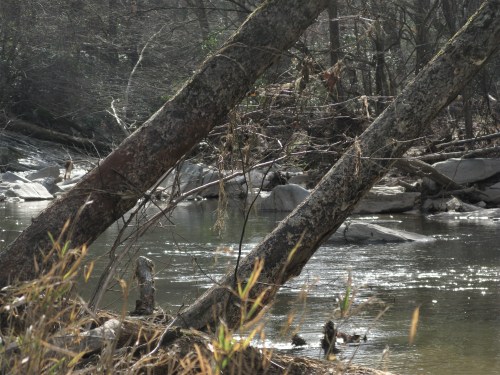
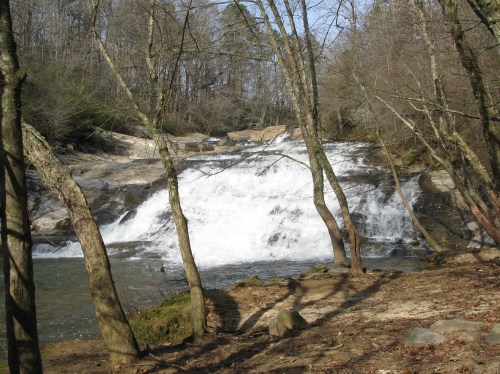
Forest Bathing Trail, Grassy Creek off Mountains-to-Sea Trail

[with poems by Lucinda Trew and Jane Craven]

Last week I took a walk in the woods with my oldest friend Bill (distanced by 2-meter dog leash). We were forest bathing (shinrin yoku): phones off, listening to Grassy Creek accompany our rustic trail, smelling leafmold, fungus, pines, going nowhere and getting there; reflecting on the moment, simmering in our conjoined past which stretches all the way back to our grandfathers who worked together on the same railroad 60 years ago.

Every trail, though, has a way of turning. Almost back to our cars, Bill happened to ask, “What are you going to do with your stuff before you die?” Us old guys, especially old poets, think about dying. Good story fodder. Let me tell you the one about . . . . Just not usually as concrete as what will become of our earthly matter when no one wants it any more.

Stoff: German, translates as substance. Two synonyms for Oxygen are Sauerstoff and Atemluft, the first meaning acid substance (early chemists’ misconception that all acids must contain oxygen) and the second meaning air for breathing. We humans can live about 3 minutes without oxygen before our brains lose neurons and our substance begins to degrade, but oxygen is pure poison to many microorganisms and tricky to deal with even for our own mammal cells (or why else would anti-oxidants be such a big deal?).

Stuff is pretty frangible. Are the moment’s mental occupations or the day’s consuming concerns any more tangible? Bill shared with me a photo of his granddad Enoch Blackley in his engineer’s gear from the 30’s, outline of pocket watch visible through the denim of his overalls. I have one very similar of my granddaddy Peewee Griffin. The bit of stuff comprising those old prints, grains of silver on paper, is mere milligrams of matter; the cubic volume of memory those images reveal is larger than many lives.

My Stoff – carbon, nitrogen, phosporus – will feed the trees. May I leave behind the tempo of my walk, the sound of laughter, honest tears of compassion, a couple of good poems. Maybe that’ll do.

.     .     .     .    .     .     .

These two poems are from Kakalak 2020, the annual anthology of Carolina poets, by writers whom I don’t know and hadn’t read before. Lucinda Trew’s Of Stars fills me with wonder, all the universe in a crow-eye seed, somewhere within the secrets of universe wanting to be spilled out. Jane Craven’s Speaking of the World does just that, the image of a small flower expanding to hold the pain and contradictions of the most intimate relationships.

Metaphor is the tool that communicates the mysteries which swirl around us and within us, the inexplicable spark of our synapses, the spin of our electrons. Some things can’t be spoken, only sung.
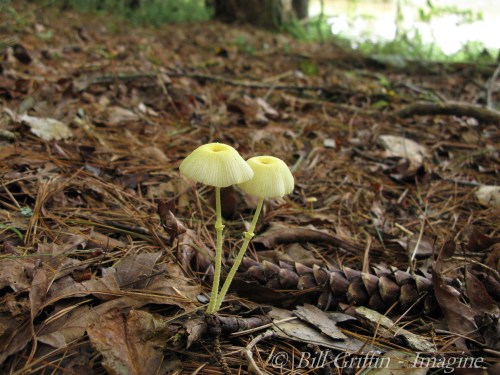
Forest Bathing Trail, Grassy Creek off Mountains-to-Sea Trail

.     .     .     .    .     .     .

Of Stars
If you wish to make an apple pie from scratch, you must first invent the universe. – Carl Sagan

The conjuring orchard man
holds hemispheres in sturdy hands
cupping chaos and creation
presenting apple halves
for inspection
and the revelation

of stars
a crop circle enigma etched
within sweet flesh
five symmetrical rays cradling
crow-eye seeds
small enough to spit
vast enough to hold eternity –
the very dust and stuff

of stars
carbon, nitrogen, oxygen
phosphorus – the breath and wingbeat
of birds who rise from reeds and nest

the rush and thrum
of boys who scrabble up bark, swagger
wave applewood swords

the sway and silhouette
of branches, girls dancing
longing for the moon

of pulse and surge
of cities, song, engines
prayer

the earthen realm
of roots and worm, turnips
and bones

the axial turn
of tides and shells
molecular chains

and of apples
twisted exquisitely, evenly
in half
spilling stars
and seeds and secrets
of the universe

Lucinda Trew, Kakalak 2020, Main Street Rag Publishing Company

.     .     .     .    .     .     .
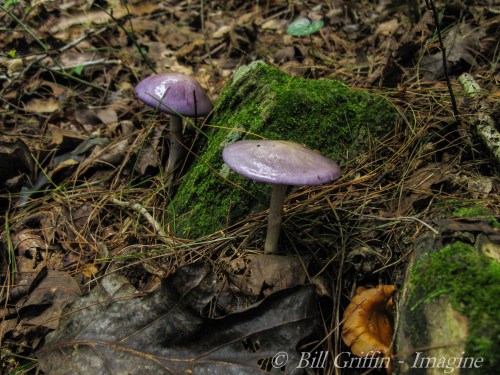
Forest Bathing Trail, Grassy Creek off Mountains-to-Sea Trail

.     .     .     .    .     .     .

Speaking of the World

Pinprick faces open in a violet fever behind my house – swathes
of mazus flowering downhill. A cultivar

from the Himalayas, it’s bred to survive scarcity and climate extremes.

In your world, the doctors have gone, left your body

a prescribed burn, lightly
elevated in a rented hospital bed, handfuls of pills labeled for days.

The trees, to a one, freeze beneath a milky lichen – and you who sleep

year round with open windows are speaking of the world –
of the last deer you saw weaving through balsam, of the bear

who bent double the birdfeeder, wild turkeys and their long-
neck chicks, a lone slavering coyote crossing the yard.

Grief, you say
three times,
each a dry leaf
papering
from your lips.

I left you in the boreal world, rushed back to my own life.
And I admit this with unnatural ease, like there’s no shame

in turning toward the sun, in enduring.

Jane Craven, Kakalak 2020, Main Street Rag Publishing Company

.     .     .     .    .     .     .

Lucinda Trew: http://trewwords.com/about/
Jane Craven: https://www.janecraven.com/bio

.     .     .     .    .     .     .
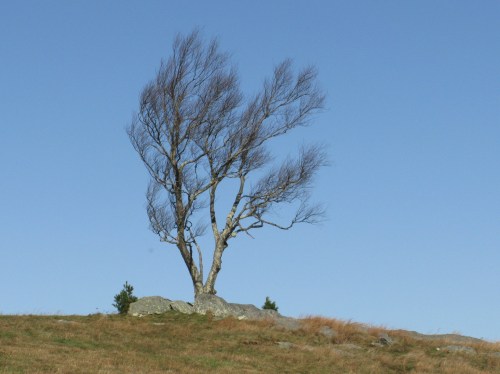
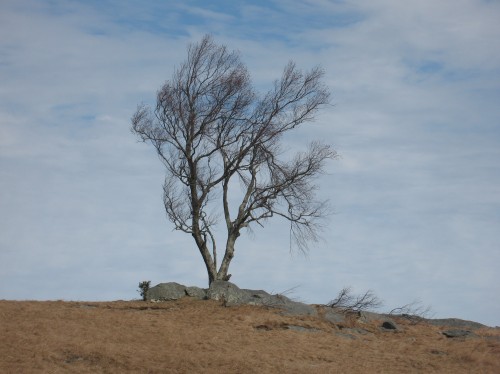
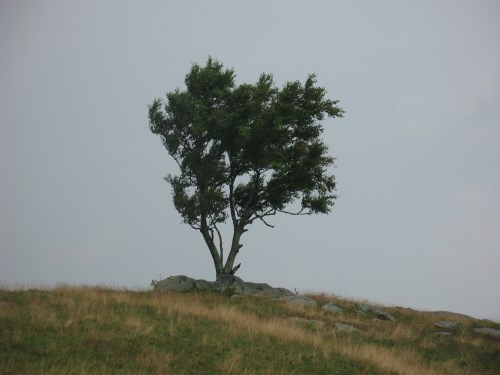
2020-11-03b Doughton Park Tree

Nothing is Happening

[with poems by Joan Barasovska and Kathy Ackerman]

Everything or nothing. The radio is off. The screen is frozen. The refrigerator snores. The clock won’t tick any faster, any slower. In an hour we leave for Raleigh to see our grandson (backyard, distanced, masked) but right now nothing is happening

I’m no good at nothing. If I wake in the dark my brain whirls venom trying to bite its tail. Where is dawn’s blessed peace? If I take deep breaths, watch the feeder, daily agendas begin to scroll down the back of my cornea. How many seconds after emptying myself before I fill back up with everything?

We are entering the season of nothing. The azalea may feint a few off-season blossoms but will we ever bloom again? We are in the season of waiting. Where is the so fragrant earth we lost so long ago? Where is the muscle and spunk of summer that convinced us we might carry through? The season of turning. What justice like waters, what righteousness like an ever-flowing stream? When? How do these shortened days stretch so long?

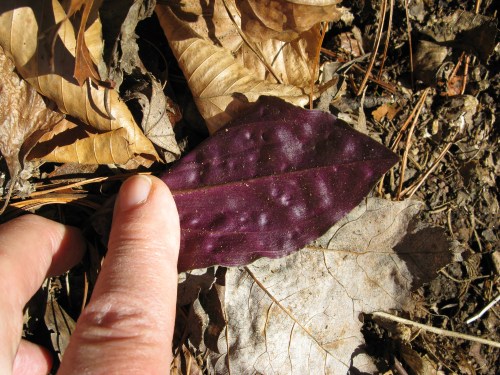
In the woods, something is happening. Orchids are making sugar. How have I missed that? One species will bloom in May, the second in August, but their leaves are now. Their delicate little tenacious tough-ass corms swell all winter waiting to rocket up a spike of summer flowers into a leafed-out overshaded world.

Something is always happening. Something is deeper than those scrolling agendas. Something in the world and something behind my optic chiasm in deep matter. Something that maybe wants me to be still and notice. Something to hope for, to wait for, to go forth and meet.

There is no nothing. It’s all everything.

.     .     .     .     .     .

These two poems are from Kakalak 2020, the annual anthology of Carolina poets. It is an eclectic volume – conversational, confessional, contemplative. Not as many COVID poems as I expected but wait until 2021.

The poems by Joan Barasovska and Kathy Ackerman speak to me of the winding thread that connects our past to our present. Knots and tangles, yes, but also a lashing to secure us in the lashing storm. The something that is happening every day is us becoming human.

.     .     .     .     .     .

Cranefly Orchid, Tipularia discolor

.     .     .     .     .     .

Her Breath

Mike and I exchange a glance
over her cooling body.
Our eyes are dry.
Elsie wears a faded housedress
with a pattern of flowers.
Thirty minutes ago
an aide crossed
her swollen hands.

All morning we sat waiting
while Death rattled her.
She died in the afternoon
while we were out walking.
Our mother took a slow
rollercoaster ride to this day,
dragging us with her on
every shivery dip and climb.

Back from the dead,
Mike said when she woke
from a coma, angry to find herself
in a clean hospice room.
She raged until he put her back home.
Frail, sick, ninety-three, hanging on
ten hears after Dad’s death.
She scolded me yesterday.
I was late for lunch.
I had forgotten to pick up her mail.

Their old bed had been replaced
by a narrow hospital bed
rolled in the hospice workers
while she fumed in the living room
and I boiled water for tea.
Now her jaw is slack,
her last silent treatment.
Above her head hangs
a sad-eyed portrait of me at nine,
painted in blues and grays.

Mike and I are limp with relief.
the secret of Elsie’s anger died with her,
but it was probably sadness.
We are second-generation Americans,
inheritors of the sadness seed.

This mother
lying flat between us
birthed me sixty years ago.
With her last breath,
She’s in a better place
and so am I.

Joan Barasovsaka, Kakalak 2020, Main Street Rag Publishing Company

.     .     .     .     .     .

Adam-and-Eve Orchid, “Puttyroot,” Aplectrum hyemale

.     .     .     .     .     .

Misnomer
for Goliath, my father

i.
This story begins when I believed every word my daddy said.
Honeysuckle, he called them, tending the cuttings
that go all the way back to Rock Creek 50 years,
Aunt Gracie’s yard in the hills where I never lived.

Honeysuckle was all I had to root me to that ancient soil,
so every home I bought I planted some
from Daddy’s supply, rooted in plain clear water.
I wondered why it had no scent, was not a vine,
was pink, for crying out loud.

Now shopping for plants for house #5,
I see the truth in 5-gallon pots before me:
Weigela.

I imagine old Aunt Gracie shooing my father away
from her quilting or canning or sitting alone.
Go cut back that honeysuckle
before it swallows up the outhouse.

Later, seeing his mistake, she didn’t correct him –
a name is just a name –
Grace just glared at tiny Goliath
so proud of his mound of pink and green
already wilting

while the roof of the outhouse
still plushed with yellow sweetness
he’d confuse for 80 years
with a plant that belongs
to the same family, after all,
but so much harder to say.

ii.
Start me some honeysuckle, Daddy, I blurt out
in one of awkward lulls.
I want to imagine his hands on the branch,
the snip of sprigs of coal country
where Gracie’s old feist
barked me all the way to the outhouse and back
when I was too small to know
how hard it is
to keep what lives alive.

Kathy Ackerman, Kakalak 2020, Main Street Rag Publishing Company

.     .     .     .     .     .

.     .     .     .     .     .

Let justice roll down like waters, and righteousness like an ever flowing stream.
Amos 5:24

.     .     .     .     .     .

2019-02-09 Doughton Park Tree

Blue

[with poems by Ryan Wilson and A. R. Ammons]

I didn’t intend to count birds when I set out Tuesday morning. Just a nice weekly hike to Carter Falls and back, a weekday’s solitude – I’m not sure I intended anything more than cooling my brain and heating my muscles. Tamping down the trail maintenance we completed last Saturday. Following the season’s advance into winter.

But then a heron flew out from under the footbridge as I crossed Grassy Creek. Whoever coined the phrase a force of nature was probably in the presence of a Great Blue Heron. Up close they are mute and fearsome. Flying they arouse precognitive awe. When Linda and I encounter one feeding we address it by its nickname: “Hello, Spike.” When one passes overhead we think, “Pterodactyl.” Great Blue demands that one notice.

After gasping at the heron’s sudden flight, I began noticing birds. If they had been calling and singing during the preceding mile my striding deliberation had shut them out. Now they were continuous and various. Counting, I recede and the birds advance.

.     .     .     .     .     .     .

Below are two favorite poems which I return to regularly. They strike me as creating a continuum – the advance of a life toward discovering its meaning, the advance of a life toward its end. I read these and I recede into the lines, but as I read them I expand into my self.

.     .     .     .     .     .     .

At Carter Falls trailhead a Black Vulture perched overlooking; I scanned up past the parking area and saw the roadkill possum the vulture was waiting to ripen. At the Powerhouse (the riverstone foundation, all that’s left of the old generating plant) a Kingfisher daggered up the river and disappeared above the spray. I pulled an index card and a pen out of my pack. Here’s what I came home with:

Great Blue Heron / Belted Kingfisher / Northern Flicker / Red-Bellied Woodpecker / Black Vulture / Turkey Vulture / Carolina Wren / Carolina Chickadee / Tufted Titmouse / Golden-Crowned Kinglet / Eastern Phoebe / White-Breasted Nuthatch / Blue Jay / Eastern Bluebird / Cedar Waxwing / Pileated Woodpecker / Red-Shouldered Hawk / Chipping Sparrow / Northern Mockingbird / American Crow / Common Raven

And since I wasn’t carrying binoculars I’ll just include the numerous chippers and chirpers in the thickets as LGB’s (little gray birds, also sometimes known as LBJ’s, little brown jobs).

.     .     .     .     .     .     .

Face It

A silence, bodied like wing-beaten air,
Perturbs your face sometimes when parties end
And, half-drunk, you stand looking at some star
That flickers like a coin wished doen a weill,
Or when you hear a voice behind you whisper
Your name, and turn around, and no one’s there.
You’re in it the, once more, the stranger’s house
Perched in the mountain woods, the rot-sweet smell
Of fall, the maples’ millions, tongues of fire,
And there, whirl harrowing the gap, squint-far,
Than unidentified fleck, approaching and
Receding at once, rapt in the wind’s spell –
Pulse, throb, winged dark thar haunts the clean light’s glare –
That thin that you’re becoming, that your are.

Ryan Wilson
from The Best American Poetry 2018, first published in The New Criterion

Ryan Wilson was born in Griffin, Georgia and resides in Maryland. Of this poem he writes, “Face It was written in West Virginia at a mountaintop cabin belonging to my great friend, Ernest Suarez. During a break near dusk, I stepped out onto the porch, from which one can see more than fifty miles on a clear day. I was tantalized by a hawk hovering in the western gap, how it seemed to approach and to recede at once on the wind, never near enough for me to identify its species, or even its genus.”

.     .     .     .     .     .     .

Finishing Up

I wonder if I know enough to know what it’s really like
to have been here: have I seen sights enough to give
seeing over: the clouds, I’ve waited with white
October clouds like these this afternoon often before and

taken them in, but white clouds shade other white
ones gray, had I noticed that: and though I’ve
followed the leaves of many falls, have I spent time with
the wire vines left when frost’s red dyes strip the leaves

away: is more missing that was never enough: I’m sure
many of love’s kinds absolve and heal, but were they passing
rapids or welling stirs: I suppose I haven’t done and seen
enough yet to go, and anyway, it may be way on on the way

before one picks up the track of the sufficient, the
world-round reach, spirit deep, easing and all, not just mind
answering itself but mind and things apprehended at once
as one, all giving all way, not a scrap or question holding back.

A. R. Ammons
from The Best American Poetry 2018, first published in Poetry

Archie Ammons was born outside Whiteville, NC in 1926, attended college in Wake Forest, NC, and taught at Cornell for over 34 years. He was guest editor of The Best American Poetry 1994. He died February 25, 2001. A two-volume set of his collected poems was published by W. W. Norton in 2017.

.     .     .     .     .     .     .

.     .     .     .     .     .     .

2014-07-13 Doughton Park Tree