Feeds:
Posts
Comments

Archive for the ‘family’ Category

 . 
[with poems by Frank X Walker]
 . 
Statues of Liberty
 . 
mamma scrubbed
rich white porcelain
and hard wood floors
on her hands and knees
hid her pretty face and body
in sack dresses
and aunt jemima scarves
from predators
who assumed
for a few extra dollars
before christmas
in dark kitchen pantries
they could unwrap her
present
 . 
aunt helen, her sister
took in miss emereen’s laundry
every Saturday morning
sent it back
had washed, air dried,
starched
ironed, folded
and cleaner
than any professional service
 . 
she waited patiently
for her good white woman
to die
and make good on her promise
to leave her
a little something
only to leave her first
 . 
aunt bertha, the eldest
exported her maternal skills
to suburbia
to provide surrogate attention
to children of money and privilege
and spent every other moment
preaching about
the richness of the afterlife
before the undertaker
took her
to see for herself
 . 
housekeepers
washer women
maids
a whole generation
of portable day care centers
traded their days for dimes
allowing other women
the freedom to shop
and sunbathe
the opportunity to school
or work
 . 
this curse-swallowing sorority
dodged dicks
and bosses
before postwar women
punched clocks
they birthed civil and human rights
gave the women’s movement
legs
sacrificed their then
to pave the way for a NOW
their hard-earned pennies
sent us off to college
and into the world
our success is their reward
we are their monuments
but they
are our statues of liberty
 . 
Frank X Walker
from Affrilachia, Old Cove Press, Lexington KY. © 2000
 . 
❦ ❦ ❦
 . 
She and I squat beside the mudgreen puddle and discover a universe. I can’t quit watching the inch-long worms grubbing through the muck, their muscular tubular bodies, how they poke their siphon up to the break the surface tension. Is that the head-end or the butt-end? Lily points out the cadres of dusky tadpoles, some sprouting new legs, and she suspects they’re connected to the vibrato croaks we’ll soon hear from overhanging branches at dusk. Lily’s mom, Jodi, and I play Dueling Nature Apps to see who can broadcast Cope’s Grey Treefrog first.
 . 
In a couple of weeks, Lily will return to Kentucky for her senior year at Berea. I don’t know her major but her field of study is the earth and all that’s in it. When she was seven (and eight, and nine . . .) and came down from West Virginia to North Carolina to spend a summer week at Camp Auntie Lin & Uncle Bill, she was the little girl picking up every bug we encountered and calling out the name of every bird that sang. This afternoon she has showed me her newest drawings: wildflowers, amphibians, a howling wolf. Her big plush firefly is already packed with her other critters for college. If your home is a cabin in the woods and your mother is a Park Service Ranger, how could you become other than a lily of the mountains?
 . 
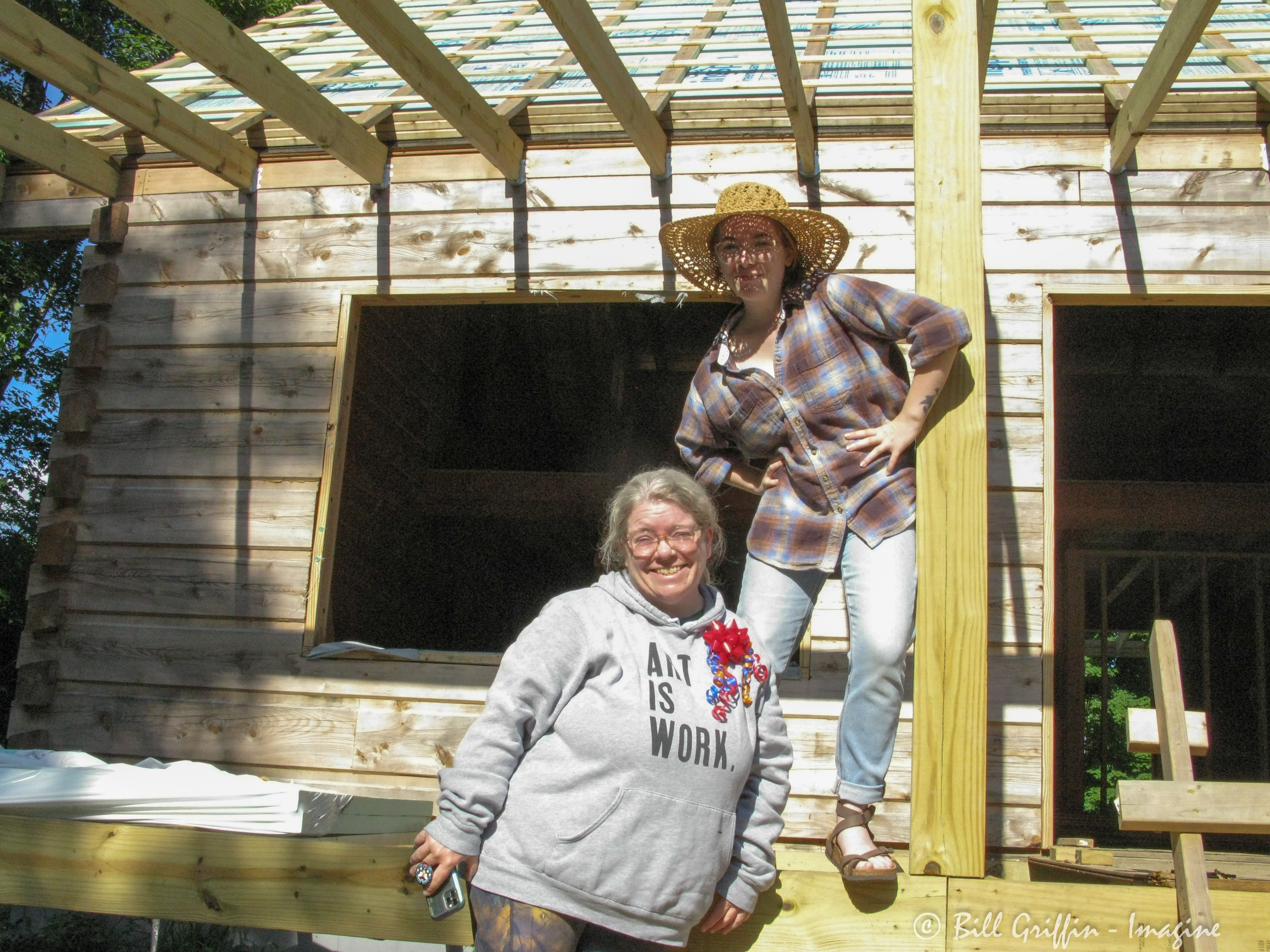
Now the shadows are stretching out across the Crownbeard and Yarrow and the last breeze of July has knocked off several degrees. Jodi’s birthday gathering with sisters draws to an end; Linda, Saul, and I have to head back south. Tomorrow at first light the roofers will arrive with slate-gray tin for Jodi and Lily’s new cabin, and the two women ask me for one last favor. I lug three stout logs from the woodpile and stand them on end to half ring the tadpole puddle. Jodi will flag it so the drivers don’t squash their trucks through the little persistent pool of new life. For the next two weeks, Lily will visit every day to mark the tree frogs’ and peepers’ metamorphosis. When she completes her classes in the spring and drives east again on Rte. 60, the Midland Trail, back to this little hilltop of trees and creatures, no doubt a new chorus will greet her.
 . 
 . 
I am thankful for names that anchor their meaning into my sieve-like memory – Tetraptera; Erythrophthalmus; Frank X Walker. I noticed poems by Frank X popping up in my favorite anthologies, like Black Nature and The Ecopoetry Anthology. The universe kept inviting me to read more, to add this new species to my lexicon, and then I discovered that Frank X Walker will be the instructor at the inaugural Tremont Writer’s Workshop in the Smokies. The universe led me to his books.
 . 
Affrilachia is deep as the Ohio River Valley and broad as the Cumberland Mountains; it is angry and also healing, somber and laugh-out-loud. Most of all, Affrilachia is unique. Frank X Walker’s voice is true and sure from page to page to page but what a voice, rural and hip, local and universal, Southern and Black. I could not put this collection down. Then twenty years later, with many other books in between, comes Last Will, Last Testament. This is an extremely focused book, the first months of his son’s birth and the last month’s of his father’s death, but within these transecting interconnected events the man tells his entire life’s story. He concludes In Another Universe with these lines: Forgiveness is our new last name, / Loving is our first. But he is not describing some distant unattainable universe; these lines are the universe of Frank X Walker’s now. From isolation, loss, and pain come revelation and joy. I have been richly blessed by these poems.
 . 
Tetraptera means ‘four wings’ and is the species name of Carolina Silverbell. Erythrophthalmus means ‘red eye’ and is the species name for Eastern Towhee. Frank X Walker means ‘multidisciplinary artist’ and first African American poet laureate of Kentucky and he has been voted one of the most creative professors in the South. Frank X is founding editor of pluck! The Journal of Affrilachian Arts & Culture and is Professor of English and African American and Africana Studies at the University of Kentucky in Lexington.
 . 
 . 
❦ ❦ ❦
 . 
Harvest Time
 . 
Cancer came
on quiet possum feet
disguised as pneumonia,
until the steady hack and cough
just wouldn’t go away.
 . 
Everybody but him had forgotten
that he smoked
two packs a day for fifty years.
 . 
When he added up the cost,
realized he could buy that tiller
he wanted +++ in a month,
he took his last puff
and quit +++ without blinking.
 . 
If only he could use it
on the tension in this room
and plow up the nastiness,
mistrust, and division
rooted in the dirt
from a past he can no longer
turn under the ground.
 . 
Frank X Walker
from Last Will, Last Testament, Accents Publishing, Lexington KY. © 2019
 . 
❦ ❦ ❦
 . 
Afrofuturistic Messaging
 . 
When I hear him laughing
until he runs out of breath,
gulping more air and giggling again
at something unseen in the ether,
or catch him staring intently
over my shoulder
in the direction
of our Dogon masks
at something invisible
and possibly vibrating
in a spectrum of light only accessible
to the newly-arrived
or those about to depart,
I assume it is you +++ or mama
continuing one of the last and best
conversations you had on this side,
or exchanging coordinates.
 . 
He, barely a haiku, had just met you
and began jabbering and cooing
in couplets, like an old friend
from some other space and time.
 . 
You were even happier
to stare into familiar eyes,
to be comforted
about all that was ahead,
to catch up
with the old and the knew,
the breath between you
transforming into something
interdimensional,
the twinkle in your eye
starlight
from another galaxy.
 . 
Frank X Walker
from Last Will, Last Testament, Accents Publishing, Lexington KY. © 2019
 . 
 . 
❦ ❦ ❦
 . 
Affrilachia
(for gurney & anne)
 . 
thoroughbred racing
and hee haw
are burdensome images
for kentucky sons
venturing beyond the mason-dixon
 . 
anywhere in appalachia
is about as far
as you could get
from our house
in the projects
yet
a mutual appreciation
for fresh greens
and cornbread
an almost heroic notion
of family
and porches
makes us kinfolk
somehow
but having never ridden
bareback
or sidesaddle
and being inexperienced
at cutting
hanging
or chewing tobacco
yet still feeling
complete and proud to say
that some of the bluegrass
is black
enough to know
that being ‘colored’ and all
is generally lost
somewhere between
the dukes of hazzard
and the beverly hillbillies
but if you think
makin’ ‘shine from corn
is as hard as kentucky coal
imagine being
an Affrilachian
poet
 . 
Frank X Walker
from Affrilachia, Old Cove Press, Lexington KY. © 2000
 . 
❦ ❦ ❦
 .
 .  
❦ ❦ ❦
 . 
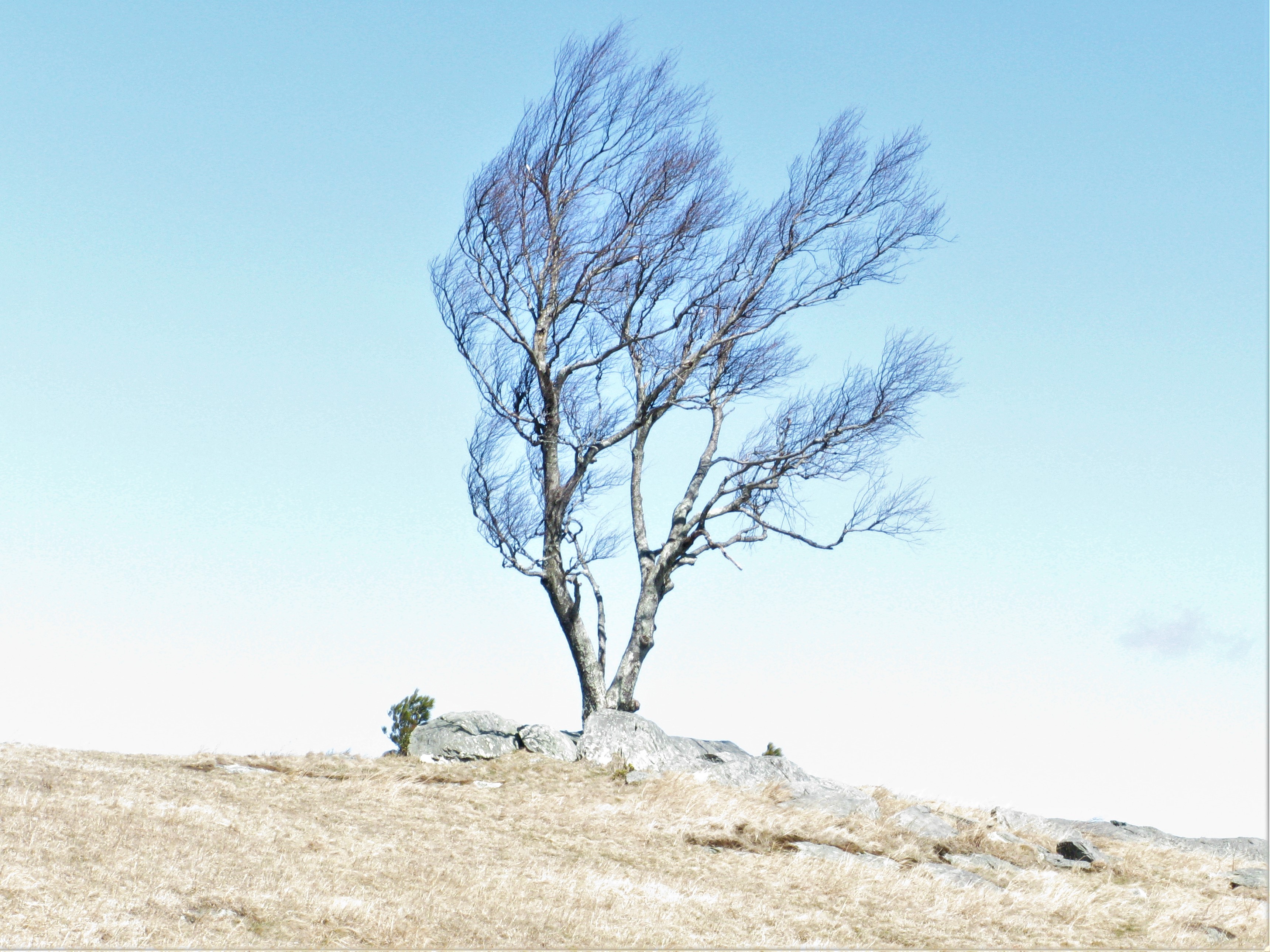
2020-03-07 Doughton Park Tree

Read Full Post »

 . 
[with 3 poems by Michael Hettich]
 . 
Abide with Me (excerpt)
 . 
That first year together, we lived in the shadow
of a fishing line factory, next to a super
highway, under a railroad bridge,
 . 
behind a field of junked cars – mountains
of tires, hub caps, and smashed glass – and we
 . 
prayed fervently for our love to return
this world to the poised grace we could imagine
when we touched each other just right, or when we saw sunlight
glint on the stream full of chemicals and junk
that ran by the factory walls.
 . 
We prayed with our yearning. That year we could float things
in midair on the hymns
we sang in perfect harmony.
 . 
We practiced one hymn – “Abide With Me” –
until we could lift cancered minnows from that stream,
until we could lift stray cats and junkyard dogs,
until we could lift each other as high
as our voices carried. We harmonized versions
 . 
of our families and secrets, until we could float
each other in unison, knowing if we fell silent
for even on moment, we’d fall . . .
 . 
Michael Hettich
from The Halo of Bees
 . 
❦ ❦ ❦
 . 
When did I lose my knack for magic? Oh, I can still work what from a distance appears to be magic. I can wiggle my nose and make a seven-year old girl laugh. I can pull from my tall black hat the Latin binomial for obscure little flowers that most people don’t even consider flowers. I can perform any number of spells that compel my wee ancient mother to say , “You’re such a good boy.”
 . 
I don’t mean I can’t work magic; I mean I’m afraid I’ve lost the knack of magic working me. This morning the home health aide arrived to ride herd on Mom and Dad so I could spend the morning on the beach with grandson Bert and friends. The kid dads had planned some long postponed surf fishing; while Anthony dug for mole crabs, Josh whirled the casting net into the waves and hoped for minnows. On the third throw he brought up two tiny pompano the size of silver dollars and slipped them into a blue plastic bucket of sea water.
 . 
Bert, Wyatt, and Mari were more than rapt. The magic of flipping silvery fishes totally captured them and transported them into a new realm. Who would have thought four- and five-year olds could stare into a bucket for a solid hour? The magic of touching those velvet smooth wriggles, the magical bigness of becoming the ones responsible for bringing fresh water from the waves and moving the bucket with the shifting shade, the shocking magic of closeness, even intimacy, with something up until now just so many pictures in books – the magic worked those children. I witnessed their magic and regret to confess that I until I did I had only seen those little fish as bait.
 . 
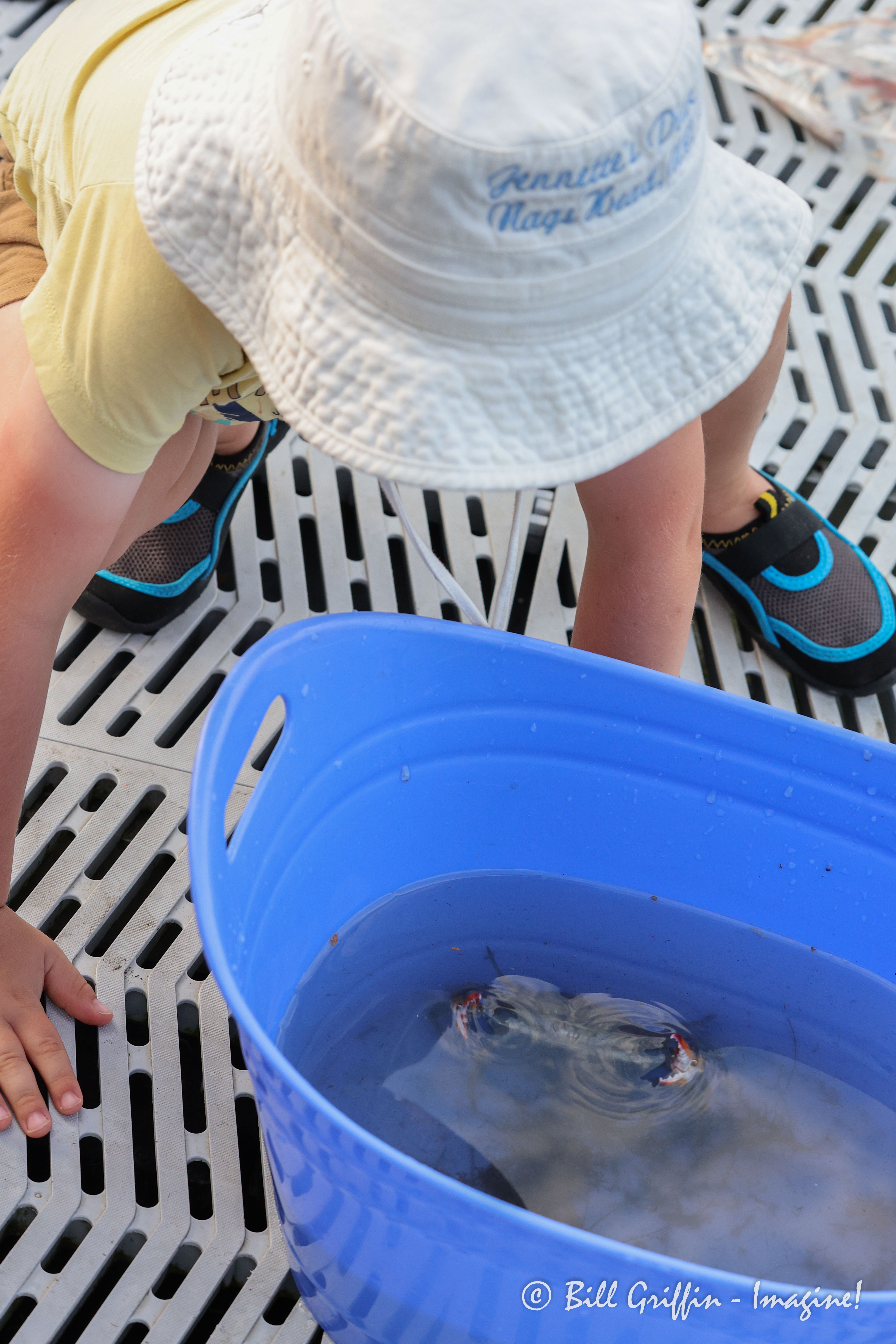
That same evening I drove Mom and Dad over to Bogue Sound – Josh and Bert were going to catch a crab. The tide was right; the dead fish on a string was acceptably fragrant; the blue crab crept closer through the reeds. On his second try, Josh scooped up the dangerous decapod with a dip net and untangled his swimmerets and claws until he plopped into the blue bucket of sound water. A feisty one! Every time Bert moved his hand, the crab snapped claws up out of the water with undaunted ferocity. Bert was magic-smacked. “I never thought I would get this close to a real crab!” This from the boy with a hundred plastic sea creatures of every class, order, and family.
 . 
Perhaps I’ve lost the knack to be worked by magic because I read too much about and spend too little time staring into the blue depths of this unrelentingly odd and utterly magical universe. Perhaps the only hope for me is to catch a little magic as it streams off the children who are still so joyously connected to it. Or perhaps there are others also willing to share their magic. Those persons around me who are inching ever nearer to the magic as the long years of their living come ever nearer to their ending. Driving home from Bert and the Sound at dusk, Mom riding shotgun, I mention, “This is a good time of evening to see bunnies, Mom. Keep your eyes peeled.”
 . 
We turn the corner and Mom spots her at once, a fat cottontail smack in the middle of the neighbor’s lawn. And then we see her two smaller companions, the three of them considering us and chewing thoughtfully as we pass. Mom laughs and claps. “Oh Billy, how did you know we’d see bunnies? It’s just like magic!”
 . 
 . 
One magic that poetry works is to occupy a different life. In Michael Hettich’s poems, he often seems to occupy several lives, each one exceedingly strange and each entirely commonplace. Through the thirty some years that the poems in this collection occupy, the writer walks around trying on other people’s lives. The surprise of his body may be rivers, trees, dry grass, a child sprouting wings. Bodies may be seedpods or they may burst into flame, they might be figures that dissolve into night or into water. These strange and wonderful transpositions and transformations are not fearful or repulsive – we as readers simply step into these bodies with Michael and become part of the magic.
 . 
This is the magic of wildness. Repeatedly, the poems remind us and display for us how wildness is at the heart of each of us. And this is the magic of music, not that the poem uses music to achieve its end but that the noise the world makes is music — poem discovers it and it reveals magic. So many of Michael’s characters sing. Or become song. Those not known for music as well as those whose music we have shut out of our busy non-wild lives. Michael sings, his wife sings, his father and family sing, and the songs weave magic that levitates and elevates and brings joy. When the ringing of my ears and of my machines has deafened me to the everything that makes up this universe of ours – the only known residence, after all, of magic – I know I can return to these poems and be restored.
 . 
The Halo of Bees, New & Selected Poems 1990-2022, Michael Hettich. Press 53, Winston-Salem NC, © 2023
Today’s post features “Selected” poems from the collection. Also see last week’s post, Catch Fire, which features “New” poems.
 . 
 . 
❦ ❦ ❦
 . 
The Frogs
 . 
He loved frogs, so he spent his afternoons
wading in the tall grass, or standing in the leafy water
where the stream turned. Charmed by their stories
of woods and muck, he practiced singing with them
at dusk at pond’s edge, while his mother and father
sat talking, with their cocktails, on the porch. As dark fell
his parent called him, most evenings, for dinner,
but sometimes they let him stay down there until the frogs
were hushed by the cicadas, whose conversations
startled him back to himself. He wandered
up to the house through the tall grass, through the dark,
still singing in his own language. Don’t think of him now,
drinking in a city bar, talking to strangers
who ignore him. Don’t think of him walking out into
the empty street, slightly drunk. He’ll be fine.
Think instead of that walk through the dark wet grass,
the sound of a child’s body moving through the grass;
think instead of those frogs falling silent, of that forest,
of mushrooms that push up overnight like elbows
in the moon-drenched mind of the woods.
 . 
Michael Hettich
from The Halo of Bees
 . 
 . 
❦ ❦ ❦
 . 
House of Light
 . 
Someone breaks open like a seedpod or a flower
to spill out across the street, and we all keep walking by
because it is too beautiful to notice, or too frightening,
as the river just moves on, the clothed and dreaming river,
the speaking river feeling just the way it needs to, nothing more.
There are feathers in the sky. Say birds, generic things,
or simply ignore them. But what about those other people
bursting into flame? will the singe you? Step away
from those other fires, as though you weren’t wild yourself
in all the parts that matter: in your blood and vivid thinking, seeing
colors for their secrets: how to move and be and feel
until you burst aflame. Some buildings built of stone are made
to echo now and then, forever – no one can escape –
but others made of wood are filled with window after window,
so many windows you could ever open all of them
in a single lifetime. No one lives that long. But you could open some.
 . 
Michael Hettich
from The Halo of Bees
 . 
 . 
❦ ❦ ❦
 . 
2020-06-11a Doughton Park Tree

Read Full Post »

 . 
[3 poems from The ECOPOETRY Anthology]
 . 
from Song of Myself
 . 
6
A child said What is the grass? fetching it to me with full hands;
How could I answer the child? I do not know what it is any more than he.
 . 
I guess it must be the flag of my disposition, out of hopeful green stuff woven.
 . 
Or I guess it is the handkerchief of the Lord,
A scented gift and remembrancer designedly dropt,
Bearing the owner’s name someway in the corners, that we may see and remark, and say Whose?
 . 
Or I guess the grass is itself a child, the produced babe of the vegetation.
 . 
Or I guess it is a uniform hieroglyphic,
And it means, Sprouting alike in broad zones and narrow zones,
Growing among black folks as among white,
Kanuck, Tuckahoe, Congressman, Cuff, I give them the same, I receive them the same.
 .  . 
And now it seems to me the beautiful uncut hair of graves.
Tenderly will I use you curling grass,
It may be you transpire from the breasts of young men,
It may be if I had known them I would have loved them,
It may be you are from old people, or from offspring taken soon out of their mothers’ laps,
And here you are the mothers’ laps.
 . 
This grass is very dark to be from the white heads of old mothers,
Darker than the colorless beards of old men,
Dark to come from under the faint red roofs of mouths.
 . 
O I perceive after all so many uttering tongues,
And I perceive they do not come from the roofs of mouths for nothing.
 . 
I wish I could translate the hints about the dead young men and women,
And the hints about old men and mothers, and the offspring taken soon out of their laps.
 . 
What do you think has become of the young and old men?
And what do you think has become of the women and children?
 . 
They are alive and well somewhere,
The smallest sprout shows there is really no death,
And if ever there was it led forward life, and does not wait at the end to arrest it,
And ceas’d the moment life appear’d.
 . 
All goes onward and outward, nothing collapses,
And to die is different from what any one supposed, and luckier.
 . 
Walt Whitman (1819-1892)
collected in The Ecopoetry Anthology, Ann Fisher-Wirth & Laura-Gray Street (Trinity University Press, San Antonio, Texas, © 2020)
 . 
❦ ❦ ❦
 . 
They are alive and well somewhere . . . there is really no death
 . 
June 21 is cold and rainy. Perhaps that is why the slug feels confident to patrol the deck rail fully exposed. They (one slug being both male and female) retract their delicate ommatophora when we approach, perhaps because we are large and our movement is easily sensed. After a minute they once again extend those beautiful slender eyestalks, perhaps because we are large and easily overlooked. In a moment their glide and wander will discover a dense patch of algae shaded by a finial. Their many-toothed radula will work hard and satisfy.
 . 
Amelia and I watch until the rain drives us indoors. In a quarter hour it lessens and we return, but the slug has motored out of sight. Who knew it was so speedy? We peer under and around – no slug. She desires more slugs, so we hunt each post and rail of the deck, the green-hazed porch screens, the planters. We reach the far corner and look down into the mud and mangled trunks and branches left by this spring’s severe storm. Amelia asks why there is a layer of straw strewn across a patch of ground there.
 . 
 . 
Seeing the forecast for a week of rain, on Monday morning I had finally taken up my fire rake and attacked the old sandbox site. When April’s tornado uprooted a big maple and white oak next to it (along with a dozen other trees behind our house), it exposed the bones of half-eaten 6×6’s I’d used to build the sandbox for Josh and Margaret in 1983. I dug them up and hacked out chickweed, smartweed, much despised stiltgrass. What had once been white sand was now filled with worms and 40 years of accumulating humus. Delicious.
 . 
June 19-24 was Naturalist Challenge Week, sponsored by Great Smoky Mountain Institute at Tremont. Participate from anywhere on earth; earn points and you can win a prize – 10 points for planting pollinators. I mixed all my leftover native seeds from last fall: a tablespoon of Bluecurl my son-in-law Josh collected for me, four kinds of milkweed, some monarda and coreopsis and who knows what. I sowed them across 200 square feet now newly introduced to sunlight. I  sprinkled with straw as Amelia noticed. And around the edges I planted pumpkin seeds preserved from soup last Christmas, seeds Josh begged from his 100 year-old grandmother, perpetually propagated.
 . 
Yes, it’s late in the season for planting. Then again, who knows if we’ll even have frost this winter? Foothills NC, the new tropics. Every week Amelia and I can pause from our slug hunt, peer over the deck rail, and watch a patch of earth turning newly green. More life. I’ll save you a photo.
 . 
 . 
❦ ❦ ❦
 . 
November Cotton Flower
 . 
Boll-weevil’s coming, and the winter’s cold,
Made cotton-stalks look rusty, seasons old,
And cotton, scarce as any southern snow,
Was vanishing; the branch, so pinched and slow,
Failed in its function as the autumn rake;
Drouth fighting soil had caused the soil to take
All water from the streams; dead birds were found
In wells a hundred feet below the ground—
Such was the season when the flower bloomed.
Old folks were startled, and it soon assumed
Significance. Superstition saw
Something it had never seen before:
Brown eyes that loved without a trace of fear,
Beauty so sudden for that time of year.
 . 
Jean Toomer (1894-1967)
collected in The Ecopoetry Anthology, Ann Fisher-Wirth & Laura-Gray Street (Trinity University Press, San Antonio, Texas, © 2020)
 . 
❦ ❦ ❦
 . 
Today’s poems are from The Ecopoetry Anthology, edited by Ann Fisher-Wirth and Laura-Gray Street, with a rousing introduction by Robert Hass (Trinity University Press, San Antonio, Texas, © 2020). It is a comprehensive volume, with over a hundred twentieth- and twenty-first century poets, and the book’s opening Historic section includes, among many others, the three poets in today’s selection:
Walt WhitmanLeaves of Grass was first published in 1855 and by the second edition had doubled in length. Today’s small excerpt from Song of Myself highlights the manifold metaphor of the most common of green living things.
Jean Toomer – moved to the South in 1921 and was inspired to write Cane in 1923, a hybrid work intertwining narrative and poetry, then continued on to pursue a literary career. He became an important figure in the Harlem Renaissance.
Wallace Stevens – the vice president of an insurance company, Stevens wrote poetry late into the night and on vacations. He also wrote treatises which suggested poetry’s ability to supplant religion; his Collected Poems in 1955 won the Pulitzer Prize.
 . 
 . 
❦ ❦ ❦
 . 
from Sunday Morning
 . 
VI
Is there no change of death in paradise?
Does ripe fruit never fall? Or do the boughs
Hang always heavy in that perfect sky,
Unchanging, yet so like our perishing earth,
With rivers like our own that seek for seas
They never find, the same receding shores
That never touch with inarticulate pang?
Why set the pear upon those river-banks
Or spice the shores with odors of the plum?
Alas, that they should wear our colors there,
The silken weavings of our afternoons,
And pick the strings of our insipid lutes!
Death is the mother of beauty, mystical,
Within whose burning bosom we devise
Our earthly mothers waiting, sleeplessly.
 . 
VII
Supple and turbulent, a ring of men
Shall chant in orgy on a summer morn
Their boisterous devotion to the sun,
Not as a god, but as a god might be,
Naked among them, like a savage source.
Their chant shall be a chant of paradise,
Out of their blood, returning to the sky;
And in their chant shall enter, voice by voice,
The windy lake wherein their lord delights,
The trees, like serafin, and echoing hills,
That choir among themselves long afterward.
They shall know well the heavenly fellowship
Of men that perish and of summer morn.
And whence they came and whither they shall go
The dew upon their feet shall manifest.
 . 
Wallace Stevens (1879-1955)
collected in The Ecopoetry Anthology, Ann Fisher-Wirth & Laura-Gray Street (Trinity University Press, San Antonio, Texas, © 2020)
 . 
❦ ❦ ❦
 . 
 . 
2016-05-08a Doughton Park Tree

Read Full Post »

« Newer Posts - Older Posts »