.
April 22, 2024
.
Whatever attributes we claim as unique to the human species, such as our propensity for art and science and spirituality – these are gifts of the ground. Curiosity and exploration and awe require a world – a ground – to grow up from and in conversation with.
++++++ Eileen Crist, ecologist, 4/22/24, in The Sun, December 2020
.
❦ ❦ ❦
.
In Memoriam Mae Noblitt
.
This is just a place:
we go around, distanced,
yearly in a star’s
.
atmosphere, turning
daily into and out of
direct light and
.
slanting through the
quadrant seasons: deep
space begins at our
.
heels, nearly rousing
us loose: we look up
or out so high, sight’s
.
silk almost draws us away:
this is just a place:
currents worry themselves
.
coiled and free in airs
and oceans: water picks
up mineral shadow and
.
plasm into billions of
designs, frames: trees,
grains, bacteria: but
.
is love a reality we
made here ourselves—
and grief—did we design
.
that—or do these,
like currents, whine
in and out among us merely
.
as we arrive and go:
this is just a place:
the reality we agree with,
.
that agrees with us,
outbounding this, arrives
to touch, joining with
.
us from far away:
our home which defines
us is elsewhere but not
.
so far away we have
forgotten it:
this is just a place.
.
A. R. Ammons (1926 – 2001)
from A Coast of Trees by A.R. Ammons. Copyright © 1981 by A.R. Ammons.
.
Shared by Jane Hazelman, Elkin, NC, who writes:
.
My only comments would be… and it’s interesting, now that I think carefully about it…
This poem caught me at time when I was grieving the loss of my father who died the same week my family moved to NC…. I felt the ground beneath my feet dropping away… I needed an anchor and somehow the poem nudged me to connect my spirit to the natural world of spider silk, streams and trees, breezes – that comfort was all around me, holding me to its self.
.
++++++ Jane
.
❦ ❦ ❦
.
Erase the lines: I pray you not to love classifications.
The thing is like a river, from source to sea-mouth
One flowing life.
++++++ Robinson Jeffers
.
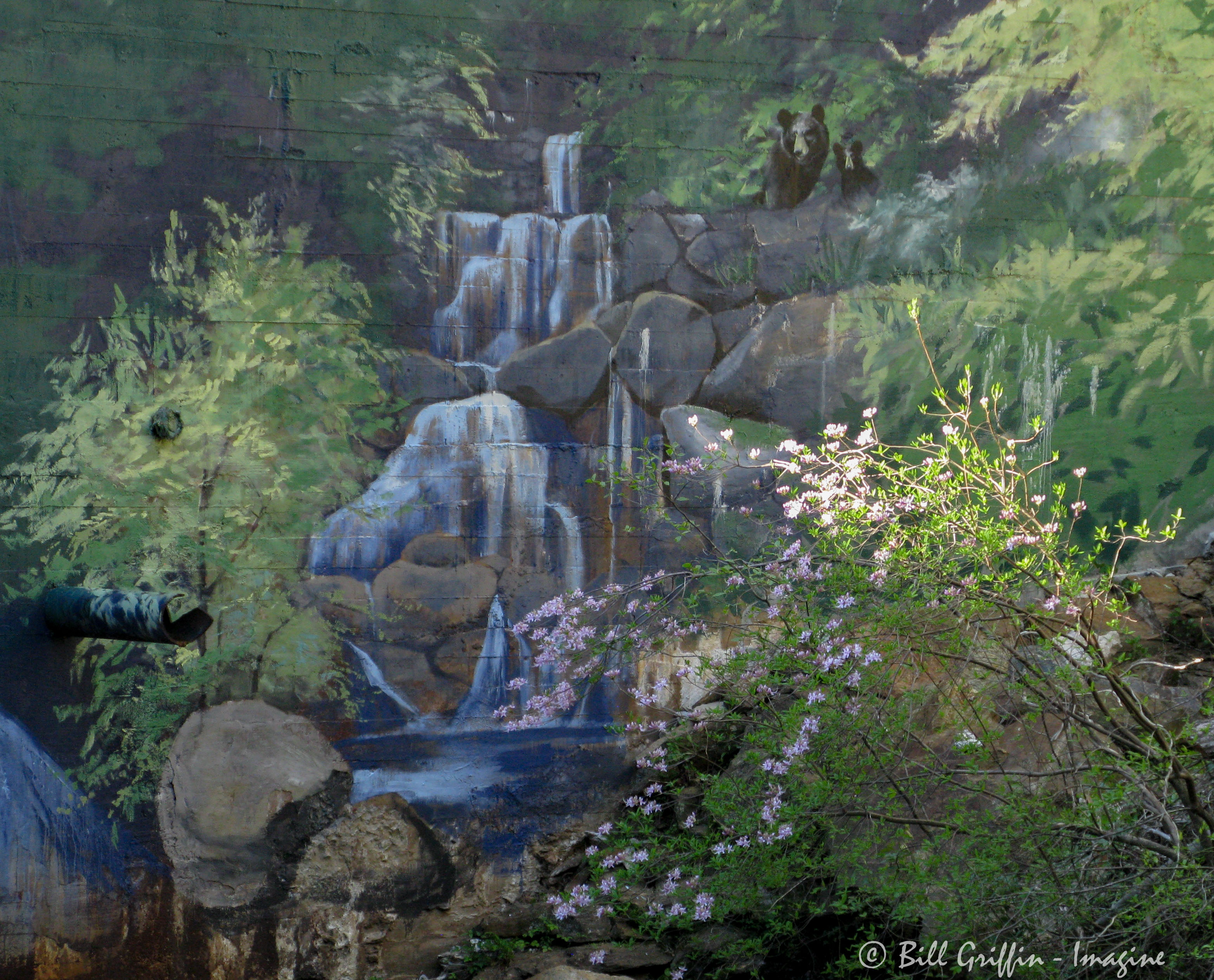
Klondike Lake Dam, mural by Eva Crawford
.
❦ ❦ ❦
.
The Beauty of Things
.
To feel and speak the astonishing beauty of things—earth, stone and water,
Beast, man and woman, sun, moon and stars—
The blood-shot beauty of human nature, its thoughts, frenzies and passions,
And unhuman nature its towering reality—
For man’s half dream; man, you might say, is nature dreaming, but rock
And water and sky are constant—to feel
Greatly, and understand greatly, and express greatly, the natural
Beauty, is the sole business of poetry.
The rest’s diversion: those holy or noble sentiments, the intricate ideas,
The love, lust, longing: reasons, but not the reason.
.
Robinson Jeffers (1887 – 1962)
from Poetry, Vol. 77, No. 4, Jan., 1951
.
Shared by Catherine Carter, Cullowhee NC, who writes:
.
I’ve selected this one because lately I’ve been thinking a lot about paying attention as a holy act, maybe THE holy act, and, if not “the sole business” of poetry, at least a large part of it. So much of what we lose and destroy is because we won’t or can’t give attention; we think of the tree we cut as “ordinary”, as “just” a tree, of the insects we poison as just flaws in our experience of the world, as if our experiences of the world were all that mattered.
.
Along those lines, I’m also including the final poem from my book, Larvae of the Nearest Stars, “The Promise”. That poem first appeared in Still: The Journal, October 2017, and was then reprinted in the collection. Its tone is very different, and I certainly wasn’t thinking about “The Beauty of Things” when I wrote it…but it’s basically promising to do what Jeffers is talking about—paying attention to what’s all around us, what we sweep away or walk right over or destroy without ever knowing it because we think it’s “ordinary.” And I thought of this one, Bill, because of your wonderful post about the tiny, tiny flowers.
.
+++++++ Catherine
.
❦
.
The Promise
.
Life-root, blazing out in your golden rags.
Killdeer, skimming the soccer field,
pealing the glad word of May. Soft lamb’s
quarter, powdered with pewter dust
that might’ve come from the Horsehead
Nebula, putting spinach to shame
with your mineral riches. Wood
thrush trilling your deep flute-
notes from the high canopy, almost never
seen. Tiny henbit, more glamorous
and sexy in your freckled orchid pink
than Marilyn Monroe’s…et cetera.
Et cetera. The list goes on longer
and deeper than any human voice,
and how many hear any of you
over the clamor of ego and ad,
how many know you were ever
here? Nor can I save you
when they come with the mowers,
the poisons, nor make the world
plant milkweed for its true-born monarchs.
What I can do is what I am
doing: look for you. Listen
as you proclaim your many
names in all the tongues
of earth. Speak those names back:
as long as lichens
star this mountain’s boulder-bones
in flat seaglass rosettes, so that even the rock
blooms some wordless joy
into the day’s high air, I will
not cease. I will go on
doing my work in this world.
.
Catherine Carter
from Larvae of the Nearest Stars, LSU Press.© 2019
.
❦ ❦ ❦
.
Both from an ecological perspective and from Genesis’ point of view, goodness resides in the community, the web of life, in the relations of the whole biosphere.
++++++ Rabbi Ellen Bernstein
.
Look at the animals roaming the forest: God’s spirit dwells within them. Look at the birds flying across the sky: God’s spirit dwells within them. Look at the tiny insects crawling in the grass: God’s spirit dwells within them.
++++++ Pelagius (4th century Celtic theologian)
.
.
❦ ❦ ❦
.
Miracles
.
Why, who makes much of a miracle?
As to me I know of nothing else but miracles,
Whether I walk the streets of Manhattan,
Or dart my sight over the roofs of houses toward the sky,
Or wade with naked feet along the beach just in the edge of the water,
Or stand under trees in the woods,
Or talk by day with any one I love, or sleep in the bed at night with any one I love,
Or sit at table at dinner with the rest,
Or look at strangers opposite me riding in the car,
Or watch honey-bees busy around the hive of a summer forenoon,
Or animals feeding in the fields,
Or birds, or the wonderfulness of insects in the air,
Or the wonderfulness of the sundown, or of stars shining so quiet and bright,
Or the exquisite delicate thin curve of the new moon in spring;
These with the rest, one and all, are to me miracles,
The whole referring, yet each distinct and in its place.
.
To me every hour of the light and dark is a miracle,
Every cubic inch of space is a miracle,
Every square yard of the surface of the earth is spread with the same,
Every foot of the interior swarms with the same.
.
To me the sea is a continual miracle,
The fishes that swim—the rocks—the motion of the waves—the
ships with men in them,
What stranger miracles are there?
.
Walt Whitman (1819 – 1892)
Collected in The Golden Treasury of Poetry ; in the public domain.
.
Shared by Nancy Barnett, Eustis FL, who writes:
.
My brother Tom was a wonderful gift giver. We had lost our brother Frank in June 1962 when I was 11 years old. Tom gave me a book during that time by Louis Untermeyer, The Golden Treasury of Poetry (1959).
.
When I went back to school in the fall our 6th grade teacher Mrs. Heinlein asked the class to bring something to read aloud and I chose Miracles from Untermeyer’s collection. I loved the image of nature and the hopefulness of life being seen as a miracle. I knew nothing about Walt Whitman then. (The version in The Golden Treasury of Poetry was somewhat sanitized for the young reader.)
.
The Poet Laureate Joy Harjo noted that her love of poetry was fostered by the very same book.
.
++++++ Nancy
.
.
❦ ❦ ❦
.
Indeed, one outcome of my watch at the mandala has been to realize that we create wonderful places by giving them our attention, not by finding ‘pristine’ places that will bring wonder to us.
++++++ David George Haskell
.
from The Forest Unseen: A Year’s Watch in Nature, in which Dr. Haskell spent a year visiting almost every day a small circle of ground in the southern Appalachian forest, his mandala, and simply opened himself to its presence.
.
❦ ❦ ❦
.
Crane Migration, Platte River
.
I am in danger of forgetting the cranes,
their black wavering lines in the sky,
how they came as if from the past,
how they came of one mind,
wheeling, swirling over the river.
I am in danger of losing
the purling sound they make,
and the motion of their long wings.
We had stopped the car on the river road
and got out, you and I,
the wind intermittent in our faces
as if it too came from a distant place
and wavered and began again, gusting.
Line after line of cranes
came out of the horizon,
sliding overhead.
The voices of cranes
harsh and exciting.
Something old in me answered.
What did it say? Maybe it said Kneel.
I almost forgot the ancient sound,
back in time, back, and back.
The road, the two of us at the guardrail,
low scraggle of weeds flattening and rising
in wind. This is what I must retain:
my knees hit the damp sand of the roadside.
This is what I remember:
you knelt too. We were wordless together
before the birds as they landed on the sandbars
and night came on.
.
Marjorie Saiser
from The Woman in the Moon, University of Nebraska Press, Backwaters Series, © 2018
.
Shared by Michael Beadle, Raleigh NC, who writes:
The opening line to this poem from the anthology The Wonder of Small Things: Poems of Peace and Renewal is a call to us all: against forgetting. Against ignoring the beauty that startles us. It dares us to step deeper into the mystery, turns us into wide-eyed children again as we look up at the heavens, peer into a clear lake, gaze across a field or behold a magnificent tree or bird. This poem reminds us that nature is within range, that it has not disappeared (yet), though we humans are doing our damnedest to foul up the sky, poison the waters, plunder the earth for profit. This poem is about holding ourselves still in that moment of awe, stopping our busy lives to listen to the wind, to the flap of wings, to the crunch of gravel, the swish of tall grass. In such moments of grace and wonder, we are, quite literally, brought to our knees as we show respect for the world around us, the world that breathes into us, the world we have to be reminded of from time to time that was here long before we were and will be here long after we are gone.
.
++++++ Michael
.

.
❦ ❦ ❦
.
I go to Nature to be soothed and healed, and to have my senses put in tune once more.
++++++ John Burroughs, naturalist
.
I believe that there is a subtle magnetism in Nature, which, if we unconsciously yield to it, will direct us aright.
++++++ Henry David Thoreau, fromWalking
.
Teach the children. We don’t matter so much, but the children do. Show them daisies and the pale hepatica. Teach them the taste of sassafras and wintergreen. The lives of the blue sailors, mallow, sunbursts, the moccasin-flowers. And the frisky ones – inkberry, lamb’s-quarters, blueberries. And the aromatic ones – rosemary, oregano. Give them peppermint to put in their pockets as they go to school. Give them the fields and the woods and the possibility of the world salvaged from the lords of profit. Stand them in the stream, head them upstream, rejoice as they learn to love this green space they live in, its sticks and leaves and then the silent, beautiful blossoms. Attention is the beginning of devotion.
++++++ Mary Oliver
.
❦ ❦ ❦
.
To celebrate EARTH DAY 2024 we are featuring seven posts of poems submitted by readers – poems by William Blake to Walt Whitman, Robinson Jeffers to A.R.Ammons to Linda Pastan, and by a number of contemporary poets. Check in every day or two – connect to the earth and to each other!
.
❦ ❦ ❦
.
. 
.




 V E R S E and I M A G E
[…] About/Submit […]