North Carolina Poets for Christmas
Sam Ragan ++++++++.+.+. (1915-1996)
Carol Bessent Hayman ++.+ (1927-2017)
Reynolds Price ++ ++.(1933-2011)
Anthony S. Abbott ++++……. (1935-2020)
. . . . . . .
Winter Watch
In those winter fields
Where only the dead grass
Hides the movement of mice
And the loping fox long away
From hunters, horn and dog,
Walking and watching wind bend
Bare branches at the wood’s edge.
This then is the beginning,
The walk and the waiting,
Winter is a time of waiting,
The pause, the slowed feet,
The watching, the waiting.
Sam Ragan
from Collected Poems of Sam Ragan, St. Andrews Press, Laurinburg NC, © Sam Ragan 1990
. . . . . . .
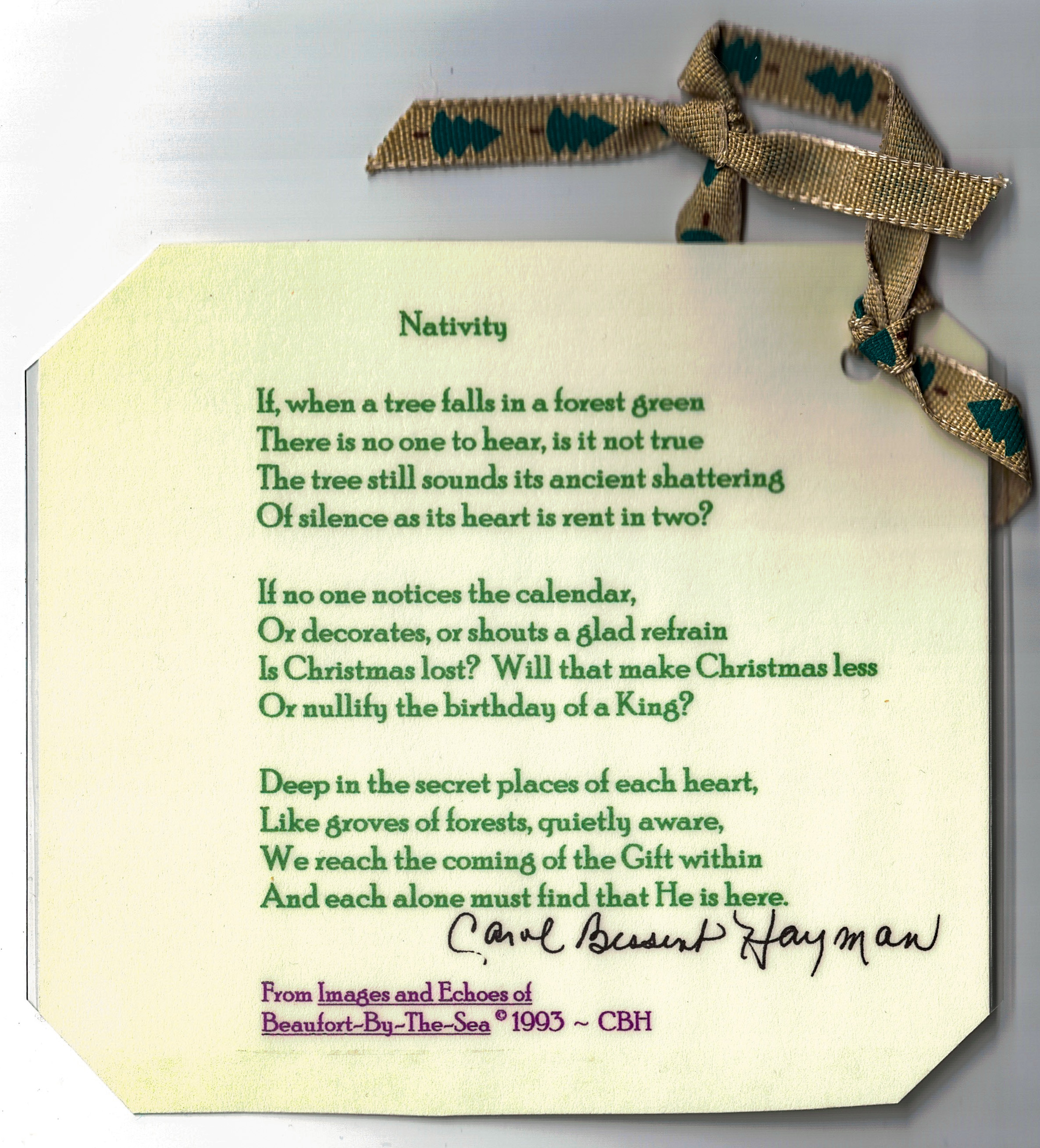
Nativity
If, when a tree falls in a forest green
There is no one to hear, is it not true
The tree still sounds its ancient shattering
Of silence as its heart is rent in two?
If no one notices the calendar,
Or decorates, or shouts a glad refrain
is Christmas lost? Will that make Christmas less
Or nullify the birthday of a King?
Deep in the secret places of each heart,
Like groves of forests, quietly aware,
we reach the coming of the Gift within
And each alone must find that He is here.
Carol Bessent Hayman
from Images and Echoes of Beaufort-By-The-Sea, © 1993 Carol Bessent Hayman
. . . . . . .
A Christmas Night
It was a cold night
And there was ice on the road,
Our car started to slide
As it moved up the small hill,
And the headlights caught the old man
In a thin jacket
Pushing a cart filled with sticks.
There were some bundles and a package
Piled on top, and the old man
Grinned and waved at us
As he pushed the cart
Into the yard of the ligglt house
Where a single light shone.
The tires gripped the road
And we drove on into the darkness,
But suddenly it was warm.
Sam Ragan
from Collected Poems of Sam Ragan, St. Andrews Press, Laurinburg NC, © Sam Ragan 1990

. . . . . . .
A Heron, A Deer – A Single Day
A dull tin noon and, struck down on us
From the crest of pines, a heron – the one
That’s brought me each winter solstice
For twenty-six years now whatever code
I’ve earned for the past year, need for the next:
Vast as a stork in a child’s old reader
And fierce in the head as a demon deputed
To pluck out human eyes in vengeance,
Bolt them down hot.
++++++++++++++++ Yet our two faces
Broaden – eased, assured once more
Of witness at least: our names a precise
Address still known to Guidance Central.
Midnight mist and roaring cold,
We roll toward home from Christmas-eve dinner;
And there in the glen, frozen at the verge,
A six-point buck, young in eye
And grace of joint but flat-eternal
In steady witness. We slow to spare him –
Or think to spare a soulless thing.
He spares us. Sustaining our glare
A long instant of still composure,
His eyes consume whatever we show.
Then in a solemn choice to leave,
He melts a huge body, graceful as girls,
Through two strands ov vicious barbed-wire
We pass unscathed, drive in silence
A last slow mile, then both laugh sudden
At the sight of home. Seen, well-seen
But spared to pass.
Reynolds Price
collect in Word and Witness: 100 Years of North Carolina Poetry, Carolina Academic Press, © North Carolina Poetry Society 1999

. . . . . . .
The New Magi
It is dusk. The sun has tipped backward
behind the old town hall. Inside the patterned
windows of the church, candles not to candles
until it seems the world is only light
and festive voices singing, “Silent Night.”
Out of the dark the siren wails, once,
twice, a third time, and grinding ears
disturb the “all is bright,” while somewhere
in another town a black man in a stocking cap
folds quilts around himself to stop the night.
Out of the dark the siren wails ans somewhere
in another town a woman flushes yesterday’s news
from under the rest room door and a red-haired girl
with shrouded eyes holds out her hand
to strangers walking through the station’s
swinging doors. Where is the star that calls you,
black man? Where is the star that seeks you,
woman? Where is the star that lifts you, shrouded
girl? Walk to us, now, over the battered highways.
Walk to us slowly over the rutted roads.
Walk to the siren’s wail, and the grunting sound
of fire in the night. Throw open the church’s door.
Walk with your papers and your quilts and the sorrow
in your eyes, bringing your gifts past the carpet
of our candles to the manger’s straw. Kneel and turn
And bid us follow with our light up the long aisle
out, out into the grace of the beckoning night.
Anthony S. Abbott
from New & Selected Poems, 1989-2009, Lorimer Press, Davidson NC, © Anthony S. Abbott 2009

. . . . . . .
In a Bus Station on Christmas Eve
There are still travelers
Even at this late hour.
A radio is playing “Joy To the World.”
They sit and stare,
Clutching packages
Wraped as they are wrapped,
With some of the corners torn
Sam Ragan
from Collected Poems of Sam Ragan, St. Andrews Press, Laurinburg NC, © Sam Ragan 1990
. . . . . . .
Sam Ragan served as NC Poet Laureate from 1982 until his death in 1996. He had a long career in journalism at various publications and from 1969 to 1996 was owner, publisher, and editor of The Pilot in Southern Pines, NC. Sam received about every possible NC literary award, including the North Carolina Award in Fine Arts, the Roanoke-Chowan, Parker and Morrison Awards; the North Caroliniana Society Award; and has been inducted into the North Carolina Journalism Hall of Fame and North Carolina Literary Hall of Fame.
Carol Bessent Hayman was the first Poet Laureate of Carteret County and the city of Beaufort, NC. She was a 50-year member of the National League of American Pen Women, served as Southeast editor for their national publication, The Pen Woman, and was a member of the National Board. She was a member of the founding board of N.C. Writers Network, taught many workshops, and published hundreds of poems and five books of poetry.
Reynolds Price, a native of Macon, NC, taught literature at Duke University for 53 years and was James B. Duke Professor of English. In 1962, his novel A Long and Happy Life received the William Faulkner Award. He went on to publish fiction, poetry, essays, and plays and is equally known as the venerated educator of generations of Duke students. For the last third of his life he was confined to a wheelchair due to paralysis resulting from complications of a spinal tumor; his memoir A Whole New Life: An Illness and a Healing has been an inspiration to thousands.
Tony Abbott was a beloved professor of modern drama and American literature at Davidson University (NC). He touched many lives with his deep compassion and spiritual seeking, not only the lives of his students but of everyone who knew him, worked with him, read with him, read his work. His first book of poems, The Girl in the Yellow Raincoat, was nominated for a Pulitzer Prize. He went on to write three novels, four books of literary criticism, and eight volumes of poetry, his last, Dark Side of North, published posthumously in 2021 by Press 53. His tenure on the Board of Directors of the NC Poetry Society has left an influence of creativity, collegiality, and craft that continues today.

. . . . . . .









[…] https://griffinpoetry.com/2021/04/21/earth-day-eve/ https://griffinpoetry.com/2021/01/08/we-do-favor/ . . . ❀ ❀ ❀ ❀ ❀ . Thank you for visiting…