Feeds:
Posts
Comments

Posts Tagged ‘Tony Hoagland’

 . 
[ from What Narcissism Means to Me,
Gray Wolf Press, Minneapolis MN: © 2003 by Tony Hoagland ]
 . 
America
 . 
Then one of the students with blue hair and a tongue stud
Says that America is for him a maximum-security prison
 . 
Whose walls are made of RadioShacks and Burger Kings, and MTV episodes
Where you can’t tell the show from the commercials,
 . 
And as I consider how to express how full of shit I think he is,
He says that even when he’s driving to the mall in his Isuzu
 . 
Trooper with a gang of his friends, letting rap music pour over them
Like a boiling Jacuzzi full of ballpeen hammers, even then he feels
 . 
Buried alive, captured and suffocated in the folds
Of the thick satin quilt of America
 . 
And I wonder if this is a legitimate category of pain,
or whether he is just spin doctoring a better grade,
 . 
And then I remember that when I stabbed my father in the dream last night,
It was not blood but money
 . 
That gushed out of him, bright green hundred-dollar bills
Spilling from his wounds, and—this is the weird part—,
 . 
He gasped, “Thank god—those Ben Franklins were
Clogging up my heart—
 . 
And so I perish happily,
Freed from that which kept me from my liberty”—
 . 
Which is when I knew it was a dream, since my dad
Would never speak in rhymed couplets,
 . 
And I look at the student with his acne and cell phone and phony ghetto clothes
And I think, “I am asleep in America too,
 . 
And I don’t know how to wake myself either,”
And I remember what Marx said near the end of his life:
 . 
“I was listening to the cries of the past,
When I should have been listening to the cries of the future.”
 . 
But how could he have imagined 100 channels of 24-hour cable
Or what kind of nightmare it might be
 . 
When each day you watch rivers of bright merchandise run past you
And you are floating in your pleasure boat upon this river
 . 
Even while others are drowning underneath you
And you see their faces twisting in the surface of the waters
 . 
And yet it seems to by your own hand
Which turns the volume higher?
 . 
Tony Hoagland (1953-2018)
 . 
 . 
❀    ❀    ❀
 . 
Why have I gotten myself into this? Dutiful half hour early at the Forsyth County Public Library, pick up my packet, find my table and sit down to await unnamed arrivals for the poetry reading and discussion. I know no one here. The other table facilitators chat with their neighbors, comfortable and congenial. They definitely look like they know what they’re doing, what they’ll say when the small group interactions begin. They look smart. What am I doing here?
 . 
Now my table has filled up and we’re all listening to the librarian introduce Tony Hoagland, but when he stands up and smiles he is not professorial or imposing. He is a guy reading a poem. Afterwards the people at my table have nothing to say and my throat is too dry to croak out one of the prompts on the sheet I’ve been given, but then a woman and then her sister start telling stories somehow connected to Tony’s poem. He himself sits down to listen. I’m sweating. A good facilitator fades into the background and let’s his students shine, right?
 . 
Tony nods, speaks to those two women, moves to the next table. Later I’m driving home and the whole scene keeps spooling through my head. I miss my turnoff. Next week The Sun arrives in the mailbox. There’s a poem by Tony Hoagland. No, no, I just made that part up, but safe to say there have been poems by Tony Hoagland lurking in my mind ever since that afternoon in the library. Lurking, and every once in a while stepping into the light.
 . 
❀    ❀    ❀
 . 
Poetry Day America
“. . . I am asleep in America too,
  and I don’t know how to wake myself, either”
America, Tony Hoagland
 . 
And then the famous poet stops by my table
to eavesdrop on our discussion of his poem, and Betty
 . 
goes on and on about how we are each one of us
in our own little world, we don’t see
 . 
the people drowning around us, we don’t want to,
and even she who is sensitive sometimes prays
 . 
she won’t see another stray dog beside the road,
while Donna the quiet sister finally tells us
 . 
the first two lines remind her
of the teenage brothers who catch the school bus
 . 
out front of her house, how when she asked
why they wear those baggy jeans half-hanging
 . 
off their hips the older one just shrugged, “It’s
the style,” but the younger boy piped
 . 
“It looks cool!”  Yeah cool, she told him,
well you’d better have a cute little tush because
 . 
it’ll be real cool when those pants fall down. Then
she agrees with Betty, the poem’s about
 . 
how we’re all put on earth to help each other.
I’m on the poet’s side, I want to be the one
 . 
who helps the sisters open up, look deeper
into the lines, think metaphor, discover something
 . 
true, and while the famous poet explains how a poem
can have many voices and that the conversation
 . 
and conflict between them jars and shudders
us into new ways of knowing, I can’t quit nodding.
 . 
After the workshop I’m halfway home before I quit wishing, no
before I even admit to myself I have been wishing
 . 
I’d been the moderator at that other table
where they called the poem’s opening strophe
 . 
Dante’s Inferno only shorter. Hell, I’d come armed
with my own strophes, Ginsberg’s America
 . 
“like Henry Ford my strophes are as individual as his
automobiles more so they’re all different sexes,”
 . 
and I’m remembering during Q&A the banter
between the famous poet and that golden table,
 . 
the hot smart brightness of it still not large enough
to reach across the room for me,
 . 
but here on the fourlane I’ve missed my exit
because now I feel like a real little shit
 . 
for mentally dissing those sisters, me who would never
confess that before the reading I had to look up “strophe”
 . 
in the dictionary, while right at this moment Donna is meeting
those boys as they get off the bus and Betty has stopped
 . 
beside the road, her Ford Taurus, solid, best thing Henry’s put out
since the Model A, to pick up a stray dog.
 . 
Bill Griffin
April 13, 2007
[Poetry Day America won the McDill Award given annually by the NC Poetry Society]
 . 
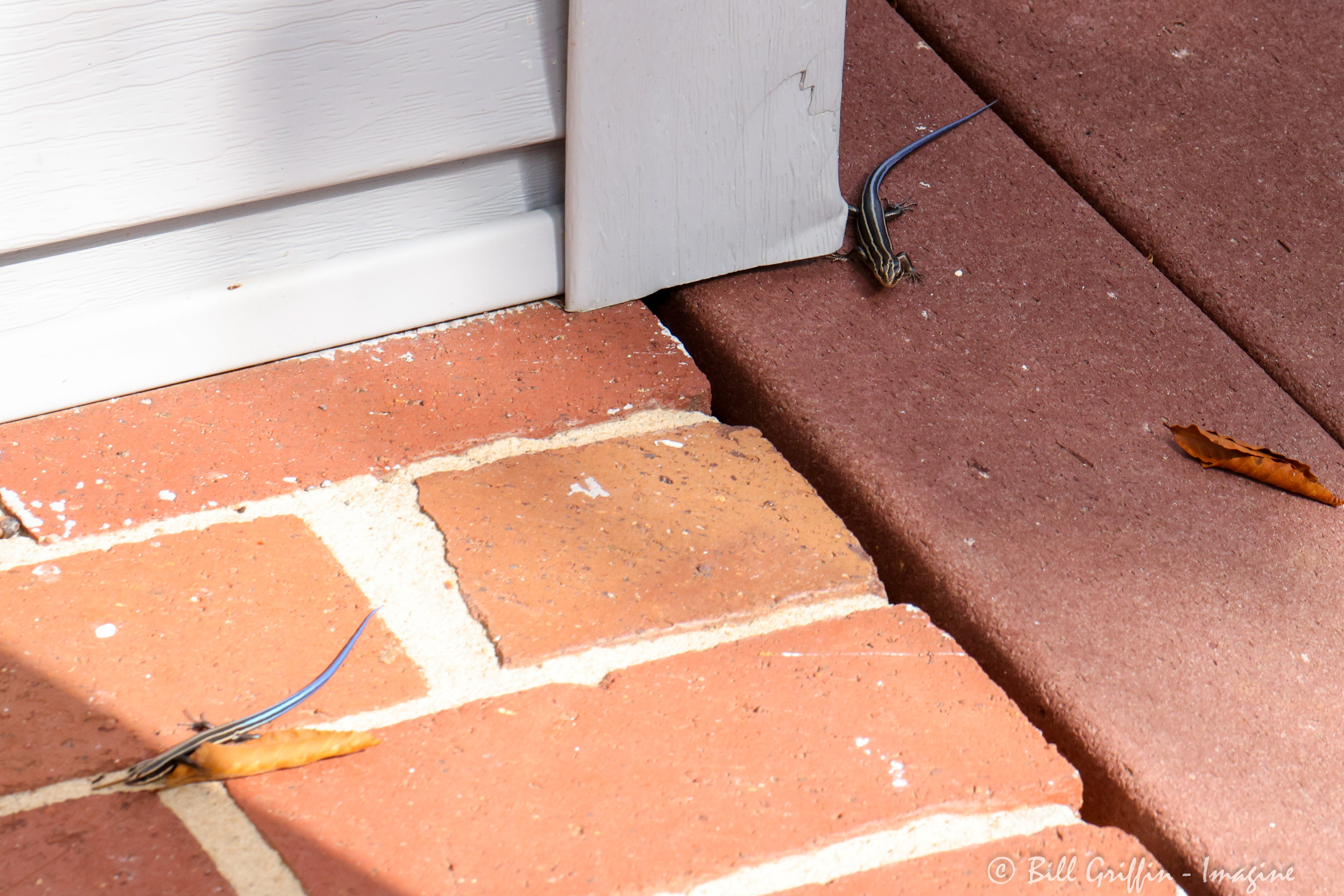
 . 
❀    ❀    ❀
 . 
My first introduction to Tony Hoagland was in the pages of The Sun magazine, published in Chapel Hill, NC, then later at the workshop I’ve described above, sponsored by the Winston-Salem / Forsyth County Library. Tony was born in Fort Bragg, North Carolina. As the child of an army doctor, he moved often during childhood. According to the novelist Don Lee, Hoagland “attended and dropped out of several colleges, picked apples and cherries in the Northwest, lived in communes, followed the Grateful Dead and became a Buddhist.” He earned an MFA from University of Arizona and in addition to his many awards, fellowships, and positions as educator, he re-established his NC roots by serving on the faculty of the low-residency Warren Wilson College MFA Program for Writers. What Narcissism Means to Me (2003), was a finalist for the National Book Critics Circle Award. Tony Hoagland died in 2018 at age 64 of pancreatic cancer.
 . 
❀
 . 
[The quotation by Don Lee is from  Ploughshares Authors & Articles > Tony Hoagland, Zacharis Award > by Don Lee Archived October 13, 2007, at the Wayback Machine.]
 . 
❀    ❀    ❀    ❀    ❀
 . 
Thank you for visiting Verse and Image:
. . . . . every Friday I present one or more poems I’ve read this week that particularly speak to me;
. . . . . some Saturdays I present one or two poems submitted by YOU, my readers.
 . 
If you would like to offer a poem for consideration, either by a favorite author or your own work, please view these GUIDELINES for Saturday Readers Share:
 . 
 . 
If you would like to receive an email each time a post appears, please SUBSCRIBE to Verse and Image using the button on the Home Page.
 . 
If you have a hard time finding the SUBSCRIBE button on this WordPress site, you can send me your email address and I will add you to the subscriber list. Send your request to
 . 
COMMENTS@GRIFFINPOETRY.COM
 . 
Thanks again for joining the conversation.
 . 
– Bill
 . 
 .

Read Full Post »

 . 
[ from What Narcissism Means to Me,
Gray Wolf Press, Minneapolis MN: © 2003 by Tony Hoagland ]
 . 
The Time Wars
 . 
It was the winter we ate a lot of oatmeal to stay warm.
We lived on 17th and G Streets; Kath called it the G spot.
At night in the bathtub I read The Collected Letters of Virginia Woolf,
trying to keep the pages of the 20th-century prose from getting wet,
reading the guest lists for her dinner parties
as she knocked out book after book between her shattering depressions.
 . 
Sometimes I would meet Richard at the Chinese place for dinner,
and one two three hours would vanish like our food.
We would stand outside The Great Wall, adjusting our scarves
in a pastoral moment of urban separation,
watching the cabs whiz by in the dusk.
 . 
The Vietnam War monument was just five blocks away;
on Saturday you would always see a vet or two,
in their windbreakers and baseball caps—
heads down, crying in the shrubs—
the little POW buttons and various insignia attached to their clothing
like they were advertising something.
 . 
We ourselves were fighting the Time Wars:
we could feel it speeding up, rapidly escaping,
like the hiss from a leaky balloon.
We were trying to plug it, to slow it down, to decelerate,
but none of us was having much success—
 . 
One day in February Kath brought in some roses and said,
“Here, the sun came 93 million miles
to make these flowers that I killed for you,”
and I said, “Kathleen, my talents are not capacious enough
to properly exaggerate your virtues,”
and we both burst out laughing
and time stopped right over our heads like a little red car.
 . 
On June 14th, Virginia Woolf wrote in her journal,
“Windy day. I am the hare, far ahead of my critics, the hounds.”
Something endearing about the mixture of weather report and vanity.
Something lonely about this image of success.
 . 
We ourselves aren’t thinking about the future anymore.
What we want is to calm time down, to get time in a good mood,
to make time feel wanted.
We just want to give time many homemade gifts,
covered with fingerprints and kisses.
 . 
Tony Hoagland (1953-2018)
 . 
❀ . 
 . 
My first introduction to Tony Hoagland was in the pages of The Sun magazine, published in Chapel Hill, NC, then later at a workshop sponsored by the Winston-Salem / Forsyth County Library. Tony was born in Fort Bragg, North Carolina. As the child of an army doctor, he moved often during childhood. According to the novelist Don Lee, Hoagland “attended and dropped out of several colleges, picked apples and cherries in the Northwest, lived in communes, followed the Grateful Dead and became a Buddhist.” He earned an MFA from University of Arizona and in addition to his many awards, fellowships, and positions as educator, he re-established his NC roots by serving on the faculty of the low-residency Warren Wilson College MFA Program for Writers. What Narcissism Means to Me (2003), was a finalist for the National Book Critics Circle Award. Tony Hoagland died in 2018 at age 64 of pancreatic cancer.
 . 
❀
 . 
[The quotation by Don Lee is from  Ploughshares Authors & Articles > Tony Hoagland, Zacharis Award > by Don Lee Archived October 13, 2007, at the Wayback Machine.]
 .

 . 
❀    ❀    ❀    ❀    ❀
 . 
Thank you for visiting Verse and Image:
. . . . . every Friday I present one or more poems I’ve read this week that particularly speak to me;
. . . . . some Saturdays I present one or two poems submitted by YOU, my readers.
 . 
If you would like to offer a poem for consideration, either by a favorite author or your own work, please view these GUIDELINES for Saturday Readers Share:
 . 
 . 
If you would like to receive an email each time a post appears, please SUBSCRIBE to Verse and Image using the button on the Home Page.
 . 
If you have a hard time finding the SUBSCRIBE button on this WordPress site, you can send me your email address and I will add you to the subscriber list. Send your request to
 . 
COMMENTS@GRIFFINPOETRY.COM
 . 
Thanks again for joining the conversation.
 . 
– Bill
 . 
Doughton Park Tree 2025-07-10
 . 

Read Full Post »

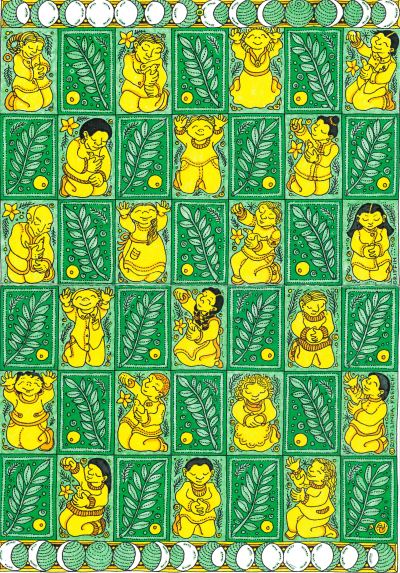
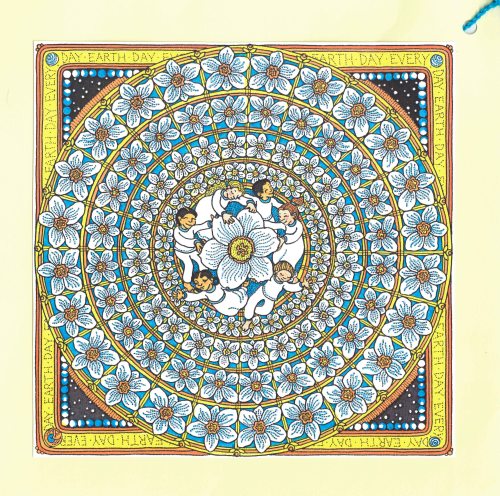
Earth Day artwork by Linda French Griffin

[with poems by Dorianne Laux and Tony Hoagland]

The sensual man conforms thoughts to things; the poet conforms things to his thoughts. The one esteems nature as rooted and fast; the other, as fluid, and impresses his being theron.

Ralph Waldo Emerson, Nature, 1836

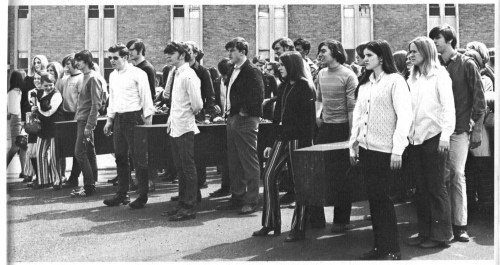
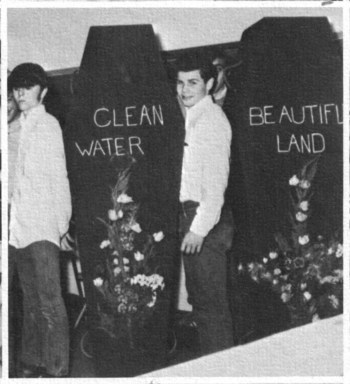
April 22, 1970 – the entire student body of Aurora High School is milling around outdoors in the Ohio springtime. In the front parking log five or six big black coffins are set up like grim milestones. The coffins bear epitaphs like “Clean Water” and “Beautiful Land” – the administration has granted the Student Council’s request to have an assembly to celebrate the first Earth Day.

I am taking photos for Borealis, the yearbook; my girl friend Linda French is assistant editor. She is vastly more the environmental activist than I. Our little farm town / bedroom community is forty miles from Cleveland and where the Cuyahoga River crosses our local golf course it’s only an insubstantial creek. The year before, though, the Cuyahoga River where it enters Lake Erie in downtown Cleveland caught fire and burned, and not for the first time. No big deal – oil slicks and pollution mean progress, full employment. Forget about it.

Maybe we all would have forgotten, except Time Magazine published articles about the burning river and then in December National Geographic featured it on the cover – “Our Ecological Crisis.” Congress had established the Environmental Protection Agency in January 1970; by spring even we kids in sleepy Aurora must be worrying how much longer we’ll have clean water and beautiful land.

Earth Day 1970

.     .     .     .     .     .     .

A couple of years ago Linda and I took a road trip to northeastern Ohio to visit all the old haunts. The high school has additions and facilities we can’t even figure out. The golf course is now a reclaimed and replanted nature preserve with walking trails. There’s lots of new development in Aurora but there are still cow pastures and horses.

We also paid our first visit to Cuyahoga Valley National Park. Designated a National Recreation Area in 1974, the same year we got married and moved to North Carolina, it became a National Park in 2000. Between Akron and Cleveland it comprises more than 33,000 acres following the river and the old Ohio & Erie Canal and reaching all the way into metropolitan Garfield Heights – the nation’s largest urban park. Even outside the Park the Cuyahoga is cleaned up, restored, back in the business of fish and wildlife and recreation instead of oil slicks. In 1970 if you fell into the river it meant an immediate trip the ER; now you just climb back up on your paddle board.

Without catching on fire.

Earth Day 1970

Earth Day 1970

.     .     .     .     .     .     .

These two poems are collected in The Ecopoetry Anthology, edited by Ann Fisher-Wirth and Laura-Gray Street, Trinity University Press, San Antonio, Texas, © 2013.

Dorianne Laux has taught creative writing at NC State University and elsewhere. Her most recent book among many is Only as the Day Is Long: New and Selected Poems (W. W. Norton, 2019).

Tony Hoagland (1953-2018) was born in Fort Bragg, NC, and taught at the University of Houston and Warren Wilson College. His many books of poetry include Unincorporated Personas in the Late Honda Dynasty (Graywolf Press, 2005)

.     .     .     .     .     .     .

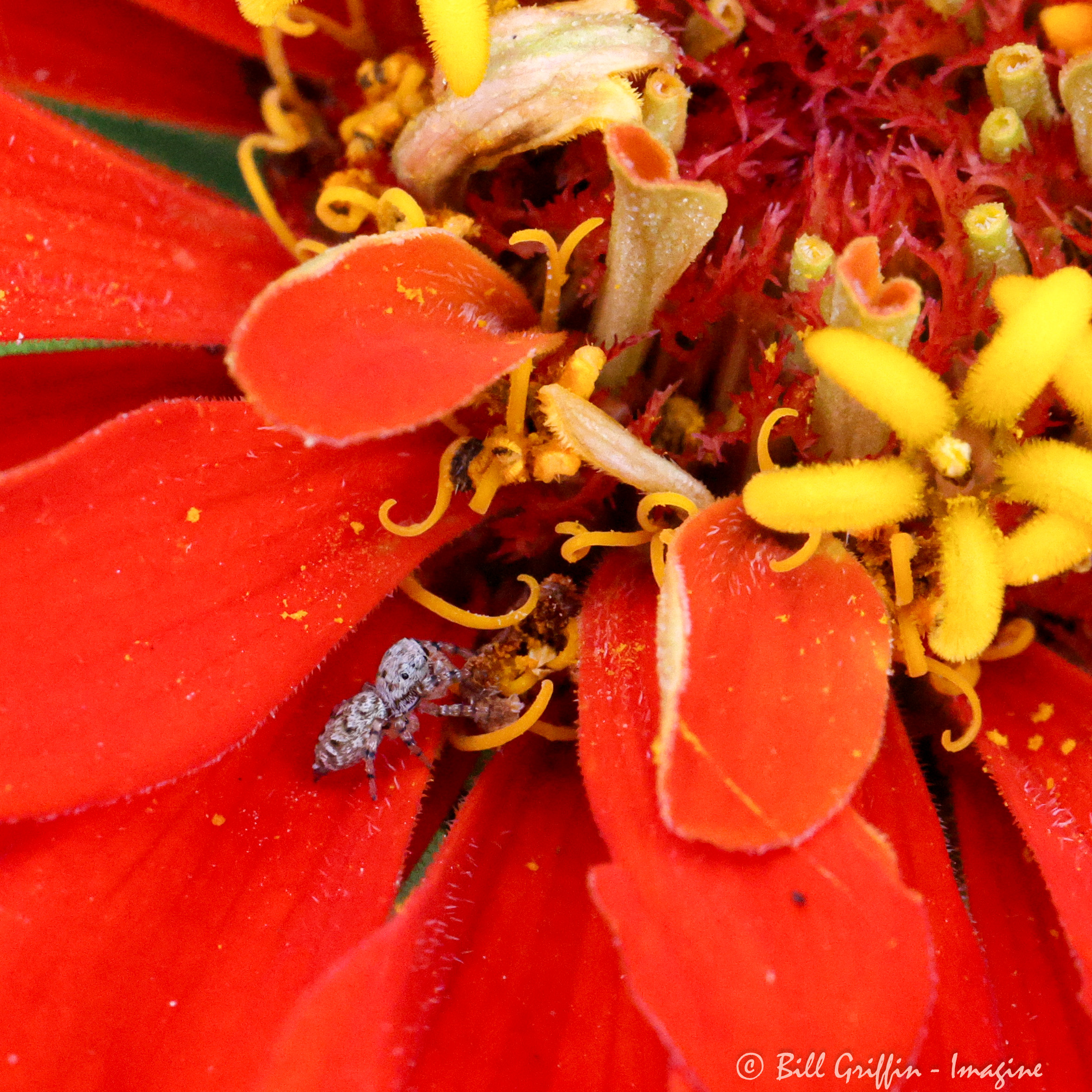
Life is Beautiful

+++++++++ and remote, and useful,
if only to itself. Take the fly, angel
of the ordinary house, laying its bright
eggs on the trash, pressing each jewel out
delicately along a crust of buttered toast.
Bagged, the whole mess travels to the nearest
dump where other flies have gathered, singing
over stained newsprint and reeking
fruit. Rapt on air they execute an intricate
ballet above the clashing pirouettes
of heavy machinery. They hum with life.
While inside rumpled sacks pure white
maggots writhe and spiral from a rip,
a tear-shaped hole that drools and drips
a living froth onto the buried earth.
The warm days pass, gulls scree and pitch,
rats manage the crevices, feral cats abandon
their litters for a morsel of torn fur, stranded
dogs roam open fields, sniff the fragrant edges,
a tossed lacework of bones and shredded flesh.
And the maggots tumble at the center, ripening,
husks membrane-thin, embryos darkening
and shifting within, wings curled and wet,
the open air pungent and ready to receive them
in their fecund iridescence. And so, of our homely hosts,
a bag of jewels is born again into the world. Come, lost
children of the sun-drenched kitchen, your parents
soundly sleep along the windowsill, content,
wings at rest, nestled in against the warm glass.
Everywhere the good life oozes from the useless
waste we make when we create – our streets teem
with human young, rafts of pigeons streaming
over squirrel-burdened trees. If there is
a purpose, maybe there are too many of us
to see it, though we can, from a distance,
hear the dull thrum of generation’s industry,
feel its fleshly wheel churn the fire inside us, pushing
the world forward toward its ragged edge, rushing
like a swollen river into multitude and rank disorder.
Such abundance. We are gorged, engorging, and gorgeous.

Dorianne Laux
from Smoke, BOA Editions Ltd., © 2000 Dorianne Laux

.     .     .     .     .     .     .

Wild

In late August when the streams dry up
and the high meadows turn parched and blond,

bears are squeezed out of the mountains
down into the valley of condos and housing developments.

All residents are therefore prohibited
from putting their garbage out early.

The penalty for disobedience will be
bears: large black furry fellows

drinking from you sprinkler system,
rolling your trashcans down your lawn,

bashing through the screen door of the back porch to get their
first real taste of a spaghetti dinner,

while the family hides in the garage
and the wife dials 1-800-BEARS on her cell phone,

a number she just made up
in a burst of creative hysteria.

Isn’t that the way it goes?
Wildness enters your life and asks

that you invent a way to meet it,
and you run in the opposite direction

as the bears saunter down Main Street
sending station wagons crashing into fire hydrants,

getting the police department to phone
for tranquilizer guns,

the dart going by accident into the
neck of the unpopular police chief,

who is carried into early retirement
in an ambulance crowned with flashing red lights,

as the bears inherit the earth
full of water and humans and garbage,

which looks to them like paradise.

Tony Hoagland
from Unincorporated Personas in the Late Honda Dynasty, Graywolf Press, © 2005 Tony Hoagland.

.     .     .     .     .     .     .

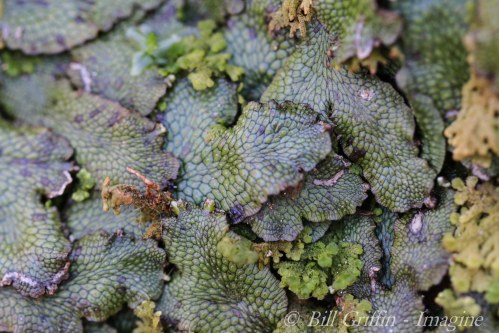
Liverwort, Marchantia species; Liverworts are primitive nonvascular plants, perhaps the most primitive true plants still in existence.

Isn’t life beautiful? Not always pretty but always beautiful. Often messy, invariably smelly, predictably unpredictable, unexpectedly weird, but always beautiful. Scrunch down low enough to notice; don’t let it bite you (much); take off your anthropocentric glasses; what did I tell you – beautiful!

.     .     .     .     .     .     .

+     +     +     +     +

[original artwork by Linda French Griffin (c) 2021]

Read Full Post »