Feeds:
Posts
Comments

Posts Tagged ‘Peter Makuck’

 . 
[with 3 poems from Tar River Poetry]
 . 
Submersible
 . 
+++ “Red Sky at Morning”
++++++ – for Peter Makuck
 . 
All day and into the evening sullen rain has bucketed dow upon us,
and I think of Peter and the blue-black coastal squalls purpling seaward.
 . 
Ignoring heavy weather is what natives do on Emerald Isle. Years ago
I failed to talk him and Phyllis into fleeing Hurricane Florence, a monster
 . 
storm grinding on Wilmington. Likewise, I used to remind my rother
at Kitty Hawk, half-joking, that he lived in the middle of the god-damned
 . 
Atlantic Ocean. He never listened either – even after his son refused
evacuation from Hurricane Isobel and almost drowned inside their cottage
 . 
with his loyal dog and bobbing bamboo furniture. Tenaciously, Peter and
Phyllis have been anchored to their apartment for years, weathering cancer
 . 
treatments and the Pandemic. Finally – like my father decades ago –
Peter had had enough of chemo, remission, drug cocktails and radiation,
 . 
so six weeks back he stopped. Meanwhile the world obsesses over five men
trapped in the submersible Titan, its only hatch bolted from the outside and
 . 
the seven ways it’s supposed to shed weight and resurface from its great drop
down to Titanic’s ghost spines. The one porthole is small. They’re out of air.
 . 
Peter too has begun a long descent through the murky waters of memory,
morphine, and goodby to land finally (I hope) upon the soft silt of forever.
 . 
Everyone’s half-waiting for the last storm to fade and for Peter – teacher, poet,
and sailor – to resurface and note with delight, again, a red sky at night.
 . 
Don Ball
from Tar River Poetry, Volume 63 Number 1, Fall 2023, Greenville NC.
 . 
❦ ❦ ❦
 . 
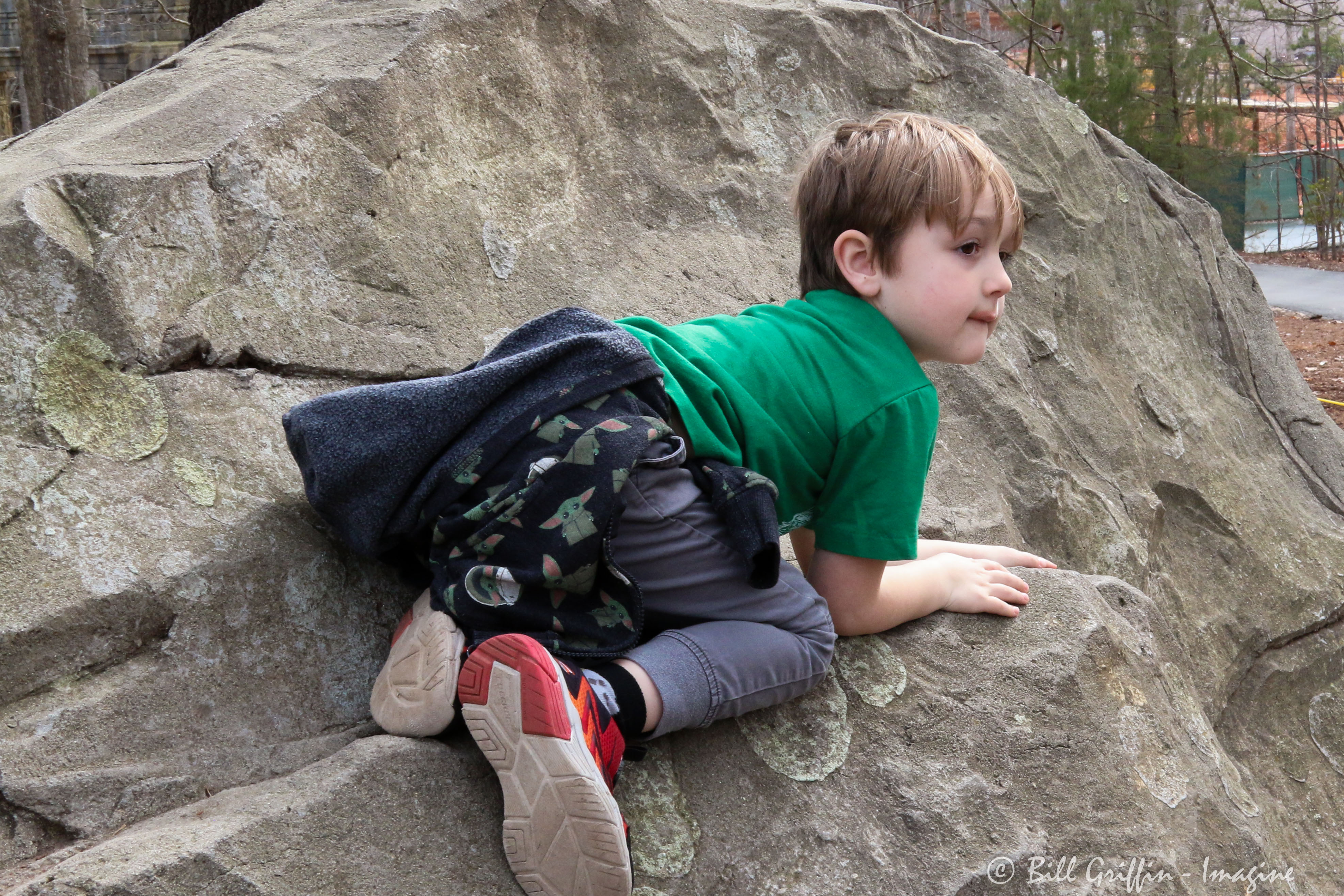
As soon as he hops from the car he’s Tyrannosaurus, miniature dangling forelegs, ferocious jaw gaping as he swivels his head side to side, Linda and me his prey. While we wait for food Chameleon appears, thin compressed lips, deliberate robot-like ratcheting gait, front digits at right angles all asplay. Later we interrupt our walk for him to climb the big rock, Gila Monster, but then he elongates his body along a fissure and becomes Chuckwalla.
 . 
Boys are animals. This boy, though, is the master of animals. Not only in transforming himself one into another but also in the thousand and one details he can tell us about their lives and characteristics. We imagine his kindergarten teacher’s eyebrows rising higher and higher at the revelations he pours forth. And what is the best place to really mix it up with animals? Besides, that is, the back yard – bird feeders, bunnies, snakes, hens – and walks along the greenway – deer, skinks, herons, eagles? Well, of course the North Carolina Zoological Park!
 . 
This is the second straight year we’ve spent my birthday at the Zoo with Bert. And with about a thousand other boys and girls of every possible age, shape, size, and color. Come to the Zoo and see the wild children! What other place can keep kids walking for hours and miles with minimal meltdowns? (And what other place features Polar Bear pee and Gorilla poop, fascinating stuff.) Just pack plenty of snacks and you won’t hear the first whine. And while we adults are rewarded minute by minute with Bert’s company, it’s only fair to end the day with one final reward for him at the gift shop. Another addition to the home menagerie. Next time we’re together, I’ll be sure to keep my fingers to myself when Boy Snapping Turtle meets me at the door.
 . 
 . 
❦ ❦ ❦
 . 
The Dead
 . 
We want to button them to us,
wear them like clothes. We want
to savor our morning café au lait
with them, hold yoga poses,
walk dogs, skateboard, eat sushi,
rake leaves, stream movies, tango
dribble basketballs with them.
We want them to ride beside us,
windows down, singing
along with our favorite playlists.
We want to tuck them in books
to mark our place, jingle them
in our pockets, lucky coins,
hook them over our arms
like umbrellas to keep us dry.
Coming home at night, we want
the porchlight’s yellow halo
to mean they’re waiting up.
As our key turns the lock,
we pray they’ll call out to us
from the empty rooms
of our dark house.
 . 
Janis Harrington
from Tar River Poetry, Volume 63 Number 1, Fall 2023, Greenville NC.
 . 
❦ ❦ ❦
 . 
I first immersed myself in Peter Makuck’s poetry when I was poet-in-residence at the NC Zoo in 2012. I was working on the Poetry of Conservation project, selecting poems by North Carolina writers that might be displayed in the park, and I also published daily posts of my observations (spending all day every day in the Zoo – it doesn’t get better than that!). In my very first post I featured Peter’s poem, My Son Draws an Apple Tree, a beautifully simple poem that cuts to the truth of the bittersweet relationship between father and son. Peter’s collection in which the poem appears, Long Lens, is filled with generous, haunting, contemplative recollections and themes.
 . 
Peter Makuck founded Tar River Poetry and served as its editor for decades during his tenure at East Carolina University. The current issue arrived this week [vol 63, nr 1, fall 2023] and is dedicated to him – he died last year at the age of 83. Peter inspired me through his writing but equally through his generosity and friendship. Somehow we struck up an email correspondence through the years, first about poetry, then about the NC coast, nature sightings, just stuff we discovered we had in common. Even when wearing his editor’s hat – and I have accumulated more rejections than acceptances from him and Luke Whisnant, the current editor – he was never anything but encouraging and giving of himself. He would have liked me to believe that I, even I, could write poetry as worthy as his own.
 . 
 . 
Tar River Poetry is a journal of national stature and reputation, but the three poems I’ve featured today are all by North Carolina writers who appear in this current issue (the wonderful poem One Year Old by Rebecca Baggett is also in this issue but space constraints etc.). Check out TRP and join me in subscribing HERE
 . 
Long Lens by Peter Makuck is available HERE. Learn more about Peter and his other books HERE
 . 
 . 
❦ ❦ ❦
 . 
Picking Up Trash with My Sister
on Crab Orchard Road
 . 
She plunges a foot into the dry ditch,
tosses cans, plastic bottles, empty
cigarette packs onto the gravel road
so we can sort them into garbage
and recycling. As she works she asks,
Is this poison ivy? Is this?, trusting me
to protect her as I’ve trusted her since my beginning,
older sister in pictures at ages five and three,
reading to me as we sit on the sofa,
feet sticking straight out, book open in her lap,
pink cat’s eye classes she pushed with one finger
back up her nose.
 . 
And later, at nine and eleven, trying
to sooth with the only stories that made sense:
we’re fleeing the potato famine in Ireland
or Nazis coming to take us away
that morning we heaped dolls into blankets,
shoved clothes into flowered suitcases, fearing
each floorboard creak might be our father
come home to carry out night’s drunken threat
to shoot our mother.
 . 
My sister stomps a beer can flat,
drops it in her bag, slips a Styrofoam cup
into mine. Who would do this? she says,
shaking her head, pushing dark purple glasses
with one finger back up her nose. She twists the lid
from a water bottle, pours the last sip
over the roots of a wilted aster
 . 
Pam Baggett
from Tar River Poetry, Volume 63 Number 1, Fall 2023, Greenville NC.
 . 
 . 
 . 
❦ ❦ ❦
 . 
IMG_6944
 . 

Read Full Post »

[poems from Word and Witness: A. R. Ammons, Julie Suk, Peter Makuck]

Carnage ensues at the table while I make coffee. As all the other animals look on in abject silence, large plush Starfish (carnivore, you know) has captured Baby Chick and is eating him with authentic suck-the-juice-right-out-of-you sound effects.

I remark that I’m going to be sad to miss little yellow Chicky. My grandson looks up, all innocence, and simply reminds me, “That’s just the way the food chain works.”

So it must be. Nine years before the publication of Darwin’s The Origin of Species, Alfred Lord Tennyson had already warned us (“she” being Nature, “types” being species):

. . .
She cries, ‘A thousand types are gone:
I care for nothing, all shall go.

‘Thou makest thine appeal to me:
I bring to life, I bring to death:
The spirit does but mean the breath:
I know no more.’ And he, shall he,

Man, her last work, who seem’d so fair,
Such splendid purpose in his eyes,
Who roll’d the psalm to wintry skies,
Who built him fanes of fruitless prayer,

Who trusted God was love indeed
And love Creation’s final law–
Tho’ Nature, red in tooth and claw
With ravine, shriek’d against his creed –

Who loved, who suffer’d countless ills,
Who battled for the True, the Just,
Be blown about the desert dust,
Or seal’d within the iron hills?

+++++ from In Memoriam A. H. H. (1850)

Shall we weep for Baby Chick? For the extinctions accelerating around us? For ourselves, our loss? A few years back I was leading a group of Junior Highs on a nature walk when we spotted a marvelously large spider shuffling along the path ahead of us. When we reached it, though, we found it was not the legs of the spider that were walking but the legs of the pint-sized wasp that had stung and paralyzed it and now dragged it to a favorable spot for egg laying. In an instant the spider transformed from an object of fear and loathing to a spike of compassion in our hearts.

This week a very talkative red shouldered hawk is haunting the woods out back. No coincidence: that’s where the bird feeders hang. We hope he’s eyeing the squirrels – there are more than enough squirrels, eat all you want Sir Hawk. And the mice that come for the seeds dropped to the ground from the feeders, and then store them in our basement, yes, eat them, too. But please, not the cute chipmunk who hides in the ivy or the finches we love. Alas, I guess we don’t get to choose. That’s just how the food chain works.

But wait – do all our choices come to nothing? Our love, our suffering of countless ills, our battles for the True and Just – is the end of all these to be blown to desert dust? Can’t we choose to engage with embattled Nature? Can we reduce our relentless consumption of the planet, choose leaders of vision and intelligence, make peace with our brothers and sisters? How lengthy shall I extend this list? Shall we abandon hope and just accept our place in the food chain while the warming earth devours us?

If a spider can inspire a moment of compassion in a 13-year old, I will have to accede that there may yet be hope for our species.

❦ ❦ ❦

The Yucca Moth

++ The yucca clump
is blooming,
++ tall sturdy spears
spangling into bells of light,
++ green
in the white blooms
++ faint as a memory of mint.

I raid
++ a bloom,
spread the hung petals out,
++ and, surprised he is not
a bloom-part, find
++ a moth inside, the exact color,
the bloom his daylight port or cove:

though time comes
++ and goes and troubles
are unlessened,
++ the yucca is lifting temples
of bloom: from the night
++ of our dark flights, can
we go in to heal, live
++ out in white-green shade
the radiant, white, hanging day?

A. R. Ammons
collected in Word and Witness: 100 years of North Carolina Poetry, Carolina Academic Press, © 1999 North Carolina Poetry Society

❦ ❦ ❦

This week a friend asked me to send him the table of contents of Word and Witness for a project on biodiversity he’s considering The book was published by the North Carolina Poetry Society in 1999 and edited by Sally Buckner with an afterword by Fred Chappell, who was NC Poet Laureate at the time. It spans the full 20th Century of North Carolina poetry and poets, and as I was scanning the TOC to email my friend a PDF, I re-discovered the names of so many folks who have inspired and befriended me over the last two decades.

Poetry continues to thrive in “the writingest state.” Word and Witness is 261 pages; it would be a real challenge to prepare Volume II for just the first quarter of the 21st Century and limit it to that length. I believe it is still possible to purchase a copy from Carolina Academic Press. You need to get yourself one.

❦ ❦ ❦

Waiting for the Storyteller

Once more we wait for the storyteller
to step into the margin and reveal intentions:
why the first letter flowered,
spiraling down the page with intricate designs,
the hand translating what the tongue began.

Clues drop, mostly forgotten,
so on and so on stacked like bricks,
crumbling when we look back,
a voice once close now a stranger.

All through the book we wild-guess the villain,
so deceived by this one or that
we look for reprieve, a surprise ending,
the page turning to a house in the woods,
dogs locked up, gun put a way.

In the still forest of words,
where the hidden appears in its season,
hills darken and move in.
Like lean horses that have rocked a long way home,
they circle the pool of our hands.
A deer riffles through leaves, then a bird
sings begin again, begin again.

Julie Suk
collected in Word and Witness: 100 years of North Carolina Poetry, Carolina Academic Press, © 1999 North Carolina Poetry Society

❦ ❦ ❦

Dogwood Again

Home from college, I’d leave my reading,
climb the hill through trees behind the house,
listen to a rough wind suffer through
new leaves and, too aware of myself, ask why?

The answer could have been stone wall,
wind or some other words. In April, our house
lived in the light of those first white petals
and now I think more about hows than whys –

How, whenever we fished at Pond Meadow,
my father dug a small one up, carefully
wrapped the rootball in burlap, and trucked it
home until our hard blazed white all around,

and how, at Easter, those nighttime blossoms
seemed like hundred of fluttering white wings.
Again that tree goes into the dark loaded
with envy, those leaves full of light not fading.

And this morning, a fogbright air presses
against the blank white pane and would have us
see the way mist burns from within, shimmers,
slowly parts, and flares upon an even whiter tree,

tinged now with orange, and how a soft fire
runs to the farthest cluster of cross-like petals,
each haloed with clear air, finely revealed.

Peter Makuck
collected in Word and Witness: 100 years of North Carolina Poetry, Carolina Academic Press, © 1999 North Carolina Poetry Society

❦ ❦ ❦

Bios adapted in part from Word and Witness:

After growing up on a tobacco farm near Whiteville, A. R. Ammons (1926-2001) received a degree from Wake Forest College, and served as an elementary school principal, but he lived most of his adult life outside his native state. His interest in writing developed during long hours aboard ship when he served a term of duty with the Navy. In 1964 he joined the faculty at Cornell University, where he was ultimately Goldwin Smith Professor of English. Among his many honors are the Bollingen Prize, the national Book award (twice), the MacArthur Fellowship, and the 1998 Tanning Prize from the Academy of American Poets.

A native of Alabama, Julie Suk (b. 1924) has lived for many years in Charlotte, where she worked in a nature museum. In addition to authoring six volumes of her own poetry, she has co-edited (with Anne Newman) Bear Crossings: An Anthology of North American Poets. Her collection The Angel of Obsession won the 1991 University of Arkansas national poetry competition, and in 1993 she won the Bess Hokin Prize given by Poetry magazine. In 2004 Julie received the Irene Blair Honeycutt Lifetime Achievement Award from Central Piedmont Community College; her book The Dark Takes Aim won the 2003 North Carolina Poetry Society’s Brockman-Campbell Book Award and The Oscar Arnold Young Award from The Poetry Council of North Carolina.

Among previous occupations, Peter Makuck (b. 1940) lists, “truck driver, painter, mechanic,” but he is best known as writer and as Distinguished Professor of Arts and Sciences at East Carolina University. Pilgrims won the Zoe Kincaid Brockman Award for the best book of poems by a North Carolinian in 1989. In 2010 Long Lens: New & Selected Poems was nominated for a Pulitzer Prize. In addition to his eight collections of poetry, he has published numerous short stories and essays. Peter has received the International Poetry Forum’s Charity Randall Citation; a Connecticut native, he has been a Fulbright Lecturer at the Universite de Soavoie, Chambery, France. He founded Tar River Poetry in 1978 and served as editor until 2006.

❦ ❦ ❦

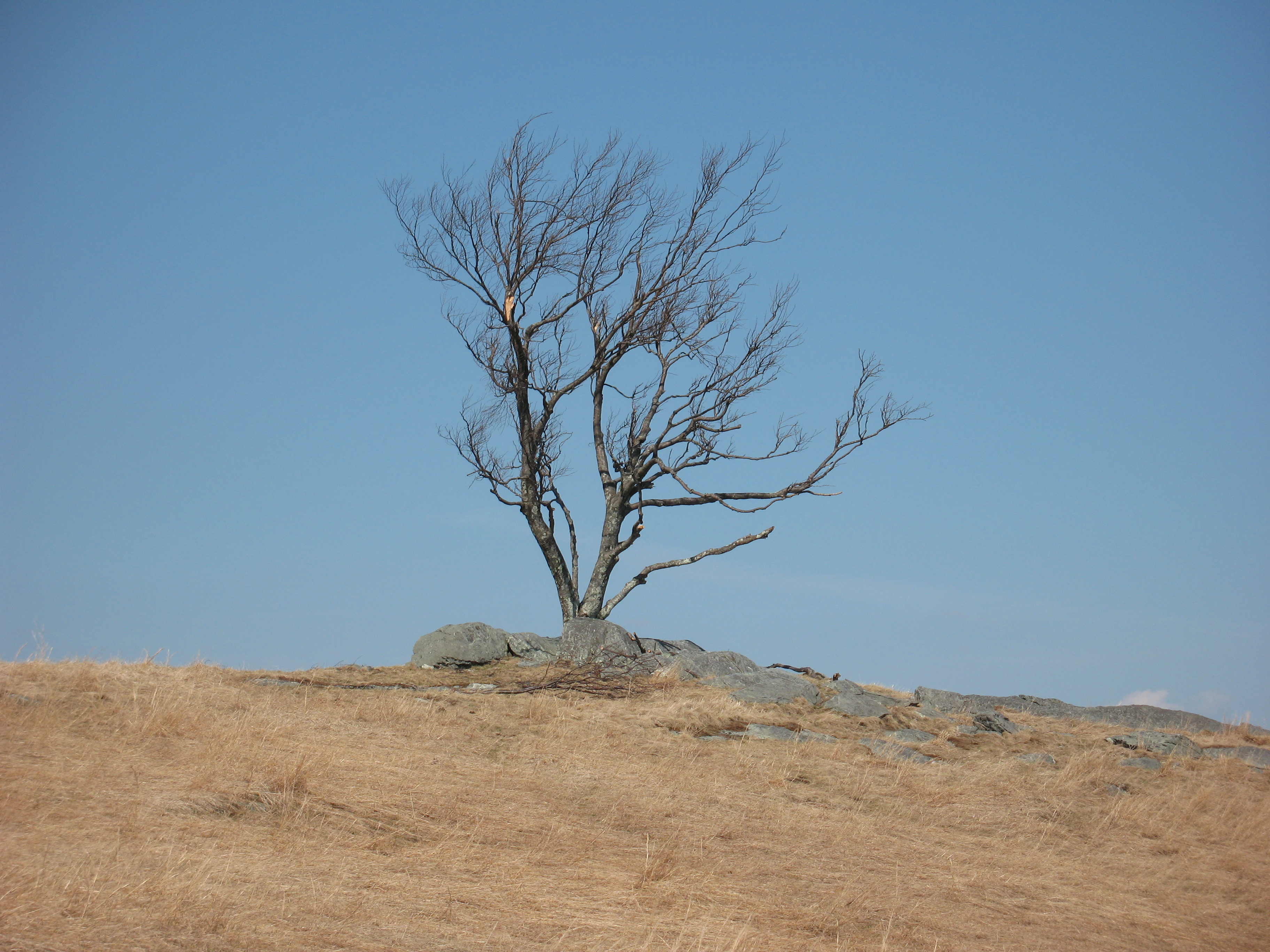
Doughton Park Tree 2021-10-23

Read Full Post »


[poems by David Radavich, Peter Makuck,
Paul Jones, Sam Barbee]

Earth Song

It is something between
lament and celebration,

perhaps both at once,
perpetually mourning yet

dancing in survival

like the seed that
disappears one whole season
then erupts in a plume
of green or garish purple.

Animals hear it, even plants,
but rarely humans

who are too busy raking
off what they can never get
enough of, this free air

that awards us love
in every verse.

Listen to the chorus
tonight and always,
so long as we’re alive

among the sentience
even now chanting
all around us
like bells or birds.

David Radavich

❦ ❦ ❦

I am trying to listen, Earth. I hear the celebration, I breathe it in, I feel it in my chest and beneath my feet. But I hear the lament as well. Loud, always louder. Is it even possible for me to give more than I take, or is despair all that is left for me? Left for us?

What can this one single person do to preserve you, Earth?

Earlier this year I took a hike in the Smokies with a lichenologist. Oh Smokies, your blue mist horizons, your saturated earth and clear chattering streams. Oh you temperate rainforest, your endless variety of creatures that creep and buzz and flit. Oh you breathless diversity of trees and flowers, heath and ferns, every patch of everything alive.

But this was a winter hike. The hardwoods were bare, the understory brown. After a brief chill shower, though, and how often it showers, nondescript grey patches on every branch, bark, and stone turned green – lichens photosynthesizing.

This is where the lichenologist explained the term poikilohydric – lichens passively soak up moisture from the air and passively release it when the air is less humid. They can’t actively retain water. They’re just little sponges. One little sponge isn’t likely to create those blue mist horizons or temperate fecundity, but in the Smokies everything is covered in lichen. Kneel and examine any rock – you’re not likely to discover much actual “rock” showing.

One lichen might not do much but billions of little sponges actually do moderate the microclimate about them. They contribute their small yet huge part to Great Smokies National Park possessing greater biodiversity than the Amazon rainforest.

One person’s contribution may not seem like much but there are billions of us. Small changes are the stream running a little clearer and colder so the brookie can spawn. Small changes are one more monarch laying her hundred eggs. Small changes are the wood thrush discovering insects for her chicks when they hatch.

Read below for some ideas about small changes. Celebrate each one. And thank you, Earth, for the opportunities.

❦ ❦ ❦

Red Foxes at Pahaska Tepee

In an isolated no-frills cabin
on the banks of the Shoshone,
we spent two nights on the site
of Wild Bill Cody’s hunting camp,
but unlike Bill, I had no gun
+++++ to discourage the bears.

Make noise when you walk the trails,
they told us at the office,
and don’t go into the woods after dark.

As a kid growing up in the country,
I read about Cody,
+++++ Crockett, and Boone,
had a pistol and two rifles,
hunted rabbit and squirrels for the table,
trapped muskrat, fox, and mink for the money,
often missing the bus into school.

Behind our cabin one morning,
I spotted five deer
and a fawn feeding among the aspens.
At first I thought they were shadows.
+++++ A few minutes later,
my binoculars brought a fox up close,
black forelegs and white-tipped tail.

I couldn’t stop watching her
down on a path by the riverbank.
I’d never seen one playfully roll in the dust,
or stretch out while her two kits
+++++ nipped at each other,
and tumbled over their mother.

Years ago
+++++ when I saw a fox
it was held in the jaws of my trap –
five bucks bounty from the farmer’s grange,
another buck and a half for the pelt.
+++++ Who was I?
What was I doing?
I must have imagined I was Crockett.
What stays
from one of those mornings
is a red fox, bloody foreleg tight in my trap.
She was just standing there panting
with her tongue out
like my good dog Jonesy on a hot day.

But now as I watched, she jumped up,
this red fox mom,
+++++ looked right at me, frozen,
flanked by her two kits.
I was dangerous,
I didn’t deserve this gift of seeing.

Something stirred in the bushes beside me.
When I looked up again and tried to refocus,
they were gone,
+++++ +++++ and the riverbank empty.

Peter Makuck
from Mandatory Evacuation, BOA Editions Ltd, Rochester NY, © 2016

❦ ❦ ❦

Earth, you’re looking stressed. Getting a little balder – someone cutting down your forests to raise cattle? Dryer – rivers become trickles, aquifers squeezed, not enough water to go around? Dirtier – nitrates in your ponds, forever chemicals (PFAS) in your streams, microplastics in everydamnthing? And of course hotter, always hotter?

O Earth, we’re all feeling stressed, too. We don’t need to be the pika at the top of Bear Tooth Pass with no higher to go to cool off – we know we’re all running out of everything and especially time. Habitat loss, phenological mismatch, aridification, salinization, sea level rise – all accelerating.

What do we do?

Perhaps one response parallels the Naturalist method: notice; ask questions; make connections; tell about it. With one added step – take action. A big action, a little action, a lot of actions but make sure to choose something that makes you happy. Earth Day Every Day is celebration, not burden.

One idea: plant native. Non-native trees and shrubs are plant deserts for birds and butterflies but my Serviceberry feeds the neighborhood all three seasons: kinglets and chickadees eat the buds, wrens and bluebirds feed babies caterpillars and other insects, robins and waxwings arrive in the fall for berries. And my soul is fed every spring by the starry petals falling like late snow.

Another idea: eat closer to the ground. If not every meal then at least a few meals. Eat things that sprout instead of eating things that eat things that sprout. Growing one pound of protein from beans requires 2,270 gallons of water. One pound of beef protein uses 13,438 gallons. One acre can produce 250 pounds of beef or 20,000 pounds of potatoes. (And we’re not even considering the powerful greenhouse gas methane = cow farts).

Here are a few interesting readable resources. SHARE YOUR OWN FAVORITES WITH US IN YOUR COMMENTS!

Earth Day 2022 – Invest in Our Planet

World Water Day

Water footprint of your favorite food & bev

Tips from 2019 World Water Day

How much water do you save the planet if you eat less meat?

101 tips to save water at home

GreenMATCH – becoming ecofriendly

30 tips to be ecofriendly today

❦ ❦ ❦

At The Big Sweep

No one likes to wade
knee deep in the creek
to pull out plastic
snags from the places
turtles seek the sun.
I pretend I do
to do the hard work
that needs to be done.
I take what I have
of magic, of what
I found of pleasure,
in cleaning the creek.
I remember why
I hate what mud can
do to weigh plastic,
to make the load twist
and shudder and shift.
My feet find new paths
in the sucking mud,
some purchases on stone,
that lead to the bank.
My slow slogs resets
stream’s rushing free flow.
I remember nights
I couldn’t fall asleep
on a mountain train
how it like the creek
would twist, turn, and shift
along the river.
I got off the train
and it moved again.
More smoothly or so,
it seemed as distance
grew and the river
ran in parallel.
I knew then, as here,
that joy comes when work
and journeys are done.

Paul Jones


This poem in honor of the Big Sweep was first published by Silver Birch Press in their Saving the Earth series.
Paul writes: The Big Sweep is a continuing volunteer effort to free the waterways and other natural areas of litter – especially plastic. Some may find these efforts a pleasure, but for me these necessary tasks are more rewarding in retrospect when you can see the results from a distance in time and space. Writing is, of course, similar as are taxing trips on rattling trains.


❦ ❦ ❦

Flowers Mean May

April’s rimless wet
++++++++++++ wagers grief’s roulette.
Blooms rattle,
++++++++ frenetic mesh.
Prod imperfection;
++++++++++++ spatter flimsy rosette:
desperate for a kindly set
++++++++++++++++ to count-off
and confirm us.
++++++++++ Hold dear.
Tactic of desire –
++++++++++ odd-numbered
to denote She Loves Me. . . .

I stroll the peristyle
++++++++++++ encircled
with springtime bouquet.
++++++++++++++++ Piecemeal fragrance
to wilt all winter weed.
++++++++++++++ Appetite of delicate petals
on cue:
++++ summon like addiction
Snatch a daisy
++++++++ off the edge,
eager to dissect our fate.
++++++++++++++++ Each casualty
may heal, while any sum
++++++++++++++++ must be forgiven –
abide pledge
++++++++ as she may love me not.

Sam Barbee
from The Writer’s Morning Out on-line site in Pittsboro, April 2020

❦ ❦ ❦

Early in April I asked readers to share a favorite poem that celebrates the interdependence and interconnection of all life on earth. I am including their offerings in three posts before, on, and after Earth Day, April 22. Thank you to all those who responded, and thanks to all of you who read this page and share in the celebration of life on earth.

❦ Bill Griffin ❦

2016-10-17a Doughton Park Tree


Read Full Post »

Older Posts »