Feeds:
Posts
Comments

Posts Tagged ‘NCPS’

[poems from Word and Witness: A. R. Ammons, Julie Suk, Peter Makuck]

Carnage ensues at the table while I make coffee. As all the other animals look on in abject silence, large plush Starfish (carnivore, you know) has captured Baby Chick and is eating him with authentic suck-the-juice-right-out-of-you sound effects.

I remark that I’m going to be sad to miss little yellow Chicky. My grandson looks up, all innocence, and simply reminds me, “That’s just the way the food chain works.”

So it must be. Nine years before the publication of Darwin’s The Origin of Species, Alfred Lord Tennyson had already warned us (“she” being Nature, “types” being species):

. . .
She cries, ‘A thousand types are gone:
I care for nothing, all shall go.

‘Thou makest thine appeal to me:
I bring to life, I bring to death:
The spirit does but mean the breath:
I know no more.’ And he, shall he,

Man, her last work, who seem’d so fair,
Such splendid purpose in his eyes,
Who roll’d the psalm to wintry skies,
Who built him fanes of fruitless prayer,

Who trusted God was love indeed
And love Creation’s final law–
Tho’ Nature, red in tooth and claw
With ravine, shriek’d against his creed –

Who loved, who suffer’d countless ills,
Who battled for the True, the Just,
Be blown about the desert dust,
Or seal’d within the iron hills?

+++++ from In Memoriam A. H. H. (1850)

Shall we weep for Baby Chick? For the extinctions accelerating around us? For ourselves, our loss? A few years back I was leading a group of Junior Highs on a nature walk when we spotted a marvelously large spider shuffling along the path ahead of us. When we reached it, though, we found it was not the legs of the spider that were walking but the legs of the pint-sized wasp that had stung and paralyzed it and now dragged it to a favorable spot for egg laying. In an instant the spider transformed from an object of fear and loathing to a spike of compassion in our hearts.

This week a very talkative red shouldered hawk is haunting the woods out back. No coincidence: that’s where the bird feeders hang. We hope he’s eyeing the squirrels – there are more than enough squirrels, eat all you want Sir Hawk. And the mice that come for the seeds dropped to the ground from the feeders, and then store them in our basement, yes, eat them, too. But please, not the cute chipmunk who hides in the ivy or the finches we love. Alas, I guess we don’t get to choose. That’s just how the food chain works.

But wait – do all our choices come to nothing? Our love, our suffering of countless ills, our battles for the True and Just – is the end of all these to be blown to desert dust? Can’t we choose to engage with embattled Nature? Can we reduce our relentless consumption of the planet, choose leaders of vision and intelligence, make peace with our brothers and sisters? How lengthy shall I extend this list? Shall we abandon hope and just accept our place in the food chain while the warming earth devours us?

If a spider can inspire a moment of compassion in a 13-year old, I will have to accede that there may yet be hope for our species.

❦ ❦ ❦

The Yucca Moth

++ The yucca clump
is blooming,
++ tall sturdy spears
spangling into bells of light,
++ green
in the white blooms
++ faint as a memory of mint.

I raid
++ a bloom,
spread the hung petals out,
++ and, surprised he is not
a bloom-part, find
++ a moth inside, the exact color,
the bloom his daylight port or cove:

though time comes
++ and goes and troubles
are unlessened,
++ the yucca is lifting temples
of bloom: from the night
++ of our dark flights, can
we go in to heal, live
++ out in white-green shade
the radiant, white, hanging day?

A. R. Ammons
collected in Word and Witness: 100 years of North Carolina Poetry, Carolina Academic Press, © 1999 North Carolina Poetry Society

❦ ❦ ❦

This week a friend asked me to send him the table of contents of Word and Witness for a project on biodiversity he’s considering The book was published by the North Carolina Poetry Society in 1999 and edited by Sally Buckner with an afterword by Fred Chappell, who was NC Poet Laureate at the time. It spans the full 20th Century of North Carolina poetry and poets, and as I was scanning the TOC to email my friend a PDF, I re-discovered the names of so many folks who have inspired and befriended me over the last two decades.

Poetry continues to thrive in “the writingest state.” Word and Witness is 261 pages; it would be a real challenge to prepare Volume II for just the first quarter of the 21st Century and limit it to that length. I believe it is still possible to purchase a copy from Carolina Academic Press. You need to get yourself one.

❦ ❦ ❦

Waiting for the Storyteller

Once more we wait for the storyteller
to step into the margin and reveal intentions:
why the first letter flowered,
spiraling down the page with intricate designs,
the hand translating what the tongue began.

Clues drop, mostly forgotten,
so on and so on stacked like bricks,
crumbling when we look back,
a voice once close now a stranger.

All through the book we wild-guess the villain,
so deceived by this one or that
we look for reprieve, a surprise ending,
the page turning to a house in the woods,
dogs locked up, gun put a way.

In the still forest of words,
where the hidden appears in its season,
hills darken and move in.
Like lean horses that have rocked a long way home,
they circle the pool of our hands.
A deer riffles through leaves, then a bird
sings begin again, begin again.

Julie Suk
collected in Word and Witness: 100 years of North Carolina Poetry, Carolina Academic Press, © 1999 North Carolina Poetry Society

❦ ❦ ❦

Dogwood Again

Home from college, I’d leave my reading,
climb the hill through trees behind the house,
listen to a rough wind suffer through
new leaves and, too aware of myself, ask why?

The answer could have been stone wall,
wind or some other words. In April, our house
lived in the light of those first white petals
and now I think more about hows than whys –

How, whenever we fished at Pond Meadow,
my father dug a small one up, carefully
wrapped the rootball in burlap, and trucked it
home until our hard blazed white all around,

and how, at Easter, those nighttime blossoms
seemed like hundred of fluttering white wings.
Again that tree goes into the dark loaded
with envy, those leaves full of light not fading.

And this morning, a fogbright air presses
against the blank white pane and would have us
see the way mist burns from within, shimmers,
slowly parts, and flares upon an even whiter tree,

tinged now with orange, and how a soft fire
runs to the farthest cluster of cross-like petals,
each haloed with clear air, finely revealed.

Peter Makuck
collected in Word and Witness: 100 years of North Carolina Poetry, Carolina Academic Press, © 1999 North Carolina Poetry Society

❦ ❦ ❦

Bios adapted in part from Word and Witness:

After growing up on a tobacco farm near Whiteville, A. R. Ammons (1926-2001) received a degree from Wake Forest College, and served as an elementary school principal, but he lived most of his adult life outside his native state. His interest in writing developed during long hours aboard ship when he served a term of duty with the Navy. In 1964 he joined the faculty at Cornell University, where he was ultimately Goldwin Smith Professor of English. Among his many honors are the Bollingen Prize, the national Book award (twice), the MacArthur Fellowship, and the 1998 Tanning Prize from the Academy of American Poets.

A native of Alabama, Julie Suk (b. 1924) has lived for many years in Charlotte, where she worked in a nature museum. In addition to authoring six volumes of her own poetry, she has co-edited (with Anne Newman) Bear Crossings: An Anthology of North American Poets. Her collection The Angel of Obsession won the 1991 University of Arkansas national poetry competition, and in 1993 she won the Bess Hokin Prize given by Poetry magazine. In 2004 Julie received the Irene Blair Honeycutt Lifetime Achievement Award from Central Piedmont Community College; her book The Dark Takes Aim won the 2003 North Carolina Poetry Society’s Brockman-Campbell Book Award and The Oscar Arnold Young Award from The Poetry Council of North Carolina.

Among previous occupations, Peter Makuck (b. 1940) lists, “truck driver, painter, mechanic,” but he is best known as writer and as Distinguished Professor of Arts and Sciences at East Carolina University. Pilgrims won the Zoe Kincaid Brockman Award for the best book of poems by a North Carolinian in 1989. In 2010 Long Lens: New & Selected Poems was nominated for a Pulitzer Prize. In addition to his eight collections of poetry, he has published numerous short stories and essays. Peter has received the International Poetry Forum’s Charity Randall Citation; a Connecticut native, he has been a Fulbright Lecturer at the Universite de Soavoie, Chambery, France. He founded Tar River Poetry in 1978 and served as editor until 2006.

❦ ❦ ❦

Doughton Park Tree 2021-10-23

Read Full Post »

[with poems by Ana Pugatch, David Poston, Maureen Sherbondy, Joan Leotta]

The original Constitution of the North Carolina Poetry Society stated these objectives: to foster the writing of poetry; to bring together in meetings of mutual interest and fellowship the poets of North Carolina; to encourage the study, writing, and publication of poetry; and to develop a public taste for the reading and appreciation of poetry. These tenets still inspire the mission of NCPS. During the second decade of the twenty-first century that mission has expanded, metamorphosed, and grown wings.

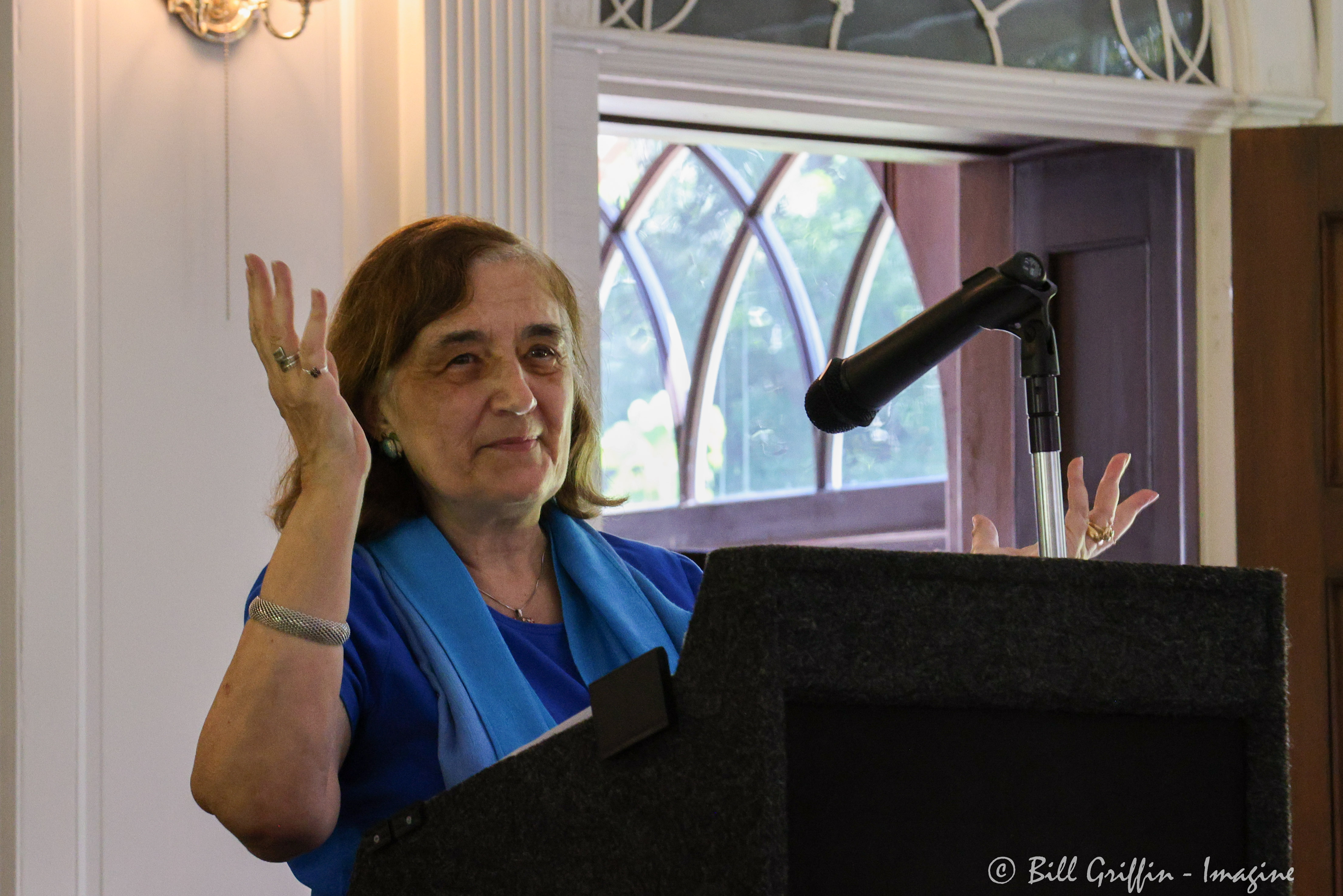
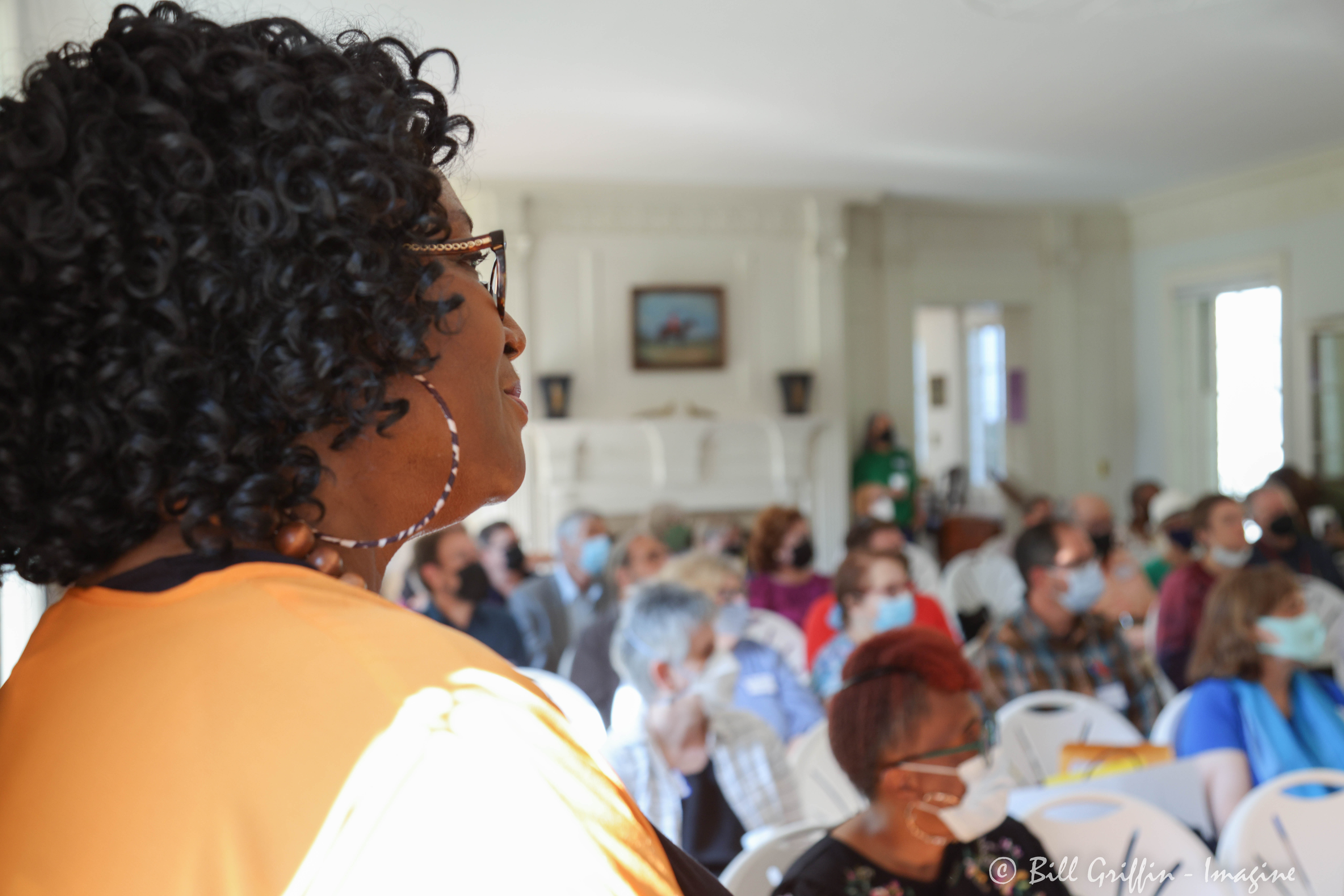
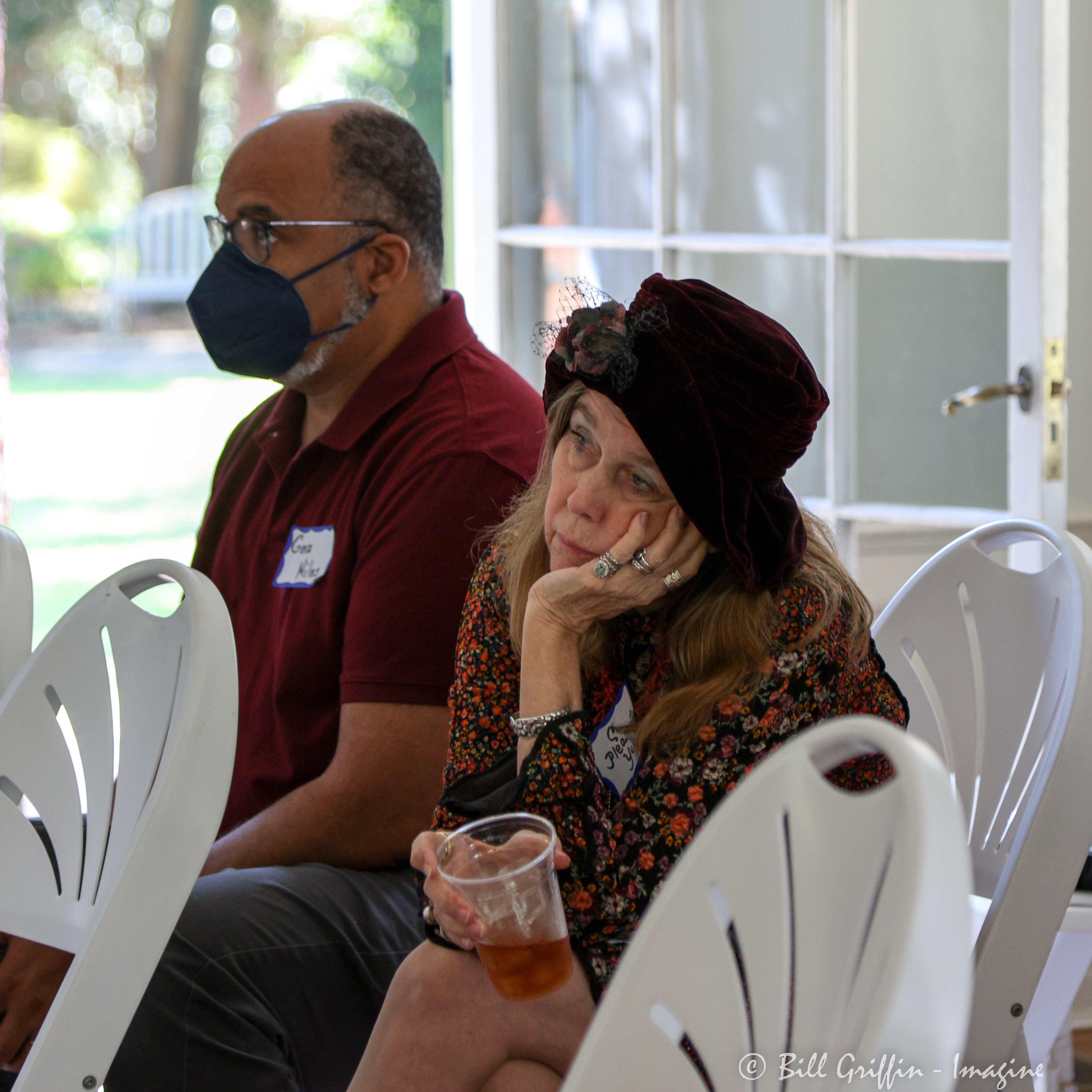
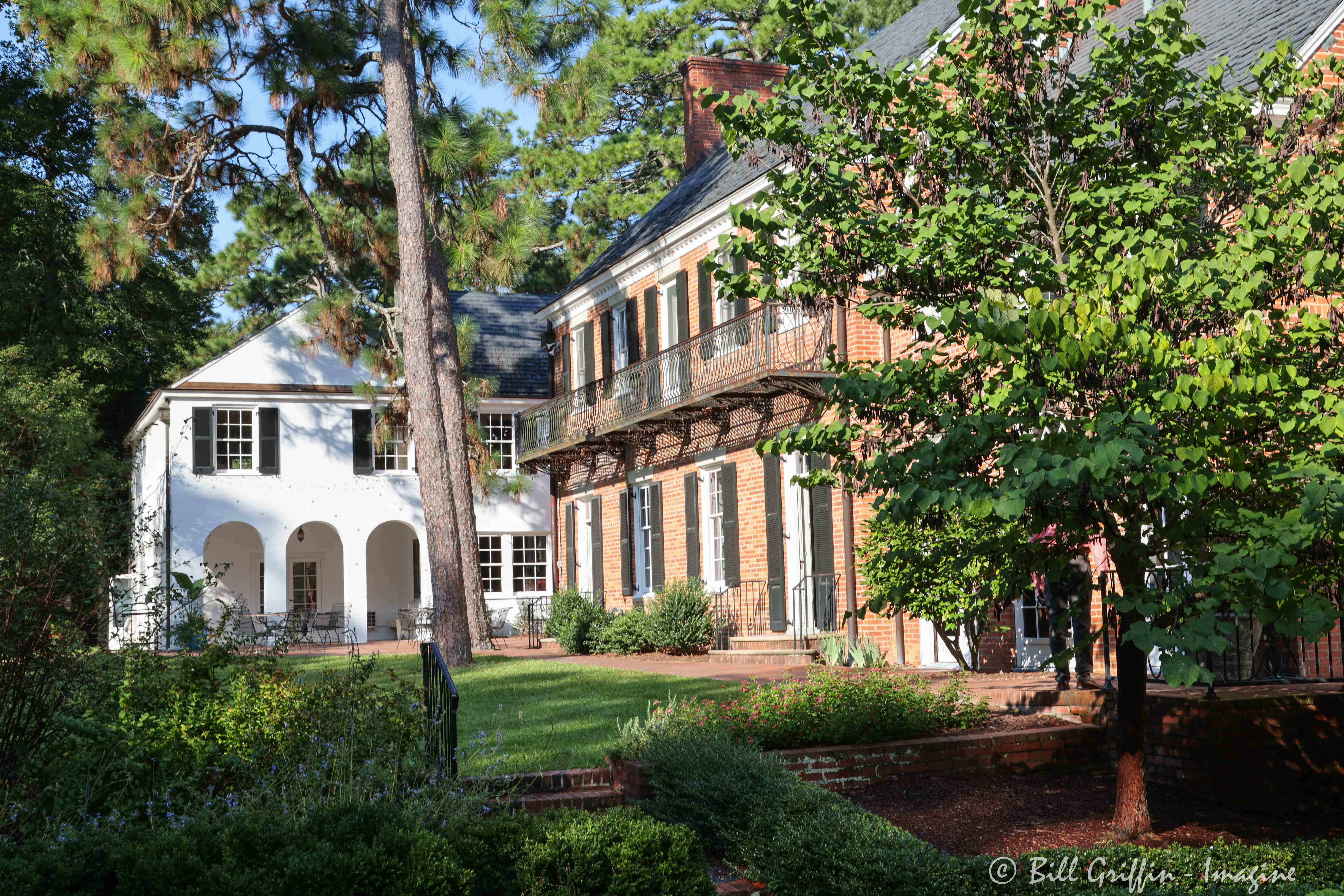
On September 17, 2022, the NC Poetry Society gathered at Weymouth Center for the Arts and Humanities for a gala celebration of our 90th Anniversary. This was the first meeting in person since the spread of COVID19 two and a half years earlier. After dozens of virtual workshops, poetry readings, Zoom programs, and online open mics, our faces had somehow remained familiar but we had come to know many new faces as well. When we walked into the Boyd House in Southern Pines the greetings were ecstatic, the hugs manifold, and behind the masks were face-splitting smiles. Joy overwhelming!

And isn’t this the essential nucleus of the mission of NCPS? Oh yes, we thrive on the unexpected metaphor, the well-honed line, the expressive reading. Poetry, though, is more than craft. It is the art and magic of connecting, the door that opens shared experience, a key to community. As we share poetry we share our self. Suddenly there are two of us walking this journey of humanness, two to delve its depths, two to breach its heights. Wherever poets and lovers of poetry gather, wherever a hard and beautiful and true word is spoken, there is joy.

❦ ❦ ❦

❦ ❦ ❦

The Lena M. Shull Poetry Manuscript Contest was established in 2013. The Poetry Council of NC disbanded and donated its residual assets to NCPS to endow an annual full length poetry manuscript contest named for Lena Shull, the founder of PCNC. NCPS publishes the winning manuscript; the author receives fifty copies, a monetary award, and featured readings. The inaugural prize was awarded to Becky Gould Gibson for her book Heading Home. The 2022 winner is Ana Pugatch for Seven Years in Asia. Finalists are David Poston for Letting Go and Maureen Sherbondy for The Body Remembers.

❦ ❦ ❦

Dissolution

You’ve come to a place that is always raining. The silence: a flood.
At five a.m., the group stands like still poplars outside
the monastery. The previous night, your white uniform had blown
from the laundry line into the dirt and the smell of earth never leaves you.

She tells you about how she cut class to go sit on the toilet,
contemplating ways to end her life. “I knew then that I had to do something,”
the monastic explains. “That something needed to change.” Your head is shaved,
each strand an earthly attachment; when you sweep up

the pile of sunlight you don’t feel any lighter. The poplars paint
their characters and you’re told to stop smiling. On Mt. Wutai, the prayer flags
flutter furiously. There’s never enough rice and your body burns
through itself; those flags are a fitful hunger. At night,

you don’t bother turning over when water drips from cracked
plaster onto your forehead and you begin to wonder
why do lay people come here—why did you come here—and has your pride
become a fist—does dukkha melt in summer snow—

You share a room with a stranger. The pilgrim’s back is hunched, her eyes
a brilliant black. “N duō dà le?” you ask. She thinks she’s eighty but can’t be sure.
You shit in a hole and shower alongside her, your frame nearly twice
her size. She doesn’t care you’re a giant or that it’s your birthday.

The mountain is chilly in July. When you give a monk your WeChat, he sends
a pixelated lotus; you reply with thank you hands. The monastics’ robes are flecks
of crimson. You can sense the five flat peaks, the thousands of vertical pines. Your skin
is so damp you become Wutai, and the well of your anger dissolves into rain.

Ana Pugatch
from Seven Years in Asia, winner of the 2022 Lena Shull Contest of the North Carolina Poetry Society. Dissolution first appeared in The Poet’s Billow and won their 2020 Atlantis Award.

Ana lives in Raleigh, NC, with her husband and son. She has taught English in China and Thailand while studying Buddhism. Ana received her MFA from George Mason University, where she was awarded the ’20-’21 Poetry Heritage Fellowship.

❦ ❦ ❦

Something Beautiful

Last month,
as the Fourth of July barrage
dissolved into the night
and people around me
gathered camp chairs and blankets
for the slog through everyone’s trash
back to their cars,
I stood there in the dark
waiting for
one more
bright flowering
I knew
would never come.

Now, lying alone
just before dawn
waiting for the Perseids
to flare across
the edge of sight
as the sky begins to pale
behind a rumple of mist
where the dark lake waits,
I shouldn’t worry about
which faint streaking
will be the last.

I’m remembering
my ninety-year-old father
bursting into laughter
at the Dairy Queen
as he ate a banana split,
and what was so funny to him
was the sudden thought-
he said this-
that it might be
the last one he ever ate,
and what could I do
but laugh with him
and remember later
that he was right?

David Poston
from the manuscript Letting Go, finalist for the 2022 Lena Shull Poetry Award.

David Poston lives with his wife Bee in Gastonia, NC, and is a frequent book reviewer for Pedestal Magazine and a co-editor of Kakalak. He has published three poetry collections, including Postmodern Bourgeois Poetaster Blues, winner of the 2007 Randall Jarrell/Harperprints Competition.

❦ ❦ ❦

Cousins I Never Met

Fire burns down the entire forest
but still one flower thrives. The moon’s
silhouette against the sky reminds me
yes, we are still alive. We ran and walked
through yesterday’s parade. You thought
the kite you ran with on the sand could
fly up to the night-imprisoned moon. My cousins, too,
(all gone too soon) watched this same light
in Germany as night-time, day-time prisoners in
rooms fit for two or three, not fifty.

Two years ago we let go of white balloons
at the newborn’s funeral. Five days
he lived. Son, nephew, brother. Five days. We looked up
until white globes blurred into white clouds.
Devoured. We throw rocks at death both now
and then. Still, death stays with you and me hours,
months, through years of lingering. Remember

painting the German Shepherd thick
with tomato juice to release the stink.
Oh, that stink, it lingers. Oh, this scent
of death too. Stink of burning flesh,
I have heard about it, read about it.
Lampshade flesh, they whisper in the halls.

Now walk with me inside
the burned-down forest, take in the sweet
perfume of one flower reaching up
to the sun and moon. My relatives made it
through until the final hours and then
and then. Auschwitz, final hour. The end
when release could be tasted, sulphur burning
on his defeated tongue. Fuhrer fury. The end arrived
when release could be swallowed from the air
so close, and yet. Their blood, our blood waters
burnt soil. We plant new seeds. We march forward.

Maureen Sherbondy
first appeared in Connotation Press

Maureen lives in Durham, NC, with her husband Barry Peters and her cat Lola, and teaches at Alamance Community College. She has published eleven poetry collections, most recently Lines in Opposition.

❦ ❦ ❦

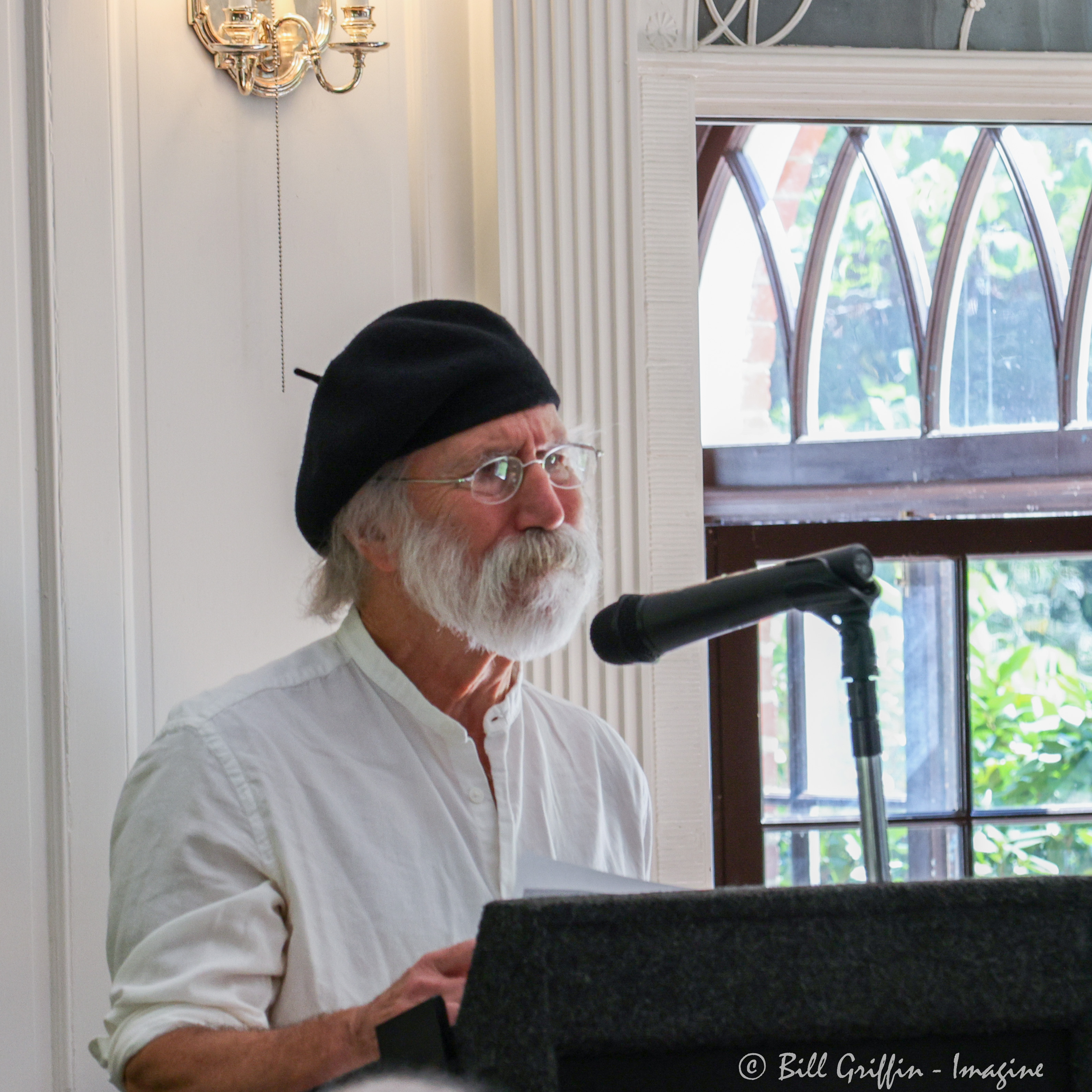
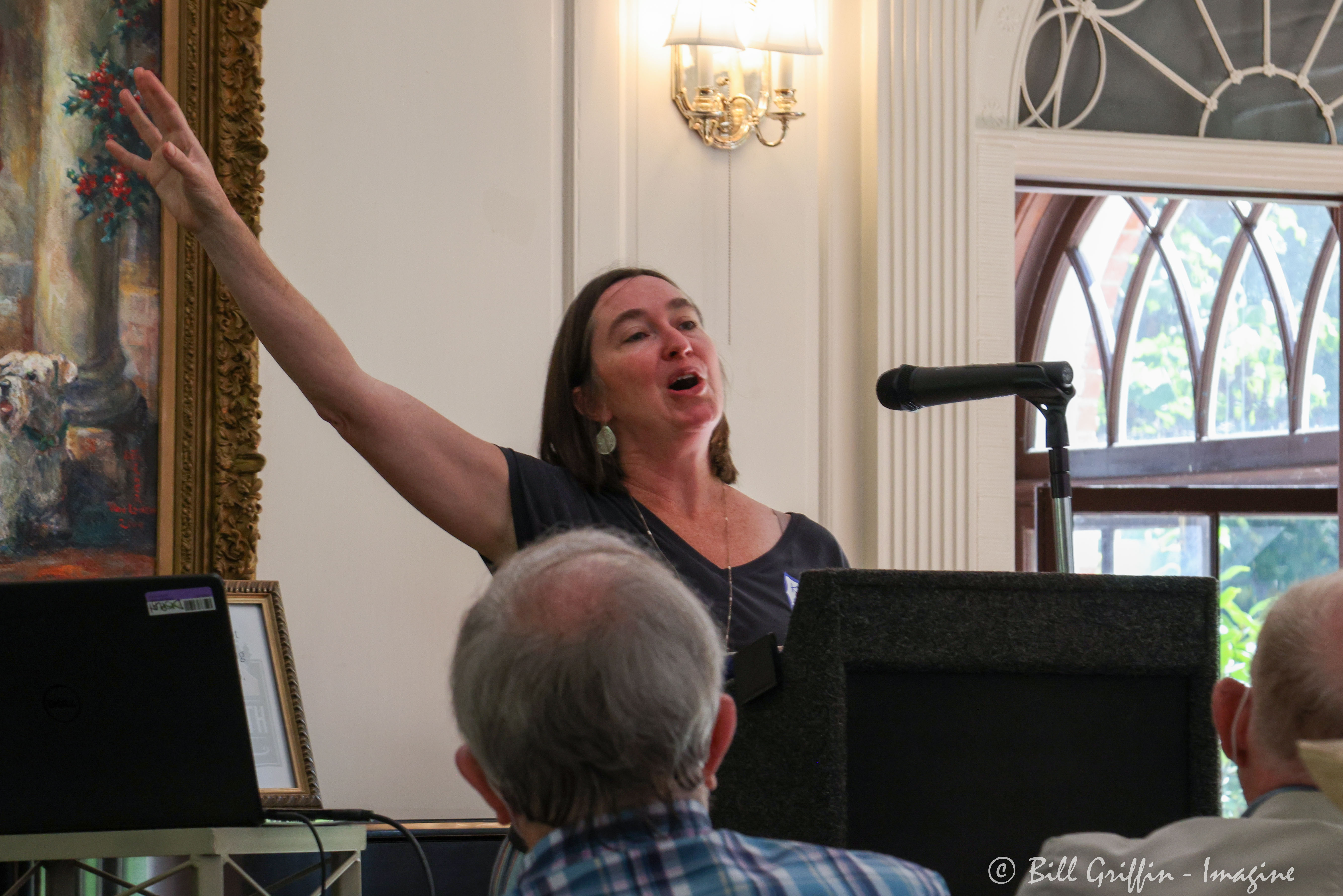
No gathering of poets at Weymouth Center would be complete without a workshop. for the afternoon program Joan Leotta presented The Art of Poetic Storytelling, exploring how verse and narrative intersect. She used the metaphor of the moon’s phases to convey the various forms narrative may take, minimal to whole, partial to complete. One of her own poems illustrates, as Joan says, “an example of a crescent moon–only part of the story arc present, a slim piece, the rest filled in by the reader/listener:”

an owl continually questions
my identity
as I watch the stars

[first appeared in haikuniverse]

Joan also introduced her workshop with this insightful observation she solicited from Joseph Bathanti, Seventh NC Poet Laureate 2012-2014, for just this occasion:

“I fancy myself, essentially, a narrative poet, one that relies a good bit on what I call reimagined autobiography – though not all of my poems are narrative or autobiographical. I’m also a novelist, so I’m always preoccupied with story and I also think it’s important that a poem be accessible, rather than a coded conversation a poet has with him/her/their self that only the poet understands. Strong narrative poems tell stories through utilizing classic conventions of fiction such as dialogue, plot, conflict, characterization, setting/place, etc., while still relying heavily on key elements of poetry such as compressed, often impressionistic, language; rhythm; stylized line and stanza breaks; and attention to sound. They balance the image-charged voltage of poetry with traditionally discursive narrative strategies of fiction and creative nonfiction, focusing on
the occasion of the poem, and the dramatic situation that inspired it.”
++++++++++++++++++++++++++++++++ Joseph Bathanti

Joan is a Pittsburgh native who now lives in Calabash, NC. In addition to poetry she has written novels and non-fiction food and travel guides. Her poetry collection Feathers on Stone is forthcoming in 2023 from Mainstreet Rag Publishing. Besides teaching writing and performing, Joan is also herself a performer and story teller.

❦ ❦ ❦

The Randall Jarrell Poetry Competition is sponsored by the North Carolina Writers’ Network; winners are invited to read at the fall NCPS meeting and this year are part of the 90th Anniversary celebrations. Their poems will be published in storySouth and we hope to present the poems here at a future date:
+++++ Winner – John Haugh: Consider the Word Pursuit on the Winter Solstice
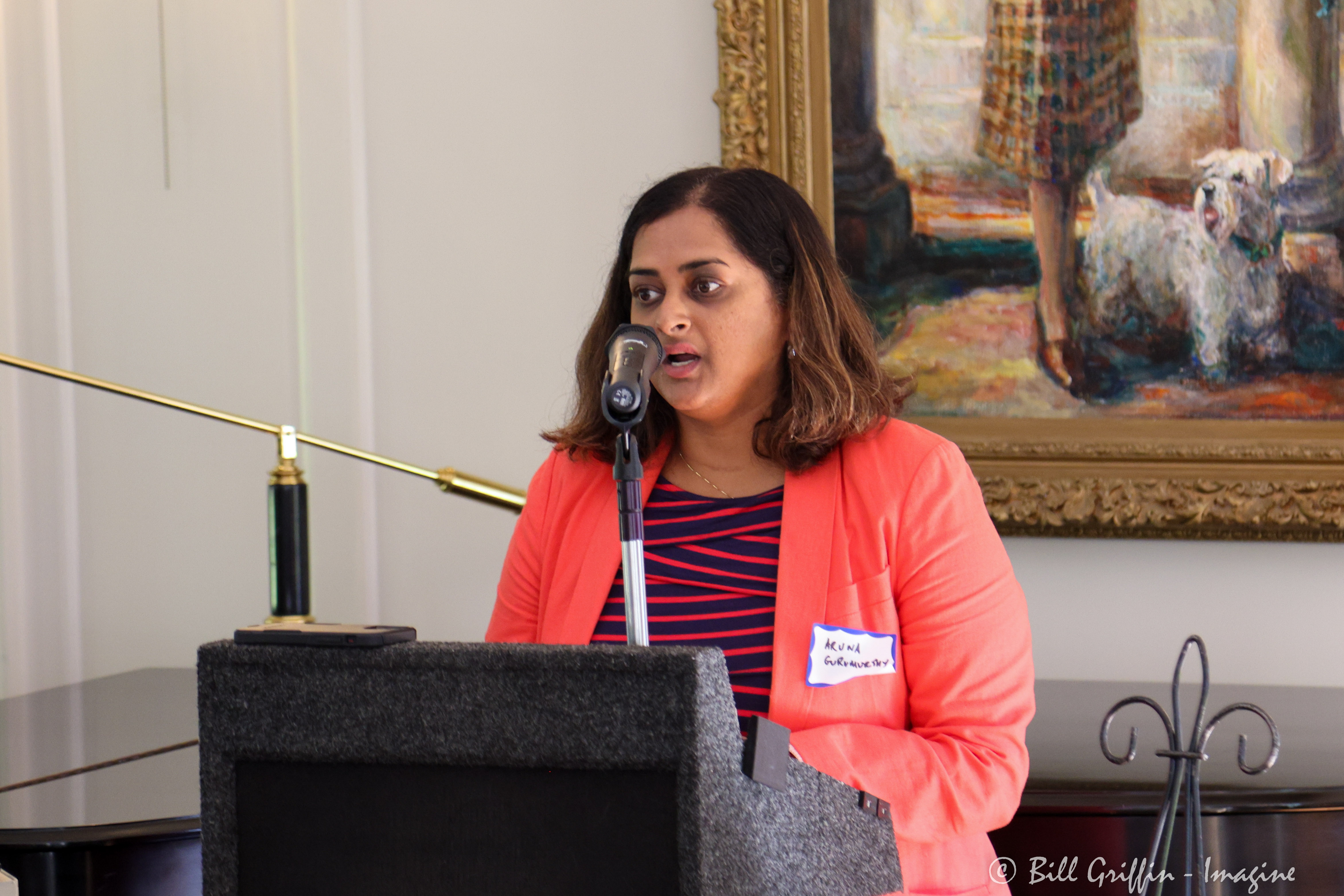
+++++ Runner-up – Aruna Gurumurthy: Madras
+++++ Honorable Mention – Jeff Miles, Vivian Bikulege

❦ ❦ ❦

THANK YOU to so many who made this North Carolina Poetry Society 90th Anniversary gathering not only possible but truly worthy of the banner, Infusing Ceremony with Celebration: Poetry with Light, Soul, and Sound: Lynda Rush-Myers, for a year of planning and countless hours of preparation and presentation; Celestine Davis, ever-present ever-encouraging ever keeping the wheels on the bus; Regina Garcia, heart and soul and thrilling Tribute introductions, and Romeo Garcia making sure we all got lunch; the entire NCPS Board of Directors, setting up, hanging signs, welcoming and greeting, picking up the trash; and special thanks to the staff of Weymouth Center and Executive Director Katie Wyatt, we/you couldn’t do it without you/us.


LAST WEEK: additional NCPS 90th Anniversary celebrations with poems by Brockman-Campbell Book Award winner Kim O’Connor and finalists AE Hines and Cheryl Wilder, plus Susan Laughter Meyers Fellowship in Poetry winner Yvette R. Murray.

❦ ❦ ❦

Portions adapted from The North Carolina Poetry Society: Part 5 – 2012-2022, Ninety Years of Creativity, Challenge, and Change; compiled and composed by Bill Griffin with special collaborator David Radavich; © 2022 The North Carolina Poetry Society.

Doughton Park Tree 2021-03-23

Read Full Post »

[with poems by Kim O’Connor, AE Hines, Cheryl Wilder, Yvette Murray]

The North Carolina Poetry Society was organized in 1932 at the Charlotte home of Edna Wilcox Talley. The six members present elected Zoe Kincaid Brockman, well known poet and women’s editor of the Gastonia Gazette, as the organization’s first president. Could those six writers have imagined that ninety years later their idealistic endeavor would be thriving, with a membership of over 500 and sometimes more than a hundred persons from all across the state attending meetings? That through the decades the North Carolina Poetry Society would be the forerunner of additional writers’ organizations such as the Poetry Council of North Carolina, NC Writer’s Network, and NC Writer’s Conference, not to mention numerous local and regional groups in NC towns and counties? That poetry would be happening in schools with Poetry Out Loud, in shop windows and on buses through Poetry in Plain Sight, in countless books and journals published in North Carolina every year?

Zoe Brockman, Edna Talley, and friends knew the truth long before Doris Betts coined the phrase: North Carolina is the “writingest state.” Perhaps they wouldn’t have expressed it so eloquently but they would have agreed with Ed Southern, NC Writers’ Network executive director, that “one cannot spit, piss, or throw a rock in the Old North State without hitting a writer.” I like to believe those women of an earlier time would have been pleased but unsurprised at the many poets inducted into the NC Literary Hall of Fame after its inauguration by Sam Ragan at Weymouth Center in 1996; they especially would have applauded when all the inductees in 2014 were poets – Shelby Stephenson, Betty Adcock, Ron Bayes, Jaki Shelton Green. The Charlotte Six would no doubt have volunteered to serve as mentors in the Gilbert-Chappell Distinguished Poet Series, helped set up tables at the Sam Ragan Poetry Festival, and host open mic on Zoom during the pandemic. We who participate in the North Carolina Poetry Society of 2022 benefit from their high ideals, keen vision, and energy – we uphold a worthy tradition, and we have embraced the creativity, inclusion, and diversity that now make this tradition our own.

NCPS gathered to celebrate its 90th anniversary on September 17 at Weymouth Center for the Arts & Humanities, Southern Pines, NC – the first meeting in person in two and a half years. We look back and we look forward. We pay tribute to those who have taught and inspired us, and we open ourselves to the newest voices among us. We listen to the words of poets who dedicated their lives to building the power of literature in North and South Carolina: Joseph Bathanti reading Kathryn Stipling Byer, Shelby Stephenson reading Marty Silverthorne, David Radavich reading Susan Laughter Meyers. And we listen to the words of today’s poets reading the poems of now.

The Brockman-Campbell Book Award is the most prestigious honor bestowed by NCPS, awarded annually for the best book of poetry published by a North Carolina poet in the preceding year. Past winners have included Fred Chappell, AR Ammons, Betty Adcock, and Robert Morgan, among many others. The 2022 winner is Kimberly O’Connor for her book White Lung. Finalists are Anything That Happens by Cheryl Wilder and Any Dumb Animal by AE Hines.

❦ ❦ ❦

The History of My Silence
Hendersonville, North Carolina, 1961

white people sit in the front my great-grandmother
says my mother is angry
she wants to sit in the back

my mother is six years old
her first time on a bus
she wants to sit in the back

why? she stamps her foot

my great-grandmother does not answer the rest of the world
the boycotts the marches the fire
hoses let loose on children burning
crosses any of it does not
exist for them

they sit in the front like good white
women I think that

their silence their
compliance
has flowed into me
a river I have to swim
even as the water turns to flame.

Kimberly O’Connor
from White Lung (Saturnalia Books, Ardmore PA, © 2021)

Kim is a North Carolina native who lives in Golden, Colorado. She received an MFA from the University of Maryland and has taught creative writing and literature in middle school, high school, and college classrooms in Colorado, Maryland, West virginia, and North Carolina.

❦ ❦ ❦

Naturalization

We’d been lucky. I’d made it out of Guatemala
alone with the baby, and the baby still alive.
I hadn’t let him crawl out a hotel window.
I hadn’t let him swallow a button from my sleeve.
Managed to feed him and change him
and carry him in taxis and embassies, through
markets and airports, beneath the electric barbwire
of US Immigration. In Houston, I watched
badged women and men berate
brown men in shackles while they sat
tethered to stiff chairs beside us. Most stared
at their shoes. I am embarrassed to admit
I did nothing. Said nothing. Didn’t catch a man’s
tired eye and offer him even a nod, my feeble Spanish.
Instead, I just called my little son’s name over
and over, and bounced him on my lap.
Then we were ushered back into the land
I’d promised him. Bound together by law,
and off to our next gate without a glance back
at the men on their way to whatever place
they no longer called home.

AE Hines
from Any Dumb Animal (Mainstreet Rag Publishing, Charlotte NC, © 2021)

Earl grew up in rural North Carolina and currently resides in Portland, Oregon where he is pursuing his MFA from Pacific University. He is winner of the Red Wheelbarrow Prize and a finalist for the Montreal International Poetry Prize.

❦ ❦ ❦

Bailed Out

The house stirs with my stirring.
I am the elephant, the devil’s minion.
Secure in my arms a woven afghan

blue and darker blue. I run
fingers through holes and open
like a wish bone but cannot pull

them apart. A wish not wished
establishes habit, like sleep-dancing
or tangling the vacuum cord around my wrist

to make love. I am two people now—
the before and the after; one I’ve already forgotten
the other I have not met. I hear voices whisper

what if—a crossroad so difficult to leave
I build a roadside bench. At some point
I will rise from this bed, speak though I only hear

his curdled breath, allow my first taste of bone
in the broth I can smell, but no one will notice
my stained hands, the bloody prints on the wall.

Cheryl Wilder
from Anything That Happens (A Tom Lombardo Poetry Selection, Press 53, Winston-Salem NC, © 2021.)

Cheryl lives near the Haw River in North Carolina, where she gives talks and workshops on art and writing, serves as president of the Burlington Writers Club, and owns a small web development company. She is co-founder and editor of Waterwheel Review.

❦ ❦ ❦

The Susan Laughter Meyers Fellowship in Poetry was established in 2017 in memory of former president of both the North Carolina and South Carolina Poetry Societies, Susan Meyers. The annual merit-based fellowship for one North Carolina or South Carolina poet requires submission of five poems with blind judging by a three-judge panel. It is co-sponsored by NCPS and the Weymouth Center for the Arts and Humanities, and includes a one-week residency at Weymouth Center plus an honorarium. The 2022 Fellowship recipient is Yvette R. Murray.

Poem In Which Words

don’t deserve this.
They have been around a long time; served us well.
Why then do we use them like poisoned blue darts?
Words have been so kind as to adapt.
They want to stay relevant too.
But we spit them into red plastic cups like
‘bacca juice and leave them on the side of the road.
They never harmed us,

Yet we turn them ugly side out,
Pit them against each other,
Use our fangs to inject venom.

The poor words can’t be unheard,
the ring after of their scent,
makes folk mad.

I hope they don’t cry,
I hope they don’t die by suicide,
I hope they don’t vanish within.

Then we will never again find the words.
They might like that though.
Scrubbed clean with different color hair
They can hold hands,
stroll the streets,
carry their shopping bags,
or look for a bistro
in peace.

Yvette R. Murray
from a gathering together literary journal, Spring 2021

Yvette is a Gullah poet from Charleston, SC. She writes because she has to. The words bump around in her head and give her headaches. Just kidding! For Yvette, Poetry is the most beautiful event space on the planet.

THANK YOU to so many who made this North Carolina Poetry Society 90th Anniversary gathering not only possible but truly worthy of the banner, Infusing Ceremony with Celebration: Poetry with Light, Soul, and Sound: Lynda Rush-Myers, for a year of planning and countless hours of preparation and presentation; Celestine Davis, ever-present ever-encouraging ever keeping the wheels on the bus; Regina Garcia, heart and soul and thrilling Tribute introductions, and Romeo Garcia making sure we all got lunch; the entire NCPS Board of Directors, setting up, hanging signs, welcoming and greeting, picking up the trash; and special thanks to the staff of Weymouth Center and Executive Director Katie Wyatt, we/you couldn’t do it without you/us.

NEXT WEEK: NCPS 90th Anniversary celebrations continue with the Lena Shull Manuscript Prize: poems by winner Ana Pugatch, finalists David Poston and Maureen Sherbondy, and workshop presenter Joan Leotta

❦ ❦ ❦

Portions adapted from The North Carolina Poetry Society: Part 5 – 2012-2022, Ninety Years of Creativity, Challenge, and Change; compiled and composed by Bill Griffin with special collaborator David Radavich; © 2022 The North Carolina Poetry Society.

Why We Are “The Writingest State”; Southern, Ed. North Carolina Literary Review; Greenville NC, Nr. 25 (2016): 92-99.


Read Full Post »

« Newer Posts - Older Posts »