Feeds:
Posts
Comments

Posts Tagged ‘NC Poets’

NCPS Program VP Chad Knuth

 . 
NC Poetry Society at the Cary Arts Center
[poetry by award winners Mark Cox, Michael Hettich, and more]
 . 
All Right
 . 
The boy doesn’t know what to do. He’s only twelve. And he’s never seen adults weep, not like this at least, so distraught, disconsolate. He can see his grandmother from the kitchen, through her bedroom doorway. Prisoner of her dementia, the old woman lies fully clothed atop the chenille bedspread, her floral house dress faded, her shoes scuffed and worn, light from one window cutting her in two. Her good dishes have disappeared, the piano is still in the old farmhouse, the cows need to be milked, her young sons are still in France at war. The boy sits at the breakfast table, adrift in a sunlit swirl of dust motes. He understands none of this is true, but how is he to help? What can anyone say? To live is to leave, the boy thinks; we make our way, but lose something always and wherever we go. Our shoe soles wear down, our hair thins, our bodies diminish and so we travel always through galaxies of our own shed lint and skin, the leavings of once known things. Finally, at a loss, he just lies down next to her, his sneakers alongside her purpled ankles. He knows nothing ever is going to be all right, but he says it anyway.
 . 
Mark Cox
from Knowing, winner of the 2025 Brockman-Campbell Book Award of the North Carolina Poetry Society
 . 
 . 
Mark Cox is chair of the Department of Creative Writing at University of North Carolina, Wilmington. He also teaches in the Vermont College of Fine Arts MFA Program. His six previous books include Sorrow Bread: Poems 1984-2015 (2017) and Readiness (2018). Read more about Knowing and purchase your copy at Press 53 HERE.
 . 
Claudine Moreau is second place finalist for the 2025 Brockman-Campbell Award, for her book Demise of Pangaea. Visit this site on October 3 for more about her book and a sample poem.
 . 

Mark Cox

 . 
❦ ❦ ❦
 . 
Each September at its fall meeting the North Carolina Poetry Society features readings by the winners of the following contests:
 . 
Brockman-Campbell Book Award (NCPS): best book of poetry published by a North Carolina author in the preceding year
Lena Shull Manuscript Award (NCPS): for a manuscript by a North Carolina author; the winning book is published by NCPS
Susan Laughter Meyers Fellowship (NCPS): a one week residential fellowship at Weymouth Center for the Arts and Humanities for one North or South Carolina poet
Randall Jarrell Poetry Prize (sponsored by North Carolina Writers’ Network): for an individual poem by a North Carolina author
Jaki Shelton Green Performance Poetry Award (co-sponsored by North Carolina Literary Review at East Carolina University and NCPS): for an individual poem recited / performed
 . 
For information about North Carolina Poetry Society contests VISIT HERE:
 . 
In 2023 the September NCPS meeting was held at the NC Museum of Art in Raleigh, in 2024 at the NC Arboretum in Asheville, and this year’s meeting on September 13 celebrated the Cary Arts Center, formerly the Cary High School (1939), listed on the national registry of historic places. Today’s and next Friday’s posts feature some of the poetry shared at the meeting by the 2025 contest winners; return to this site on October 3 for more offerings!
 . 
 . 
❦ ❦ ❦
 . 
The Meadow
 . 
++++ I woke in a tall-grass field at first light,
and listened to the birds, and hummed with a dream
 . 
++++ ++++ I made up from wisps
++++ that ran through my body
++++ ++++ shivering marrow, making me notice
 . 
++++ the dew that dampened
my face and the spider webs
++++ starting to shimmer the trees.
 . 
Everything was breathing; the long night echoed
++++ in the dawn-light: stars
++++ ++++ and vast migrations
 . 
++++ as the breeze stuttered a moment, then stilled.
++++ Across the field, my companion was singing
++++ ++++ her own perfect song, which was silence. Still
++++ ++++ ++++ I could hear her somehow, so I got up and set off
 . 
++++ ++++ ++++ ++++ to thank her for sharing this beautiful place
++++ ++++ ++++ she’d known all her life, this place where she’d always
++++ ++++ ++++ ++++ felt happy, the place she yearned to stay
 . 
++++ ++++ as long as she breathed. And then, she’d told me,
++++ she’d turn into something more perfect: the vast
sky, so blue it hurt the eyes,
++++ or a meadow like this one, that stretched to the horizon.
 . 
Michael Hettich
from Waking Up Alone, winner of the 2025 Lena Shull Manuscript Award of the North Carolina Poetry Society, to be published later this year by Redhawk Publications.
 . 

Michael Hettich

 . 
 . 
After years in New York, Colorado, Florida, and Vermont, Michael Hettich now lives in Black Mountain, North Carolina. He holds a Ph.D. from the University of Miami and taught for many years at Miami Dade College where he was awarded an Endowed Teaching Chair. Over five decades he has published more than two dozen books of poetry and received numerous honors, including several Individual Artist Fellowships from the Florida Division of Cultural Affairs, The Tampa Review Prize in Poetry, the David Martinson/Meadowhawk Prize, and a Florida Book Award.
 . 
Additional Finalists for this year’s Lena Shull Award are Becky Nicole James and Charles Wheeler.
 . 

Michael Hettich

 . 
❦ ❦ ❦
 . 
Feathers
 . 
When September slips in the window like a forgotten lover,
Reaching for me from my burrow
+++++++++++++++++++++ With its hands of feathers
 . 
In the early morning croak of crows, and I can smell
That someone has lit a fire,
+++++++++++++++++++++ An utterance of feathers,
 . 
Such that I can’t remember if I’m seven, in a log house my father built,
And he’s kindled the first autumn fire,
+++++++++++++++++++++ Fanned the feathers,
 . 
Or I’m twenty-five in the wooded hollow alone
But for the cats, dogs, and calls of coyotes, having lit the fire myself
+++++++++++++++++++++ That spanned feathers,
 . 
But no, when you roll over
In a twist of sheets,
+++++++++++++++++++++ In a band of feathers,
 . 
And I hear a young tail thump softly on the floor, a brief whine-
When someone else’s woodsmoke slips through the window
+++++++++++++++++++++ Like sanded feathers,
 . 
And I am here with you, and we’ve struck our own match-
When you reach across and slip your arm around my waist,
+++++++++++++++++++++ With the sustenance of feathers-
 . 
Narya Rose Deckard
from her debut poetry collection Wolfcraft (Broken Tribe, © 2025), available from Bookshop.org
 . 

Narya Rose Deckard

 . 
 . 
Narya Rose Deckard teaches writing at Lenoir-Rhyne University, where she earned her MFA in poetry at the Thomas Wolfe Center for Narrative. Originally from the mountains of Maryland, she currently lives in Valdese, NC with her husband, dog, five cats, and a few chickens, but she also spent ten years in Asheville studying literature and philosophy at UNCA. As winner of the 2025 Susan Laugher Meyers Fellowship, she receives an honorarium and one week writing residency in Southern Pines at Weymouth Center for the Arts and Humanities.
 . 
Susan Laughter Meyers was a widely published Carolina poet who mentored many rising poets and promoted literature across the South for decades. She served at different times as president of both the South Carolina and North Carolina Poetry Societies. Her family, friends, students, and other admirers of her life’s work have endowed this Fellowship in her name for the North Carolina Poetry Society. Many thanks to Weymouth Center, as well, for donating space and support for the poet residency.
 . 
 . 
❦ ❦ ❦
 . 
Begin With Me
 . 
I got up
off the ground
near some graves—I share
the last name with.
 . 
I begin,
with what I was handed,
a mama, a daddy I saw a few times,
because he hid
in the hues he knew.
 . 
My little brother full of love
like the corner store in heaven. I knew
his lying like I knew our daddy’s lying,
same song, but a higher key.
My mama taught me to
 . 
ask my dead plenty of questions—
to let the moon touch me on the mouth,
to ring my black bell.
 . 
Tyree Daye
from a little bump in the earth, Copper Canyon Press, © 2025
 . 

Tyree Daye

 . 
 . 
Tyree Daye led the writing workshop for the afternoon session of this NCPS meeting, He focused on breath: within and around a poem; what it might reveal and what it might hide. The writer can strive to become more conscious of their own breath as they splice syllables and thump out the poem’s rhythm. The reader can strive to slow down and feel their own breath as they silently speak the words. Breath can hold the meaning and feeling that the poem wants to birth into the world. Hold it, and let it out.
 . 
Tyree Daye grew up in Youngsville, North Carolina. He is the author of three poetry collections, including River Hymns (winner of the APR/Honickman First Book Prize), Cardinal, and most recently a little bump in the earth. He has been a 2017 Ruth Lilly Finalist and Cave Canem fellow. He serves as Assistant Professor at the University of North Carolina, Chapel Hill. Tyree Daye teaches. Not just reading and writing, not just poetry – he teaches what it means to be human, a human with a past and with a future. One reaction to his new book: Poem by poem, Daye is honoring the people of Youngsville and “bringing back the dead.”
 . 
❦ ❦ ❦
 . 
Tune in next week, folks . . . in our October 3 post we will continue to celebrate the riches of this September 13 meeting in Cary with poetry by Claudine Moreau, Becky Nicole James, Charles Wheeler, and more.
 . 

Tyree Daye

 . 
❦ ❦ ❦
 . 
 . 

Joan Barasovska and Kathy Ackerman, Membership VP and NCPS Secretary

 . 
 . 
 . 
 . 
 . 

Read Full Post »

 . 
[for my mother]
 . 
Liminal
crepuscular
 . 
You take my hand and lead
me from the porch, leavings
of sticky watermelon rind,
half-eaten hotdogs, out into
the yard where the older kids
whoop in the descent
of darkness almost too deep
to see through; at its edge
grownups in folding chairs,
the orange winks of their cigarettes
like lightning bugs.
 . 
Too dark. You feel me hanging back
but here around the corner
real fireflies guide us, cool green,
silent. You catch one
in your hands, Like this . . .
when I was a girl, laughing
in the twilight; you pinch off
its tiny ember and smear
the glowing on your eyelids
so that when you close your eyes
its faint gaze assures
that you still see me.
 . 
And the truly wondrous thing,
besides this moment together while
the luminescence fades
and I am able too to laugh,
is that once you were a girl.
 . 
❦❦❦
 . 
All stories are true. The story’s facts may get a bit smudged & skewed, a bit shuffled & stretched, a bit jiggled & juxtaposed & conflated, but the story’s truth is undiminished. Good stories know their truth. The best stories know your truth. You discover it in their pages. Perhaps it was always in you, smudged & skewed – now you are following its trail into the open.
 . 
A poem has its own particular way of telling its story. Planed down until you can see the grain. That burl is a metaphor for the winter storm when something cracked. The curly maple echoes laughter you can still hear tinkling faint from the past. Storms and laughing are metaphors for what you’re facing this morning when you roll out of bed. The poem rolls you out of bed. It won’t feed you lying down.
 . 
And in a poem the story lives on its own fine edge. It balances the limn between nothing and everything. Wait here, breathing slowly, at the transition between dusk and night. Or between darkness and dawn. The poem’s story may seem at ease but in the silence beside the swift river you can hear the rush, the flow, the movement. The poem taps the shoulder of awareness – look ahead, look back, live right now in all those moments that coalesce to make a life. Your story is unfolding, and don’t you know it’s true?
 . 
 . 
❦❦❦
 . 
Liminal
riparian
 . 
Let’s tube the Brandywine: you
are brilliant, my kids so fractious,
lucky to keep them for an hour
in the same room with Grandmommy
much less engaged.
All the lazy afternoon
watched over by staid sycamores
of summer, the splashing,
the dunking, and through smooth
passages you get them talking
about yesterday’s museum, Howard Pyle
and the Wyeths, art, its stories,
how if we can only imagine
something strongly enough
we may make it so.
 . 
Imagine: all things flow,
the benevolent stream, its clarity
every possibility of color
and everything it collects,
benediction of damp
on our bodies, water and salt,
half-adrift in the dailyness
of life and where
might this meandering take us?
 . 
At the takeout toweling off
you touch my shoulder, point:
a tree swallow’s looping masterwork
has knit together river, forest, sky,
metallic blue . . . brilliant.
 . 
❦❦❦
 . 
A story about Mom: when I was five we lived in a little house on Marion Road in Memphis. Mom had made a special cake for my birthday surprise, German chocolate with thick gooey coconut and pecan frosting. She hid it in the little closet pantry until after supper, but when she brought it out for five candles, she wept. It was covered with ants. Don’t you think my brother and I were able to pick off the little crawlies and eat it anyway? And every year at birthday time we piped up, “Mom, make us another Ant Cake!” It was years before she could laugh.
 . 
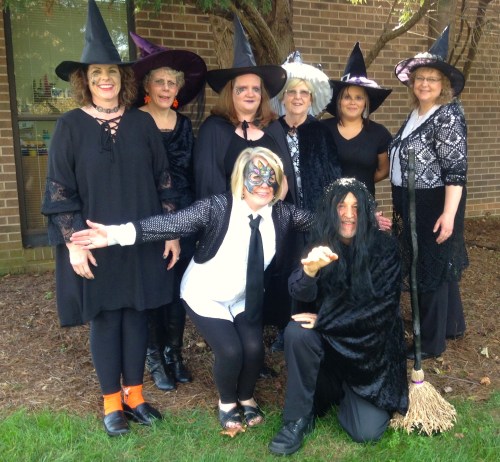
Another one: Mom and Dad moved away from the South before I was born, but her friends in Michigan or Ohio or Delaware could still detect the remnants of her North Carolina accent. I believe they always thought her a bit prim. When I was fifty I happened to visit Mom in Wilmington DE around Halloween. She said, “Let’s go trick-or-treating!” I figured we’d just walk down the block and say Hi to the neighbors, but she came out of the bedroom wearing a cape and hunchback, an old wig pulled all the way down over her face, and stark staring eyes painted on her cheeks. A wooly booger. None of the neighbors knew who the hell she was and they flinched visibly when she cackled.
 . 
Last story?: Mom was the czarina of crosswords, and she could finish the entire Jumble in the morning paper while I was still juggling the first word. The last few months of her life, at ninety-six, she would sit on the couch after breakfast and I would bring in the paper, sit down beside her, and hand her a pen. Sometimes, I admit, I had to offer her hints (assuming I myself could figure out the words). But at times she would put pen to paper, hesitate just a moment, and fill in the blocks with faint, spidery letters. Just right, Mom. Just right.
 . 
 . 
❦❦❦
 . 
Liminal
nonagenarian
 . 
Every Sunday after church I knock
at your kitchen door then forge on through
to the living room before you can struggle
from your favorite chair, milky tea
half-finished, The Times crossword
and a few spaces you’ve saved me,
78 down, wings, four letters, and today
I’ve brought my grand-daughter,
 . 
your great-. We’ve taken to calling her
Sister like your brother and all
the cousins called you,
and while she cuddles your old doll
almost ninety itself and explains
to it the universe of her three years
you settle your pad across your lap,
charcoal on your fingers, capture
the purity of her which is the closest
we will ever come to defining love,
the three of us a grand alignment
 . 
of planets in some untrammeled
system, and although the scratch scratch
on paper binds me to this moment
I see you luminescent, intangible,
the halo of fine white hair that limns
your face, your wings, alae,
strong enough to lift us all.
 . 
Bill Griffin
first appeared in Grey Sparrow Journal  –  Issue 32, Summer 2018
 . 
❦❦❦
 . 
 . 
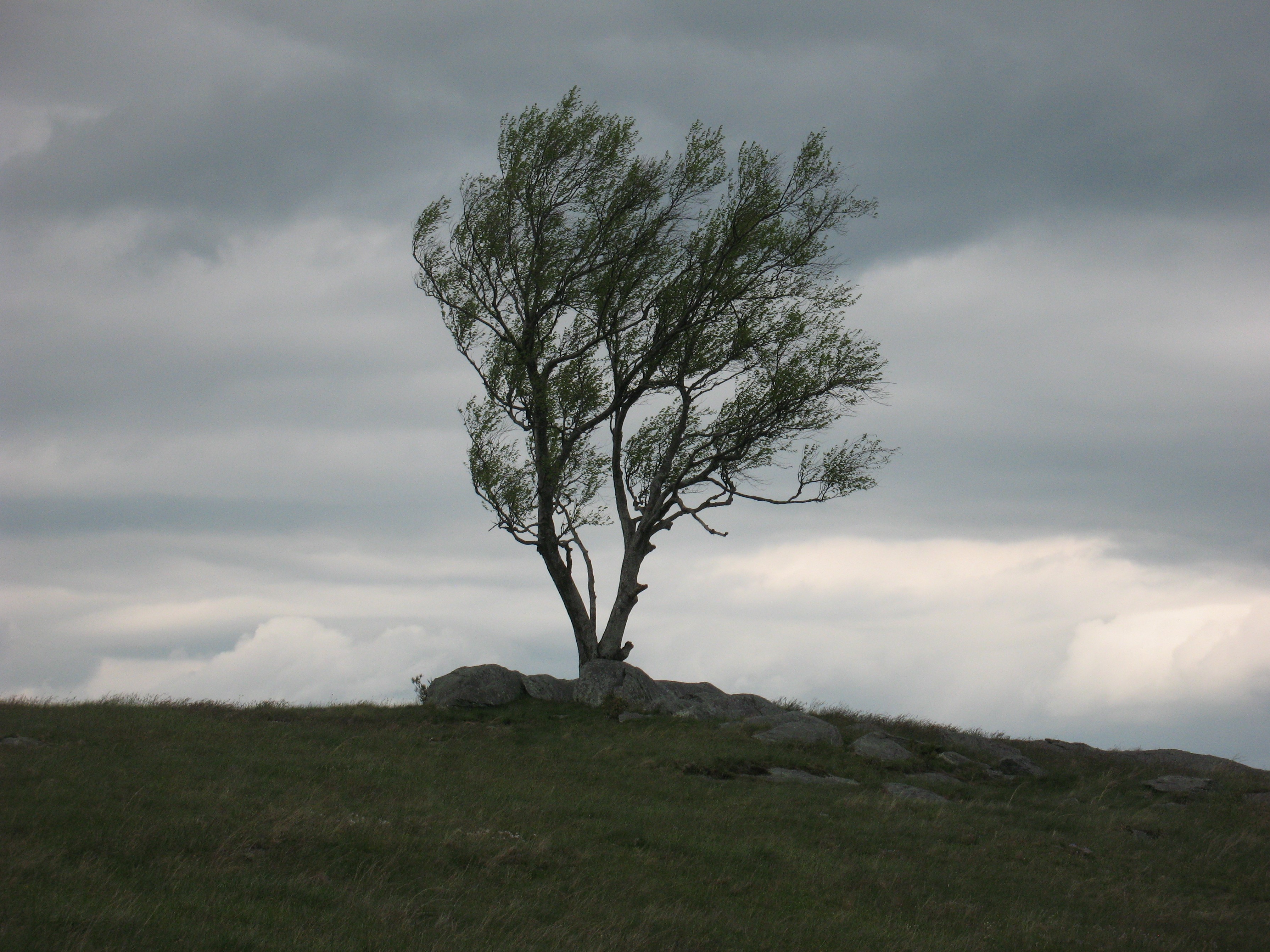
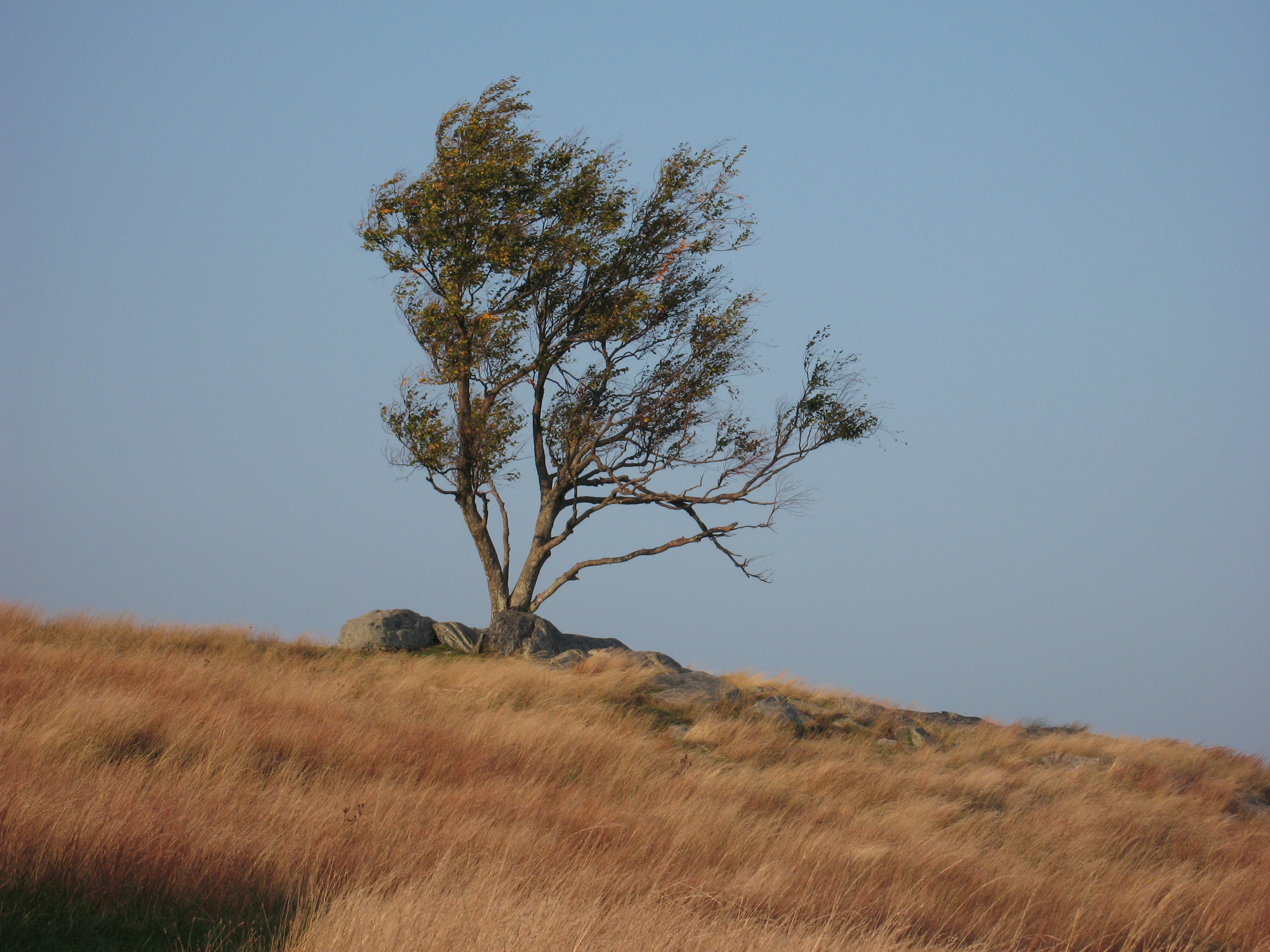
2020-06-11a Doughton Park Tree

Read Full Post »

 . 
[with 3 poems by Beth Copeland]
 . 
Fog
 . 
Morning fog erases the mountain and trees.
No, not an erasure but unseen.
 . 
Not an erasure but unseen.
The mountain, the laurel still green.
 . 
Unlike the mountain and laurel still green,
the dearly departed lie beneath white sheets.
 . 
The deer depart beneath white sheets
of fog, stepping into a forgotten dream
 . 
of fog slipping into a forgotten dream
the ghost mountain dreams.
 . 
The ghost mountain dreams.
Crows fly to pines on mascara wings.
 . 
Crows fly to pines on mascara wings,
mourning. Fog erases the mountain, the trees.
 . 
Beth Copeland
from I Ask the Mountain to Heal My Heart, Redhawk Publications, The Catawba Valley Community College Press, Hickory NC; © 2025
 . 
❦ ❦ ❦
 . 
It’s a big web, here in the corner of our screened porch, but I’m not ready yet to broom it down. The spider is a jointed dried kernel in its center; when I blow, she doesn’t twitch. I don’t see an egg pouch or spiderlings. The strands are not an orb but a diffuse tangle, a chaos of delicate angles and tensions — a miniature of filaments revealed by the background microwave radiation that weave the structure of our entire universe. And what are they made of, those filaments? These I can see before me are nanometer reworkings of hemolymph from mosquitoes denied the opportunity to bite me. Most visible when dusted with pollen. A mess. But I and my broom are not ready yet to offend, to say farewell to the tribe of spiders.
 . 
Last week we visited Blue Whales with our grandson, turning eight. The North Carolina Museum of Natural Sciences in Raleigh is hosting this exhibit of the largest creatures that have ever lived on our planet – the mystery of their migrations, language, culture; the vital interconnections between their diet of krill, their massive enriching orange poop, and the entire deep ocean ecology. Linda and I stood in silence before the model of a blue whale brain and a model of our own. The whale’s is twice as large and twice as complex, convoluted with its twisting gyri and deep sulci. Surely such an abundance of neurons and synapses must create thoughts as complex as our own. Or more so. And yet blue whales struggle to survive as a species in a world degraded by human beings. I am thinking of that brain and I am not ready yet to say farewell to the tribe of whales.
 . 
Chapel Hill cartoonist Keith Knight draws a weekly panel titled (th)ink. Today’s is a portrait of and quotation by James Baldwin (1924-1987): “To be a Negro in this country & to be relatively conscious is to be in a rage almost all the time.” Human being who is relatively conscious, choose your own rage focal point du jour – human beings caged like animals in a Florida concentration camp; children intentionally starved to advance a particular political agenda; boosting fossil fuels burned to appease a few billionaires; an ocean filled with plastic nanoparticles and deafening human vibrations where blue whales may soon be extinct? Some days I feel like I am not ready to go on living. Some days I am more than ready to say goodbye to the tribe of humans. In a few years I will depart as an inhabitant of planet Earth. Some years after that the last memory of my having been an inhabitant will finally depart as well. On that day, will any whales still remain to swim the depths? Will any love between humans remain, or any love for other creatures? I am not ready yet to answer.
 . 
 . 
❦ ❦ ❦
 . 
October Valentine
 . 
A heart-shaped leaf spied in the weeds on my walk
down the hill to the mailbox. I didn’t see a redbud tree
 . 
on the roadside, so it must have lifted on the wind
and dropped – a gift! – near my feet. Is it a message
 . 
from someone I love – my sweet mother in a halo of light,
my father singing the names of trees in his strong baritone?
 . 
Or is it from someone I’ve never seen and may never meet?
 . 
As I hike up the hill, I tuck the leaf in my pocket, rubbing it
with my thumb – as if I could read it – skin to skin – by osmosis.
 . 
Halfway home, I stop to study it. Cerise with splotches of green,
dark spots, a wormhole bored like a bullet wound, a battered
 . 
heart, like yours, like mine, but maybe its scars make it more
beautiful than before. My friends, there’s still so much
 . 
love in this world even when you’re alone.
 . 
Beth Copeland
from I Ask the Mountain to Heal My Heart, Redhawk Publications, The Catawba Valley Community College Press, Hickory NC; © 2025
 . 
❦ ❦ ❦
 . 
Is it strange for me to be toying with despair while reading a book of healing and love like Beth Copeland’s I Ask the Mountain to Heal My Heart? Actually, if you’re not toying with despair you are the strange one. Give grudging thanks, though. Thank the stars and the mysterious hemlocks and the dark fecund earth that in a world full of rage and despair there are poems like Beth Copeland’s. These poems know the feeling of being lost in endless night. These poems have been battered, they have fallen, they have doubted plenty of times whether there is any wholeness or healing available to them, but these poems stand up to testify, My friends, there’s still so much love in this world even when you’re alone.
 . 
Often I tell myself it is ridiculous to imagine that any sort of inner peace is possible. I have my share of personal regrets and ongoing grief, and even though I’m tempted to look around and envy those people who don’t, when I’m really honest I admit that no one escapes whipping. But peace can’t be a wall built around my sadness – walls keep more things in than out. Despair is inevitable. How foolish is it, then, and how strange, to spend a few hours with a book of words arranged in lines on paper and discover the tightness in my throat is easing? The mountain has rested in one place for 480 million; today its peak is less than a third of its height when it was first thrust up in the big crunch. Does it reflect on loss and diminishment, or does it find peace in the weight of its daily being? Am I inflamed and scarred by the revelations of Beth Copeland’s battles and pain, or am I grateful for her gratitude and strengthened by her strength?
 . 
The tribe of human beings seems determined to destroy itself. The tribe of human beings seems determined to link arms and hearts in love. Perhaps discovering a moment of beauty is not a cowardly attempt to escape dire reality – perhaps it is the only thing capable of healing us.
 . 
 . 
Explore REDHAWK Publications, including Beth Copeland’s I Ask the Mountain to Heal My Heart and Shibori Blue: Thirty-Six Views of the Peak HERE.
 . 
Sample poems from Shibori Blue at Verse & Image HERE.
 . 
More information about the North Carolina Museum of Nature Sciences HERE.
Dive into the K Chronicles with Keith Knight HERE.
 . 
 . 
❦ ❦ ❦
 . 
My Daughter Paints a Mountain
 . 
She wasn’t thinking as her brush swept
across canvas in wave-length strokes,
 . 
channeling a crest she’d never seen,
while I was still in the Sandhills
 . 
where there aren’t any hills, just fields
of cotton, soybeans, and cedar stumps
 . 
in swamp water, sleeping on an air mattress
in a small apartment with prints and paintings
propped against walls instead of hung,
newly separated, newly sober, living
 . 
between the husband and home I’d left
and a haven I hadn’t found yet.
 . 
*****
 . 
As I drove up a steep road to see a house
in the Blue Ridge, a large buck leapt
 . 
in front of the car to welcome me,
and I knew I’d found my new home.
 . 
I didn’t know the mountain seen at the top
of the hill was the mountain she’d painted
 . 
months before, and she didn’t know I’d move
to that house with a view of the mountain
 . 
she’d painted as if in a dream or fugue.
How could her mountain – purple, lavender,
 . 
pink, and forest green swirled to a peak
with white streak of snow against a blue sky –
 . 
mirror the one framed in my window?
Was it coincidence or synchronicity
 . 
that the mountain in her mind’s
eye was more map than metaphor?
 . 
It was a message from the universe:
You’re home. Open the door.
 . 
Beth Copeland
from I Ask the Mountain to Heal My Heart, Redhawk Publications, The Catawba Valley Community College Press, Hickory NC; © 2025
 . 
 . 
❦ ❦ ❦
 . 
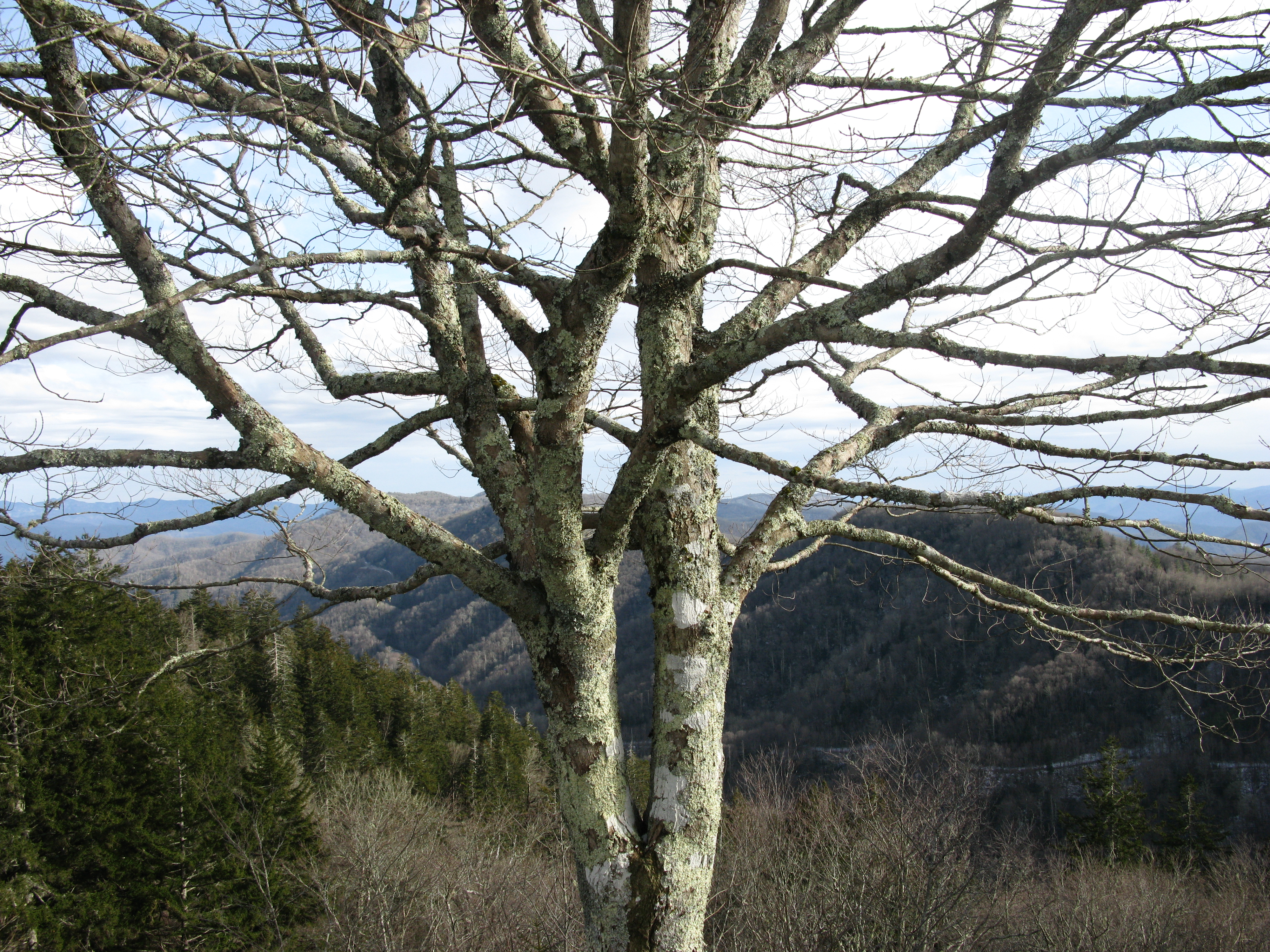
Doughton Park Tree 2020-11-22
 . 
❦ ❦ ❦
 . 

Read Full Post »

« Newer Posts - Older Posts »