Feeds:
Posts
Comments

Posts Tagged ‘nature’

[#Beginning of Shooting Data Section]<br /> Nikon CoolPix2500<br /> 0000/00/00 00:00:00<br /> JPEG (8-bit) Normal<br /> Image Size: 1600 x 1200<br /> Color<br /> ConverterLens: None<br /> Focal Length: 5.6mm<br /> Exposure Mode: Programmed Auto<br /> Metering Mode: Multi-Pattern<br /> 1/558.9 sec - f/4.5<br /> Exposure Comp.: 0 EV<br /> Sensitivity: Auto<br /> White Balance: Auto<br /> AF Mode: AF-S<br /> Tone Comp: Auto<br /> Flash Sync Mode: Front Curtain<br /> Electric Zoom Ratio: 1.00<br /> Saturation comp: 0<br /> Sharpening: Auto<br /> Noise Reduction: OFF<br /> [#End of Shooting Data Section]

 . 
[with 3 poems from Had I a Dove]
 . 
Grief for These Trees
 . 
Nearly half, we’re told, downed by wind,
wrenched from river-flooded ground.
 +++ Clogging streets, parks, schoolyards,
 . 
blocking our hiking trails. Our town is dank
as a worn graveyard, branches and brambles
 +++ strewn among marble stones.
 . 
 +++ So what to do with the haunt
of these crippled trees? My muse would say
go to the woods, hike the trail anyway.
 . 
And I will. But before lacing my boots,
let me honor what we’ve learned of nature,
 +++ how in mystery
 . 
trees speak to one another – give support
 +++ and shade, share water and sun.
And like old friends, mourn when one dies.
Let me rub my fingers into the wound
 +++ of this tulip poplars’s bark,
nod to the beetles and lichen who thrive.
 . 
Smell the sweet air of pine sap.
 +++ Scrunch my body
over broken bones of oaks and willows,
 . 
cling to the dead the way I’d cling
as a kid to our sugar maple
 +++ next to Daddy’s tomato patch.
 . 
Limbs holding me safe,
 +++ a flutter of breeze through leaves
always whispering my name.
 . 
Let me linger here in the trees I”ve known,
the ones now gone, the ones
 +++ still upright and grieving.
 . 
Barbara Conrad
from Had I a Dove: Appalachian Poets on the Helene Flood, edited by Hilda Downer. Redhawk Publications, Hickory NC; © 2025
 . 
❦ ❦ ❦
 . 
It was cold enough to frost last night but I hear music outside my bedroom window and raise the sash. A sparrow is calling, perched on a branch just a few feet from the house. He swivels his head west-south-east and at each turn chirps a metallic almost musical tink. He means business. He is not just any little brown bird – he’s a White-Throated Sparrow, migrated here from Canada to spend the winter. And his perch is not just any tree – it’s a native dogwood. It holds onto color, its coppery leaves, while the tuliptree and maple are already browning in the road. This tree holds onto life when so many of its kinfolk have been taken down by blight.
 . 
Tink, tink, tink. I am here. Brassy foliage and scarlet berries. I am here. We are here for each other.
 . 
Poets who survived hurricane Helene mourn their trees. The poems in Had I a Dove bear witness – trees uprooted, splintered, tumbled down mountainsides, tangled in rivers. Trees crushing houses and blocking roads, trees wiped from entire ridgelines, and with every fresh breeze our own reborn fear of trees falling. We being a species which can grasp large numbers, we try to calculate. How many trees destroyed by wind and flood? Millions? Dozens of millions? It becomes unimaginable. At the loss of even one tree, the heart suffers. That big hickory that shaded the garden. The righteous oak that lifted and held the kids’ tire swing. The dogwood where sparrows perched.
 . 
Hurricane Hugo roared through Charleston in 1989 and felled thousand-year old cypresses in the blackwater swamps, then stomped on up the Appalachian chain to leave behind downed trees all the way to Ohio. Near our home a hundred year old oak blocked Flat Rock Ridge trail where it winds from Basin Cove up to the Blue Ridge Parkway. An anonymous Park Service volunteer with a huge chain saw cleared the trail, and into the face of that massive stump he carved “Hugo 9-21-89.” I have paid homage every time I hike past, until a couple of years ago I had to stop and cast about to find the stump. Rot and lichen and a thick beard of moss had cloaked the inscription. Overhead, the canopy had closed as fellow trees shouldered their way in. In the midst of grief and loss, we hold onto life.
 . 
 . 
❦ ❦ ❦
 . 
I could not hear the trees fall
the morning that yowling she-wolf,
Helene stormed up from Florida,
sank blood-stained fangs into Appalachia,
her torrential mad-drool rain,
drowning wide river valleys,
and all those skinny little hollers.
 . 
From a kitchen window I watched
her lay into a neighboring ridge, her super-charged
breath knocking down magnificent oaks,
colossal hickories, and hundreds of tall pines
which dominoed one by one by one.
She left nothing standing in the upper hillside grove.
 . 
The next day, after that noisy bitch moved on,
I heard an immense tree fall somewhere
close by. There was a crack,
a ghostly groan, a swoosh of leaves,
then, as it met the ground, a tremendous bellow.
And I whispered a prayer for the passing.
 . 
Suzette Clark Bradshaw
from Had I a Dove: Appalachian Poets on the Helene Flood, edited by Hilda Downer. Redhawk Publications, Hickory NC; © 2025
 . 
❦ ❦ ❦
 . 
Barbara Conrad has lived in North Carolina all her life and in Asheville since COVID. She edits Waiting for Soup, an anthology created by her writing group with houseless folks.
Suzette Clark Bradshaw lives in western North Carolina, writes and sculpts, and is employed by her county to manage Helene recovery projects and FEMA grants.
Molly Bolton lives in Foscoe, North Carolina, and upholds the spiritual practice of collective liberation with weekly posts at enfleshed.com.
Had I a Dove: Appalachian Poets on the Helene Flood, an anthology collected and edited by Hilda Downer, includes a preface by Joseph Bathanti. More than 80 poets, voices as various and deep as those wild mountain ridges and hollers, share the night that hurricane Helene’s “thousand year” flooding and gales devastated the mountain counties of North and South Carolina, Georgia, and Tennessee. They share the days and weeks and now months that have come after, the scars and healing. Available from Redhawk Publications at Catawba Valley Community College Press in Hickory, NC.
 . 
 . 
❦ ❦ ❦
 . 
somehow bloodroot
 . 
For Western North Carolina & Gaza
 . 
still blooms, the same
spot as last year
at the crumbling edge
 . 
of the driveway
in the seam
of march and April
 . 
under the body
of a fallen elder oak
each flower coming up
 . 
wrapped around
its stem like a windless
white flag.
they say
among the rubble
there will be dancing –
 . 
beautiful people
in ancient lands
tending fires
 . 
while they are hunted
ghosts unsurprised
by the power of greed
 . 
to route bombs towards
children, a hurricane
to the mountains. my sister
 . 
had to come get me
through maze of
washed-out roads &
 . 
Here
I am, still alive
same spot as last year
 . 
bumming a cigarette outside
the todd community square dance
just to watch smoke rise
 . 
from the creaky porch
past the blown-open riverbank
to the cold white stars.
 . 
Molly Bolton
from Had I a Dove: Appalachian Poets on the Helene Flood, edited by Hilda Downer. Redhawk Publications, Hickory NC; © 2025
 . 
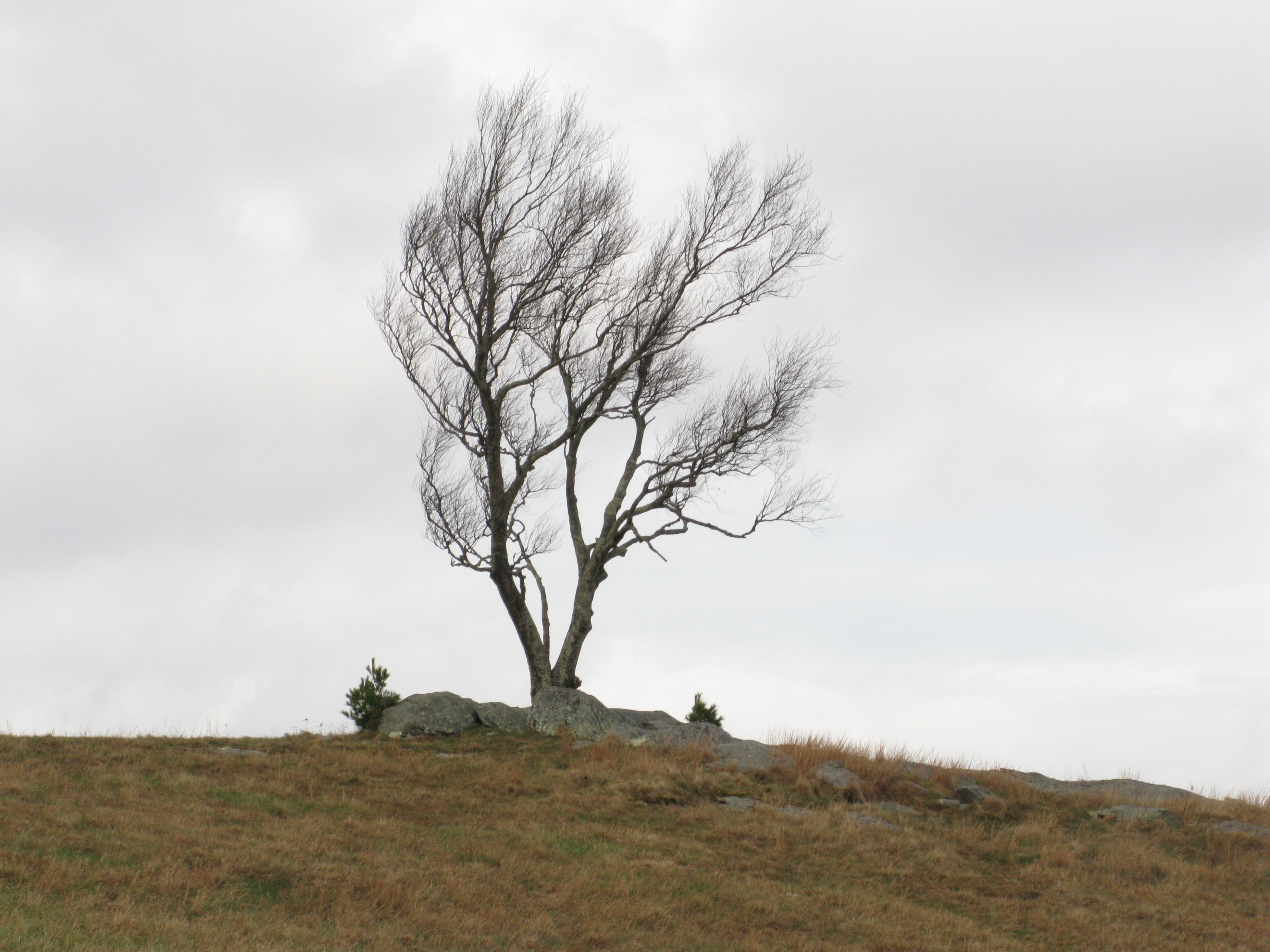
2016-05-08b Doughton Park Tree
 . 
❦ ❦ ❦
 . 
2015-06-15Doughton Park Tree
 . 

Read Full Post »

 . 
[with 2 poems by Catherine Carter]
 . 
Crow cosmogony
 . 
The day we made the world, scattered
shattered sand across the deep
steeps and hollows of the sea,
we were playing with chance,
a stance few other gods admired.
We retired then from creation and let things
sing as they would, go
to whatever end luck called good.
We could, and did, breath in a platypus here,
a shearwater there – evolution
our solution to dogma and fate,
the weight of always being in charge
of stars, shoals, plague, all that –
but by and large, we let go, let
sweat and thought fall away,
stray like questing possums
or blossoms of blown snow.
So it was. We didn’t worry how
our sowing would grow. We went back
to hacking with our thick
black bills at death and waste, harrying
carrion, even as the dead
bled ever more numerous over the new
true-straight roads, here
where we shaped the bright turns
and returns of the world, invited
night in: do that, and you get
what you get. Despised
as flies, we pick through pale grass
for carcasses gone flat and dry;
we rise under your very wheels
from meals scant and cold, bring
strings of gut back to our young. But so
goes the world, when you let it go,
throw yourself in its rolling motion, chance
chance: we live on broken squirrels
in the world we made this way.
 . 
Catherine Carter
from By Stone and Needle, Louisiana State University Press, Baton Rouge LA; © 2025; winner of the L. E. Phillabaum Poetry Award for 2025
 . 
 . 
❦ ❦ ❦
 . 
The postmark is 03-09-97. Linda found the torn envelope, letter inside, at the bottom of a box of mementos she’s still sorting from her parents’ home after their deaths over a decade ago. Dear Dad . . . It’s me writing to my father-in-law, the nuclear physicist. I’ve got an idea for a new story and I need your help. Dad French and I would sometimes share first drafts with each other, his hard science fiction that could use a cool breath or two of metaphor, my airy prose in desperate need of some fact checking. So here’s my pitch:
 . 
Imagine a craft traveling to Proxima Centauri, 4.25 light-years away. It’s under a constant acceleration of 2G for the first half of the voyage, then 2G deceleration for the second half. What would be its peak velocity at the mid-point? And how much time will pass for the voyagers relative to earth time? 
 . 
Relative is the operative word. Dad French was an Einsteinian guru. His favorite Saturday afternoon pastime was to lean back on the couch with a big yellow legal pad and work through the equations of Special Relativity. He felt that he had identified a flaw and was determined to elucidate (from the Latin, “bring it into the light”). The most I could understand from his explanations of time dilation is that any object, whether charged particle or self-aware being, as it approaches the speed of light experiences a slowdown in the passage of time. To me on that spaceship there’s no difference in the ticking of my clock, but if my buddy back on earth could listen in he’d hear an expanding silence between each tick and the next.
 . 
But big deal. Who hasn’t felt time speed up or slow down in certain situations? Man, last week was so busy it just flew by.  – or – I feel like I’ve been sitting in this waiting room for a week. We human beings are just rubbish at time. If you asked that charged particle, it would know to the femtosecond how long since it got spat out of the cyclotron. My perception of time, though, is all tangled with context and saturated with subconscious. Don’t even ask me how long I’ve been sitting here at this keyboard, much less whether a certain something happened five years ago or ten.
 . 
Which is why, when I wake up in the dark, I avoid looking at the clock. If I should still happen to be lying there with my brain in fifth gear when light begins to seep around the shades, when any hope of re-entry into the land of Nod is laughable, then I don’t want to know how long it’s been. I don’t want to know that I’ve just spent two hours on this inventory of all my faults and failings. Surely no more than a handful of ticks. Grant me the bliss of imagining I’m half way to Proxima Centauri at nine-tenths the speed of light and I have all the time in the universe.
 . 
 . 
Oh, and here is what else I found in that old envelope along with the letter: a Post It stuck to the page with these lines in Dad French’s handwriting.
 . 

Park French

 . 
❦ ❦ ❦
 . 
Choptank bluegills take part
in the creation of the world
 . 
You couldn’t say bluegills create the stream.
Torn from the stream, they choke
on blazing air. And yet. Those nests,
those few dozen shallow divots together
pocking the creek bottom in dimples
rich with sunfish generations: changing
creekbed, reshaping foundation.
That steady fan-flow of air-
bearing water over eggs settled among
the pebbles, ever so slightly changing
the river’s braiding and unbraiding. That labor
of life: the work to work
with the current as it is and yet
to change it just enough, to manifest
a place a little better for bluegills, co-creating
the world in concert with oxygen exchange,
tectonic motion, that smashed and gash-
edged hubcap pinning down an immortal
plastic bag, the gravity of the moon, whirligig
beetles inscribing creek-skin with runes
written in water, whatever God you say. Flood
of protestors in the street’s torrent, choking
on blazing air. A woman stirring cut
onions over heat, changing them just enough
to turn their burning tears to something
a little more sweet. Fingers moving the pen, the keys,
the lever, and the air and ground
of our lives ever so slightly shifting
in response, recreated (ever so slightly) anew.
The fearful fact: it matters what you do.
 . 
Catherine Carter
from By Stone and Needle, Louisiana State University Press, Baton Rouge LA; © 2025; winner of the L. E. Phillabaum Poetry Award for 2025
 . 
 . 
❦ ❦ ❦
 . 
What is left for us to believe in? What even matters? When hate is the day’s currency, those who can’t bring themselves to live on hate are emptied and cast aside. As if! Whatever. It’s all just relative, anyway. But stone is still stone, underfoot, under earth, under all, and if you rub the lodestone along the needle and suspend it by a thread, it will still swing north.
 . 
And so these poems. Crows and bluegills continue to create the universe and stirring onions in a skillet continues to make the world just that much sweeter. There is still truth you can pin down, categorize, calculate, and right alongside that truth is the truth of breath, discovery, awe. I am not afraid to say it, Catherine: you make me believe that even I matter. How could any of us walk through a world that smells a little of skunk; feel sun on our face while the grass turns that sun into sugar; tremble one moment at the closeness of death and the next moment laugh as life surprises us; travel these lines of verse into strange realms and incantations that transform into our own familiar muscle and blood and mind; how could we do all this and not discover that we matter and that this planet we love matters?
 . 
I believe. That there is still hope for us all. And for all that surrounds us.
 . 
 . 
Catherine Carter’s By Stone and Needle is available from LSU PRESS.
If you read one book of poetry this year, make it By Stone and Needle. These poems are comforting and harrowing, enlivening and enlightening. They are true.
I featured two additional poems from the collection at last weeks posting (October 10, 2025).
 . 
 . 
❦ ❦ ❦
 . 
 . 

Read Full Post »

 . 
[poems by Stephen Dunn, Robert Bly, Bill Griffin]
 . 
Circular
 . 
Daylight illuminated, but only for those
who had some knowing in their seeing,
and night fell for everyone, but harder
for some. A belief in happiness bred
despair, though despair could be assuaged
by belief, which required faith,
which made those who had it
one-eyed amid the beautiful contraries.
Love at noon that was still love at dusk
meant doubt had been subjugated
for exactly that long, and best to have music
to sweeten a sadness, underscore joy.
Those alone spoke to their dogs,
but also to plants, to the brilliant agreeableness
of air, while those together were left
to address the wall or open door of each other.
Oh for logs in the fireplace and a winter storm,
some said. Oh for Scotch and a sitcom, said others.
Daylight concealed, but only for those
fond of the enormous puzzle, and night rose up
earth to sky, pagan and unknowable.
How we saw it was how it was.
 . 
Stephen Dunn (1939-2021)
Shenandoah, Volume 52, Number 3; Fall 2002
 . 
❦ ❦ ❦
 . 
Josh has taught me how to spot a sourwood across the meadow along the treeline. Always crooked. Curved and arched, clutching branches and trunk like an old man’s spine, in medical parlance kyphosis. It must be because the sourwood is grasping at something always out of reach. Always overtaken by shadow but always trying to edge closer into the light.
 . 
When we bought this house in 1983 the steep back lot was choked with hickory and tuliptree; in front, two weighty red oaks flanked the door, centenarian sentries. A dogwood struggled in their shade and at the northern lot line one sourwood straggled out from under. Crooked! That first summer I noticed, of all the trees in leaf, only the sourwood labored with tent caterpillars, messy tangled webbing and bare patches chewed out of its foliage. I though maybe I should try to save old sourwood from its pests, but they were too high for me to spray and I had no spare cash for an arborist. Oxydendrum arboreum, you are on your own.
 . 
After Hurricane Hugo walloped the Appalachians in 1989, we cut down those two oaks that leaned two threatening meters from our walls and roof. At the base they were bigger around than oil drums. A few years after those monsters came down I noticed the sourwood, not standing any straighter but now stretching a new arm pure vertical, due upward, sunward. Another thirty years along and that sourwood is still making flowers in the spring, champion of honeybees, and still sharing its bright summer green with any and all itinerant webworms. The dogwood and redbud look up and pay homage from around its knees. But even with all the newfound light my sourwood remains crooked as hell.
 . 
Teach me the same lesson, Josh and Sourwood. Life ain’t ever going to get cobbled together perfect. Most mornings I have to claw through a web of nasty wormsilk before I can struggle up from sleep. Most days I’m noticing the weeds and cankers I haven’t yet yanked from my beds more than I’m noticing the asters’ spiral floret emerging or bumblebees’ shanks stuffed with pollen. Step back. Look again. Forgive the mess of life just making its daily living. Forgive the darkness that less hides the light than shows it brighter. Forgive myself that I can’t fix it all, make it come out straight. Forgive my own crookedness. Isn’t that what makes the sourwood a sourwood?
 . 

Oxydendrum arboreum

 . 
❦ ❦ ❦
 . 
What Things Want
 . 
You have to let things
Occupy their own space.
This room is small,
But the green settee
 . 
Likes to be here.
The big marsh reeds,
Crowding out the slough,
Find the world good.
 . 
You have to let things
Be as they are.
Who knows which of us
Deserves the world more?
 . 
Robert Bly (1926-2021)
Academy of American Poets, https://poets.org/poem/what-things-want
 . 
 . 
❦ ❦ ❦
 . 
Sourwood
 . 
Bent from overshadowing,
+++++ crippled
by the broad red oak;
tent caterpillars, years
+++++ of limp submission,
robbed of flowers
by heartless shade.
 . 
Rocky soil, no tap root, many winters:
the big red finally kneels, prostrates itself,
 . 
and Spring delivers sun to sourwood.
Straight up tangent to the curve of trunk
+++++ new arms jubilate,
new fingers reach to pull down sky, bees
celebrate creamy clusters
 . 
and there is honey.
 . 
Bill Griffin
featured in Poetry in Plain Sight 2014 by the Winston Salem Writers.
 . 
 . 
❦ ❦ ❦
 . 

Wingstem & Bill

 . 
❦ ❦ ❦
 . 
IMG_0880, tree

Read Full Post »

« Newer Posts - Older Posts »