Feeds:
Posts
Comments

Posts Tagged ‘nature photography’

[with 4 poems by John Hoppenthaler]

When Saul turned 9, his Mom passed down her old tablet to him. No phone, internet disabled; he didn’t use it to learn higher math or play games. What Saul did with that cracked and creaky tablet was create videos. He wrote, produced, and narrated a whole series titled, “Animal Habitat.” First were the off-center and slightly zany documentaries of the daily lives of the family pets. Then he moved on to both parents, then toddler sister (not an entirely complimentary biopic of the latter). The search for ever more subjects led him to, uh oh, grandparents.

“Welcome to Animal Habitat. Today we explore a very strange creature, The Granny. Here she is in her native surroundings doing what she loves to do most – tear up old National Geographics. Why does she do this every afternoon? That is just one of the mysteries of Animal Habitat.”

Yes, Linda does tear up old National Geographic magazines. We had close to fifty years of accumulated piles – beginning with the oldest, she’s been ripping out articles she wants to keep, reread, and refer to before recycling the discards. She sorts the articles by topic and stores them in clear plastic sheaths (leftovers from my comic book collection). We’ve been learning a lot. I believe she’s made it to August, 2010.

Tearing up National Geographics – the perfect metaphor for our long marriage. You can’t hang on to all your old garbage; sometimes the big heave ho is mandatory. Some of that stuff is mildewed, nasty, blacks your fingers. Nevertheless, there are definitely some pearls in there worth recovering and holding up to the light. Better yet, you might learn something new. In fact, there’s a new issue every month – you’d better always be open to learning something new.

One more thing – when Linda does discover anything cool, she shares it with me.

John Hoppenthaler discovers metaphors in the garden: metaphors for the prickly beauty of love, for weeds of rejection and disappointment, for childhood and parenthood, for loss and luminous joy. John’s 2015 collection, domestic garden (Carnegie Mellon University Press), is one I won’t be tearing up or consigning to a plastic envelope. I’ll keep it on a shelf nearby, ready for when I need to learn something new.

❦ ❦ ❦

domestic garden

A ghost has disarranged these roses
+++ lining the walkway. Some greenhouse
++++++ jokester must have switched

Jackson & Perkins packaging – Heaven
+++ on Earth for Change of Heart, Black

Magic with Beloved. I’ll name them
+++ rancor lilies in your absence, though
++++++ I don’t hate you, & they’re not lilies,

& you aren’t really gone, except in the way
+++ presence sometimes contradicts itself.

Should they grow on me – fugitive varietals
+++ I never thought to plant – will they lure
++++++ your bouquet any closer, spirit

away weeks I’ll name neglect, aphids
+++ who’ll stay aphids, sucking at the stalk?

John Hoppenthaler
from domestic garden, Carnegie Mellon University Press, 2015

❦ ❦ ❦

passing

I’ve just received a text that says a buddy
died last night but that doctors brought him back
to us with a shot, and so my friend is a Lazarus.

I’m in a boathouse owned by another old pal;
he is traveling for work somewhere abroad.

Mallards have lifted from the vernal pond,
and thousands of frogs are singing
because it’s raining. I wish Bill ws here so we could

talk about our friend who has gone and returned.
Crows call to each other across the lake. Same old

story: there’s danger and it surrounds us. And now
the blue heron I’d failed to notice pulls his legs
free of mud and flies away. A small falcon skims

the shoreline. When he was raised, was Lazarus pleased?
I wonder how he lived the rest of his unforeseen days.

Were his preparations any different than they’d been before?
It’s early March, and Easter will be here soon. Jesus, too,
realized how permeable the membrane is that keeps us

this side of death, and that the dead can come back
if they’re summoned. The ducks, the hawk and the heron

have passed on through to somewhere else,
but the joyful frogs remain crazy
with song. A hunter’s gunshots punctuate the distance,

a single crow lands in the crook of a tree, and it seems
as though the blessed rain has nearly stopped for now.

John Hoppenthaler
from domestic garden, Carnegie Mellon University Press, 2015

❦ ❦ ❦

John Hoppenthaler is Professor of English at East Carolina University in Greenville, NC. For ten years, he served as Editor for A Poetry Congeries online journal, and he currently serves on the Advisory Board for Backbone Press, specializing in the publication and promotion of marginalized voices. domestic garden won the North Carolina Poetry Society’s Brockman-Campbell Award for the best book of poems by a North Carolinian in 2015.

❦ ❦ ❦

what we find when we’re not looking

++++++ I was hiking the quiet ridge of pines
beyond Lake Kathleen. it felt so like a church then
++++++++++++++++++++++++++++++ that I knelt.

++++++ When I stood again, when I was able,
I found a woman’s Timex strapped around a limb,
++++++++++++++++++++++++++++++ thick as your wrist.

++++++ She’d been pacing – that much I could see –
and kept stopping at the watch’s face. Was time moving
++++++++++++++++++++++++++++++ slowly or quickly?

++++++ Late sun rolled from the valley. Rain
would surely come. No one – I called out once but no one.
++++++++++++++++++++++++++++++ She looked over

++++++ nearly a dozen cabins, the bed and breakfast.
She could see the vacant day camp, the eagle’s nest. Things
++++++++++++++++++++++++++++++ were about to end,

++++++ and soon it would begin. It felt so like a church then
that she knelt, stood up, took off her watch and strapped it around
++++++++++++++++++++++++++++++ the branch. She

++++++ meant to free herself from time. It couldn’t last.
She lost her definition; time defines us. She was hiking
++++++++++++++++++++++++++++++ and lost her watch.

John Hoppenthaler
from domestic garden, Carnegie Mellon University Press, 2015

❦ ❦ ❦

the way to a man’s heart
+++for Christy

To sautéed garlic and onions I add
pureed plum tomatoes, a great splash
of good, red wine. Never cook with
wine you wouldn’t drink, someone
offered, and we agree. I pour a glass.
Later, I’ll add coarsely chopped basil
from the herb garden, sea salt, maybe
a pinch of sugar, and always the drizzle
of extra virgin.
++++++++++++ But now, as you see,
this extended metaphor is dissolving,
so I’m left with Pinot Noir and the glass,
fresh basil sprigs which remind me of you
And now there’s musing on the oil’s earthy flavor,
and not this aching hunger, and who is it
who says poetry makes nothing happen?

John Hoppenthaler
from domestic garden, Carnegie Mellon University Press, 2015

❦ ❦ ❦

Read Full Post »

[with 3 poems by M. Scott Douglass]

I don’t eat meat. Just a decision ten years ago, my choice. It has nothing to do with you; I don’t think you’re “bad” if you eat meat. I has nothing to do with Bambi; I don’t think oysters are especially cute but I refrain from eating them as well. It has nothing to do with personal health; my cholesterol readings were already to (not) die for. And it certainly has nothing to do with ought or should; hominids evolved eating meat (and lots of insects) – perhaps all that protein made possible these brains we think are so big.

All it has to do with is my personal effort to make somewhat less of an impact on this planet. Leave it in a little better shape for my grandkids. Per pound of protein, how much acreage . . . water . . . diesel fuel . . . nitrates & phosphates . . . methane & CO2? Beans and beets will always beat out beef and poultry. How many billions of people can this planet sustain? Not nearly all the billions we have right now if we all want meat every day.

But what baffles me is how “vegetarian” has become a fighting word to some people. If I order plant-based sausage at Cracker Barrel will it make the guy at the next table choke on his chicken-fried steak? Simmer down, Dude. If nine billion people eating meat is going to hurry up and toast Mother Earth to a crispy golden caramelized finish, isn’t it kind of cool that a few people opt for rabbit food? Think of the choice this way – consider it my gift to you.


❦ ❦ ❦

A Tinderbox of Unsubtle Discourse
++++ It is the law: as a civilization dies and goes down
++++ to eat ashes along with all other dead civilizations
++++ – it is the law all dirty wild dreamers die first –
++++ gag ‘em, lock ‘em up, get ‘em bumped off.
++++ And since at the gates of tombs silence is a gift,
++++ be silent about it, yes, be silent – forget it.
+++++++++++ ~ Carl Sandburg, from At the Gates of the Tombs

There are those who prefer silence
to the sound of the wind in the trees.
For them, my voice rustles their peace
like a harsh unwelcome breeze.

I am the ghost of a storm they
would rather forget, as if they
believe a wave of their hand could
disperse an approaching hurricane.

There’s a red sky this morning,
red as the hot California hills,
and they think they can wish it
away with happy thoughts.

The wind has had its day, they say.
They want to muffle it, muzzle
the barking dog that wakes them,
shakes them from their comfort zone.

I am an inconvenient dog,
a crusty leaf skittering down the road,
a spark dropped in a dry forest:
Pretending won’t make me go away.

M. Scott Douglass
from Living in a Red State Blues, © 2022, Paycock Press, Arlington VA

❦ ❦ ❦

In the forward to his poetry collection Living in a Red State Blues, Scott Douglass wonders about attracting readers. The people on the reading end may have been burned out by it. Perhaps they were eager to move on from this period in our history or tired of hearing angry voices – . . . I prefer to think of it as exhaustion. Yep, I’d say that about sums it up. Exhaustion. Probably explains why the book’s cover stared at me from my desk for months before I finally cracked it open. I just get bone tired sometimes. Many’s the day I haven’t even opened my news feeds because I figure I already know all the headlines.

Also probably because I know Scott Douglass does not suffer fools gladly. Or quietly. But which of us has never been the fool? OK, I know this book will include at least one (high decibel) rant about all the bullshit of our current epoch, but it has been born from the pen and heart of a human being. One whose voice I respect. And hey, I’m a human being, too. Scott and I have something in common. Oh yes, we do.

❦ ❦ ❦

Reunion in an Airport Restroom

What do you do when
the man at the adjacent urinal
starts a conversation as if
resuming a thought left hanging
with a long-lost relative at
a wedding or picnic. You,
having held silent the business
at hand, the business for which
you have waited for hours stuffed
into a flying steel barrel, your
plumbing aching to be drained
for so long now that, amid this
scintillating discussion, it
sputters to a slow rebellious
drip, but wait, did he ask
a question; try to divert you
from your primary purpose
in this porcelain concourse,
where all the gates are full
and line runs from the door
to the tarmac; try to draw you
out of your self-conscious state,
shake off antisocial incivility,
embrace your fellow man?

M. Scott Douglass
from Living in a Red State Blues, © 2022, Paycock Press, Arlington VA

❦ ❦ ❦

March 13

Today is the anniversary of my
father’s death, or was it the day before
when his eyes last opened ore the week before
when he froze in mid-sentence, rigid fingers
reaching up to still air for stray words
that never returned to him again.

His words find me at odd times.

It’s only the last two minutes
of the game that matter.

But it’s unspoken moments
that haunt me most, moments
that echo throughout my day: the way

he turned a cereal spoon upside down
on the table when he was finished eating,
peanut butter spread to the edge
of a Ritz, a dab of Smucker’s
black raspberry jelly in the middle.

knowledge is the only thing that’s truly ours,
the only thing they can never take away.

On a shelf above my head he sits,
an eight-year-old on a black and white pony,
tall and proud, fists full of reigns. Sometimes
I look up to that pony boy and chuckle knowing
his parents paid a nickel to have it taken at
a carnival, how it was the closest he ever got
to riding a real horse, city boy that he was.

if you’re going to do something,
don’t do it half-assed

I though of my father every day
of the week leading up to this date,
but morning found me immersed in work,
the work he taught me, a job he envied.
When my nephew texted a photo of
his grandfather in a 1940’s Navy uniform,
shame swept a chill through me, realizing
I’d almost let the day slip by neglected.

do unto others as you would have them
do unto you

I look up at the pony boy on the shelf
and remember why, of all the photos
I have of him, I choose to display this one.
It’s because it frames him as someone
I know he never was, but reminds me
of his most cherished gift to me:
a sense of wonder, imagination,
the foresight to perceive the possible.

face the music, even when
you don’t like the tune

I am my father’s dreamer son,
the one who sometimes loses track
of time, the one who’s been tossed
from numerous horses, landed hard,
but always found a nickel to climb back on
because that’s what he expects of me.
While I may forget days and dates,
I will never forget that. Not that.

M. Scott Douglass
from Living in a Red State Blues, © 2022, Paycock Press, Arlington VA

❦ ❦ ❦


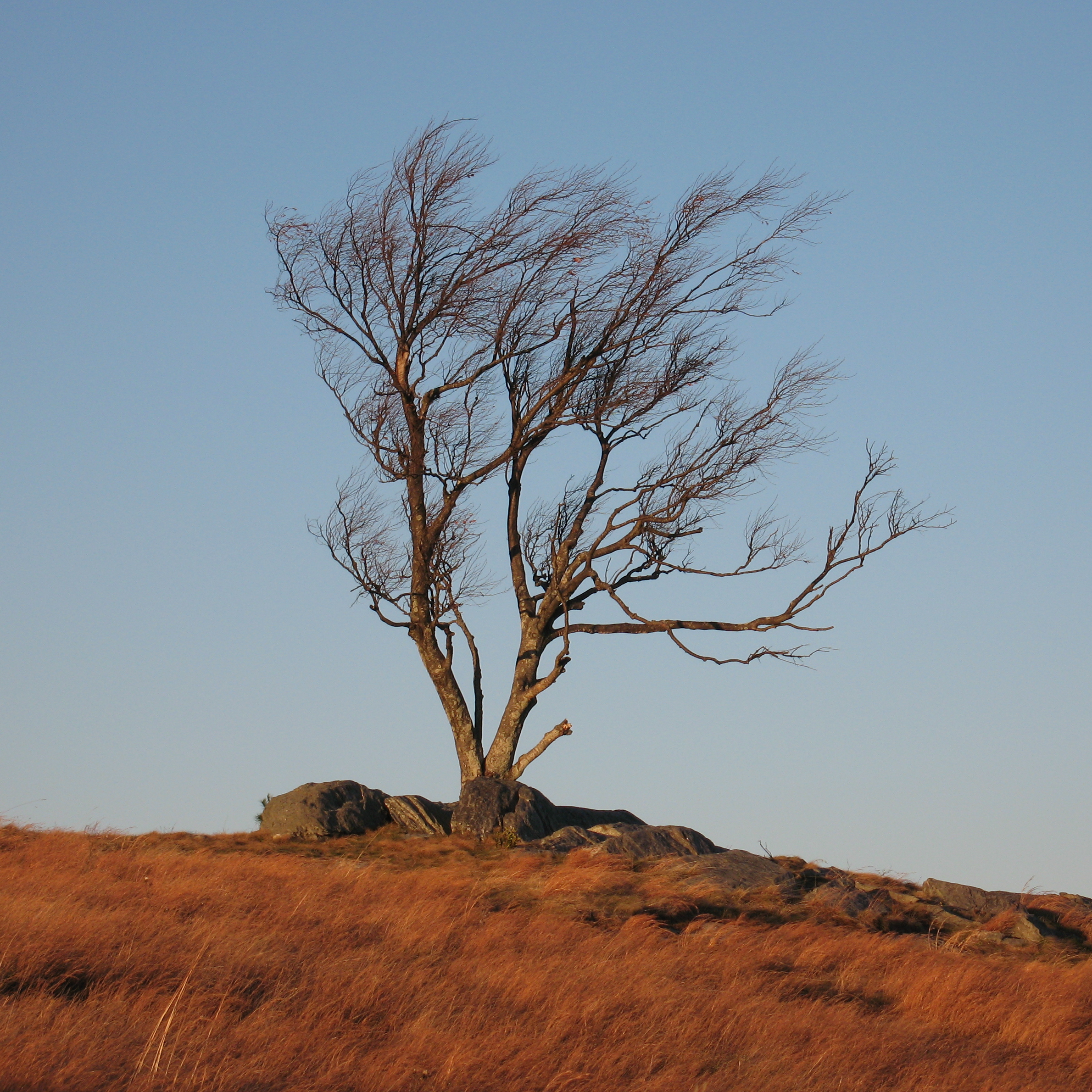
2020-03-07 Doughton Park Tree

Read Full Post »

[with 4 poems from I Thought I Heard a Cardinal Sing]

Eyes closed I listen as if casting a great spiral net into the forest. Behind, around me, above, although my two ears fixed in the horizontal plane are not excellent at discerning degrees of vertical, the vibrations arrive. Rarefaction and compression, faint means far, high amplitude is close beside me. A great disk of song and squeak and rustle, a half globe. What is the definition of a sphere? A surface whose every point is equidistant from the center.

How difficult, then, not to imagine the center is me. Plant my feet in sand and watch the sun descend below the western horizon; lie on my back at night for an hour and notice how Taurus and the Sisters wheel around me, I the fixed tether of all movement, I the pivot of their dance. My mind will argue against such silliness but my senses know its truth. As kids we never question the solar system we learn in school, later we even snicker at Ptolemy, his deferents, epicycles, and yet centrality is burned into us, ten thousand years of human psyche.

But imagine. What if? Hardwood creaks upstairs, Linda out of bed, but instead of imaging her descending soon to join me I am with her now, stretching, brushing teeth, gathering her hair and braiding. The first step is to step away from the imaginary center. The second is to not look back at self. Look out, look into the space between the hickory leaves and ferns, fly up with feathers and lace-veined wings. Claw the earth, creep between the rootlets. Not just imagine – be the other lives that pass in cars, that tend a child, that worry. Be the angry ones, the broken, the sad & silent. Behind, around, above. First step is to give up the center.

❦ ❦ ❦

Common Ground

What’s incomplete in me seeks refuge
in blackberry bramble and beech trees,
where creatures live without dogma
and water moves in patterns
more ancient than philosophy.
I stand still, child eavesdropping on her elders.
I don’t speak the language
but my body translates best it can,
wakening skin and gut, summoning
the long kinship we share with everything.

Laura Grace Weldon
from I Thought I Heard a Cardinal Sing: Ohio’s Appalachian Voices, edited by Kari Gunter-Seymour; Sheila-Na-Gig Editions, © 2022

❦ ❦ ❦

Cardinal

I know my mother’s weeping is real by the way
she exhales, fragmented and flailing,

like someone newly mourning. My head only hip-high,
I stare up to her saddened face, too young to understand

any of this, but old enough to know something
is broken, and that with breaking, anguish follows,

old enough to know she would want to watch
the male cardinal she feeds every morning

newly perched in the bare Maple outside
the kitchen window. I nearly tell her to look,

to witness its bright red flame up against all
that white winter. But I wait, keep quiet

and listen, trying to hear in place of her grief,
the cardinal’s song just beyond the glass.

William Scott Hanna
from I Thought I Heard a Cardinal Sing: Ohio’s Appalachian Voices, edited by Kari Gunter-Seymour; Sheila-Na-Gig Editions, © 2022

❦ ❦ ❦

As I read deeper into I Thought I Heard a Cardinal Sing, I feel my center shifting. In good poetry I discover how the poet feels; in excellent poetry I discover how I feel. These pages enfold an entire world – gardens and farms, back roads and highways, mining towns and river towns; people who struggle, joyful people, yearning, grieving, loving. Line by line, image by image these voices create a powerful place. I am drawn in, I am invited and indeed welcomed in. Hearing with their ears, seeing with their eyes, feeling their hearts I discover what has made meaning in my own life.

Thank you, Ohio’s Appalachian Voices. I am humbled to become part of the family.

Oh, and don’t forget the cardinals. I’ve lost count of the poems with the singing of cardinals. Spirits of the dead and still desired; messengers of color in a countryside too often locked in grey and white; outstanding singers of endless variation – and shared by OH and NC as state bird (along with WV, VA, IL, IN, KY)! Visitors from the West Coast see their first Cardinalis cardinalis and say, “I didn’t believe they were real!” Yes indeed, as real as these poets and as real as their poems.

❦ ❦ ❦

Chink

Backyard,
this is as small
as the cardinal’s good cheer gets,
sharp shard of sound
chipped from as-if-frozen air.
Still, if it were to have color
it would be pointed scarlet,
like a splint of fire,
or blue-white
like the flame of acetylene.
If it were music
it would be one high C,
some maestro’s hot-headed urge
of his horns.

In the woods,
chink is enough.
Under pine signs,
near the stony mumble
of the creek,
it speaks everything needed
to cardinal:
Here.
I know you’re there.
Listen.

Richard Hague
from I Thought I Heard a Cardinal Sing: Ohio’s Appalachian Voices, edited by Kari Gunter-Seymour; Sheila-Na-Gig Editions, © 2022

❦ ❦ ❦

This Place Does Not Care If I Am Happy

This ruby-throated world is not for me.
Not mine, this jack pine tar, this chunky sunlight.
Not mine, the eggs or weeds or garter snakes.
This limping yellow willow is not for me,
Nor is the wrinkled willow that the lake makes.

These thrushes will still be here when I go.
Maybe not this robin and maybe not these reeds
But some robin in some reeds will be here when I go.
Some or another maple, some lightning-bent bough,
Some summer-sick magnolia will be here when I go.

This place has never cared if I am happy.
The fungus does not care, the fox does not care,
The deer looks as though – for just a moment –
But no. This place does not care if I am happy.

And I am thank you, thank you, I am.

Erica Reid
from I Thought I Heard a Cardinal Sing: Ohio’s Appalachian Voices, edited by Kari Gunter-Seymour; Sheila-Na-Gig Editions, © 2022

❦ ❦ ❦

❦ ❦ ❦

IMG_0880, tree


Read Full Post »

« Newer Posts - Older Posts »