Feeds:
Posts
Comments

Posts Tagged ‘Lena Shull Book Contest’

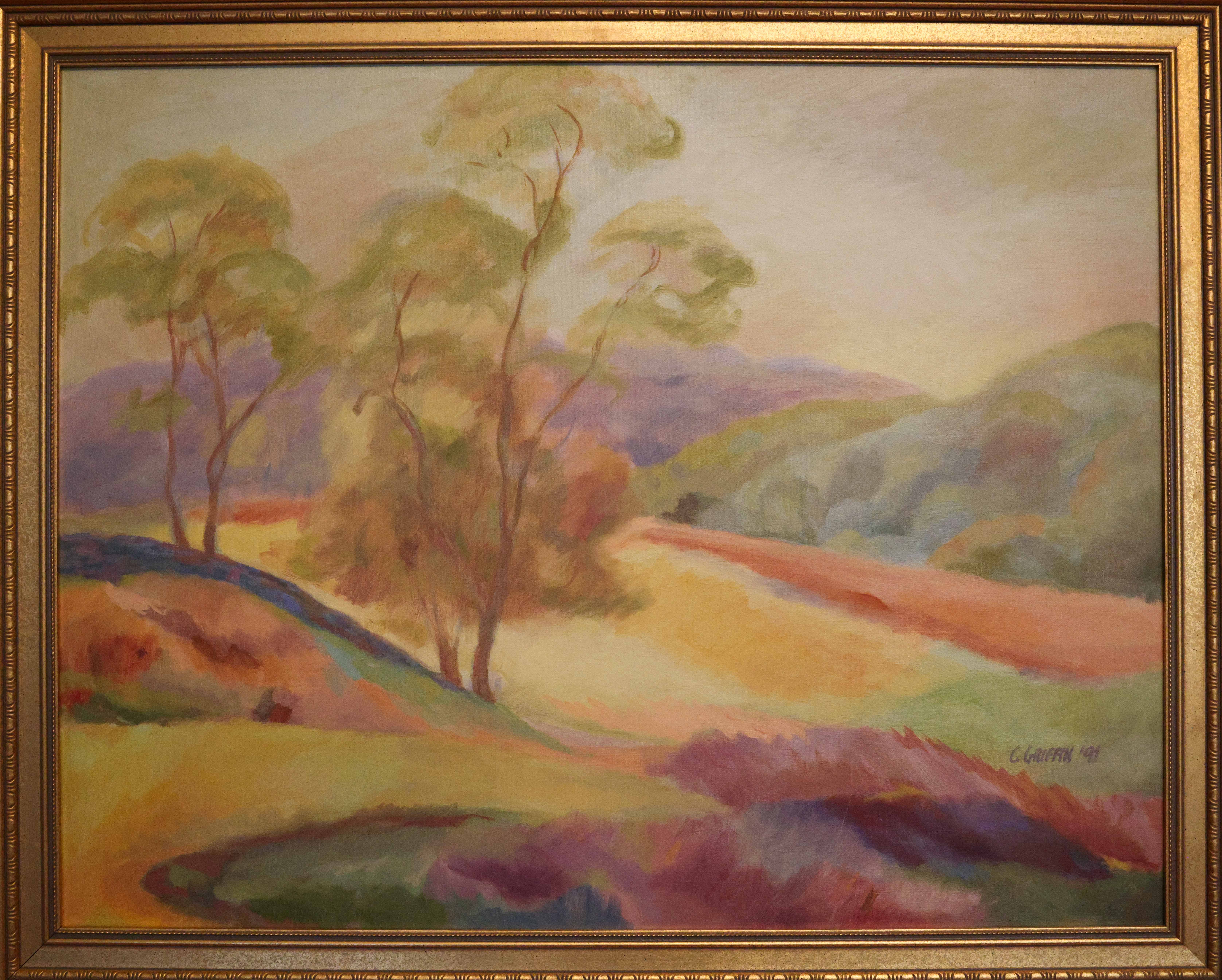
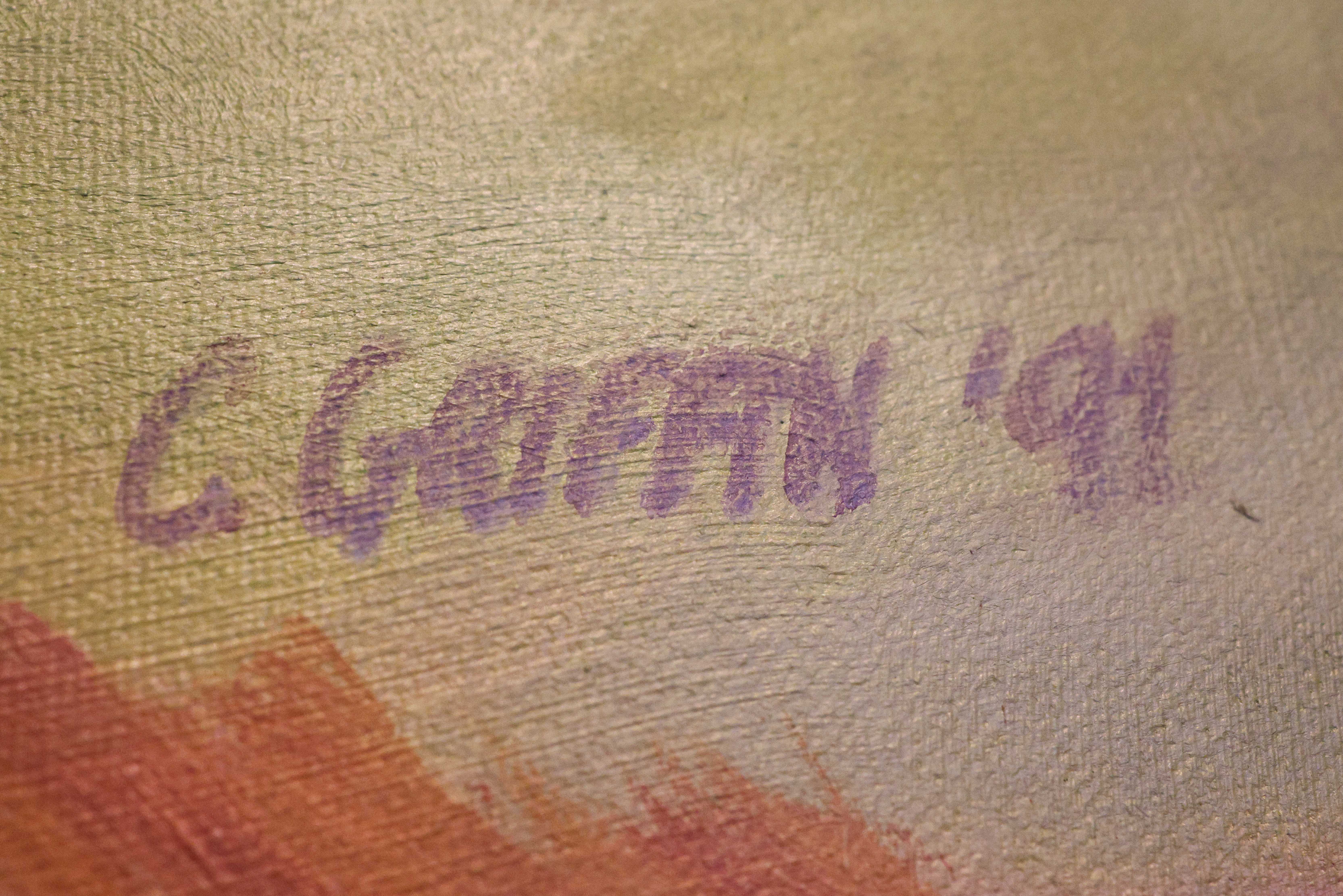
BRANDYWINE CREEK — C. Griffin, ’91

 . 
[with 3 poems by Gail Peck]
 . 
Still Life with Birds’ Nests
++ after van Gogh, 1885
 . 
the possibility
++ of life, those eggs
blue and cream – one
 . 
so dark it’s almost invisible,
++ two nests close together,
another propped
 . 
on a branch –
++ no wings, nothing
fluttering in or out
 . 
with straw
++ in beak
determined to make
 . 
what will hold –
++ see how
the light is braided
 . 
in straw, debris –
++ to pluck a strand
from the whole
 . 
seemingly easy
++ at least from
the outer edge, but
 . 
not the center
++ where eggs lie
until
 . 
the first
++ fissure, then
the struggle,
 . 
who will survive,
++ breaking silence
into refrain
 . 
Gail Peck
from The Braided Light, Main Street Rag Publishing Company, Charlotte NC; © 2015. Winner of the 2014 Lena Shull Book Contest of the North Carolina Poetry Society
 . 
❦ ❦ ❦
 . 
I find it in the back bedroom against the back wall of the closet, other cartons piled against it. The cardboard of two boxes has been sliced apart and refolded to fit, about 26 inches by 32 inches by 4, still taped solidly together from their final move, Delaware back to Winston-Salem in 2012. Across the narrow top in black marker, “Brandywine Creek.” My mother’s printing.
 . 
In 1949, Clara Jean “Cookie” Cooke carried her bachelor’s degree in art from Women’s College of the University of North Carolina back home to Winston-Salem to take a job in medical illustration at Bowman Gray Hospital. A year later she married Wilson, alias Dad, and moved to Atlanta, to live in student housing at Georgia Tech. About three years after that my parents moved to Niagara Falls, New York, just in time for me to be born. In the decades that followed Mom never entirely laid aside the brush – the oil she painted of my little brother at age two is a great likeness. But how often does art get stacked in a back closet behind being housekeeper, Mom, chauffeur, even later Kindergarten teacher?
 . 
When we three kids were fully fledged and Dad finally retired, Mom re-committed herself to linseed oil and pigment. Her home and then ours as well gradually filled with landscapes and still lifes from her workshops and classes. Then began her magnum opus: portraits. She painted from life (I posed as Jesus) and she’d sort through to pick out her favorite photos to transform into paintings. Year by year the five grandkids were memorialized at all ages and activities. In her 80’s, Mom pivoted again. Now she was capturing on canvas every dog and cat of every friend and neighbor and giving them all away. Hoping for ice cream when we visited, we would more likely open the freezer to discover a palette wrapped in wax paper awaiting her next project.
 . 
The last year of her life, Mom required more nudging to pick up a pen or pastels. If I placed a photo in front of her of something she loved, dogs especially, along with paper and a few colored pencils, she would make art. For what would be Mom’s last birthday, my sister arranged a family afternoon with an art instructor who had us all paint the same scene, two of the great-granddogs. We never laughed or enjoyed ourselves so much.
 . 
Six month’s after Mom’s memorial service, I’m cleaning out the townhouse when I unearth the carton. I peel off the old tape, tearing some of the packing paper as I lift out its contents. The large framed canvas is not one I remember seeing before, but I remember Mom’s brainstorm when we visited them in Delaware that we should all go tubing together down the Brandywine. There’s no water in this painting, though, only rolling hills of wind-blown grass in every color and tall lithe trees whose branches catch the breeze. Brandywine Creek chuckles and rills outside my line of sight.
 . 
So much has passed, now, beyond my vision. I wonder if I am losing, have lost, those many images I took for granted all those years. Her teasing and laughter, her quickness at crosswords and puzzles, her patient smile. Her gratitude. Especially her hand, poised, its skill, the slender fingers that wafted the magic of color so lightly across this surface I am now holding to the light. Look, just look at those brush strokes.
 . 
 . 
❦ ❦ ❦
 . 
Bowl with Potatoes
++ after Van Gogh, 1888
 . 
A yellow bowl filled
with potatoes, hues
of pink and blue making
them not so ordinary.
Waiting to be sautéed
to accompany the fricassee
of rabbit simmering with white
wine, herbs, pearl onions.
I peel potatoes, cut around
each eye with a sharp knife.
Olive oil, first pressing, and local
wine to drink. A task to make
us happy, to cheer
from the lingering fog,
where we can’t even see the deck.
I seem to be braiding worries,
and have carried this day
like a heavy stone. The best
cloth and napkins, and a centerpiece
of yellow roses, smell that bring some memory
from childhood, but what? Running
near the house, getting snagged
by thorns. I try to push sadness away,
yet the candle flickers
each loss, and I worry that
one day my husband won’t
recognize my face, mistake
the pattern on the china for food,
the way his father did, fork
scrapping against the plate,
and only my chair with a view.
 . 
Gail Peck
from The Braided Light, Main Street Rag Publishing Company, Charlotte NC; © 2015. Winner of the 2014 Lena Shull Book Contest of the North Carolina Poetry Society
 . 
❦ ❦ ❦
 . 
Art conjures its mysteries and we don’t spy the hand moving in shadow. A piano chord major to minor and the sun passes behind a cloud. Tangles of color on canvas blend into a fond memory of childhood. Our senses know more than we do. The smell of old perfume upon opening a closet. There we are, transported.
 . 
And what about the art of words? Isn’t each meaning distinct, circumscribed, listed for us in the lexicon? And yet the words’ unspoken histories conjure mystery when we read in them a new tangle, a new melody, a new canvas. Nevertheless, the poet has set herself a difficult and arcane magic when she undertakes to recreate the vision of color on canvas in print. Gail Peck accomplishes this in The Braided Light, an entire volume that captures, line upon line and page upon page, the impressionistic imagery of Van Gogh and Monet.
 . 
Perhaps the impressionist painters imagined they would not make us see but allow us to see. The light is ever changing; the colors in our minds arise from emotion and perception, not lines on a spectrograph. In the same way Gail’s poetry shows rather than tells. Her heart is tangled in the brush strokes and colors, but she opens space for my heart fall into the imagery as well. One might think there are only a finite number of meanings for a word and only a finite number of words for a color. Our senses, however, know more than we do. Look, just look at those brush strokes.
 . 
 . 
The Braided Light by Gail Peck was the winner of the 2014 Lena Shull Poetry Manuscript Contest of the North Carolina Poetry Society, and is available online from Main Street Rag Bookstore.
 . 
NEXT WEEK: Gail Peck’s new book from Finishing Line Press, In the Shadow of Beauty
 . 
 . 
❦ ❦ ❦
 . 
Weeping Willow
++ after Monet, 1918-1919
 . 
Whatever your sorrow is
++ is yours alone.
++ ++ Tall lithe figure
 . 
swaying darkness, what
++ have the years
++ ++ brought except
 . 
silver among green leaves
++ trailing the bank.
++ ++ You can’t turn away.
 . 
You stand rooted
++ in faith that rain
++ ++ will come, wash
 . 
away debris, that the sun
++ will glint through
++ ++ what wind hasn’t
 . 
severed. Part of me
++ longs to enter
++ ++ your canopy,
 . 
lie beneath your shade,
++ but the ground
++ ++ is damp and grass
 . 
won’t grow there.
++ View from my window –
++ ++ my black-shuttered house.
 . 
Gail Peck
from The Braided Light, Main Street Rag Publishing Company, Charlotte NC; © 2015. Winner of the 2014 Lena Shull Book Contest of the North Carolina Poetry Society
 . 
❦ ❦ ❦
 . 
 . 
 . 
 . 
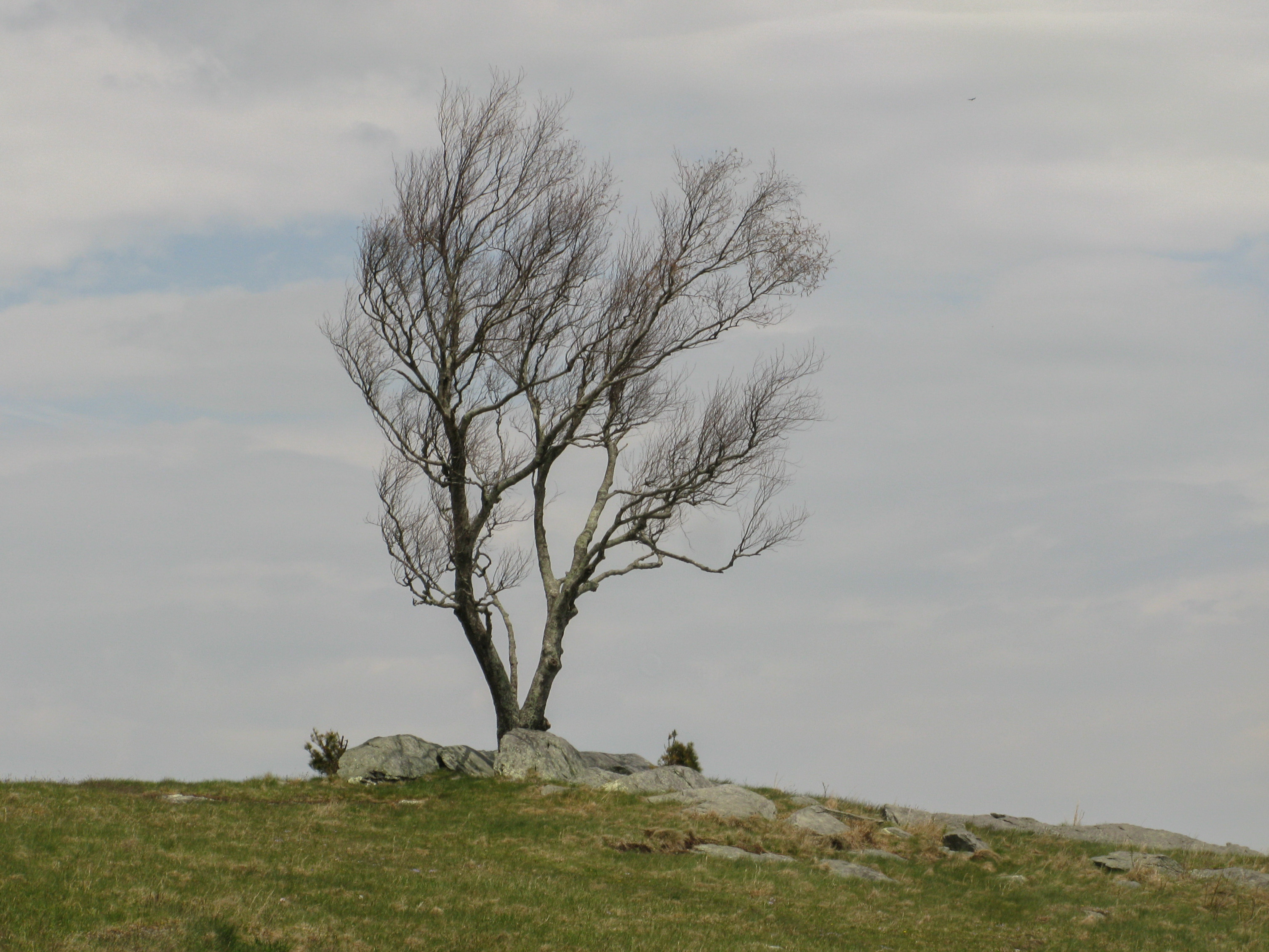
Doughton Park Tree 4/30/2022
 . 

Read Full Post »

 . 
[with 3 poems by Ana Pugatch]
 . 
My Mother’s Visit
 . 
The woman sensed that I now
looked down on her. That the earth
had turned slowly
 . 
into night. That her kin would only be
a distant moon. She watched
shards of light slice through the bamboo
 . 
thicket, the stars’ edges harden
and cool. In daytime she marveled
at the strength of a water buffalo, how
 . 
it shoulders could shift continents.
But I knew it would never be
enough.
 . 
We looked down
from the bamboo raft, and below
the glass surface saw
 . 
what flickered in turbid
darkness. Like my mother I thought
of the day when the river
 . 
would freeze over –
and how I’d give up everything
to feel its final stillness.
 . 
Ana Pugatch
from Engrams, Seven Years in Asia, winner of the 2022 Lena Shull Book Award of the North Carolina Poetry Society; Redhawk Publications, Hickory, NC; © 2023
 . 
❦ ❦ ❦
 . 
Above the river a west-facing ridge, protected, always cool and moist, and a narrow rustic trail that veers from the main — this is the path I take the day after Christmas. Winter brown, mossy stones and lichen, these are all I expect today, but here and there are premonitions. Ruddy toothed leaves, foamflower will bloom in March; bright green variegated heartleaf hides beneath pine needles today but soon will hide its own little brown jugs. So much muted beauty to share, but what is this! Hepatica is blooming!
 . 
Right here along this little path is the first place I ever discovered native hepatica in Elkin. (I still clearly remember where I was standing when I added my first bird to my life list decades ago, a chestnut-sided warbler — do normal people hold onto these sorts of memories?) But this is December — the earliest we ever see hepatica in bloom is late February, preceding even the rush of trout lilies. Nevertheless here is one plant with a flower and two swelling buds. Too, too early. Winter too warm. I can’t say I’m filled with happy thoughts for our planet.
 . 
A few days later I’m back with a camera. I can’t say I’m filled with happy thoughts of botany and phenology. Last night my brother and sister and I had a lengthy conference about our Mom’s decline. Tomorrow I’ll be sitting down with her and Dad to discuss a palliative care consultation and possibly moving to a higher level of care. I have to watch my footing carefully on parts of this trail – exposed stones, roots, erosion. Going downhill is when you’re most likely to fall. Mom’s descent has been steady for years, gradual, but the path ahead appears much steeper.
 . 
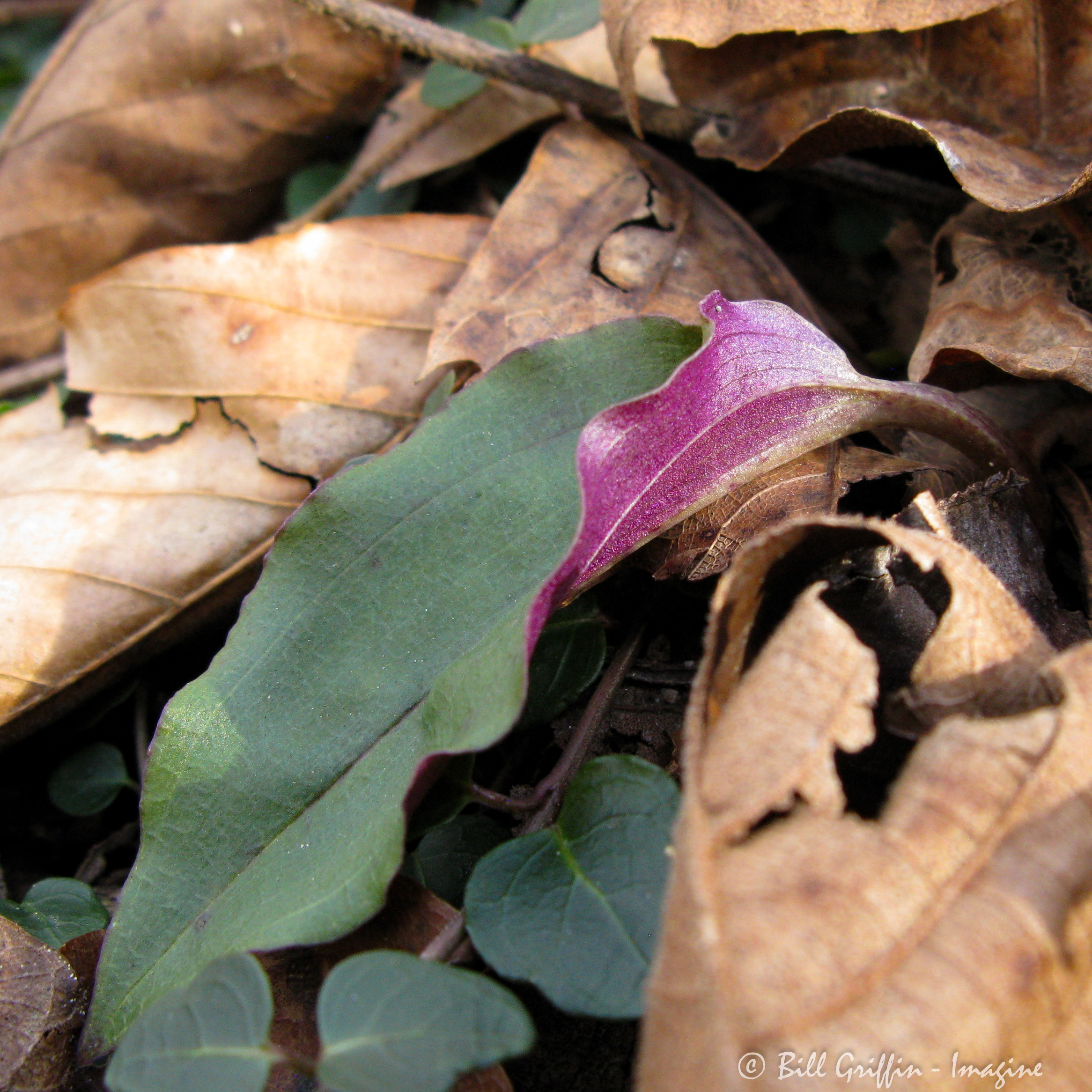
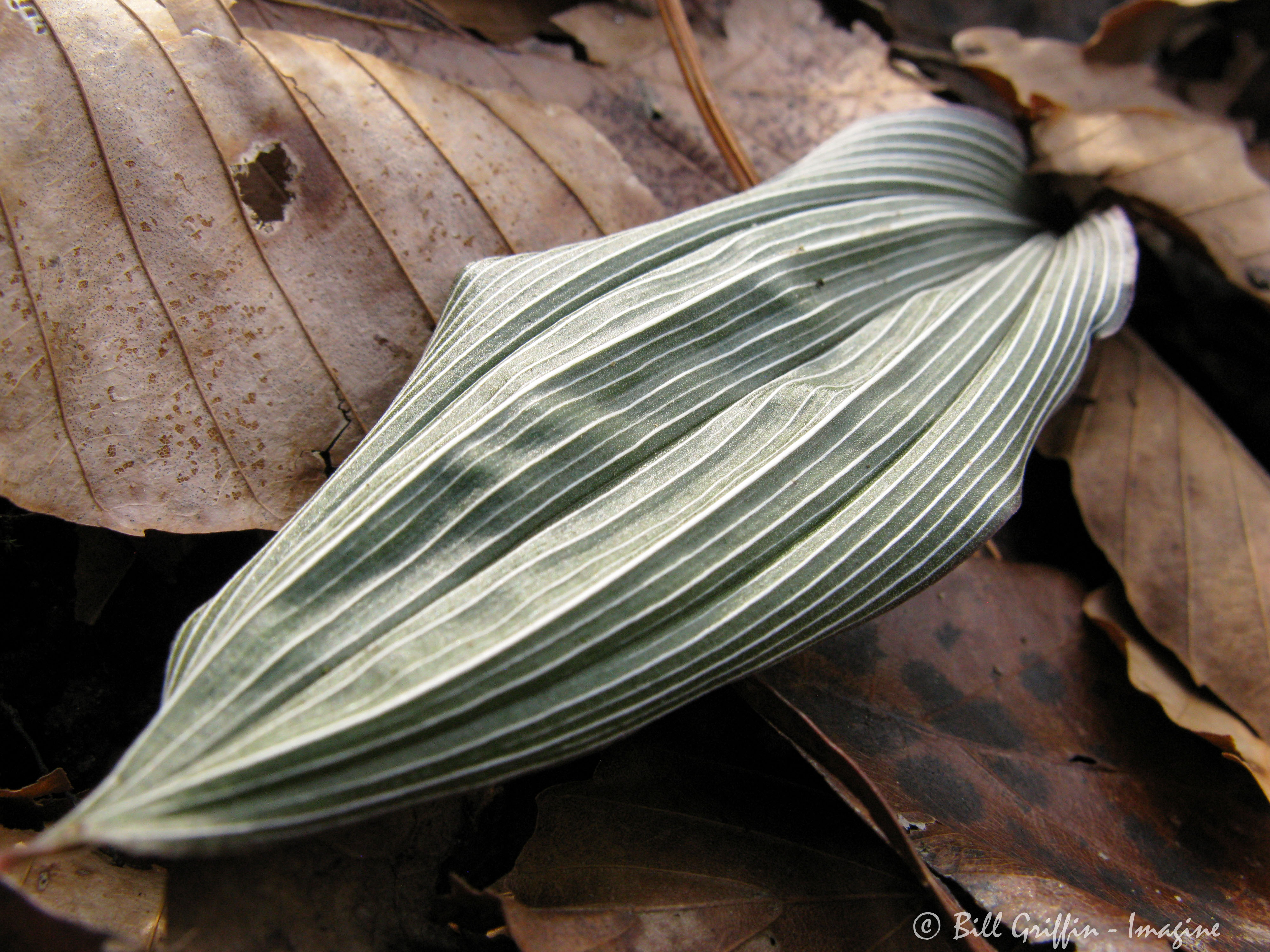
This is interesting – a single clump of pinstriped leaves, Adam-and-Eve Orchid. And Cranefly Orchid with its magenta underleaf is plentiful here. When the surrounding trees lose their leaves these orchids make sugar from winter sun. Their own leaves will fade and disappear before spikes of tiny flowers appear  mid-summer. Similar for the hepatica: last year’s flecked and nibbled liver-lobed leaves are making way for new green even now. Diminished light, cold and frost, life makes what it can of every season. I bend lower for a better look at each delicate yet resolute little family of leaves. Not a single flower to be found today.
 . 
 . 
❦ ❦ ❦
 . 
The Nightjar
+++ for S.
 . 
In the evenings you fold your wings
in a hammock on the porch.
 . 
your jaw clicks in imitation
of car locks. Your hair grows dark
to form a nest, twilight clouds:
 . 
a puff of throat. Mangrove roots
of a slow entanglement; filaments of stars
hang above us.
 . 
Don’t forget you say with the fan-eyes
of your tail as you fly away
 . 
each morning. You’re known
to frequent other lives, exhale their smoke,
catch tiny deaths on the temple’s
 . 
low wall. You’re known
for your camouflage, the concealment
of thoughts in daylight.
 . 
But I’ll still hold you, hoping
you’ll stay. Even if your ones are hollow,
 . 
fragile – I know one day you’ll roost
on steady ground.
 . 
Ana Pugatch
from Engrams, Seven Years in Asia, winner of the 2022 Lena Shull Book Award of the North Carolina Poetry Society; Redhawk Publications, Hickory, NC; © 2023
 . 
❦ ❦ ❦
 . 
Where does a memory live? Where does its root take hold, where is its safe repository? The sudden intake of breath at one sepia photo slipped from a pile of many others? A brief waft of scent upon opening a long-closed drawer? A word spoken in an unknown language ferrying meaning beyond its meaning? A phrase written in a notebook long misplaced? A dream?
 . 
Perhaps our memories are truly embedded in biochemical engrams deep in our hippocampus, hard-wired each in its own bud of synapse, but where is the map to its local address? Ana Pugatch knows to follow the narrow alleys and unmarked streets. Her poems are visions, aromas, sensations that may chill or warm. That may be fearful and unsettling or openly inviting. Her memories weave a world for me. Her world opens me to my own alleys, dim at times but becoming brighter; she opens me to streets I had forgotten. Or have yet to travel.
 . 
 . 
Is it because the world is so big and there are so many of us in it that we react by closing ourselves and retreating? Are we threatened by the rush and clamor of ideas, practices, cultures? Is that why we draw a line around our tribe and push all others away? We imagine that to survive we must deny, even destroy, everything outside our comfortable patch of expectations. To my mind, humankind’s survival depends on just the opposite. We can’t close the door but most open it. Perhaps we do feel frightened when confronted with anything that challenges our assumptions, whether a person, an artifact, an idea. Perhaps. And perhaps responding to novelty with imagination rather than rebuff is what allowed Homo sapiens to expand while Homo neanderthalensis dwindled and disappeared (except for the handful of Neanderthal genes we’ve acquired and still carry!).
 . 
Within poetry is concealed the map to our local memories. And in poetry we encounter shared memory and experience, doorways that may lead us out of our cloister and into the embrace of the different, the foreign, the alien, the frightening. As I read Ana Pugatch’s sensitive and sometimes ephemeral visions of her years in China and Thailand, and now of her presence in North Carolina, I am not an impartial observer watching a travelogue. I connect with those struggles. We are human, she and I and all the people she encounters. From the strangeness I feel a common thread winding around my heart. May that thread continue to pull me forward, and outward.
 . 
 . 
Engrams, Seven Years in Asia is available from Redhawk Publications.
The Lena Shull Book Award for a full length poetry manuscript is sponsored annually by the North Carolina Poetry Society. Submission period opens June 15, 2024.
 . 
 . 
❦ ❦ ❦
 . 
Unfurnished
 . 
I would write down the date if I knew
which day it was.
It’s Tuesday, I think,
and the baby cries upstairs.
 . 
I’ve never seen the family;
I only know them by
the red and gold characters posted
on their door.
 . 
Their laundry hangs
on the lines above mine;
Cantonese echoes through
my empty rooms.
 . 
We share the same view of Zhuhai.
We share that space of sky and trees
and we open our doors
when it rains.
 . 
Ana Pugatch
from Engrams, Seven Years in Asia, winner of the 2022 Lena Shull Book Award of the North Carolina Poetry Society; Redhawk Publications, Hickory, NC; © 2023
 . 
❦ ❦ ❦
 . 
 . 
❦ ❦ ❦
 . 
2018-02-09 Doughton Park Tree

Read Full Post »

photo by Saul Griffin

[with 3 poems by Becky Gould Gibson]

Amelia’s Papa Jimmy brought the bunnies to playschool yesterday. Four of them had fallen from a nest destroyed as he cleared a field two weeks ago. No mother in sight.

When we heard he’d bought bunny milk at Tractor Supply and was feeding them four drops every two hours we first thought, Is he raising them for the dogs? Not to eat, to teach. He trains young beagles to hunt; maybe they need to learn the smell of rabbits?

But no, not at all, it’s just that Jimmy can’t leave helpless young to die. Tractor Supply will mix up formula for any small critter you may have need of. He used a dropper until they learned to suck from a nipple. Two weeks later they’re hopping, eating tasty greens.

Yesterday each four- and five-year old got to hear the bunnies’ story, touch their soft ears and heads. Today Jimmy will release them at the edge of the woods, restored to bunny-ness, preserved for no other purpose than themselves.

.     .     .     .     .     .     .

Stand of Birches

The woods are wet this morning – rain yesterday
or the day before, maybe – such a sense of quiet,
all the damp peace of it, mostly trees to be with,
birches especially, minimalists in chic black and white,
raw silk with horizontal markings like wounds
slashed across white paper, dashes, staples, lines
of ghostly scansion, every beat, every syllable
of wood and glade accented, no scales or hierarchies
scored in their bark, rather universal emphasis,
as if everything mattered – this tiny white-headed
flower, this ant on some errand, even the mosquito
buzzing my ankles, these low-growing grasses,
branch with its bark pulled back, underbelly softening,
chartreuse mosses – though brief, briefly important.

Becky Gould Gibson

photo by Saul Griffin

.     .     .     .     .     .     .

These poems by Becky Gould Gibson are from her book Heading Home, the winner of the inaugural Lena Shull Book Contest in 2013. The poetry is strongly rooted in family and place but also richly steeped in literary tradition and history. I keep coming back to Stand of Birches for its eloquent, even spiritual expression of the deepest premise of Ecology: not utilitarian, not exploitative, not derivative or charismatic or anthropocentric – each living thing in all its interconnectedness is of value in and for itself.

Yes, yes, OK, OK, even mosquitoes.

In 2012 the Poetry Council of North Carolina elected to dissolve its organization and merge its residual funds with the North Carolina Poetry Society. Since 1949 PCNC had promoted the craft of poetry in the state with its annual contests; now in collaboration with NCPS it established an endowment to sponsor the annual Lena Shull Book Contest for an unpublished full length manuscript by a North Carolina writer, named for founder and first president of PCNC. Becky Gould Gibson was the first Lena Shull winner.

.     .     .     .     .     .     .

Scuppernongs
+++ Immortal life will be given . . .
+++ The Lord of harvest gathers us, / Sheaves of the dead –
++++++++++++++++++++++ for Bill

When death lifts its edge a little,
as in the first movement of Mahler’s C minor symphony,
you wonder will you be ready.
We finish a bowl of scuppernongs from the market,
wild bronze from childhood,
delighting in the bite, thick skin between our teeth,
touch tongue-tip to tongue-tip.
You taught my tongue to talk back.
I recall all those summers,
you in another county, nearly a decade before we would meet.

Now, come with me.
We’re together, then. It’s a languid afternoon in late August.
I’m eight. You’re ten.
As for death, I still think I can talk my way out of it.
Follow me across the un-mowed yard,
weeds tickling our legs,
to the scuppernong bush at the edge of Mr. Marcus’s field.
For you, death is no fiction.
At six, made to duck under your desk at school,
wear a dog tag, so someone could identify your body.
No bucket. We stuff ourselves madly.
Know what happens if you swallow a seed? We laugh.

No, love. It is not my own death I worry about, but yours –
will I ever be ready for it?
To be alone as I was that distant August,
memory plucking the fruit of you, scuppernong ripe in my mouth.

Becky Gould Gibson

.     .     .     .     .     .     .

Lines to Yeats on the Anniversary of His Death
++++ January 28, 1939
++++ for Alice

To a soul just fledged, still damp, in a nest
Of paper, flimsy bits of Plato, Paul,
Shelley, Wordsworth, Tennyson, all the rest
Who believed (or even half-believed) soul
Could soar above the earth (earth a mere cast
Of heaven), spirit somehow separable
From flesh, you came, William (my dear Willie)
With your poems of pure song, heart’s own music.

No wonder it entered my veins, my pulse
Learned to tick your rhythms. No matter you
Warned not to pleasure soul at the expense
Of body, who could even listen to
Such warning with such a beat, sound and sense
So perfectly married, as if to show
A manmade thing could become immortal,
Gold bird on a gold limb sing out its soul.

You made me more impatient than ever
To conceive such a poem of my own.
Your artless art merely fed the fever,
Yet every line fell stillborn from my pen.
Blood had become a colorless liquor
Nourished on symbols. Life had to happen,
And it did. Not a woman but a child,
Rather a child’s birth. It was a girl-child

Split me apart. No way to staunch the flood
(Nothing’s sole or whole that has not been rent)
Of blunt necessity. You had your Maud.
I had my Alice. She caught me up, lent
Me her knowledge. She, no man or bird-god,
Made loins shudder, roused me from those years spent
In abstraction, taught me bone, bowel, breath,
Body’s mortal work. She taught me my death.

Becky Gould Gibson

three poems from Heading Home, Winner of the 2013 Lena Shull Book Contest, Main Street Rag Publishing Company, © 2014 Becky Gould Gibson

.     .     .     .     .     .     .

.     .     .     .     .     .     .

2016-05-08a Doughton Park Tree

Read Full Post »