Feeds:
Posts
Comments

Bridge

[with 3 poems by J. S. Absher]

Building bridges. Maybe as a metaphor the phrase is not quite as worn down, rusty, and liable to drop chunks of concrete as the old Elkin bridge that carried US 21 high above the Yadkin River and railroad tracks. Built in 1931, stretching 1509 feet, named for Hugh G. Chatham, even after it was condemned by DOT in 2008 we still couldn’t bring ourselves to call in the demolition crews for that old bridge until 2010. Spanning a treacherous gulf. Lowering barriers between two rival communities. Safe passage, a more elevated view of life, making connections. Grand old metaphor.

The bridge we built today, though, is not a metaphor. It’s a 50-foot aluminum frame that will span a creek near the Mitchell River to extend the Mountains-to-Sea trail a few more miles. Mike, the engineer, showed us how to lay out the dozens of struts and braces and then we were on them like chicks on a Junebug. We put it together in three sections inside the big Surry County maintenance building at Fisher River Park; later we’ll move it into place, bolt the last connectors, and add planking. Amazing to see pallets of unrecognizable metal pieces becoming a structure.

Some of these volunteers today were born with a torque wrench in their fist but some are like me, tinkering all day with my Erector Set when I was 10. Sweating even with the giant fan blowing, pinching our fingers, joking. I still can’t get the smell of Anti-Seize out from under my fingernails. Someday soon will I hike across that bridge with my grandkids and say, “Hey, that’s one of my bolts!?” Moving out into a new world. Grand old metaphor.

September, 2022, all that’s left of the old Chatham Bridge on the Surry County side is a pleasant pedestrian garden with a long stairway from Gwyn Avenue down to Main Street. And, near the former base of one of those mighty pylons, the Angry Troll Brewery.

❦ ❦ ❦

The Day

The little room’s only window looked out
towards the ridgetop, the Dunkard church in the curve
of the two-lane, and, just beyond, the graveyard.

The morning sun sidled in past the partly
closed slats and resolved into rays and flecks
burning in the light – dust motes, I know,

and likely knew then, too, but still I watched
entranced one morning after our breakfast.
On this day I’d have otherwise forgotten,

probably my grannies were in the kitchen –
Emma with arms stretched out to read who’d died
(she’d be in the Dunkard cemetery soon),

half-crippled Sallie stringing the green beans
(years of suffering and strokes lay just ahead) —
while I stood quietly in the little room

watching the random sparkles in the sunbeam,
worlds I could move with a single breath
of poem or prayer, but could not control.

J. S. Absher
from Skating Rough Ground, © 2022 J. S. Absher, Kelsay Books, American Fork, UT

❦ ❦ ❦

worlds I could move with a single breath / of poem or prayer, but could not control

I have often been moved by Stan Absher’s poetry. Not moved as by a shiver of emotion or a momentary ah ha at his thesis or his craft. Rather I’ve felt myeself shifted into a different awareness, a new plane of being. Translocated. Enlightened. Despite the deep bedrock of conviction in all his work, despite the scholarship and the epiphany, he writes as if he is still searching, searching for truth. A spiritual seeker. So he may claim, but I consider Stan Absher a spiritual finder. I can’t help believing as I read these poems that he has encountered and grasped the numinous, wrestled with God as did Jacob.

Worlds he can move but not control? Perhaps that is the secret Stan conveys and which I would do well to take into my own heart. The seeking itself is intrinsic to the desideratum. The bridge. The poems in Skating Rough Ground cover such a lot of ground. Family history, Christian history, art history, and every topic and observation is put to diligent good work unfolding the petals of the human flower. Stan is in perfect control of his art, which makes even more believable his message that our condition enfolds a great mystery.

One other remark: even though Stan mentions Wittgenstein and his book includes sixteen erudite endnotes, his poems are never high-flown or inaccessible. He is not looking down on us mortals from the heights; he is right here among us. And he is not above a little poke in the ribs or the murmur of a wry joke. These poems are companionable companions – pick up the book and come along on the journey.

[additional information on works by J. S. Absher . . . ]

❦ ❦ ❦

The Conversation of Matter

I could hear things talk. When something was lost,
I stood in the room, asked it to show itself.
Sometimes it spoke an image in the mind – a drawer
++++ to search, a cherry
++++ bureau to look under.

Those who have spent their lives mastering tools
and techniques can hear their material speak,
David crying naked out of Carrara marble
++++ to be rescued from
++++ Agostino’s botched start.

But things usually speak by resisting –
weight too heavy to lift, edge too sharp to hold,
a moving part that grinds and heats and breaks, a poem’s
++++ application of
++++ friction to language –

slow it! stoke it hotter than Gehenna!
salt its path with grit!
keep it from slip-sliding
away on its own melt! flick sawdust into the eye
++++ to make it dilate!
++++ Without friction – so said

Wittgenstein, older and word-worn – language
does not work. If it wears skates on rough ground, it
takes a tumble. Even prayer needs resistance – a stick
++++ crosswise in the throat
++++ garbling words like a sob.

How hard to admit we love the world – how
hard it ought to be – yet its unrequiting
beauty resists abandonment: Show yourself, come out
++++ of hiding, come out
++++ of quarantine, and live.

J. S. Absher
from Skating Rough Ground, © 2022 J. S. Absher, Kelsay Books, American Fork, UT

❦ ❦ ❦
The Creator Praises Birds

Vent and crissum,
lores and crest and comb: I
made them all – the

nares, nape, those
horny bill plates – I in
feathered trochees

made them: peacock,
sparrow, tufted titmouse,
flitting jenny

filled with joy of
beaking worm, of strut and
glide, of piping

double on their
syrinx. Praise how flock and
murmuration

call out warning,
call to fly or roost or
call for pleasure:

See me! Hear me!
Pur-ty! Pur-ty! Pur-ty!
Cheer up! Pibbity!

Praise the brave-heart
tender fledgling, wobbly
winging over

houses, over
pavement, risking all to
climb the air by

beating wind I
too created, rising
heavenward in joy.

J. S. Absher
from Skating Rough Ground, © 2022 J. S. Absher, Kelsay Books, American Fork, UT

❦ ❦ ❦

Life Alert


[with 3 poems by Miles A. Coon]

to become the very brink you live on . . . Miles Coon

The other day I was trying to fix my Dad’s Life Alert system while the rest of the family ate lunch fifteen feet away. I couldn’t figure out why the damn lights kept flashing. While I was cussing the instruction booklet – there’s such a thing as being written too simply – I overheard Dad tell my daughter, “Bill sure does a lot for us.”

Haven’t I always been the good boy? May I confess that all my life I’ve chosen to do things that would confirm my good boy status? Around 20 years ago I wrote a sonnet titled, Good Boy Turns 50; the closing couplet reads, So let’s give him what he needs in the next fifty / if he ever discovers what that might be. Was I trying to slip in a bit of tension there, as if maybe I don’t always like myself for striving always to be the person everyone likes?

Someday I’ll write a poem about being twenty and driving the interstate back to college from Pittsburgh with my friend John in the big bashed up Mercury I’d inherited from Granddaddy. One of the near-bald tires blew, and as we rolled to a stop on the shoulder we looked at each other and started to sweat. In the trunk, on top of the spare, was a big trash bag of illegal vegetation John had plucked up, roots and all, from where he’d been growing it out back of his parents’ estate while they were in Paris or Tokyo or some such. We tried to look purposeful, puttering around the trunk until the traffic thinned, then threw the bag up into the weeds (no pun, please), jacked up the car, wrenched on the spare, and retrieved John’s harvest. No lights & sirens. Back at school in central Ohio after dark, I unloaded John behind his dorm. End of story. Good boy escapes to be good another day.

Someday I’ll write a poem about that.

Not today.

❦ ❦ ❦

The Beginning

Before I had a self, I grew
in the half-dark, half-light world
I knew belonged to me.

Two disappointing gods
shaped me. Before I had
a self, I was a topiary.

Birds were everywhere
in me, singing, while I
stood mute.

One day, the gods split
this world in two.
Before I had a self,

I was taken by each of them
to the great sea of disillusionment,
thrown in from separate shores.

My first-self emerged from the sea,
my body soaked in brine.
I could taste my own salts.

To be washed clean,
to be naked and alone,
to become the very brink you live on

is to bury your gods,
as your heirs will bury you.
This is genesis, where we begin.

Miles A. Coon
from The Quotient of My Self Divided by Myself, © 2022, Press 53, Winston-Salem NC.

❦ ❦ ❦

As I reached the close of each poem in The Quotient of My Self Divided by Myself, I paused, loosed held breath, then returned to the beginning to read it again. Not because the poems are difficult to understand. The poems are so full of understanding I couldn’t hold it all in a single reading. The language is as beautiful and fresh as the stories are piercing and full of hurt, yet the speaker heals in the telling and heals us. Observer, actor, perpetrator – innocent, confused, divine – Miles Coon enters himself through doors he opens as if for the first time and enters us as if we are knowing another person for the first time.

I am still learning about myself from this book. Perhaps that is its theme, that we may explore our selves all our lives and never reach the end of our journey. How heartbreaking and how full of joy the final line of the final poem: How little of this world I know.

[Note: Miles died on May 21, 2022, just days before the publication by Press 53 of his first book-length collection of poems.]

❦ ❦ ❦

Where I Was Going

I.
Where was I going under the weight
of my bookbag, case law, and statutes? Not to the
Harvard Café for Salisbury steak and mashed potatoes.
Not to the cinderblock dorms, their dimly lit corridors
of thought. Not home. Where was I going so full of
argument and words?

II.
I joined the cynical and jaded. My father hired me.

Not to work next to illegal aliens in the plastics factory.
Not to load forty-two-foot trailer trucks with
one hundred forty thousand garment hangers, stacked
in cases, side-by-side, front-to-back, floor-to-
ceiling, every cubic inch packed tight.

Not to the boss’s office where the Harvard Law degree
vanished into uh-oh, here comes the boss’s son.
Not to the trade shows at the Hotel New Yorker
where I licked the soles of jobbers, plied them
with booze.

III.
Where was I going? To the fertility expert with my semen
in a jar? Never to Little League with my son. Never
to go ice-skating with my daughter. Where was I going?

Not three times a week to Dr. Bernie, self-indulgent,
taking a magnifying glass to my problems. He said
I had it wrong. We were removing the magnifying glass.

IV.
Where was I going, going to
my father’s funeral, my mother’s grave. I was going
to the closing when I sold the business. I was going
to my daughter’s wedding, to the firehouse where my son
showed me his gear and the enormous truck
he drove to Ground Zero.

Where was I going? Not to grow fables of my own
making: I was just going to my wife’s studio
to help support her art, I was going to write a poem for her,
always my best reader.

Miles A. Coon
from The Quotient of My Self Divided by Myself, © 2022, Press 53, Winston-Salem NC.

❦ ❦ ❦

Against a Wall

Sometimes, when the moon
is courted by wolves,
and the bats shake themselves out,

I’ll move through the mouth
of the cave like a breath,
press against the windowpane,

and there inside the house
a frail young boy stands stiff
against a wall. His father measures him.

His mother, tanned, hair bleach-blonde,
shines the sterling silver tray,
then serves a fifth of Haig & Haig

in the cut crystal drinking glass.
The boy’s dismissed
the minute his father takes a sip.

I’ve pressed my ear
to the landscaped ground
and heard the panic in his retreat

on tiptoe, in stocking feet.
His only trace, his father’s mark,
indelible on the measuring wall.

Though I cannot leave
the dark until it’s dark,
I do survive.

Here, inside the cave,
bats hang
harmless as handkerchiefs.

I can hear my tardy rebel stir
from years of sleep,
rising up, stretching his limbs,

hungering for light.
Soon, I will follow him out,
marking the walls as I go.

Miles A. Coon
from The Quotient of My Self Divided by Myself, © 2022, Press 53, Winston-Salem NC.

❦ ❦ ❦

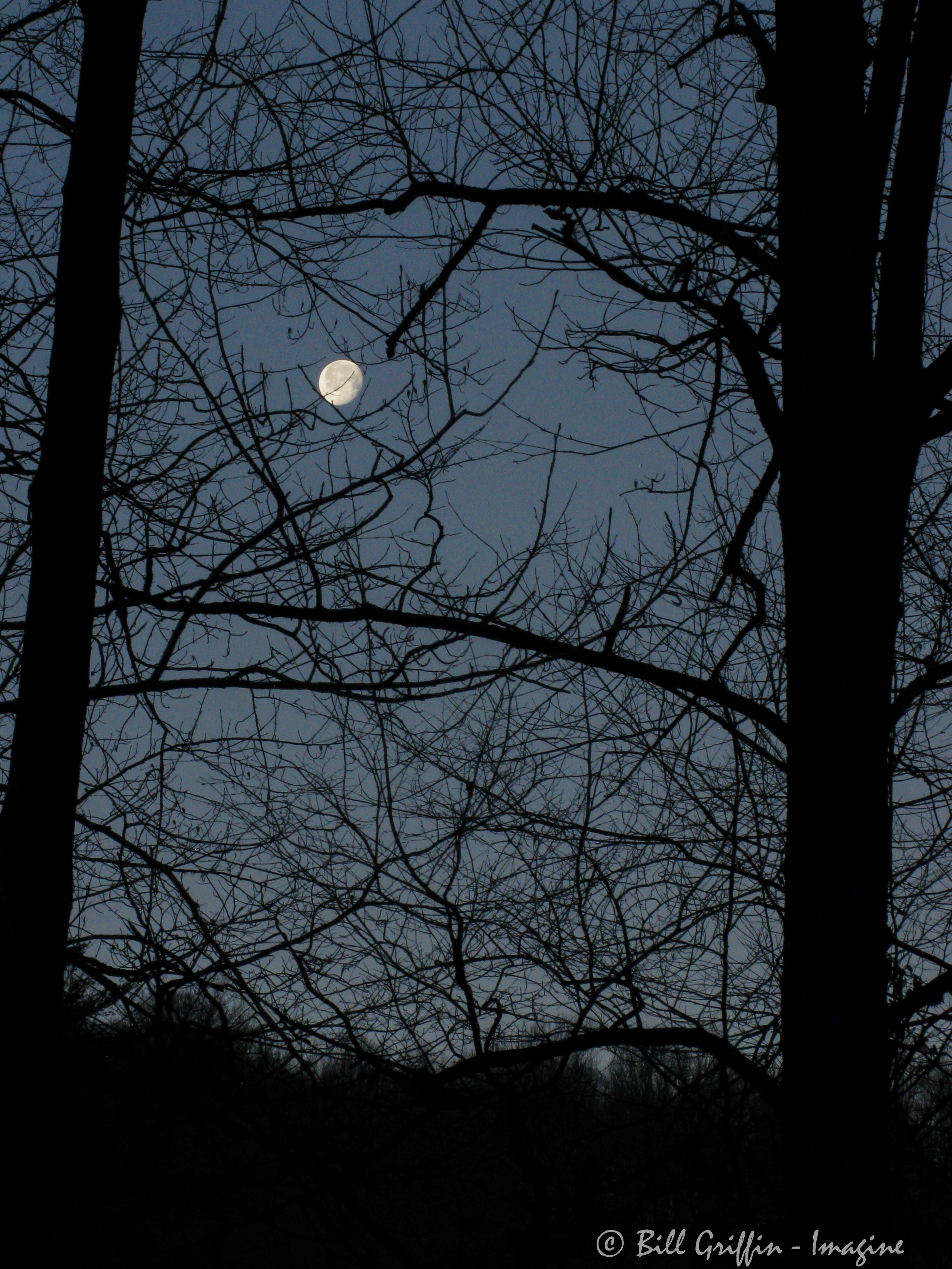
It takes the lake to make a line of moonlight . . . Miles A. Coon, from Shadow Life


Poetry Submissions CalendarUPDATE AUGUST, 2022

Placing yourself at the mercy of the editors, are you?! In 2015 I originally posted a table I use to keep track of when and where to submit poems for publication. Not to say I thrive on rejection, but the occassional favorable comment from an editor, not to mention an acceptance, do nourish one’s motivation.

Here is the most recent update:

……….. Poetry Submissions Table – PDF file ……….

Since my last posted update in February, 2022, I’ve added another 30-40 entries and corrected several dozen, including sites no longer accepting submissions. There are currently more than 250 journals and contests listed.

.     .     .     .     .     .     .

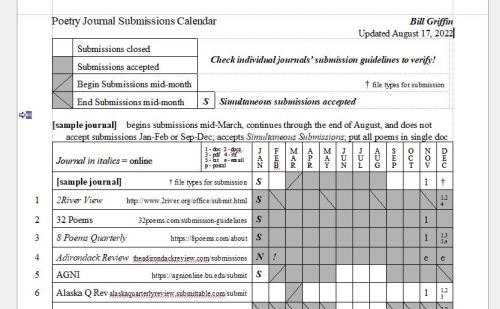
Here’s how I use the calendar:

It’s arrayed by month – look down the column to see what journals and sources are open for submissions right now!


Subscription Calendar Screen Shot: August, 2022 —-CLICK TO ENLARGE

Each row includes the web address – be sure to check before you submit, because requirements may have changed since I last updated!

The row also includes other information such as:

Is this an online only publication ?
Do they accept simultaneous submissions?
Should your submission be a single document?
What format files do they accept?

There are more instructions on the table itself. Feel free to print it out. And I would really appreciate it if you notify me of any errors or suggested changes!

In particular, if you have journals to which you’ve enjoyed submitting I can add them to the table! Please send me the details, especially the web address!

I will try to post an updated table several times a year and whenever I have made significant additions and corrections to the table. And . . . scroll all the way to the end of the document for extra tidbits, awards for most rapid response, and a new list of sites accepting art and photo submissions.

Here’s the original post from 2015 with a little musing about rejection:

https://griffinpoetry.com/2015/08/31/editors-mercy-part-2/

.     .     .     .     .     .     .

Enjoy!

And if you find this useful or discover errors please reach me at comments@griffinpoetry.com

BILL GRIFFIN

❦ ❦ ❦


Note that during the PDF conversion process from WordPerfect the table header rows do not display properly — you can only read the months on page 1. This is a problem with ADOBE for which I have not discovered a fix. Suggestions welcome. ………………. BG