Feeds:
Posts
Comments

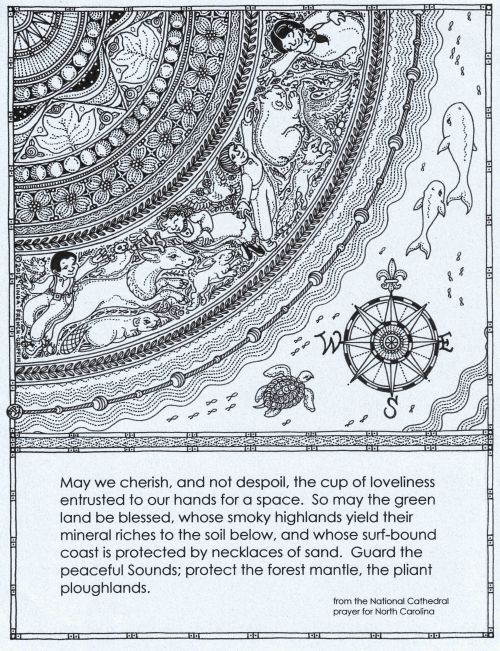
[poems by Gary Snyder, Wendell Berry, Rose Fyleman, David Radavich]

an offering from Craig Kittner . . .

Piute Creek
– Gary Snyder –

One granite ridge
A tree, would be enough
Or even a rock, a small creek,
A bark shred in a pool.
Hill beyond hill, folded and twisted
Tough trees crammed
In thin stone fractures
A huge moon on it all, is too much.
The mind wanders. A million
Summers, night air still and the rocks
Warm. Sky over endless mountains.
All the junk that goes with being human
Drops away, hard rock wavers
Even the heavy present seems to fail
This bubble of a heart.
Words and books
Like a small creek off a high ledge
Gone in the dry air.

A clear, attentive mind
Has no meaning but that
Which sees is truly seen.
No one loves rock, yet we are here.
Night chills. A flick
In the moonlight
Slips into Juniper shadow:
Back there unseen
Cold proud eyes
Of Cougar or Coyote
Watch me rise and go.

Piute Creek” by Gary Snyder from Riprap and Cold Mountain Poems. Copyright © 2009 by Gary Snyder

.     .     .     .     .     .     .

an offering from Alana Dagenhart . . .

The charming landscape which I saw this morning, is indubitably made up of some twenty or thirty farms. Miller owns this field, Locke that, and Manning the woodland beyond. But none of them owns the landscape. There is a property in the horizon which no man has but he whose eye can integrate all the parts, that is, the poet.

Ralph Waldo Emerson, Nature, 1836

Poet, will you put the parts back together? The seed, the roots, the petals that have been thrashed and trampled? The bits that once meshed and fit now distracted and ignored? The air we can’t taste, the sunlight we can’t breathe, the stone beneath our feet, the water in our hair? Who will put us back together and put us into the places where we belong, all together?

Several friends have offered poems that speak to them about our Earth and which offer to gather us all in together to celebrate Earth Day! I’m posting their offerings April 21, 22, and 23. What do you see? What do you hear? What do you notice? What do you feel?

.     .     .     .     .     .     .

an offering from both Lynda Rush-Myers and Kitsey Burns Harrison . . .

The Peace of Wild Things
– Wendell Berry –

When despair for the world grows in me
and I wake in the night at the least sound
in fear of what my life and my children’s lives may be,
I go and lie down where the wood drake
rests in his beauty on the water, and the great heron feeds.
I come into the peace of wild things
who do not tax their lives with forethought
of grief. I come into the presence of still water.
And I feel above me the day-blind stars
waiting with their light. For a time
I rest in the grace of the world, and am free.

The Peace of Wild Things” by Wendell Berry, from Collected Poems (North Point Press), © 1985

.     .     .     .     .     .     .

an offering from Kitsey Burns Harrison . . .

Mice
– Rose Fyleman –

I think mice
are rather nice;
Their tails are long,
their faces small;
They haven’t any
chins at all.
Their ears are pink,
their teeth are white,
They run about
the house at night;
They nibble things
they shouldn’t touch,
and, no one seems
to like them much,
but, I think mice
are rather nice.

Mice” by Rose Fyleman (1887-1957)

.     .     .     .     .     .     .


Roundleaf Yellow Violet; Viola rotundifolia; Mountains-to-Sea Trail above Brinegar Cabin

an offering from David Radavich, his poem . . .

Enough

Rare is better:
The price soars
when you lack
what you need.

A poem carries
everything
in your pocket
like a mind.

Love can be
stored in a cell
whose DNA
heartens life.

Music is soul
saving, the simplest
math and finding
one solution.

O earth that is
rare and good,
sing to the unclean
with your seas.

“Enough” by David Radavich, originally appeared in Iodine Poetry Journal

.     .     .     .     .     .     .



+     +     +     +     +

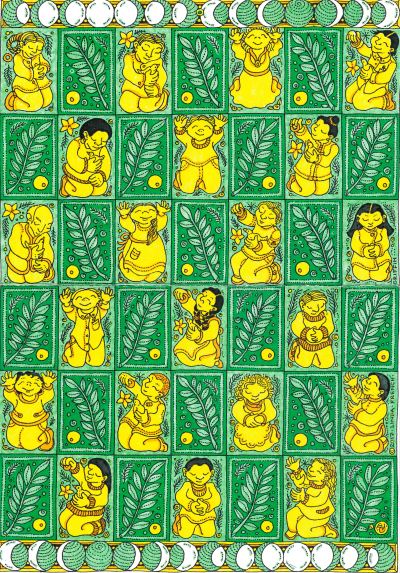
[original artwork by Linda French Griffin (c) 2021]
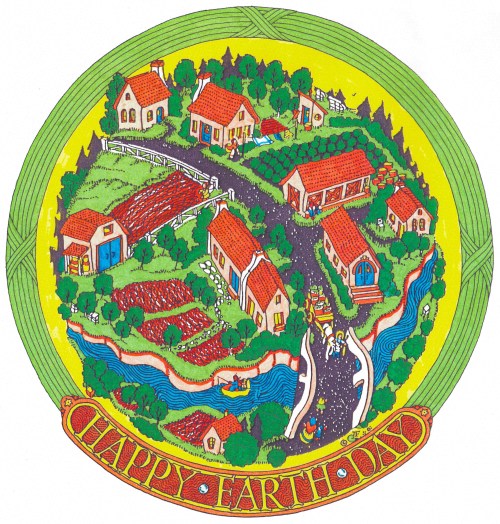
 

[poems by Joy Harjo, Wendell Berry, Mary Hennessy]

an offering from Debra Kaufman . . .

Remember
– Joy Harjo –

Remember the sky that you were born under,
know each of the star’s stories.
Remember the moon, know who she is.
Remember the sun’s birth at dawn, that is the
strongest point of time. Remember sundown
and the giving away to night.
Remember your birth, how your mother struggled
to give you form and breath. You are evidence of
her life, and her mother’s, and hers.
Remember your father. He is your life, also.
Remember the earth whose skin you are:
red earth, black earth, yellow earth, white earth
brown earth, we are earth.
Remember the plants, trees, animal life who all have their
tribes, their families, their histories, too. Talk to them,
listen to them. They are alive poems.
Remember the wind. Remember her voice. She knows the
origin of this universe.
Remember you are all people and all people
are you.
Remember you are this universe and this
universe is you.
Remember all is in motion, is growing, is you.
Remember language comes from this.
Remember the dance language is, that life is.
Remember.

Remember”; Copyright ©1983 by Joy Harjo from She Had Some Horses by Joy Harjo

.     .     .     .     .     .     .

There is something we want to hear that poetry speaks to us. We don’t know what it is until we feel its vibrations. How could we know? Do you only see what you know you want to see and never turn around and the redbud has burst into bloom? Do you only smell what you know you want to smell and baking shortbread never wafts you into Nana’s kitchen?

Poetry wants to say to us the thing we didn’t know we wanted to hear but deep within us we do know and do desire. Remember all is in motion, is growing, is you. / Remember language comes from this. (Joy Harjo).

Several friends have offered poems that speak to them about our Earth and which offer to gather us all in together to celebrate Earth Day! I’m posting their offerings April 21, 22, and 23. What do you see? What do you hear?

.     .     .     .     .     .     .

Linda French Griffin

an offering from Catherine Carter . . .

A Purification
– Wendell Berry –

At start of spring I open a trench
in the ground. I put into it
the winter’s accumulation of paper,
pages I do not want to read
again, useless words, fragments,
errors. And I put into it
the contents of the outhouse:
light of the sun, growth of the ground,
finished with one of their journeys.
To the sky, to the wind, then,
and to the faithful trees, I confess
my sins: that I have not been happy
enough, considering my good luck;
have listened to too much noise;
have been inattentive to wonders;
have lusted after praise.
And then upon the gathered refuse
of mind and body, I close the trench,
folding shut again the dark,
the deathless earth. Beneath that seal
the old escapes into the new.

A Purification” by Wendell Berry from New Collected Poems. Counterpoint © 2012

.     .     .     .     .     .     .


Plantainleaf Pussytoes; Antennaria plantaginifolia; Mountains-to-Sea Trail above Brinegar Cabin

an offering by Mary Hennessy, her poem . . .

Repeat After Me:

jettison the idea of shelter.
Say it’s like a camera,
one more thing to hold between

ourselves and the world.
In hand, an invitation by library card
to leave the room of a little life.

Move out unwashed and unredeemed.
Wear a raggedy-assed back pack
like a harness.

The smell of pressed meat
from the back of the bus,
The curve at the top of the world

visible. Something you could Braille-
the almost arc of it.
You tell me that the composer Ravel repeats

every line, I say, “so do the birds.”
Sometimes they go on repeating
until I lose count.

Without looking up you say, “the world
will be gone a long time before anyone notices.”
The world will be gone a long time.

“Repeat After Me” © Mary Hennessy, first appeared in Pinesong 2018, annual anthology of the North Carolina Poetry Society

.     .     .     .     .     .     .

+     +     +     +     +

[original artwork by Linda French Griffin (c) 2021]
Earth Day 1970

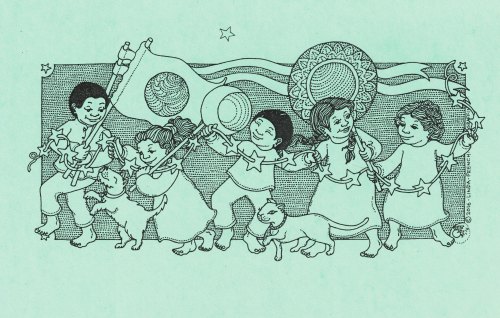
Earth Day artwork by Linda French Griffin

[with poems by Dorianne Laux and Tony Hoagland]

The sensual man conforms thoughts to things; the poet conforms things to his thoughts. The one esteems nature as rooted and fast; the other, as fluid, and impresses his being theron.

Ralph Waldo Emerson, Nature, 1836

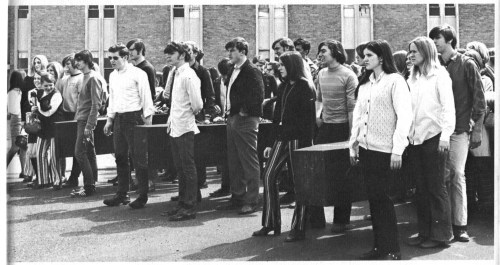
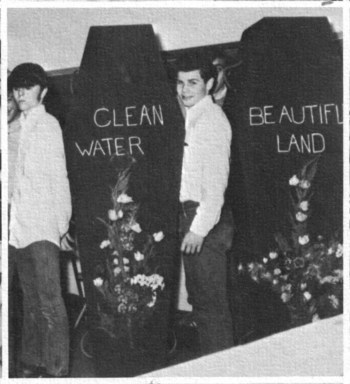
April 22, 1970 – the entire student body of Aurora High School is milling around outdoors in the Ohio springtime. In the front parking log five or six big black coffins are set up like grim milestones. The coffins bear epitaphs like “Clean Water” and “Beautiful Land” – the administration has granted the Student Council’s request to have an assembly to celebrate the first Earth Day.

I am taking photos for Borealis, the yearbook; my girl friend Linda French is assistant editor. She is vastly more the environmental activist than I. Our little farm town / bedroom community is forty miles from Cleveland and where the Cuyahoga River crosses our local golf course it’s only an insubstantial creek. The year before, though, the Cuyahoga River where it enters Lake Erie in downtown Cleveland caught fire and burned, and not for the first time. No big deal – oil slicks and pollution mean progress, full employment. Forget about it.

Maybe we all would have forgotten, except Time Magazine published articles about the burning river and then in December National Geographic featured it on the cover – “Our Ecological Crisis.” Congress had established the Environmental Protection Agency in January 1970; by spring even we kids in sleepy Aurora must be worrying how much longer we’ll have clean water and beautiful land.

Earth Day 1970

.     .     .     .     .     .     .

A couple of years ago Linda and I took a road trip to northeastern Ohio to visit all the old haunts. The high school has additions and facilities we can’t even figure out. The golf course is now a reclaimed and replanted nature preserve with walking trails. There’s lots of new development in Aurora but there are still cow pastures and horses.

We also paid our first visit to Cuyahoga Valley National Park. Designated a National Recreation Area in 1974, the same year we got married and moved to North Carolina, it became a National Park in 2000. Between Akron and Cleveland it comprises more than 33,000 acres following the river and the old Ohio & Erie Canal and reaching all the way into metropolitan Garfield Heights – the nation’s largest urban park. Even outside the Park the Cuyahoga is cleaned up, restored, back in the business of fish and wildlife and recreation instead of oil slicks. In 1970 if you fell into the river it meant an immediate trip the ER; now you just climb back up on your paddle board.

Without catching on fire.

Earth Day 1970

Earth Day 1970

.     .     .     .     .     .     .

These two poems are collected in The Ecopoetry Anthology, edited by Ann Fisher-Wirth and Laura-Gray Street, Trinity University Press, San Antonio, Texas, © 2013.

Dorianne Laux has taught creative writing at NC State University and elsewhere. Her most recent book among many is Only as the Day Is Long: New and Selected Poems (W. W. Norton, 2019).

Tony Hoagland (1953-2018) was born in Fort Bragg, NC, and taught at the University of Houston and Warren Wilson College. His many books of poetry include Unincorporated Personas in the Late Honda Dynasty (Graywolf Press, 2005)

.     .     .     .     .     .     .

Life is Beautiful

+++++++++ and remote, and useful,
if only to itself. Take the fly, angel
of the ordinary house, laying its bright
eggs on the trash, pressing each jewel out
delicately along a crust of buttered toast.
Bagged, the whole mess travels to the nearest
dump where other flies have gathered, singing
over stained newsprint and reeking
fruit. Rapt on air they execute an intricate
ballet above the clashing pirouettes
of heavy machinery. They hum with life.
While inside rumpled sacks pure white
maggots writhe and spiral from a rip,
a tear-shaped hole that drools and drips
a living froth onto the buried earth.
The warm days pass, gulls scree and pitch,
rats manage the crevices, feral cats abandon
their litters for a morsel of torn fur, stranded
dogs roam open fields, sniff the fragrant edges,
a tossed lacework of bones and shredded flesh.
And the maggots tumble at the center, ripening,
husks membrane-thin, embryos darkening
and shifting within, wings curled and wet,
the open air pungent and ready to receive them
in their fecund iridescence. And so, of our homely hosts,
a bag of jewels is born again into the world. Come, lost
children of the sun-drenched kitchen, your parents
soundly sleep along the windowsill, content,
wings at rest, nestled in against the warm glass.
Everywhere the good life oozes from the useless
waste we make when we create – our streets teem
with human young, rafts of pigeons streaming
over squirrel-burdened trees. If there is
a purpose, maybe there are too many of us
to see it, though we can, from a distance,
hear the dull thrum of generation’s industry,
feel its fleshly wheel churn the fire inside us, pushing
the world forward toward its ragged edge, rushing
like a swollen river into multitude and rank disorder.
Such abundance. We are gorged, engorging, and gorgeous.

Dorianne Laux
from Smoke, BOA Editions Ltd., © 2000 Dorianne Laux

.     .     .     .     .     .     .

Wild

In late August when the streams dry up
and the high meadows turn parched and blond,

bears are squeezed out of the mountains
down into the valley of condos and housing developments.

All residents are therefore prohibited
from putting their garbage out early.

The penalty for disobedience will be
bears: large black furry fellows

drinking from you sprinkler system,
rolling your trashcans down your lawn,

bashing through the screen door of the back porch to get their
first real taste of a spaghetti dinner,

while the family hides in the garage
and the wife dials 1-800-BEARS on her cell phone,

a number she just made up
in a burst of creative hysteria.

Isn’t that the way it goes?
Wildness enters your life and asks

that you invent a way to meet it,
and you run in the opposite direction

as the bears saunter down Main Street
sending station wagons crashing into fire hydrants,

getting the police department to phone
for tranquilizer guns,

the dart going by accident into the
neck of the unpopular police chief,

who is carried into early retirement
in an ambulance crowned with flashing red lights,

as the bears inherit the earth
full of water and humans and garbage,

which looks to them like paradise.

Tony Hoagland
from Unincorporated Personas in the Late Honda Dynasty, Graywolf Press, © 2005 Tony Hoagland.

.     .     .     .     .     .     .

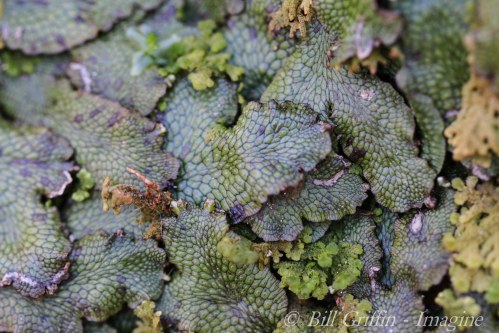
Liverwort, Marchantia species; Liverworts are primitive nonvascular plants, perhaps the most primitive true plants still in existence.

Isn’t life beautiful? Not always pretty but always beautiful. Often messy, invariably smelly, predictably unpredictable, unexpectedly weird, but always beautiful. Scrunch down low enough to notice; don’t let it bite you (much); take off your anthropocentric glasses; what did I tell you – beautiful!

.     .     .     .     .     .     .

+     +     +     +     +

[original artwork by Linda French Griffin (c) 2021]