Feeds:
Posts
Comments

Archive for the ‘family’ Category

[with 3 poems by Diana Pinkney]

Oh, I couldn’t possibly eat all that. Thank Heavens I haven’t heard Mom utter those words for quite a while now. For the fifty years prior I believe we heard that phrase with each plate set before her. Some impulse ingrained in the 30’s in the genteel South? A mantra for all the new college girls in the 40’s? How, we would ask ourselves behind her back, could someone forever twig slender so fear gaining a pound?

This week at the doctor’s office I watch the nurse enter Mom’s vitals in the computer to make sure she hasn’t lost a pound. Dad admits he hates to nag her to eat her breakfast – too engaged with the paper or too forgetful to take a bite? Yesterday I cooked them both lunch – calm down, it was just 10 minutes in the skillet from Trader Joe’s – and served the plates. It’s no trick, really, just sit across the table from Mom for long enough and she will finally finish what you’ve given her. Don’t forget the milk! The doctor says you need more fluids.

Grandmother, Dad’s Mom, had her own mantra for us grandkids in the 50’s and 60’s: Children are starving in Europe. Yes, swear to God, she actually said that more than once. Chubby me was more than happy to clean his plate, but one breakfast I recall her disapproval. I had scooped up the last Cheerio but there was still milk in the bowl overlying its substratum of teaspoons of sugar. That evening I washed down my cornbread with a big gulp of sudden sickening sweetness Grandmother had rescued from that bowl.

Now I’m clearing the table while Mom stares at the last of her milk, a layer of ice melt above the 2%. In a few minutes, though, as I stand at the sink rinsing, she walks in carrying the empty. I have to say it. Good job, Mom!

❦ ❦ ❦

Super Cuts, Six Months after My Daughter’s Death

The stylist snips, snips my hair, shorter
and shorter. As she works, we talk.

You have children, she asks. Yes,
I answer. Do you? Oh, I have two girls.

How about you? Three, I say, my voice
tight, clipped as the gray strands covering

the floor. My daughter’s hair was long
and red, until it was blonde. She loved

the sun. A little less on the sides, please.
Why didn’t I say I have two children, sons,

and that would have been that. Except that
will never be that. I will always have three

children. Do they live here, she asks?
The sons do. My daughter lives nowhere

and everywhere. It’s good, she says, you
have a girl, too. Yes, I answer, it is good.

Diana Pinckney
from Hummingbirds & Wine, Main Street Rag Publishing, Charlotte, NC, © 2022

❦ ❦ ❦

How impossible to bear, losing a child to death. How much more impossible to write about it. Diana Pinckney in Hummingbirds and Wine overcomes the paralysis of grief, but not as chronicle or biography or personal therapy. Although she confesses I live / behind a veil, these poems are the bridge that leads her and us beyond the Valei of Teeris. These lines are twisting tracks that connect past and present, parent and child, and that connect poet and reader.

On the tree of suffering there is a twig of joy that grows up from dark earth. The root of happiness is the same / as perhaps, both descendants / / of hap – hazard or chance. Diana’s poetry is not rationalization, not sentimentality, not desperate. These are poems that share one moment, then another and another, along the path she has had to walk and which we can now walk together.

❦ ❦ ❦

Sea Turtles

Loggerhead, Leatherback, Ridley or Green, they all drag
themselves onto a beach. Alone under the same moon
on different shores, in their struggle to lay eggs.
Volunteers like Elizabeth spent hours at dawn

searching for the side, clawed tracks, uncovering
and moving the eggs to sand dunes, staking orange
mesh over the nest. Protection, maybe, she said,
from dogs, crabs, lots of things. Oh, my girl, I couldn’t

protect you, holed up in your house in the company
of bottles. Still, in your best years, you waited weeks
for dozens of thin-shelled eggs to split as the tiny feet
tore an opening, and under nodding sea oats, started

their spill up and out. Each one, no bigger than a silver dollar,
struggling to climb into moonlight, and down to the sea’s white foam.

Diana Pinckney
from Hummingbirds & Wine, Main Street Rag Publishing, Charlotte, NC, © 2022

❦ ❦ ❦

Beach Walker

I can still see her stretching in the hazy sun
each morning, strolling the surf, breathing salt

and the musky scent of creatures curled inside
shells – whelks, clams, conchs – once alive.

She so many miles from y city home.
So many Hey Mom’s when I’d lift the phone.

How is it that a heart so loved could weaken
through the days and weeks, and I never knew.

A heart that beat with the rhythm of the sea
and one bright morning would fail her and me.

Diana Pinckney
from Hummingbirds & Wine, Main Street Rag Publishing, Charlotte, NC, © 2022

❦ ❦ ❦


❦ ❦ ❦


Read Full Post »

[with 4 poems by Doug Stuber]

“Look at that one, Mom, a Rainbow Unicorn Skeleton.”

“Oh my, and all the spiders!”

We’re driving through residential Ardmore in Winston-Salem, just the two of us. An outing! On our way to the pharmacy and yes, we’ll pick up a prescription for Dad, but this is one time we made him stay home. Dad’s 96th birthday is Thursday and this is Mom’s chance to pick out a card, maybe a few goodies. And see all the Halloween decorations.

It’s rare that I have Mom all to myself. At her doctor’s appointments Dad tags along, and well he should since Mom’s memory is failing and he needs to tattle on her. The grocery store, the dry cleaners, Trader Joe’s, those are all on Dad’s agenda; usually Mom stays home with the CNA. As Mom ages she’s become more withdrawn, much more passive, but get her one on one and she’ll tell you what she thinks. So here she is riding shotgun, laughing at the yard art, game to grab her cane when we arrive at the store.

While I head to the pharmacist window I leave Mom in the Birthday Card aisle – we have five family birthdays in the next four weeks. When I return, maybe 15 minutes later, she hasn’t picked anything out. I point to a couple that seem likely. She can’t quite decide. That’s OK. I find one with dogs on it that seems right for Dad, get her approval, find some for Allison, Margaret, the Josh’s, subtly nudge her to pick one each. When we finally have our five it’s on to snack selection. I tell her if she’s not sure what Dad would like just get stuff she likes (see how that works?). When we’ve finally paid and returned to the car, I have her put Dad’s chocolates & nuts etc. into the gift bag we bought. Once she’s looked each item over she finally says, “I can’t believe you could pick all that out.” Shoot, Mom, I was wanting you to think YOU picked everything out.

Sadness is just one story we can tell ourselves. I could hold onto Mom’s bewilderment and indecision, nothing like the Mom that raised me. Or I could buckle her in as we laugh, thinking about Dad’s face when he sees his pile of loot. And I could prepare a big build up for the drive home, remind her to look out her window at the Rainbow Unicorn Skeleton, both of us enjoying it again for the first time.

❦ ❦ ❦

Hikaru

One cherry blossom detaches, falls, a single unit
allowing fruit its space, starting its new journey: island
to reflecting pond, orchard to cottage yard, daughter to
love, enhanced by the wind, if even for only six seconds.
Transformed to long-boned genius, long-yearning adult,
considerate friend, purple-green plaid from soft pink,
tan suede boots from five-petalled bloom. Hikaru, as they
say in Japan, hits the town running, arms crossed, cradling
herself like the war-torn victims of Vietnam, but not
worn or torn, she flings enthusiastic youth toward
outstretched limbs. She captures her beginning and future
simultaneously, shedding one form, embracing another,
sweating humid Spring, still awkward in this skin.
Descending unannounced, she moves among mere mortals
spreading joy, quietly demanding obedience, offering all
in exchange for all. Most cannot accept, choose an
easier, less complicated path; but those brave strong souls
born from deep roots, blessed metamorphosed
being who join Miss Cherry soon realize, if for one day,
week, or lifetime, their lives will never be the same

Doug Stuber
from Chronic Observer, Finishing Line Press, Georgetown KY, © 2019

❦ ❦ ❦

Doug Stuber is a crabby pessimistic lyrical idealist. Doug is a sharp-eyed sharp-tongued teary-eyed lover. Humankind, Doug Stuber as chronic observer constantly notices, has royally fucked up and Doug is more than ready to rub our noses in it. Human individuals, Doug reveals over and over in his poetry, are beautiful in their brokenness and he must open his heart. Poetry is silk on the breeze: at first we flinch and claw but with each turn we draw closer together, are drawn, maybe to cocoon or maybe to struggle forth with spread wings and open eyes.

I side with Clark Holtzman in his comment about Doug Stuber’s book: All the poems of Chronic Observer engage the world we are given, natural or political, fair or foul, as the given it is. Buy this book, read it. You’ll see what it means.

❦ ❦ ❦

The Mangrove Blues

The sun sinks.
A pumping heron
Chases dreams into the night,
Resting momentarily
In a life of constant motion.

The wind shakes.
Trees stretch out,
Anticipating winter.
Orange floods
Mangrove and the pines.

The cold turns.
Clouds gather
Over murky surroundings,
Drifting slowly inland
To dump a fresh-new load.

The tears run.
A skipping child
Delivers momentary reprieve.
Gloom infests
The evening of a lonely-hearted man.

Doug Stuber
from Chronic Observer, Finishing Line Press, Georgetown KY, © 2019

❦ ❦ ❦

Rules

It took this long to hide my penchant: Rhymes.
Another reading forces inner looks.
Where is Ed and his heroic Elegy for us?
What happened when we traded love of lines
For time cards, bosses, corporate crooks?

Here’s what happened: life became a chore,
There is not time left to rage creating.
Competitive suburban gardening ins a bust.
What there is left is not elating
Except the love of soul-mates through this door.

The Eagle’s Nest is now a restaurant:
You get a 15-dollar turkey plate up there.
But is a fourth Reich rising from the rust,
Or are we evil, just nonchalant?
Oklahoma City fades like sunset air:

The only lasting image is your own.
One veto and the fascists will shut us down.
One thousand points of veto from the upper crust
Without a batted eyelash from this clown.
What further outrage can we condone?

As long as TV says it is OK
Our lives submit to the worst human rages.
Just when we’ve farmed this place to dust
Some half-assed savior might come our way
Passing manna to those left: food of the ages.

Doug Stuber
from Chronic Observer, Finishing Line Press, Georgetown KY, © 2019

❦ ❦ ❦

❦ ❦ ❦

[Given the approaching season, I just have to include this final poem of Doug’s.]

KC and the Thanksgiving Prayer

I gave a thanksgiving prayer to a new family I met near Asheville. I got twigs and built a triangle (the three goddesses: corn, squash, and beans) and a square (the four directions: North – Winter and cleansing, East: Spring and beginnings, South: Summer and warmth, West: Fall and remembrances). the triangle sits above the square, because it is the goddesses who feed us: corn, squash, and beans.

You start in the square facing West and, while turning right for each new direction, say:

We salute you for your wind and fresh new sky
We salute your wonderful people and cleansing snow
We greet the day with dreams to labor by
We salute your sun and love and fun and go

To green mountains, cold river by the leaves
Of Rhododendron bushes, tall black trees.
A new friend of mine now believes,
Captured by spirits she feels and doesn’t have to see.

Doug Stuber
from Chronic Observer, Finishing Line Press, Georgetown KY, © 2019

❦ ❦ ❦

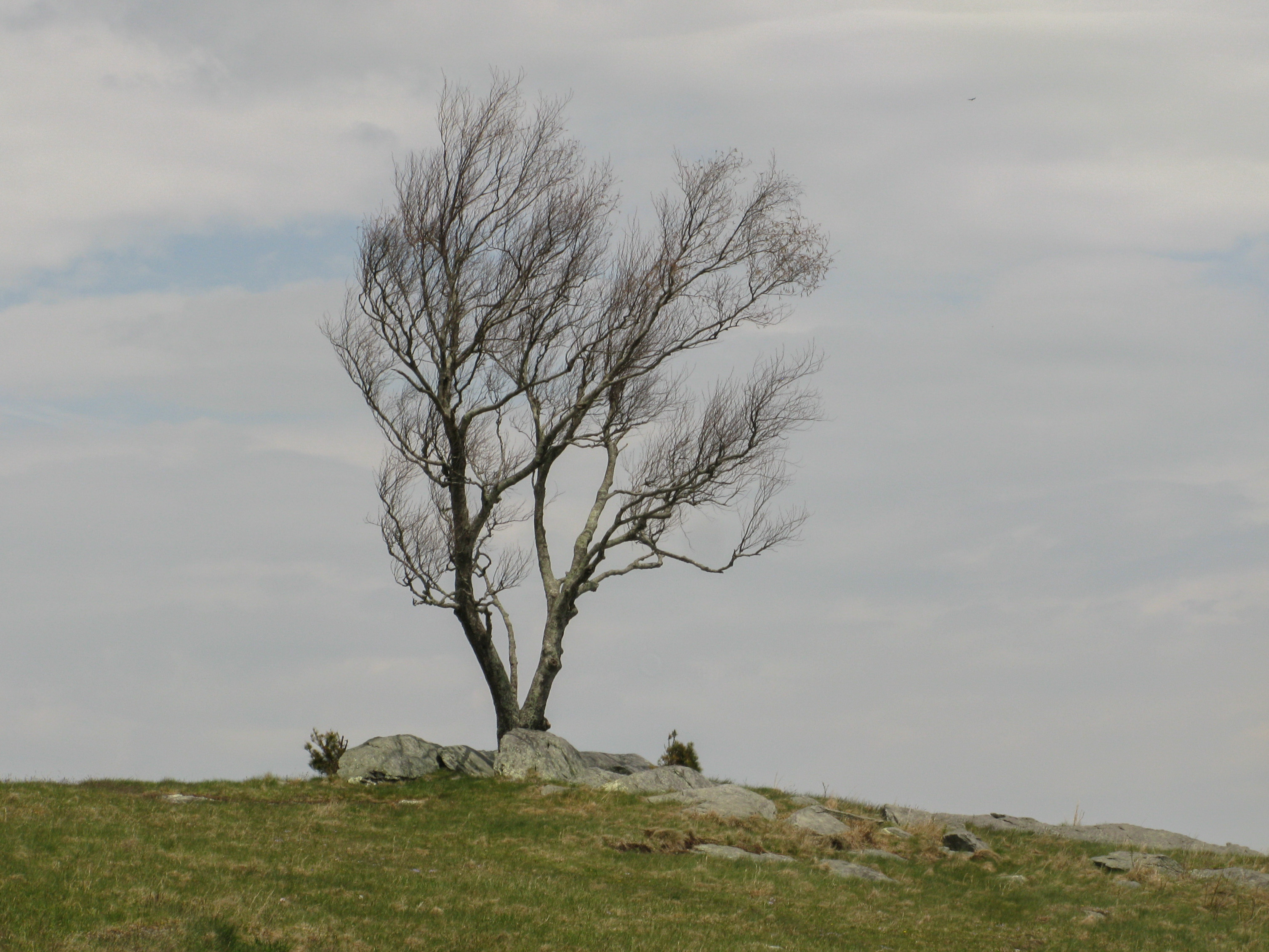
2016-01-30 Doughton Park Tree

Read Full Post »

[with poems from Visions International]

From the ridge above the creek the tallest tulip trees poke their heads up to catch the evening sun. Hammered gold, bright lemon and lime, for a moment they torch the forest and we who look up catch their display. Without this certain angle of sun, autumn lends these trees only ochre dashed with butterbrown; without us looking up at just this certain moment we might not appreciate them at all.

Most everyone mid-October is planning their looking up. Hey Honey, wanna drive up on the Parkway on Saturday (the crowds, the crowds!)? Which weekend will be peak color? Was late summer wet enough and September nights cool enough for the maples to manufacture their anthocyanins? (Yes, most everyone is debating phytochromes and anthocyanins whether they know it or not.) Slowing the car. Craning necks. Meanwhile Linda and I are back in deep shade where beech and hickory still hold onto their leaves. We’re looking down, not up. The color we seek is reclusive, modest, avoiding the limelight.

Right now is when Beech Drops bloom. No one is noticing. If you see them at all, you probably assume they’re the leafless twigs of some summer forb that’s already succumbed. It’s hard to even realize that their bare centimeter-long appendages are flowers. Bud, bloom, and pod all look pretty much the same. In fact I didn’t even realize they were blooming until I got down on my belly with a macro lens and then blew up the images. A streak or two of deep purple up their sides; pursed lips of fused petals; one protruding yellow stigma, anthers too delicate to see – but little friends, you’re gorgeous!

Epifagus virginiana is the only member of its genus. It is parasitic, like many other members of the Broomrape family (Orobanchaceae). It attaches to roots of Beech trees for all of its nourishment; it makes no chlorophyll and the only remnants of leaves are tiny scales along its stem. There’s no sign that Beech Drops weaken or harm their host, but in late summer and fall their pale stems emerge from the leaf litter like bony fingers of the undead – just in time for Halloween! Walk through a beech grove: when you notice your first Beech Drop you’ll suddenly realize there are hundreds all around you, and when the low angle of late sun catches them, translucent purple like pale flesh, you might just get creeped out.

For years I had mistaken Beech Drops for the dry leavings of Puttyroot or Cranefly Orchid. Now that I’ve learned their identity, I make a point of seeking them out. On display, this is the one qualification of the Naturalist: Curiosity. The four steps along the path of the Naturalist: Pay attention; Ask questions; Make connections; Share. And the motto of the Naturalist, a motto I just made up and have taken for myself, at least: Semper plus discere. “Always more to learn.”

❦ ❦ ❦

Snow on the Back of Cattle

They seem, at first, dark formations of stone,
half drifted in, bunched and volcanic, rectangular
with oddly shaped outcroppings, sun glinting
on crystal, fringes of gray-green and palest
yellow: lichen, sage, bleached dry grasses
Then small puffs of steam, their breath, shift
and snuffle, soft voices lowing, hooves cracking
the frost. In two places near the herd’s edge,
bright splashes of red where calves dropped
in the darkness, where rough tongues licked
them clean and muzzles nudged small bodies
until they stood, shaking with wonder, to
search out the straining udders and drink.

B. J. Buckley (Power, Montana)
from Visions International, #106, Autumn, 2022

❦ ❦ ❦

Forty years ago Bradley Strahan collected work from poets from around the world and created the first slender volume of Visions International. Twenty years ago I first picked up a copy from a table at a poetry conference, not fully grasping what I was holding. I wondered about the title. Not the International part – holy cow, Bulgaria, Ukraine, Ireland, Italy – but the Visions. For the past several years I’ve been a subscriber and I think I’m finally getting it. To see . . . with another’s eyes, from within another’s place and persona. With every issue that arrives, the poems nudge, jostle, encourage with their quiet insistence that I open my eyes. And learn.

Semper plus discere – always more to learn. The two Latin roots disco and doceo are closely related (from the same Proto-Indo-European origin) – to learn, to understand / to teach, to instruct or show. I perceive that Bradley’s mission is to rattle us loose from the cage of our unquestioned routine, to crack a first fracture into our ossified assumptions. Always more to teach, always more to learn. And how about the homologue discern – from dis – cernere, to take apart – to be able to distinguish or perceive the differences between two things that might at first have seemed to be identical. The poems in Visions International never fail to open my eyes, my mind, my heart to a larger world, more varied, more diverse. More exciting!

❦ ❦ ❦

Tell Me Where All Past Years Are

She had a broad lap, a feed sack apron.
We sat warming on the stoop, and everything around falling
fell into her sack, golden
catkins, chinquapin burs, pods
of locust sticky with their honey,
dust of stars, dust out of the furrows.
She hummed; I translate:
+++++ When will the time come back to me
when hours were in my pocket
as man and heavy as loose pennies,
when days oozed thicker than
end-of-summer honey, when happiness
formed in my hands like butter from the churh
to squeeze and pat into a cake
and print with a petal crown of daisies?
+++++ No we both are humming, sixty or more
years between renditions, and while
we sing the sun clocks out and the moon
on the ridgetop stands and shakes out its lap,
a glowing radium dial.

J. S. Absher (Raleigh, North Carolina)
from Visions International, #106, Autumn, 2022

❦ ❦ ❦

Magpie Potential

The cloak requires to be worn lightly.
You cope with its invisibility
and, trying it on for size, dip your hands
in its deep pockets until they

smuggle up four eggs of lustrous blue,
brown-spotted, the same eggs
you climbed to find in Ballyduggan wood
in your barefoot childhood.

One by one you put the eggs
to your ear, amazed to hear from each
the whir of magpie potential.
Gently you bed them back down,

hoping for wingtips to sprout, bodies
and legs and darkly the eyes
and cowled heads
to come about. Hoping for feathered

iridescence, even for flight,
and your life of hoard-need, or reining in,
of fear that you might fail,
seems only a grounding for this

exuberant scatter and go. You withdraw
your hands, but all is empty now,
and clay, make of it what you
will, clings cold under every fingernail.

Patrick Deeley (Dublin, Ireland)
from Visions International, #106, Autumn, 2022

❦ ❦ ❦

Note: Issue Number 106 of Visions International also includes a poem by Deborah Doolittle (Jacksonville, North Carolina) that I admire, Bird Poem, plus work by poets from Italy, China, Germany, France, Bulgaria, Hungary, Ireland, Ukraine, and eleven states in the USA.

Visions International is published by Visions International Arts Synergy, a 501(c)3 non-proift group for the promotion of poetry and the arts. Subscriptions are $25 for 4 issues; Contact BLACK BUZZARD PRESS / 309 Lakeside Drive / Garner, NC 27529.

To which little magazines do you subscribe? Support poetry by reading it. I’ve got 20 years of Mainstreet Rag piled on the bookcase; the mailman brings me every issue of Tar River Poetry and Cave Wall. Semper plus discere. Semper plus legere.

❦ ❦ ❦

Doughton Park Tree 4/30/2022


Read Full Post »

« Newer Posts - Older Posts »