Feeds:
Posts
Comments

Archive for the ‘family’ Category

[with 3 poems by Maria Rouphail]

A stroll down the beach at dusk – I was sixteen and she was almost. Would you call it our first date? I think we held hands. I know we didn’t kiss. Fifty-four years later the beach is still there, although not the pier we walked beneath, things the earth makes, less so human desires. This afternoon she is upstairs writing a letter and I have just cleaned up after lunch. Where have we been and where are we going? Well, in an hour we’ll take a walk beside the river.

Oh Wise One, long-married, specialist in domestic bliss and expert in the cultivation of love, impart your secrets! Are you kidding me? I’ve spent all morning making a list and it is exactly two items long: (ONE) Never Imagine You Know; and, (TWO) Never Quit Working to Find Out. Number One becomes apparent every time I assume or jump to a conclusion or utter as comfort some empty platitude (or, cardinal sin, just wasn’t paying attention). Number Two is the quick corollary as Number One’s immediate aftermath and the sooner engaged the better – not Working to Find Out usually invites conflagration.

Which is probably why love is such a necessary obsession of poetry. Infatuation is the hot minute of attraction; love is the cool hour of reflection. Poetry may germinate unseen underground as the temperature rises, but its sprout becomes visible when the creature is leaned back in chair, pen hovering listless over paper, the image of affection growing into clarity within the cool, reflective mind. And as I reflect further, I perceive that the seeds of most of my own love poems involve messing up with Number One and Two, above, only to be rescued and reconciled by the big sighs and small gods of forbearance and forgiveness.

Even now I imagine her at her desk, pen and paper, that elegant typographer’s script, those meticulous phrases – oh yes, I want to love her and I do.

❦ ❦ ❦

Annunciation
++++ (after Lynn Emmanuel)
+++++++ for Robert

He wants to be born.
So first he enters the dream of the woman
a doctor has told will never conceive.

He lets himself in through the gate
of her sleeping brain
during a hard snow
in late November.

He give himself eyes and hair like hers,
wraps himself in thick fleece, his fingers curving
over the hem, like a paws of a burrowing mammal.

She wakes with the dream of him still clinging,
I’ve birthed a back-eyed baby boy, I’ve carried him
up the aisle of the church to the baptismal font.

She goes to the window where slantwise
snow erases the houses across the street.
Only a curbside lamp on its iron stalk breaks through,
++++ a yellow clot in the boreal blur.

After she has laid aside the dream or forgotten it,
he enters her body sometime in January.
His arrival ignites engines and fires up turbines

with power unknown to her, making her whole
being a construction zone for the laying of foundations,
the framing of the many rooms of his evolving body.

In April, cornerstone and beam well set and level,
he shows her his brain and spine, a string of perfect lights
blinking the in the midnight sky of the sonogram.

The doctor is speechless. But the woman
rehearses the names of her beloved living and dead.
She will pick one of them.

She watches the tiny heart strobe in its cage.
Beacon of what is coming in October.
A swaddling blanket. A christening.

Maria Rouphail
from All the Way to China, Finishing Line Press, © 2022

❦ ❦ ❦

One line echoes in each poem I read in Maria Rouphail’s collection: Even then, / I could not say you did not love me. All the Way to China is a conversation between daughter and mother that spans decades, even generations. Many different speakers inhabit the poems, in many places and circumstances, but the voice of daughter/mother is audible in each, even if only as a whisper. Through harsh treatments, neglect, destructive choices, and pain that whisper of love still works to keep itself alive.

Love is work. In one of Fred Chappell’s novels, a youngster asks his old grandfather how is it possible that he and grandmother have managed to stay married for so many years. The old guy’s answer? “You don’t leave, and you don’t die.” In Maria’s poems, leaving is a frequent threat and dying too soon is a reality, but the magical work of poetry allows the dialogue to continue in spite of, maybe even because of, mortality. Telling a story allows it to discover its meaning. Telling a hard and painful story allows it to discover new meaning that just may open a door to healing.

The final two poems in the book bring meaning and healing forward and invited me to turn back to the first page and read the cycle again: Laudate Omnes (in praise of everything), and Mother and Daughter, Two Voices – III, Daughter. Yes, this collection is the work of love.

❦ ❦ ❦

Laudates Omnes
++++++(for Asher, young grandson)

Let’s talk
to the bees.

++++++Let’s say

Ladies, thank you
each and all

for coming this day
to the hyssop and bergamot.

Thank you
for diving

into the boggy throats
of pale blue sage.

Thank you
for letting sticky

pollen crawl
up your hairy legs.

Thank you
for the sweet spit of the hive.

Now to the trees turn and say,
Brothers,

I don’t know all your name
or what families you belong to,

but you over there,
tall and handsome with your spiky green:

if you and I were lone survivors
of a meteorological catastrophe,

I’d live with you.
I’d hole up under your branches.

Leaves and rain
would be our food and drink each day.

Now let’s say thanks and thanks and thanks
for the hive’s honeyed paradise,

for meadows of thick-maned mares
drowsing with their foals,

for bees, horses, and trees,
ocean, plains, and the sky.

Let’s say thanks
for the darkness between stars

which is not an emptiness,
but a rookery

where God dreams us.
And if we found ourselves

on a comet flying
beyond Pluto’s orbit,

even there we would
be not separate and alone,

but we would be
as now we are

in the heart of things,
the very heart.

Maria Rouphail
from All the Way to China, Finishing Line Press, © 2022

❦ ❦ ❦

Margie’s Daughter Talks Back

Wood. Shell. Bone. Buttons
in every size and color your mother saved for mending.

You, too, saved them,
in the round cookie tin on a high shelf.
Rainy days, and you’d take it down
and we’d remember
buttons from faded summer dresses,
buttons from coats returned from war,
buttons with bits of garments still clinging,
flesh and tendon of them. Red grosgrain,
shock of silver wedding silk,
fingers of fragrance still clinging.
Attar of rose and vetiver still clinging.
Heft and pour, the cascading clack and clatter
of buttons, like coins or pretend jewels.

You, too, loved them.
You and I together breathed the old secrets hanging
like the kitchen smells in that Bronx apartment.
Buttons from a man’s flannel before zippers were.
Your father’s, you said. And the blue bruise
your mother tried to hide with a lock of hair when
you, looking, and in your small voice, asked,
What happened to your eye, Mama?
as she reattached the right arm of your school sweater.
In the next room the bleats of a baby boy,
and a darkness you hoisted onto your twelve-year-old hip
and hauled through the rest of your life.
Hauled it into my life, too.

Would you believe me if I told you?
I have survived the winter.
Here is the faith I’ve entered with myself,
rule, rite, and rigor of it:
I will not belong to whatever happens to me.
It’s OK to say these things.

Maria Rouphail
from All the Way to China, Finishing Line Press, © 2022

❦ ❦ ❦


❦ ❦ ❦

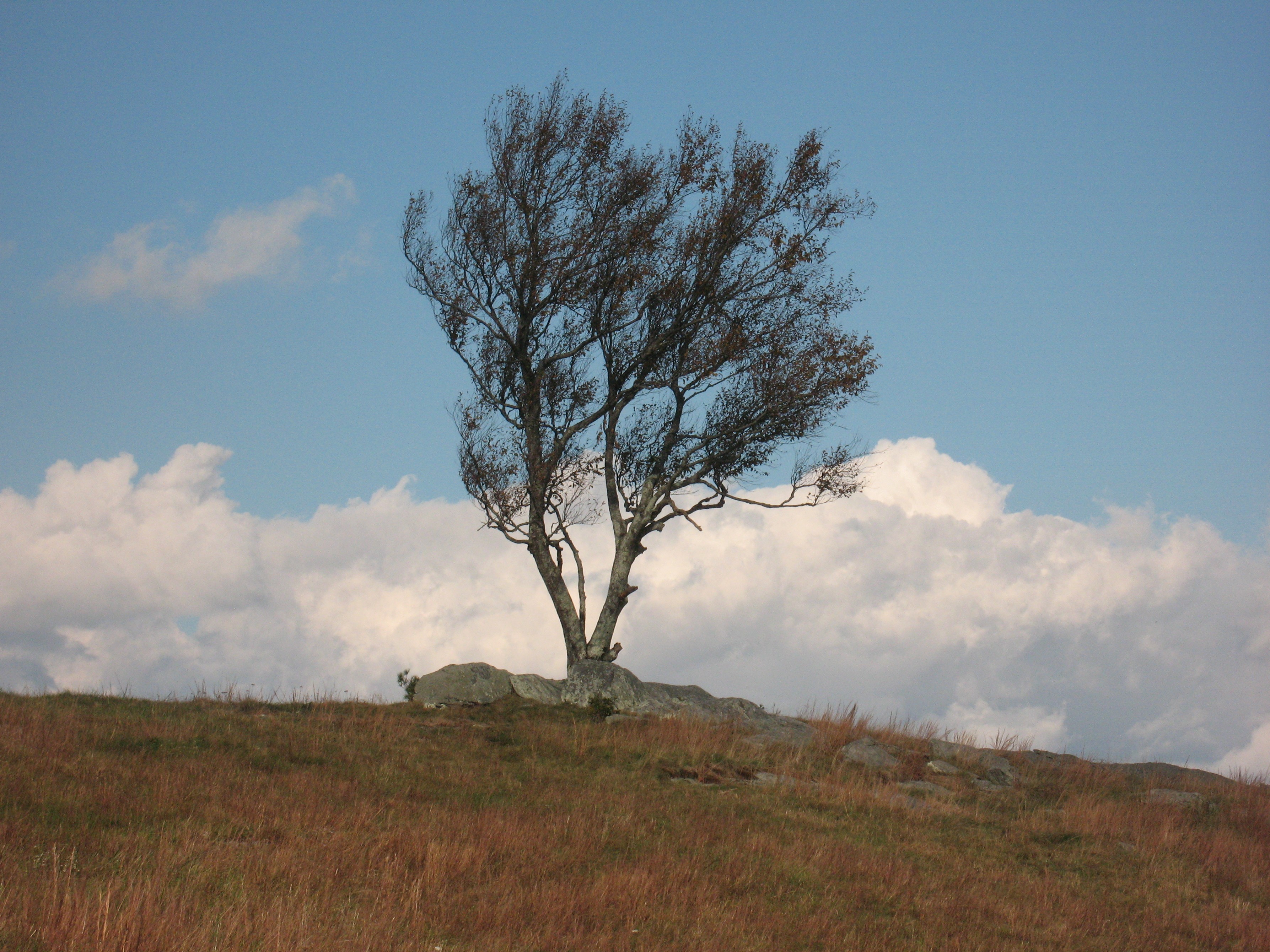
2019-02-09 Doughton Park Tree

Read Full Post »

[with 3 poems by Scott Owens]

. . . walls that don’t line up, some bricks
uneven, some not quite the right size,
and that’s what the mortar’s for,
the gray areas of tolerance,
forgiveness, understanding,
empathetic appreciation of things
being left imperfect, only as good
as we can stand to make them be.
+++++++ from Reclamation

E&A Nature Trail, Elkin rec center, Mountains-to-Sea, Forest Bathing – none of these trails today. Instead Mom and Dad and I walk their customary course behind the townhouse, traversing maybe 200 meters of blacktop. They tap their canes on the far curb to mark the first turnaround; it’s a little uphill and a lot slower approaching the second turn but then all downhill back to their doorway. Some days we keep going a little farther. This afternoon we feel like it’s been enough.

And why do we spend 45 minutes on our little trek, 3 or 4 careful steps per meter? Just needing the exercise? A breath of fresh air? Halfway through our circuit, Maggie’s owner appears and drops her leash, little fluffdog who gallops to Dad because she knows he always carries biscuits in his pockets. Norris stops to share the latest (oldest) joke. Here’s Peggy to check on how Mom and Dad made it through family travels over New Year’s (and to say Hi to this particular family person still staying with them tonight). Wave at Julia who’s expecting company for supper, wave at the FEDEX guy. Comment on all the little gardens behind each townhouse – Nice wreath! Is that a new bench?

This slow-gaited noticeably-hunched deliberate meander is the mortar of Mom and Dad’s days. These few folks they greet, and never overlook the dogs, are their neighborhood. “I’m going to get better, I’m going to walk farther,” says Dad, but even this afternoon it no doubt strengthens him just as much to hear, “I just can’t believe you’re 96.” Acceptance, understanding, empathy for the relentlessness of aging and decline – these hold the chipped, uneven bricks together. Let’s take another walk tomorrow, no matter how meager, no matter how slow.

And you can keep an eye out with me – I have yet to catch Dad slipping those dog biscuits into his pocket.

❦ ❦ ❦

Common Ground

My brother has never kept a single lake,
a single lost grave to himself.
Always he calls, then waits until I
can come, lets me lead the way,
find it like the first time,
proclaiming the names I know, the shapes
of bird and stone, cloud and tree.

Once in the same day I saw
a kestrel, a mantis, an arrowhead
and took it as a sign, though since
I have seen each in their own days
and miles away from each other.

I do not believe God will bend
to kiss this mouth. I do not believe
the wine will turn to blood. But something
knows the moment of sunflower,
the time of crow’s open wing,
the span of moss growing on rock,
and water washing it away.

In the pictures I remember, there is you
letting me stand on the fallen tree
as if it were mine. There is you
letting my arm rest on top of yours
around our mother. There is you
lifting me up to the limb I couldn’t reach.

This is the faith I’ve wanted, to know
that even now we are capable of such
sacrifice, such willingness to love.

Scott Owens
from Prepositional, New and Selected Poems, Redhawk Publications, The Catawba Valley Community College Press, © 2022 Scott Owens.

❦ ❦ ❦

Scott Owens travels through life in this solid, substantial collection of poems, Prepositional. He is coming from it, being of it, finding its deep inside and its dark under, discovering its thrall over and above. And as Scott sees through and into life, he invites us to accompany, to courageously push things forward.

As the newest in a long line of books from a prolific poet, this collection yet seems to be an inflection, an exhalation of breath long held. These poems walked a long way to take their seats here. Some are new but all have been selected to become new. Or maybe it’s their relationships to each other that have grown new, as Scott explains in 13 Ways of Prepositions: every way a squirrel can be / in relation to a tree. These are poems about poetry, its art, its craft, but more so the arising of something greater out of something lesser. These are poems about students and teaching and being a student; these are poems about family ties in every Venn you can imagine. All these poems have gathered here, though, for a common purpose: to water the seeds of relationship; to somehow connect with each other and with you and me, their readers.

When I finished the last poem and laid the book down, this is the reverberation I still heard ringing in my mind: “The world is a wonderful place. You are a wonderful person. I’d like the two of us to sit down and share something of these two wonderful facts.”

❦ ❦ ❦

Words and What They Say

Some say you can’t tell anything
from the language that people use,
that Eskimos in fact have no
more words for snow than we,
nor Anglo-Saxons more
for cut, stab, thrust,
and the fact that our words for animals
when we eat them, beef, pork,
poultry, all come from French
doesn’t prove they’re better
cooks or bigger carnivores,
any more than 23 acronyms
for laughter shows that texting
teens just want to have fun,
but when I hear my carful of 2nd graders
from Sandy Ford Montessori School
making up names for the sun,
and the moon, and the stars that only
come out when you’re camping and the fire
goes out, and you turn off your flashlights
while our mother holds you in her arms,
I can’t help but believe
that not only is there hope for us all
but that the hope we have
is strongest when we find a way
to put it into words.

Scott Owens
from Prepositional, New and Selected Poems, Redhawk Publications, The Catawba Valley Community College Press, © 2022 Scott Owens.


❦ ❦ ❦

Of

Poetry is contrary to productivity.
Poetry encourages idleness.
Poetry stands at the window
because it is curious about the flowers,
this flower with its yellow fringed face
around its one brown eye.
Poetry stands at the window
because it is curious about the trees,
this tree with heart-shaped leaves,
some turning yellow in the first
days of fall, some fallen off and still
the limbs reaching up to the sky.
Poetry stands at the window
because it is curious about the sky,
how it got there, where it goes,
what it’s like where it ends.
Poetry wants the window down.
Poetry walks back and forth
through a field going nowhere.
Poetry thinks it’s okay to look
at the same sky day after day,
sometimes minutes at a time,
sometimes with no other purpose
but remembering blue.

Poetry refuses to follow the rules
of efficiency: get in line,
speak only when spoken to,
never say anything that would embarrass your mother.

The first poem ever written was a drum.
The first poem ever written was a foot
tapping on the side of the crib.
The first poem ever written was a rope
slapping the red clay playground
of William Blake Elementary School.

It is not necessary for poetry
to be beautiful
though sometimes it is.
It is not required of poetry
that it be profound
though it rarely closes its eyes.
It is not expected that the face
of poetry be etched with tears,
the hair dripping with sweat,
the mouth expressing awe.
Poetry owes nothing to anyone.

Still, poetry wakes up each morning,
walks to the edge of the world
and jumps, believing one time
it will fly, believing one time
the dive will not end, believing one time
an answer will rise from somewhere beyond.

Scott Owens
from Prepositional, New and Selected Poems, Redhawk Publications, The Catawba Valley Community College Press, © 2022 Scott Owens.

❦ ❦ ❦

Redhawk Publications; The Catawba Valley Community College Press;
2550 US Hwy 709 SE; Hickory, NC 28602.
Prepositional, New and Selected Poems by Scott Owens.

❦ ❦ ❦

Read Full Post »

MERRY CHRISTMAS!


❧ ❧ ❧

Let the Stable Still Astonish

Let the stable still astonish:
Straw-dirt floor, dull eyes,
Dusty flanks of donkeys, oxen;
Crumbling, crooked walls;
No bed to carry that pain,
And then, the child,
Rag-wrapped, laid to cry
In a trough.

Who would have chosen this?
Who would have said: “Yes,
Let the God of all the heavens and earth
be born here, in this place.” ?

Who but the same God
Who stands in the darker, fouler rooms of our hearts
and says, “Yes, let the God
of Heaven and Earth
be born here —-

in this place.”

Leslie Leyland Fields

❧ ❧ ❧

from
The 2022 Elkin Community Chorus
60th Anniversary Christmas Concert
Tonya Smith Directing
Lillie Sawyers – Alto Solo
Amy Johnson – Piano
Sylvia Grace Smith – Cello


Let the Stable Still Astonish
composed by Dan Forrest, lyrics Leslie Leyland Fields

[Digitally recorded on December 4, 2022,
First Baptist Church of Elkin, North Carolina
by John Rees, GodsChild Records, Mt. Airy, NC
Digitally mastered and distributed by John Williams,
Engineer, Douglasville, GA]


❧ ❧ ❧

MERRY CHRISTMAS!

❧ ❧ ❧


❧ ❧ ❧

2016-10-17b Doughton Park Tree

Read Full Post »

« Newer Posts - Older Posts »