. .
Archive for the ‘family’ Category
Neck and Neck
Posted in family, Photography, poetry, tagged Bill Griffin, Galileo Press, imagery, Jan LaPerle, nature, nature photography, poetry on September 15, 2023| 4 Comments »
.
[with 3 poems by Jan LaPerle]
.
Cupboard
.
One day I decide I’ll do something
good for people,
but I forget, then I nap.
My daughter wants to make
lemon cake so we do that.
I stand on the stool
and begin this great hunt
for poppy seeds.
Hours pass, and I’m on my tiptoes.
I stop searching for a minute to listen
to the wind. The branches snapping.
My daughter ran off agin to her swing,
her swing tied to the branch
of the tree she climbs,
the tree run through with electric wires
in the yard she flies her kite in.
She flies it high as the cell tower.
Her dragon kite breathing fire.
Her dragon kite headed in a nosedive
straight into those electric lines.
I can’t do anything about anything.
I’m trapped in the cupboard
forgetting what I’m searching for.
I dust the spice tops; they go on forever.
My hair too tight in its bobby pins.
Here as good as any place to pray.
.
Jan LaPerle
from Maybe the Land Sings Back, Galileo Press, Aiken, SC. © 2022
.
❦ ❦ ❦
.
The dark and the light are neck and neck again. When dark creeps in the light just doesn’t seem to have much of a chance. This is a close as we come to living dangerously – taking a walk in the woods on an afternoon that promises thunderstorms. Today Linda and I are at Friendship Trail, part of the Mountains-to-Sea Trail east of town. Such a lovely name – almost no one walks here but when we do cross paths the others always smile. Perhaps they’re filled with the same thoughts as the two of us: cool shade, gentle slopes, chuckling creek. Green welcome.
.
Only a lumpy heap of black sky to the north, that’s all we could see from the parking lot. For the moment sun slants through the pines and tuliptrees. Cicadas sing. Into our third mile, though, shadows begin to deepen and the leaves get nervous. We can still see blinks of blue straight up through the branches but dark is moving in, shouldering it all aside. A stick drops from height to land at my feet. Will a widow-maker be next?
.
What gives dark its edge? Why its power to blot out a cheery afternoon and replace it with foreboding? Dark needn’t even knock yet I open the door to it.
.
Dark 4 AM’s are worst although understandable: the hour when the soul’s earthly tether / gently uncoils its smoky grasp / as tenuous as breath.* If I awaken at such an hour I immediately implore myself, “Don’t think, don’t think of . . . ,” but so swiftly the dark lines up its charges, some sharp as yesterday, some rank with decades, some uncertain ever to arrive at all but all too easily imagined. Dark loves the quiet unprotected moment.
.
But why, then, into light and airy freedom of mind is dark also able to intrude? I discover myself on a rural highway, green tunnel and morning dew, but instead of anticipating certain joy around the next bend I am reliving random moments of my own stupidity or, worse, recreating injuries and insults in some delusion that this heaps coals upon the heads of my enemies. Not Buddha but someone apparently equally enlightened said that to hold a grudge is to drink poison while imagining it will kill your foes. Here I am fueling the dark with anti-matter I’ve brought to the bonfire myself. This negativity, what could be more precisely the opposite of experiencing life in the moment? I open dark’s door myself.
.
Take a deep breath. Give my heart a good airing. No blame, no shame, just look straight up through the branches and accept what you see. Gray now, but not black. Threatening gusts have settled back to cooling breeze; just a few cold drops on my neck and no more. Here is the edge of the woods, the field, our car up ahead. Linda and I say, as we tend to, “Well, we carried our umbrellas and that’s what kept it from raining on us.” For a stretch it seemed neck and neck, but even so this hour has been full of green welcome. If at this moment we were instead dripping, shoes aslosh, about to shiver, we could still likely bring ourselves to say, even as we are about to now, “That was a wonderful walk.”
.
❦
.
The dark and the light are neck and neck again. So they seem to be in every poem by Jan LaPerle. Maybe the Land Sings Back is not a book of platitudes and happy endings. In fact, this is the anti-platitude book. But neither do these lines ever surrender to unremitting darkness. Despair dances with hope even if they are both stepping on each other’s feet. Gray sadness cracks and a thin bright line of joy refracts into color down the wall. These poems accept the small daily trials we might think inconsequential as well as the towering existential anxieties we have to admit if we are alive in this century. These poems offer us the chance to share all of these and in doing so they invite us to become more human.
.
Many of these poems are constructed as a series of observations. No, not observations, not apart from the experience but within the experience: these poems are a series of lived moments. Our image of the writer – her age and circumstance, her partner and parent relationships, what she fears and what she loves – is not constructed from what we are told or shown but from sharing the experiences as she does. She struggles to find meaning. So do we. She is surprised that a small act can dispel loneliness or that a small memory can carry a huge weight of joy. We experience surprise at the very moment she does. I have been blown through this collection by a wind of anticipation and revelation and promise. At the end I am simply convinced that, even though neck and neck, the dark doesn’t have much of a chance.
❦
.
Maybe the Land Sings Back, Jan LaPerle, Galileo Press, Aiken, SC. © 2022. Jan LaPerle lives in Kentucky with her husband and daughter, and is a master sergeant in the U.S. Army at Fort Knox. Galileo Press was founded in 1979 by Julia Wendell and Jack Stephens, now lives in Aiken, South Carolina, and also publishes the journal Free State Review.
.
[* from Circadian (Welcome Morning) by Bill Griffin, published 2005 in Bay Leaves by the Poetry Council of North Carolina and collected in Crossing the River, Main Street Rag Publishing, Charlotte, NC. © 2017)]
.
.
❦ ❦ ❦
.
Dear Tuth Fary
.
This is the beginning of my
daughter’s letter, and in it folds
a tiny tooth, small as the foot of the mouse
we caught this morning in a trap
that looks like a hallway to heaven.
The light at the end illuminating a dollop
of peanut butter, heaven enough
for the mouse who was still alive,
still zipping its stringy tail back and forth
across the hardwood. My daughter
and I went outside to set it free, left the tea
warm on the counter, the teabag
with one of those little paper sayings,
The earth laughs in flowers, but there’s no laughing here,
just ice creeping across everything, making us feel
even more zippered-in, my daughter
on the threshold right before the cry.
She could go either way, and this is always
up to me to maneuver. So I make up some life
for this mouse to get back to, some little car,
tiny house, little teacup tinier than a mouse tooth.
Isn’t it all so cute? Isn’t it great, how I can
hold the world in the light like this?
I cannot talk to her about why the mouse
went in there, the temptation, peanut butter
and loneliness, the pinhole of light in all the darkness,
like when she woke in the middle of the night
and came to my door to say, so sweetly, Hi mama,
which I snuffed out quickly with all my middle-aged
darkness. Midnight breath its own nightmare.
In the morning, I go to my coffee, my office
in the attic where I belong, and the squirrels
scrabble across the shingles and we laugh a little,
we being me and the comic part of me that
pops her head through the skylight to talk
to the critters above and below, and I can hear
it all from there. The inconsequential-ness
of my life is a cinch on my heart. The sweetness, too,
of my little girl growing in the most beautiful person
I have ever seen. That’s enough.
The dark and the light are neck and neck again.
I am freezing from my heart up.
I am right here, rooting from the window.
.
Jan LaPerle
from Maybe the Land Sings Back, Galileo Press, Aiken, SC. © 2022
.
❦ ❦ ❦
.
Big Quiet Things
.
Forever we remember her
on our way to the coast,
in the back seat, quiet
for a million miles,
watching movies with
headphones on and
then, as if a word were
a thing, as if quiet
were an ocean,
and out of it: CRAB!
And years now later,
my husband can say it
or I can say it,
and we are warmed together
even when all around us,
sinking us, pulling us under,
a riptide. And it feels
impossible. And there’s
nothing to hold onto.
Silence for a million miles.
Then out of it
a word, and then more where
that one came from,
all washing up, and the sun
warm, the sand
here with us,
waiting with us.
.
Jan LaPerle
from Maybe the Land Sings Back, Galileo Press, Aiken, SC. © 2022
.
.
❦ ❦ ❦
.
How We All Fly
Posted in Ecopoetry, family, poetry, tagged Bill Griffin, family, How We All Fly, imagery, nature, nature photography, nature poetry, NC Poets, poetry, Southern writing, The Orchard Street Press on August 29, 2023| 14 Comments »
.
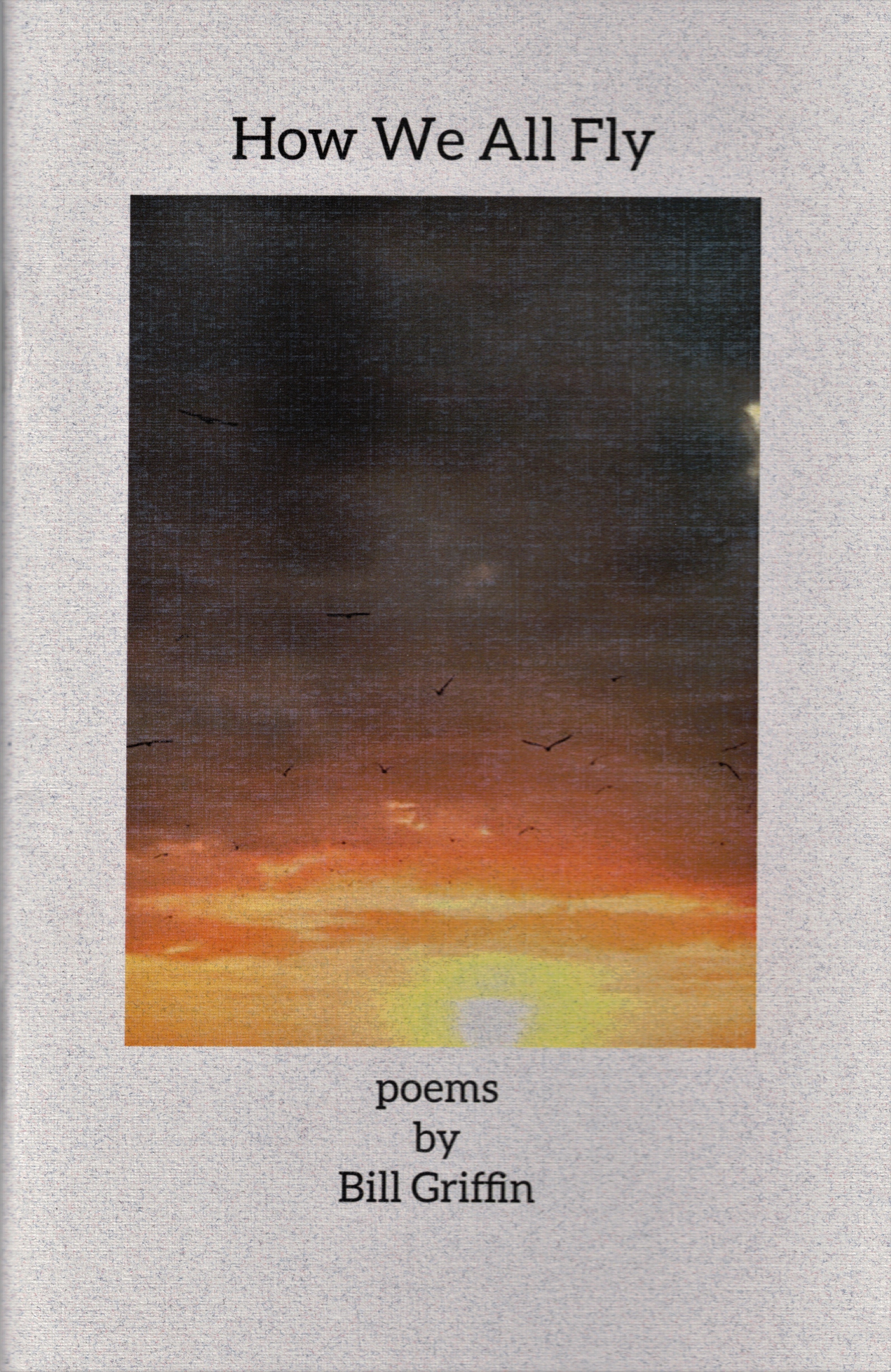
[2023 chapbook by Bill Griffin]
.
We Never Give Up Hoping
.
Morning frozen hard. Pour
++++ boiling water
into the birdbath;
++++ they will come
to drink when I have gone.
.
++++ God of holy ice, holy
++++ ++++ steam,
++++ give my children
++++ ++++ water
++++ that all my hoping
++++ ++++ can’t.
.
Sound of wings, splash
++++ diminishing;
find the world again
++++ iced over.
Fill the kettle. Holy water.
.
Bill Griffin
from How We All Fly, The Orchard Street Press. Gates Mills, OH, © 2023
originally published in Quiet Diamonds
.
❦ ❦ ❦
.
Join me in celebrating the release this month of my newest chapbook, How We All Fly, from The Orchard Street Press.
.
Poet Patricia Hooper describes the collection: “Through close observations of the physical world, these clear, direct poems yield insights into the corresponding life of the spirit.” And Rebecca Baggett says this: “Throughout these poems, but particularly toward the collection’s end, How We All Fly leads the reader up and onward, infusing even inevitable losses with tenderness, trust, and hope.”
.
Patricia Hooper is author of Wild Persistence, University of Tampa Press.
Rebecca Baggett’s most recent book is The Woman Who Lives Without Money, Regal House Publishing.
.
❦ ❦ ❦
.
.
❦ ❦ ❦
.
Thank you for your support, both of the writing you discover here and of the literary arts!
.
You may purchase a copy of How We All Fly directly from me by mailing a check for $15 (postage included) to this address:
++++++ 131 Bon Aire Rd.
++++++ Elkin, NC 28621
Please make your check payable to Bill Griffin.
.
If you would prefer to pay via PayPal, please contact me for transaction details at: comments@griffinpoetry.com
.
❦ ❦ ❦
.
In Praise of Home
Posted in family, Imagery, Photography, poetry, tagged Bill Griffin, Fred Chappell, imagery, nature poetry, NC Poets, poetry, PRAISES, Shelby Stephenson, Southern writing on August 18, 2023| 4 Comments »
.
[with poems from Shelby Stephenson’s PRAISES]
.
The World Leads Us to the Arts and Back
+++ for Sam Ragan (December 31, 1915 – May 11, 1996)
.
How glad I am that my school helped move your hand toward journalism
and poetry and democracy with a little “d.” Cleveland High School:
This land of ours if full of schools, schools both great and
.
small; when it comes to praising them, why my school beats them all.
I’m proud you graduated from my Johnston County alma mater. I’m
sorry your family lost the farm in Granville, around Berea, Shake Rag,
.
Stem. You came to Bailey’s Crossroads, lived near Ebenezer Church,
among the Ogburns; your love of words showered acres, snuffling the
burning crosses. Hope was your story, lyric, svelte. Poverty? You
.
wrote in “That Summer”: “a wild turkey flew out of the woods / And
even if it was out of season, He fed a family for two days. / And it was
better than that mud turtle / That looked like mud and tasted
.
like mud.” I loved to walk into your office piled high with papers.
You’d peer over them, rise, jingle some change in your pocket and say,
“Well, what do you know?” “On a scale of one to five, Sam, about
.
minus two,” I’d say. Your vacations you took in your office, mostly.
Sunday mornings? When I’d drive by, I’d see your Buick parked beside
The Pilot.
.
Shelby Stephenson
from PRAISES, Main Street Rag Publishing Company, Charlotte, North Carolina. © 2021.
.
❦ ❦ ❦
.
Can a poem which is simply a list mean anything? Can a list of place names – counties and towns and neighborhoods and destinations – catch in the throat and widen the eyes? What are all these words if not the name someone has found for home?
.
Canton, Carolina, Carrollton, Carpinteria, Cary, Chapel Hill,
.
Driving south from Ohio, we exit I-77 at Pearisburg (the four-lane still under construction up the escarpment), careen switchbacks from Fancy Gap to Mount Airy, then cross the state line into North Carolina: at their first glimpse of Pilot Mountain, my parents break out in unison every time, “Here’s to the Land of the Longleaf Pine, a summer land where the sun doth shine . . . .”
.
Cleveland, Columbia, Dan, Dauphin, Durham, Edenton,
.
But I wasn’t born here. I didn’t grow up here. A couple of summer weeks in Morehead with Nana, Bogue Sound funk and fig preserves; in Hamlet, the iron bed in the back bedroom with Grandaddy’s snores, his Old Spice and gun oil; a swing past the house on Runymede near Old Salem where Mom grew up – phantoms, atavisms, only glimpses and dreams, none of them really my home. So why do the names in Shelby Stephenson’s Precedence, the introductory poem in his book PRAISES, why do they have the power to squeeze my heart?
.
Hamlet, Harnett, Highlands, Hillsborough, Huntersville,
.
Five days after we married Linda and I moved to Durham: June 20, 1974. That’s hot breath on the neck of fifty years in North Carolina and Lord how I have wanted to call this place my home! The generations of Griffins plowing fields in Union County, can they bring me home? Great-grandmother Griffin holding me on her knee in that old photo in Mt. Gilead above the dam, can she? Two kids born in Durham County General, two grandkids at Hugh Chatham in Elkin, surely they must be able. There must be something that can heal me of the apprehension that in any conversation someone may at any moment accuse, “You’re not from around here, are you?”
.
Nashville, New Bern, New Hope, Neuse, Northampton, North Wilkesboro
.
This book of Shelby’s has come as close as anything. His long and careful listing A to Z – I read and recall all the clay and sand and sod Linda and I have trod. That summer we lived in Clinton and she learned to drive. The sweet corn from his garden Dr. Murphy bestowed when I externed with him in Hillsborough. Two little kids with us on those rotations in Fayetteville, Goldsboro, Mt. Olive. Every detail of all the lighthouses climbed, of Tryon Palace, of the Town Creek Mounds, of our little patch of Blue Ridge. Hiking the state parks and greenways and nature trails in all seasons and all weathers, even Nags Head Woods in February and Roanoke Sound beginning to freeze. Years and changes and the earth moving beneath our feet.
.
Wake Forest, Waxhaw, Weaverville, Weymouth, Winston-Salem
.
Dang, I guess we are from around here. Thank you, Shelby, you who still live on Paul’s Hill in the house where you were born, thank you for opening the door that invites us all inside to discover that we’re home.
.
❦
.
After that one prefatory poem, each page of Shelby Stephenson’s PRAISES is just that – praise and homage for those who have created literature and art in North Carolina for 300 years. He begins with John Lawson (b. 1674) and George Moses Horton (b. ~1798) and ends a hundred pages later with Jill McCorkle (b. 1958) and Randall Kenan (b. 1963). Many of the poems are rooted in anecdote and personal friendship but they reach into the heart of everything that makes the writing vital. Perhaps there is no North Carolinian past or present who could have created such a treasure. As Ron Smith writes on the cover, “Shelby Stephenson does not offer lyric effusion in a neutral space; he demonstrates that Emerson’s “the mind of the Past” is best encountered through the generous sensibility of a grounded poet. . . . This volume should be in every collection devoted to Southern Studies.”
.
. . . Every form grows beauty
and impermanence, layers of voices, precise as one head, hand, face,
.
page, pen.
.
.
❦ ❦ ❦
.
Making Words Breathe Conscience
+++ for Jaki Shelton Green (June 19, 1953 – )
.
One day I went to her poetry reading.
I stole tones and breaths of her poet’s song.
I could hear Billie Holliday singing “Strange Fruit.”
I wanted to ask for mercy,
.
Undo history’s botched economics,
when the mercury’s 103 and there is
more to do with heat than trees.
.
I stubbed my toe in the room,
to doubt the river branching
blossoms, watery,
.
in Efland
running
with wild deer and rabbits,
Carolina wrens turning
oceans to hope,
a thing with hymns
and children whiling
desire, their shoes digging
ruts a flagpole schools.
.
Possums wobbled
cobbled swamps,
home of the blue-tailed hare.
.
Listen, she hears this.
.
Shelby Stephenson
from PRAISES, Main Street Rag Publishing Company, Charlotte, North Carolina. © 2021.
.
❦ ❦ ❦
.
.
❦ ❦ ❦
.
Looking for the Apple Tree
. +++ for Fred Chappell (May 28, 1936 – )
.
+++ HIS NAME that was ever used was Stovebolt Johnson and he was a short
+++ black man, heavily muscled, a chunk of a man.” (The opening sentence in
+++ the story “Blue Dive” in Moments of Light)
.
++++++++++ I
.
He loves to salute with a drink
And raise a wrinkling thumb
Towards intellection, think,
I mean, then throw all thought to some
Seeming lore a shortstop
Might snag, talking up baseball.
He can carry on about a hog-box
And make you see the hog, a Farmall
In the mix, and Pope, too,
Alexander, I mean: never would he
Name a poem for any part of the pope, though.
His work’s morality plays the wee
Canton, his stomping ground, though he left
It here and there,
For occasional sightings as allegory.
.
++++++++++ II
.
I’ve seen Lee Jones ride a bucket down
To clean out our lot-well
And to retrieve my mother’s doggie, brownie.
I read River to a bunch of students
Once and they sprouted shoots and shouts
When I danced in front of them,
Letting Virgil Campbell swear he could
Shoot the god-raging Pigeon swurging
In his pants, the yard, the rose
Garden gate, open, debris watering fast
Familiar voices gushing from a cathedral funeral,
Yet common as a mule drinking water from a trough,
.
And, lo, Fred came out with three more volumes,
Bloodfire, Wind Mountain, Earthsleep,
And I was sore surprised the tenor
Of the faces of parents and grandparents,
The children passing by, the cornered bull
.
In the pasture, all lounged animals and human flesh
In lineages for miles to keep away
The drinking Virgil put into words,
The fish slapping and sliding for lures
Snagging murmurs of drifting glasses
Shot-filled and choked with gregarious whiffs
Undoing his own talking.
.
++++++++++ III
.
In prose, essays, fiction,
Short stories, forms diction,
Multi-told tales along
Side villanelles, sestinas, you name it, Infinity, Plus One,
The scattered debris of chewed billy goat wads,
the cuds of cows on the Blue Ridge, the lows
Murmuring indolence dependent
On freedom he lends
To every piece, hails,
Then takes on the world again and nails
A greeting the page spans – he makes me laugh right out and smile
Aslant at rhythms working syllables mile by mile
Until haints themselves
.
wallow down beside me, as if to say,
Goodnight, Somewhere, there’s a beyond
The world’s engine dawdles:
The raised fist for freedom
Shines humor for consolation;
Wanting not to be bored, the Muse of Music
Surprises him with more news,
A book of verse, collection of stories, another novel.
Universes, constellations, – lower
Shoals for minnows fanning
Swirling apple blossoms bedding
.
Shelby Stephenson
from PRAISES, Main Street Rag Publishing Company, Charlotte, North Carolina. © 2021.
.
❦ ❦ ❦
.
Shelby Stephenson earned many awards for teaching during his long tenure at UNC Pembroke, where he also edited Pembroke Magazine and raised it to national prominence. He served as Poet Laureate of North Carolina 2015-2018. Recent books: Possum (Bright Hill Press), winner of Brockman-Campbell Award; Elegies for Small Game (Press 53), winner of Roanoke-Chowan Award; Family Matters: Homage to July, the Slave Girl (Bellday Books), the Bellday Prize; Paul’s Hill: Homage to Whitman (Sir Walter Press); Our World (Press 53); Fiddledeedee (The Bunny and the Crocodile Press; reprinted by Press 53); Nin’s Poem (St. Andrews University Press); Slavery and Freedom on Paul’s Hill (Press 53); Shelby’s Lady: The Hog Poems (Fernwood Press). He lives at the homeplace on Paul’s Hill, where he was born.
.
Author Clyde Edgerton says of Shelby: “He writes poems that skin raccoons, sweeten the pot-likker, shine through the window, and sing like a gold and silver bird. I’m lucky to know the boy.”
.
.
❦ ❦ ❦
.


[…] About/Submit […]