Feeds:
Posts
Comments

Archive for the ‘Ecopoetry’ Category

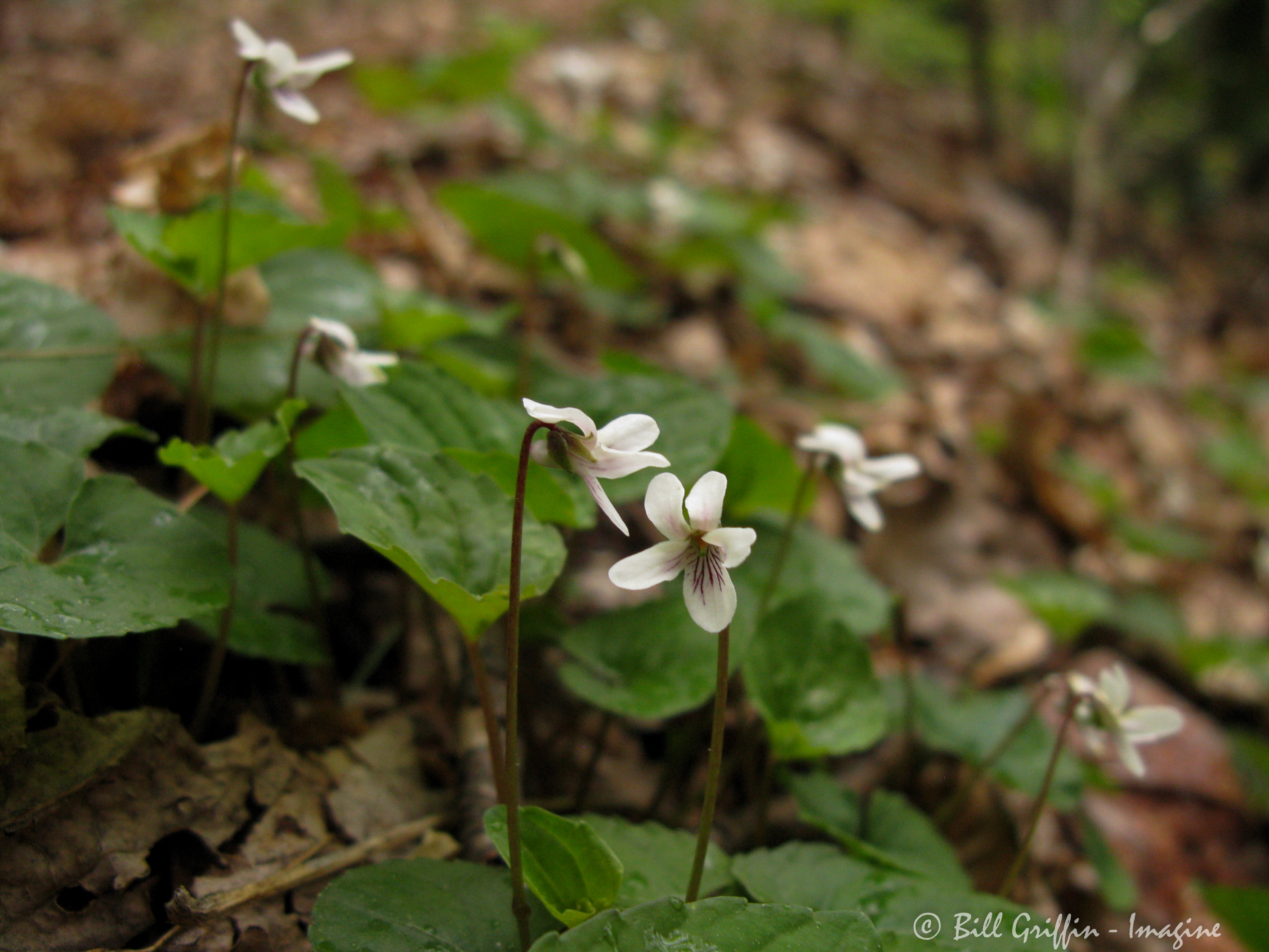
Hepatica americana (Buttercup family), last year’s foliage and new barely opened blossoms

[with 3 poems by Sam Love]

On March 15 I walked an Elkin trail I hadn’t visited in months. The Elkin & Allegheny Nature Trail includes a couple of miles of restored railway grade and many more miles of side trails, loops, and spurs, plus 5-6 miles of intermediate level bike trail. I hiked most of those miles on the 15th but only partially for the exercise – I was walking mostly for ephemera.

Note the date. Looking back at my photos and notes I uncover Hepatica blooming as early as January 27, a single plant in a protected hollow, but usually here in Elkin, elevation around 1000 feet, the earliest Hepatica and Trout Lily emerge toward the middle or end of February. So who’ll be showing themselves mid-March? I ask myself, and how long will they last?

The study of cyclical biological phenomena is phenology. When do migrating warblers arrive from Central America? We saw our first Ovenbird March 19; I heard a Northern Parula out back on April 3. When do Wood Frogs lay eggs? When do Midges and Mayflies hatch out and Eastern Bluebirds build their nests? Sometimes local weather affects a given year’s record but longer term trends are linked to climate change. Can’t help worrying about those Parulas if the hatching of their chicks is out of sync with the juicy bugs. Phenology is a leading indicator of climate change impact, especially on vulnerable species.

For today, my phenology project is discovering tiny blooms just making their appearance.

And if that weren’t enough, as I walk a section of bike trail beside Elkin Creek a pair of wood ducks skitter up from the water and the male flashes his phenomenal colors before they veer around a bend.

Solitary Pussytoes, Antennaria solitaria (Aster Family), flowers less than 10 mm in diameter

.     .     .     .     .     .     .

A Monument to Another Time

A winding rutted road
rambles through scattered rocks
to an abandoned homestead
that traces time backwards.

In the overgrown clearing
a hand laid stone chimney
pokes above winding vines
and gnarled tree limbs.

The fireplace stands as
tribute to an unknown mason
whose calloused hands
meticulously stacked the stones.

With the charred house gone
front porch music
no longer blesses the mountain
with notes and harmonies
that surf the Appalachian wind.

In spring wild flowers
scatter sun dappled beauty
among the crannies of this dream
of a simpler life, an abundant garden
and a small homestead taming nature.

Through winter the chimney
stands alone among
a palette of brown hues
that wait for spring shoots
to burst forth and repaint
the landscape.

Sam Love
Earth Resonance – Poems for a Viable Future, The Poetry Box, Portland, Oregon, © 2022

.     .     .     .     .     .     .


Bloodroot, Sanguinaria canadensis (Poppy family, Order Ranunculales), flower barely unfurling


Yellow Trout Lily (Adder’s Tongue, Dogtooth Violet, Erythronium americanum (Lily family)


.     .     .     .     .     .     .

Thanks to Sam Love for alerting me to his new book of poetry about ecology and the environment: Earth Resonance – Poems for a Viable Future. Such an edgy relationship we humans have with all the other creatures in our biosphere. Mostly we ignore them except when they’re on our dinner plates. Any surprise that we have so much trouble getting along with things that creep and crawl and skitter and pounce (much less the ones that just stand there being green) when we can hardly get along with they guy whose yard sign doesn’t match ours?

And thanks to the Town of Elkin Recreation Department and the Elkin Valley Trails Association for all the great places to walk!

.     .     .     .     .     .     .

Visiting Khatyn
+++Peace Memorial in Minsk Region, Belarus

At sunset each step up the earthen berm
slowly reveals stone chimneys standing
as monuments to an unimagined darkness
that reduced hundreds of villages
to stone rubble and ashen timbers.

Across the field masonry memorializes
thousands of villagers burned alive
as Fascists sought revenge
for partisan guerilla attacks
launched from surrounding forests.

On hearths reaching to the horizon
urns rest filled with ashes and soil
scooped from the 628 flamed hamlets.
Each now lovingly stands as
a spiritual reminder of war’s insanity.

Three solitary birch trees and an eternal flame
symbolize the one quarter of Belarusians killed
in the world war that targeted their villages.
On this site twenty-six bells toll every hour
to remember the homes that once stood here.

The wind that whipped the flames
and charred the flesh, now cleanses the earth
leaving only spirits to haunt the memorial
and remind us of the horrors of war.

Sam Love

.     .     .     .     .     .     .


Virginia Pennywort, Obolaria virginica (Gentian family), flowers just about to open


.     .     .     .     .     .     .

Turtle Earth

In the Lenape creation story—Nanapush asks,
“Who will let me put cedar branches on top of you
so that all the animals can live on you?”
And the turtle says, “You can put them on me
and I’ll float on the water.”

In a vision the Native American holy man
sees the animals bringing earth
from under the water to make land
on the back of the turtle
to create a verdant Eden
where plants and animals flourish.

In another dream the Indian shaman
sleeps a long sleep and
sees a barren turtle
with writhing serpents
thrashing rattlers through portals
in its armor-plated shell.

This hollow eerie sound
resonates with a dry rattle
of primordial notes memorializing
the emerging death of nature.

Sam Love

Virginia Heartleaf, Hexastylis virginica, tiny brown jugs are the flowers just emerging

.     .     .     .     .     .     .


IMG_1948

Read Full Post »


My Niece Ka’liyah Studies Ecology

.     .     .     .     .     .     .


EARTH DAY 2022 is April 22. Send me a poem you love!

THEME: COMMUNITY & CONNECTIONS

German biologist Ernst Haekel coined the term ecology in 1866, derived from Greek oikos for household. Haekel had studied Darwin’s The Origin of Species since it was published in 1859; from his study of sea creatures, Haekel was convinced that the way to understand their development was to examine them in the context of their surroundings: their connections and interactions with every creature around them, with every feature of their environment.

Ecology is the branch of biology which studies the relationships between living organisms and their environment. Their community, their connections. From the level of individual all the way up to the entire biosphere, our connections entwine and enfold every one of us with each other.

Send me a favorite ecology poem by your favorite poet about
COMMUNITY AND CONNECTIONS!

Choose a poem that has spoken to you deeply. If you wish, state briefly why you’ve chosen the particular poem and what it means to you.

For the weeks before and after EARTH DAY, April 22, I will try to post several ecopoems daily. If I receive a large number of offerings I may not be able to post them all, so I am really looking for poetry that expands our awareness of how all living things are interdependent. Where is the beauty and wonder in those connections? What happens if we live in denial of our interrelatedness?

To summarize:

One poem per person, please.
Previously published poems only!
Any author, living or dead, including but not limited to you!

Email to: Comments@GriffinPoetry.com

Thanks! I can’t wait to see what you love!

Bill

.     .     .     .     .     .     .

[NOTE: I only post previously published poems on GriffinPoetry.com. If you choose to send a poem you yourself have written, please include its publication info. For poems written by other authors also include where you read it, and it would be wonderful if you could send me a link if it appears online.]

HTTPS://WWW.EARTHDAY.ORG/


IMG_0877

Read Full Post »

[poems by James Dickey, William Carlos Williams, Robert Frost]

Last Friday I got to play a new game with my grandson Bert, one he made up with his Dad – This Animal. We had walked a mile or so on the Crabtree Creek Greenway in Raleigh and it was time to head home. Along the waterway there were plenty of enticements: red-headed woodpecker at the tip of a snag; big splashes chunking clinkers into the stream; Spring Beauties (why does Pappy kneel down and look at every flower?); tiny slug rescued from squishing.

Now we’ve turned into the neighborhoods to walk on home. Sidewalks. Lawns. Much less exciting. Soon I hear a little voice pipe up, “Let’s play This Animal!”

I get first crack. “I’m an animal that sleeps during the day . . .” “No, Pappy! You have to say This Animal!” Oh yeah, got it. Four-year olds are sticklers for protocol. “This animal sleeps during the day hanging upside down then flies around at night catching insects.”

“A bat!”

Bert knows his animals. In his presence you’d better not mistake a Blue Whale for a Sperm Whale. Or even a Crocodile for an Alligator. Now it’s his turn: “This Animal has ten legs, a stinger, AND claws!” (Hint: In his pocket Bert is clasping the plastic scorpion he’s been playing with all afternoon.)

What a kid! One of these days we’ll kick the game up a notch to This Bird. He can already name most of them that come to the feeder. And I can foresee the day when Bert has me totally stumped as we play This Lichen.

.     .     .     .     .     .     .

.     .     .     .     .     .     .

The Heaven of Animals

Here they are. The soft eyes open.
If they have lived in a wood
It is a wood.
If they have lived on plains
It is grass rolling
Under their feet forever.

Having no souls, they have come,
Anyway, beyond their knowing.
Their instincts wholly bloom
And they rise.
The soft eyes open.

To match them, the landscape flowers,
Outdoing, desperately
Outdoing what is required:
The richest wood,
The deepest field.

For some of these,
It could not be the place
It is, without blood.
These hunt, as they have done,
But with claws and teeth grown perfect,

More deadly than they can believe.
They stalk more silently,
And crouch on the limbs of trees,
And their descent
Upon the bright backs of their prey

May take years
In a sovereign floating of joy.
And those that are hunted
Know this as their life,
Their reward: to walk

Under such trees in full knowledge
Of what is in glory above them,
And to feel no fear,
But acceptance, compliance.
Fulfilling themselves without pain

At the cycle’s center,
They tremble, they walk
Under the tree,
They fall, they are torn,
They rise, they walk again.

James Dickey (1923-1997)
from The Whole Motion: Collected Poems 1945-1992. Copyright © 1992 by James Dickey.


.     .     .     .     .     .     .


All three of today’s poems are collected in The Ecopoetry Anthology; Edited by Ann Fisher-Wirth and Laura-Gray Street, © 2013, Trinity University Press, San Antonio, Texas.

Today’s photographs are from the exhibit at the North Carolina Museum of Natural Sciences Exquisite Creatures by Christopher Marley. These amazing works are created by Marley from preserved specimens from around the world (and no vertebrates were killed in creating his art). The Museum describes this as a dialogue with art, nature and science, and Marley states his intention to allow each of us to tap into our innate biophilia, our love of life and living things.

Oh yes, and the little plastic insects came from the Museum gift shop. We all had to stop and play with them as soon as we left the building.

[The last day of the exhibit in North Carolina is March 20, 2022. It is appearing simultaneously in Idaho; check for future exhibits at Christopher Marley’s site.]

.     .     .     .     .     .     .


Spring and All

By the road to the contagious hospital
under the surge of the blue
mottled clouds driven from the
northeast-a cold wind. Beyond, the
waste of broad, muddy fields
brown with dried weeds, standing and fallen

patches of standing water
the scattering of tall trees

All along the road the reddish
purplish, forked, upstanding, twiggy
stuff of bushes and small trees
with dead, brown leaves under them
leafless vines—

Lifeless in appearance, sluggish
dazed spring approaches—

They enter the new world naked,
cold, uncertain of all
save that they enter. All about them
the cold, familiar wind—

Now the grass, tomorrow
the stiff curl of wildcarrot leaf
One by one objects are defined—
It quickens: clarity, outline of leaf

But now the stark dignity of
entrance—Still, the profound change
has come upon them: rooted, they
grip down and begin to awaken

William Carlos Williams (1883-1963)
from Spring and All, first published in 1923 by Robert McAlmon’s Contact Publishing Co.

.     .     .     .     .     .     .


The Need of Being Versed in Country Things

The house had gone to bring again
To the midnight sky a sunset glow.
Now the chimney was all of the house that stood,
Like a pistil after the petals go.

The barn opposed across the way,
That would have joined the house in flame
Had it been the will of the wind, was left
To bear forsaken the place’s name.

No more it opened with all one end
For teams that came by the stony road
To drum on the floor with scurrying hoofs
And brush the mow with the summer load.

The birds that came to it through the air
At broken windows flew out and in,
Their murmur more like the sigh we sigh
From too much dwelling on what has been.

Yet for them the lilac renewed its leaf,
And the aged elm, though touched with fire;
And the dry pump flung up an awkward arm;
And the fence post carried a strand of wire.

For them there was really nothing sad.
But though they rejoiced in the nest they kept,
One had to be versed in country things
Not to believe the phoebes wept.

Robert Frost (1874-1963)
first published in 1923 in Frost’s New Hampshire poetry collection; public domain.

.     .     .     .     .     .     .


.     .     .     .     .     .     .


.     .     .     .     .     .     .


IMG_1827

Read Full Post »

« Newer Posts - Older Posts »