Feeds:
Posts
Comments

Archive for the ‘ecology’ Category

 . 
[with 3 poems by Denton Loving]
 . 
Lake Sagatagan Summer
 . 
After evensong at the abbey, we walk circles
in the woods, weaving through deerflies
 . 
in kamikaze flights. The cerulean warbler
mates among these trees, we’re told,
 . 
so we keep vigil for blue flickers in the leaves.
So far, nothing. On half-submerged logs
 . 
turtles perch like hard-shelled gods –
We canoe to the deepest part of the lake
 . 
before we can talk about who we were
before the other existed as witness.
 . 
Night descends, and we have to compete
with the liturgy of loons,
 . 
but here, surrounded by water, by darkness,
is the only safe place to tell the truth.
 . 
Denton Loving
from Feller, Mercer University Press, Macon GA; © 2025
 . 
❦ ❦ ❦
 . 
Last month I took a walk in the woods with my brother Bob, visiting from Montana. Here in North Carolina it was 78 and sunny, leaves still on the trees, plenty of shade. Bob wore a long-sleeve shirt rated SPF 50, sun blocking mitts, a neck gaiter pulled up over his ears, and a broad-brimmed hat. Yesterday I spent four hours with Dad at the plastic surgeon’s office. Besides freezing several superficial cancers on Dad’s scalp, she gave him the option of not treating the half-inch basal cell cancer on his nose. After all, he’s 99. What if he should choose to just ignore that cancer?
 . 
My brother seems to be choosing to live another thirty years skin cancer free. My father seems to have chosen never to wear a hat. Bob lives in the future. Dad lives with his past. The sun shines on us all. But this is not a microessay about UV protection or dermatologic wellness.
 . 
God sendeth rain on the just and on the unjust. If you are trying to farm in an arid plain like Judea, rain is not a downer but a blessing. The threatening proposition would seem to be, The sun shines on us all. But here’s a phrase even more ominous – He lives with his past. As Linda and I drive through the neighborhood this morning, she asks me if I’m OK after I let out a deep involuntary sigh. Am I OK? Where did that come from? I tick back – we had just passed the house of a man who used to be my patient. I made a bad choice in his care, he got mad, and he went and found another doctor. Fifteen years ago. You can’t live in a small town for decades without daily reminders of your choices. You can’t live on the earth, it sometimes seems, without your past constantly poking you and calling you out.
 . 
The other night at chorus we men sat and listened while the women rehearsed their own piece, SSAA. There is Linda, intent on the director and facing away from me, but the clear flute of her soprano reaches my heart. For one bright moment I am swept up in perfect love and peace. Tomorrow we’ll again flash our prickles, maybe argue about whether I’m paying attention or choosing to ignore her, but right now every choice I’ve ever made tastes sweet.
 . 
So here’s what Dad didn’t choose: to be alive on the 99th anniversary of his birth. Plenty of years for that ultraviolet to penetrate and warp his squamous cells and basal cells. And even though basal cell carcinoma never kills you, it will keep on growing until it bleeds and hurts. Especially if you are someone who vows on every birthday, as if you actually have a choice in the matter, to live five more. I tell the surgeon, “We choose the knife.” I tell myself, “Choose the music.”
 . 
 . 
This is a bit more of that passage from the fifth chapter of Matthew, Jesus speaking to a crowd of seekers who had followed up a mountainside: You have heard it said, You shall love your neighbor and hate your enemy. But I say to you, Love your enemies, bless them that curse you, do good to them that hate you, and pray for them which despitefully use you and persecute you; that you may be the children of your Father who is in heaven: for he makes his sun to rise on the evil and on the good, and sends rain on the just and on the unjust. [Matthew 5:43-45 ]
 . 
 . 
❦ ❦ ❦
 . 
The Octopus School of Poetry
 . 
Yes, that they have three hearts is remarkable.
So too, the way they navigate man-made mazes.
 . 
That their eight arms simultaneously perform
separate tasks. That they can unscrew jar lids
 . 
even when they’re trapped inside the glass.
But of all the strange facts, I can’t get past
 . 
their ability to squirt jets of black ink,
theatrical for sure, but an effective tactic
 . 
to distract a hungry eel or seal or albatross –
not unlike the poem, shooting fireworks
 . 
to ward off what haunts us. Such a nifty trick.
Almost worth the burden of those extra hearts.
 . 
Denton Loving
from Feller, Mercer University Press, Macon GA; © 2025
 . 
❦ ❦ ❦
 . 
Almost worth the burden of those extra hearts.
 . 
I try to divert my eyes from the cover endorsements when I pick up a new book of poems. You don’t read the last page of a novel first, do you? One joy of reading poetry is the sudden encounter with a line that leaps into revelation – opening a window into the writer’s heart – or into epiphany – opening the reader’s heart.
 . 
Anyhow, I figure I know Denton Loving’s poetry from his books Crimes Against Birds and Tarp. I rub my hands together in anticipation of mountains and hollers, of creatures and musk. And this new book does not disappoint. Denton displays the naturalist’s eye and ear and sensibility; every poem is rich with place and presence. But Feller is even deeper and richer than nature. The natural landscape is simply gesso for the canvas – these poems are about the burden of heart. These are love poems, and loss poems. While the naturalist observes, questions, connects, we are permitted to observe and connect with his deepest feelings and honest vulnerability. These pages are a safe place to tell the truth.
 . 
 . 
Denton Loving publishes interviews and reviews at https://dentonloving.com/ and has just announced a call for poems by Appalachian writers with and about disability, an upcoming anthology edited by Kendra Winchester. Denton is co-founder and editor at EastOver Press and its literary journal Cutleaf. For over a decade, he co-directed the Mountain Heritage Literary Festival at Lincoln Memorial University. He lives on a farm near the Cumberland Gap, where Tennessee, Virginia, and Kentucky meet.
 . 
Feller is available from Mercer University Press.
You may sample Denton Loving’s prior books here in previous posts at VERSE & IMAGE:
 . 
 . 
❦ ❦ ❦
 . 
The Eagle and the Drone
 . 
My soul leapt, you said when you witnessed
the eagle attack the drone in mid-flight –
the drone’s camera capturing its own finish,
the eagle cementing her reign of the sky.
 . 
When you read this, I think you’ll know
the triumphant eagle is not a symbol
of America, and neither is the lost drone.
This is no polemic or war-time parable;
 . 
as far as I can tell, there’s no clear wisdom
gained when we pit nature against technology.
I only know medicine men say eagles bring new vision –
like light through a lens passing obliquely
 . 
from air into a prism’s flat panel of glass,
refracting and separating the sun’s beams –
to help us understand our complicated past
and present, to guide us through the mysteries
 . 
of the future. That reminds me of the last trip
I made to visit you in Florida, when an eagle rose
from one of Highway 417’s narrow strips
of median as you drove me to the airport in Orlando.
 . 
The eagle winged directly toward our windshield,
and we agreed it was a very good omen:
how she caught our eyes, how pure white her bald
head appeared before she flew into the morning sun.
 . 
Denton Loving
from Feller, Mercer University Press, Macon GA; © 2025
 . 
❦ ❦ ❦
 . 
 . 

Read Full Post »

[#Beginning of Shooting Data Section]<br /> Nikon CoolPix2500<br /> 0000/00/00 00:00:00<br /> JPEG (8-bit) Normal<br /> Image Size: 1600 x 1200<br /> Color<br /> ConverterLens: None<br /> Focal Length: 5.6mm<br /> Exposure Mode: Programmed Auto<br /> Metering Mode: Multi-Pattern<br /> 1/558.9 sec - f/4.5<br /> Exposure Comp.: 0 EV<br /> Sensitivity: Auto<br /> White Balance: Auto<br /> AF Mode: AF-S<br /> Tone Comp: Auto<br /> Flash Sync Mode: Front Curtain<br /> Electric Zoom Ratio: 1.00<br /> Saturation comp: 0<br /> Sharpening: Auto<br /> Noise Reduction: OFF<br /> [#End of Shooting Data Section]

 . 
[with 3 poems from Had I a Dove]
 . 
Grief for These Trees
 . 
Nearly half, we’re told, downed by wind,
wrenched from river-flooded ground.
 +++ Clogging streets, parks, schoolyards,
 . 
blocking our hiking trails. Our town is dank
as a worn graveyard, branches and brambles
 +++ strewn among marble stones.
 . 
 +++ So what to do with the haunt
of these crippled trees? My muse would say
go to the woods, hike the trail anyway.
 . 
And I will. But before lacing my boots,
let me honor what we’ve learned of nature,
 +++ how in mystery
 . 
trees speak to one another – give support
 +++ and shade, share water and sun.
And like old friends, mourn when one dies.
Let me rub my fingers into the wound
 +++ of this tulip poplars’s bark,
nod to the beetles and lichen who thrive.
 . 
Smell the sweet air of pine sap.
 +++ Scrunch my body
over broken bones of oaks and willows,
 . 
cling to the dead the way I’d cling
as a kid to our sugar maple
 +++ next to Daddy’s tomato patch.
 . 
Limbs holding me safe,
 +++ a flutter of breeze through leaves
always whispering my name.
 . 
Let me linger here in the trees I”ve known,
the ones now gone, the ones
 +++ still upright and grieving.
 . 
Barbara Conrad
from Had I a Dove: Appalachian Poets on the Helene Flood, edited by Hilda Downer. Redhawk Publications, Hickory NC; © 2025
 . 
❦ ❦ ❦
 . 
It was cold enough to frost last night but I hear music outside my bedroom window and raise the sash. A sparrow is calling, perched on a branch just a few feet from the house. He swivels his head west-south-east and at each turn chirps a metallic almost musical tink. He means business. He is not just any little brown bird – he’s a White-Throated Sparrow, migrated here from Canada to spend the winter. And his perch is not just any tree – it’s a native dogwood. It holds onto color, its coppery leaves, while the tuliptree and maple are already browning in the road. This tree holds onto life when so many of its kinfolk have been taken down by blight.
 . 
Tink, tink, tink. I am here. Brassy foliage and scarlet berries. I am here. We are here for each other.
 . 
Poets who survived hurricane Helene mourn their trees. The poems in Had I a Dove bear witness – trees uprooted, splintered, tumbled down mountainsides, tangled in rivers. Trees crushing houses and blocking roads, trees wiped from entire ridgelines, and with every fresh breeze our own reborn fear of trees falling. We being a species which can grasp large numbers, we try to calculate. How many trees destroyed by wind and flood? Millions? Dozens of millions? It becomes unimaginable. At the loss of even one tree, the heart suffers. That big hickory that shaded the garden. The righteous oak that lifted and held the kids’ tire swing. The dogwood where sparrows perched.
 . 
Hurricane Hugo roared through Charleston in 1989 and felled thousand-year old cypresses in the blackwater swamps, then stomped on up the Appalachian chain to leave behind downed trees all the way to Ohio. Near our home a hundred year old oak blocked Flat Rock Ridge trail where it winds from Basin Cove up to the Blue Ridge Parkway. An anonymous Park Service volunteer with a huge chain saw cleared the trail, and into the face of that massive stump he carved “Hugo 9-21-89.” I have paid homage every time I hike past, until a couple of years ago I had to stop and cast about to find the stump. Rot and lichen and a thick beard of moss had cloaked the inscription. Overhead, the canopy had closed as fellow trees shouldered their way in. In the midst of grief and loss, we hold onto life.
 . 
 . 
❦ ❦ ❦
 . 
I could not hear the trees fall
the morning that yowling she-wolf,
Helene stormed up from Florida,
sank blood-stained fangs into Appalachia,
her torrential mad-drool rain,
drowning wide river valleys,
and all those skinny little hollers.
 . 
From a kitchen window I watched
her lay into a neighboring ridge, her super-charged
breath knocking down magnificent oaks,
colossal hickories, and hundreds of tall pines
which dominoed one by one by one.
She left nothing standing in the upper hillside grove.
 . 
The next day, after that noisy bitch moved on,
I heard an immense tree fall somewhere
close by. There was a crack,
a ghostly groan, a swoosh of leaves,
then, as it met the ground, a tremendous bellow.
And I whispered a prayer for the passing.
 . 
Suzette Clark Bradshaw
from Had I a Dove: Appalachian Poets on the Helene Flood, edited by Hilda Downer. Redhawk Publications, Hickory NC; © 2025
 . 
❦ ❦ ❦
 . 
Barbara Conrad has lived in North Carolina all her life and in Asheville since COVID. She edits Waiting for Soup, an anthology created by her writing group with houseless folks.
Suzette Clark Bradshaw lives in western North Carolina, writes and sculpts, and is employed by her county to manage Helene recovery projects and FEMA grants.
Molly Bolton lives in Foscoe, North Carolina, and upholds the spiritual practice of collective liberation with weekly posts at enfleshed.com.
Had I a Dove: Appalachian Poets on the Helene Flood, an anthology collected and edited by Hilda Downer, includes a preface by Joseph Bathanti. More than 80 poets, voices as various and deep as those wild mountain ridges and hollers, share the night that hurricane Helene’s “thousand year” flooding and gales devastated the mountain counties of North and South Carolina, Georgia, and Tennessee. They share the days and weeks and now months that have come after, the scars and healing. Available from Redhawk Publications at Catawba Valley Community College Press in Hickory, NC.
 . 
 . 
❦ ❦ ❦
 . 
somehow bloodroot
 . 
For Western North Carolina & Gaza
 . 
still blooms, the same
spot as last year
at the crumbling edge
 . 
of the driveway
in the seam
of march and April
 . 
under the body
of a fallen elder oak
each flower coming up
 . 
wrapped around
its stem like a windless
white flag.
they say
among the rubble
there will be dancing –
 . 
beautiful people
in ancient lands
tending fires
 . 
while they are hunted
ghosts unsurprised
by the power of greed
 . 
to route bombs towards
children, a hurricane
to the mountains. my sister
 . 
had to come get me
through maze of
washed-out roads &
 . 
Here
I am, still alive
same spot as last year
 . 
bumming a cigarette outside
the todd community square dance
just to watch smoke rise
 . 
from the creaky porch
past the blown-open riverbank
to the cold white stars.
 . 
Molly Bolton
from Had I a Dove: Appalachian Poets on the Helene Flood, edited by Hilda Downer. Redhawk Publications, Hickory NC; © 2025
 . 
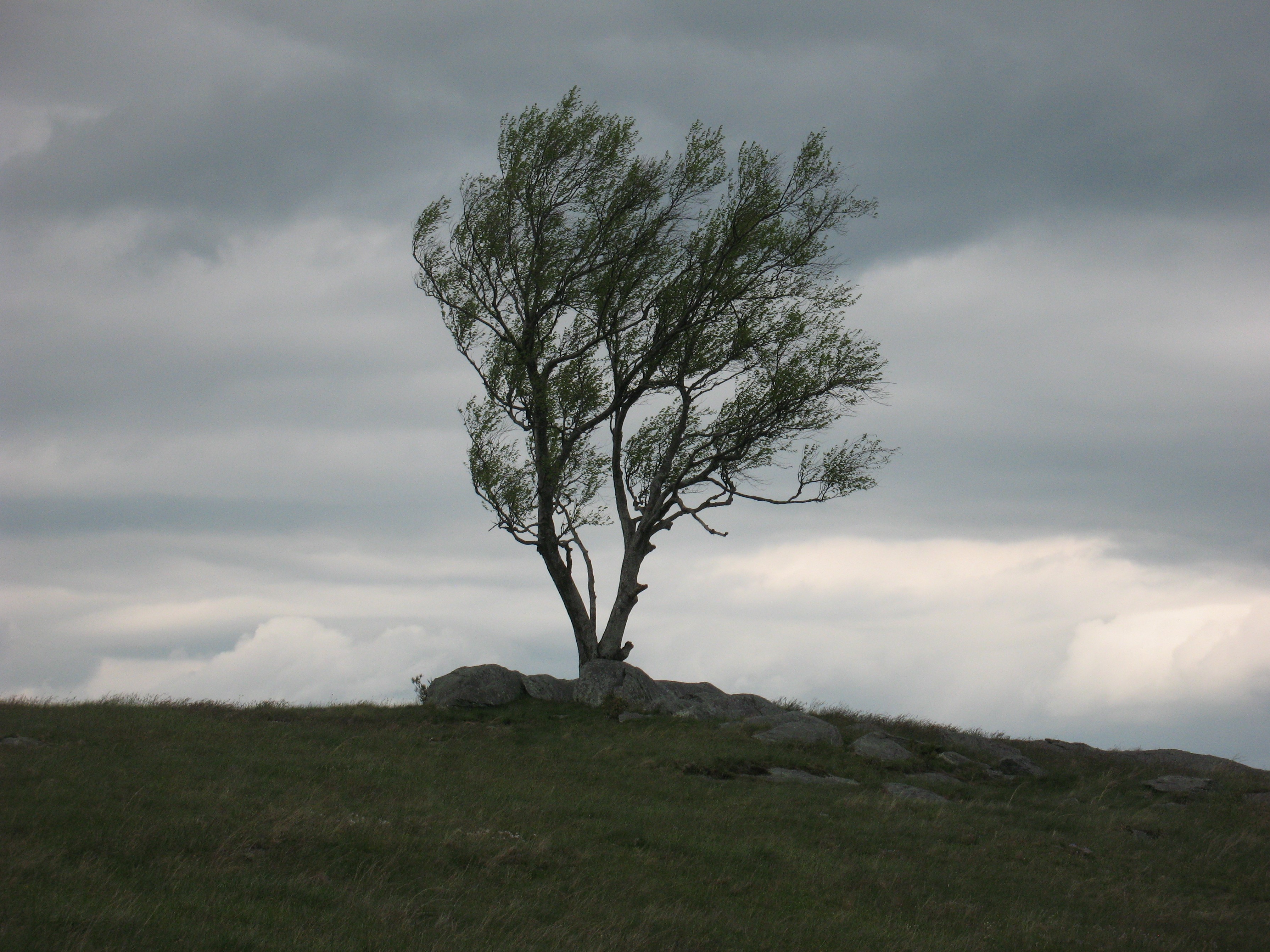
2016-05-08b Doughton Park Tree
 . 
❦ ❦ ❦
 . 
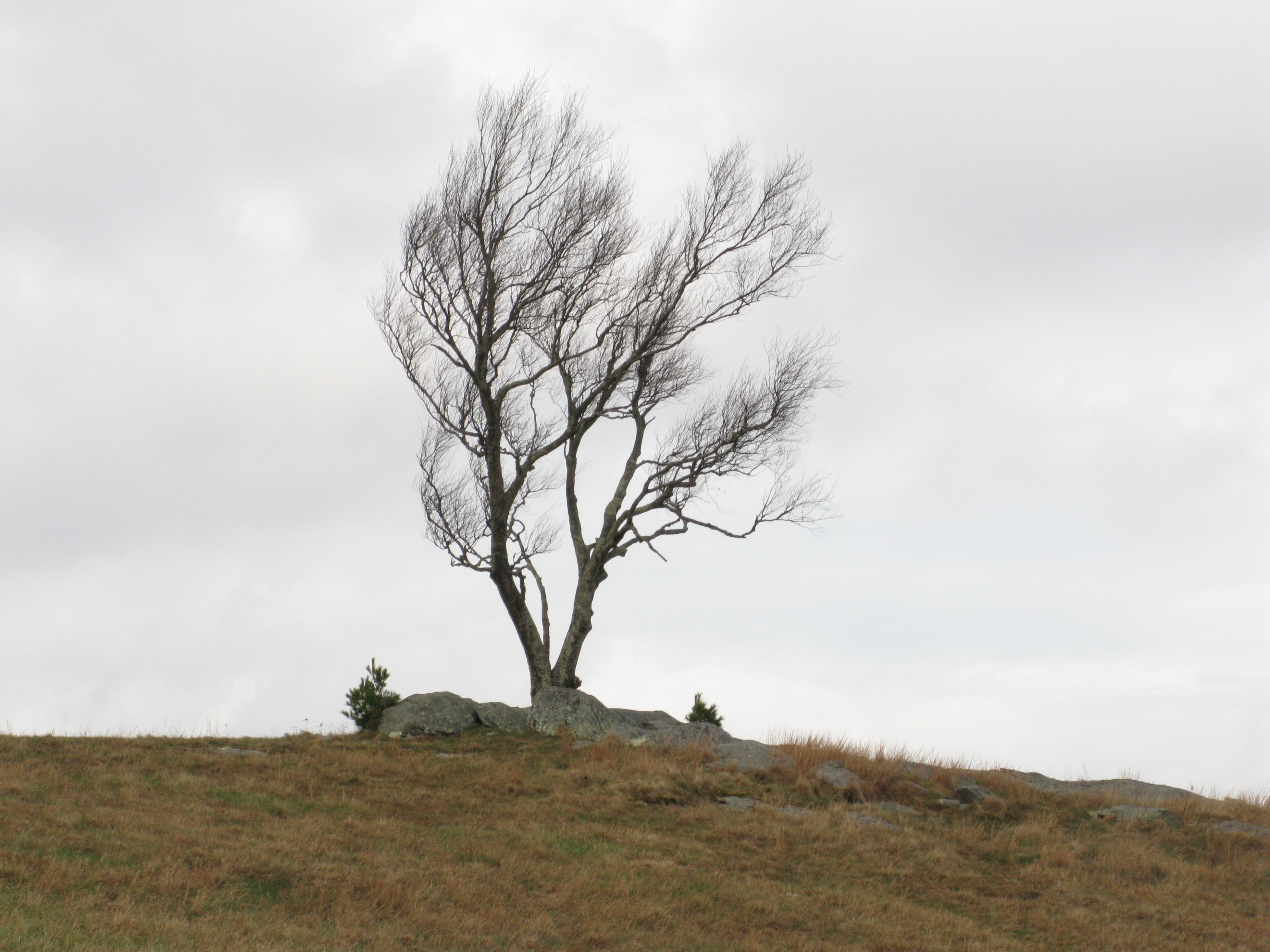
2015-06-15Doughton Park Tree
 . 

Read Full Post »

 . 
[with 3 poems by Beth Copeland]
 . 
Fog
 . 
Morning fog erases the mountain and trees.
No, not an erasure but unseen.
 . 
Not an erasure but unseen.
The mountain, the laurel still green.
 . 
Unlike the mountain and laurel still green,
the dearly departed lie beneath white sheets.
 . 
The deer depart beneath white sheets
of fog, stepping into a forgotten dream
 . 
of fog slipping into a forgotten dream
the ghost mountain dreams.
 . 
The ghost mountain dreams.
Crows fly to pines on mascara wings.
 . 
Crows fly to pines on mascara wings,
mourning. Fog erases the mountain, the trees.
 . 
Beth Copeland
from I Ask the Mountain to Heal My Heart, Redhawk Publications, The Catawba Valley Community College Press, Hickory NC; © 2025
 . 
❦ ❦ ❦
 . 
It’s a big web, here in the corner of our screened porch, but I’m not ready yet to broom it down. The spider is a jointed dried kernel in its center; when I blow, she doesn’t twitch. I don’t see an egg pouch or spiderlings. The strands are not an orb but a diffuse tangle, a chaos of delicate angles and tensions — a miniature of filaments revealed by the background microwave radiation that weave the structure of our entire universe. And what are they made of, those filaments? These I can see before me are nanometer reworkings of hemolymph from mosquitoes denied the opportunity to bite me. Most visible when dusted with pollen. A mess. But I and my broom are not ready yet to offend, to say farewell to the tribe of spiders.
 . 
Last week we visited Blue Whales with our grandson, turning eight. The North Carolina Museum of Natural Sciences in Raleigh is hosting this exhibit of the largest creatures that have ever lived on our planet – the mystery of their migrations, language, culture; the vital interconnections between their diet of krill, their massive enriching orange poop, and the entire deep ocean ecology. Linda and I stood in silence before the model of a blue whale brain and a model of our own. The whale’s is twice as large and twice as complex, convoluted with its twisting gyri and deep sulci. Surely such an abundance of neurons and synapses must create thoughts as complex as our own. Or more so. And yet blue whales struggle to survive as a species in a world degraded by human beings. I am thinking of that brain and I am not ready yet to say farewell to the tribe of whales.
 . 
Chapel Hill cartoonist Keith Knight draws a weekly panel titled (th)ink. Today’s is a portrait of and quotation by James Baldwin (1924-1987): “To be a Negro in this country & to be relatively conscious is to be in a rage almost all the time.” Human being who is relatively conscious, choose your own rage focal point du jour – human beings caged like animals in a Florida concentration camp; children intentionally starved to advance a particular political agenda; boosting fossil fuels burned to appease a few billionaires; an ocean filled with plastic nanoparticles and deafening human vibrations where blue whales may soon be extinct? Some days I feel like I am not ready to go on living. Some days I am more than ready to say goodbye to the tribe of humans. In a few years I will depart as an inhabitant of planet Earth. Some years after that the last memory of my having been an inhabitant will finally depart as well. On that day, will any whales still remain to swim the depths? Will any love between humans remain, or any love for other creatures? I am not ready yet to answer.
 . 
 . 
❦ ❦ ❦
 . 
October Valentine
 . 
A heart-shaped leaf spied in the weeds on my walk
down the hill to the mailbox. I didn’t see a redbud tree
 . 
on the roadside, so it must have lifted on the wind
and dropped – a gift! – near my feet. Is it a message
 . 
from someone I love – my sweet mother in a halo of light,
my father singing the names of trees in his strong baritone?
 . 
Or is it from someone I’ve never seen and may never meet?
 . 
As I hike up the hill, I tuck the leaf in my pocket, rubbing it
with my thumb – as if I could read it – skin to skin – by osmosis.
 . 
Halfway home, I stop to study it. Cerise with splotches of green,
dark spots, a wormhole bored like a bullet wound, a battered
 . 
heart, like yours, like mine, but maybe its scars make it more
beautiful than before. My friends, there’s still so much
 . 
love in this world even when you’re alone.
 . 
Beth Copeland
from I Ask the Mountain to Heal My Heart, Redhawk Publications, The Catawba Valley Community College Press, Hickory NC; © 2025
 . 
❦ ❦ ❦
 . 
Is it strange for me to be toying with despair while reading a book of healing and love like Beth Copeland’s I Ask the Mountain to Heal My Heart? Actually, if you’re not toying with despair you are the strange one. Give grudging thanks, though. Thank the stars and the mysterious hemlocks and the dark fecund earth that in a world full of rage and despair there are poems like Beth Copeland’s. These poems know the feeling of being lost in endless night. These poems have been battered, they have fallen, they have doubted plenty of times whether there is any wholeness or healing available to them, but these poems stand up to testify, My friends, there’s still so much love in this world even when you’re alone.
 . 
Often I tell myself it is ridiculous to imagine that any sort of inner peace is possible. I have my share of personal regrets and ongoing grief, and even though I’m tempted to look around and envy those people who don’t, when I’m really honest I admit that no one escapes whipping. But peace can’t be a wall built around my sadness – walls keep more things in than out. Despair is inevitable. How foolish is it, then, and how strange, to spend a few hours with a book of words arranged in lines on paper and discover the tightness in my throat is easing? The mountain has rested in one place for 480 million; today its peak is less than a third of its height when it was first thrust up in the big crunch. Does it reflect on loss and diminishment, or does it find peace in the weight of its daily being? Am I inflamed and scarred by the revelations of Beth Copeland’s battles and pain, or am I grateful for her gratitude and strengthened by her strength?
 . 
The tribe of human beings seems determined to destroy itself. The tribe of human beings seems determined to link arms and hearts in love. Perhaps discovering a moment of beauty is not a cowardly attempt to escape dire reality – perhaps it is the only thing capable of healing us.
 . 
 . 
Explore REDHAWK Publications, including Beth Copeland’s I Ask the Mountain to Heal My Heart and Shibori Blue: Thirty-Six Views of the Peak HERE.
 . 
Sample poems from Shibori Blue at Verse & Image HERE.
 . 
More information about the North Carolina Museum of Nature Sciences HERE.
Dive into the K Chronicles with Keith Knight HERE.
 . 
 . 
❦ ❦ ❦
 . 
My Daughter Paints a Mountain
 . 
She wasn’t thinking as her brush swept
across canvas in wave-length strokes,
 . 
channeling a crest she’d never seen,
while I was still in the Sandhills
 . 
where there aren’t any hills, just fields
of cotton, soybeans, and cedar stumps
 . 
in swamp water, sleeping on an air mattress
in a small apartment with prints and paintings
propped against walls instead of hung,
newly separated, newly sober, living
 . 
between the husband and home I’d left
and a haven I hadn’t found yet.
 . 
*****
 . 
As I drove up a steep road to see a house
in the Blue Ridge, a large buck leapt
 . 
in front of the car to welcome me,
and I knew I’d found my new home.
 . 
I didn’t know the mountain seen at the top
of the hill was the mountain she’d painted
 . 
months before, and she didn’t know I’d move
to that house with a view of the mountain
 . 
she’d painted as if in a dream or fugue.
How could her mountain – purple, lavender,
 . 
pink, and forest green swirled to a peak
with white streak of snow against a blue sky –
 . 
mirror the one framed in my window?
Was it coincidence or synchronicity
 . 
that the mountain in her mind’s
eye was more map than metaphor?
 . 
It was a message from the universe:
You’re home. Open the door.
 . 
Beth Copeland
from I Ask the Mountain to Heal My Heart, Redhawk Publications, The Catawba Valley Community College Press, Hickory NC; © 2025
 . 
 . 
❦ ❦ ❦
 . 
Doughton Park Tree 2020-11-22
 . 
❦ ❦ ❦
 . 

Read Full Post »

« Newer Posts - Older Posts »