Feeds:
Posts
Comments

Archive for July, 2023

 . 
[with poems from Heron Clan X]
 . 
Chimney Swifts at the Historic Carolina Coach Garage
 . 
Two now more arrive and flit into the swirl,
swelling hive mind they shift and shape
the wind, counter then clockwise whirl
above old brickwork’s beckoning gape
 . 
left standing here erect as testament,
our conservational intent to leave
some landmark urban respite, benevolent
perhaps, perhaps self-serving; we’ve
 . 
taken advantage of their propulsive drive,
pushed our chairs back from the table
in the court to lean & steal their lives
and freedom open mouthed, rapt, able
 . 
for these few moments until darkness falls
to rise with them, untethered, bold
venture to where the elemental almost calls
but too soon bedtime, now our supper’s cold.
 . 
 . 
[For decades this warehouse and shop in Raleigh, North Carolina was a hub of activity servicing Carolina Coach Company buses, in the 1940s the nation’s largest regional bus company.]
 . 
Bill Griffin
from Poems from the Heron Clan Ten, Katherine James Books, Chapel Hill NC. © 2023
 . 
❦ ❦ ❦
 . 
Mom can no longer hear their restless chitterings up the flue on summer evenings. When we sit on the front porch she doesn’t notice their atmospheric ellipsis, punctuating summer afternoons with their aerobatics. She can’t believe they’re calling constantly to each other and to us until I try to mimic that chatter and she laughs. What she most definitely can, though, is wish to see them diving into her chimney at dusk, especially when I tell her I’d seen one do just that last night.
 . 
Revered ornithologist Roger Tory Peterson described Chimney Swifts as little dark cigars with wings. Tapered on the head end and the tail end with sharply tapered wings jutting out mid-fuselage, fluttering so rapidly you’d swear those wingbeats were uncoordinated and asynchronous, well, yes they do look like airborne cigars. Although they often appear in field guide pages adjacent to those other famous aerial foragers, the Swallows, taxonomists place Swifts most closely related to Hummingbirds (based on wing structure). No hovering, though, for these Chimney Swifts – always forward, forward, forward with their loops and barrel rolls. Some species of Swift only alight to lay eggs, spending all the rest of their lives in the air.
 . 
Once you recognize a Chimney Swift’s fricative titter, you’ll realize they’ve accompanied you on hot afternoons and evenings all your life (assuming you live in the Eastern US). Although they winter in Peru, all summer long from the Great Plains to the Atlantic coast Chimney Swifts are widespread and common, probably more common today than they were pre-colonization, when they depended on hollow trees for breeding. These days they sometimes nest by the hundreds in abandoned chimneys, great clouds spiraling in at dusk, perhaps mistaken for bats. You can even buy chimney-like roosting boxes to attract them to your yard to eat the mosquitos.
 . 
After supper, I carry our chairs to the deck for a clean line of sight to the chimney. No smoke has risen from these three pots for decades. Mom and I watch. And watch. The birds circle and tantalize, gyre away, spiral out of earshot then back again so swiftly she misses their brief passage. Keep looking. Don’t blink. Two Swifts buzz the opening but then pull up in a high-G climb. Sky darkens. Dusk wants to coalesce around us, trundle us back indoors. Suddenly one little bird at full throttle blips straight down into the chimney. Then another. It’s become too dark to count the rest, but when we return to the couch beside the fireplace we hear the nestling together of a congenial company who’ll rest here with us until first light.
 . 
 . 
Doug Stuber, Ed Lyons, and Richard Smyth Ph.D. hatched the idea for Poems from the Heron Clan in Rochester, New York in 1998. After Doug returned in 2015 from a seven-year professorship in South Korea, the anthology has been published every year. Not only does Volume Ten encompass a wide geography – poets from five continents, poets from Turkey, Brazil, Dominican Republic, Montenegro, and a dozen other countries – it also embraces a lavish geography of style and theme. The editors explicitly state: “We aim to represent well-established poets and emerging writers, young and mature poets, and poets of color.”
 . 
And North Carolina. NC poets populate these pages abundantly. JS Absher, Glenn Cassidy, Earl Huband, Shelby Stephenson, Steve Cushman, Anna Dallara, the three founders themselves – if you live in the South and read poetry, you’ll recognize these voices accompanying you all summer, all seasons. I’m drawn to all of the Carolina poetry in this volume and tempted to sample each one in this post. Alas, perhaps you’ll just have to purchase a copy. Meanwhile, here are Priscilla Webster-Williams, Preston Martin, and Bradley Strahan from Heron Clan X.
 . 
 . 
❦ ❦ ❦
 . 
Morton Salt
 . 
Under a purple umbrella, a girl in a yellow raincoat
carries a box of salt, the cover art singing out
When It Rains It Pours. I studied the dark blue carton
that lived on the kitchen table, the Morton Salt Girl
smiling with each shake of the cylinder.
 . 
Morton, my father, toured with the big bands,
playing what he called Mickey Mouse Music,
tunes too tame for one who’d grown up crating
spicy Chicago jazz with Red Nichols and Jimmy Dorsey.
 . 
Morton met Jean, my mom-to-be, at the Nicollet,
where she was hostess of the grand dining room:
Grant Wood murals, double white linens,
real silver silverware, and a stage
for the musicians and the act.
 . 
Morton must have winked at Jean
from behind his golden trombone,
the vocalist crooning I’ll be seeing you
in all the old familiar places.
He must have whispered some kind of proposal
as they floated like movie stars across the dance floor.
 . 
When I was six, Mother shredded my Father’s photo,
set her stoic Midwestern jaw, and never spoke
of him again. She didn’t need to, his features etched
on my face like the grooves in one of his Bluebird records,
the same strawberry-blond hair appearing in my mirror.
 . 
Each day, I gazed at his name on that dark blue box
stamped with the Good Housekeeping Seal of Approval,
and over time, Morton, my founding father,
became a pillar of salt.
 . 
Priscilla Webster-Williams
from Poems from the Heron Clan Ten, Katherine James Books, Chapel Hill NC. © 2023
originally published in The Narrative Possibilities of Coral, Main Street Rag Publishing, Charlotte NC. © 2017
 
 . 
❦ ❦ ❦
 . 
Elegy, Gloria Died in Eden
 . 
She took the well-traveled road
two nights ago.
No more tractoring up the back hills
or brush cutting lower fields,
or using her Daddy’s walking stick
++++ down beside the creek –
or oiling the mower or
penciling in the Reds box score,
or sipping an evening sweet wine
on the porch
++++ as nightly geese call down,
close overhead, descending to the reservoir.
 . 
She noted in her diary the day the flew on south.
And who will shoot the coyotes now?
 . 
Preston Martin
from Poems from the Heron Clan Ten, Katherine James Books, Chapel Hill NC. © 2023
 . 
❦ ❦ ❦
 . 
Empty Places
 . 
In the end we are all archaeologists,
sifting through the ruins of existence
to find shards of pottery
inscribed in a strange tongue:
a letter from a friend left on a picnic table
a poem written on the back of a menu,
the sketch of a girl whose name you can‘t recall,
a yellowed photograph with stranger’s eyes.
 . 
We keep on struggling with left over pieces
from a childhood puzzle, trying to fill the gaps
left my smiling lips missing from a face,
tears frozen on eyeless cheeks,
fingers absent from an outstretched hand.
But somehow cannot fill the empty place
and the dark comes creeping in.
 . 
Bradley Strahan
from
Poems from the Heron Clan Ten, Katherine James Books, Chapel Hill NC. © 2023
originally published in Gargoyle
 . 
❦ ❦ ❦
 . 
The editors of Poems from the Heron Clan invite you to buy a copy, explore their previous issues at their BLOG, and consider submitting three poems and a 50-word bio to:
katherinejamesbooks@gmail.com
 . 
 . 
❦ ❦ ❦
 . 
 .

Read Full Post »

 . 
[with poems by John Brehm (and A. R. Ammons)]
 . 
Songbird
 . 
Even thou I have not seen it,
I know how it could be,
how when the skylark flees
from a falcon’s quick pursuit
 . 
it will turn sometimes and begin
to sing, as if to say, “Being
eaten by a falcon is the last thing
in the world I’m worried about.
 . 
You cannot catch me, Tra, la, la.
I’ve got breath enough to waste
on a song like this, which you
may as well enjoy before I vanish
 . 
into air.” And the raptor know
it’s true, knows that anyone
foolish enough to sing in such
a circumstance is quite beyond
 . 
ever being caught, and that for all
his hunger he’ll be given just
a song, tumbling through the air,
as the body he desires disappears.
 . 
John Brehm
from Sea of Faith, winner of The Brittingham Prize in Poetry, University of Wisconsin Press, © 2004
 . 
❦ ❦ ❦
 . 
For the past two months I am an ant whose dead moth has been lofted by an unseen hand. Go this way, go that way, it’s got to be around here somewhere. Tornado, no power for three days, driveway blocked, hundreds of trees down in our neighbors’ yards and a dozen in ours. Check the roof with the adjuster, walk the property with the arborist, wake up and go to bed with chainsaws and cherry pickers. We’ve lived in this house for forty years and the oak, hickory, maple, tuliptrees where already mature when we moved in. We’ve been used to one deep green engulfing embrace all summer, every summer. Now everything has changed.
 . 
I took a “break” this month, as I’d promised them last winter, to serve as primary caregiver for my nonagenarian parents while they spent a fond bit of time at their beach house. The first thing I noticed when Linda pulled back into our driveway the evening I returned was . . . WEEDS! Holy cow, fallow earth so used to deep shade must have been preserving this seed cache forever! Pokeberry, pilewort, hawkweed, fleabane, despised mimosa, uncounted escaped purple basil a friend gave me three decades ago – they’re everywhere and BIG! The invasion is overwhelming. As if life weren’t overwhelming me already.
 . 
After supper I walked out front to check the progress of a volunteer pumpkin that has grown up into the azaleas. Maybe I shouldn’t have instructed Linda to water it twice a week. The black-eyed susans have finally completed their conquest of our borders. Plants – they do enjoy sunlight. I stop in the middle of the roadway and turn to look back at our property. Is this the first time in two months I’ve looked up? Above and behind and around our house – sky. Empty sky. How long before the remaining trees fill it? How long until I lose this dread feeling that nothing will ever be the same?
 . 
 . 
A number of years ago I read an anthology that I often return to: The Poetry of Impermanence, Mindfulness, and Joy, edited by John Brehm. When life is overwhelming and being in the moment is about to set my last few hairs on fire, I open to any page. There is no judgement here. No finger-wagging that I am not doing “enough.” There are no spiritual prescriptions or required agendas. I know as I read I’ll simply be sharing with a companion, another human being. It’s nice to be just one human among other humans, from Basho to Billy Collins and Saigyō to Shakespeare, friends all. I am an ant who feels no anxiety for his moth.
 . 
Then one day my issue of The Sun arrived I discovered these two by John Brehm himself:
 . 
Wanting Not Wanting
 . 
I wish I didn’t
want things
 . 
to be other
than they are
 . 
but wanting
to be some-
 . 
one who
doesn’t want
 . 
things to be
other than
 . 
they are is
just another
 . 
way of wanting
things to be
 . 
other than
they are —
 . 
and I don’t
want that.
 . 
 . 
On Turning Sixty-Four
 . 
The slowing down
is speeding up.
 . 
John Brehm
from The Sun. Chapel Hill NC, June, 2020
 . 
Oh my. Ohhhh my. I photocopied the page and kept it taped the wall beside my desk for months. Eventually I said to myself, “This John Brehm fellow has gotten into my head. I’d better get to know him better now that we’re friends.” I ordered Sea of Faith and was immediately floored (or exalted?) by the inscription: To the memory of A. R. Ammons ( 1926-2001). Oh my, here’s my other perennial poetry inspiration. So to come full circle I share with you another poem which I resemble intimately, this Ammons poem that appears in The Poetry of Impermanence.
 . 
Old Geezer
 . 
The quickest
way
to change
 . 
the
world is
to
 . 
like it
the
way it
 . 
is.
 . 
A. R. Ammons (1926-2001)
from The Poetry of Impermanence, Mindfulness, and Joy. Wisdom Publications, Somerville MA, © 2017
 . 
 .
 . 
 . 
 . 
❦ ❦ ❦
 . 
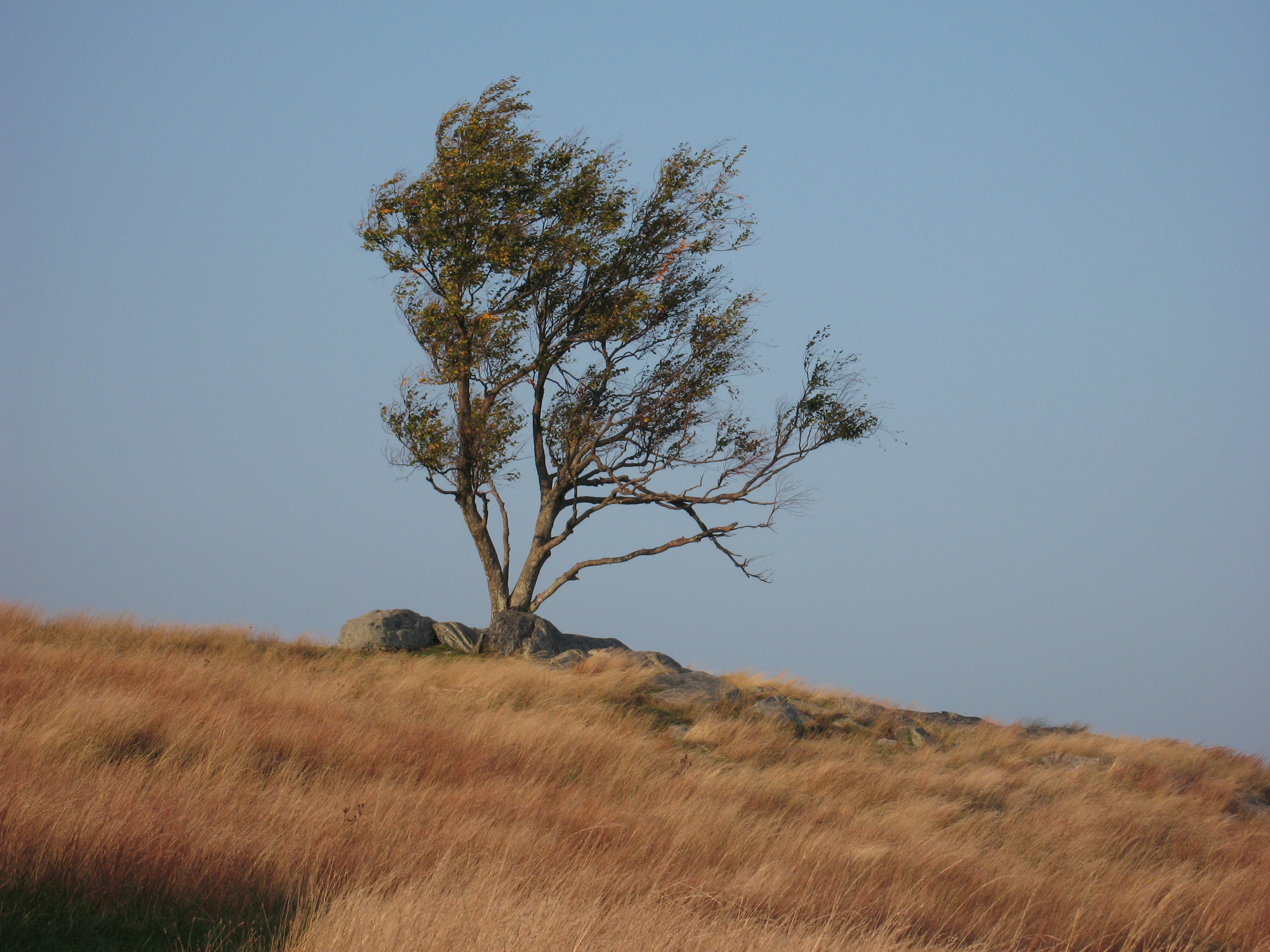
The Blasted Tree
 . 
Of all of them along the path
that curved for twenty miles
through thickest forest, it was
the blasted tree I loved
best. Among thousands of firs
risen beyond the eye’s reach,
among colossal cedars
with their bark soft
as humid earth, among
groves of slender birches that
filtered winds cast across
these hills from Asia,
among even the hemlocks, gripped
in rocky ground and holding
two hundred years of darkness
in each leaf, among all these
it was the blasted oak
I loved best. Just as the path
turns and ascends, it stands
in a little clearing, like
a signpost to the walker
who would go on farther, as if
to say there is some price
to be paid, or only
the stricken may enter here.
Perhaps because it stood alone
the lightning bolt found its way
to it, the branch that would
have arched above and shaded
the meadow, torn off in a
brilliant flash of the sky’s
violence, ripped cleanly
from the trunk, though you can
still see the black scorched
teeth of the wood where
it broke and let
the limb fall to earth.
It must have been a ghastly
sound and a sight heart-
breaking to behold, the perfect
symmetry and elegance gone
in an instant. And now
a piece of sky no one would
ever have seen from here
come clearly into view,
empty and lue and cleaner
than before because of
the branch’s vivid absence.
I loved the damaged grandeur
of that tree, how it bore
its loss with such composure,
and kept on growing, lop-
sided, irreparable, beautiful,
the catastrophe of its history
written on its body.
And though I am not one
who’s been appointed to say
what trees may mean, it was
no mystery why it could hold
me so still, compel my eye
to such study, whenever
I passed that way.
 . 
John Brehm
from Sea of Faith, winner of The Brittingham Prize in Poetry, University of Wisconsin Press, © 2004
 . 
 . 
❦ ❦ ❦
 . 
Signs and Wonders
 . 
I’m not entirely in favor of summer,
what with its drop-dead heat,
its shallow unbothered
 . 
air of fullness beyond ending or
enduring. Sure I like to see
half the world disappear
 . 
behind this velvet green pulled from
the magician’s hat of the month
of May just like everybody
 . 
else. And I’m aware of the sun’s
unbearable importance because
why would we have ever
 . 
stood upright if not to get the sun
off our backs when we dropped
from the trees onto
 . 
the burning savannas five million
years ago? Now we can scan
the horizon, carry things
 . 
in our hands, give and take things to
and from one another. From
which all history
 . 
follows. Still, I wonder whether
swinging wordlessly from
branch to branch
 . 
might be better. I don‘t fell all
that thankful towards the
sun for bringing us
 . 
here or staging this big production,
this overwritten text in which
every meaning contains its
 . 
opposite – the furious tenacity
of life calling forth the sev-
ering response of death,
 . 
etc. Just last night I was walking
home thinking is my lover
going to leave me?
 . 
when a dead bird plummeted
from the sky, slammed onto
a car hood and rolled
 . 
onto the sidewalk beside me.
I’m as un-Homeric as the
next person, but Jesus,
 . 
I said, this cannot be a good
sign. Did it have a heart
attack mid-flight, Or
 . 
was it dropped from the talons
of a predator? Or knocked
out of the sky by an
 . 
airplane? Or thrown down by
the god assigned to watch
over and comment on
 . 
my various questions and pre-
dicaments? If we’d stayed
in the cool shade of
 . 
the forest no birds would ever
fall on us, or if they did we
wouldn’t kill ourselves
 . 
trying to decipher what they
might foretell. And this
morning coming up
 . 
the 34th Street subway I passed
a young Russian man hand-
ing out pamphlets, saying,
 . 
“Jesus is alive. Jesus loffs you.”
I don’t think so but I don’t
know anything, only
 . 
that it’s hot and we don’t belong
here and our hands betray us
and you’re gone.
 . 
John Brehm
from Sea of Faith, winner of The Brittingham Prize in Poetry, University of Wisconsin Press, © 2004
 . 
 .
 . 
❦ ❦ ❦
You
 . IMG_1783
 . 

If you would like to buy a book mentioned in these pages:
– – – visit your local independent book store – or –
– – – click the publishers’ links I try to include each week – or –
– – – purchase online at Bookshop.org, where a portion of each sale is returned to independent booksellers. Thanks!

Read Full Post »

 . 
[with 3 poems by Michael Hettich]
 . 
Abide with Me (excerpt)
 . 
That first year together, we lived in the shadow
of a fishing line factory, next to a super
highway, under a railroad bridge,
 . 
behind a field of junked cars – mountains
of tires, hub caps, and smashed glass – and we
 . 
prayed fervently for our love to return
this world to the poised grace we could imagine
when we touched each other just right, or when we saw sunlight
glint on the stream full of chemicals and junk
that ran by the factory walls.
 . 
We prayed with our yearning. That year we could float things
in midair on the hymns
we sang in perfect harmony.
 . 
We practiced one hymn – “Abide With Me” –
until we could lift cancered minnows from that stream,
until we could lift stray cats and junkyard dogs,
until we could lift each other as high
as our voices carried. We harmonized versions
 . 
of our families and secrets, until we could float
each other in unison, knowing if we fell silent
for even on moment, we’d fall . . .
 . 
Michael Hettich
from The Halo of Bees
 . 
❦ ❦ ❦
 . 
When did I lose my knack for magic? Oh, I can still work what from a distance appears to be magic. I can wiggle my nose and make a seven-year old girl laugh. I can pull from my tall black hat the Latin binomial for obscure little flowers that most people don’t even consider flowers. I can perform any number of spells that compel my wee ancient mother to say , “You’re such a good boy.”
 . 
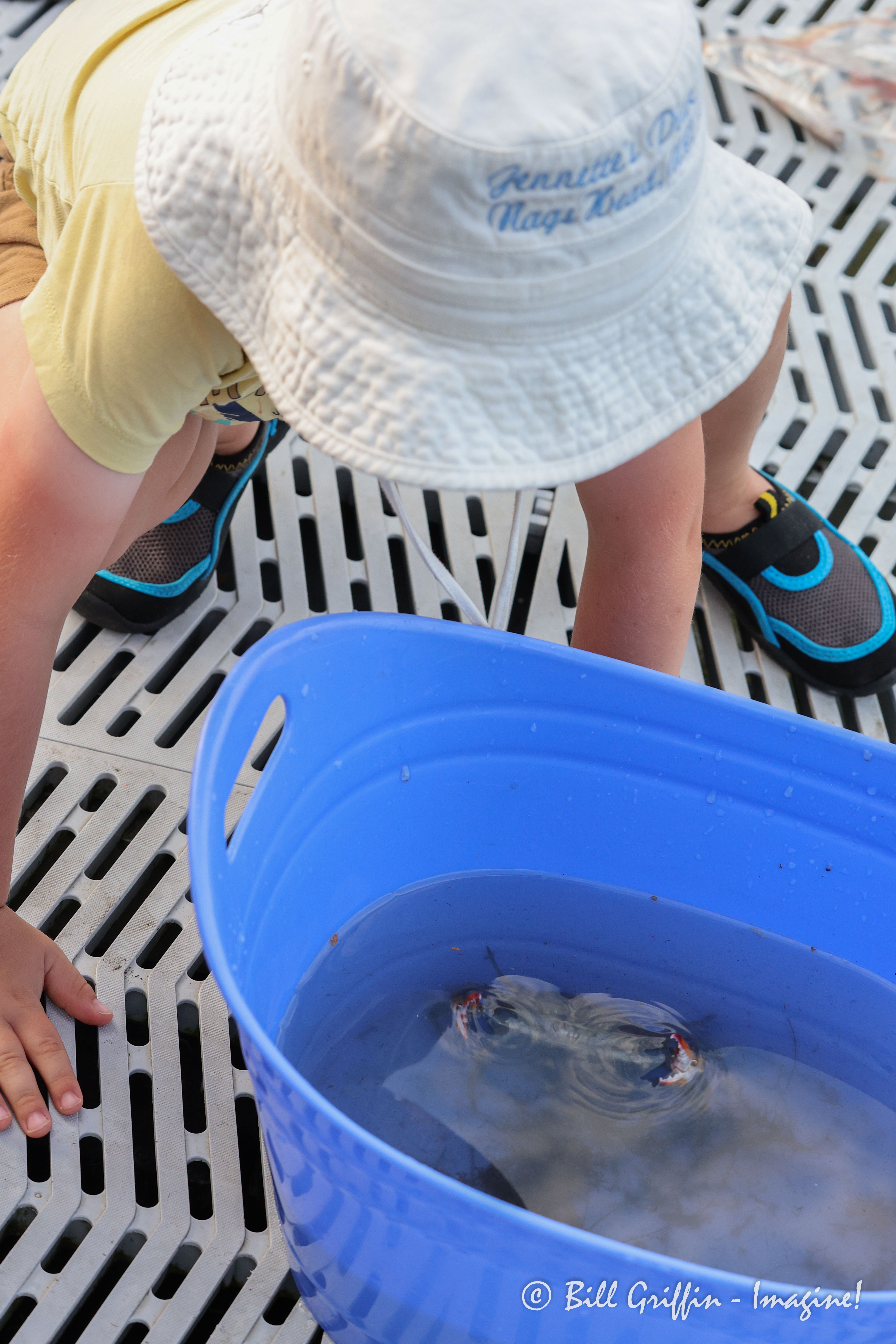
I don’t mean I can’t work magic; I mean I’m afraid I’ve lost the knack of magic working me. This morning the home health aide arrived to ride herd on Mom and Dad so I could spend the morning on the beach with grandson Bert and friends. The kid dads had planned some long postponed surf fishing; while Anthony dug for mole crabs, Josh whirled the casting net into the waves and hoped for minnows. On the third throw he brought up two tiny pompano the size of silver dollars and slipped them into a blue plastic bucket of sea water.
 . 
Bert, Wyatt, and Mari were more than rapt. The magic of flipping silvery fishes totally captured them and transported them into a new realm. Who would have thought four- and five-year olds could stare into a bucket for a solid hour? The magic of touching those velvet smooth wriggles, the magical bigness of becoming the ones responsible for bringing fresh water from the waves and moving the bucket with the shifting shade, the shocking magic of closeness, even intimacy, with something up until now just so many pictures in books – the magic worked those children. I witnessed their magic and regret to confess that I until I did I had only seen those little fish as bait.
 . 
That same evening I drove Mom and Dad over to Bogue Sound – Josh and Bert were going to catch a crab. The tide was right; the dead fish on a string was acceptably fragrant; the blue crab crept closer through the reeds. On his second try, Josh scooped up the dangerous decapod with a dip net and untangled his swimmerets and claws until he plopped into the blue bucket of sound water. A feisty one! Every time Bert moved his hand, the crab snapped claws up out of the water with undaunted ferocity. Bert was magic-smacked. “I never thought I would get this close to a real crab!” This from the boy with a hundred plastic sea creatures of every class, order, and family.
 . 
Perhaps I’ve lost the knack to be worked by magic because I read too much about and spend too little time staring into the blue depths of this unrelentingly odd and utterly magical universe. Perhaps the only hope for me is to catch a little magic as it streams off the children who are still so joyously connected to it. Or perhaps there are others also willing to share their magic. Those persons around me who are inching ever nearer to the magic as the long years of their living come ever nearer to their ending. Driving home from Bert and the Sound at dusk, Mom riding shotgun, I mention, “This is a good time of evening to see bunnies, Mom. Keep your eyes peeled.”
 . 
We turn the corner and Mom spots her at once, a fat cottontail smack in the middle of the neighbor’s lawn. And then we see her two smaller companions, the three of them considering us and chewing thoughtfully as we pass. Mom laughs and claps. “Oh Billy, how did you know we’d see bunnies? It’s just like magic!”
 . 
 . 
One magic that poetry works is to occupy a different life. In Michael Hettich’s poems, he often seems to occupy several lives, each one exceedingly strange and each entirely commonplace. Through the thirty some years that the poems in this collection occupy, the writer walks around trying on other people’s lives. The surprise of his body may be rivers, trees, dry grass, a child sprouting wings. Bodies may be seedpods or they may burst into flame, they might be figures that dissolve into night or into water. These strange and wonderful transpositions and transformations are not fearful or repulsive – we as readers simply step into these bodies with Michael and become part of the magic.
 . 
This is the magic of wildness. Repeatedly, the poems remind us and display for us how wildness is at the heart of each of us. And this is the magic of music, not that the poem uses music to achieve its end but that the noise the world makes is music — poem discovers it and it reveals magic. So many of Michael’s characters sing. Or become song. Those not known for music as well as those whose music we have shut out of our busy non-wild lives. Michael sings, his wife sings, his father and family sing, and the songs weave magic that levitates and elevates and brings joy. When the ringing of my ears and of my machines has deafened me to the everything that makes up this universe of ours – the only known residence, after all, of magic – I know I can return to these poems and be restored.
 . 
The Halo of Bees, New & Selected Poems 1990-2022, Michael Hettich. Press 53, Winston-Salem NC, © 2023
Today’s post features “Selected” poems from the collection. Also see last week’s post, Catch Fire, which features “New” poems.
 . 
 . 
❦ ❦ ❦
 . 
The Frogs
 . 
He loved frogs, so he spent his afternoons
wading in the tall grass, or standing in the leafy water
where the stream turned. Charmed by their stories
of woods and muck, he practiced singing with them
at dusk at pond’s edge, while his mother and father
sat talking, with their cocktails, on the porch. As dark fell
his parent called him, most evenings, for dinner,
but sometimes they let him stay down there until the frogs
were hushed by the cicadas, whose conversations
startled him back to himself. He wandered
up to the house through the tall grass, through the dark,
still singing in his own language. Don’t think of him now,
drinking in a city bar, talking to strangers
who ignore him. Don’t think of him walking out into
the empty street, slightly drunk. He’ll be fine.
Think instead of that walk through the dark wet grass,
the sound of a child’s body moving through the grass;
think instead of those frogs falling silent, of that forest,
of mushrooms that push up overnight like elbows
in the moon-drenched mind of the woods.
 . 
Michael Hettich
from The Halo of Bees
 . 
 . 
❦ ❦ ❦
 . 
House of Light
 . 
Someone breaks open like a seedpod or a flower
to spill out across the street, and we all keep walking by
because it is too beautiful to notice, or too frightening,
as the river just moves on, the clothed and dreaming river,
the speaking river feeling just the way it needs to, nothing more.
There are feathers in the sky. Say birds, generic things,
or simply ignore them. But what about those other people
bursting into flame? will the singe you? Step away
from those other fires, as though you weren’t wild yourself
in all the parts that matter: in your blood and vivid thinking, seeing
colors for their secrets: how to move and be and feel
until you burst aflame. Some buildings built of stone are made
to echo now and then, forever – no one can escape –
but others made of wood are filled with window after window,
so many windows you could ever open all of them
in a single lifetime. No one lives that long. But you could open some.
 . 
Michael Hettich
from The Halo of Bees
 . 
 . 
❦ ❦ ❦
 . 
2020-06-11a Doughton Park Tree

Read Full Post »

Older Posts »