Feeds:
Posts
Comments
 . 
[ 2 poems by Maura High ]
 . 
Excursions in Moss
+++++ — for Barbara
 . 
They were here, all this time,
in this same world,
here for the seeing:
 . 
green shag and starfield, clumps, pinheads,
frilled with lichen,
 . 
and poking up through them the green
first leaves of violet, wood sorrel,
for example, among the ephemera —
 . 
here, in the piedmont of North Carolina,
all the greens in creation:
a landscape within landscapes,
slow as,
quiet as,
 . 
as back along
the rims of lakes and drainages in the early Cambrian.
In this same old world:
the same creep and cling
and drill into the surface
 . 
with their fragile rhizoids, into rock fissures,
now bark, now exposed root,
 . 
into the Anthropocene and still
green between paving stone,
on verges, stuck fast
 . 
to rocks along the banks of Bolin Creek,
down a grit-and-gravel driveway.
 . 
A green gift
my friend gave me:
moss scrapings, from her yard
 . 
over in the next county;
in late summer
 . 
the waggly spore capsules
pop open, and a million spores float
off and up into whatever wind.
 . 
❀    ❀    ❀
 . 
Reprise
+++++ — for Frances
 . 
One leaf falls from the hickory
+++++ outside my window—
 . 
+++++ a slow loop right,
an about turn, and squiggle—
 . 
so cursory a gesture, it looks
+++++ like something written
 . 
+++++ in an alphabet of leaves:
a charm against insects
 . 
and woodpecker; a plea
+++++ for all the leaves that fall,
 . 
+++++ blacken, and rot, and leach
into the earth, and rise again
 . 
to new petiole, new leaf,
+++++ singing the green song of desire
 . 
+++++ and the brown of thrift;
the whispery, creaky name
 . 
the tree gives itself;
+++++ or the name we have given it,
 . 
+++++ full of ourselves and our own
histories, as a child
 . 
writes her given name and sees
+++++ herself there, her first self-portrait.
 . 
Maura High
from Field as Auditorium, Redhawk Publications, The Catawba Community College Press; Hickory NC; © 2025.
 . 
 . 
❀    ❀    ❀    ❀    ❀
 . 
Maura High speaks the language of wild. She writes in an alphabet of leaves. Her poems sometimes withdraw entirely from the touch or consideration of human presence and become encompassed entirely by field, by forest – crownbeard setting seed in the wilding meadow, Bolin Creek about its business of undercutting a bank of clay, moss creating soil from stone. Maura translates for us the deep language of life and of time. Where did this come from? Where are we going?
 . 
As I read Maura High’s poetry, I consider the many lives I have overlooked, forgotten, ignored. I am reminded to listen for the soft peeps of sparrows and finches settling into the shrubbery at sunset. Listen closer – the seep of water in the dirt beneath my feet and the striving of rootlets and mycelia. Closer yet – the movement of seasons, long connections across time, encircling connections gathering life and nudging forward. From careful observation and contemplation of the unremarkable features of a creek, a tree, a flower, Maura creates an opportunity for us, her readers, to participate in the most remarkable story of all.
 . 
 . 
Maura High was born in Wales but grew up on Planet Earth. She has established tender rhizoids in piedmont North Carolina but the wind is apt to blow her to distant climes at any moment. These two poems are from her newest book, Field as Auditorium, from Redhawk. She has also published The Garden of Persuasions, winner of the Jacar Press chapbook contest (2013), and Stone, Water, Time in collaboration with artist Lyric Kinard, Lyric Art Publishing (2019). Sample more of her poetry at MauraHigh.com.
 . 
 . 
❀    ❀    ❀    ❀    ❀
 . 
Thank you for visiting Verse and Image:
. . . . . every Friday I present one or two poems I’ve read this week that particularly speak to me;
. . . . . every Saturday I present one or two poems submitted by YOU, my readers.
 . 
If you would like to offer a poem for consideration, either by a favorite author or your own work, please view these GUIDELINES for Saturday Readers Share:
 . 
 . 
If you would like to receive an email each time a post appears, please SUBSCRIBE to Verse and Image using the button on the Home Page.
 . 
If you have a hard time finding the SUBSCRIBE button on this WordPress site, you can send me your email address and I will add you to the subscriber list. Send your request to
 . 
COMMENTS@GRIFFINPOETRY.COM
 . 
Thanks again for joining the conversation.
 . 
– Bill
 . 
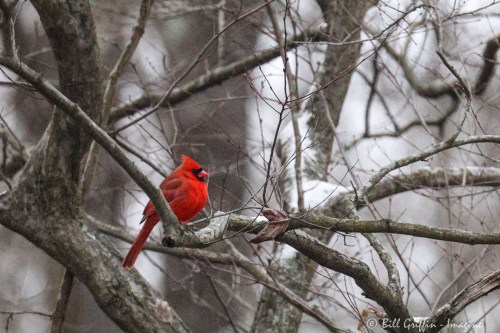
Doughton Park Tree 2021-10-23
 . 
 . 
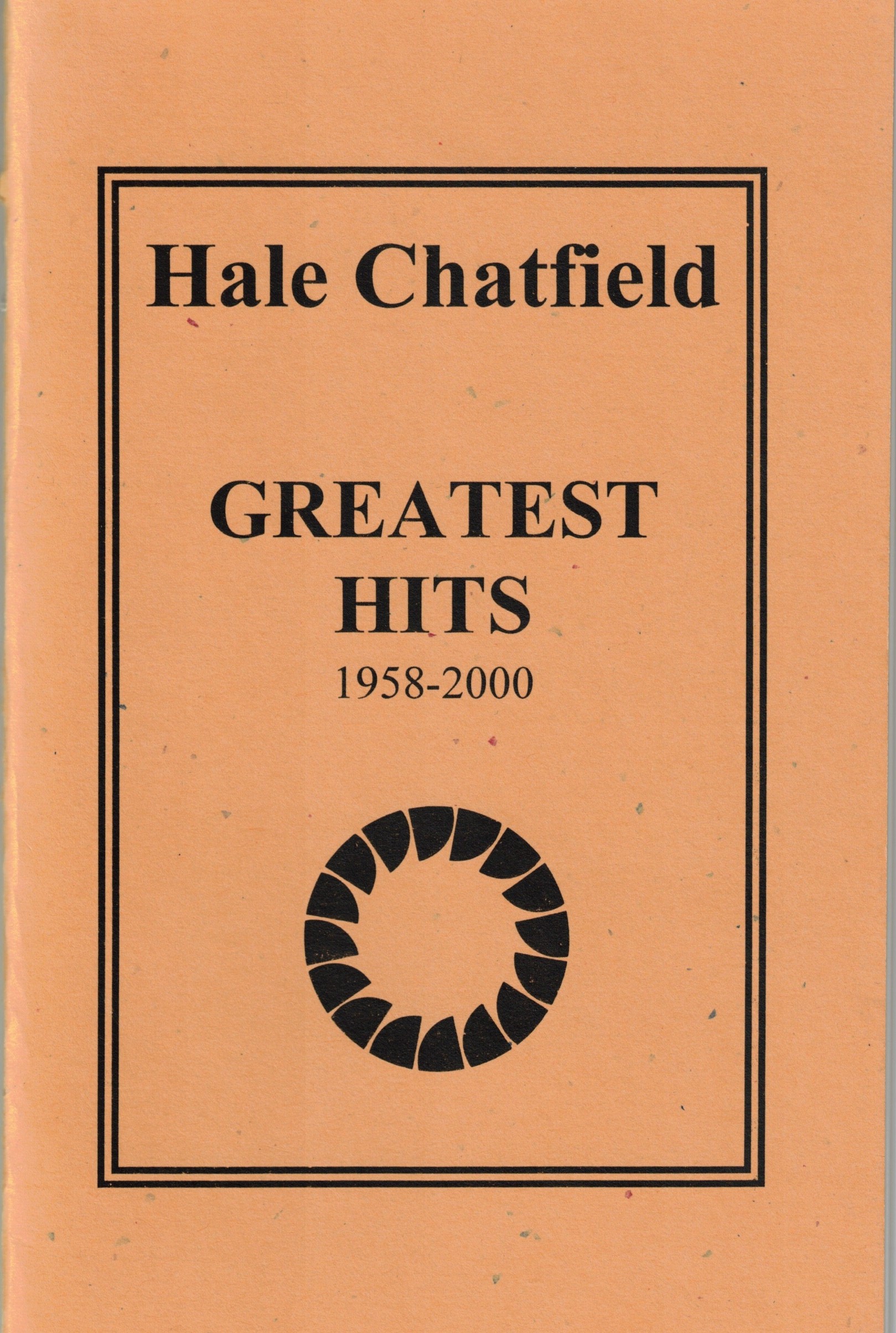
[ 2 poems from Hale Chatfield’s Greatest Hits ]
 . 
So Much of Wanting is Vague
 . 
So much of wanting is vague
we are lucky to have words.
 . 
So much of wanting is vague,
unnameable desire. The tides
within our cells yearn outward.
 . 
We might tell them they yearn
to sizzle against nameless stars.
 . 
And if we are articulate,
as we are articulated matter,
we name our desire — make it
matter specifically. We focus and sharpen
our dullest pain with taxonomy.
 . 
Without words wanting is vague.
As children we struggle to invent new languages
and we carry our vocabularies,
like banners, into nations of longing
where we are sovereign.
 . 
For simplicity we elongate our vowels.
We want more. We want peace.
All. We want it all.
 . 
Without words wanting is vague.
We accrue our nouns. We pin them
to our wishes like medals.
 . 
Hale Chatfield (1936-2000)
 . 
❀    ❀    ❀
 . 
Etude: The Frailty of Consequence
 . 
O yes, no
I remember the word:
I’d toyed with inconsequential,
but what he had actually said was
these poems are so trivial
I could just weep.
 . 
I have sometimes wanted to weep
myself.
 . 
For the same reason.
 . 
Because everything one loves
is so trivial.
The stars are trivial.
The ocean is trivial.
Olive trees seen from the top of a mountain
are trivial, and seen close up
they are infinitely more trivial.
 . 
If I could, I’d write something
so trivial we would all weep.
 . 
All of us in the world.
 . 
We’d prop our heads on our hands.
We’d shed tiny trivial tears.
 .  . 
Hale Chatfield (1936-2000)
❀    ❀    ❀
 . 
Hale Chatfield’s comments on these poems:
 . 
“So Much of Wanting is Vague” is kind of oetic I think: our moods become poems in our heads, attributing our joys and sorrows to persons and events (though the moods may just come and go inside us innocently and perhaps without any but metabolic causes). 
“Etude: The Frailty of Consequence” is the happy outcome of a rejection slip from an editor who sent back an envelope of my poems lamenting that he’d just read over a hundred poems, and, having saved my bunch for last, was rendered nearly tearful by their disappointing triviality.”
 . 
 . 
❀    ❀    ❀    ❀    ❀
 . 
Hale Chatfield was my wife’s first college professor. Between her sophomore and junior years at Aurora High School, Linda took a summer semester English course at nearby Hiram College. Writing intensive. Dr. Chatfield was ruthless on grammar and style. But he was also incredibly funny. Linda ended up graduating from Hiram, a self-designed major in Medieval Studies, with two additional courses from Chatfield. They left their marks on each other. Twenty years after graduating, Linda returned to campus to use the Hiram library. As she walked across the quad a tall figure approached. When he drew near Chatfield looked up and said, “Hello, Linda.”
 . 
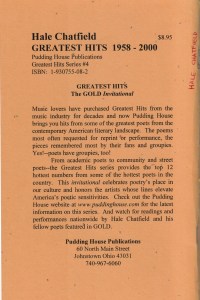
Jennifer Bosveld at Pudding House was my first editor and publisher. I was a finalist in her poetry chapbook contest and she helped me put the finishing touches on Barb Quill Down in 2004. During three decades of Jennifer’s fiery leadership, Pudding House published dozens of anthologies and over 2,000 chapbooks, including the infamous Greatest Hits Series. Jennifer would invite a poet she admired to select a handful of her or his favorite poems and publish them with commentary. Hale Chatfield was #4 in the Series. Jennifer Bosveld left her mark on me: I still treasure the manifesto she included as preface in every single collection she published:
 . 
Publisher’s Position Statement
on the Value of Poetry Arts
This chapbook is limited edition fine art from the poet
Hale Chatfield
whose work you support for a few cents per page. you are not buying paper and printer’s ink by weight. You selected language art that took as long to create as paintings or other fine art. Pudding House caters to those who understand the value of the poet’s good work. We are in business to make and enhance reputations rather that to assure profits for our press. Manuscripts are chosen on the basis of their contributions to the literary arts and to the popular culture. On behalf of a large community of contemporary poets, this poet is particular, and Pudding House Publications, thank you for your patronage.
 . 
 . 
 . 
Hale Chatfield (1936-2000) was professor and dean at Hiram College in northeastern Ohio and founded the Hiram Poetry Review. Besides publishing sixteen books, including eight poetry collections, he created an educational television series on poetry with NBC-TV. He was an early proponent of computers in education and founded Chatfield Software, Inc. At Linda’s first encounter, he introduced the class to a spreadsheet of grammar and style he used to mark their papers, including the dreaded “D-13″ = cliché.
..
 . 
Jennifer Bosveld (1945-2014) was a powerhouse advocate for the literary arts in Columbus, Ohio and throughout the region. She founded Pudding House, at one time the nation’s largest small press for poetry. She also worked as a suicide-prevention counselor and directed Ohio State University’s Disaster Research Center and the Friends of the Homeless. Jennifer received the Pioneer Award of the National Association for Poetry Therapy, which she co-founded in 1978; a Dispatch Community Achievement Award for cultural advancement in 1986; and an Ohio Arts Council poetry fellowship in 1996.
 . 
 . 
❀    ❀    ❀    ❀    ❀
 . 
Thank you for visiting Verse and Image:
. . . . . every Friday I present one or two poems I’ve read this week that particularly speak to me;
. . . . . every Saturday I present one or two poems submitted by YOU, my readers.
 . 
If you would like to offer a poem for consideration, either by a favorite author or your own work, please view these GUIDELINES for Saturday Readers Share:
 . 
 . 
If you would like to receive an email each time a post appears, please SUBSCRIBE to Verse and Image using the button on the Home Page.
 . 
If you have a hard time finding the SUBSCRIBE button on this WordPress site, you can send me your email address and I will add you to the subscriber list. Send your request to
 . 
COMMENTS@GRIFFINPOETRY.COM
 . 
Thanks again for joining the conversation.
 . 
– Bill
 . 
 . 
 . 
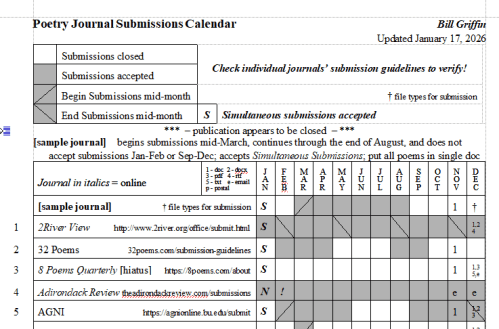
Calendar Update – January 17,2026
 . 
My friend Scott Owens asks this question: What is it that poets want?
 . 
The answer: To Write! To write and write until fire fills the room and our words burn themselves into the page. Or at least to come back to what we wrote yesterday and say, well, that’s not so bad.
 . 
Some poets, not all but some, also want to be read. Some of us would like our poems to be read by someone other than our mother, our friend, our teacher. So we send our poems to editors.
 . 
I share this Submission Calendar in hopes it will make the process a little easier. It will not convince you that your poem is okay or hold your hand when rejection arrives, it probably won’t ease the process of saying goodbye as your poem speeds into the ether, but it will help you put your poems in editor’s hands.
 . 
 . 
Here’s how I use the CALENDAR:
 . 
It’s arranged by month – look down the column to see what journals and sources are open for submissions right now!
 . 
Each row includes the web address – be sure to check before you submit, because requirements and schedules are always changing!
 . 
The row also includes other information such as:
Is this an online publication only?
Should your submission include all poems in a single document?
What file formats do they accept?
 . 
There are more instructions on the table itself. Feel free to print it out. The table currently (17 Jan 2026) contains 353 listings, including journals on hold or defunct (to save you from wild goose chases). At the end are some random references I’ve collected, a table of winners and losers on promptness of reply, and a few journals accepting art & photography.
 . 
I would really appreciate it if you notify me of any errors or suggested changes! If you have journals you’d like me to add to the table please do send me the particulars! I will try to post an updated table once or twice a year and whenever I have made significant additions and corrections to the table.
 . 
A sad postscript: as I checked listings for this update, I encountered many lit mags, both online and print, whose doors are shuttered. Some have no residual online presence at all. I can only imagine the stress that small publishers feel in our current culture, where art and truth are under full-throated attack. If you are able to make a donation, large or small, to your favorite publisher, you are keeping literature strong. You are worthy of praise.
 . 
❦ ❦ ❦
 . 
May your own poems leap out and insist upon their acceptance to the friendly neighborhood editor who is reading them. And even if they don’t, well, that was at least one reader!
 . 
If  you find this useful, if you can suggest more journals to include, or if you discover errors please send me a comment, correction or suggestions at:
 . 
comments@griffinpoetry.com
 . 
BILL GRIFFIN / ELKIN, NORTH CAROLINA / USA
 . 
❦ ❦ ❦
 . 
Oh, and here’s the origin story: In 2015 I posted the prototype of this table as I was developing a tool to keep track of when and where to submit poems for publication. As the second of a two-part muse on why oh why we place ourselves at the mercy of all powerful editors, here’s the original post with description, but make sure you’re using the link at the top of this page for the most up-to-date version:
 . 
 .