Feeds:
Posts
Comments

Posts Tagged ‘Redhawk Publications’

[with poetry by Alana Dagenhart]

Here, take some with you. You’re not likely to leave my Dad’s presence without hearing these words. It could be a little plastic tub of leftovers from the meal I just brought him and Mom; maybe cookies or a chocolate; a couple of apples – he says he and Mom can’t eat them all. You’ll definitely be carrying the stack of New Yorkers and Sunday funnies he’s been saving. Just try leaving empty handed after visiting my Dad, just try.

Here, take some. How many years before I realized he always has and always will say this? How long have I been trying to analyze why he does? Does anyone ever really understand their father (or their son, for that matter)?

Here, take. It can be too easy to overlook Dad’s deep, even urgent, desire to give. He may seem stubborn and commandeering (just like me, although I prefer “assertive”). He takes charge of every conversation (probably because he literally can’t hear anyone talking but himself; maybe he thinks he’s just filling an awkward lull). Admit it, he acts like a Dad – so let me cut him some slack and open my eyes to the source of his generous essence.

Dad grew up during the Depression in the rural South – just imagine. World War II paid for him to go to Duke. He worked for the same huge company from the time I was four until he retired; he always seemed to be traveling and working at home nights & weekends. Because of Dad’s promotions we moved three times in two years while I was in Junior High (origin of my many quirks, no doubt), but then he declined promotions so my little sister didn’t have to move midway through High School.

Dad saw to it that I graduated from university and med school with no more debt than I could manage. When Linda and I got married and our old boat of a car couldn’t bear the load, Dad towed a trailer from Ohio to North Carolina to meet us after our honeymoon. All these years I can’t recall him spending money on himself, except maybe golf clubs every few decades, but Dad will keep shelling out whatever it takes to maintain the old beach house so all his grandkids can go on enjoying it after he and Mom are gone.

Don’t you want some more? Oh yeah, that’s the other thing Dad says. I hope he can hear me when I reply, “Thanks, Dad, it’s been plenty.”


.     .     .     .     .     .     .

All the Silver Space

Fire pops and burns blue, Sunday morning
October in the Blue Ridge Mountains.
Hiss and hum, the constant roaring –
wood is changing,
solid to light,
before my eyes
like you, Dad
muscle to sacks of dry ice.
We both know.

I walk the mountain top trail
yearning for afternoon heat,
your sun in my bones

Sunset: the inside of a buttercup
empty at the horizon.
The sky fades like a tie-dyed tee-shirt,
from canary to lizard
gravel to irises to ocean.
The underbellies of clouds
are streaked in cotton candy.

Moon again, full and daring
around pine and rock.
Your blue eyes
not saying what we know
to be true. Back

cover first.
I knew to look,
bottom corner,
last page of the book,
your handwriting
small and faint.
You didn’t even want to leave a mark.

Alana Dagenhart

.     .     .     .     .     .     .

Alana Dagenhart’s Yellow Leaves is not a narrative time line, it is a lyrical collage of visions and visitations interwoven with the relentless thread of her father’s death. We enter her dreams, intrusive but illuminating; we get to know ancestors imagined and remembered; we are invited to share Alana’s days most mundane and most profound. The thread of family tangles and unspools, knots and releases, and what could be dark, somber, a burden too heavy, becomes another bright morning, all the colors of revelation, a yellow leaf whirled and unsettled finally discovering its place of rest.

All today’s poems are from Yellow Leaves, Alana Dagenhart, Redhawk Publications, Hickory, NC. © 2022

.     .     .     .     .     .     .

Yellow Then, Will Fly to Every Eave

The blackest bruise
of our human trauma may
not heal completely through.
Some lingering yellow stays.

But Nature’s first green is gold,
her hardest hue to hold,
and what was yellow once and bold
fades in time in form and folds.

Blue will tend the sky of day,
and black will stay the night,
but yellow always leaves again
when sun is out of sight.

Death’s second self, made up of all
the dark the Earth contains,
snuffs bright yellow out, till
none but veiled despair remains.

Then violence bangs
& cuts us to our knees,
blooded-violet searing pain,
rooted between burning trees,

Coral dies, and chestnuts’ blight,
and green is gone –
all gone to dust and yellow leaves.

Unless a poet writing through the night,
will pen an echo fluttering of light
and yellow the, will fly to every eave
and someone late will read from time-tinged leaves

a verse or tow that speaks to them alone
a shelter of thatched pages, like a home.

Alana Dagenhart

Nature’s first green . . . from Robert Frost’s Nothing Gold Can Stay; Death’s second self from Shakespeare Sonnet 73.

.     .     .     .     .     .     .

What Yellow Light

illuminates the fields of the dead?
What fevered hue burns hot
on the faces of our beloved?

What lime? What straw?

What platinum beam cast triangles
on the oak board floors
of the room they wait
beyond this spectrum?

The Yellow Submarine blaring loud
COMCRUDESLANT command
where sailor scrub-shine metal
and Navy top brass smile big teeth
behind sunglasses?

The neon yellow of the pick-up truck
where my brother and I rode
our backs against the cab
in October, Boone, the Blue Ridge
with our legs under a patchwork quilt?

Th old gold of historic hallways
restored in the color of statesmen?

The palest lemonade sides
of papa’s house, squash in the filed
a buckwheat horse?

The sure blonde of my towheaded little brother?

What frequency has that light?

Is it far from here?

Alana Dagenhart

.     .     .     .     .     .     .

.     .     .     .     .     .     .

POSTSCRIPT: Dad at age 95 says some scary stuff, too. The most anxiety provoking = I have complete confidence in my ability to drive. The ability part is scary enough but the confidence is terrifying.

.     .     .     .     .     .     .

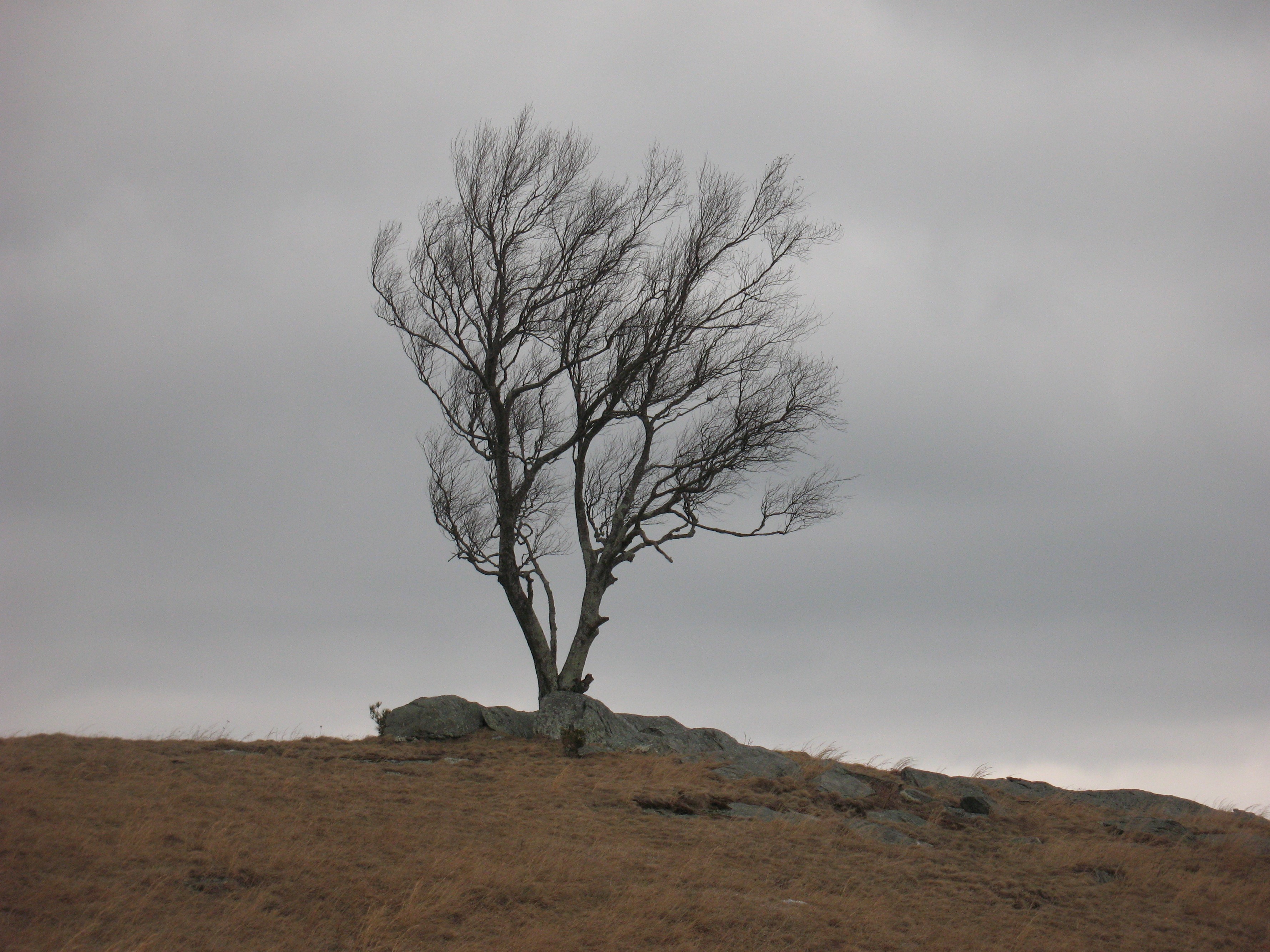
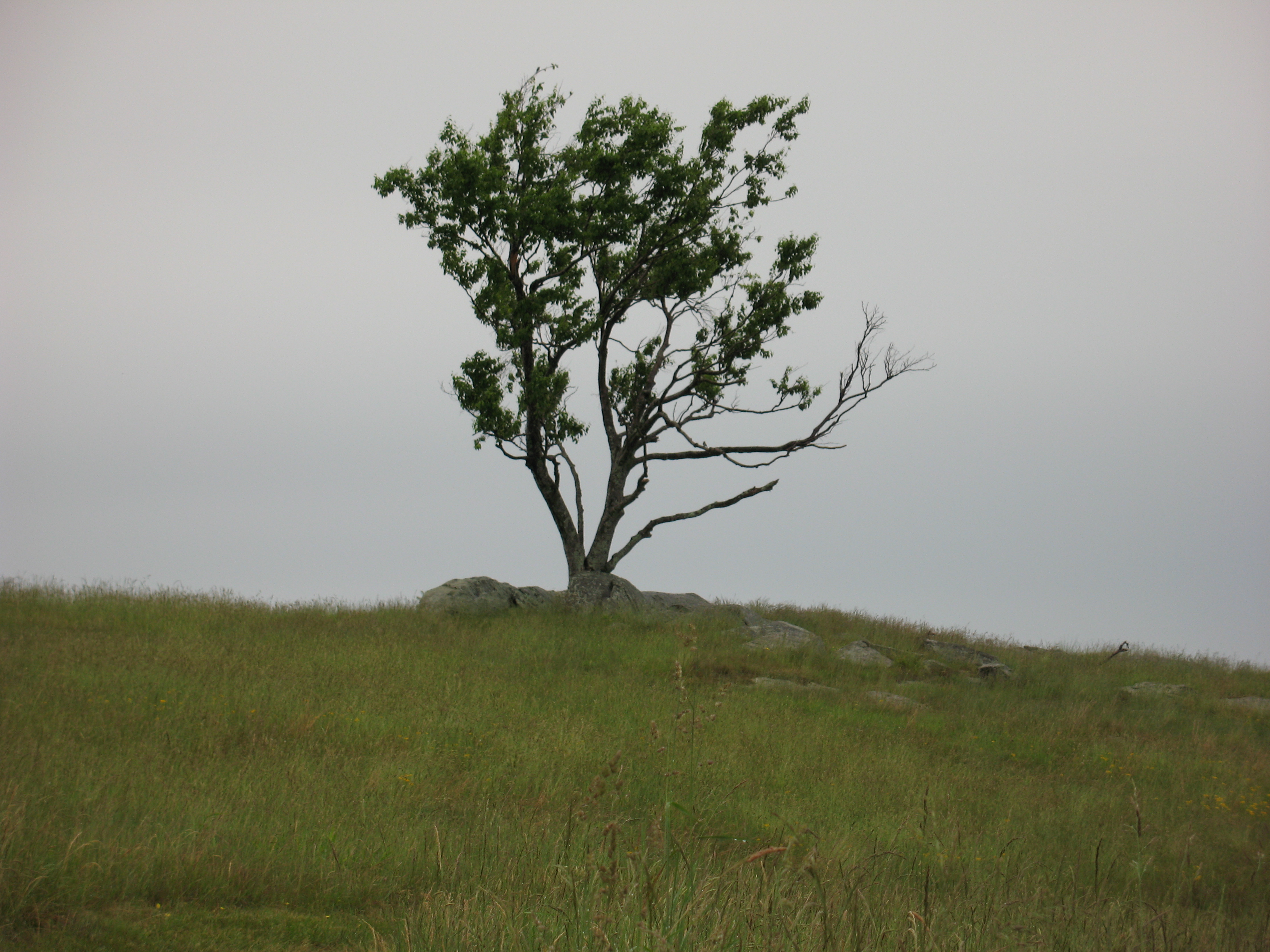
2016-10-17a Doughton Park Tree


Read Full Post »

[with 3 poems by Scott Owens]

Which came first? Separate a few of the living creatures in the photo above and see what you can identify: the distinctive mottled leaf of Saxifrage; beneath it a glimpse of moss, its diminutive creeping green; a big hairy leaf, I should know that one but I don’t. Down in the damp there’s bound to be a little township of bacteria, waterbears, wormy things, arthropods.

And what’s that right in the center? A little stemmed goblet corroded like verdigris growing out of that patch of gray-green flakes (squamules)? Center stage – lichen, probably Cladonia pyxidata. Its tiny cup is pebbled within by extra lichen bits growing there (more squamules!) and some of the rough and powdery appearance may be an obligate lichen-loving fungus taken up residence. So which came first in this little community of many kingdoms and phyla?

Most likely the lichen comes first. It can hold onto bare rock where nothing else lives. It gathers moisture into itself out of the very air and how could a wandering moss spore resist? Anything drifting by may land and latch. Plus that little lichen chemical factory can break down rock so that others may use the minerals. Pretty soon a Saxifrage seed finds just enough earth to sprout and enough wet to grow and wedge its roots further into rock (saxifrage = rock-breaker). Everything discovers what they need; everyone adds to the life of the community.

What gifts may I add to my little community? A bit of cautious optimism and encouragement. An appreciation for all living things (OK, yes, that does extend to human beings, at least I’m trying my best). Appreciation of a good joke and appreciation as well of the folks who tell bad jokes. Curiosity and a sense of wonder. The world’s best recipe for Nutty Fingers.

We all need something but we all bring something. Who knows, maybe what I’ve got is just what you need. When one really gets down to it, all the stuff growing in that photo looks pretty haphazard and messy. Just like a real community. Just like life.

And if you know what that hairy leaf is, please tell me!

.     .     .     .     .     .     .

In the Cathedral of Fallen Trees

Each time he thinks something special
will happen, he’ll see the sky resting
on bent backs of trees, he’ll find
the wind hiding in hands of leaves,

he’ll read some secret love scratched
in the skin of a tree just fallen.
Because he found that trees were not
forever, that even trees he knew

grew recklessly towards falling,
he gave in to the wisteria’s plan
to glorify the dead. He sat down
beneath the arches of limbs reaching

over him, felt the light spread
through stained glass windows of leaves,
saw every stump as a silent altar,
each branch a pulpit’s tongue.

He did not expect the hawk to be here.
He had no design to find the meaning
of wild ginger, to see leaves soaked
with slime trails of things just past.

He thought only to listen
to the persistent breathing of tres,
to quiet whispers of leaves in wind,
secrets written in storied rings.

Each time he thinks something special
will happen. He returns with a handful
of dirt, a stone shaped like a bowl,
a small tree once rootbound against a larger.

Scott Owens
from Sky Full of Stars and Dreaming, Red Hawk Publications, © 2021

.     .     .     .     .     .     .


I’ve admired Scott Owens for many years, not only as a poet but even more so as a builder of community. Scott’s writing wields its openness, its wonder, its unflinching honesty to invite us to realize we are all part of one human family. As in his poem, Words and What They Say: the hope we have / grows stronger / when we can put it into words. Not only words – in everything else he does Scott is building as well. He teaches, he mentors, he makes opportunities happen for the people around him. Perhaps his poems are a window into why he values people as he does, and why he works so hard to make hope a reality.

Sky Full of Stars and Dreaming is Scott Owens’s sixteenth poetry collection. He is Professor of Poetry at Lenoir Rhyne University, former editor of Wild Goose Poetry Review and Southern Poetry Review, and he owns and operates Taste Full Beans Coffeehouse and Gallery where he coordinates innumerable readings and open mics, including POETRY HICKORY, and enlarges the community of creativity.

.     .     .     .     .     .     .


The Possibility of Substance Beyond Reflection

I didn’t see the V of geese fly overhead in the slate gray sky as I sat waiting for a reading in my Prius in front of the Royal Bean Coffee House & Gift Shop in Raleigh, NC.

What I saw was the V of geese presumably flying overhead in the slate gray sky reflected in the slate gray hood of the Honda CRV parked before me in front of the Royal Bean Coffee House & Gift Shop in Raleigh, NC.

And they took a long time to travel such a short distance, up one quarter panel, across one contoured crease, then the broad canvas of the hood’s main body, down the other crease and onto the edge of the opposite quarter panel before

disappearing into the unreflective nothingness beyond, where even they had to question just how real they were or just how real they might have been.

Scott Owens
from Sky Full of Stars and Dreaming, Red Hawk Publications, © 2021

.     .     .     .     .     .     .

Sharing a Drink on My 55th Birthday

Sharing a drink on my 55th birthday,
my son, his tongue firmly planted
in his cheek, asks what advice I have
for those not yet as old as I,
and I, having had too much to drink,
miss his humor and tell him
always get up at 5
as if you don’t want to miss
any part of any day you can manage.
Clean up your own mess
and don’t clean up after those who won’t.
Take the long way home,
hoping to see something new,
or something you don’t
want to not see again.
Stay up late, drink in as much
of every day as you can.
Be drunk on life, on love, on trees,
on mountains, on spring,
on rivers that go the way
they know to go,
on words, on art, on dancing,
on poetry, on the newborn
fighting against nonexistence,
on night skies, on dreams, on mere minutes,
on the ocean that stretches beyond
what you ever imagined forever could be.
And when someone asks you
what advice you have, give them,
as you’ve given everyone and everything,
the best of what you have.

Scott Owens
from Sky Full of Stars and Dreaming, Red Hawk Publications, © 2021

.     .     .     .     .     .     .


.     .     .     .     .     .     .


*** Extra Geek Credit — the lichen Cladonia pyxidata is host to the lichenicolous (lives on lichens) fungus Lichenoconium pyxidatae. Such fungi are parasites of their lichen host and mostly specific to a single genus or even to single species of lichen, but although some may be pathogens for the lichen in many cases the relationship is commensal. No harm done. Join the party!

Read Full Post »


[poems by Joyce Compton Brown and Billy]

Happy Birthday to Me!

Yep, February 11, this is my day. Sixty-nine years ago my Mom was probably feeling the Niagara rumble from her birthing bed on the umpteenth floor of St. Mary’s. On the American side of the Falls, if you were wondering. Name already picked out – Eugene Wilson the Third – but already in use by Dad and Granddaddy so nickname picked out as well – Billy.

In a few years Mom and Dad moved back down south – Memphis, this time – then over the next ten years to Delaware, Michigan, finally Ohio, but never back to their home state of North Carolina. “Here’s to the land of the Long-Leaf Pine, a summer land where the sun doth shine.” Linda and I moved to NC a week after our wedding – to Durham, Duke Med – and held a place for them here. Just in case.

It’s a good thing. Ten years ago Mom and Dad at last resettled near us, Winston-Salem, where Mom grew up and went to Reynold’s High. They’re right across the street from historic Old Salem. I visited yesterday (secretly hoping there might be cake and candles – Birthday Party #1-of-many). Today I’m expecting Margaret and Bert (4) from Raleigh. Maybe tomorrow Saul (13) and Amelia (6) from across just around the corner. Maybe more cake?

So what do I actually want for my birthday? In Russia I’d have a pie with my name in the crust; in China a longevity noodle that fills the entire bowl (with scallions & bok choy); Hungarians would pull my earlobes (69 times); Jamaicans would dust me with flour.

All those sound awesome, but no, don’t bring presents. I have a walk in the woods with Linda planned. I have Grandkids to wear me out and make me laugh. We have the Blue Ridge with its arms spread to hold us here, not saying much, not needing to. Trees and mountains, family, homeplace – happy birthday to me!

.     .     .     .     .     .     .

.     .     .     .     .     .     .

Looking Across

the fog shuffles
++++ within
++++ ++ the folded mountain

whispers
++++ old stories
++++ ++ of before we were

Joyce Compton Brown
++++ from Standing on the Outcrop, Redhawk Publications, © 2021

.     .     .     .     .     .     .

I’ve heard Joyce Compton Brown read her poetry at many a gathering and my admiration still grows and grows. There is a treasure of different voices in this collection from Redhawk, Standing on the Outcrop, but they all have in common their deeply felt truth, authentic as hunger and earth. These are rural voices, Southern voices, mountain voices, mostly from the first half of the twentieth century; they are telling urgent stories in danger of being lost if Joyce does not hear them and reveal them to us. Places, history, personal struggle, hard-won triumph — these are Joyce Brown’s specialties and she here treats them well.


.     .     .     .     .     .     .

Mattie, 1955

Before our families came
++++ there wasn’t much.
They say there were some old forts,
++++ and arrowheads
the men turned up
++++ in the plowing.
We mad collections,
++++ sent them to school
++++ ++++ for the kids to show.

They say these pastures
++++ were good hunting grounds,
And I don’t wonder,
++++ look at this land, these two mountains –
Linville, with its craggy top, Honeycutt
++++ folding on up toward the highlands,
this river, the clearest water.
++++ Any living thing would be drawn
++++ ++++ to this valley.

they say the Catawba and Cherokee fought
++++ over it till we came.
Then they fought us.
++++ It was perfect for these farms.
You can still see,
++++ those big old white houses
from before the land got too divided
++++ and people had to find work.

They say it had a name,
++++ Conasaga, an Indian word
for beautiful valley.
++++ That may just be talk.
But we use the name
++++ for our cookbook, and the kids use it
for their school yearbooks.
++++ They like the way it sounds.

Joyce Compton Brown
++++ from Standing on the Outcrop, Redhawk Publications, © 2021


.     .     .     .     .     .     .

Stroke

Afterwards he was free
to speak a new language,
come back to tell them all.

They strained to understand
to interpret his assertions
to feel his newfound power.

He told them how
he’d hated factory saws
the whine of lathe and blade

Told them how
the smoldering glow
held by tight-closed lips

kept him from
trying to tell
what they didn’t

want to hear.
How he’d loved
his fingers shuffling

guitar strings
that flatpick style
speaking its own sad voice

milking the cow
in his own sweet barn
before everybody else was up

They couldn’t see
the fiery tongue
above his head.

They couldn’t feel
the pyretic fury
in his mind.

But now he was
at center, felt the
glow from lips of fire,

felt the heat
in seething brain,
felt the gift

of flaming tongue,
watched them all
leaning inward.

Joyce Compton Brown
++++ from Standing on the Outcrop, Redhawk Publications, © 2021


.     .     .     .     .     .     .


.     .     .     .     .     .     .

I’ll close my Birth Day post with a poem I wrote almost 20 years ago. Oldest son, first grandson, I was always the good boy. Never got into trouble (or at least never got caught). High school class pres. Early admissions, graduations with honors. Married my high school honey and we’re still best buds.

(Although when we were college Juniors and told my parents we wanted to get married, my Mom said, “Oh thank goodness, I’m so glad you didn’t decide to run off and live in a commune!” I guess maybe my hair was a little on the long side that year.)

Being the eternal good boy might become a burden – especially when one knows full well that one is not nearly as good as everyone makes out. (But anyway I prefer, Linda too, the silence of a forest to the company of people – no dang commune for this good boy.)

.     .     .     .     .     .     .

Good Boy Turns 50
++++ “I ain’t no physicist, but I knows what matters.” – Popeye

How did he earn this golden sobriquet
first christened by Nana for the merest trait
of being born the first grandchild, the grinning gay
toddler who could do no wrong? And wait,
how did he keep it all through the sixties when
pick up your toys and set the table gave way
to a ponytail and poems by Ho Chi Minh
(though there was no doubt he’d still bring home the A)?
Forever the glass-half-full sort of guy,
in marriage, too, he hefts vows more abundant
than Old Fred’s prescription, “Don’t leave and don’t die” –
the grace of wanting to want what she may want.
++++ So let’s give him what he needs in the next fifty
++++ if he ever discovers what that might be.

Bill Griffin
++++ first appeared in Pinesong, annual anthology of the NC Poetry Society;
++++ ++++ first place in the “formal poetry” category, 2004
++++ collected in Crossing the River, Main Street Rag Publishing, © 2017


.     .     .     .     .     .     .

.     .     .     .     .     .     .

Read Full Post »

« Newer Posts - Older Posts »