Feeds:
Posts
Comments

Posts Tagged ‘poetry’

 . 
[with 4 poems from I-70 Review]
 . 
Bears Active in This Area
 . 
++++ warning sign in my mountain cabin
 . 
This time, others have seen you,
treading circles on the gravel drive,
shouldering through grapevine tangles.
The possibility of you was always here,
in the night-mouth of the cave that gapes
below my porch, in dark boulders
hulking along the trail.
 . 
Your presence countermands silence –
I chatter and sing as I walk the open road,
snatches of carols, toddler songs –
and shy from the path that meanders
to a sunlit filed strewn with windfalls
from long-neglected trees. I imagine
you keeping pace, just out of sight,
your huffs mocking my jabber,
your heavy steps a counterpoint
as I scurry past thickets, scan uneasily
the curving trail ahead, intruder
in a world that was never mine,
though you are the first to insist
that I acknowledge it.
 . 
Rebecca Baggett
from I-70 Review, Eighteenth Edition, 2024
 . 
❦ ❦ ❦
 . 
What would a toddler remember about moving away? The apartment in Niagara Falls is a dream of stairwells and windows and darkness outside; the new house in the new subdivision with no grass at all is a neighbor’s dog named Bishy. Or was Bishy the neighbor’s toddler I played with?
 . 
I am four when we move away again, from New York to Tennessee, and I remember plenty about Marion Road: Bob and I watching Little Rascals until Mom declares, “You’re going to turn into rascals!”; our little sun room Aunt Ellen fitted up as a bed-sit while she attended Memphis State, and we kids hiding giggling under her covers until she came home each afternoon; the neighbor boy who introduced us to the word butt and we thought we were the first humans ever to utter something so outrageous. Memories of the neighborhood, yes, but memories of moving there? Packing and unpacking? Worrying that Puppy would get lost in the shuffle or that somehow Mom wouldn’t be there when we arrived? None of that remains.
 . 
Our family makes one more inconsequential move just blocks away when I am six, but then when I’m twelve the Big Away arrives. Up until this what a tranquil 1950’s childhood: I walk to Colonial Elementary every morning with my friends and play with the same friends every evening until the streetlights come on. Serene. Now I’m midway through sixth grade, still coasting, when the bomb drops. Did I protest when Dad announced in January we were leaving Memphis to move to Delaware? Maybe, I don’t recall; that memory is muddy, but this one is sharp as crystal – I walk into class in my new school and my new classmates all turn to look. My clothes aren’t right, my accent is a joke (literally – within about sixty seconds I will have the nickname “Memphis,” which sticks), and I have a different teacher for every subject. And then in just six more months we will move to Michigan. Just over a year beyond that, two months into eighth grade, we move to Ohio.
 . 
So, my friend, is it any wonder that some sixty years later I have trouble remembering your name until the fourth or fifth time we meet? That as we converse in a group you notice me smiling and nodding and slowly drifting off into space? That I would rather write this blog into the wee hours than drop by your house for coffee? I want to be a good friend to you, and in fact I like you and this hug from me to you is real, but ah, it’s risky. There’s always that possibility, without warning and with no desire on my part, that someday soon I might be moving away.
 . 
 . 
It never occurred to me to wonder how Dad felt about all those moves. The moving was his fault, after all, necessary for his promotions and advancement with DuPont, for whom he worked all his life. I can scarcely imagine the million details he had to sift through to put his family into boxes and take them out again hundreds of miles away. I’m not surprised that as I clean out his house I find drawers full of lists on yellow pads, on the backs of junk mail, on bills and receipts. Half the time when he calls me, it’s to add something to the shopping list. And then there are still those boxes in the attic labeled Allied Van Lines.
 . 
But what about the rest of us? Did Dad wake sweating in the middle of the night worrying how moving away would affect his family? Just one time he blinked: after I was married and gone but Mary Ellen was still at home, a junior in high school, Dad turned down a promotion so she could graduate with her class. A sacrifice that stalled his career for a decade.
 . 
Tomorrow is Dad’s last moving day. Since Mom died in July, Dad has agreed to move closer to us. For a week I’ve ferried boxes and duffels, checked off my lists and then made new ones, and tomorrow after lunch I’ll drive Dad to a nursing center just two miles from our house. He says he’s willing to move as long as the food is good (it is). We’ve hung portraits of the grandkids, pastels by Mom. His Duke pillow is on the recliner and his new Duke banner hangs on the door of room 507 to welcome him. God knows I’ve been waking in the middle of the night sweating the million details. Let us hope that after 98 years of moving, Dad will discover in this new and final home a place to rest.
 . 
 . 
❦ ❦ ❦
 . 
Porta Nigra   *
 . 
++++ Trier, Germany
 . 
The breath of sun and rain
only darkens on my face.
The cat-claws of millennia,
the graffiti of tourists,
fade into my walls.
 . 
I, who guarded this city so long,
sit truncated now.
My frieze the sweaty flesh
of lovers on cool bare stones.
 . 
Catch me in another thousand years,
your eyes as hard and dark as mine.
See if these holes will match
the mysteries of death
and flesh on blackened stone.
 . 
Bradley Strahan
from I-70 Review, Eighteenth Edition, 2024
 . 
* a gate in the remaining piece of Trier’s old Roman wall
 . 
❦ ❦ ❦
 . 
The 2024 issue of I-70 Review arrived in last week’s post. Besides many wonderful voices new to me, I discovered within its pages several old friends who’ve agreed to let me reprint their poems.
 . 
I-70 Review, Writing and Art from the Middle and Beyond is based in Kansas, USA, but publishes poetry, short fiction, and art from around the world. They also sponsor the annual Bill Hickok Humor award for poetry.
 . 
Submission guidelines HERE
Purchase a copy HERE
 . 
 . 
❦ ❦ ❦
 . 
Messenger in Early November
 . 
++++++ – in memory of Jay Klokker
 . 
Driving past Agate Bay, I catch a glimpse
of this deer in a splotch of sun and shadow –
the brown-tail’s flanks on the edge of the road
in yellow leaves, thin branches. Las May
after your death, a bear cub loped beside my car
like a lost Labrador, seemed to disappear
under my front bumper. Slamming on the brakes,
I felt no thud, heard nothing. Amazing, the cub
as if uninjured, clambered up the ditch-bank.
Only later, after your memorial, did I reread
your last poems, that black bear nosing
at your sleeping bag in the camp site
in Arizona; recalled marmots whistling
in the pillow basalt near Mt. Baker; the grouse
thumping its tail near our driveway,
feasting on red hawthorn berries.
You noticed. I cannot believe you said no
to another go-round on the cancer wish machine,
you called it, completed your book First Stars.
On you last hike, you raced downhill
in your wheelchair, shouting. You must
be in these sun spots, mottled shadows.
Too excellent a camouflage, my friend –
thin, flickering branches, a few gold leaves,
before all the color goes away.
 . 
Richard Widerkehr
from I-70 Review, Eighteenth Edition, 2024
this poem will appear in Richard’s new book, Missing The Owl (Shanti Arts Press)
 . 
❦ ❦ ❦
 . 
The Other
 . 
Last night coyotes laughed
at the neighbor’s bulked-up lab restrained
behind his chain-link, his fearful bark,
their yips of liberty and mild derision;
 . 
are coyotes such demons, or just particular
about whom they allow to know them?
Or are they perhaps spirits of the other,
avatar of all we hominids in our marrow
 . 
know to fear? How to live beside that feeling?
Afraid of attack I stab; afraid of pain I cause it.
 . 
In the woods before daylight willingly lost,
soft tread, a twist in the trail then face to face –
perhaps she and I look into each other’s eyes
for two seconds, perhaps the rest
 . 
of my life; coyote impassive,
considerate, measures our distance,
our closeness, then softly pivots
and pads away, prudent, fearless,
 . 
willing to allow the two of us
to share the universe.
 . 
Bill Griffin
from I-70 Review, Eighteenth Edition, 2024
 . 
❦ ❦ ❦
 . 
 . 
❦ ❦ ❦
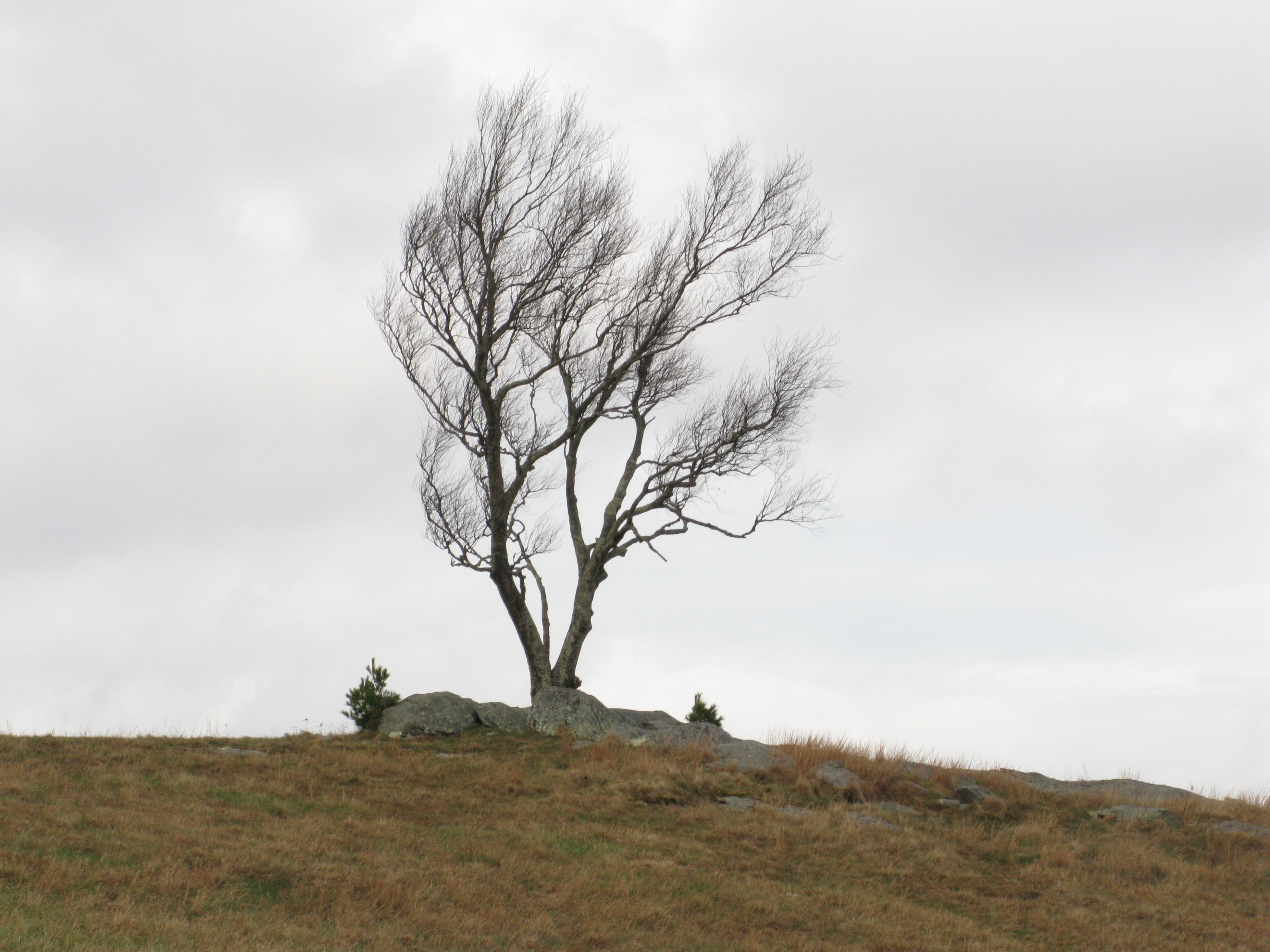
Doughton Park Tree 2020-09-08b

Read Full Post »

I learned today from our friends at CHARLOTTELIT that Dannye Romine Powell died on October 10, 2024. She was a joyful and fearless supporter of literature, the arts, and poetry in North Carolina for many decades, and whenever I asked her advice or permission to use her work, she was a gracious friend.

I am re-printing this post from December 30, 2020 so that we can share again these evocative poems by Dannye. In Memoriam.

 . 

❦ ❦ ❦

 . 

NEW

 . 

[with poems by Dannye Romine Powell]

When we lower her pack from the tree where it has swung all night like a bell mocking the bear, the skunk, she opens it and screams: a fairy crown atop her sweatshirt and socks, a perfect round nest and four perfect hairless mouse pups like squirming blind grubs. We peer in awe, shepherds at the manger.

Mother mouse has hidden herself — she is not in the pack with her babies. We lift the nest intact, hide it in a bush beside the tree, nestle leaves around. Mother will sniff out her precious ones, reclaim her treasure. But we have other lambs to tend.

We eat, stow gear, shoulder our packs, face the trail, and consider: the pack was in the tree just one night; the nest is woven from meadow grass where we slept; the mother who climbed – how many trips up and back? – was heavy with her brood.

Miles before us, a new year before us – how heavy will each day’s burdens become before night brings rest?

.     .     .     .     .     .     .

A new book by Dannye Romine Powell arrived in the mail this week: In the Sunroom with Raymond Carver from Press 53 in Winston-Salem. I meant to read one or two poems this morning but I have read them all. A central persona that weaves through the collection is Longing: she visits rooms in old houses, unfolds memories into the light, shares the pain that others might lock in closets. Grief shared conceives within us hope to rekindle joy. Sharing grief, sharing joy, we become more human.

.     .     .     .     .     .     .

The Secret

Light glazes the near-empty streets
as I drive. Beside me, my grown son asks
if a secret I thought I’d kept buried
is true. A secret
that can still catch fire.
We stop on red. A bird flies
by the windshield. My father’s words:
Easier to stand on the ground
and tell the truth than climb a tree
and tell a lie. Now, I think. Tell him.
I stare at my son’s profile,
straight nose, thick lashes.
I remember, at about his age,
how a family secret fell
into my lap, unbidden.
That secret still ransacks a past
I thought I knew, rearranging its bricks,
exposing rot and cracks,
changing the locks on trust.

.     .     .     .     .     .     .

In the Night, the Wind in the Leaves

swirled and rustled
out our open window as if
for the first time,
as if we never were,
the earth newborn, sweet.

And what of us – asleep
on the too-soft bed
in the old mountain house?

Gone.

Also our children.
the ones who lived, the ones who died
before they grew whole. All night

the breeze swirled and rustled
through the leaves as if it played
a secret game, swirling
and rustling all night

as if we never were.

from In the Sunroom with Raymond Carver, Dannye Romine Powell, © 2020 Press 53

.     .     .     .     .     .     .

Dannye Romine Powell has won fellowships in poetry from the NEA, the North Carolina Arts Council, and Yaddo. Her poems have appeared over the years in The Paris Review, Poetry, Ploughshares, The Southern Review, Harvard Review Online, Beloit, 32 Poems, and many others. She is also the author of Parting the Curtains: Interviews with Southern Writers. For many years, she was the book editor of the Charlotte Observer. In 2020 she won the Randall Jarrell Poetry Competition for her poem “Argument.”

.     .     .     .     .     .     .

Read Full Post »

 . 
[with 3 poems by Rae Spencer]
 . 
Innate
 . 
what does a hummingbird know
in its world of nectar and need
 . 
nightly forced to torpor
by the constant urge to feed
through staggering migration
 . 
are its dreams equally desperate?
 . 
does it wake hungry
ill-tempered with beauty
cramped with desire
 . 
suddenly alert to the nature of sugar
aware that satisfaction can only ever be
 . 
illusory
 . 
and what does the hummingbird sense
as it sips the flower’s allure
 . 
does it know of delicate meanings
pitched fever-tight
into its tiny world of furtive speed
 . 
dare I surmise anything?
 . 
maybe nectar is only a meal
sugar an ache that will pass
beauty an accident of form
 . 
and nothing means more than a wing
clasped into the air and released
 . 
effortless
 . 
Rae Spencer
from Alchemy, Kelsay Books, American Fork, UT; © 2024
 . 
❦ ❦ ❦
 . 
Hovering to sip sugar water, flicking your tongue into the red plastic flower, then dive bombed by a lance-tipped green blur – this is daily life for a hummingbird in the Eastern US. We only have the one species here, ruby-throated, and they do not play well with others. When it comes to a choice feeder there is no sharing, unlike the scene in the Western US where a cloud of a dozen birds, four or five different species, will jointly keep a feeder sincerely humming.
 . 
These last two weeks of September we have been visited hourly by the chunkiest hummingbird I have ever seen. The sleeker slimmer birds will chase her away but then she’s right back. (She-birds only; all the males have left for Central America by the end of August and these more svelte visitors and chasers have likely already burned fat as they’re migrating through from farther north). I realize hummingbirds have to bulk up each autumn, entering a period of hyperphagia before migration similar to black bears before hibernation, but this bird is a real hunk. She is going to have no problem making the 800 km flight from Florida to Yucatan, a natural miracle for such a tiny creature who, even at twice her normal body weight, still weighs only 6 grams – about the weight of a postcard, or of the well-sharpened pencil you’ll use to write a note to Guatemala to let them know to expect this ruby-throat in a couple of weeks.
 . 
Audubon NC suggests continuing to fill hummingbird feeders until the second week in October. Abundant sugar will not deter the birds from setting out on their southward journey; their migration is triggered by light, or actually its absence, the diminishing length of day. All creatures live by their own internal clock. For some the clock’s ticks are soil temperature, snowmelt, the movement of water through earth; for others alarms are set by earth’s rotation and the stretch of sunlight and shadow.
 . 
And no creature lives in isolation. What if come clocks tick out of rhythm with the others? In the Western US, when broad-tailed hummingbirds arrive from their wintering grounds they depend on spring-blooming glacier lilies for nectar to replenish their exhausted energy. By 2012, however, biologists noted that the lilies were beginning to open seventeen days earlier than they had several decades prior. Some would already be withered before the hummingbirds even arrived. By 2050 the birds may completely miss the span of lily bloom.
 . 
Phenological mismatch is the term for this consequence of global climate change. What if migrating flycatchers miss their fly hatch? What if flowers bloom to no pollinators? Some species seem to benefit from early spring – marmots have a longer season to chow down and birth more marmettes. Some species can adapt to new timings but many can’t, especially as climate clocks accelerate their vagaries and variations. We can’t yet know all the consequences, but we know our children and grandchildren are experiencing a different world from the world in which we grew up.
 . 
 . 
❦ ❦ ❦
 . 
Belyaev’s Foxes
 . 
When most only wanted their fur
Belyaev wanted their genes
 . 
He selected those he could touch
The ones who ate from his hand
 . 
Exerting curious pressure
On his wild silver stock
 . 
Closed in outdoor cages
To bear Belyaev’s chosen litters
 . 
Where is the gene for submission
For loyalty and bonding?
 . 
Somewhere, it seems
Connected to curly tails
 . 
White stars on the face
Flopped ears and blunt snouts
 . 
Wags and whines and barks
Which compete for favors
 . 
Other than food
So Belyaev’s foxes tamed the men
 . 
With prolonged puppyhood
And after thirty generations
 . 
Heeled happily across their yard
In through the open front door
 . 
Rae Spencer
from Alchemy, Kelsay Books, American Fork, UT; © 2024
 . 
❦ ❦ ❦
 . 
Embryology, cosmology, evolution . . . double helices, insect wings, quarks . . . mystery, contemplation, enlightenment: the poems of Alchemy wend their way through an expanding universe of discovery. There is scarcely a field of science or philosophy that Rae Spencer does not embrace in this collection, using language both precise and technical as well as elevated and elevating. This slim coverlet of atmosphere that supports us, this beneficent congregation of creatures within such mild extremes of warmth and moisture and light, how can one walking through such a place not be inspired?
 . 
And once inspired, what enters us to feed our hearts, what strikes a tonal chord within our minds What shall we believe in? What shall we hope for? Nothing is beneath our noticing; nothing is unworthy of praise. Perhaps the best way to receive Rae Spencer’s expansive embrace embodied in her universalistic collection is as, in the poet’s own words, a patchwork philosophy of wonder (Agnost).
 . 
 . 
Rae Spencer is a veterinarian and lives in Virginia, USA. Alchemy is available at Kelsay Books.
 . 
 . 
❦ ❦ ❦
 . 
Means of Dispersal
When I view all beings not as special creations, but as the lineal descendants of some few beings which lived long before the first bed of the Silurian system was deposited, they seem to me to become ennobled.
++++++++++++++++++ – Charles Darwin in The Origin of Species
 . 
He spent pages contemplating seeds
How some survived in seawater
Others in the crops of owls
In the feces of locusts
In the stomachs of fish
Frozen in icebergs
Dried in a clump of mud
Between the toes of a partridge
 . 
“In the course of two months,
I picked up in my garden 12 kinds of seeds,
out of the excrement of small birds, and these
seemed perfect…”
 . 
How long in the garden?
Hovering over phials of curiosity
Some rank with the rot of failure
Others yielding green secrets
To the man who struggled to ask
Is there another explanation?
And in the end answered himself
With seed, with barnacles and pigeons
 . 
“…from so simple a beginning
endless forms most beautiful and most
wonderful have been, and are being,
evolved.”
 . 
So Darwin concluded
Without the benefit of Mendel’s peas
Or Watson, Crick, and Franklin’s helices
Without diffusion gels
Sequencers and microchips
Argument is as simple as a garden
Heavy and sweet with fruit
Ripe with answers
 . 
Rae Spencer
from Alchemy, Kelsay Books, American Fork, UT; © 2024
 . 
❦ ❦ ❦
 . 
 . 
 . 

Read Full Post »

« Newer Posts - Older Posts »