Feeds:
Posts
Comments

Posts Tagged ‘poetry’

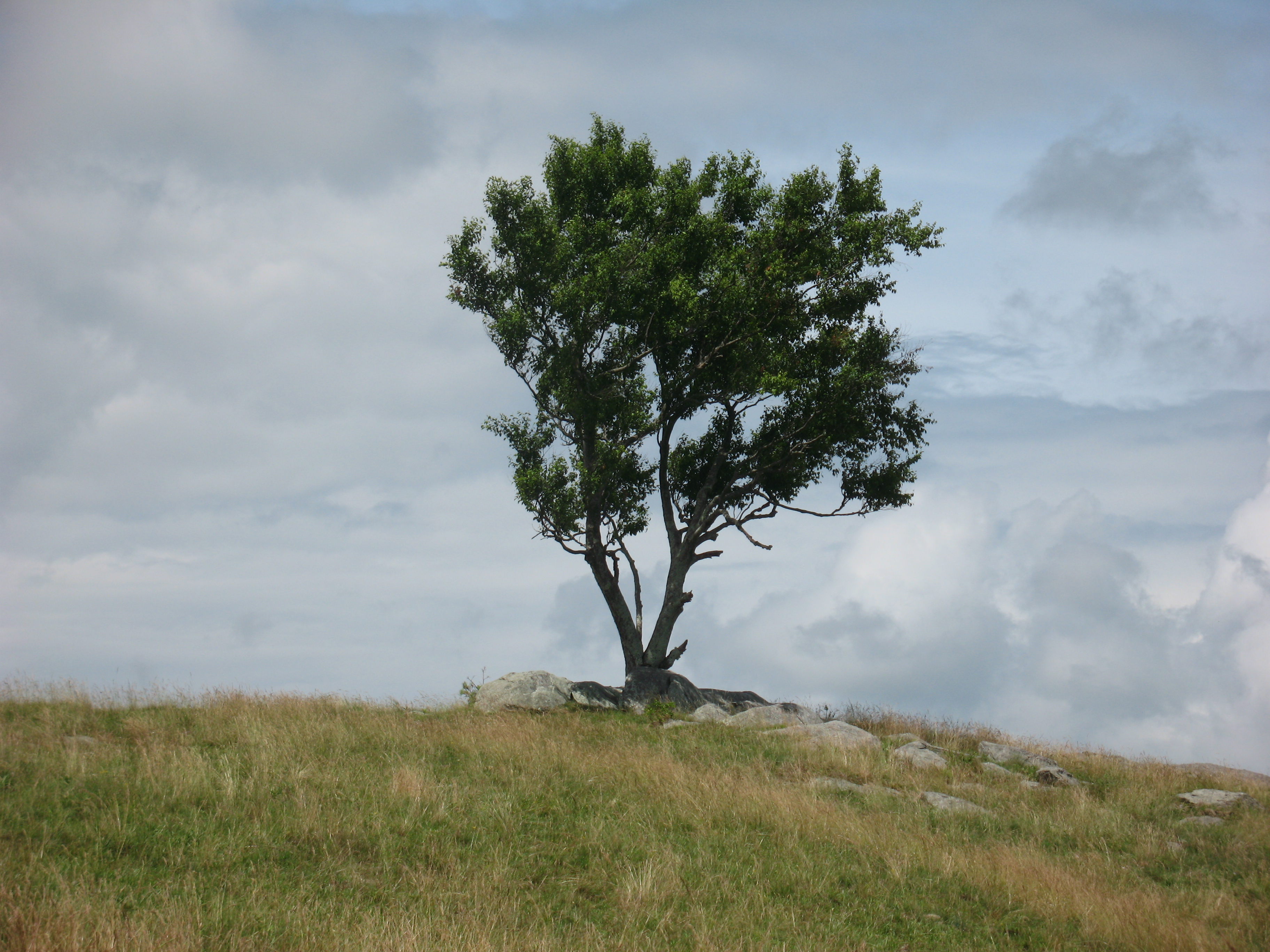
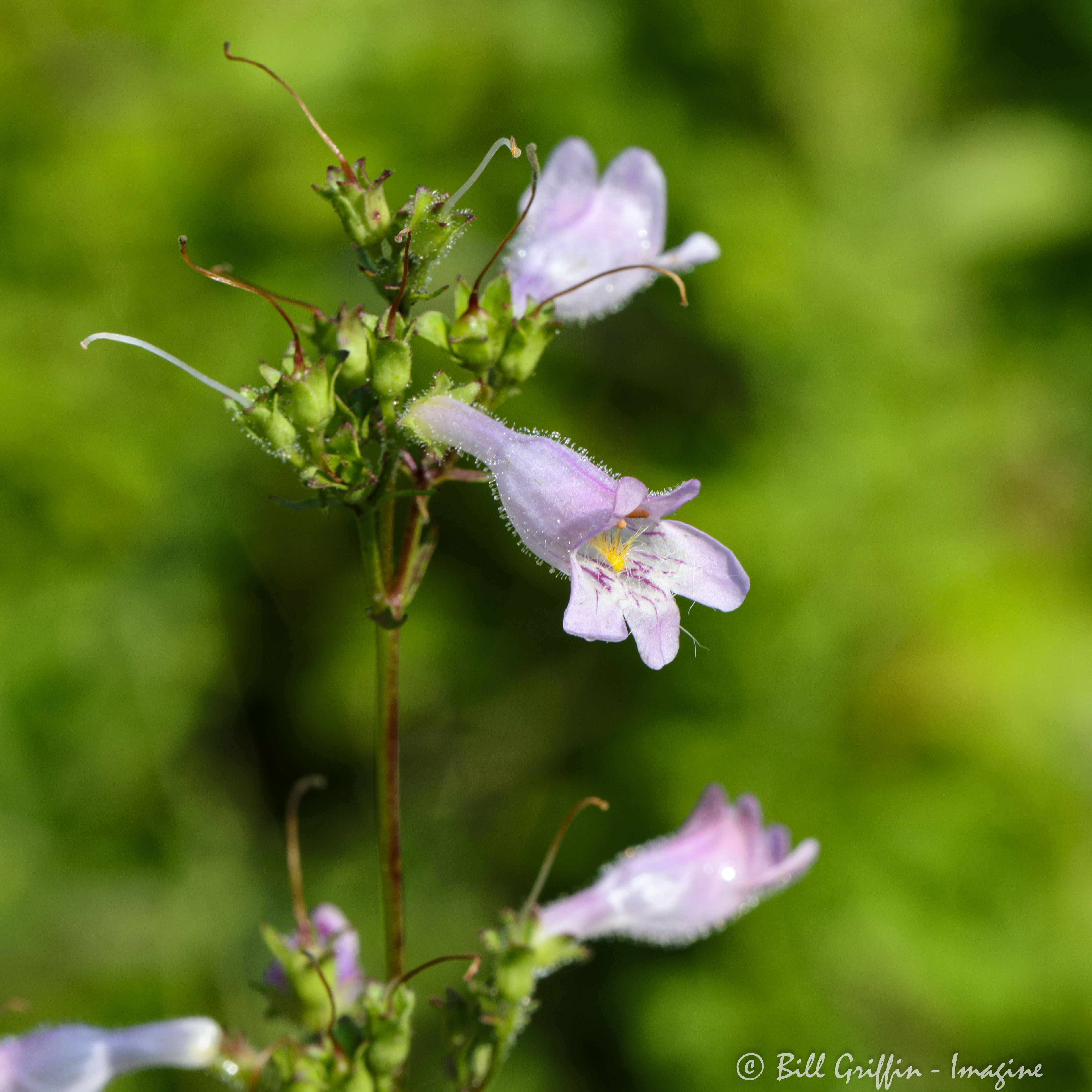
IMG_4192_crop

Albert Mountain Sunrise

 . 
[with 3 poems by Kathy Ackerman]
 . 
Heritage Lost
 . 
Hills are keening,
yellowed voices of serious photos
call me home to “precious memories,
how they linger,
how they ever flood my soul.”
 . 
How in a displaced caravan
we went to lay her down
in shining soil,
flecks of coal on shovels
in the hills of familiar gravestones.
It had to be that church,
that pastor’s family name,
Rock of Ages, Beulah Land.
 . 
How odd to call it home and feel it so
without a waiting bed of down
to follow the wake,
all of us gone north for good,
except for this.
 . 
How we walked between
the railroad and the shallow ditch
collecting tadpoles in a pail
we’d flush in the motel’s aqua bathroom
because I would not understand.
Death, a newborn slippery thing.
 . 
How the stone had to be a heart
to bear the name of Mother,
how the heart had to be a stone
to be left behind
in its rightful place
in the hills near the church
near the home place bought by strangers.
 . 
We packed the memories once again
in bursting overnight bags,
left the motel beds unmade,
because we could
and settled into our procession.
CB radios, Thermoses, Styrofoam,
we headed back up north
to our factories, unions, high schools,
without looking backward.
 . 
Kathy Ackerman
from Coal River Road, Livingston Press, The university of West Alabama; © 2013
 . 
❦ ❦ ❦
 . 
Where is home? Is it a house number, 1074 Marcia Road, a side yard, fence, and oak tree I can still see as clearly as when I was 10? I could walk right through the carport sixty years later and show you exactly where we buried my hamster. Or is home a garage full of cardboard boxes and bric-a-brac from four other homes of parents and grandparents, houses you only spent a few dozens of nights in altogether? Is home the towns those houses occupied? The states?  Whose home is your home? Whose place is yours?
 . 
I was barely four when we moved from Niagara Falls to Memphis. Not until years later was I able to piece together the stories of my parents’ migration, how they drifted together across those red clay counties of piedmont North Carolina, then pinballed via Atlanta to New York before birthing me. All my solid early childhood memories abide in those eight years in Shelby County, Tennessee, that little four-square subdivision on the outskirts of Memphis.
 . 
Then we moved. And moved again. The sixth graders in Delaware mimicked my accent and immediately nicknamed me “Memphis.” It doesn’t take long for a 12-year old to figure out how important it is to fit in. For the next couple decades I can now see that I lived as if the place I was staying would never be the place I stayed.
 . 
Here in the rural South, when you meet someone new question number one is not, “What do you do?” but, “Where are you from?” One longs to fit in; one doesn’t want to whack the conversation with an axe by replying, “New York.” I invented my stock answer right quick: “Both of my parents are from North Carolina.” Subtext: “I want to be from North Carolina. I want you to let me be.”
 . 
I have now lived exactly 70% of my entire lifespan in North Carolina. NC driver’s license, NC property taxes, kids born in NC, grandkids too. Maybe being almost from here is an advantage. Every new state park we visit, every historical factoid, every endemic flower species I learn, every third generation progeny of a friend I greet while out walking – I tally them all securely in my calculus of belonging. Way back when Linda and I arrived in Durham a week after we’d married, a month before I started med school at Duke, we just assumed that in four years we’d be moving back to Ohio to be closer to her huge family. Now it’s been fifty-one years in The Old North State, forty-four of those in rural Elkin in rural Surry County. Lately we’ve started talking about downsizing, moving somewhere we can age in place through to the end of our allotted spans. Linda says, “You know where I’d really like to live?” Oh my God, is Ohio still calling her? Is the place we’ve been staying never to be the place we stay? She looks at me level, no joking here. “Winston-Salem.”
 . 
Well, I guess we are from North Carolina. It’s nice to be home.
 . 
 . 
❦ ❦ ❦
 . 
Cul-de-sac
 . 
From Coal River Road to White Mist Lane
is more than forty years,
several hundred miles
as the crow truly flies, one point to another,
and sometimes back,
no straighter than a crooked river
wrecked by mines.
 . 
Here the landscapers claw in stony earth
to sow some seed
while wings of straw fly it away.
My lawn’s a futile thing
where rocks and trees should be.
 . 
I stoop to gather stubborn stones,
pretend I do it for the grass,
but in their quartz and granite peaks
admittedly ground to bits by time
I find the mountain of my blood
and hear the ancient syllables spilled,
silenced now by cul-de-sac
and swaying Mylar storks,
a neighborhood of strangers
increasing overnight.
 . 
Kathy Ackerman
from Coal River Road, Livingston Press, The university of West Alabama; © 2013
 . 
❦ ❦ ❦
 . 
Linda spots the book on top of my pile, next in queue for reading, and its title speaks right up and makes its demands known. “We need to save this one for Jodi.” Who was born in Ohio but lives in coal country, and whose career has been to tell its stories as naturalist and interpreter in the New River Gorge near Beckley, WV. Indeed, I’ll share it with Jodi, this book I bought from a friend whose poetry I’ve admired for many years, whom I’ve come to know better through the North Carolina Poetry Society Board, and whose more recent book I featured here three years ago. Now I open the book, though, and out spill the connections and intersections. Kathy, just up the road there at Isothermal Community College, I never realized we’ve come from the same place!
 . 
Kathy Ackerman grew up in Ohio (like me, at least from 8th grade on) far from her birthplace and her family’s heritage. In later years she has mainly visited the old home state for funerals, but the landscapes, place names, family memories, and fortunes (or lack thereof) of West Virginia are the palette from which she paints these poems of Coal River Road. This collection is yearning for home, but home is something slippery and out of reach. A bright fleck in a stone might remind her of the mountain in her blood, but returning to stand on the that mountain she discovers a hint of strangeness and regret. Perhaps the yearning itself is home, the uprooted and cast adrift feeling that keeps a person looking for something solid, for something that means.
 . 
I identify with these poems. Kathy uses imagery and memory not just to disclose the past but to define the present. She can only be the person she is because she’s traveled the twisting roadways through old hollers and coves as well as the West Virginia Turnpike straight up to Ohio’s new sown lawns. And finally I-77 South. Although Kathy Ackerman didn’t settle in this state until a full ten years after I did, I can assure you that she is from North Carolina.
 . 
 . 
Coal River Road by Kathy Ackerman is available from Livingston Press. Her more recent book is Repeat After Me from Redhawk Publications (2022).
 . 
 . 
❦ ❦ ❦
 . 
Whitesville, WV
 . 
Because we never had the conversation
I am following a hearse that winds
down Coal River Road toward Whitesville.
 . 
How to say irrational to bury you here
in the only land we own outright,
owned for generations
though none of us can visit your grave
in less than a day.
 . 
These plots foreshadow the ending
no matter the story you wanted to tel.
you never wanted to return, like this or not.
 . 
You’d cringe to see this dingy place,
smelling of rot as if what remains
of the Big Coal River
seeps in each night while the corpses await
their faraway bereaved.
 . 
For once, I’m relieved to by unromantic.
That body is merely a souvenir
a keepsake – you wore it every day.
Symbol. Skin. Form.
 . 
I am relieved to know you’re not really here
though there’s nowhere else for us to go
to pay our respects. It is not respect
that brought you here, but silence,
the failure to make a better plan
because you never learned to say goodbye.
 . 
Kathy Ackerman
from Coal River Road, Livingston Press, The university of West Alabama; © 2013
 . 
❦ ❦ ❦
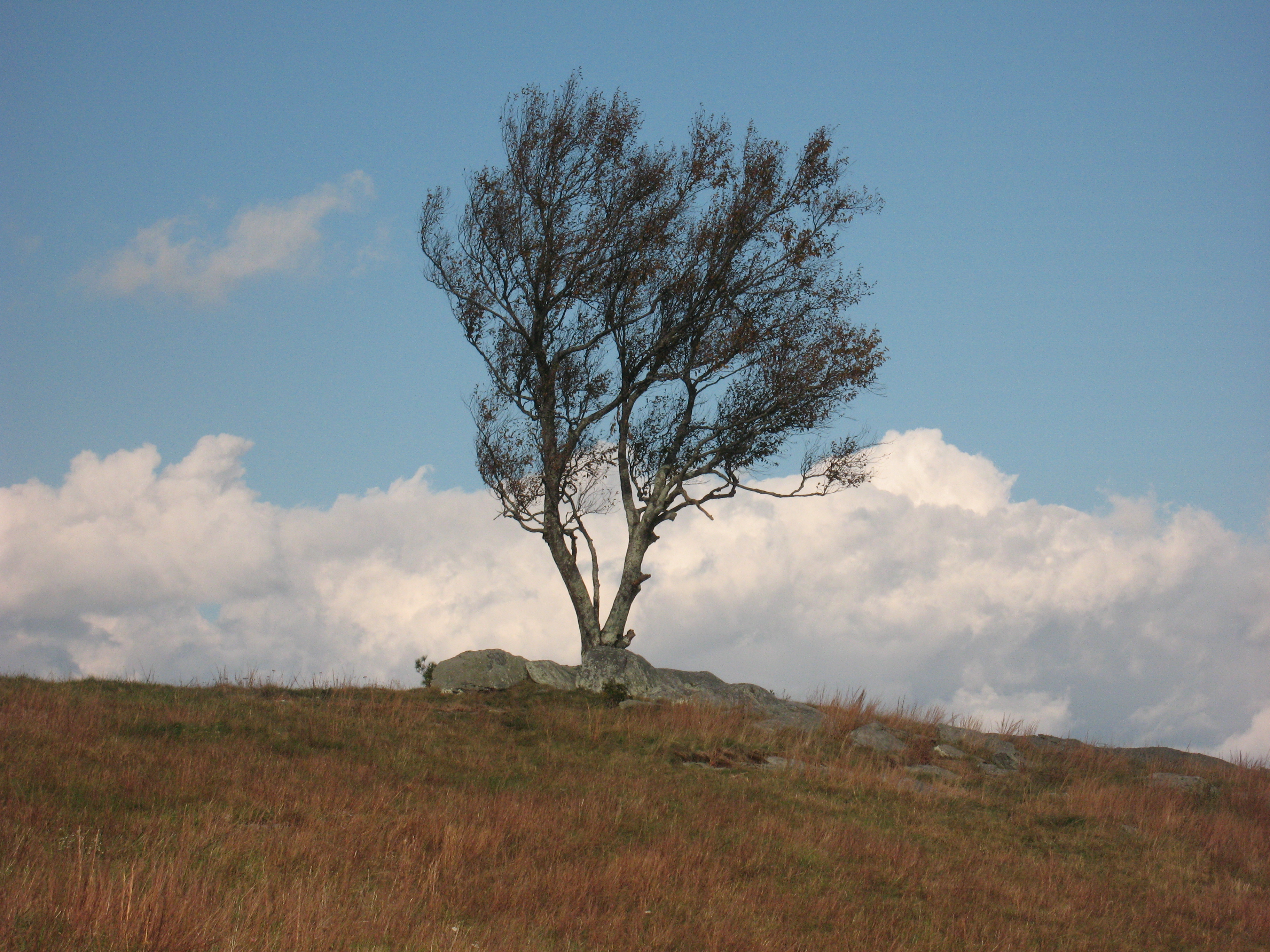
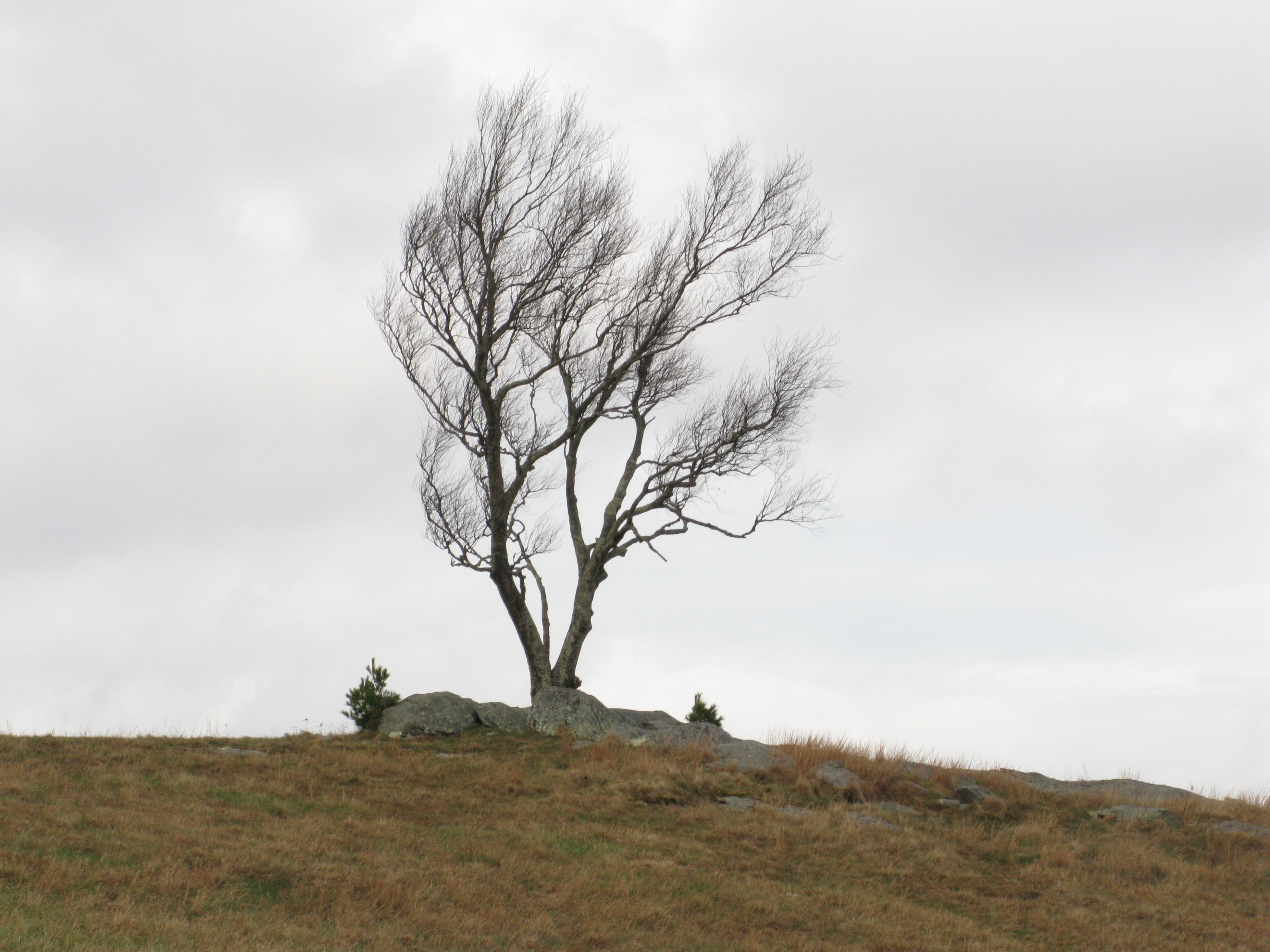
Doughton Park Tree 2020-09-08b

Read Full Post »

 + 
[poems from BRILLIG: a micro lit mag]
 + 
Ghazal for sunrise
 + 
Wrens are first out of bed at sunrise. Their sharp warbled song suits the sky’s deep red at sunrise.
 + 
Down the hill a deer slips out of mist. Then her fawn, ready to be fed, at sunrise.
 + 
Then a fieldmouse, light as a wisp, climbs a spent coneflower with most careful tread – at sunrise
 + 
The night’s winds are done. Above, only a last fading star, and a few clouds sill ragged at sunrise . . .
 + 
I join this pause to which all things have led (at sunrise), I close my eyes on what he last said, at sunrise.
 + 
Matt Snyder
from BRILLIG: a micro lit mag, Winter/Spring 2025
 + 
❦ ❦ ❦
 + 
Gravity is an illusion, a charade played out behind the scenes by matter as it warps spacetime. The illusion is complete within my deep never-spoken sense that somehow the universe ponderously orbits me. Where is my wider view? Long lens and tight focus blur everything except the center where for one moment light falls.
 + 
Thoreau sits beside the pond for hours so long and so still that the otters have come to consider him simply a natural element within the universe they inhabit. They pursue their plashy play all about him unperturbed. When the otters finally leave for elsewhere, Thoreau walks to town to buy a pair of socks.
 + 
Oh Mr. Lennon, my beloved, my idol, is life really what happens while you’re making other plans? Or is life the plans the universe has made for you whether you subscribed to them or not? Evidently the universe is not a bus you can hop off at the penultimate stop before you reach the bad side of town.
 + 
I’m trying to figure this out. The mockingbird doesn’t shut up when my neighbor fires up his Terrafirminator and attacks the clover. Just sings louder, it seems. And me? An hour walking in the woods, sweat and deep cleansing breaths, but driving home I hear again that last snarling conversation and begin another rehearsal of its next installment in my head. I thought I might have hopped off that bus, but no.
 + 
The titmouse perches above the peanuts I’ve laid out and squeaks and scolds with his head thrown back, ten iterations. Then he swoops down and pecks the hell out of them. What was he saying up there? “These are mine, bug off!” – or – “Hey world, good eats here!” What am I saying to the universe? Scratch that – what am I saying to myself?
 + 
 + 
❦ ❦ ❦
 + 
Vim
 + 
Your clay pots are stacked into towers.
Stakes propped in the garden shed corner.
Out-of-use stuff claims off-season place:
a montage of tools ready to oblige.
+++++++++++++++++++++++++++ Regret
drops by every day, helps leisure select midwinter
pastimes. Our most-recent waltz only a twitch
in the calf on gray afternoons. So much
overlooked when we busy ourselves.
 + 
I rake leaves wedged into fences. Sharpen tools
in case we plant again. Zest fallen out of favor,
the Almanac forecasts weather cycles, but desire
for a new garden is shelved.
++++++++++++++++++++++++ Verve fastened
behind the shed door, our pursuits dwindle.
Intuition must carry us through seasonal tedium,
and each loss it festers. You stare at me and ask,
+++++++ Tell me again where do seasons go?
 + 
Sam Barbee
from BRILLIG: a micro lit mag, Winter/Spring 2025
 + 
❦ ❦ ❦
 + 
 + 
When Deborah Doolittle first placed in my hands a copy of her hand-made lit mag BRILLIG, all I could say was, “O Frabjous Day!” The slim booklet is delicate yet solid with surprising heft; it is simple in its turning pages yet subtle and complex with its interlockings and interweavings, concealing treasures, revealing them. But glue and ink and color are not enough to create treasure. The words, the lines, the flow, the side-steps and juxtapositions – these poems by ten authors link arms and pull me into their circle.
 + 
If you were to step into my office and attempt to calculate the mass of processed printed-upon cellulose that surrounds you, you would intuit that I have a thing for words on paper. Oh yes, most every day I read from my bright paper-white monitor the poems the internet offers up to me, but if you were to step onto my back porch today when it’s 85 degrees and 85 percent humidity and discover me there with a book nonetheless, you would intuit that real creative thought requires an adequate escape velocity from computer gravity. And if a print journal’s appeal is an order of magnitude greater than poems online, then art and quirky originality, BRILLIG, is an order greater yet.
 + 
I unfold the pages, read backwards and forwards, turn and return. These poems surround me as if I am an element of the universe they inhabit. While they pursue their plashy play, I will abide in their circle. I have all the socks I need.
 + 
 + 
Deborah Doolittle contrives and creates BRILLIG: a micro lit mag with the help of artist friends and submissions of poetry. Each issue is published in a limited edition, but she no doubt has one she would like to send you and will make an extra copy if you subscribe.
 + 
 + 
❦ ❦ ❦
 + 
Onions
 + 
I think of you prepping risotto,
stirring the pan while you add
onions, red wine and broth.
you wore a red-striped apron.
I have it still. Should have worn it.
My shirt is dotted with oil.
Oversized sweet onions
roast in the oven, ready
to add life to a sandwich.
My eyes leak. Nose drips.
I yank a paper towel off
the rack and remember.
 + 
Patricia Joslin
from BRILLIG: a micro lit mag, Winter/Spring 2025
 + 
❦ ❦ ❦
 + 
 + 
Doughton Park Tree 2021-10-23
 + 

Read Full Post »

 . 
[with 3 poems by Joan Barasovska]
 . 
The Box
 . 
They are quiet in their photographs,
my mother’s dead.
 . 
They speak to me, entreat me to explain.
 . 
A magnifying glass held to their fading faces
proves scant help.
 . 
To listen, I must listen to myself,
to memory.
 . 
Joan Barasovska
from Unblessed, Unsung, Main Street Rag Enterprises, Edinboro PA; © 2025
 . 
❦ ❦ ❦
 . 
To speak with the dead, one must listen to oneself.
 . 
Before my mother died we talked about dying. Her dying. When I helped her fill out the living will forms. Before the first visit from the palliative care nurse. As her health took yet another sudden stepwise decline. I asked her, not at all for the first time, “Do you want to go to the doctor? To the hospital?” “No. No.” And then we didn’t talk about it any more.
 . 
Instead we talked with the dead. Some people approaching the end of their life close themselves off. They draw the veil about their diminishment and turn inward. My mother, though, turned outward, like a great flower that slowly pivots throughout the day to face the sun. Like one of those giant radio telescopes that can hear the earliest whispers of creation, she became a passive receptor who welcomed anything anyone desired to bring her. I brought her the dead.
 . 
Photographs of the dead. Some were in antique frames, some dropping from ancient scrapbooks, most of them loose in envelopes or the bottom of cartons. She and I collected them all into a grand new album and along the way we told each other stories. “Isn’t that Lucy and Ted just married? Linda and I met them at Nana’s reunion 50 years ago. And there’s you with Lucy, both teenagers. Now here’s Carlyle in the little car Grandpop built for him. I guess it was already obvious he’d be crazy for cars the rest of his life.”
 . 
Some stories she told me; some I imagined while she fingered the photos and nodded in silence. At the moment of shutterclick, each photo was created within its world of vast significance. Those worlds dissipate, decrescendo in brilliance like photons that have traveled light-years to reach our eyes, red-shifted with distance in an expanding universe. But during those moments together my mother could enter their world and hear them, the dead, their voices.
 . 
Next month it will have been a year since my mother exhaled her last breath. Her living essence has joined the whispers of the cosmos. Her essence still lives in me and all who knew her and who have not yet joined the dead. Yesterday I found a photo Grandpop took of Mom at age 10 surrounded by her wonderful collection of dolls. There it is, that hint of a smile on her lips, in her eyes, the joyful teasing hint I have seen in person a million times. But looking at that photo is not when I miss her most. The pang of absence strikes me most sharply when a random question pops into my head: “Did you have boy friends before Dad? What was it like to be living 500 miles from Nana and Grandpop when I was born? Who is that standing behind you in this photo?”
 . 
Some of the questions I may once have asked but don’t recall her answers. Most are questions it never occurred to me to ask while we were together on the earth. Now when I pull that grand album off the shelf, her picture will also be among those gone mute. But not completely so. Memory tangles and untangles itself to create new stories. I will listen to my heart. I am now the one who must speak with the dead.
 . 
 . 
❦ ❦ ❦
 . 
In Shul on Rosh Hashonah
 . 
Elizabeth is home with the baby; Ben sits beside his sons
on the hard bench. All three wear yarmulkes, Ben is draped
in his tallis – Reuben and Joseph are too young. The black
straps of tefillin tightly encircle his left hand and arm;
the boxes press into his forehead and bicep.
 . 
The drone of men praying, the vibrato of the old rebbe raised
above their voices, the distant murmur and rustle of women
and girls in the balcony above, and Ben’s own chanted Hebrew,
eyes closed, davening deeply – all are as necessary and familiar
as his heart’s beats and his quiet breaths.
 . 
His boys can barely wait for the blowing of the shofar,
the twisted, ridged ram’s horn the see near the ark.
Ben hears Joe whisper to Rube, “When?” and Rube’s loud
“Shush!” Ben is clean-shaven, unlike the older men. He goes
daily to Boris Adelman, the barber on 21st Street, who keeps
a chin mug painted with his name, Benjamin Nax, on a shelf.
His disc of soap, his ivory brush. Boris strops the razor on a
lng leather strap It’s sinful to let his mind wander like this
on a Day of Awe. He gives thanks for his children: Rube,
a little man; Joseph, their angel. now Elsie.
 . 
He was once a boy sitting with is father and grandfathers
in shul. His chest hollows around their absence. They could easily
be dead, and his uncles and mother, lined up to be shot on the
edge of a ditch. No wisdom from grandfathers for his boys.
 . 
The cantor raised the shofar to his lips and fills his lungs.
Joe has fallen asleep leaning against him, and starts awake at the
first blast. Intervals of blast and chant: Tekia! Sevarim! T’ruah!
Renew our days! Mercy is aroused! Judgement is removed!
Reverberating in the small chilly building, this uncanny sound
of the desert, the First Temple, the shtetl, and the ninety-nine
synagogues of Minsk.
 . 
Ben takes his boys’ hands, and the three are surrounded
on the sidewalk by greetings: L’shonah tovah! Gut yontif!
A gut gebentsht yor! It isn’t his name, Benjamin Nax.
It was changed at Ellis Island, from Binyomin Nakhimovsky.
What is there to believe, in America?
 . 
Joan Barasovska
from Unblessed, Unsung, Main Street Rag Enterprises, Edinboro PA; © 2025
 . 
❦ ❦ ❦
 .  .  .  .  . 
Love flares in the sleeper’s dream,
blue as a Sabbath candle flame, warm as
the kitchen of her grandmother’s house.
from Elizabeth’s Travels
 . 
Her story begins in cruelty concealed and unspoken. It wends its way through hardship and regret, between guilt and resentment. It ends as it started, in death. But that is not all. That is only one harsh thread of the story. The story feeds itself with family love and devotion. It clings to hope in darkness. The story opens its pages because of the expansive heart of the one who desires to be its guardian, its intrepid explorer, its teller. Thus the journey of Unblessed, Unsung by Joan Barasovska.
 . 
There is a bit of mountain trail that winds across a mile or two of bald slopes at Bluff Ridge along the Blue Ridge Parkway. If the summer grass has grown waist high and the cows have not been pastured there this season, the trail is obscured, untraceable except for this: in the 1930’s, the Civilian Conservation Corps placed concrete markers, posts two feet tall, to guide the hiker along the path. Joan has found her own waypoints to reveal her own path into her past: a few fading sepia photographs; recollections written down by cousins; conversations with a last survivor. To these she has applied the poet’s toolkit, observation and imagination, to render this book and bring it to life.
 . 
Some of the questions Joan must ask about her grandparents have discernable answers. Where did they grow up? What year did they arrive in America? But many answers are as intangible as smoke from an extinguished candle and as difficult to clasp. Joan uses what clues she can amass – a facial expression in an old photo; a fragment of tale from a distant cousin – to build an enlarging picture. If we don’t always know exactly how this man and that woman felt, at least we know that they did feel and we can hope to project their circumstances into our own dilemmas and responses. Considering another person’s memories is a fruitful impetus to reliving our own memories. At the beginning of Unblessed, Unsung Joan quotes Zora Neale Hurston: There is no agony like bearing an untold story inside you. Here is a story borne and bared. May these poems now weave and tangle more stories, a never-completed tapestry.
 . 
 . 
Joan Barasovska lives in Orange County, North Carolina, USA, and has authored three previous poetry collections. Unblessed, Unsung is available from MAIN STREET RAG.
 . 
 . 
❦ ❦ ❦
 . 
Listen
 . 
If I told you I hear their voices
in the apartment on Christian Street,
would you visit there with me?
 . 
At the table where they take their meals,
or by the stove, where Elizabeth stands,
adding potatoes to stretch a soup?
 . 
Between husband and wife,
what heat, what chill, what
balance of force and yield?
 . 
The rooms are scrubbed raw-clean,
it’s crowded, voices are raised,
the three children witness everything.
 . 
It’s a time before parents learned
to safeguard childhood. If I told you I hear
cruelty, in word if not in deed, trust me.
 . 
Joan Barasovska
from Unblessed, Unsung, Main Street Rag Enterprises, Edinboro PA; © 2025
 . 
❦ ❦ ❦
 . 
 . 
 . 

Read Full Post »

« Newer Posts - Older Posts »