Feeds:
Posts
Comments

Posts Tagged ‘poetry’

[After the fashion of Ralph Waldo Emerson, with apologies; and also with admiration and gratitude to Emily Stein, educator, naturalist, and instructor who prompted, “Make me care about an apple.”]

Behold! [the speaker lifts high in his right hand a bright green globe] Behold . . . the unnamed spheroid before us, orb, minor planetoid, imperfect representation of 4/3 π r3. What shall we call it? What is it?!

Is it Creature? Shall it pick itself up, scuttle about of its own motivation, turn itself ‘round to display its obverse hemisphere presently concealed from our vision?

Is it Mineral, thus created and apportioned and ever so to remain for millennia save it be worked and reworked by wind, water, the abrasion of ever degrading time?

Or is it perhaps . . . Vegetable, and now a revelation of its true nature leaps into my consciousness: is it not Fruit? May we not so surmise when we detect the telltale declivity at its northern pole from whose depth protrudes a brown and spiraled worm so very like a stem? YES, its roundiness, its gloss, its green green GREEN sings life and liveliness, living fruit, fresh, taut, shiny, reflecting what meager light may penetrate these benighted chambers to inspire our minds even as we are inspired by the light of our own great yellow star.

That star which nurtures us has also nurtured our green fruit’s life and growth to this size, this heft, wide in diameter as my four fingers, rounder in circumference than my fist can grasp. Firm and solid it appears, clean and whole, but upon finer inspection decorated with speckles and freckles, minute specks not blemishes but marks of its natural beauty, painted by creation to elevate our perception that Beauty and Truth and even Life itself are not ideal forms that reside solely in the imaginings of philosophers but are real, here before us, weighty, textured, worthy of adulation with all their variations and imperfections, with all their uncertainties, with all our own doubts about how to discover them and what to name them.

But what is Life that we should esteem it so? Life is bruises when we fall. If you prick us, do we not bleed? Life is clamor and confusion that fill the senses to bursting, sight and sound and scent sometimes sweet but oftentimes so foul. Can you convince me that Life is not suffering? Days and years unremitting even such that some might in despair willingly choose to forsake their life?

And yet . . . and yet, where can suffering prevail when we, my fellows, stand together? Where can the horror of decay and decrepitude persist when there is yet Beauty in the world?

Look again upon my treasure’s smiling green visage! Look to the living green that buds and swells and streams through hills and valleys where Life insists it must return to the gray and blasted earth. Look to the green water that calls down from the rocky slopes lithe creatures that hop and slither and find each other, there emphatically to declare their confidence in Life as we discover the motile forms of tadpole and eft.

Look, my friends, into your own hearts and discover there some fresh green shoot arising, a green hope that may yet draw you anew into this day of wonder, a hope that may, my friends, just may [here the speaker bites into the green apple] may taste this sweet! This is what I choose and this is what I treasure – this Life.

I care not what you name my green friend here – seed pod, drupe, jampot, pie bait, cider berry. I name it LIFE. And this rose by any other name would smell as sweet.

.     .     .     .     .     .     .

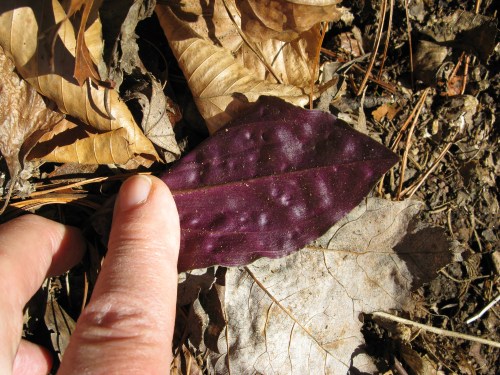
Mitchella repens – Partridge Berry

This essay was prepared as an oral class presentation for “Skills for Sharing Nature,” Southern Appalachian Naturalist Certification Program, Great Smokies Institute at Tremont, February 23, 2020.

.

Thinking, for Emerson, was not the contemplation of final Truth, but the daily encounter of an active mind with its environment; it was not a special activity but life itself.

Stephen E Whicher, editor
Selections from Ralph Waldo Emerson, Houghton Mifflin, © 1957

.     .     .     .     .     .     .

Apple, genus Malus, is the largest fruit in the family Rosaceae, which also includes plums, pears, cherries, apricots, peaches, quince, blackberries, strawberries, raspberries, almonds, rowan, hawthorne and . . . roses.

.     .     .     .     .     .     .

Viola rostrata – Beaked Violet or Longspurred Violet

The Rhodora
On Being Asked, Whence is the Flower?

In May, when sea-winds pierced our solitudes,
I found the fresh Rhodora in the woods,
Spreading its leafless blooms in a damp nook,
To please the desert and the sluggish brook.
The purple petals, fallen in the pool,
Mad e the black water with their beauty gay;
Her might the red-bird come his plumes to cool,
And court the flower that cheapens his array.
Rhodora! if the sages ask they why
This charm is wasted on the earth and sky,
Tell them, dear, that if eyes were made for seeing,
Then Beauty is its own excuse for being:
Why thou wert there, O rival of the rose!
I never thought to ask, I never knew:
But, in my simple ignorance suppose
The self-same Power that brought me there brought you.

Ralph Waldo Emerson, 1839

.     .     .     .     .     .     .

Middle Prong Little River

The Apology

Think me not unkind and rude
That I walk alone in grove and glen;
I go to the god of the wood
To fetch his word to men.

Tax not my sloth that I
Fold my arms beside the brook;
Each cloud that floated in the sky
Writes a letter in my book.

Chide me not, laborious band,
For the idle flowers I brought;
Every aster in my hand
Goes home loaded with a thought.

There was never mystery
But ‘tis figured in the flowers;
Was never secret history
But birds tell it in the bowers.

One harvest from thy field
Homeward brought the oxen strong;
A second crop thine acres yield,
Which I gather in a song.

Ralph Waldo Emerson, 1846

.     .     .     .     .     .     .

Gyrinophilus porphyriticus -spring salamander

The Southern Appalachian Naturalist Certification Program is administered by Great Smokies Institute at Tremont within Great Smoky Mountains National Park (near Townsend, Tennessee) and offers weekend intensive programs towards a certificate from the University of Tennessee. More information at www.gsmit.org

.     .     .     .     .     .     .


.     .     .     .     .     .     .

IMG_0877

Read Full Post »

In the Bleak Midwinter

In the bleak midwinter, frosty wind made moan,
Earth stood hard as iron, water like a stone;
Snow had fallen, snow on snow, snow on snow,
In the bleak midwinter, long ago.

Our God, Heaven cannot hold Him, nor earth sustain;
Heaven and earth shall flee away when He comes to reign.
In the bleak midwinter a stable place sufficed
The Lord God Almighty, Jesus Christ.

Enough for Him, whom cherubim, worship night and day,
Breastful of milk, and a mangerful of hay;
Enough for Him, whom angels fall before,
The ox and ass and camel which adore.

Angels and archangels may have gathered there,
Cherubim and seraphim thronged the air;
But His mother only, in her maiden bliss,
Worshipped the beloved with a kiss.

What can I give Him, poor as I am?
If I were a shepherd, I would bring a lamb;
If I were a Wise Man, I would do my part;
Yet what I can I give Him: give my heart.

by Christina Rossetti

[first published under the title “A Christmas Carol”, in the January 1872 issue of Scribner’s Monthly]

.     .     .     .     .


.     .     .     .     .

.     .     .     .     .

Christmas Service, Kernersville NC Community of Christ, December 22, 2019

Valeria and Andrew portrayed Joseph and Mary for their fifth consecutive year.

Read Full Post »

A ten minute walk from Buxton Woods there are a hundred people milling around at the base of the lighthouse waiting to climb or just spraining their necks. A ten minute walk into Buxton Woods it’s just the three of us. The trail rises, ancient dune now eternal with live oak and yaupon. Surf crash can’t reach us here but the hum is constant, cicadas, mosquitoes, something swift in peripheral vision. We descend to a slough, marsh slowly becoming meadow then woodland. Looks ancient. Smells ancient.

Even in deep shade the trail is not cool but our grandson thinks it’s cool to be here. We’ve never seen this many different colors of dragonflies. Along one stretch a platoon of thumb-sized toads is invisible until one hops across the trail. It’s not a dinosaur, this trail, not yet extinct but endangered. Not only because every other scrap of maritime forest along the outer banks is scrutinized greedily by developers with bulldozers, but because this is the Outer Banks. The dune ridges are a timeline of shoreline creeping ever west, the bank rolling over itself for millennia, now faster and faster. Thousand year old clam and oyster middens are still uncovered, evidence of the human beings that have visited and resided here. How much longer?

This little trail is an insect in amber. Engrave it in memory. From the gallery rail on Hatteras Lighthouse they can’t see us here.

–     –     –     –     –     –     –

This poem is from Susan Meyer’s My Dear, Dear Stagger Grass. I return to this book when the world smells like asphalt and I need a whiff of spartina. I mean, when my own ideas are pedestrian and my inspiration is muckbound and I need something with clear veined wings to chase me back into sunlight. Or a chiseled head and slender neck. How can writing be at once so rooted and so lofty? Oh Susan, how few words we need.

–     –     –     –     –     –     –

Two Friends Hiking at Old Santee Canal

Ahead of me, he balances his feet, left then right,
on the first of two planks – an unsteady bridge of sorts –
laid down for hikers to cross
what, on most days,
would be bog,
but on this one, after weeks of rain, is flooded.

We are learning the look and feel of swamp.

Waiting my turn, I can see his every step.
He pauses halfway across, standing sweaty
in the midst of the ordinary.
An inch or so beneath his heels,
under the seam of the two boards,
I see the loops and curves
of a thick brown snake.
The chiseled head, the slender neck. Above them,
his bare ankles.
How few, the words we need.
Snake, I say, unable to utter where
or put sense to it.
Which way should I go? He is a statue,
his arms frozen in air.
I tell him to come back, and he does.
We watch the snake uncurl
and disappear, but in the thrill of fear just past,
our bodies, all breath and jitters, now belong
to someone we don’t recognize.
Forward is the direction we want to choose
but neither of us can step onto the board.
We know what we must do:
stumble through ferns and mud,
clotted roots, the thick
of mosquitoes, a limestone bluff –
backtrack in the safety of a path already taken.

Susan Laughter Meyers
from My Dear, Dear Stagger Grass, Cider Press Review, 2013

–     –     –     –     –     –     –


–      –     –     –     –     –     –

IMG_0880

Read Full Post »

« Newer Posts - Older Posts »