.
April 15, 2024
.
In the end we will conserve only what we love.
+++ We love only what we understand.
++++++ We will understand only what we are taught.
+++++++++ Baba Dioum, Senegalese environmentalist
.
Everyone enjoys the smell of earth after rain. No one wants to cough every breath.
Everyone thirsts for a drink of cool water. No one wants to sicken from drinking it.
Everyone needs bread. No one wants to go hungry.
.
On April 22, 2024 every human being will wake up on the only planet where humans can live (well, not counting a handful of folks waking up on the International Space Station). Seems like cause enough to celebrate! To be honest, though, the threat of what we have lost and are losing so often seems much greater than the joy of what we have saved and are preserving.
.
How far have we come since the first Earth Day in 1970? It was just eight years earlier that Rachel Carson published Silent Spring, the wake up call to industrial pollution and the poisoning of the earth. In 1970 there was no Environmental Protection Agency, no Occupational Health and Safety Administration, no Clean Air Act or Clean Water Act. When we protested air and water pollution, we had little inkling of the even greater threat; we couldn’t imagine needing an Intergovernmental Panel on Climate Change.
.
Twenty million Americans marched, demonstrated, and celebrated that first Earth Day. Ten percent of the nation’s population. I was a junior in high school photographing our events for the year book: carrying a coffin through the parking lot to signify the dying planet. Earth Day is now celebrated in 193 countries; one billion people are expected to commemorate Earth Day 2024. That still leaves some eight billion to get on board. Legislation and politics won’t take us there. In the end we will conserve only what we love.
.
❦ ❦ ❦
.
I think it pisses God off if you walk by the color purple in a field somewhere and don’t notice it. People think pleasing God is all God cares about. But any fool living in the world can see it always trying to please us back. .
+++++++++ Alice Walker, The Color Purple
.

.
❦ ❦ ❦
.
The Field Index
Abandoned field, Orange County, North Carolina
.
Asters: lesser stars in these constellations, for the native bees, late-summer smatterings of a color I might call blue, blue petals and fireworks along the margins of the track, and
.
broomsedge, bluestems: stooped in the fall and shimmering, shivering in the wind, spinning out seed, bird fodder, tangled (insert here) into brambles, blackberries, this year’s, last year’s canes knotting and weaving, and
.
crabgrass: crabby claw and crab leg of a herb: edges into the wilding mint and onion grass, the tall stands of raggedy, wing-stemmed (my favorite) crownbeard gone to seed, where I am with my small dog, and
.
dogwood: not here yet, but it will come; also redbud (q.v.) and holly; the birds will bring it, in their guts, its white bracts and inconspicuous flowers, its small understory leaves will open and turn into the sunlight, before the canopy leafs out and shades
.
exotics: migrants, stowaways and hitchhikers, too much at home; see invasives, stiff-stemmed privet with its small dark leaves, and the clustered graceful arcs of autumn olive, honeysuckle vines, dead stiltgrass flopped into heaps, good for nothing except time
.
ferns: rise and unfurl like our letter f, old as fossils, here before letters and fiddles and bows and Michaux and his acrostics, first and last green under the trees, with
.
ghost plants: the ancestors, clusters rising from damp, unsunned patches of leaves along the margins of wood; also: smatterings of green-and-gold, the droop-headed goldenrod
.
honeysuckle: announcing itself in scent on the wind and winding up and around the living and the dead: colors coral (see natives), creamy white curling to yellow (see exotics)
.
invasives, see exotics; index of vexed and vicious cycles; see also, kill
.
jaywalkers: I, alive, among others, on and off the old farm road, on pirate paths, seed-spreader, compacting soil, alarming insects and deer, stealing berries and sprigs and twigs and clumps of lichen or moss, colored leaves, I
.
kill: by ice and drought, sapsuckers, larvae, blight, competition, succession (it happens, why do I grieve?), deer rub and browse, humans; see jaywalkers
.
loblolly pine: its spiny cones and bundles of three long needles green, or fallen and draped in the shrubberies; aka oldfield pine, straight up, above all, old-meadow native homesteader in the lobby-lolly soil of this wide floodplain
.
milkweed: var. swamp milkweed, its pink inflorescence and faint scent, drawing monarchs among butterflies and pollinators, queen of weeds, fecund, its large brittle-dry pods burst and spewing cloudy seed over the bewilding meadow
.

.
natives: as in, before our time here, before this language and its metaphors and usages, before people, and which we watch with sorrow as they fall back and dwindle, are cut down; see exotics, see
.
oaks, passim, and Osage orange, spiny along the branch bank, its large green nobble-skinned fruit fallen in the path and long grass, bitter, slow to blacken and rot, unscavenged by all but small seed-eaters
.
persimmon (native), privet (not; see exotics): one, provender for all comers, all creatures, i.e., small bell-shaped flowers, small sweet ripe fruits; the other just minding its own business, i.e., to thrive
.
Queen Anne’s lace: umbels and fine-cut leaves, branching stems, aka wild carrot and medicine, queen unknown and from elsewhere, and the lace medallions for her bodice and gown, for her headdress, her cuff, all scattered to the people (winged and crawling insects), self-seeding
.
red cedar: modest, upright, native, pioneer in this process of succession, spindle of evergreen and scent rolled between the fingers (here I am again, breaking the rule of no taking and leaving of souvenirs); and redbud: see understory, flights of pink-purple blossom in the spring woods, pleiades, announcing light and wings again, after all that
.
stiltgrass: Japanese, Microstegium vimineum, in summer blithe, feathery and green under the trees over creeper and grass, but poor food, tick haven (see exotics; see also jaywalkers); and sweetgum: all over this old field, native and opportunistic, prolific and prodigal, Liquidambar of the spiny round seedhead and star-shaped, lobed leaves, their margins calling to mind (my mind) calligraphy or the gestures of dance, delight of form that is mutable and has prickly edges, deliquescence, decadence, a nuisance, really
.
tulip tree: tulipifera, the saplings standing here and there, innocuous, like any other small tree, but give them time, they’ll rise; the yellow-and-pale green petals of their flowers say in English “tulip,” the Tutelo-Saponi name lost, yellow-green the heartwood, yellow the leaves in fall, and early to fall
.

.
understory: native holly and redbud and dogwood, parsimonious and irregular in habit, sparse fruit, sparse flower; now also autumn olive, privet, and exotic forbs and grasses, the introduced and naturalized, myself and dog under the canopy
.
vines: Virginia creeper, close-to-ground native; grape vine, gangly fox grape, looping and loping up branch and stem, dbh often equal to small trees; poison ivy, not the inconspicuous three-leaved forb of the northlands, but (learn this, human) rampant, thick-stemmed, hairy vine, stuck fast to the trunks of trees
.
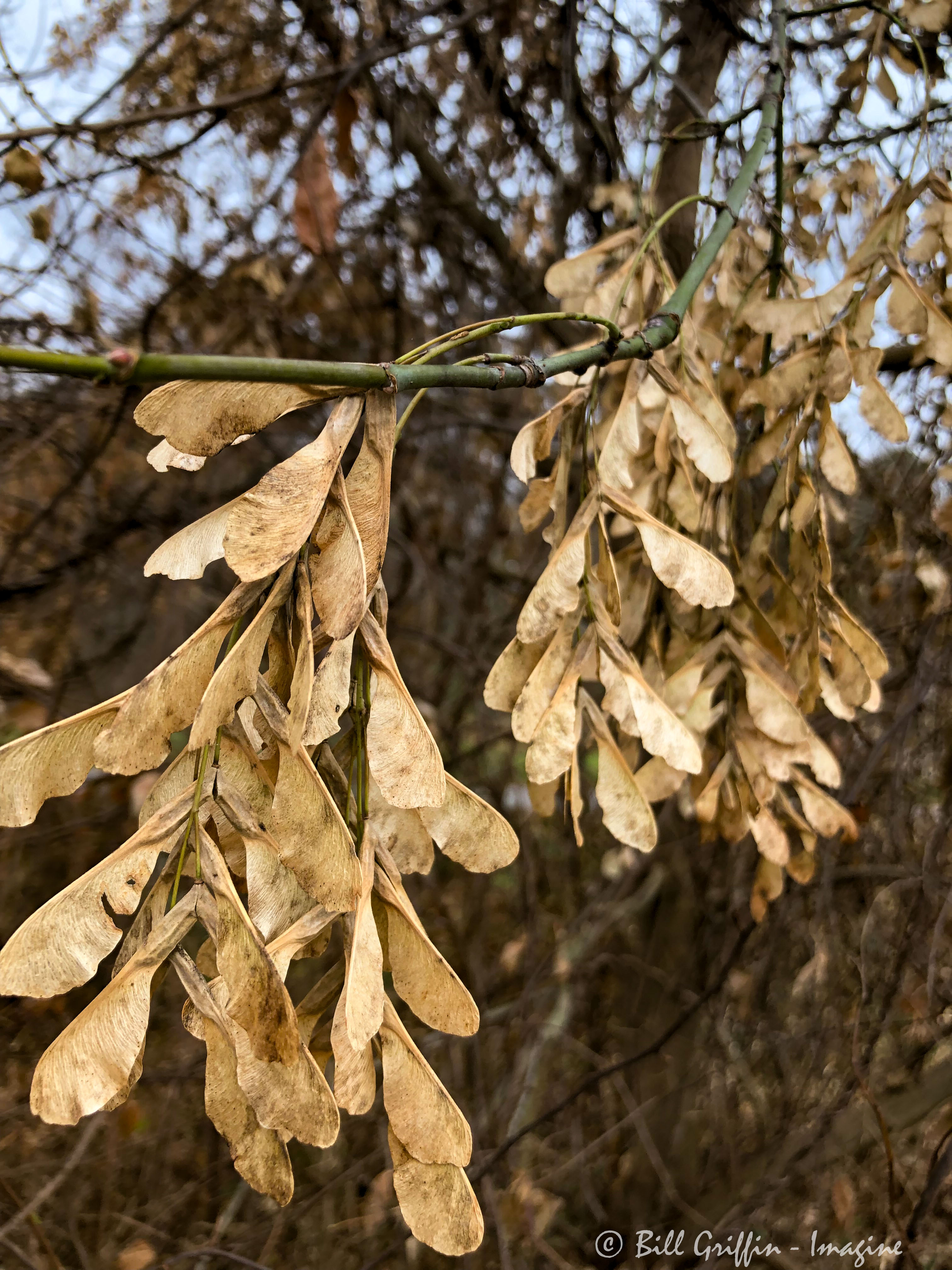
winged elm: small tree of delicate, dry stem, and long, corky flanges along its branches; old (to my eye) before it’s old, strange (to my eye); unknowable why those wings
.
x: Xanthium through Xyris in Radford’s Manual, as in chicory and the yellow-eyed grass; also, a sign for canceling and for marking you are here, this is the place, this, my mark, my thumbprint
.
yellow poplar: see tulip tree and weep
.
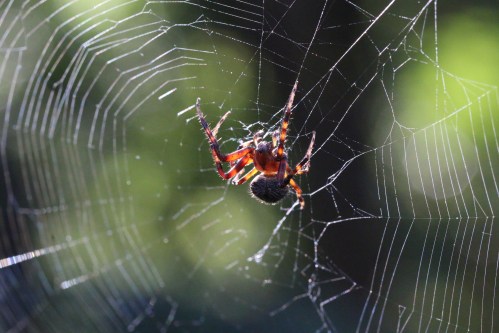
zigzag: of silk in the web of the orb-weaving spider, homespun look-at-me and distraction, quirk among zoologies of abandoned gardens and meadows; zee, zed, the end of bee flights and alphabets
.
Maura High
. 

.
Notes:
Acrostic: Med. Lat. acrostichis, from Gk. akrostikhis, from akros“at the end, outermost” (from PIE root *ak– “be sharp, rise (out) to a point, pierce”) + stikhos “line of verse,” literally “row, line,” from PIE root *steigh- “to stride, step, rise” [Online Etymological Dictionary]. The Christmas fern’s botanical name is Plystichum acrostichoides (Michaux) Schott.
André Michaux (1746 –1802), French botanist, author of Flora Boreali-Americana (1803; “The Flora of North America”), made at least five visits to North Carolina.
Loblolly: Pinus taeda, From Wikipedia: The word “loblolly” is a combination of “lob,” referring to the thick, heavy bubbling of cooking porridge, and “lolly,” an old British dialect word for broth, soup, or any other food boiled in a pot. In the southern United States, the word is used to mean “a mudhole; a mire,” a sense derived from an allusion to the consistency of porridge. The pine is generally found in lowlands and swampy areas.
Manual of the Vascular Flora of the Carolinas, by Albert E. Radford, Harry E. Ahles, and C. Ritchie Bell (Chapel Hill: University of North Carolina Press, 1968). Commonly known as Radford.
Pleiades, Gk., perhaps literally “constellation of doves” from a shortened form of peleiades, plural of peleias“dove” (from PIE root *pel-“dark-colored, gray”) [Online Etymological Dictionary].
.
Shared by Paul Jones, Chapel Hill NC, who writes:
.
Maura High knows her field from A to Z. She sings individual songs of the particularity of the place so clearly and precisely that we learn and love the place as she does. Field Index is an ideal field guide to place and the places of nature that compose this quilted lively patch of our earth.
.
Every day as I walk my own favorite patch of the planet, Merritt’s Pasture and Morgan Creek, I keep Field Index in mind as a guide that shows how to attend to this world and to prepare for the next.
,
+++++++ Paul
.
❦
.
On an Okra Flower
.
A pollinating wasp sliding
from white lip to purple darkness,
the shadow-heart so deep inside,
the plant, itself, tall African
in the kitchen garden’s last row,
speaks of passage and endurance,
those far too common abstractions,
made real here in the summer heat.
.
Let it lead us, serve as a guide,
tell how each struggle leads to bliss
and what to bless when we decide
to see the past and present blend
into what we need to know
– a mind aware or in a trance? –
what to keep close, what to shun
made real hear in the summer heat.
.
What song can a wasp sing gliding
the flower’s dark throat? A long kiss
like winged tongues tangled deep inside –
a blind passion, an obsession.
I hear it as a prayer now,
music for the world’s whirling dance.
Sound, sight and scent. An orison
made real here in the summer heat
.
Paul Jones
from Something Wonderful, Redhawk Publications, Hickory NC, © 2021
.
❦ ❦ ❦
.
A man’s feet must be planted in his country, but his eyes should survey the world.
++++++++ George Santayana
.
.
To celebrate EARTH DAY 2024 we are featuring seven posts of poems submitted by readers – poems by William Blake to Walt Whitman, Robinson Jeffers to A.R.Ammons to Linda Pastan, and a number of contemporary poets. Check in every day or two – connect to the earth and to each other!
.
.





 V E R S E and I M A G E
Very true. And not that she ignores the grief and woe of living but somehow makes all of life a…