Feeds:
Posts
Comments

Posts Tagged ‘NC Poetry Society’

[with 3 poems by Tony Abbott]

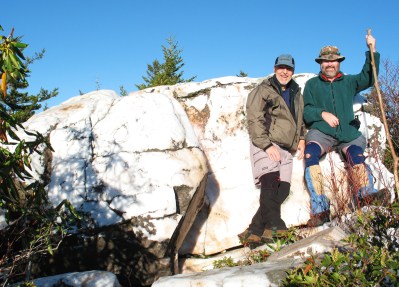
Mike and I met at a remote trailhead below Mt. Pisgah to hike up into Shining Rock Wilderness. We planned to spend one night at our favorite site after reaching it by this unfamiliar approach. End of September, gorgeous reds and golds, brittle blue sky, and we were prepared for cold above 5,000 feet.

No camp fires permitted in a Wilderness Area. We made tea over a little alcohol stove, sat on the ground, and talked until it grew too dark to see. The ultralight 2-person tent Mike had packed was cozy, which is to say it was more like a 1 ½-person tent. We’d be keeping each other warm.

I woke up after midnight in dense darkness and couldn’t breathe. Got out of the tent, pulled on my balaclava, walked away to pee, sat on a log – deep silence, no owl hoot, no chitter of flying squirrels, not one breath of wind. When my butt started to freeze I tried squeezing back into my mummy bag. No good. My chest tightened, the thick black pushed down on my face, I had to claw its hand away. Worst claustrophobia ever.

I finally dragged my sleeping pad and bag out to a level space in the pine needles, wrapped a jacket around my feet, and hunkered in just as the moon rose through the red spruce. Cold light expanded my lungs. At some point, hours creeping, moon in my eyes, I fell asleep. Mike woke me at first sun.

.     .     .     .     .     .

What can bring light into darkness? What hand comforts the clench of fear? What consoling faith casts away doubt? What companion banishes loneliness?

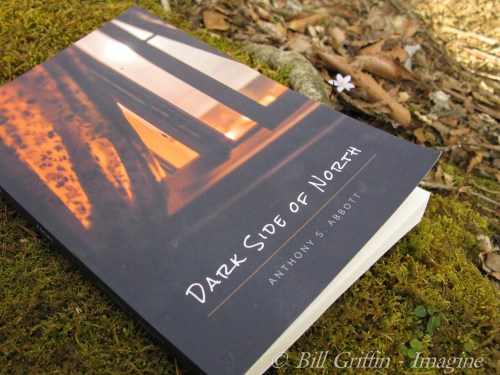
The forward to Anthony S. Abbott’s book Dark Side of North, published posthumously by Press 53 this year, consists of a remembrance presented by Dr. Jacqueline Bussie at Tony’s memorial service on October 17, 2020. Here is an excerpt:

Suffering didn’t make Tony unique. What he did with it did. Tony was the first adult, and the first teacher, I’d ever met in life who was willing to talk about the hard stuff. He taught us that suffering sucks. That suffering denied is suffering unhealed. He taught us to never sugarcoat suffering, smack a pink bow on it, or shove it to the back of the drawer. In one of my favorite lines in Tony’s poetry, he urges us to get down to “the Humpty-Dumpty business of trying to make a jewel out of the cracked pieces of the heart.”

Dr. Jacqueline Bussie, page xiv, Dark Side of North

.     .     .     .     .     .

The Boy from Somewhere Else

lived in the open mouth of the world.
He chewed on the dry branches of time.
He was handsome enough, to be sure,

but there was in his voice
the deep well of absence.
He was with them, but not of them.

His speech was familiar, but not theirs,
and when he told tales
of his drunken uncles and stage-struck

sisters, they nodded politely
and they spoke in their apple-round voices
of kith and kin, and told how their

grandfathers had founded the first
bank in Hitchcock County.
He would wait, this boy.

He would find one day the person
who could hear his music
as blood red leaves matched autumn.

He could not be mistaken about this.
When she came, he would recognize her
at once – as one knows the coming storm

by the first, distant clap of thunder.
Perhaps he could not keep her.
Perhaps one can never keep such a gift.

But, still, she would grace his years – the buds
of his growing up, the rattling trains of the
middle passage, the brittle bones of the slow

descent, the icy nights of the final coming down.

from Dark Side of North, Anthony S. Abbott, Press 53, Winston-Salem NC, © 2021 by the estate of Anthony S. Abbott

.     .     .     .     .     .

The Light in the Window
In memory of Nancy Abbott Hieronymus (1926-2017)

How early I must have known that she was
my true mother, that when she packed her bag
I must go with her. She would keep me safe.

How early I must have known that she was
my true teacher, making the sounds of the words
with her mouth so I could learn them, too.

How early I must have known that she was
my true protector, throwing herself across me
slashing her knee on the broken windshield glass.

Later, when I was nearly grown, cocky sophomore
in prep school, riding the subway home at 2 a.m.,
she left a light in the window on that I

would turn out when I came in. I didn’t know
she stayed awake until she heard the door open
and close, heard the click of the light going off.

Now I sit by her bed and watch her sleep and wake,
sleep and wake, and tell me how she loves
her precious Dick, how she will hold his hand

all the way to heaven. Beyond the light in her window
the evening comes over the island, the deer prick up
their ears, the foxes peek from their dens. In the pines

the gold crowned kinglet waits. She is coming, they say,
our friend is coming, the one who loved us all these years.
Tonight I will go home, and the friends who loved her so

will arrive, one by one, to take her in their arms,
and the next night the angel will stand at the foot
of her bed. You are loved, he will say, and enfold her

with his bright wings. And she will go where that brightness
is and, like a light in the window, shine upon us all.

from Dark Side of North, Anthony S. Abbott, Press 53, Winston-Salem NC, © 2021 by the estate of Anthony S. Abbott

.     .     .     .     .     .

The Long Afternoon

All through the long afternoon
the wind moved in the branches.
I had lived in the city and had seen
only the dust from the tires,
the diesel gas from the gray brown
buses with their leaden burdens.

Here it was different. Here on the grass
we had found by chance, walking
away, just away from everything
and then, a clearing and green
grass and the wind moving
like silver over the water
and in the branches, too. Yes,

all through the long afternoon
the wind moved and we were silent
in awe of the day and leaves
yellow and red and orange,
which floated slowly down
into our waiting hands.
aaaaaaaaaaaaaaaaa Later
I found these leaves in a book
where you had put them for
safe keeping, a book you knew
I would take down and read
some distant starry night.

from Dark Side of North, Anthony S. Abbott, Press 53, Winston-Salem NC, © 2021 by the estate of Anthony S. Abbott


.     .     .     .     .     .

Thank you, Tony. We will continue trying, and we will not stop trying, to make something beautiful from the brokenness that we are. Together. May it be and become so.
.     .     .     .     .     .

The North Carolina Poetry Society has honored Anthony S. Abbott’s memory and shared Tony’s poetry at its January, 2021 literary meeting and with a commemoration in the Winter, 2021 edition of its quarterly publication, Pine Whispers.

The line “the Humpty-Dumpty business of trying to make a jewel out of the cracked pieces of the heart.” is from Tony’s poem Before Forty in his book The Girl in the Yellow Raincoat (St. Andrews Press, 1989) and collected in New & Selected Poems (Lorimer Press, 2009).

.     .     .     .     .     .


.     .     .     .     .     .

2015-06-15Doughton Park Tree

Read Full Post »

[with 3 poems by Patricia Hooper]

Great Smoky Mountains Institute at Tremont, February 05-07, 2021

the assurance of things hoped for, the evidence of things not seen . . .

Faint tracks – but when has life ever laid it out plain, an open book, page upon page with footnotes? Aren’t I still searching between the lines, faint traces, no clear prints? Lately I dream every night of making diagnoses, explaining treatments, buffing up my charts. Is Jung telling me that this was my only purpose in life and now it’s over?

Deer walk a diagonal gait – each hoof print is really two impressions, the forefoot overlaid with the rear. If the rear hoof strikes a little lateral within each fore print it means the pelvis is wider = you are following a female.

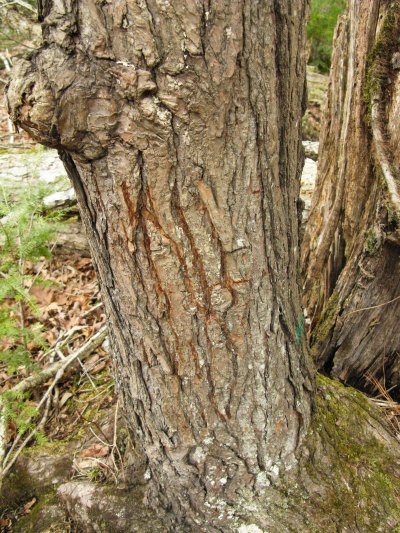
Don’t plan on seeing a bear in the Smokies in February. Mom is asleep in a hollow tree with her cubs and Dad is dozing under a bush somewhere (he snores), though he might rouse up to forage on a warm afternoon. So why are we studying mammals at Tremont in February? In the sere meadows, the leaf-littered groves, under the pale unforgiving sky the book of all their signs is open for us to read. Let’s hike up to that oak tree and see who’s been scratching for acorns, see who has left us some scat. Let’s follow that faint trail through dry brown stalks to check out predator and prey. Who clawed up this white pine? Who stepped in the mud?

Canids: dog paw prints show deep claw marks with claws of outer toes angled outward; coyote claw marks are less distinct but all aligned strait ahead; gray fox claw marks are the least distinct since they save the claws for climbing trees, and the rear pad looks scalloped like a chevron.

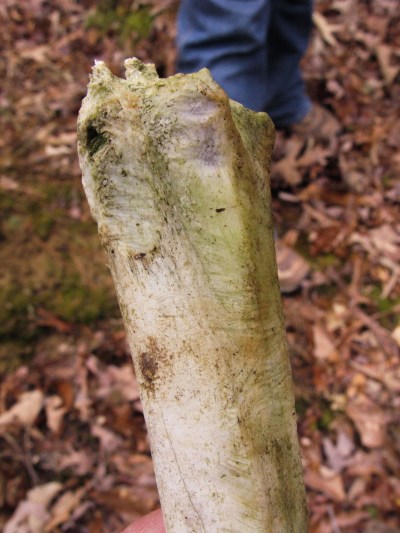
But clear prints are maybe 1% of tracking. We’re learning a new vocabulary of chewed nut and compressed grass. Tracking is patterns and connections, habitats and behaviors. Measure the size of the incisors that gnawed this antler. Measure the bits of skull and femur in this dropping.

And can I learn a new language? Maybe all these dreams are about knitting up the years, tying the last knot, laying it away to pull out when I need to reminisce. Or maybe I need to discover something missed. Life is not disjunctive – the end of every moment flows into the beginning of the next. The assurance of past creates future. Tracking in Cades Cove – a metaphor for opening oneself to an unseen message within, to the evidence of human purpose. Connections, convictions. We track a personal ecology that leaves signs for us to discover, to question, to wonder.

To follow.

Tracks have lead us to this place, maybe with a lesson or two that sunk in along the way. Some wisdom. And the tracks that still lead forward?

.     .     .     .     .     .     .

Patricia Hooper’s bright clear poetry touches earth with a feather – to bring color and flight. Garden, feeder, wild crag, starry night, in all seasons she observes the particular and discovers its connection to the universal. Nature is her palette but human nature is the canvas she illuminates. The poems of her latest book, Wild Persistence, taken singly seem to open our eyes to brief moments or localities, but as a whole these poems weave a complex narrative of family, longing, grief, redemption. I find joy in her art.

Patricia moved to North Carolina in 2006 and lives in Gastonia. In 2020 she was awarded the Brockman-Campbell Award of the North Carolina Poetry Society for Wild Persistence, awarded for the year’s best book of poetry by a North Carolina author.

.     .     .     .     .     .     .

Elegy for a Son-in-Law

1.

A distant figure on the mountainside
seems to be coming closer, then it turns,
a blue, retreating cap, a scarlet jacket.
Without another sign, I know you’re there,
climbing again the way you used to climb
before you were a ghost. I want to call
Don’t go! Come back! I have your two small sons
sleeping behind me in the car, their mother
watching the sky for falcons. But you move
farther away. Or we do. Now you’re gone,
back toward Mount Sterling where she took your ashes.
I hope it’s peaceful there. I hope you know
they’re doing well. I hope you didn’t see us.

2.
These are the mountains where you were a boy,
broad waves of mountains rolling like an ocean
into the distance, no horizon, only
these smoky contours where you knew each rise
and hemlock forest, plunging stream. Your friends
tell how you often left them for a while
after you’d reached the top, to be alone,
then met them at the camp, all tales and laughter.
Today, a red-tailed hawk riding the breeze,
gold leaves, cascading creeks, – your kind of joy:
cold rushing currents, then the ecstatic slide.

3.
This is the world you wanted: brisk fall air,
the valleys hung with haze, that long blue range
half-hidden by the clouds. It’s coming clear.
How far you must have seen from there! And here?
It’s hard to see around so many hills,
so many peaks and gorges, and the curves
are slippery on the parkway, miles of turns.
We’re heading home. The boys are waking now,
their mother’s passing crackers, pointing out
the overlook ahead: blue waterfall,
deep river valley, autumn leaves, the pines
along the ridge, the rising trail – and there,
the summit you’d have shown them. Mist and shine.

from Wild Persistence, Patricia Hooper, University of Tampa Press, 2019

.     .     .     .     .     .     .

In Tennessee

The Blue Ridge at sunset – hardly a missed note
in the hemlocks where a mockingbird is singing
while to the west a falcon dips, then glides
over the valley, indistinct from here
except that the bird falls lower than the chair
I’m sitting in, and disappears. The sky
is the color of pomegranate, and the balcony
slips into shadow like the distant hills.
No wonder that the mockingbird is singing
a medley of every song he knows,
no matter whose. No wonder that he sits
in the glow of a single flood lamp high above
the roof, a pool he must mistake for sunlight,
enough to urge him on and on and through
his repertoire that bird by bird is ringing
over the day’s end, over the night’s coming.
Maybe he has to sing to know himself
as part of things – finch, cardinal, wren, and now
that long coarse call that sounded like the crow
or Steller’s jay – whatever voice he’s pulling
out of himself, some sound against the silence,
against the signs of brightness vanishing.
The railing of the porch dissolves in mist,
the sun has set, and now we’re weightless, drifting
as if suspended in the blackening air.
His sphere of light no longer seems as clear.
Maybe he knows the lamplight isn’t sunlight.
Maybe he feels he too is disappearing
into the darkness like this porch and chair.
he has to sing, he has to keep on singing,
to know he’s really there.

from Wild Persistence, Patricia Hooper, University of Tampa Press, 2019

.     .     .     .     .     .     .


.     .     .     .     .     .     .

At the Rifle River

When the eagle unfurled, clearing
the green dome of the forest,
I almost missed it

till somebody cried, “Look up!”

and there it was
in the sky over the river

which I saw it must have owned
the way it spanned the rapids
with a single stroke,

and the sky parted.

I can’t say I believe
in messengers from the clouds,

but I didn’t believe
this was an accident either,

the way its light
tore through the drab morning
I barely lived in, and then

it rose over the steaming
forest, it disappeared.

*
At the time I was only watching
my own path by the river,

but afterward
I knew it must still be there
over the rim of maples

its white helmet, its fire,
and its gold eye turned toward me,

or something enough like it,
something powerful and amazing
which someone else sees.

Imagine my certainty
the moment before it rose
through the world, crossing the water,
that there was nothing anymore to surprise me.

Imagine my emptiness.

Imagine my surprise.

from Separate Flights, Patricia Hooper, University of Tampa Press, 2016

.     .     .     .     .     .     .


GSMIT // SANCP

Special thanks to Jeremy Lloyd and John DiDiego directors and instructors at Great Smoky Mountains Institute at Tremont, for the weekend Mammals course, which is part of the Southern Appalachian Naturalist Certification Program, and to Wanda DeWaard, guest instructor for the day and master tracker and naturalist.

The Southern Appalachian Naturalist Certification Program at GSMIT comprises eight weekend courses designed to provide fundamental and specialty skills in Southern Appalachian ecology and interpretive techniques. Each weekend includes 15 hours and more of lecture and hands-on field study. Upon completion the student receives the non-credit Southern Appalachian Naturalist Certificate from the University of Tennessee.

.     .     .     .     .     .     .

IMG_1827

Read Full Post »

[with two poems by Lenard D. Moore]

Mockingbird knows both of Blue Jay’s songs: the astringent lament that flings the blue name of the blue Corvid into pathos; the softer plaintive wheedle of him who begs to be thought better of. What does all that conversation signify when it erupts from the beak of the Jay? What meaning has the Mocker usurped, if any meaning at all? Who can listen and understand, and who can answer?

We of different class order family genus species can only speculate why the Mockingbird repeats four times each song he knows, and each song he himself composes, as he hops from the tip of power to the mailbox to the thorn bush and back again and his notes spiral the neighborhood. We are probably safe to bet that Mocker doesn’t care two bits about impressing the Jays. Song as proclamation, song as beacon, song as telegraphy, song as bulwark – let’s just imagine that Mockingbird proclaims music is glory and improvisation is king.

Listen and understand.

.     .     .     .     .     .

I have known Lenard Moore mainly from his haiku. He points the way to that parallel universe which is only a hairsbreadth from ours and then with observation and pointed brush he opens the door.

I also know Lenard as a teacher and mentor to Carolina writers in many, many different organizations and settings, and particularly I remember a meeting about 10 years ago at Weymouth Center in Southern Pines, NC. While Bill Blackley played blues harmonica, Lenard riffed and bopped with his jazz poetry. Now I’m holding a book that brings it back: The Geography of Jazz, issued in 2020 by Blair as a reprint of a publication by Mountains and Rivers Press in 2018.

Sultry, syncopated, steamy – if you can read this book without bobbing your head and tapping your foot you need a little more sax in your life.

.     .     .     .     .     .     .

At the Train Stop

I imagine the quick hand:
Thelonious Monk waves
at red, orange, yellow leaves
from Raleigh to Rocky Mount.
Alone in this seat,
I peer out the half-window
at the rainbow of faces
bent toward this train
that runs to the irresistible Apple,
determine to imagine Monk
glows like Carolina sun
in cloudless blue sky.
I try so hard to picture him
until his specter hunkers
at the ghost piano, foxfire
on concrete platform.
Now I can hear the tune ‘Misterioso’
float on sunlit air.
If notes were visible,
perhaps they would drift crimson,
shimmer like autumn leaves.
A hunch shudders
into evening, a wordless flight.

.     .     .     .     .     .     .

Ascension: John Coltrane

I didn’t pick up the tenor
and soprano saxophones
for legendhood.
I wanted only to explore chords
into progression, step into another world
I had to escape anything too strict,
take ‘Giant Steps’ all the way
from Hamlet, North Carolina.
The music shimmered like a lake
inside me and turned blue.
It was kind of spiritual.
I thought of extending the scales.
I wanted to play on and on,
sail as long as the horn could
and eventually come back again
as if I had never left.
It was maybe the only time
I left my body.

both selections from The Geography of Jazz, Lenard D. Moore, Blair Publishing 2020 reprint, © 2018 Lenard D. Moore

More about Lenard D. Moore, his poetry, and haiku.


.     .     .     .     .     .     .

Afterword: Old Jay still has a few tricks of his own. He can mimic perfectly the three Buteos in his breeding range: Red-tailed, Red-shouldered, and Broad-winged Hawks. Nobody messes with Mr. Blue Jay.


.     .     .     .     .     .     .

2020-09-08b Doughton Park Tree


Read Full Post »

« Newer Posts - Older Posts »