Feeds:
Posts
Comments

Posts Tagged ‘NC Poetry Society’

[with poems by Augusta Wray]

1932, Charlotte, North Carolina – the Great Depression has all but silenced the constant rumble of railcars from Atlanta to D.C. through this hub of the South. Most of the cotton mills are shuttered but Ben Gossett, president of Chadwick-Hoskins, has an idea. He asks President Herbert Hoover for help. Mill workers will weave cloth from 50,000 bales of cotton sitting in idled factories and sew it into clothing for the needy. Slowly the Queen City will again stir to life.

That same year, 1932, The Charlotte Symphony Orchestra was founded. More songs were recorded in Charlotte than in Nashville (and just 4 years later Bill Monroe would make his first recording in a closed Charlotte warehouse). Seeking a different kind of music, six poets gathered that spring in the home of Edna Wilcox Talley to begin a venture dedicated to expanding the appreciation of poetry in their state. The North Carolina Poetry Society would begin to admit members whose skills “measured up.” Over the next few years they would hold monthly workshops and an annual banquet, with a prominent writer as speaker, begin publication of a regional literary journal, and slowly expand their reach from Charlotte to the entirety of the state and beyond.

One of these Charter Members was August Wray. She had lived in Charlotte since her marriage in 1902. She attended every meeting of the NCPS through the 1950’s. Her poems would appear in The North Carolina Poetry Review, Journal of American Poetry, and many other publications, especially the poetry column of The Charlotte Observer, edited by Andrew Hewitt. She won many poetry honors and prizes in the 1930’s and 1940’s. And in 1959 she would publish a full length collection, Engravings on Sand, edited by Dorothy Edwards Summerrow.

.     .    .     .     .     .     .

Trees at Night

Ink spots upon a midnight sky – fantastic,
+++ sinister and dark –
At night, trees take on fearsome shapes
+++ with no detail of leaf or bark
To add to grace of swaying limb where
+++ branches curve and intertwine,
No carven foliage of jade – all monotone
+++ in black design,

Carbon pictures, weird and ghostly, of night
+++ Dragons crouched to spring,
Warily silent and foreboding, menacing,
+++ like a wounded thing –
Smoky masses, deeply shadowed, with outlines blurred
+++ that mystify –
Trees clutch the heart in night’s dark silence
+++ silhouetted against the sky.

Augusta Wray
+++ from Engravings on Sand, Poets Press, Charlotte NC, © 1959

.     .    .     .     .     .     .
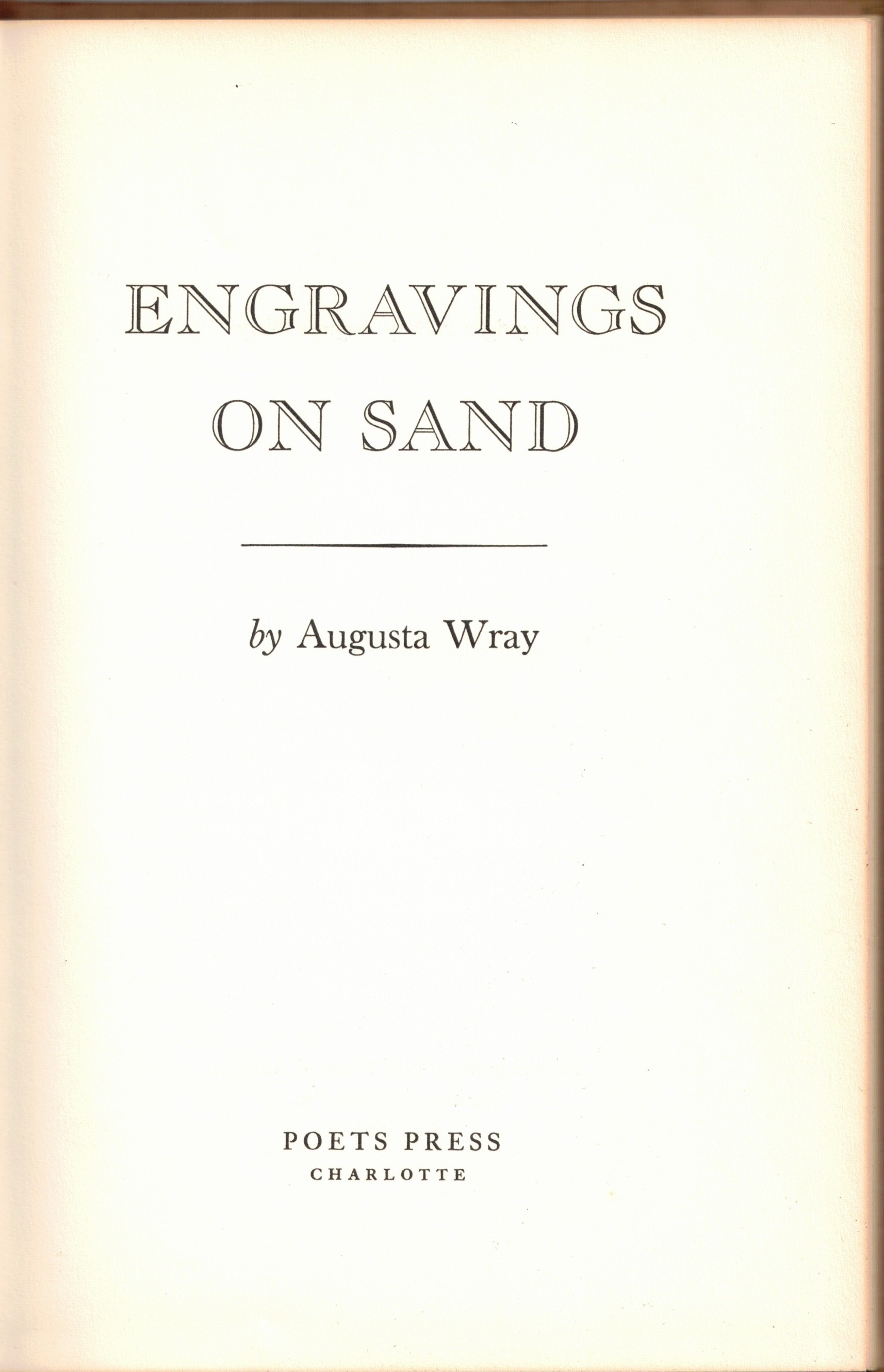
 

Last week I received Engravings on Sand in the mail. Bibliophile Carmela Dodd discovered it at a flea market and upon reading its inscription by Augusta Wray to “Mrs. Charles Evans,” Carmela felt that the book deserved a home with the North Carolina Poetry Society. Thank you, Carmela! What an amazing artifact and memorial during the Society’s 90th anniversary year.

Dorothy Edwards Summerrow, who edited the collection, writes this to begin her foreward: When, at Augusta Wray’s request, I was given the pleasure of compiling and editing “Engravings on Sand,” there was turned over to me a large suitcase literally bulging with poetry manuscript. Dorothy describes excitement but also dismay at selecting the best work of one of North Carolina’s finest poets . . . because I must of necessity select for public inspection, only a small fraction of the prodigious output of her private heart.

In 1959 Augusta Wray was 83 years old. She had been widowed four years earlier. She and her husband had no children nor other close family; she told Dorothy, “My poems are my children.” Dorothy describes the treasure before her: When I opened the suitcase entrusted to me, the sparkle of the poems made the dark, rainy afternoon brilliant with the fire of many gems.

.     .    .     .     .     .     .

Release

In the dark and tranquil stillness of the night
When quietude has simulated peace,
When joy is born without the aid of light
And sorrows softly fade away and cease,
When weary eyes are drifting into sleep
That carries them afar from day’s dull care,
When dreams appear invitingly to seep
Through all perplexities and leave them bare –
Then does the spirit take command and things
Become unreal and float away like foam;
The soul is loosed and on unweary wings
takes leave of what was once its mortal home.
++ The soul and body separate, go free,
++ When sleep, or death, gives them their liberty.

Augusta Wray
+++ from Engravings on Sand

.     .    .     .     .     .     .
Nocturne in Silver

Silver shadows in somber silence
Wrap folds around the tranquil night,
Silver rain from a silver moon
Pours its radiance through silver light.

Sleeping leaves from moon-drenched branches
Drip silver pendants edged with pearl,
Flowers with their petals closing
Gleam with silver as the furl.

Cobwebs, silver-strewn with dewdrops,
Chiming tone when brushed by moth wings,
Are silken harps, tht quivering, make
Plaintive music from silver strings.

Augusta Wray
+++ from Engravings on Sand

.     .    .     .     .     .     .

The seasons . . . love . . . death . . . these are the themes of most of Augusta Wray’s collected poems. She is steeped in Carolina culture and climes. In this final poem I’ve chosen, though, I hear an understated voice of longing and regret. Perhaps she refers here to her childlessness, but perhaps she is opening herself, and her readers, to discovering beauty in the reality that is her life – who cares what it may have seemed to some to lack?

Flowering Plum

In loveliness she stands,
Blonde beauty rare,
With white and fragile hands
Folded in prayer.

Of bridal purity,
A perfumed veil
Hides with security
A body frail.

The season waits for her,
She blooms each year
When winds softly murmur:
“Spring is now here.”

Feathered choristers sing
Blithely and loud,
Sheltered beneath the wing
Of petaled cloud..

Lonely she stand apart,
No fruit she bears.
Such beauty serves the heart.
Barren? . . . Who cares?

Augusta Wray
+++ from Engravings on Sand
.     .    .     .     .     .     .

Dorothy Edwards Summerrow was a renowned Carolina poet herself, winner in 1957 of the Roanoke-Chowan Award for Poetry. She also noted in the foreward: In Silver Echoes, the poetry anthology published in the spring of 1959 by the North Carolina Federation and edited and compiled by this editor, more of [Augusta Wray’s] poetry is included that that of any other writer in the state.

.     .    .     .     .     .     .

History of the North Carolina Poetry Society

Charlotte / Mecklenburg historical timeline

Roanoke-Chowan Award for Poetry

2015-06-15Doughton Park Tree

Read Full Post »


[with 3 poems from When There Were Horses]

Once upon a time there was a little boy . . . . a frisson of anticipation: the four-year old’s attention is now riveted on Pappy. What mischief will the boy in the story create, what adventure awaits, what danger?

When my grandson used to ask me to tell him a story it was a gift to both of us. Often the stories sprouted spontaneously from our pretending and play, their main characters usually some of his favorite companions like Mousey and Blue Rat. What joy and entertainment when you engage with the characters in a narrative! Even more so if you identify with the characters – their plight, their seeking, their discoveries strike a resonant chord in your own heart. You live a little richer and fuller through them.

But what if you are them?! What if you are the little boy in the story unfolding? What if a door opens and you enter the story and it becomes an extension of your own? The gift the teller gives you in that moment can’t be measured.

So many of the poems in Pat Riviere-Seel’s new book, When There Were Horses, open that door for me. I enter the lines. Not only do I engage, not only identify, but I become a part of the narrative. The resonance moves me to reflect on my own arc, my own plight and seeking. How does that happen?

How does poetry do that stuff? Mmmm, mystery and magic. Art and invitation. I admit I don’t actually know the details or specifics of many of Pat’s narratives but even so I have come to feel a part of them. When I get past asking, “What does she mean by that?” and just enter the flow of how she is creating meaning, then her poems crack open new earth. There, beneath the mud of daily routine, behind the obfuscation of some constant ringing little voice in my head, something waits. Waiting to sprout and bloom. Waiting to sing a new song. Waiting and wanting to peel back all that separates us from each other, and from our inner self. Something is beneath the surface, waiting to break our heart, and to heal it.

.     .     .     .     .     .     .

From the Almanac of Broken Things

I choose this earth that breaks
my heart again and again,

the woods for the way trees
bend, fall, and return to dirt.

I choose the sand dollar, the nautilus
that in brokenness finds new creation.

I choose the favorite doll that no longer cries,
loved into silence, into rags.

I choose the memory of a stranger’s touch
that lifted my face above water. Because

I did not drown, I choose morning,
the gauzy-gray dawn that returns.

I choose the once-wild Palomino
whose beauty can never be tamed.

I choose light from long dead stars
that illuminates without heat.

I choose March with its promise of spring,
the warm days that tease, the blizzard

that insulates and warms the bulbs, the seeds,
all that lies beneath the surface, waiting.

Pat Riviere-Seel
inspired by Linda Pastan’s poem The Almanac of Last Things


.     .     .     .     .     .     .

What the Moon Knows

She knows shadow, how to
slip behind clouds. She’s perfected
the art of disappearing. She knows
how to empty herself into the sky,
whisper light into darkness.
She knows the power of silence,
how to keep secrets, even as men
leave footprints in the dust, try to claim her.
Waxing and waning, she summons
the tides. Whole and holy symbol,
she remains perfect truth, tranquility.
Friend and muse, she knows the hearts
of lovers and lunatics. She knows
she is not the only one that fills the sky,
but the sky is her only home.

Pat Riviere-Seel


.     .     .     .     .     .     .

Enough

Ahead, I see her watching me, pity
or compassion, hard to tell
from this distance. I want to ask her,
my future self, what she knows
and when she knew it. I want to know
whose laughter fills her hours? Does she
still dance? Still run? What does she know
of grace? These days I know so little.

But she’s still faithful, the self I look back
to see at dawn, a quarter century ago,
running out Colbert Creek road between
woods and murmur of the South Toe River, two-lane
Highway 80 South, past Mount Mitchell Golf Course,
down macadam that turns into gravel, clatter across
the low water bridge, out Rock Creek Road,
before she turns toward her dusty driveway,
past grape vines, the garden where the black cat
waits to walk her home. She’s the one who
declared, I am enough. She’s kept her promise.
But now, knowledge brings scraps
falling from bone that offers proof
something happened here in this lost country –
three deaths, one new love.

Pat Riviere-Seel
all selections from When There Were Horses, © 2021 Pat Riviere-Seel, Main Street Rag Publishing, Charlotte NC

.     .     .     .     .     .     .

.     .     .     .     .     .     .

FULL DISCLOSURE: Pat Riviere-Seel is my cousin. Third cousin one generation removed is how I think we figured it. Pat and I first met twenty years ago at a North Carolina Poetry Society meeting at Weymouth Center for the Arts and Humanities in Southern Pines. During a break we were sharing casually about what we’d been doing lately and she mentioned her recent family reunion in Lewisville, NC.

“We met at an old Methodist Church in Lewisville where my Great-Great-Grandfather is buried.”

“No way, we had a family reunion in Lewisville a few years ago and we met at a church, might be the same one, where my Great-Great-Great-Grandfather is buried. His name was J.N.S. Daub.’

“Uh, hmm, mine is named Daub, too. Reverend Daub.”

“I’ve got a photo of the headstone at home. I’ll send you a copy.”

Sure enough, one and the same Daub. That was my maternal Great-Grandmother’s maiden name. Three Daub sisters married three McBride brothers. So Pat and my Mom are third cousins (although separated in age by more than a generation).

All those years, something beneath the surface, waiting.

– – – B

.     .     .     .     .     .     .

2020-11-03a Doughton Park Tree


Read Full Post »

photo by Saul Griffin

[with 3 poems by Becky Gould Gibson]

Amelia’s Papa Jimmy brought the bunnies to playschool yesterday. Four of them had fallen from a nest destroyed as he cleared a field two weeks ago. No mother in sight.

When we heard he’d bought bunny milk at Tractor Supply and was feeding them four drops every two hours we first thought, Is he raising them for the dogs? Not to eat, to teach. He trains young beagles to hunt; maybe they need to learn the smell of rabbits?

But no, not at all, it’s just that Jimmy can’t leave helpless young to die. Tractor Supply will mix up formula for any small critter you may have need of. He used a dropper until they learned to suck from a nipple. Two weeks later they’re hopping, eating tasty greens.

Yesterday each four- and five-year old got to hear the bunnies’ story, touch their soft ears and heads. Today Jimmy will release them at the edge of the woods, restored to bunny-ness, preserved for no other purpose than themselves.

.     .     .     .     .     .     .

Stand of Birches

The woods are wet this morning – rain yesterday
or the day before, maybe – such a sense of quiet,
all the damp peace of it, mostly trees to be with,
birches especially, minimalists in chic black and white,
raw silk with horizontal markings like wounds
slashed across white paper, dashes, staples, lines
of ghostly scansion, every beat, every syllable
of wood and glade accented, no scales or hierarchies
scored in their bark, rather universal emphasis,
as if everything mattered – this tiny white-headed
flower, this ant on some errand, even the mosquito
buzzing my ankles, these low-growing grasses,
branch with its bark pulled back, underbelly softening,
chartreuse mosses – though brief, briefly important.

Becky Gould Gibson

photo by Saul Griffin

.     .     .     .     .     .     .

These poems by Becky Gould Gibson are from her book Heading Home, the winner of the inaugural Lena Shull Book Contest in 2013. The poetry is strongly rooted in family and place but also richly steeped in literary tradition and history. I keep coming back to Stand of Birches for its eloquent, even spiritual expression of the deepest premise of Ecology: not utilitarian, not exploitative, not derivative or charismatic or anthropocentric – each living thing in all its interconnectedness is of value in and for itself.

Yes, yes, OK, OK, even mosquitoes.

In 2012 the Poetry Council of North Carolina elected to dissolve its organization and merge its residual funds with the North Carolina Poetry Society. Since 1949 PCNC had promoted the craft of poetry in the state with its annual contests; now in collaboration with NCPS it established an endowment to sponsor the annual Lena Shull Book Contest for an unpublished full length manuscript by a North Carolina writer, named for founder and first president of PCNC. Becky Gould Gibson was the first Lena Shull winner.

.     .     .     .     .     .     .

Scuppernongs
+++ Immortal life will be given . . .
+++ The Lord of harvest gathers us, / Sheaves of the dead –
++++++++++++++++++++++ for Bill

When death lifts its edge a little,
as in the first movement of Mahler’s C minor symphony,
you wonder will you be ready.
We finish a bowl of scuppernongs from the market,
wild bronze from childhood,
delighting in the bite, thick skin between our teeth,
touch tongue-tip to tongue-tip.
You taught my tongue to talk back.
I recall all those summers,
you in another county, nearly a decade before we would meet.

Now, come with me.
We’re together, then. It’s a languid afternoon in late August.
I’m eight. You’re ten.
As for death, I still think I can talk my way out of it.
Follow me across the un-mowed yard,
weeds tickling our legs,
to the scuppernong bush at the edge of Mr. Marcus’s field.
For you, death is no fiction.
At six, made to duck under your desk at school,
wear a dog tag, so someone could identify your body.
No bucket. We stuff ourselves madly.
Know what happens if you swallow a seed? We laugh.

No, love. It is not my own death I worry about, but yours –
will I ever be ready for it?
To be alone as I was that distant August,
memory plucking the fruit of you, scuppernong ripe in my mouth.

Becky Gould Gibson

.     .     .     .     .     .     .

Lines to Yeats on the Anniversary of His Death
++++ January 28, 1939
++++ for Alice

To a soul just fledged, still damp, in a nest
Of paper, flimsy bits of Plato, Paul,
Shelley, Wordsworth, Tennyson, all the rest
Who believed (or even half-believed) soul
Could soar above the earth (earth a mere cast
Of heaven), spirit somehow separable
From flesh, you came, William (my dear Willie)
With your poems of pure song, heart’s own music.

No wonder it entered my veins, my pulse
Learned to tick your rhythms. No matter you
Warned not to pleasure soul at the expense
Of body, who could even listen to
Such warning with such a beat, sound and sense
So perfectly married, as if to show
A manmade thing could become immortal,
Gold bird on a gold limb sing out its soul.

You made me more impatient than ever
To conceive such a poem of my own.
Your artless art merely fed the fever,
Yet every line fell stillborn from my pen.
Blood had become a colorless liquor
Nourished on symbols. Life had to happen,
And it did. Not a woman but a child,
Rather a child’s birth. It was a girl-child

Split me apart. No way to staunch the flood
(Nothing’s sole or whole that has not been rent)
Of blunt necessity. You had your Maud.
I had my Alice. She caught me up, lent
Me her knowledge. She, no man or bird-god,
Made loins shudder, roused me from those years spent
In abstraction, taught me bone, bowel, breath,
Body’s mortal work. She taught me my death.

Becky Gould Gibson

three poems from Heading Home, Winner of the 2013 Lena Shull Book Contest, Main Street Rag Publishing Company, © 2014 Becky Gould Gibson

.     .     .     .     .     .     .

.     .     .     .     .     .     .

2016-05-08a Doughton Park Tree

Read Full Post »

« Newer Posts - Older Posts »