Feeds:
Posts
Comments

Posts Tagged ‘NC Poetry Society’

 . 
[with poems by Jim Zola, Rhett Trull, Celisa Steele, Nancy Martin-Young,
Khalisa Rae, Joanie McLean
and a special feature by Felicia van Bork and ampydoo]
 . 
Learning to Live
 . 
For years I walked out and heard
rustling in the rhododendron
that blooms each spring and paper-mâchés
the patio with white petals.
 . 
Yet I’ve never seen wings or nest
or bolt of bird such as one might reason.
Just the flurried sound, a semaphore
of leaves and branch, that could be finch
 . 
or swallow, but isn’t.
Not coincidence, I’m convinced,
this signal more subtle than lightning
is grammar for my soul,
 . 
an insistence that I must find
a way to live among the small things
with bones like air and hearts
like small sledgehammers.
 . 
Jim Zola, winner of the 2023 Lena Shull Book Award of the NC Poetry Society for his manuscript It’s the Unremarkable that Will Last, which will be published by Redhawk Press. Learning to Live originally appeared in Rat’s Ass Review.
 . 
❦ ❦ ❦
 . 
Night before last Linda opened the final frontier of jigsaws. Galactically difficult, broad swaths of monochromatic nebulae, the merest quantum fluctuation in individual shapes – I fear that to complete this one I may have to boldly go where no one has gone before.
 . 
I almost give up before I even finish the border, its infinite deep unvarying black. Be logical here, Bill! I array the pieces by subtle color variation, columns and rows, and turn on all the lamps in the room. Still only cold inhospitable vacuum. Suddenly from the depth of blank stare I discover my fingers picking up pieces and fitting them together, six, then eight, little cellules of life spontaneously generating until logic again reaches in and shuts me down.
 . 
Is this how creativity works? A little bit Spock – analyzing patterns and calculating probabilities. A bit more Kirk – impulse, hunch, release to the flow of the subliminal. A prompt, a theme, a roadmap, all good – semper paratus – but I know for myself that the most likely moment for a line to leap up and embrace me is when I’m in free fall in love with a poem I’m reading. Creativity perches just at the periphery longing to show me the piece that will fit, the one I’ve been looking all along.
 . 
 . 
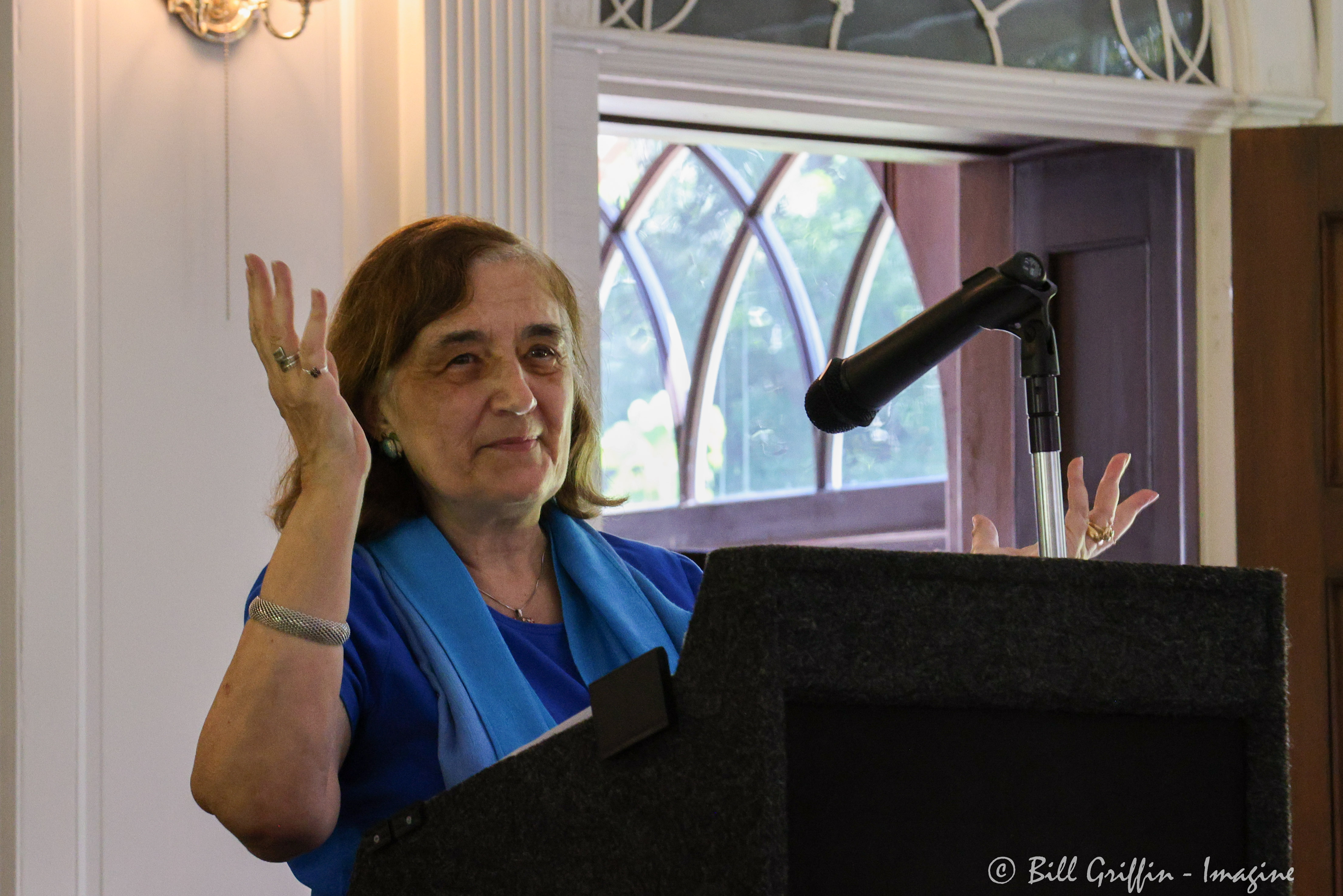
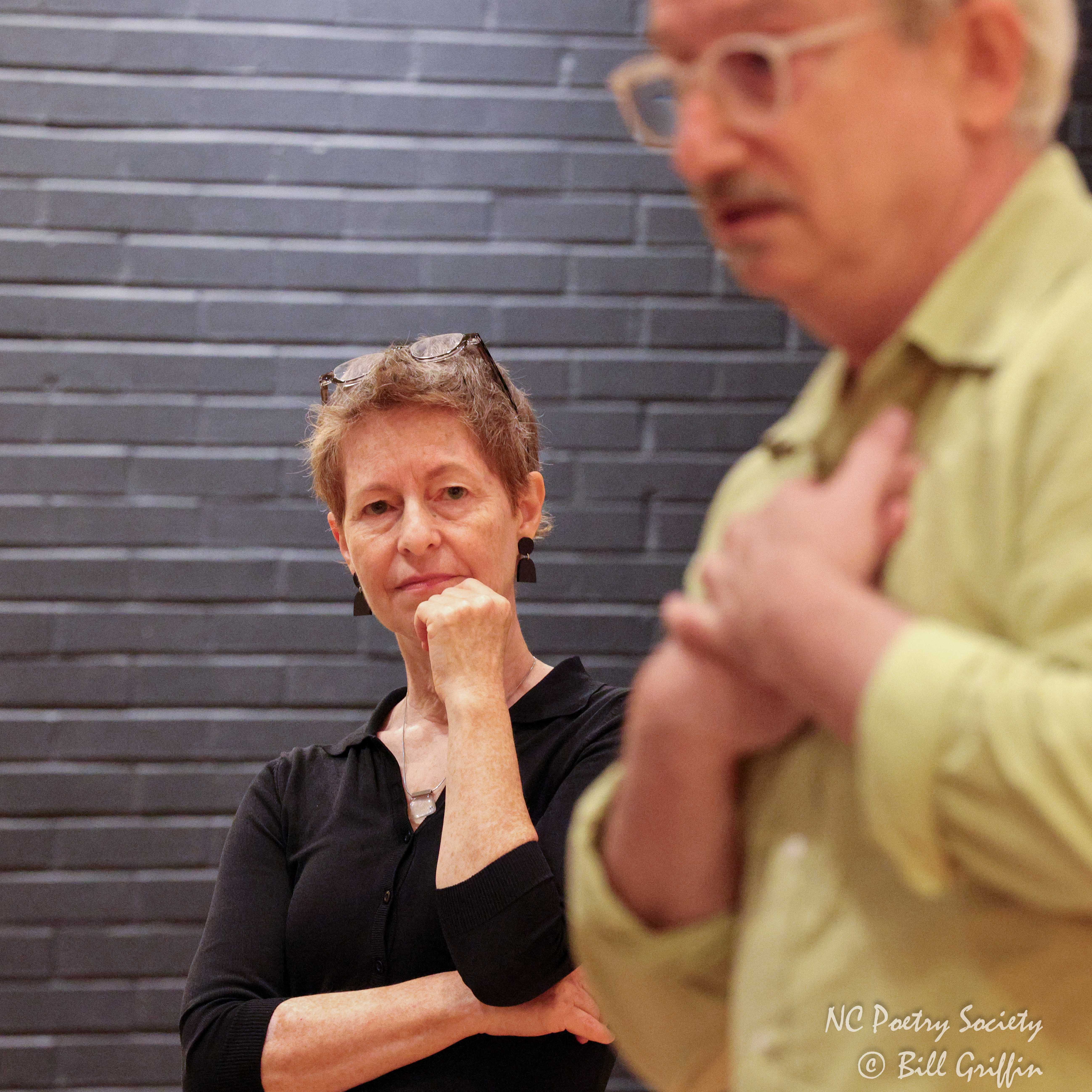
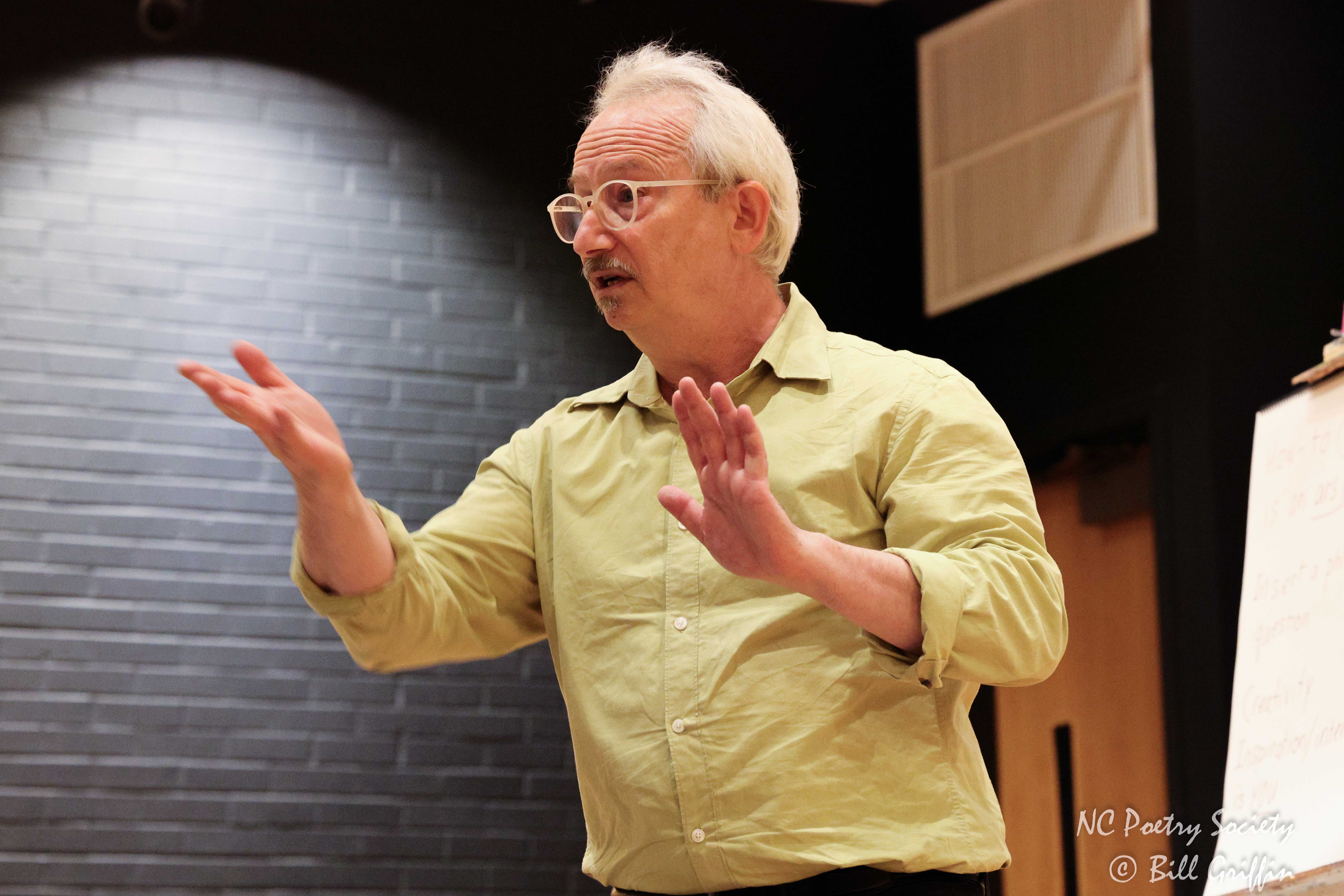
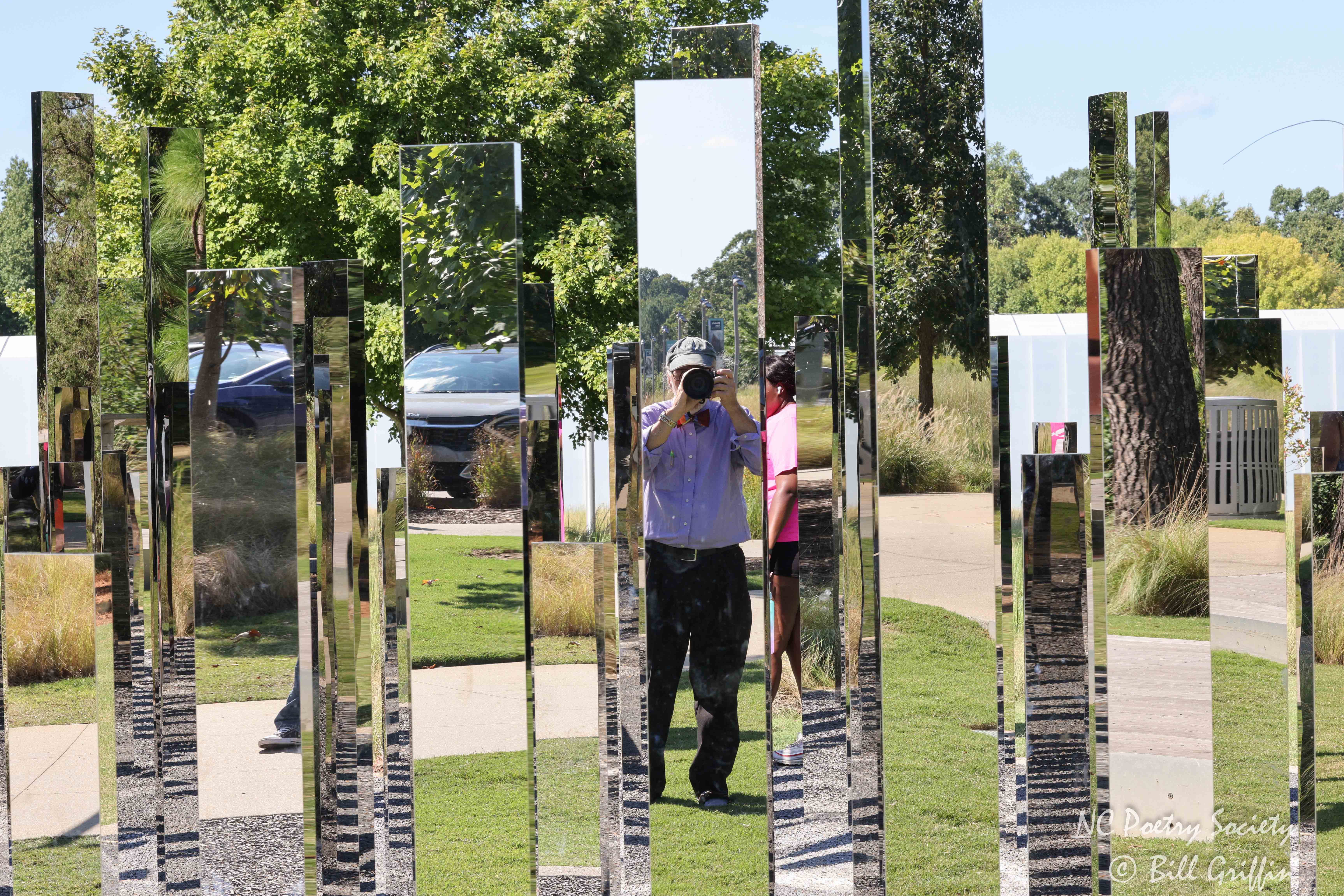
Felicia van Bork and Alan Michael Parker offer to tickle that little perching creature until you feel its firebreath in your ear. Draw a portrait without looking at the page or lifting your pen. Write five things you would never do and pick the most interesting. The two multi-creatives led The Best Creativity Workshop Ever at NC Poetry Society’s September 16 meeting at the NC Museum of Art in Raleigh. Felicia describes her life as a love affair with art. AMP describes his next book as a collection of flash fiction and Bingo cards. And when I asked if they would contribute to this feature on NCPS @ NCMA, I should have expected that they would send something unexpected.
 . 
Drawing Exercise No. 30
 . 
We come in peace.
We are the Are
Me.
Do not be a
Fraid.
Draw with us.
Together we take up
charcoal
and
Touch
the wall up high
Hi!
high as we can.
We draw down with force.
Use more force.
We step back we step forward.
We connect the vertical lines by drawing
Strong
horizontal strokes
again
again
Until we have made a fence a wall
To shelter us from the Fraids
Who will not cannot join the Are
Me.
Trace the outline of the person next to you.
Look, that outline is visible through the fence
That is a Fraid.
Now with your eraser erase the Fraid.
It won’t erase yes it smears.
It becomes more present yes the more we erase it.
Now it is inside the fence with us.
All the Fraids are inside with us.
 . 
Felicia van Bork @draw_felicia_draw
 . 
 . Alan Michael Parker @ampydoo
 . 
❦ ❦ ❦
 . 
 . 
 . 
 . 
❦ ❦ ❦
 . 
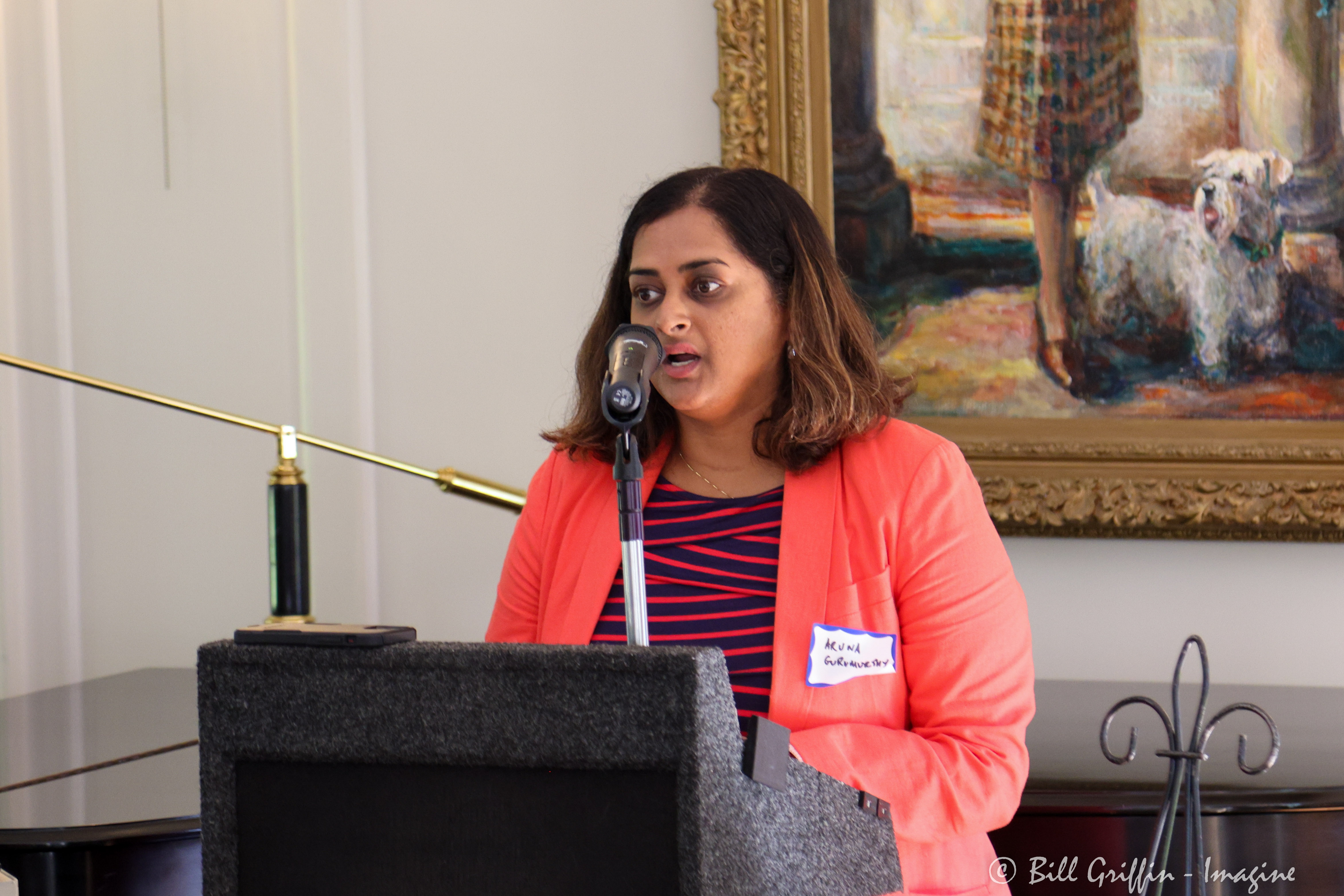
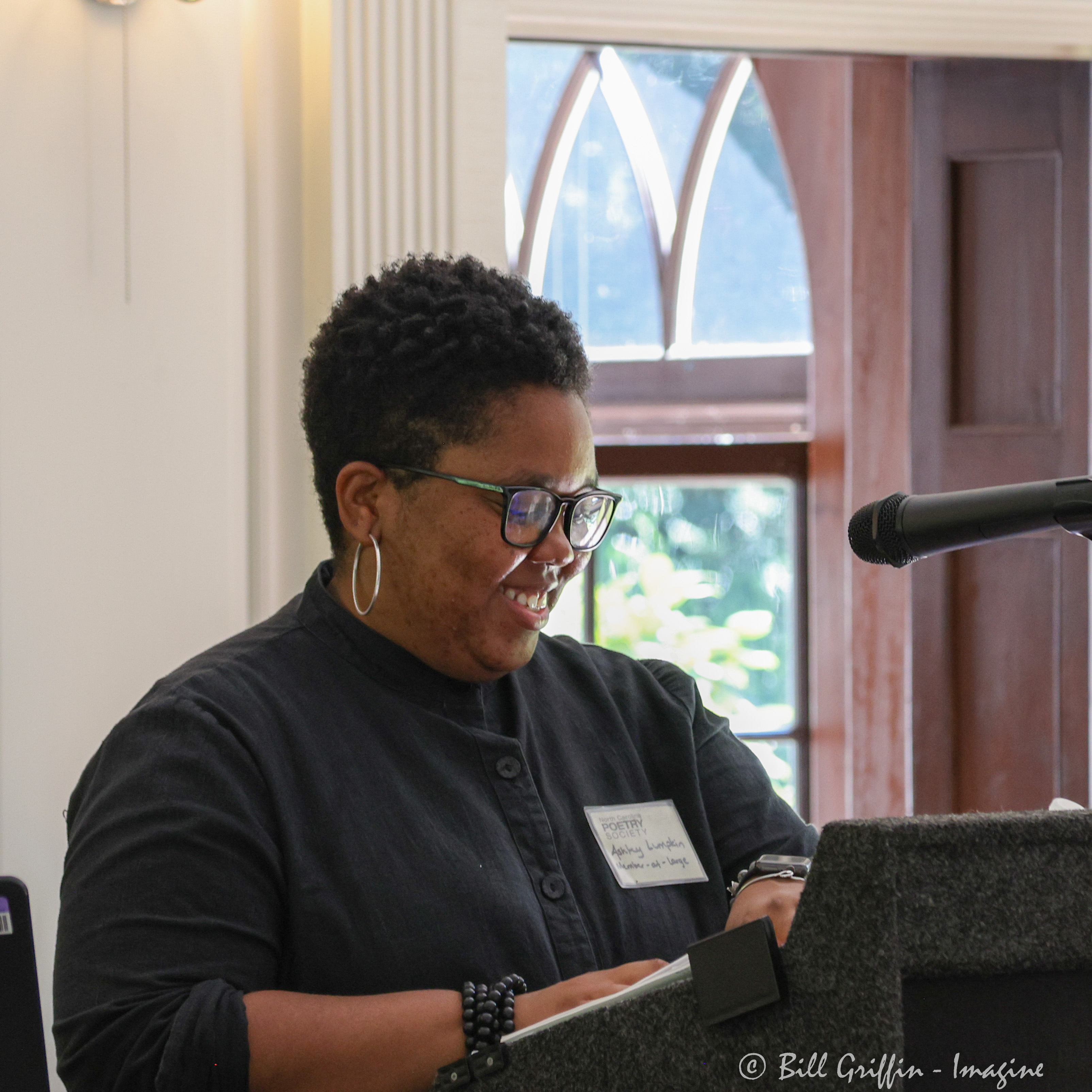
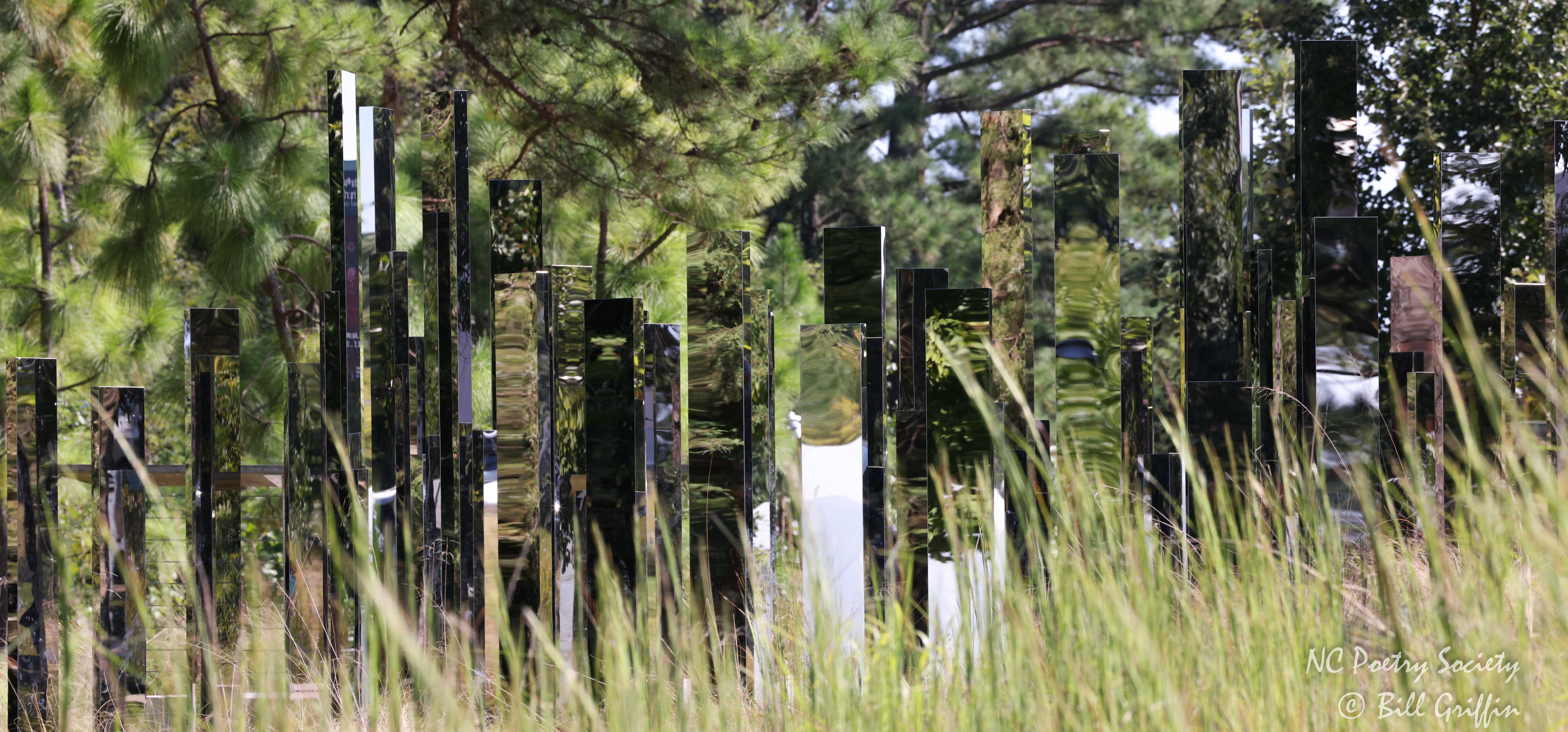
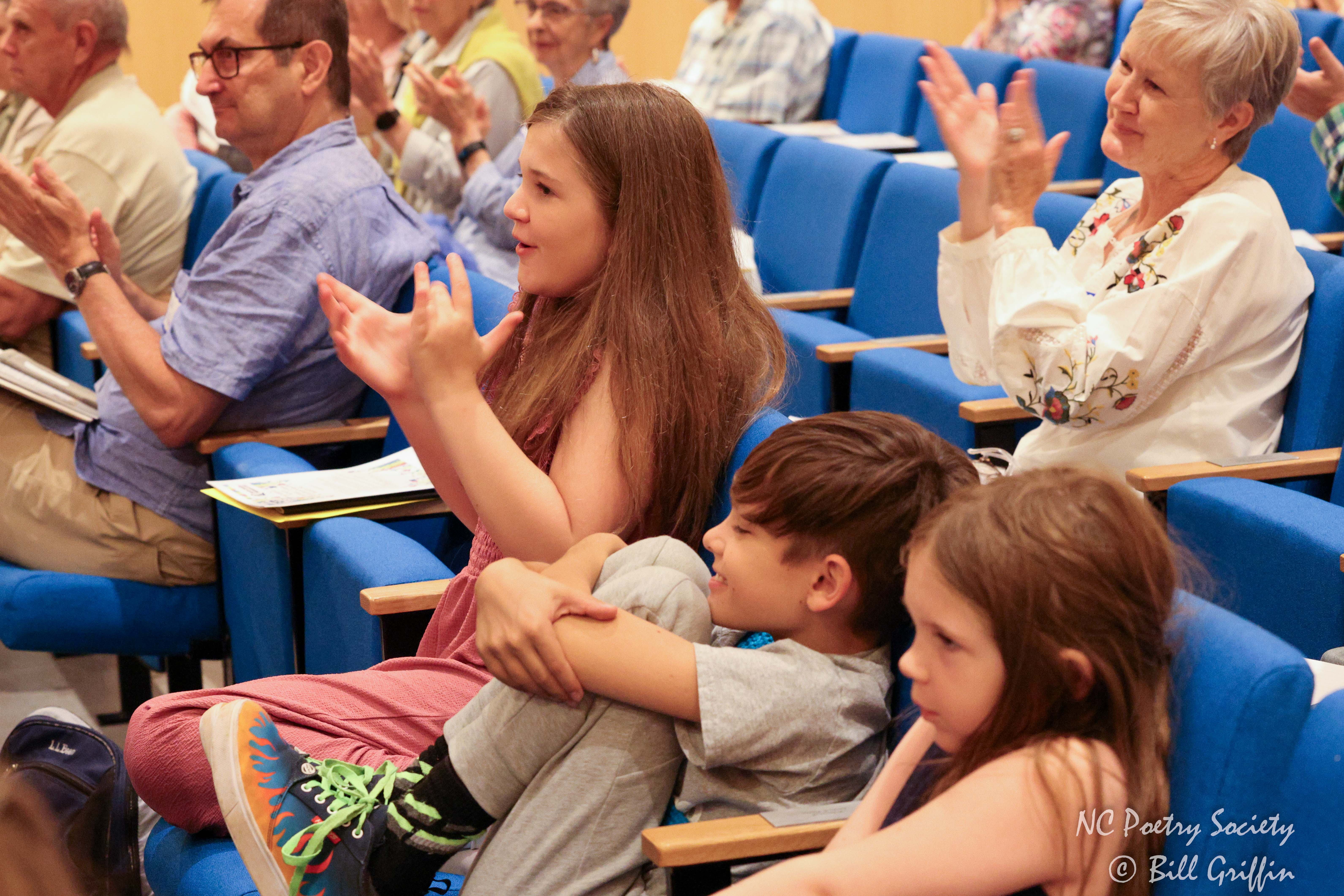
Each September the North Carolina Poetry Society meets to feature readings by winners of the year’s most competitive contests. This year for the first time NCPS has held this meeting at the North Carolina Museum of Art in Raleigh, with a morning of readings, the afternoon workshop, and an open air “pop-up” mic-less open mic hosted by Regina Garcia and Caren Stuart.
 . 
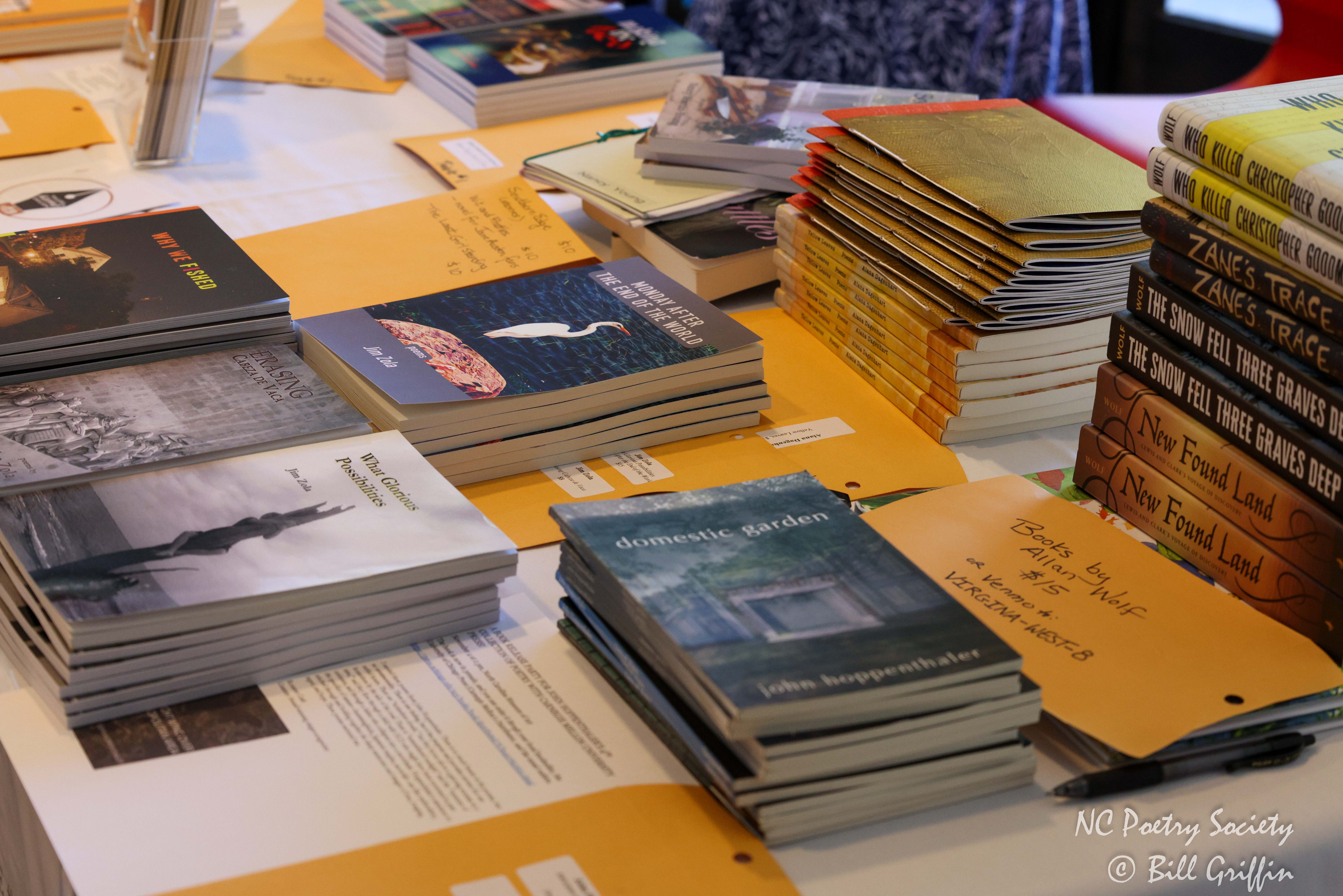
The 2023 Lena M. Shull Book Award for an unpublished manuscript from a North Carolina poet (coordinator Sherry Thrasher) goes to Jim Zola for his collection It’s the Unremarkable that Will Last; finalists are Nancy Martin-Young and Joanie McLean.      INFO
 . 
The Brockman-Campbell Book Contest is for the best volume of poetry published by a native or resident of NC in the previous year (coordinator Preston Martin); the 2023 winner is Joseph Bathanti for Light at the Seam, with finalists Eric Nelson for Horse Not Zebra and Katherine Soniat for Polishing the Glass Storm.      INFO
 . 
The Susan Laughter Meyers Poetry Fellowship (coordinator Steve Cushman) provides an honorarium and a week’s residency at Weymouth Center for the Arts and Humanities. The 2023 winner is Rhett Iseman Trull of Greensboro, with finalists Khalisa Rae, Celisa Steele, Anne Myles, and RK Fauth.      INFO
 . 
The Randall Jarrell Poetry Competition is sponsored by the North Carolina Writer’s Network coordinated by Terry L. Kennedy. Winning entries are published in storySouth and will be available to read there in the coming months. The 2023 winner is Joshua Martin, with finalists Maria Rouphail and Melinda Thomsen.      INFO
 . 
This is the first year for the Jaki Shelton Green Performance Poetry Prize, co-sponsored by NCPS and North Carolina Literary Review at East Carolina University (coordinator Devra Thomas). Winners’ videos will be posted online; the 2023 winner is Allan Wolf, with finalists Michael Loderstedt, Onyx Bradley, and Janet Ford.      INFO
 . 
 . 
❦ ❦ ❦
 . 
The Stars Align Themselves in Ancient Sisterhoods of Light
 . 
And Jade and I sat on the hood of her car
and didn’t mind the rain, the sun
that ticked on anyway, the sun would not go out.
And Megan held my hair back.
And Molly taught me cigarettes. And Sarah
kept her promise not to tell. And Riley told.
And Coach chased me down—night
we lost the playoffs and I’d planned
to kill myself, out the bus emergency door, took off
for the roof downtown—and she carried me to
Brittney’s and Brittney leant me dry clothes, underwear and all,
and let me sleep beside her, in the morning
bought us donuts, even though
I couldn’t eat, I couldn’t sleep.
And sometimes it was as if there were
a party thrown to save me, devout
committees formed, tasked
with just that job. And
 . 
sometimes there was no one
 . 
but wind off the ocean, the evening
all laid out before me like bedclothes,
and even the gleam in the eye of the wren
and the sunrise all red-dressed and boasting and once
there was this Great Dane, Charlie,
who knew—somehow he knew—
on my lap the full-grown anchor of his body, head
to my shoulder, world I didn’t want
to want to leave.
 . 
And Caleb sewed the captain star
I’d ripped from my letter jacket and
kissed me when I needed to be kissed, Bridge
of Sighs and all of Venice incandescent, inviting me
to drown. And kissing didn’t save me. And anything
might save me. And Karen understood.
And Joy did not. And Lauren grew delphinium,
she said, just for me. And Jenny—when the light spiked
sharp and I forgot the way to breathe—
held me for an hour
outside the party, outside everybody else’s ease
and laughter. And Corey found me in the field.
Her hair like smoke and ribbons. We didn’t need
 . 
to speak or touch, just watched the sky
until the bats delivered twilight. And Eli
deemed my pain divine and let me see
above his bed where he’d drawn a map of his
in a fever of blue ink after watching Fight Club, and did not
take my clothes off, even though he could.
And Brittney brought me everywhere and Brittney
kept me in her Jeep and Brittney did the talking
when I had no words.
 . 
And Nicky gave her lucky coin and Chris
the flannel off his back right after class, right
when I said I loved it. And Janelle at two a.m.,
no hesitation, let me in and shared the Irish whiskey
she’d been saving, lit us candles, until
we were the last, we were sure, awake alive.
And Leah steered us into safety, let me rest
across the back seat, Indigo Girls and yes,
I’m on fire, I’m on fire through the years.
 . 
And Jade couldn’t take it anymore
and turned away. And Heather sent an actual
disinvitation, her stationary tinged the palest pink,
but Lizzie patched me up
in the back of the cathedral and kept
her hand on me all night, even in her sleep.
And Holden stayed past visiting hours
and Vanessa, the night nurse, let him. And
under the oak tree, Stephanie
told me all her secrets.
 . 
And Brittney came each time I called,
even though her date, even though her finals, even though
I take and take and make myself the center
of each story. And Greta wrote me songs
and Katie said crawl in and
Mary did my portrait as a shadow.
And Adrienne pinned me down,
fiercest hug until I promised
not to jump. I didn’t jump. I didn’t
swallow the whole bottle. I threw out
the razor blade, even though I hid it first awhile
and touched it sometimes like a lover.
I’m lucky. And that’s all. I’m lucky
I am loved.
 . 
Rhett Trull, winner of the 2023 Susan Laughter Meyers Poetry Fellowship. Originally published in Litmosphere 2023 of Charlotte Lit.
 . 
 . 
 . 
❦ ❦ ❦
 . 
The Minister of Loneliness
 . 
has no children of her own to entrust
to an aproned au pair, no quick kisses
as she leaves each morning for work. And she
has no spouse who might grow melancholy
like temperamental orchids in the vaulted halls
of the silent house, who might open cupboards, search
neat rows of goods for a jar—just one—graced
with his wife’s precise fingerprints. And she has no
friends waiting for her call, no waggling dog
waiting to be fed. No, she was appointed
to this post because she could give everything
to this Ministry, prepared by the paper
she wrote in college—eons ago—on the geology
of loneliness that proves it doesn’t crumble
like sandstone, isn’t fissile as shale. No,
it’s smooth, she showed, and cold as polished
marble. The kind that won’t be carved into the face
of someone beloved. The kind that remains
blank and empty and clean
as counters in a kitchen where no one ever cooks.
 . 
Celisa Steele, finalist for the 2023 Susan Laughter Meyers Poetry Fellowship. Originally appeared in Southern Poetry Review.
 . 
 . 
 . 
❦ ❦ ❦
 . 
A Suitable Place
Oakwood Cemetery, Raleigh, North Carolina
 . 
I: Pick Up the Wind Phone
First, choose to wander a path with the dead
through the granite gate, past the stone bridge.
There are no signs to point the way.
 . 
Scan the landscape until you notice it, study
how it stands, nearly hidden in a hollow
downhill from the Gothic House of Memory:
a spare wooden booth, its rotary phone
discreetly placed for the disconnected.
 . 
Lift your hand to hold the heavy receiver.
Take a breath and dial the old exchange—
the one made up of words and numbers,
the one you still remember from a time
long before cell phones and contact lists.
 . 
Say hello. Speak their names. Then wait.
Share the news about the house or the baby
or the oak tree that fell in last week’s storm.
Ask forgiveness. Listen for the wind to answer
you, who are left behind, who seek an open line.
 . 
II: Scan the Landscape
Deep shade, open lanes, no traffic,
perfect for power-walking past cool stones
and twisted angels or treading up the hill
of Gettysburg dead, mostly Confederates
come home at last, but six who wore blue
unresting, out of place, as I am.
 . 
Downhill, a doe browses,
tearing faded roses from a funeral wreath.
Twin headstones pop from too-green grass,
names and birthdates freshly carved,
death dates empty, blank and patient.
Most graves are full, but life lingers
on the landscape’s edges.
 . 
While newer graveyards raze markers
to the ground, Oakwood’s monuments tower.
Workers wield weed-whackers daily,
keeping grass at bay. A toy truck,
a mini bottle of Jack—mementos left behind
on plots prove to the living that the dead lived too.
 . 
Today only I
stand in the echoing House of Memory
remembering my father, hacking his last.
His ashes kill time in my sister’s hutch.
Would he rest easy here beneath the oaks?
 . 
I’m a transplanted Yankee
trying to live long,
but in the end
I think I’d like it here
near these protruding stones
that someone has to rake around.
I’d like to have my daughter trace
my name with her finger, leave
a bottle of Malbec and two glasses.
 . 
Nancy Martin-Young, finalist for the 2023 Lena Shull Book Award. This poem first published in Flying South, 2023
 . 
 . 
 . 
 . 
❦ ❦ ❦
 .  . 
Circus Acts: No More Black Girl Magic
 . 
Black woman,
 . 
This world will make you circus,
freak show, tightrope walker,
contort your name from Saartjie
to “Sara Bartman,”
 . 
Hottentot Venus—stage performer.
Look, how they abracadabra the
royal exploitation of your form.
 . 
Watch them dissect your broad
bottom saw you into science experiment.
 . 
Call your mending—magic
your root balm and salve a work
of the devil–sorcery. Go out the trap
door, come back in the body
of Beyoncé—prized possession,
they will spit-shine the stage for you again.
What a spectacular woman—
 . 
two-headed and omnipresent
one foot here, one foot in Houdini-state.
Your magic trick is: “Look at all the wonder
I can do with two hands and twenty-four hours.”
When people say, “That’s Black Girl Magic.”
say, “I have no magic for you. I make meals
 . 
from crumbs, cast demons with just
my tongue, envision possibility
from potential.” That makes me
 . 
scientist, inventor, chemist—
spiritual being. Tell them this is
 . 
not super, this is survival.
When they call you hero,
when they hand you the cape anyway,
ask, “Haven’t I carried enough?”
 . 
When they call your strength otherworldly,
say, it is Venus rising
within me, nothing more.
 . 
Khalisa Rae, finalist for the 2023 Susan Laughter Meyers Poetry Fellowship. This poem is from her debut collection, Ghost in a Black Girl’s Throat (Red Hen Press 2021).
 . 
 .
 . 
 .
❦ ❦ ❦
 . 
Into My Field
 . 
Pete the old bay horse
called to me this morning
 . 
not so that I could hear
but so that I could not look away
 . 
he stood apart from the others
as an old horse will
 . 
his ribs showed a bit
as an old horse’s will
 . 
his russet face
with the white blaze
 . 
held so still– arrested while grazing
held my gaze without effort
 . 
and his black mane so lush
so thoroughly tossed
 . 
gave him a touch of wild
that wild that gathers these days
 . 
these fall days – translucent days
days of transubstantiation
 . 
all those things
in your hands and your lap
 . 
put them away
come into my field
 . 
and stay this time
till you are cold and hungry
 . 
and even then
stay
 . 
Joanie Mclean, finalist for the 2023 Lena Shull Book Award. Her manuscript, Like Wind Into Air, received honorable mention and has been accepted for publication with Redhawk Press.
 . 
 . 
❦ ❦ ❦
 . 
 . 
 . 
 . 
 . 
 . 
❦ ❦ ❦
 . 
 . 
Read Full Post »

[poems from Word and Witness: A. R. Ammons, Julie Suk, Peter Makuck]

Carnage ensues at the table while I make coffee. As all the other animals look on in abject silence, large plush Starfish (carnivore, you know) has captured Baby Chick and is eating him with authentic suck-the-juice-right-out-of-you sound effects.

I remark that I’m going to be sad to miss little yellow Chicky. My grandson looks up, all innocence, and simply reminds me, “That’s just the way the food chain works.”

So it must be. Nine years before the publication of Darwin’s The Origin of Species, Alfred Lord Tennyson had already warned us (“she” being Nature, “types” being species):

. . .
She cries, ‘A thousand types are gone:
I care for nothing, all shall go.

‘Thou makest thine appeal to me:
I bring to life, I bring to death:
The spirit does but mean the breath:
I know no more.’ And he, shall he,

Man, her last work, who seem’d so fair,
Such splendid purpose in his eyes,
Who roll’d the psalm to wintry skies,
Who built him fanes of fruitless prayer,

Who trusted God was love indeed
And love Creation’s final law–
Tho’ Nature, red in tooth and claw
With ravine, shriek’d against his creed –

Who loved, who suffer’d countless ills,
Who battled for the True, the Just,
Be blown about the desert dust,
Or seal’d within the iron hills?

+++++ from In Memoriam A. H. H. (1850)

Shall we weep for Baby Chick? For the extinctions accelerating around us? For ourselves, our loss? A few years back I was leading a group of Junior Highs on a nature walk when we spotted a marvelously large spider shuffling along the path ahead of us. When we reached it, though, we found it was not the legs of the spider that were walking but the legs of the pint-sized wasp that had stung and paralyzed it and now dragged it to a favorable spot for egg laying. In an instant the spider transformed from an object of fear and loathing to a spike of compassion in our hearts.

This week a very talkative red shouldered hawk is haunting the woods out back. No coincidence: that’s where the bird feeders hang. We hope he’s eyeing the squirrels – there are more than enough squirrels, eat all you want Sir Hawk. And the mice that come for the seeds dropped to the ground from the feeders, and then store them in our basement, yes, eat them, too. But please, not the cute chipmunk who hides in the ivy or the finches we love. Alas, I guess we don’t get to choose. That’s just how the food chain works.

But wait – do all our choices come to nothing? Our love, our suffering of countless ills, our battles for the True and Just – is the end of all these to be blown to desert dust? Can’t we choose to engage with embattled Nature? Can we reduce our relentless consumption of the planet, choose leaders of vision and intelligence, make peace with our brothers and sisters? How lengthy shall I extend this list? Shall we abandon hope and just accept our place in the food chain while the warming earth devours us?

If a spider can inspire a moment of compassion in a 13-year old, I will have to accede that there may yet be hope for our species.

❦ ❦ ❦

The Yucca Moth

++ The yucca clump
is blooming,
++ tall sturdy spears
spangling into bells of light,
++ green
in the white blooms
++ faint as a memory of mint.

I raid
++ a bloom,
spread the hung petals out,
++ and, surprised he is not
a bloom-part, find
++ a moth inside, the exact color,
the bloom his daylight port or cove:

though time comes
++ and goes and troubles
are unlessened,
++ the yucca is lifting temples
of bloom: from the night
++ of our dark flights, can
we go in to heal, live
++ out in white-green shade
the radiant, white, hanging day?

A. R. Ammons
collected in Word and Witness: 100 years of North Carolina Poetry, Carolina Academic Press, © 1999 North Carolina Poetry Society

❦ ❦ ❦

This week a friend asked me to send him the table of contents of Word and Witness for a project on biodiversity he’s considering The book was published by the North Carolina Poetry Society in 1999 and edited by Sally Buckner with an afterword by Fred Chappell, who was NC Poet Laureate at the time. It spans the full 20th Century of North Carolina poetry and poets, and as I was scanning the TOC to email my friend a PDF, I re-discovered the names of so many folks who have inspired and befriended me over the last two decades.

Poetry continues to thrive in “the writingest state.” Word and Witness is 261 pages; it would be a real challenge to prepare Volume II for just the first quarter of the 21st Century and limit it to that length. I believe it is still possible to purchase a copy from Carolina Academic Press. You need to get yourself one.

❦ ❦ ❦

Waiting for the Storyteller

Once more we wait for the storyteller
to step into the margin and reveal intentions:
why the first letter flowered,
spiraling down the page with intricate designs,
the hand translating what the tongue began.

Clues drop, mostly forgotten,
so on and so on stacked like bricks,
crumbling when we look back,
a voice once close now a stranger.

All through the book we wild-guess the villain,
so deceived by this one or that
we look for reprieve, a surprise ending,
the page turning to a house in the woods,
dogs locked up, gun put a way.

In the still forest of words,
where the hidden appears in its season,
hills darken and move in.
Like lean horses that have rocked a long way home,
they circle the pool of our hands.
A deer riffles through leaves, then a bird
sings begin again, begin again.

Julie Suk
collected in Word and Witness: 100 years of North Carolina Poetry, Carolina Academic Press, © 1999 North Carolina Poetry Society

❦ ❦ ❦

Dogwood Again

Home from college, I’d leave my reading,
climb the hill through trees behind the house,
listen to a rough wind suffer through
new leaves and, too aware of myself, ask why?

The answer could have been stone wall,
wind or some other words. In April, our house
lived in the light of those first white petals
and now I think more about hows than whys –

How, whenever we fished at Pond Meadow,
my father dug a small one up, carefully
wrapped the rootball in burlap, and trucked it
home until our hard blazed white all around,

and how, at Easter, those nighttime blossoms
seemed like hundred of fluttering white wings.
Again that tree goes into the dark loaded
with envy, those leaves full of light not fading.

And this morning, a fogbright air presses
against the blank white pane and would have us
see the way mist burns from within, shimmers,
slowly parts, and flares upon an even whiter tree,

tinged now with orange, and how a soft fire
runs to the farthest cluster of cross-like petals,
each haloed with clear air, finely revealed.

Peter Makuck
collected in Word and Witness: 100 years of North Carolina Poetry, Carolina Academic Press, © 1999 North Carolina Poetry Society

❦ ❦ ❦

Bios adapted in part from Word and Witness:

After growing up on a tobacco farm near Whiteville, A. R. Ammons (1926-2001) received a degree from Wake Forest College, and served as an elementary school principal, but he lived most of his adult life outside his native state. His interest in writing developed during long hours aboard ship when he served a term of duty with the Navy. In 1964 he joined the faculty at Cornell University, where he was ultimately Goldwin Smith Professor of English. Among his many honors are the Bollingen Prize, the national Book award (twice), the MacArthur Fellowship, and the 1998 Tanning Prize from the Academy of American Poets.

A native of Alabama, Julie Suk (b. 1924) has lived for many years in Charlotte, where she worked in a nature museum. In addition to authoring six volumes of her own poetry, she has co-edited (with Anne Newman) Bear Crossings: An Anthology of North American Poets. Her collection The Angel of Obsession won the 1991 University of Arkansas national poetry competition, and in 1993 she won the Bess Hokin Prize given by Poetry magazine. In 2004 Julie received the Irene Blair Honeycutt Lifetime Achievement Award from Central Piedmont Community College; her book The Dark Takes Aim won the 2003 North Carolina Poetry Society’s Brockman-Campbell Book Award and The Oscar Arnold Young Award from The Poetry Council of North Carolina.

Among previous occupations, Peter Makuck (b. 1940) lists, “truck driver, painter, mechanic,” but he is best known as writer and as Distinguished Professor of Arts and Sciences at East Carolina University. Pilgrims won the Zoe Kincaid Brockman Award for the best book of poems by a North Carolinian in 1989. In 2010 Long Lens: New & Selected Poems was nominated for a Pulitzer Prize. In addition to his eight collections of poetry, he has published numerous short stories and essays. Peter has received the International Poetry Forum’s Charity Randall Citation; a Connecticut native, he has been a Fulbright Lecturer at the Universite de Soavoie, Chambery, France. He founded Tar River Poetry in 1978 and served as editor until 2006.

❦ ❦ ❦

Doughton Park Tree 2021-10-23

Read Full Post »

[with poems by Ana Pugatch, David Poston, Maureen Sherbondy, Joan Leotta]

The original Constitution of the North Carolina Poetry Society stated these objectives: to foster the writing of poetry; to bring together in meetings of mutual interest and fellowship the poets of North Carolina; to encourage the study, writing, and publication of poetry; and to develop a public taste for the reading and appreciation of poetry. These tenets still inspire the mission of NCPS. During the second decade of the twenty-first century that mission has expanded, metamorphosed, and grown wings.

On September 17, 2022, the NC Poetry Society gathered at Weymouth Center for the Arts and Humanities for a gala celebration of our 90th Anniversary. This was the first meeting in person since the spread of COVID19 two and a half years earlier. After dozens of virtual workshops, poetry readings, Zoom programs, and online open mics, our faces had somehow remained familiar but we had come to know many new faces as well. When we walked into the Boyd House in Southern Pines the greetings were ecstatic, the hugs manifold, and behind the masks were face-splitting smiles. Joy overwhelming!

And isn’t this the essential nucleus of the mission of NCPS? Oh yes, we thrive on the unexpected metaphor, the well-honed line, the expressive reading. Poetry, though, is more than craft. It is the art and magic of connecting, the door that opens shared experience, a key to community. As we share poetry we share our self. Suddenly there are two of us walking this journey of humanness, two to delve its depths, two to breach its heights. Wherever poets and lovers of poetry gather, wherever a hard and beautiful and true word is spoken, there is joy.

❦ ❦ ❦

❦ ❦ ❦

The Lena M. Shull Poetry Manuscript Contest was established in 2013. The Poetry Council of NC disbanded and donated its residual assets to NCPS to endow an annual full length poetry manuscript contest named for Lena Shull, the founder of PCNC. NCPS publishes the winning manuscript; the author receives fifty copies, a monetary award, and featured readings. The inaugural prize was awarded to Becky Gould Gibson for her book Heading Home. The 2022 winner is Ana Pugatch for Seven Years in Asia. Finalists are David Poston for Letting Go and Maureen Sherbondy for The Body Remembers.

❦ ❦ ❦

Dissolution

You’ve come to a place that is always raining. The silence: a flood.
At five a.m., the group stands like still poplars outside
the monastery. The previous night, your white uniform had blown
from the laundry line into the dirt and the smell of earth never leaves you.

She tells you about how she cut class to go sit on the toilet,
contemplating ways to end her life. “I knew then that I had to do something,”
the monastic explains. “That something needed to change.” Your head is shaved,
each strand an earthly attachment; when you sweep up

the pile of sunlight you don’t feel any lighter. The poplars paint
their characters and you’re told to stop smiling. On Mt. Wutai, the prayer flags
flutter furiously. There’s never enough rice and your body burns
through itself; those flags are a fitful hunger. At night,

you don’t bother turning over when water drips from cracked
plaster onto your forehead and you begin to wonder
why do lay people come here—why did you come here—and has your pride
become a fist—does dukkha melt in summer snow—

You share a room with a stranger. The pilgrim’s back is hunched, her eyes
a brilliant black. “N duō dà le?” you ask. She thinks she’s eighty but can’t be sure.
You shit in a hole and shower alongside her, your frame nearly twice
her size. She doesn’t care you’re a giant or that it’s your birthday.

The mountain is chilly in July. When you give a monk your WeChat, he sends
a pixelated lotus; you reply with thank you hands. The monastics’ robes are flecks
of crimson. You can sense the five flat peaks, the thousands of vertical pines. Your skin
is so damp you become Wutai, and the well of your anger dissolves into rain.

Ana Pugatch
from Seven Years in Asia, winner of the 2022 Lena Shull Contest of the North Carolina Poetry Society. Dissolution first appeared in The Poet’s Billow and won their 2020 Atlantis Award.

Ana lives in Raleigh, NC, with her husband and son. She has taught English in China and Thailand while studying Buddhism. Ana received her MFA from George Mason University, where she was awarded the ’20-’21 Poetry Heritage Fellowship.

❦ ❦ ❦

Something Beautiful

Last month,
as the Fourth of July barrage
dissolved into the night
and people around me
gathered camp chairs and blankets
for the slog through everyone’s trash
back to their cars,
I stood there in the dark
waiting for
one more
bright flowering
I knew
would never come.

Now, lying alone
just before dawn
waiting for the Perseids
to flare across
the edge of sight
as the sky begins to pale
behind a rumple of mist
where the dark lake waits,
I shouldn’t worry about
which faint streaking
will be the last.

I’m remembering
my ninety-year-old father
bursting into laughter
at the Dairy Queen
as he ate a banana split,
and what was so funny to him
was the sudden thought-
he said this-
that it might be
the last one he ever ate,
and what could I do
but laugh with him
and remember later
that he was right?

David Poston
from the manuscript Letting Go, finalist for the 2022 Lena Shull Poetry Award.

David Poston lives with his wife Bee in Gastonia, NC, and is a frequent book reviewer for Pedestal Magazine and a co-editor of Kakalak. He has published three poetry collections, including Postmodern Bourgeois Poetaster Blues, winner of the 2007 Randall Jarrell/Harperprints Competition.

❦ ❦ ❦

Cousins I Never Met

Fire burns down the entire forest
but still one flower thrives. The moon’s
silhouette against the sky reminds me
yes, we are still alive. We ran and walked
through yesterday’s parade. You thought
the kite you ran with on the sand could
fly up to the night-imprisoned moon. My cousins, too,
(all gone too soon) watched this same light
in Germany as night-time, day-time prisoners in
rooms fit for two or three, not fifty.

Two years ago we let go of white balloons
at the newborn’s funeral. Five days
he lived. Son, nephew, brother. Five days. We looked up
until white globes blurred into white clouds.
Devoured. We throw rocks at death both now
and then. Still, death stays with you and me hours,
months, through years of lingering. Remember

painting the German Shepherd thick
with tomato juice to release the stink.
Oh, that stink, it lingers. Oh, this scent
of death too. Stink of burning flesh,
I have heard about it, read about it.
Lampshade flesh, they whisper in the halls.

Now walk with me inside
the burned-down forest, take in the sweet
perfume of one flower reaching up
to the sun and moon. My relatives made it
through until the final hours and then
and then. Auschwitz, final hour. The end
when release could be tasted, sulphur burning
on his defeated tongue. Fuhrer fury. The end arrived
when release could be swallowed from the air
so close, and yet. Their blood, our blood waters
burnt soil. We plant new seeds. We march forward.

Maureen Sherbondy
first appeared in Connotation Press

Maureen lives in Durham, NC, with her husband Barry Peters and her cat Lola, and teaches at Alamance Community College. She has published eleven poetry collections, most recently Lines in Opposition.

❦ ❦ ❦

No gathering of poets at Weymouth Center would be complete without a workshop. for the afternoon program Joan Leotta presented The Art of Poetic Storytelling, exploring how verse and narrative intersect. She used the metaphor of the moon’s phases to convey the various forms narrative may take, minimal to whole, partial to complete. One of her own poems illustrates, as Joan says, “an example of a crescent moon–only part of the story arc present, a slim piece, the rest filled in by the reader/listener:”

an owl continually questions
my identity
as I watch the stars

[first appeared in haikuniverse]

Joan also introduced her workshop with this insightful observation she solicited from Joseph Bathanti, Seventh NC Poet Laureate 2012-2014, for just this occasion:

“I fancy myself, essentially, a narrative poet, one that relies a good bit on what I call reimagined autobiography – though not all of my poems are narrative or autobiographical. I’m also a novelist, so I’m always preoccupied with story and I also think it’s important that a poem be accessible, rather than a coded conversation a poet has with him/her/their self that only the poet understands. Strong narrative poems tell stories through utilizing classic conventions of fiction such as dialogue, plot, conflict, characterization, setting/place, etc., while still relying heavily on key elements of poetry such as compressed, often impressionistic, language; rhythm; stylized line and stanza breaks; and attention to sound. They balance the image-charged voltage of poetry with traditionally discursive narrative strategies of fiction and creative nonfiction, focusing on
the occasion of the poem, and the dramatic situation that inspired it.”
++++++++++++++++++++++++++++++++ Joseph Bathanti

Joan is a Pittsburgh native who now lives in Calabash, NC. In addition to poetry she has written novels and non-fiction food and travel guides. Her poetry collection Feathers on Stone is forthcoming in 2023 from Mainstreet Rag Publishing. Besides teaching writing and performing, Joan is also herself a performer and story teller.

❦ ❦ ❦

The Randall Jarrell Poetry Competition is sponsored by the North Carolina Writers’ Network; winners are invited to read at the fall NCPS meeting and this year are part of the 90th Anniversary celebrations. Their poems will be published in storySouth and we hope to present the poems here at a future date:
+++++ Winner – John Haugh: Consider the Word Pursuit on the Winter Solstice
+++++ Runner-up – Aruna Gurumurthy: Madras
+++++ Honorable Mention – Jeff Miles, Vivian Bikulege

❦ ❦ ❦

THANK YOU to so many who made this North Carolina Poetry Society 90th Anniversary gathering not only possible but truly worthy of the banner, Infusing Ceremony with Celebration: Poetry with Light, Soul, and Sound: Lynda Rush-Myers, for a year of planning and countless hours of preparation and presentation; Celestine Davis, ever-present ever-encouraging ever keeping the wheels on the bus; Regina Garcia, heart and soul and thrilling Tribute introductions, and Romeo Garcia making sure we all got lunch; the entire NCPS Board of Directors, setting up, hanging signs, welcoming and greeting, picking up the trash; and special thanks to the staff of Weymouth Center and Executive Director Katie Wyatt, we/you couldn’t do it without you/us.


LAST WEEK: additional NCPS 90th Anniversary celebrations with poems by Brockman-Campbell Book Award winner Kim O’Connor and finalists AE Hines and Cheryl Wilder, plus Susan Laughter Meyers Fellowship in Poetry winner Yvette R. Murray.

❦ ❦ ❦

Portions adapted from The North Carolina Poetry Society: Part 5 – 2012-2022, Ninety Years of Creativity, Challenge, and Change; compiled and composed by Bill Griffin with special collaborator David Radavich; © 2022 The North Carolina Poetry Society.

Doughton Park Tree 2021-03-23

Read Full Post »

« Newer Posts - Older Posts »