Feeds:
Posts
Comments

Posts Tagged ‘nature’

[with poems from Black Nature]

The world of experience speaks the language of the Absolute. In that language, the language of the universe, all of the metaphors which spring offers must simply mean: LIVE!  – – – –  Marilyn Nelson

What makes Spring for you?

When I was a first year med student, every lecture paid homage to the History of Medicine (invariably capitalized). Even today when I read of the recent cholera epidemic in Haiti, I immediately remember Dr. John Snow, the father of modern epidemiology, who arrested the London cholera epidemic of 1854 by removing the handle from the Broad Street pump. When I progressed to the clinical wards at Duke, including Osler Ward, history continued its exposition on morning rounds with frequent pithy quotations by Sir William Osler, such as, “A physician who treats himself has a fool for a patient,” or, “It is astonishing with how little reading a doctor can practice medicine, but it is not astonishing how badly he may do it.”

One quotation baffled me a bit: “One swallow does not make a summer, but one crescent makes malaria.” I quickly learned to recognize the crescent, that minute malaria parasite living inside a red blood cell, and I spent hours at the microscope trying to find just one. But I had little experience of the natural world outside the lecture hall and the swallow part (Osler riffing on Aristotle, I learned later) made no sense. I was stuffing my head with the vocabulary of microbiology and immunology but never even heard of phenology (the study of periodic biological phenomena). The completion by swallows of their long northward migration each year defines the arrival of summer? Of that I had no clue.

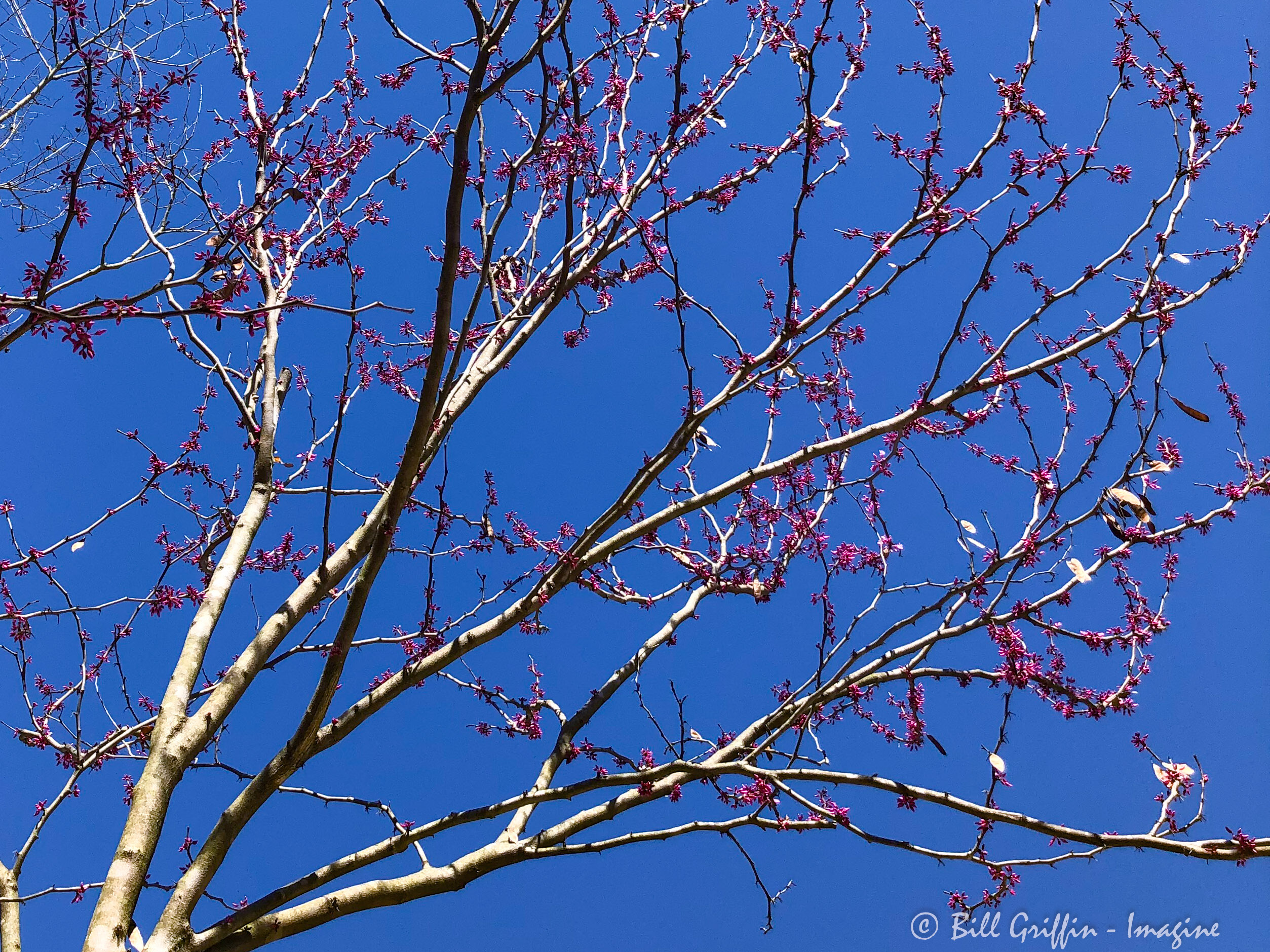
Indeed, one crocus does not make a spring. So what does make spring for you? There’s a stretch of I-40 between Winston-Salem and Kernersville where the surrounding woodland has been sheared back and sun percolates into deep shade. Over the years the native redbuds have leaned into that light. As gray February shuffles so languorously along step by step, a faint golden haze haloes the maples and deepens to peach and brick red. A willow here and there hints of green. It’s coming, it’s coming. Then suddenly, it seems within just days of each other, the redbuds pop their magenta bud covers into lush, rich, raspberry bloom. The solstice hasn’t yet arrived, but for me redbuds do make spring.

❦ ❦ ❦

Spring Dawn

There comes to my heart from regions remote
+++++ A wild desire for the hedge and the brush,
Whenever I hear the first wild note
+++++ Of the meadow lark and the hermit thrush.

The broken and upturned earth to the air,
+++++ By a million thrusting blades of Spring,
Sends out from the sod and everywhere
+++++ Its pungent aromas over everything.

Then it’s Oh, for the hills, the dawn, and the dew,
+++++ The breath of the fields and the silent lake,
And watching the wings of light burst through
+++++ The scarlet blush of the new daybreak.

It is then when the earth still nestles in sleep,
+++++ And the robes of light are scarce unfurled,
You can almost feel, in its mighty sweep
+++++ the onward rush and roll of the world.

George Marion McClellan
from Black Nature: Four Centuries of African American Nature Poetry, edited by Camille T. Dungy, © 2009 University of Georgia Press, Athens GA.
❦ ❦ ❦

This week I’ve been spending time with an anthology I’ve been reading off and on over the past year, Black Nature: Four Centuries of African American Nature Poetry, edited by Camille T. Dungy. Cycle Ten, the final section of the book, is titled Comes Always Spring. We have come through nine other cycles, including Dirt on Our Hands and Disasters, Natural and Other; we have been reminded What the Land Remembers; at last we are left with a hope of renewal. What can make Spring for us as a community, as a shared human family?

GEORGE MARION MCCLELLAN (1860-1934) was born in Tennessee and lived in Kentucky. A poet an minister, he attended Fisk University and Hartford Theological Seminary. He published Poems in 1895 and The Path of Dreams in 1916.

CLAUDIA RANKINE, born in Jamaica in 1963, earned her BA from Williams College and her MFA from Columbia University, and now lives and teaches in California. She is the author of four collections of poetry; Nothing in Nature is Private (1995) received the Cleveland State Poetry Prize.

CAMILLE T. DUNGY has received fellowships from the National Endowment for the Arts, the Virginia Commission for the Arts, the Dana Award, and Bread Loaf. She is Associate Professor of Creative Writing at San Francisco State University. Besides Black Nature, Dungy is also co-editor of From the Fishouse: An Anthology of Peoms That Sing, Rhyme, Resound, Syncopate, Alliterate, and Just Plain Sound Great.

[biographies adapted from the anthology]

❦ ❦ ❦

The Man. His Bowl. His Raspberries.

The bowl he starts with
is too large. It will never be filled.

Nonetheless, in the cool dawn,
reaching underneath the leaf, he frees
each raspberry from its stem
and white nipples remain suspended.

He is being gentle, so does not think
I must be gentle as he doubles back
through the plants
seeking what he might have missed.

At breakfast she will be pleased
to eat the raspberries and put her pleasure
to his lips.

Placing his fingers beneath a leaf
for one he had not seen, he does not idle.
He feels for the raspberry. Securing, pulling
gently, taking, he gets what he needs.

Claudia Rankine
from Black Nature: Four Centuries of African American Nature Poetry, edited by Camille T. Dungy, © 2009 University of Georgia Press, Athens GA.

❦ ❦ ❦

What to Eat, and What to Drink, and What to Leave for Poison

1
Only now, in spring, can the place be named:
tulip poplar, daffodil, crab apple,
dogwood, budding pink-green, white-green, yellow
on my knowing. All winter I was lost.
Fall, I found myself here, with no texture
my fingers know. Then, worse, the white longing
that downed us deep three months. No flower heat.
That was winter. But now, in spring, the buds
flock our trees. Ten million exquisite buds,
tiny and loud, flaring their petalled wings,
bellowing from ashen branches vibrant
keys, the chords of spring’s triumph: fisted heart,
dogwood; grail, poplar; wine spray, crab apple.
The song is drink, is color. Come. Now. Taste.

4
Down anyone’s street-bright invitations.
Suck ‘em. Swallow ‘em. Eat them whole. That’s right,
be greedy about it. The brightness calls
and you follow because you want to taste,
because you want to be welcomed inside
the code of that color: red for thirst; green
for hunger; pink a kiss; and white, stain me
now. Soil me with touching. Is that right?
No? That’s not, you say, what you meant. Not what
you meant at all? Pardon. Excuse me, please.
Your had was reaching, tugging at this shirt
of flowers and I thought, I guess I thought
you were hungry for something beautiful.
Come now. The brightness her might fill you up.

7
Daffodils are up, my God! What beauty
concerted down on us last night. And if
I sleep again, I’ll wake to a louder
blossoming, the symphony smashing down
hothouse walls, and into the world: music.
Something like the birds’ return, each morning’s
crescendo rising toward its brightest pitch,
colors unfurling, petals alluring.
the son, the color, the rising ecstasy
of spring. My God. This beauty. This, this
is what I’ve hoped for. All my life is here
in the unnamed core – dogwood, daffodil,
tulip poplar, crab apple, crape myrtle –
only now, in spring, can the place be named.

Camille T. Dungy
from Black Nature: Four Centuries of African American Nature Poetry, edited by Camille T. Dungy, © 2009 University of Georgia Press, Athens GA.

Mom looks at the Redbud

❦ ❦ ❦

And here’s one final epigram from Sir William Osler, dedicated to William J. Blackley MD, my Senior Resident for the first day I arrived on the ward as a green intern: “One finger in throat and one in the rectum makes a good diagnostician.”

More quotations by the master clinician Sir William Osler can be found here:
“The good physician treats the disease; the great physician treats the patient who has the disease.”

2016-05-08a Doughton Park Tree

Read Full Post »

[poems from Word and Witness: A. R. Ammons, Julie Suk, Peter Makuck]

Carnage ensues at the table while I make coffee. As all the other animals look on in abject silence, large plush Starfish (carnivore, you know) has captured Baby Chick and is eating him with authentic suck-the-juice-right-out-of-you sound effects.

I remark that I’m going to be sad to miss little yellow Chicky. My grandson looks up, all innocence, and simply reminds me, “That’s just the way the food chain works.”

So it must be. Nine years before the publication of Darwin’s The Origin of Species, Alfred Lord Tennyson had already warned us (“she” being Nature, “types” being species):

. . .
She cries, ‘A thousand types are gone:
I care for nothing, all shall go.

‘Thou makest thine appeal to me:
I bring to life, I bring to death:
The spirit does but mean the breath:
I know no more.’ And he, shall he,

Man, her last work, who seem’d so fair,
Such splendid purpose in his eyes,
Who roll’d the psalm to wintry skies,
Who built him fanes of fruitless prayer,

Who trusted God was love indeed
And love Creation’s final law–
Tho’ Nature, red in tooth and claw
With ravine, shriek’d against his creed –

Who loved, who suffer’d countless ills,
Who battled for the True, the Just,
Be blown about the desert dust,
Or seal’d within the iron hills?

+++++ from In Memoriam A. H. H. (1850)

Shall we weep for Baby Chick? For the extinctions accelerating around us? For ourselves, our loss? A few years back I was leading a group of Junior Highs on a nature walk when we spotted a marvelously large spider shuffling along the path ahead of us. When we reached it, though, we found it was not the legs of the spider that were walking but the legs of the pint-sized wasp that had stung and paralyzed it and now dragged it to a favorable spot for egg laying. In an instant the spider transformed from an object of fear and loathing to a spike of compassion in our hearts.

This week a very talkative red shouldered hawk is haunting the woods out back. No coincidence: that’s where the bird feeders hang. We hope he’s eyeing the squirrels – there are more than enough squirrels, eat all you want Sir Hawk. And the mice that come for the seeds dropped to the ground from the feeders, and then store them in our basement, yes, eat them, too. But please, not the cute chipmunk who hides in the ivy or the finches we love. Alas, I guess we don’t get to choose. That’s just how the food chain works.

But wait – do all our choices come to nothing? Our love, our suffering of countless ills, our battles for the True and Just – is the end of all these to be blown to desert dust? Can’t we choose to engage with embattled Nature? Can we reduce our relentless consumption of the planet, choose leaders of vision and intelligence, make peace with our brothers and sisters? How lengthy shall I extend this list? Shall we abandon hope and just accept our place in the food chain while the warming earth devours us?

If a spider can inspire a moment of compassion in a 13-year old, I will have to accede that there may yet be hope for our species.

❦ ❦ ❦

The Yucca Moth

++ The yucca clump
is blooming,
++ tall sturdy spears
spangling into bells of light,
++ green
in the white blooms
++ faint as a memory of mint.

I raid
++ a bloom,
spread the hung petals out,
++ and, surprised he is not
a bloom-part, find
++ a moth inside, the exact color,
the bloom his daylight port or cove:

though time comes
++ and goes and troubles
are unlessened,
++ the yucca is lifting temples
of bloom: from the night
++ of our dark flights, can
we go in to heal, live
++ out in white-green shade
the radiant, white, hanging day?

A. R. Ammons
collected in Word and Witness: 100 years of North Carolina Poetry, Carolina Academic Press, © 1999 North Carolina Poetry Society

❦ ❦ ❦

This week a friend asked me to send him the table of contents of Word and Witness for a project on biodiversity he’s considering The book was published by the North Carolina Poetry Society in 1999 and edited by Sally Buckner with an afterword by Fred Chappell, who was NC Poet Laureate at the time. It spans the full 20th Century of North Carolina poetry and poets, and as I was scanning the TOC to email my friend a PDF, I re-discovered the names of so many folks who have inspired and befriended me over the last two decades.

Poetry continues to thrive in “the writingest state.” Word and Witness is 261 pages; it would be a real challenge to prepare Volume II for just the first quarter of the 21st Century and limit it to that length. I believe it is still possible to purchase a copy from Carolina Academic Press. You need to get yourself one.

❦ ❦ ❦

Waiting for the Storyteller

Once more we wait for the storyteller
to step into the margin and reveal intentions:
why the first letter flowered,
spiraling down the page with intricate designs,
the hand translating what the tongue began.

Clues drop, mostly forgotten,
so on and so on stacked like bricks,
crumbling when we look back,
a voice once close now a stranger.

All through the book we wild-guess the villain,
so deceived by this one or that
we look for reprieve, a surprise ending,
the page turning to a house in the woods,
dogs locked up, gun put a way.

In the still forest of words,
where the hidden appears in its season,
hills darken and move in.
Like lean horses that have rocked a long way home,
they circle the pool of our hands.
A deer riffles through leaves, then a bird
sings begin again, begin again.

Julie Suk
collected in Word and Witness: 100 years of North Carolina Poetry, Carolina Academic Press, © 1999 North Carolina Poetry Society

❦ ❦ ❦

Dogwood Again

Home from college, I’d leave my reading,
climb the hill through trees behind the house,
listen to a rough wind suffer through
new leaves and, too aware of myself, ask why?

The answer could have been stone wall,
wind or some other words. In April, our house
lived in the light of those first white petals
and now I think more about hows than whys –

How, whenever we fished at Pond Meadow,
my father dug a small one up, carefully
wrapped the rootball in burlap, and trucked it
home until our hard blazed white all around,

and how, at Easter, those nighttime blossoms
seemed like hundred of fluttering white wings.
Again that tree goes into the dark loaded
with envy, those leaves full of light not fading.

And this morning, a fogbright air presses
against the blank white pane and would have us
see the way mist burns from within, shimmers,
slowly parts, and flares upon an even whiter tree,

tinged now with orange, and how a soft fire
runs to the farthest cluster of cross-like petals,
each haloed with clear air, finely revealed.

Peter Makuck
collected in Word and Witness: 100 years of North Carolina Poetry, Carolina Academic Press, © 1999 North Carolina Poetry Society

❦ ❦ ❦

Bios adapted in part from Word and Witness:

After growing up on a tobacco farm near Whiteville, A. R. Ammons (1926-2001) received a degree from Wake Forest College, and served as an elementary school principal, but he lived most of his adult life outside his native state. His interest in writing developed during long hours aboard ship when he served a term of duty with the Navy. In 1964 he joined the faculty at Cornell University, where he was ultimately Goldwin Smith Professor of English. Among his many honors are the Bollingen Prize, the national Book award (twice), the MacArthur Fellowship, and the 1998 Tanning Prize from the Academy of American Poets.

A native of Alabama, Julie Suk (b. 1924) has lived for many years in Charlotte, where she worked in a nature museum. In addition to authoring six volumes of her own poetry, she has co-edited (with Anne Newman) Bear Crossings: An Anthology of North American Poets. Her collection The Angel of Obsession won the 1991 University of Arkansas national poetry competition, and in 1993 she won the Bess Hokin Prize given by Poetry magazine. In 2004 Julie received the Irene Blair Honeycutt Lifetime Achievement Award from Central Piedmont Community College; her book The Dark Takes Aim won the 2003 North Carolina Poetry Society’s Brockman-Campbell Book Award and The Oscar Arnold Young Award from The Poetry Council of North Carolina.

Among previous occupations, Peter Makuck (b. 1940) lists, “truck driver, painter, mechanic,” but he is best known as writer and as Distinguished Professor of Arts and Sciences at East Carolina University. Pilgrims won the Zoe Kincaid Brockman Award for the best book of poems by a North Carolinian in 1989. In 2010 Long Lens: New & Selected Poems was nominated for a Pulitzer Prize. In addition to his eight collections of poetry, he has published numerous short stories and essays. Peter has received the International Poetry Forum’s Charity Randall Citation; a Connecticut native, he has been a Fulbright Lecturer at the Universite de Soavoie, Chambery, France. He founded Tar River Poetry in 1978 and served as editor until 2006.

❦ ❦ ❦

Doughton Park Tree 2021-10-23

Read Full Post »

[with 3 poems by Terry Blackhawk]

Monty and I are trying some new knots, big husky knots, and we’re pretty sure we have it right this time. The stalwart little paratrooper I got for Christmas, his broad red and white plastic parachute and the web of thin strings that fix to his shoulders – they just won’t hold together. Each time we fold the chute just so, roll the trooper carefully so nothing tangles, throw it as hard and as high as we can, but the lines come loose as soon as the plastic banner deploys. Our man has plummeted to his death over and over.

It’s 1965. I’ve only been living in Wilmington, Delaware for a few months; the heritage of where I moved from to get here is firmly affixed in the nickname all the other sixth graders have given me – “Memphis.” My new school might as well be Mars Colony A, so distant it seems from Colonial Elementary. I have four different teachers, most of them are men, and they seem determined to require a boy to think. On this final afternoon of winter break, Monty and I are determined to have our last hour of fun.

The breeze has picked up. Most of the snow has melted but our hands are red and chapped – you can’t tie knots with gloves on. We pull the last string tight, tighter, fold and roll, and we’re ready. I hold the soldier like a grenade, lean back, and lob him straight up with a grunt. At the peak of its arc the little package unrolls; red and white unfurls and fills with evening’s breath. The knots hold.

And the wind takes our paratrooper higher and higher into the east.

Monty and I give chase through backyards and down long sidewalks in our housing development. The parachute dims and shrinks in the distance. We run until our sides ache and the brave soldier is out of sight. Gone. We stop, gasping, and stare into the lowering dusk as lights blink on in windows around us.

I imagine my little man has crossed the Delaware River, surprising people who happen to look up from the railroad yards, the factories and warehouses. He holds his lines tight; he swings and sways. Catching the last light from that high vantage, now he can see the Atlantic. I imagine him never coming down.

❦ ❦ ❦

The Woodcock

Weary of the daily terror I turn
to the mystic body of the bird. A woodcock
I found crackling the twigs and ivy,
barely escaped from a cat’s clumsy claws.
I feared for the odd angle of its wing,
the surprised flopping it made there,
but I did not fear the extreme length
of its beak or the eyes popping diametrically
on either side of its head. I loved the feathers’
deckled edges and the light weight it made
as I scooped it up and put it, limpsy and weak,
into an old canvas book bag, and when I
released it from that soft safe space
some time later, out on Belle Isle, I missed it
at once, as one would miss a friend.
It whirred straight up, explosively,
toward freedom on the other side of the river,
its pulse now gone from my hands.

Terry Blackhawk
from One Less River, Mayapple Press, Woodstock NY, © 2019 Terry Blackhawk

note: “samples Song of Myself, 10, in which the speaker imagines succoring a runaway slave”

❦ ❦ ❦

Sometimes a knot is so twisted and curlicued you can’t make out whether it’s one string or a handful, much less how it all connects. Let’s see, Catherine Carter told me about Katherine Wakefield’s book, which led me to Patricia Hooper, who inspired me to read Terry Blackhawk. Or maybe the lines snake in and out along different paths; maybe I’m leaving out a thread here and there, most likely it goes back way farther even than that. I know, however, that I can count on this – the connections stretch and extend and I’ve not yet reached the end.

Such a warp and weft Terry threads through her book, One Less River. The Detroit River, subtropical shorelines, paths through dunes and forest, paths through myth and memory – the poems take us someplace new with each turning page. But despite shadows and storms these poems don’t cast us alone into dark landscapes. There is light. Light rises from the companionship of solid friends like Whitman and Dickinson, from companionable invitations to partake and be filled of rich intent and novel images. It is possible to wander through this book and be surprised and also reassured. The path will definitely challenge, because living is a challenge and preserving our world is a challenge. At the end we may discover that we are all tied together a little more closely. Our knots are not fetters but the shared bonds of humanness.

❦ ❦ ❦

The Extinct Fresh Water Mussels of the Detroit River
+++++++++++++++ for Kathryne Lindberg (1951-2010)

These are gone: the deer-toe maple leaf, the fat
mucket, the snuffbox, the rainbow shell. Here, still,

the rusted manhole cover and the chipping paint,
the lights and arches of the elegant bridge,

all coated no doubt then in ice. Here the breeze,
here the freighters but not the car. Quiet as it’s kept,

it’s no secret the keys were left in the ignition.

Absence makes the fond heart wander, the mind
meander, the river to swallow its flow –

the self-same river, the self-same self, even the one
that knew better, the self that knew better

than to pick up a phony ten-dollar bill folded
to disguise some evangelical come-hither.

Com hither, said the bridge.

Little earwig mussel, pimpleback, northern riffle shell,
something lacy yet along the rim.

In the print gallery a dry-point fox in outline
(“Running Fox,” R. Sintemi, Germany, 1944) floats
as if on the surface of a river, water swelling upward
on the verge of breaking up its lines –

Did you float, dear bat-out-of-hell, dear gnashing teeth –
the pointed ears, the flowing tail outlined on water not water,

on paper not paper, on the not-water before there only was
water, where we are floating now, as over a great uncertainty,
a mirroring surface that hides as much as it reveals.

No more rayed bean, purple warty back, O fragile paper shell
Where was the artist in 1944? What did he do in 1939?

You would have wanted to know.

Terry Blackhawk
from One Less River, Mayapple Press, Woodstock NY, © 2019 Terry Blackhawk

❦ ❦ ❦

Again, the Moon

And now the moon, its vitreous pour
so quickly come again
moonstruck moon melon moon

I drive the unfamiliar
town, going where Siri tells me
through unlit streets

I cannot dial back to another
moon, although there have been many –
moons of loss, lists, listing oh the self-
consciousness of the moon

Look at the moon in the sky,
not the one in the lake, says Rumi
The pleasures of heaven are with me
and the pains of hell are with me, says Whitman

So which is the lake and which
the sky? With a moon this bright
I cannot find the stars.

Terry Blackhawk
from One Less River, Mayapple Press, Woodstock NY, © 2019 Terry Blackhawk

❦ ❦ ❦

❦ ❦ ❦

Read Full Post »

« Newer Posts - Older Posts »