Feeds:
Posts
Comments

Posts Tagged ‘nature’

 . 
[with 3 poems by Adrian Rice]
 . 
Yard Work
 . 
The neighbour and I.
We joke across the avenue aisle
about the onset of porch time.
While praising the advent
of all that it means, we
comradely lament the yard work
that has to be tholed.
 . 
As if we are somehow
equals in the seasonable labour.
As if I could shake a spade
at her miraculous endeavours,
her skilled green-fingered-ness,
her laudable efforts to keep
her garden, and shrubbery, pristine.
 . 
It’s almost is if we are fellow poets,
fast farmers of verses.
As if one of us isn’t slacking
in what it takes to carry
the living thing forward,
not lacking in showing
the proper respect
 . 
for the copious rose,
the sculpted shrub,
the blade of grass,
the whole blooming lot.
As if one of us isn’t lazily inattentive,
undeserving of the true line
that is the all of spring.
 . 
Adrian Rice
from The Chances of Harm, Press 53, Winston-Salem NC; © 2024
 . 
❦ ❦ ❦
 . 
Every walk is preparation for the next. The past few weeks I’ve been preparing to share naturalist skills with poets on a walk through the woods. Poets! I’ve led fourth graders and trail maintainers and garden clubbers, but this is daunting. The organizer sent out a notice referring to the afternoon as an “Ecopoetry Walk.” What is such a thing? Will we be reciting Robinson Jeffers and Jane Mead as we struggle not to trip over tree roots? Perhaps not, but on the other hand I ought to consider holding up the ecopoetry moniker.
 . 
Ecopoetry is not synonymous with Nature Poetry. Perhaps Ecopoetry can be best summed up in three lines by Wendell Berry:
There are no unsacred places;
there are only sacred places
and desecrated places.
How do you make a place sacred? You don’t. You can’t. Its sacredness already resides within it, this little patch of dirt ribboned with mycelia and protists, springtails and worms busy making their lives and becoming someone else’s lives. Roots down and stems up and a tiny native bee stops by to test the flower for sweetness. Life has already brought sacred into being within this drab, insignificant patch.
 . 
And the stone that slowly disaggregates, the minerals it offers up to become incorporated into cellulose, chitin, bone; the light from a nearby star that filters through; the carbon turned organic, the oxygen exhaled as generous gift – all sacred. All worthy of veneration. Ecopoetry is kneeling in respect, recognizing the holy, bearing witness to the filaments of love that extend and stretch and bind everything together. Love binds us to everything and everything to us.
 . 
Turning away, withholding love, even just simply not noticing, these are desecration. Ecopoetry bears witness also of our sins. Maybe we didn’t know. Maybe we never stopped to think. Maybe we let ourselves become so disconnected that we no longer see beyond our own orbits and really believe that everything revolves around our personal center. How have we come to this place?
 . 
Let’s take a walk. Smells like autumn. Someone beyond this patch of woods is baling hay. A little less humid than last week. Tears of joy or ragweed? It’s too easy to pass beech-drops and pinesap blooming now so close to the earth, so let’s slow down. Red and green, the partridgeberry is already decorating for Christmas. One tuliptree leaf has fallen and flares lemon curling brown. All the usual September changes. There’s nothing really special here. Nothing except for everything.
 . 
 . 
❦ ❦ ❦
 . 
30 Doagh Road
 . 
She’s my grandmother, or she may be yours,
sitting in her small living room by a real fire,
sanctifying her evening corner of the fireplace.
In shot is the old black-and-white TV
standing stalk on thin brassy legs,
 . 
as much a part of the family as anyone else.
In her aproned lap she holds her knitting.
She grows colourful garments from a ball of yarn,
her hands kiting above unspooling wool-skeins.
Those busy needles of ancestral love
 . 
are clicking with effortless expertise
while she stages a smile for the camera.
Over the tiled mantelpiece, such as it is,
a family of ducks are forever in flight,
rising toward the moon of a plain white clock
 . 
cheap kind you’d see in local schoolrooms.
The chimney breast is lavishly papered,
dressed up in a floral flourish, unlike
the workaday plainness of the other walls.
On the mantelpiece there’s Scottie dog delph,
 . 
Grandchildren’s gift-knacks, small-framed pics,
another clock, a fancy one, polished and centred,
shaped like the Cavehill overlooking the house.
It tells the time, again, time that she is
religiously the last person to idly ignore.
 . 
O photographic proof of an old-fashioned
faith in the possibility of family!
O stitcher of seconds of unwasted time
into useful coverings to clothe the given clan!
Take these thanks for your example to that boy; this man.
 . 
Adrian Rice
from The Chances of Harm, Press 53, Winston-Salem NC; © 2024
 . 
❦ ❦ ❦
 . 
Lately I’ve taken to describing myself as a “full time” naturalist. All this really signifies is that I can’t walk across the yard without noticing the bugs and naming the weeds. It also reveals which books and apps occupy most of my attention. No paycheck is involved for the full time naturalist, except that when one pays attention, attention pays one back with interest.
 . 
It is obvious, reading The Chances of Harm by Adrian Rice, that he is a full time poet. No particle of life escapes his pondering gaze. He chides himself as “slacker” in Yard Work but feet-up-on-the-porch time is clearly a fertile spawning ground for poetry. Everything, in fact, becomes poetry when Adrian lays eyes and mind and heart on it. When I first opened this book, I imagined bringing those two words closer together until a blinding arc leaps between “Irish” and “Poet.” But it is not blinding. It is full and bright, the light Adrian brings, and suddenly I am seeing all the things around me in their true colours.
 . 
This world and all it holds, everything is worthy of the poet’s noticing. And I, the reader of poetry, am drawn into the poet’s embrace. Thank you, Adrian, for welcoming me to stroll through your neighbourhood and put my feet up on your porch rail. Thank you for opening the voices of things and places and people so they can share their stories. Next time I pause along my favorite trail to kneel and touch the stem of tiny lobelia peering from the shadows – pubescent? glabrous? – may it and all existence spreading out from it tell me the rest of its story, its poetry.
 . 
 . 
Visit PRESS 53 for books by Adrian Rice including his latest, The Chances of Harm
 . 
 . 
❦ ❦ ❦
 . 
This Letting Go
 . 
Why wouldn’t we invest
them with such significance?
This letting go of leaves
from the avenue trees
which feels like the deaths
of so many people,
each struggling to hang on
 . 
until the very last breath;
all of them subject
to each sudden
mood swing
of wind that sends
showers of them
wending to the ground
every time it lifts.
 . 
But we come and go,
they seem to say,
we come and go,
and at least we’re not alone
like so many of you –
just look at us lushing
the dainty driveways
 . 
with our leafy selves!
And if we hadn’t have fallen,
how long, in this world,
in your world,
do you think we could’ve
happily hung on?
How long?
 . 
Adrian Rice
from The Chances of Harm, Press 53, Winston-Salem NC; © 2024
 . 
❦ ❦ ❦
 . 
 . 
IMG_0768, tree
 . 

Read Full Post »

 . 
[with 3 poems by Catherine Carter]
 . 
Good morning, unseen
John-John was back from college and told Moses that 99 percent of
the matter in the universe is invisible to the human eye. Ever since,
Moses made sure to greet what he could not see.
        –“A Good Story,” Sherman Alexie,
The Lone Ranger and Tonto Fistfight in Heaven
 . 
Good morning, bacteria
breeding in my coiled gut,
your endless collective of many
the true core of my one. Good
morning, yeasts fermenting
diligently away at all my crevices
and folds, and magnetic field
of gravity which grounds me so close
to this home planet, your pull connecting
the water in this flesh with the drag
of the moon beneath these feet.
Good morning, hairs of fungi
connecting tree to tree and all
earth to all other earth. Good morning,
trails of mouse urine
through the multifarious paths
of grass, which to the vision
of the hovering sparrow hawk glow
ultraviolet, forming arrows
which point the way to the door
of the soft grass-lined burrow.
Good morning, possum crushed
by the roadside, visible but
from which most eyes flick away,
your unseen atoms already
disaggregating to take on fresh
lives as fly larva, carrion beetle, silver
flash beneath the flight pinion
fo the black buzzard, the death-
devourer. Good morning, unmet eyes
of Maria, whose home is this
intersection’s northeast corner;
good morning, ongoing anguish
of the lumbar vertebra fractured
in the stockroom job where she
broke and was fired for breaking;
good morning, urgent grip
of the bowels she must walk
a mile to relieve from this corner
where she stands with her sign
hoping for change that won’t come.
And good morning, unrecorded
conference called in a corner suite,
which even now is about to close
the shelter where tonight she hopes to sleep.
 . 
Catherine Carter
from Good Morning, Unseen, Jacar Press, Durham NC; © 2023
 . 
❦ ❦ ❦
 . 
Not secret. Not hidden. Neither cloaked nor covert, simply not seen. These are the glimpses of my mother’s life I am getting since she died. No tremors from within locked strongboxes, no heart attacks delivered by anonymous post – simply the small bright fragments of her unseen life. The bits not dependent on her being Mom to me.
 . 
I’m paying more attention to the glimpses because I don’t have Mom beside me on the couch any more, although she was never one to draw attention to herself anyway. Here they come, all these versions of my mother through the years, fragmentary visions arriving in photos I’ve glanced at in the past but never really examined. Here she is on her bike, smiling, maybe ten years old; here’s that very same smile again at another age, at every age. What confidence, what honesty! So open. A real person smiling at me.
 . 
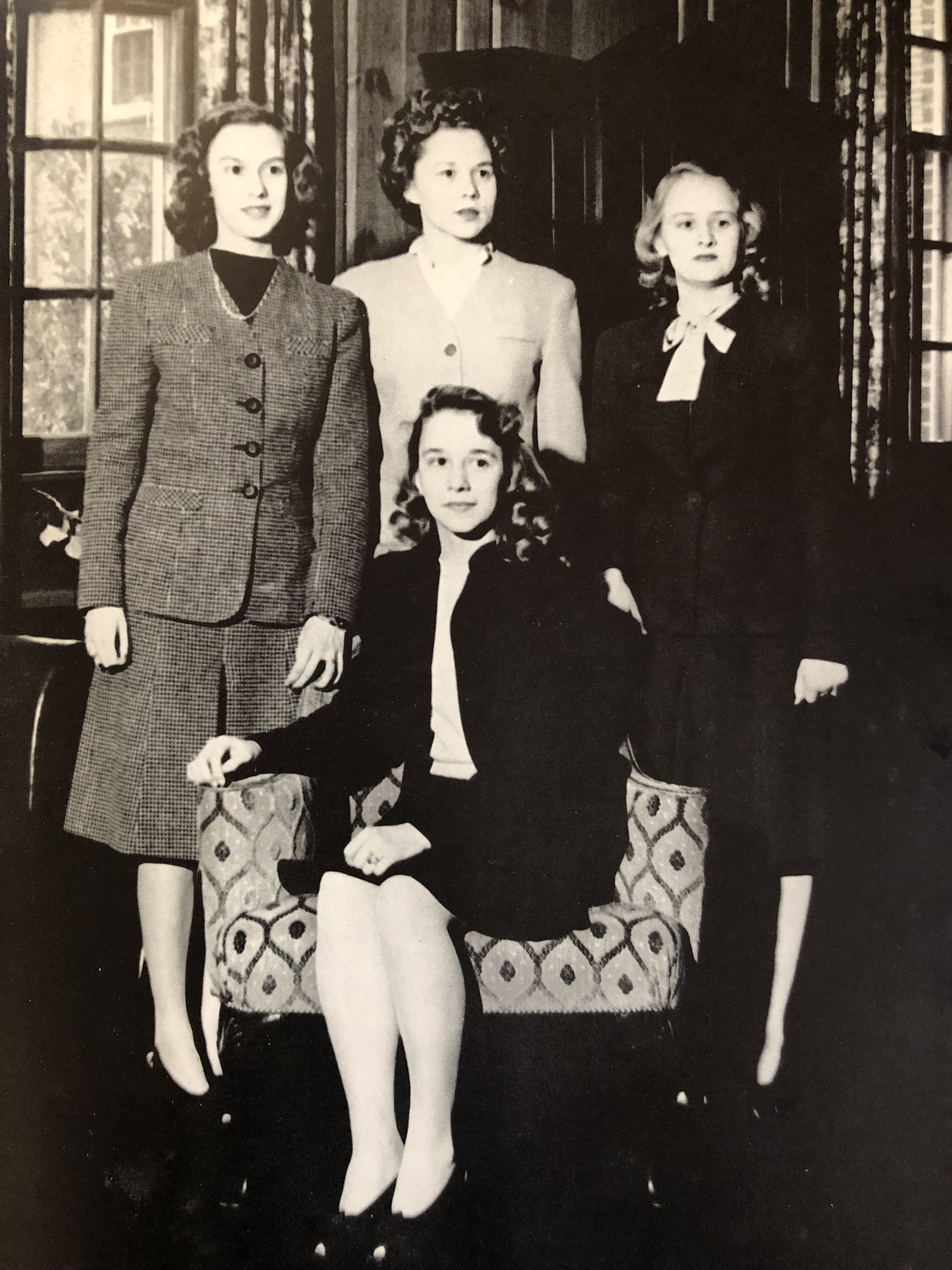
Today I’ve found her college annuals – do universities still publish such things? Do people still save them for 75 years? Here’s Mom with the other officers of her Freshman class, 1946, and she the President. I never knew! As a Junior her she is at the centerfold – with a dozen friends – from their listing in Who’s Who in American Universities. The two women beside her remained her friends for life, names even I recall her mentioning. Such a full, rich world Mom inhabited. So many worlds.
 . 
In a few weeks we’ll hold Mom’s memorial service and I’ll no doubt hear even more stories of her unseen life. Already Linda’s youngest sister has told us how she loved Miss Cookie as her Kindergarten teacher. Linda and I were already away at college; the only glimpse I had of Mom’s teaching life was when she brought the gerbils and ducklings home from her classroom for holidays. I wish I’d had the curiosity and imagination to follow her around her world for a few days. But no – she was just our Mom.
 . 
Grief is the empty place beside me on the couch that becomes the empty place inside. I try to fill it with memories, all those moments I’ve known and seen, but they aren’t nearly enough. Where to find more? Show me everything I missed before so I can try harder to open my eyes. Show me every bright fragment. Good morning, Unseen.
 . 
 . 
❦ ❦ ❦
 . 
This Stone
 . 
This stone is a particular stone,
mica-flecked lichen-splotched quartz-
veined hunk of granite hunched
by the side of the road where I climb the cove.
It has a history; it has been places.
It knew the molten earth-heart
and the grind of the glacier.
It gouged grooves in the flesh
of this world as gravity dragged it down.
It crushed small plants in its path,
and offered a matrix to lichen,
coolness to soil in the heat of the day,
shelter to mushrooms, midges, mice.
This one particular manifestation
of all that rockness,
created in fire, is still
joining in creation,
participating in being. It has known
billions of mornings; this one
is new. Though it will not answer,
I nod to it as I pass, and, if no one
human is there to hear, I speak:
good morning, you one
rock exactly like no
other. Here we are again,
short life and long one
brushing past each other beside
this road of crushed and broken
stone. Good morning,
spirit of earth, on this one morning
here on earth’s stony flesh.
 . 
Catherine Carter
from Good Morning, Unseen, Jacar Press, Durham NC; © 2023
 . 
❦ ❦ ❦
 . 
Beyond perception as well as beneath notice, these are the unseen in Catherine Carter’s Good Morning, Unseen. The bacteria in our gut upon which our lives and health depend. The homeless woman who might once have thought she could depend on the lives around her. Noticing the ignored and overlooked and essential: Catherine’s piercing images and mind frothing metaphors bring all into stark relief. These poems are revelation.
 . 
How did I miss that? Why am I only now first seeing? Unseen is the dirt that bears me up, unseen is sunlight fusing itself into wood. Glad may be the cat in coyote country but Magic is one man opening the door to one small apartment as refuge. It’s all around us, always has been. The first commandment is “pay attention.” Forgive us for how often we have sinned.
 . 
 . 
Catherine Carter’s Good Morning, Unseen is available from Jacar Press.
 . 
 . 
❦ ❦ ❦
 . 
The unseen says
 . 
from the magnolia I wave to you through the wind,
my dark leaves quivering in the glitter of winter
sun, though I knew you would not see.
As the dog I rest my chin on our bed,
tell you it’s safe to wake, as you shudder with the fear
and despair you clutch so close.
Under your feet as the dirt I bear you up;
as the air without which you cannot live
two hundred seconds, I lift your rigs again, again,
seven hundred million times, never wearying
until you do. As the sunlight I fuse myself
into wood, bursting forth again in flame;
as the rain I show you safe passage, falling,
seeping, leaping through my selves the clouds and the sea.
As you breathe, as you drink as you stretch cramped hands
to my electric coil, toast me in the bread, you ask
whether I’m even here, or forget to ask.
Refugee on the long road, back bent
with the treasures you lug, the fears you haul:
lay down the weighted silver, your grandparents;
plate and grief, let home evaporate behind you,
unbind the albatross corpse festering your neck.
Set it all down. Be free of it,
and take my hand in yours. With a second hand,
and a third, I pipe for you now:
just for a moment, dance.
 . 
Catherine Carter
from Good Morning, Unseen, Jacar Press, Durham NC; © 2023
 . 
❦ ❦ ❦
 . 
 . 
 . 
IMG_1827

Read Full Post »

 . 
[with 3 poems by AE Hines]
 . 
A foot of new snow
 . 
and down the middle
+++++ of our icy street
a dawn congregation
+++++ of ravens, all blue-black
and wing, hunch
+++++ in their strange bureaucracy,
as if arrived to divide
+++++ the daily assignments. Even
at this age, I still see signs. Even
+++++ a gathering of black birds
on a snow-covered road,
+++++ a Rorschach test
that conjures a warning
+++++ in my anxious machinery:
 . 
an assembly of plague doctors –
+++++ with folded feather arms, dark
nodding heads. I wonder what
+++++ they are here to tell me.
None of us is promised green lights
+++++ and straightaways, but sometimes
the bloodwork comes back
+++++ quietly, the tumor
benign. Sometimes, just up the road
+++++ from where you lie in bed,
brakes give way and barrel
+++++ a terrified trucker across four
frozen lanes into your
+++++ could-have-been path.
 . 
AE Hines
from Adam in the Garden, Charlotte Lit Press, Charlotte NC; © 2024
 . 
❦ ❦ ❦
 . 
Imagine you really like to eat. No, I don’t mean you enjoy sitting down at the table, plate in front of you, bite by bite, chew & swallow, push away and say, “That was good!” What I’m talking about is when your eldest son calls and asks, “How’re you doin’?”, the first thing out of your mouth is, “For supper I had . . .”
 . 
It’s a blessing that Dad likes to eat. My experience from forty years of geriatric practice is that once you lose your appetite you’re going to have a tough time ever finding it again. The first thing Dad usually brings up when we talk is what he needs me to pick up at the store. He’s thinking two meals ahead, tonight’s supper, tomorrow’s breakfast. He can’t walk as far as the kitchen any more, he can’t rummage through the cupboards or the fridge, in fact there may not be many things left in life for him to enjoy, but he can think about something good to eat.
 . 
That’s why this morning I’m poking around in the freezer and shifting unidentifiables in the back of the refrigerator, holding a shopping list and a yellow pad. Besides chucking out the old and vaguely greenish, I’m making Dad a list. A “MENU” I’ll leave at his bedside. There’s a column for meals in the fridge, a column for freezer, and at the bottom is that most important header of all: TREATS. I found four kinds of cookies in the pantry. Four flavors of pudding we originally bought for Mom. Chocolate brownies with M&M’s his cousin June brought by. Some zucchini bread a neighbor dropped off (and it is good). Please don’t forget the Trader Joe’s Vanilla Ice Cream.
 . 
From here, then, it’s off to Harris Teeter. I’m sure I’ll see some more things Dad would like as I cruise the aisles. They say the olfactory sense is tightly cross-linked to the hippocampus – a familiar smell instantly evokes vivid memories of old associations. I suspect for Dad the gustatory sense is equally evocative. Maybe he needs a little country ham with red eye gravy. Maybe spoon bread or hushpuppies. Maybe I can find the recipe for Mom’s famous German chocolate cake.
 . 
In our final days, may we all treat ourselves to what brings us joy.
 . 
 . 
❦ ❦ ❦
 . 
Eden
 . 
I recall placing ripe plantain on the lowest
branch of eucalyptus, and the tree
filling with small wings: toucans
and motmots, a flock of miniature finches
dusted with pale blue chalk. There are so few
days I would – if I could – set on repeat
and live over and over:
+++++++++++++++++ Here, the man
I love, sight of him a reviving breath,
carrying plates of chorizo and fried eggs.
Then the two of us reclined in dappled grass,
drinking hot chocolate from a single,
chipped cup beneath prehistoric ferns
that tower and sway just as they must have
with the world still new.
+++++++++++++++++ I like to pretend
then too – didn’t I? – that we were the first
and last of our kind, a multitude
of wings beating the air under a sun
that never set, our queer, middle-aged bodies
never a day older.
 . 
AE Hines
from Adam in the Garden, Charlotte Lit Press, Charlotte NC; © 2024
 . 
❦ ❦ ❦
 . 
Some quiet evenings I go out / to sit with them, all the men / I’ve been . . .
 . 
When has there ever been an evening that quiet? A space filled with invitation and empty of demands? When has my mind ever been that pliant, willing to contemplate such things much less able? Is there a garden somewhere waiting for each of us, waiting for our return?
 . 
Adam in the Garden by AE Hines offers no simple answers but it certainly invites questions. These poems span many years and many situations; even more so they span the many conditions of one human person. Broken and reborn, dead and exalted – you nor I are not one immutable creature, none of us an unvarying beam transiting the years allotted to our individual existence. If we discover a quiet moment and stop to think, we may discover the many persons we have been and are being.
 . 
Where could there be such a quiet space? Turn the page. Again. The poet invites us to join him here. He makes himself vulnerable to our gaze. He makes no other demand on us than to enter the quiet with him, to be with him and with our selves. And truthfully, I confess that I need this! I need the quieting of all those voices, external but really mainly internal, the quieting which is required to read a poem. Not to escape myself but to sit down with myself. Thank you for the invitation and for the welcome. Thank you for the sharing. It is, I assure you, a treat.
 . 
 . 
Adam in the Garden by AE Hines is published by Charlotte Center for the Literary Arts, Inc., through Charlotte Lit Press.
 . 
 . 
❦ ❦ ❦
 . 
Green Satin
 . 
++++++++++++++for Ginny
 . 
Perhaps, it’s not the drugs
when you tell me you plan
to come back as a tree, wearing
 . 
green satin gowns and scarves
made of wind. No more ridiculous,
you say, than dying, or your wig
 . 
teetering from the nightstand.
Last night, a cypress lifted its dark
roots from the earth, and lay down
 . 
Like a great, leafy-maned beast
across your yard, making room
for more morning
 . 
to flood your window, dawn
a spotlight across a hospice bed
where you labor over breathing,
 . 
a potter over clay, spinning
and kneading the mud of yourself
into finer and finer pieces.
 . 
“It must be time,” you tell me,
with summer’s sun shining
and sparrows flinging
 . 
shadows on your walls.
When even the cypress lies down
and points the way home.
 . 
AE Hines
from Adam in the Garden, Charlotte Lit Press, Charlotte NC; © 2024
 . 
❦ ❦ ❦
 . 
 . 
❦ ❦ ❦

Read Full Post »

« Newer Posts - Older Posts »