Feeds:
Posts
Comments

Posts Tagged ‘nature’

 . 
[with 3 poems by Julie Suk]
 . 
We’re Small on the Rim
 . 
of comprehension, but that shouldn’t distract
us from the fig tree
 . 
bent by fleshy globes on the verge of fall,
seed exposed where the fruit splits.
 . 
And there are the aunts
leaning over a cast-iron kettle filled
with sugar, spices, and a curl of lemon zest –
 . 
figs stewing, jars lined up, the ladle lifted
for a sample sip –
++++ never mind the times my lips were burned
++++ by a sweetness giving more than I gave back.
 . 
Hold out your hand for the unseen
my grandfather said.
 . 
There, the universe,
a potpourri of energy lit by colorful fires
that sparked me to life,
 . 
++++ accident though it was,
 . 
limb of the fig tree scratching the house,
on the table, a spoon.
 . 
Julie Suk
from Astonished to Wake, Jacar Press, Durham NC; © 2016
 . 
❦ ❦ ❦
 . 
I am crying for the beauty of these trees. An upwelling of emotion? A brain response slung through limbic system from temporal lobe because of certain inverted images on my retina? No, a watery reaction to pollen. Hazel catkins stirring in the breeze. An itch, a sneeze. But still I am crying for the beauty of these little trees.
 . 
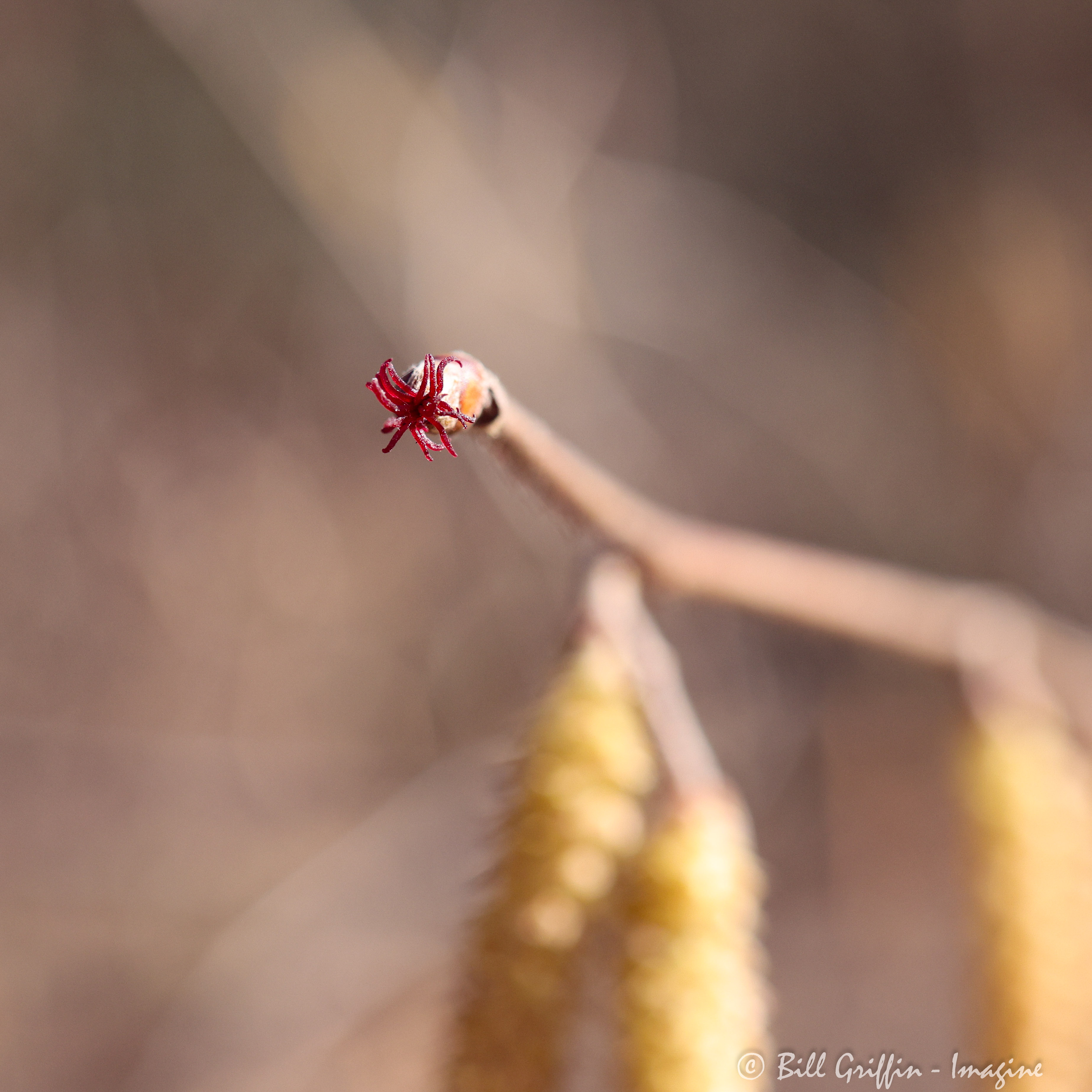
How one says a thing is more important that what one says. We stop along the nature trail to notice this unequivocal manifestation of Spring – drooping yellow pollen catkins on American Hazelnut, full and fertile long before any leaves appear. These are the male flowers. Where are the female? Solitary at the tips of limbs and buds, discover a few spidery red florets no bigger than your little fingernail. From these tiny nubs the nuts will form and we can eat them in September if we beat the squirrels. As I point out the female flowers, how they point mostly outward and upward away from the catkins, I catch myself before blurting this explanation: “They’re designed to prevent self pollination.”
 . 
Designed? The Hazels worked out this arrangement of their own volition? Or had it planned for them de novo on some cosmic drawing board? Oh Evolution, how you embrace the random and non-linear, and how we struggle to grasp such a universe. I gulp and begin a different tack. “Self pollination increases the risk of recessive traits and may weaken the line. Over many, many generations, the Hazel trees that happen to grow with their little red flowers poised to catch pollen blown in from a neighbor tree are more likely to have strong offspring that can pass that trait along.”
 . 
And does that explain why I cry for the beauty of these trees? All these trees? The red maples are already dropping their polleniferous bundles as winged seeds unspool from female flowers. Stony hickory nuts are still discoverable beside the trail from last fall’s excellent mast season. The green furze we spy at the ridgeline’s crown is tuliptrees’ earliest budbreak. The trees speak their names in the space they fill. They give their promises almost silently but always sure. There seems no end to the means my own species can devise to make the world harsh, hateful, ugly. There is no end to the beauty of these trees. I cry.
 . 
 . 
❦ ❦ ❦
 . 
The Dream It Was
 . 
Gone, the apples left last night for the deer –
 . 
shadows lighter than the night they passed through,
rune-like hoof marks carving the frosted lawn.
 . 
Like a dream,
but touch is my familiar.
 . 
May you and I morph into other bodies that meet
once this one goes
 . 
on and on into the blue heights – old trails
like those deer use around the girth of a mountain.
 . 
And after breath evaporates
may the words left without a tongue
fall into the pool where we swam,
 . 
the cold waters rushing back warm.
 . 
Julie Suk
from Astonished to Wake, Jacar Press, Durham NC; © 2016
 . 
❦ ❦ ❦
 . 
Hold out your heart for the unseen. When there are no longer lips, a mouth, to hold our words may they pool in the places we loved. May we meet again on the blue heights, on some new trail, on a very old trail. What voice would you choose in your next life? Listen for me, a song of wind thin in the high branches.
 . 
❦
 . 
What would the new day hold for us if each morning we were astonished to wake? Dogwood scratches the window as wind picks up. Throaty testosterone rumbles as the teenager across the street starts his pickup to head to school. What could urge me out of bed instead of surrendering to warmth and pulling the covers higher? But this is a new day, the vernal equinox in fact. I confess I have reached the time of life when I can see the days ticking on ahead of me are finite in number.
 . 
Turning each page in Julie Suk’s Astonished to Wake is a reminder that new days are in short supply. Perhaps this one will weave its meaning from days treasured in their remembering. Perhaps this one would prefer to eat me raw. Perhaps this is the day I really will wake up and notice every person that has made my life, and even tell them so. A good book of poetry compels one to turn each page, then the next. A great book of poetry compels one to set the book aside and enter the newness of this day.
 . 
❦
 . 
From Charlotte, NC, and former managing editor of Southern Poetry Review, Julie Suk has been a beacon in the world for poetry for decades. R. T. Smith writes, “The poetry of Julie Suk is at once deceptively spare and metaphorically rich, and the sensual mystery of her perfectly pitched and etched lines is haunting, elemental, and wild.” Her many awards include the Brockman-Campbell Award of the North Carolina Poetry Society. Astonished to Wake is Julie’s sixth collection, published by Jacar Press.
 . 
 . 
❦ ❦ ❦
 . 
The Music
 . 
When my father was young, he played the violin,
his mother, the rosewood Grand.
 . 
She also had a voice clear and sweet,
 . 
also had tuberculosis and died
when my father was thirteen.
 . 
He never played again, but loved music,
 . 
the Victrola making its rounds,
or the two of us listening to opera on the radio.
 . 
No noise allowed in the house when Rosa Ponselle sang.
 . 
In my next life I want the voice of a violin.
 . 
Tell me what you’d like played
and I’ll speak from the key of love and pain,
 . 
how the living are echoes of the past,
 . 
my grandmother staring into the darkness – as I do now,
thinking of those I must leave.
 . 
Talking into the night,
we’ll hold sorrow up close and let it weep.
 . 
Julie Suk
from Astonished to Wake, Jacar Press, Durham NC; © 2016
 . 
❦ ❦ ❦
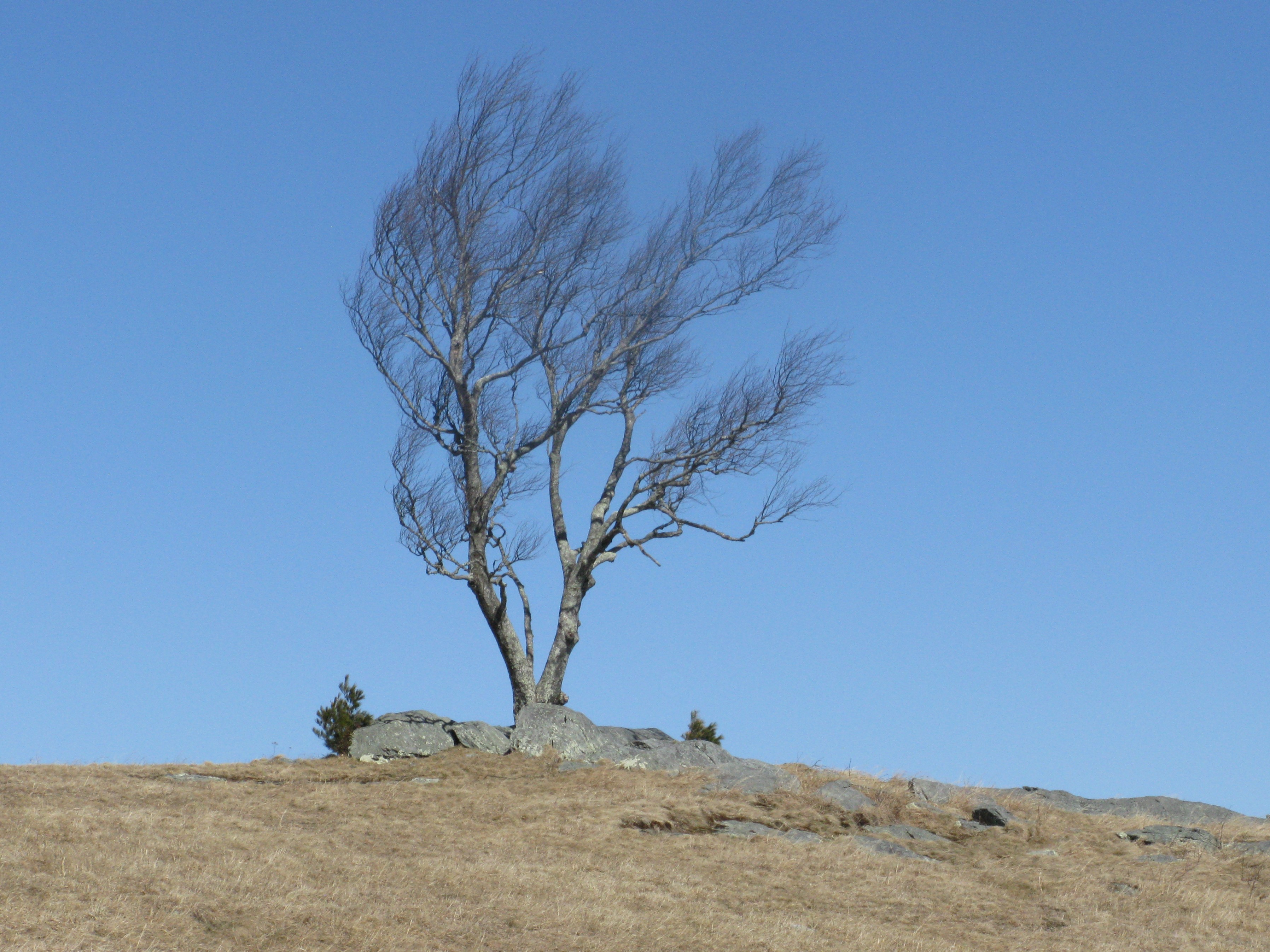
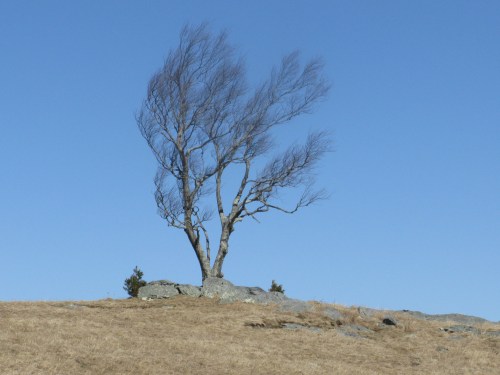
 .Doughton Park Tree 2021-02-23 
 . 

Read Full Post »

 . .
[with 4 poems by Emilie Lygren]
 . .
Ritual
 . .
In each new place I look at the leaves.
 . .
Some are gray and withered, others gold or green.
 . .
The round spots of fungi, insect holes, split lines along veins all say:
 . .
I have been here long enough for here to change me.
 . .
May I stay half as long.
 . .
❦
 . .
You Find Hope When
 . .
You find hope when you remember that
your best friend was elected Prom Queen.
 . .
We were shocked.
She was not popular or plastic or a cheerleader,
like prom queens in the movies always were.
 . .
She was kind to everyone.
 . .
When things feel bleak, remember the people out there
who thought that mattered.
 . .
Emilie Lygren
from What We Were Born For, Blue Light Press / 1st World Publishing, Fairfield IA; © 2021
 . .
❦ ❦ ❦
 . .
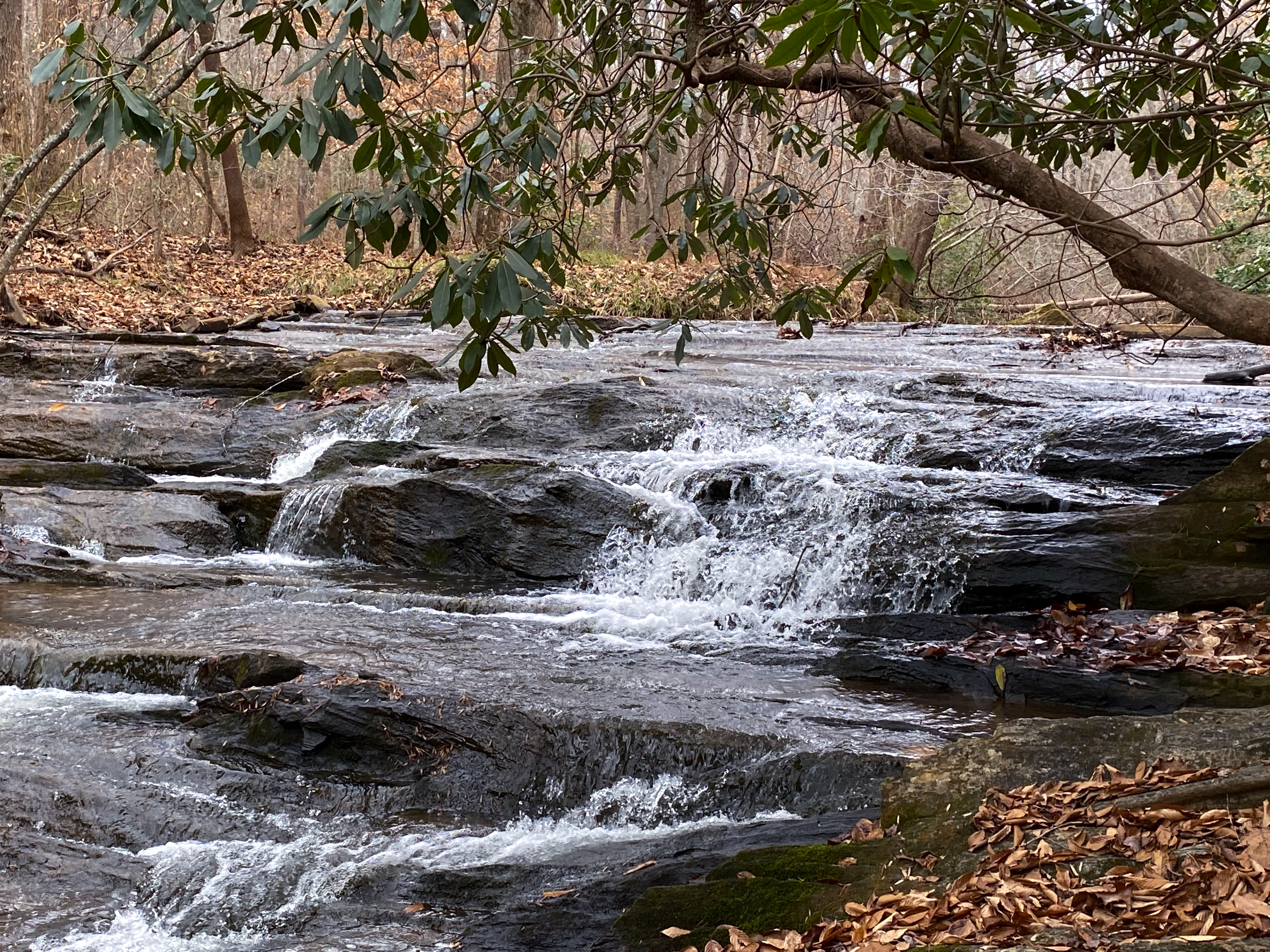
Something here beside the river is dragging. Something is slowing me down, clenching me inside, holding my skull between two fists. What is this cud of anger I’m chewing, chewing? I tug it loose when it snags on last summer’s dry aster or catches on a shard of quartz. I refuse to let go because it’s mine and I deserve to have it.
 . .
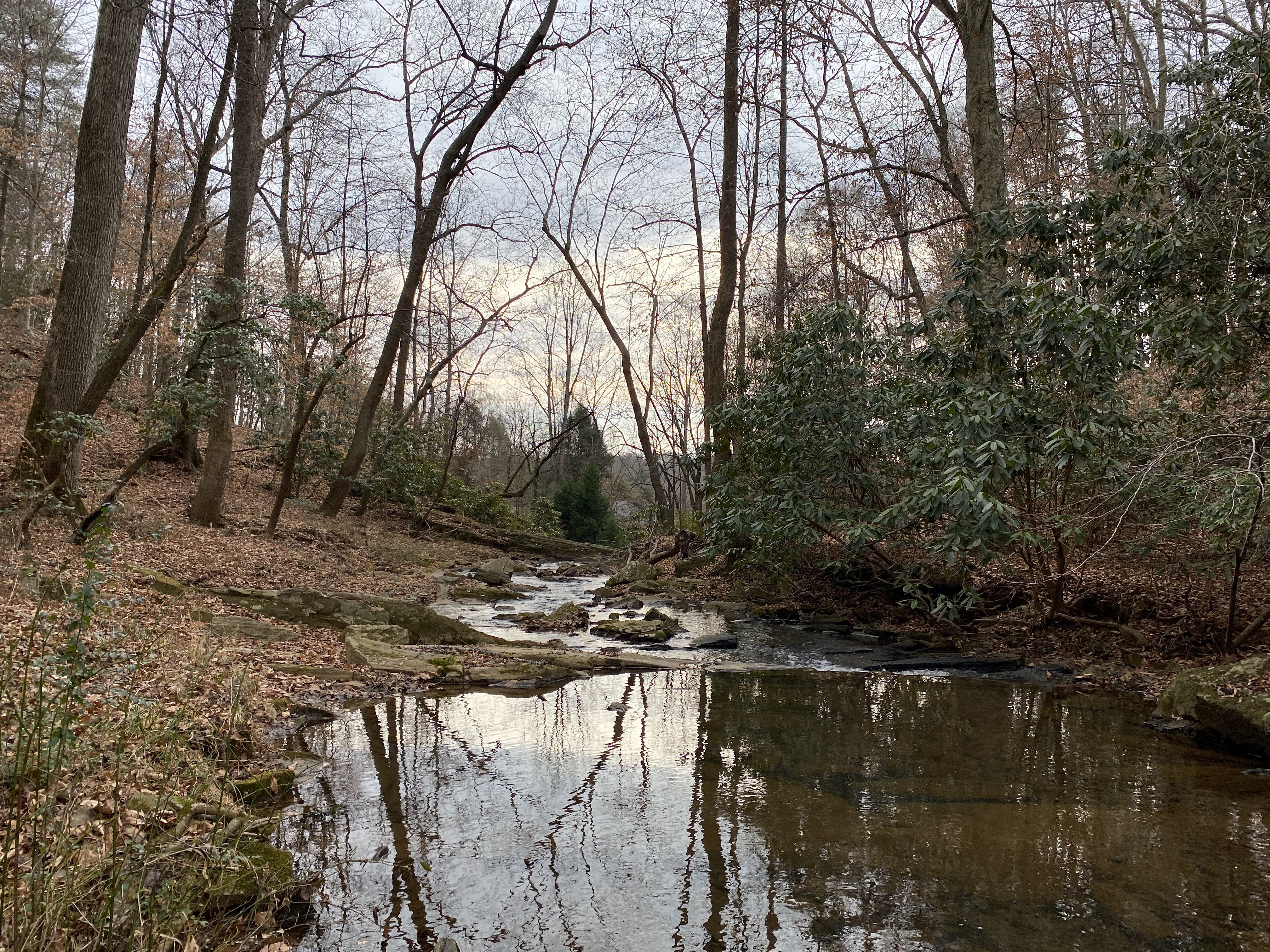
As I walk its banks, the river notices that I have stopped noticing it but the river doesn’t comment. The river refuses to tell me whether I’m good enough or why I’m not. I can’t convince it to admit that it’s really all those others hurting me and not me hurting them. The river has plenty to carry without taking on another load of trash. Stuff, big and little, just wants to tag along with the river. Silt enjoys the life of swirls and eddies, leaves love to dance. Stones tune up and provide the music. The river invites their company and moves along.
 . .
Is time passing here? The movement of water, always movement, and yet there is always always more water. Time must have passed, because I find I have misplaced whatever it was that was dragging me, I mean, whatever I was dragging. The music hasn’t stopped and there is singing. Suddenly I notice that what I really want is to join the river. And I find I have.
 . .
 . .
❦ ❦ ❦
 . .
River, competence
 . .
Rocks once ripped
from mountainsides,
broken branches of trees,
leaf or tuft of grass.
 . .
Swept up by
constant working currents,
blue undersides of streams,
mud unstuck from banks,
wed to clear movement.
 . .
Ripple pool and wave
reduce rough edges into roundness,
sand sticks into gleaming bare swords,
hold stones until their shapes converge.
 . .
Stay here long enough
and the parts of you, too,
that have been broken
will be made smooth
 . .
Emilie Lygren
from What We Were Born For, Blue Light Press / 1st World Publishing, Fairfield IA; © 2021
 . .
❦ ❦ ❦
 . .
Emilie Lygren’s poems are not all quiet. Some rage against tyrants. Some spit and hiss at what the ocean spits up, the trash we have crammed down its throat. Some push back hard against cruelty and prejudice, anything that willfully splits and cleaves.
 . .
But all of Emilie Lygren’s poems quiet me. When I am disgusted by things people do and say and think; when it hurts me that the people I love are hurting and are hurting me; when I despair that we human beings will never learn kindness; when I can’t see any hope for our future as a species or for all the species we destroy –
 . .
When all this noise and rage and torment shake me like a maple leaf, then Emilie Lygren’s poems return with their voice of understanding. We all feel these things. We all need something better. Listen, just listen. The earth is still here for you. Join it, the earth and all it embraces. Find its place in you and rediscover your place on the earth. Every day, if only for a moment – quiet.
 . .
❦
 . .
Emilie Lygren is a poet and outdoor educator in California. What We Were Born For is the winner of the 2021 Blue Light Book Award from Blue Light Press / 1st World Publishing and can be purchased at Bookshop.org.
 . .
Read an additional poem by Emilie Lygren, Erosion, HERE:
 . .
❦
 . .
All of today’s photos are by Jonathan Saul Griffin, © 2022
 . .
 . .
❦ ❦ ❦
 . .
Meditation
 . .
Sitting near the window.
I watched a fly stammering
against the glass,
trying to break free
and transcend the
transparent boundary
it could not comprehend.
 . .
As I cupped my hands around the fly
then let it out the open door,
I wished that we could trade places –
 . .
that someone would gently remove me
from the invisible walls
I have pressed myself up against,
offer an opening I am too small to see.
 . .
After sitting longer,
I start to think that maybe I am all parts of the story –
 . .
the trembling fly,
the gently cupped hands,
the clear glass window,
the necessary air outside.
 . .
Emilie Lygren
from What We Were Born For, Blue Light Press / 1st World Publishing, Fairfield IA; © 2021
 . .
❦ ❦ ❦
 . .
 . .

Read Full Post »

 . 
[with poetry by Mary Oliver and Tennyson]
 . 
On Winter’s Margin
 . 
On winter’s margin, see the small birds now
With half-forged memories come flocking home
To gardens famous for their charity.
The green globe’s broken; vines like tangled veins
Hang at the entrance to the silent wood.
 . 
With half a loaf, I am the prince of crumbs;
By time snow’s down, the birds amassed will sing
Like children for their sire to walk aborad!
But what I love, is the gray stubborn hawk
Who floats alone beyond the frozen vines;
And what I dream of are the patient deer
Who stand on legs like reeds and drink the wind; –
 . 
They are what saves the world: who choose to grow
Thin to a starting point beyond this squalor.
 . 
Mary Oliver
from Devotions, the Selected Poems of Mary Oliver, Penguin Press © 2017; originally collected in No Voyage and Other Poems, Houghton Mifflin © 1965
 . 
❦ ❦ ❦
 . 
In the Spring a young man’s fancy lightly turns to thoughts of . . . phenological mismatch.
 . 
Ah, Alfred Tennyson, better you had continued to tramp the heath and weald of old Locksley Hall and turned away from your infatuations with the inconstant and unreachable Amy. Look here! Amidst the brittle stems of last summer’s arboreal plumage and almost buried beneath autumn’s comforter, an eyelet of green! Gently peel aside the brown leavings of solemn beech and discover: seven pale lilac petals and their swarm of stamens. February 18 and Hepatica has begun to bloom!
 . 
So I hope we’ll be greeted tomorrow, February 22, on our first naturalist walk of the season. Now and every three weeks through April we will tally the progression of blooming along the Elkin Creek Nature Trail. Native wildflowers, these spring ephemerals make their living here beneath the beech / oak canopy. Hepatica, Trout Lily, Bloodroot, Foamflower, they will quickly extend their leaves into the sun before its light can be obscured by budbreak among the overarching trees. Phenological escape – the urgent days of photosynthesis before the canopy closes. These low growing herbs must earn most of their entire year’s salary in just two or three weeks.
 . 
How do they know? What triggers the perennials to leaf and bloom; what swells and opens the leaf buds overhead? What is the key to understanding their phenology (def. – the study of cyclical biological phenomena)? Warming. Soil temperature and air temperature. But some plants are more sensitive to temperature changes and the warming of planet earth than others. In North America, deciduous trees are the most sensitive to warming trends that determine when they will break bud and unfurl leaves. Beech, oak, maple they leaf out earlier as average temperatures increase; Hepatica may not, and so the window of sunlight opportunity shortens.
 . 
This is just one example of phenological mismatch. Imagine how it might affect interconnected species that gradually diverge, out of synch. Will Hepatica have time to turn photons into the sugars it must store for the next long darkness? Will its pollinators and its seed dispersers still thrive in the altered forest? What will our spring walks look like in ten years? in twenty? Alfred Tennyson, I’m afraid there are days I share your melancholy.
 . 
 . 
❦ ❦ ❦
 . 
Wild Geese
 . 
You do not have to be good.
You do not have to walk on your knees
for a hundred miles through the desert repenting.
You only have to let the soft animal of your body
+++ love what it loves.
Tell me about despair, yours, and I will tell you mine.
Meanwhile the world goes on.
Meanwhile the sun and the clear pebbles of the rain
are moving across the landscapes,
over the prairies and the deep trees,
the mountains and the rivers.
Meanwhile the wild geese, high in the clean blue air,
are heading home again.
Whoever you are, no matter how lonely,
the world offers itself to your imagination,
calls to you like the wild geese, harsh and exciting –
over and over announcing your place
in the family of things.
 . 
Mary Oliver
from Devotions, the Selected Poems of Mary Oliver, Penguin Press © 2017; originally collected in Dream Work, Grove/Atlantic Inc. © 1986.
 . 
❦ ❦ ❦
 . 
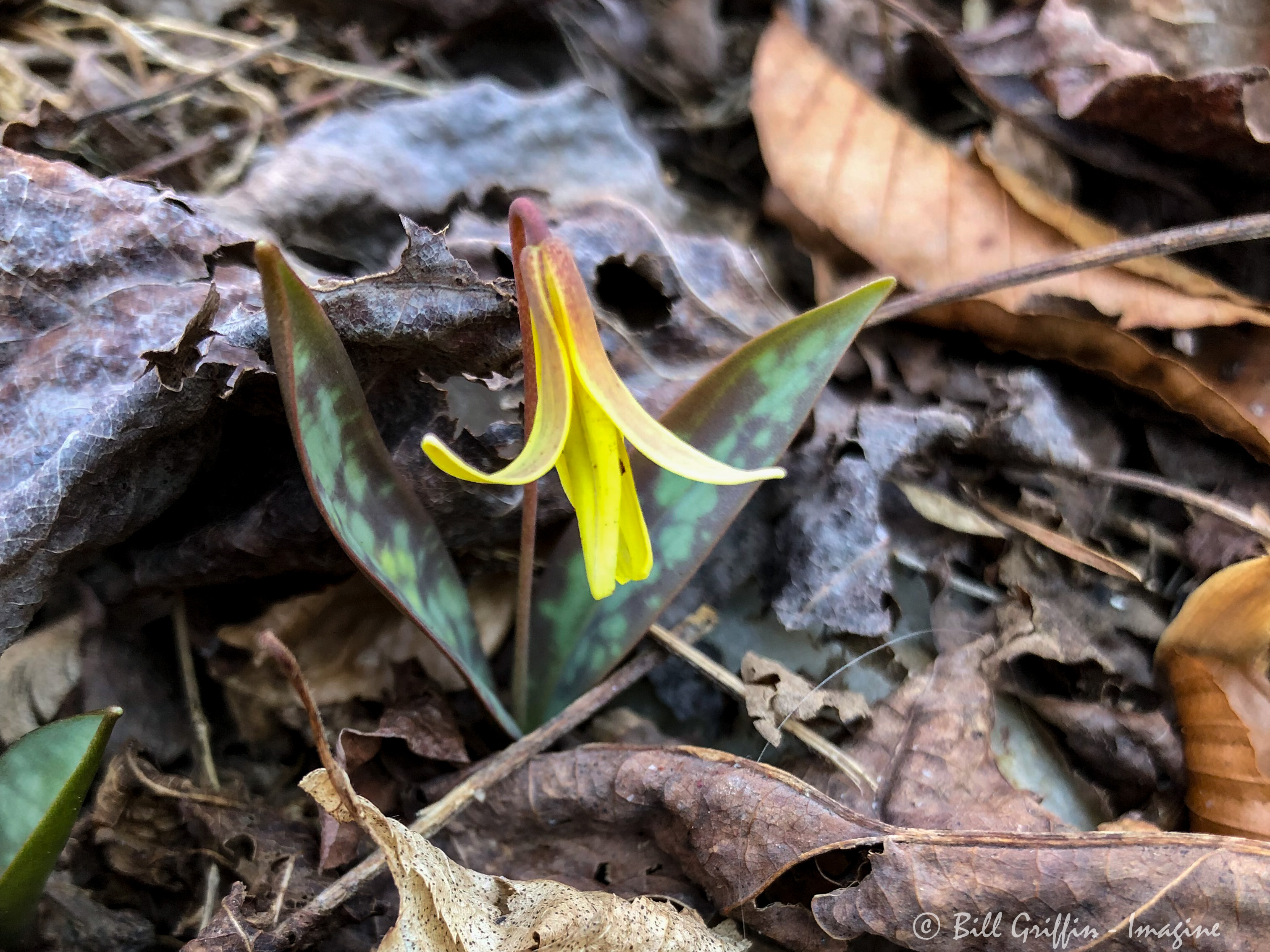
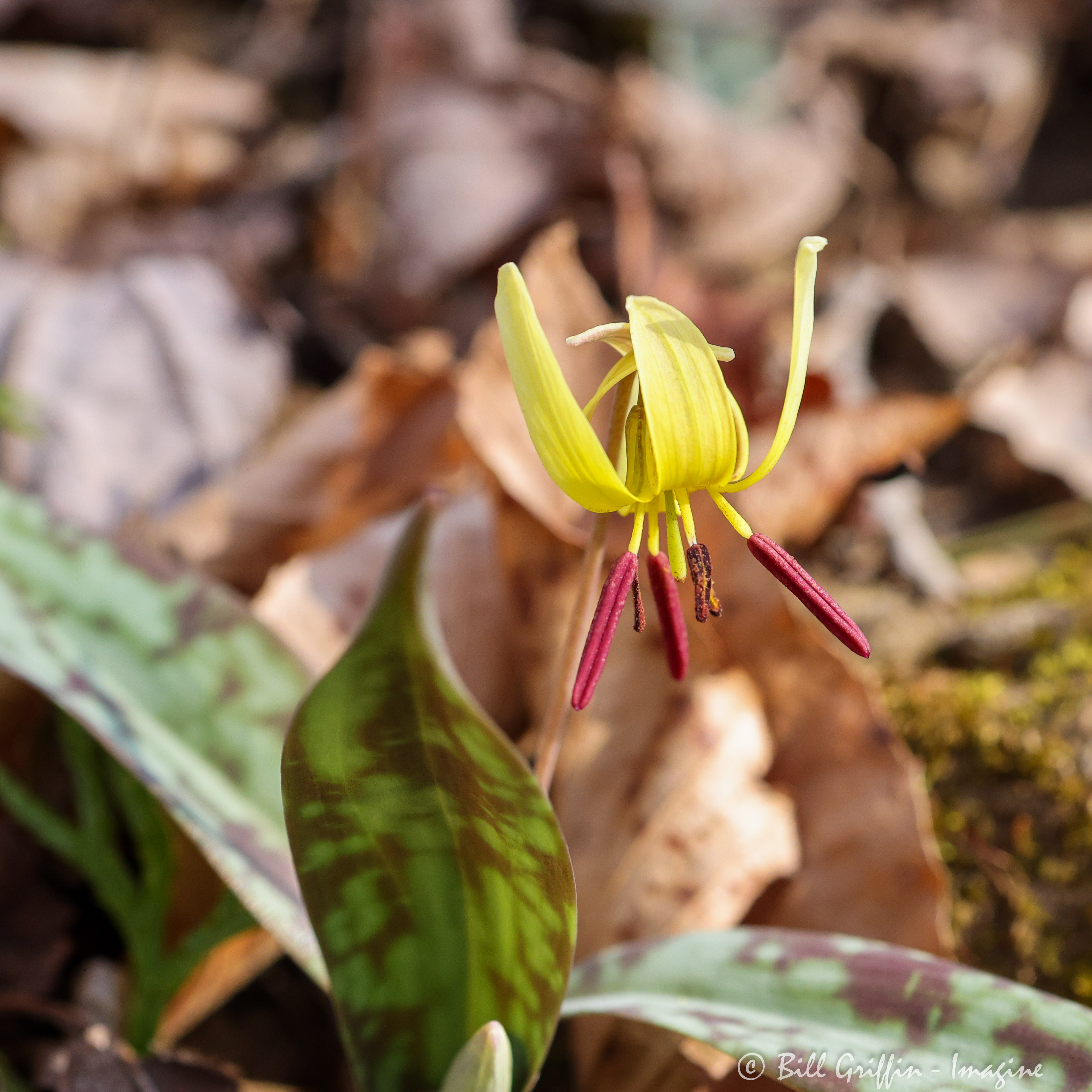
A week after our group walked the trail I am still happy for what the forest shared with us. Yes, one Trout Lily had stretched and curved its petals to open a small yellow flower. Yes, one Hepatica, among the many other slumbering liver-lobed leaves, presented the cold morning after freezing night with a single pale lilac bloom. We knelt closer for its even more remarkable surprise: beneath the blossom nodded two more, sepals already empty of petals and gone to seed. The spring ephemerals know their business and their name. They make more of themselves and fill the world whether we are watching or not.
 . 
I have been watching these flowers but not nearly long enough nor often enough. Nevertheless one remembers – color and scent may spark a flicker of joy into a life that threatens to cloak each day with darkness. On our walk, beside a particular beech tree no different from the hundreds around us, I recall the first time I ever discovered Hepatica blooming in our woods. That year it was the only one I found and I returned to it day after day until it faded. Now here it is again, the very plant. Its leaves are pocked and burnt orange from their long winter’s work. If it has buds, they are still hiding. As yet no new spring foliage. But I will be back to share this brief season with it. Perhaps we will bloom together.
 . 
 . 
❦ ❦ ❦
 . 
Spring
 . 
Somewhere
++ a black bear
++ ++ has just risen from sleep
++ ++ ++ and is staring
 . 
down the mountain.
++ All night
++ ++ in the brisk and shallow restlessness
++ ++ ++ of early spring
 . 
I think of her,
++ her four black fists
++ ++ flicking the gravel,
++ ++ ++ her tongue
 . 
like a red fire
++ touching the grass,
++ ++ the cold water.
++ ++ There is only one question;
 . 
how to love this world.
++ I think of her
++ ++ rising
++ ++ ++ like a black and leafy ledge
 . 
to sharpen her claws against
++ the silence
++ ++ of the trees.
++ ++ ++ Whatever else
 . 
my life is
++ with its poems
++ ++ and its music
++ ++ ++ and its glass cities,
 . 
it is also this dazzling darkness
++ coming
++ ++ down the mountain,
++ ++ ++ breathing and tasting;
 . 
all day I think of her –
++ her white teeth,
++ ++ her wordlessness,
++ ++ ++ her perfect love.
 . 
Mary Oliver
from Devotions, the Selected Poems of Mary Oliver, Penguin Press © 2017; originally collected in House of Light, Beacon Press © 1990.
 . 
❦ ❦ ❦
 . 
Here in closing a few lush stanzas from the overpowering lyric Locksley Hall by Alfred Lord Tennyson:
 . 
Here about the beach I wander’d, nourishing a youth sublime
With the fairy tales of science, and the long result of Time;
 . 
When the centuries behind me like a fruitful land reposed;
When I clung to all the present for the promise that it closed:
 . 
When I dipt into the future far as human eye could see;
Saw the Vision of the world and all the wonder that would be.—
 . 
In the Spring a fuller crimson comes upon the robin’s breast;
In the Spring the wanton lapwing gets himself another crest;
 . 
In the Spring a livelier iris changes on the burnish’d dove;
In the Spring a young man’s fancy lightly turns to thoughts of love.
 . 
Read Locksley Hall in its entirety at The Poetry Foundation
Purchase Mary Oliver’s Devotions at Penguin/Random House
Cutting edge phenological research at Nature.com
 . 
❦ ❦ ❦
 . 
2019-02-09 Doughton Park Tree
 . 

Read Full Post »

« Newer Posts - Older Posts »