Feeds:
Posts
Comments

Posts Tagged ‘nature poetry’

[with 3 poems by Val Nieman]

Great Smoky Mountains Institute at Tremont – February 5-7, 2021

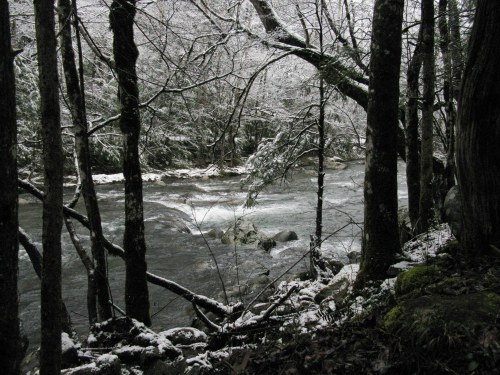
Winter on the mountain gavels its sentence, no appeal: wrestle the cold to keep it at bay; eat, feed the inner fire; light the darkness or fall and break. I pull my hood closer and hide myself. In the tent at night I bind my neck against cold fingers. I watch my feet.

The day is short. Nevertheless we fill it and discover it filling us. Small signs begin to reveal their stories – an incisored nut, scratches in the bark, one single hair. At first we hesitate, we thirteen who’ve journeyed here to explore, but in the light we gather as closely as prudence permits. Muddy track, scrabbled duff, compressed leaf, scat: where did Bear sleep? what did Coyote eat?

Winter on the mountain: what crouches here for us to notice?

The night is long. In this valley darkness is complete. The rush and growl of Middle Prong fill the cove as well as empty it. Are we alone? In the gap of sleep a brush and skitter, a brief chittered voice – I imagine dark eyes and gliding flight. The spirit is released from the prison of his tree. In the morning we will seek signs of his passing.

Winter on the mountain – I release myself to see, to question, to wonder.
 

.     .     .     .     .     .     .

Valerie Nieman journeys landscapes of memory, family, heartache to reveal stories in the signs unearthed along the way. A path may seem clear but its meanings fissure and deepen into many layers. A bud, a leaf, a branch – are they simply of themselves wholly themselves? Look deeper: there are mysteries unfolding.

Val teaches creative writing at North Carolina A&T State University but she is preparing to retire this summer and replace syllabus revisions with fly selection for a day on the trout stream. Her poetry has appeared widely and has been published in numerous anthologies, including Eyes Glowing at the Edge of the Woods and Ghost Fishing: An Eco-Justice Poetry Anthology. Her fifth novel, Backwater, will be published in 2021.

.     .     .     .     .     .     .

Becoming Ariel
for Gerald Stern

Groundhog in a tree, behaving like a bird, like a squirrel,
nibbling tender green buds at branch end, high-wiring
above a bog. Any burrow dug here would be swamped,

front door to back stoop – how did he come to cross water
and ascend, diggers curved deep in the bark as a lineman’s spikes?
A crow would think twice about lighting on a branch so frail.

Soil-shoveling wedge of a face, a fat tail that never could balance
his loose bulk: this creature was not meant for such heights.
His round belly was destined to bloat in a ditch beside the road.

Still, he sways against the sky, close to the sun, Caliban
joyously drunk on spring sap drawn up from the mud
and darkness he was born to, tiny feet dancing and dancing.

from The Georgia Review, University of Georgia

.     .     .     .     .     .     .

Captures

I sprayed for tiny ants
late last night, killing the spider
doing its best to corral them.

Between the sheets I struggled
hand to hand with old lovers
and other aliens

descending cosmic ladders
to pincer my heart,
boiling them in the ichor

my bare claws released
from their flesh.
But this morning,

I catch a humpback cricket
in the sink, cup it
between my hands

and toss it out
the back door
to take its chances.

This morning, I’m
mild as a painted virgin,
my hands empty of slaughter.

from Change 7

.     .     .     .     .     .     .

Approach

Arms stretched wise,
right hand to the dawn,
left toward eventual night,
I face north.

As latitude rises,
life flattens:
forest to taiga,
to tundra, to permanent ice.

Everything will have
a name of cold:
polar bear, arctic fox,
glacier flea, snowy owl.

~ ~ ~

A compass is known to stray
from true north, lured
by the earth’s magnetic heart.
Now the needle swings

at the approach
of a frost spirit
from those barrens
I’ll have to cross

without advice,
without a companion,
or a harness of wolf-dogs,
or good boots.

from Hotel Worthy, Press 53, Winston-Salem, © 2015

Becoming ArielCapturesApproach  © Valerie Nieman


.     .     .     .     .     .     .

The Southern Appalachian Naturalist Certification Program at Great Smoky Mountains Institute at Tremont comprises eight weekend courses designed to provide fundamental and specialty skills in Southern Appalachian ecology and interpretive techniques. Each weekend includes 15 hours and more of lecture and hands-on field study. Upon completion the student receives the non-credit Southern Appalachian Naturalist Certificate from the University of Tennessee.

Ariel, the spirit in Shakespeare’s The Tempest, is released from his prison in the split pine by the magician Prospero.


.     .     .     .     .     .     .


IMG_7952

Read Full Post »

[with three poems by Wendell Berry]

Y’all sure do favor!

So folks say when they first see my father and me together. He’s 94. I can’t say I see it but others do so there you are.

On the bookshelf in his living room is a small framed photo of my father about age 3, the same age as our grandson Bert right now. Now those two do favor! Two peas in a pod, cut from the same cloth, much of a muchness. Look at them with that one smile between them, look at those eyes, little imps, look at the domes of those foreheads. Let me just scroll through all these photos Bert’s parents have texted us and you’ll surely see how Wilson and Bert favor.

But where are the photos of my father at 3 making a face, lining up his lead soldiers, stacking his rough-cut handmade blocks? Where dancing? I suspect that framed studio portrait was a Christmas present from Grandmother’s brother Sidney – the rest of the family was surviving the depression on grits and squirrel gravy, the occasional bartered hog shoulder, never two nickels to rub together. The rare snapshots we have of aunts and cousins are from Uncle Sidney’s camera, the only one in the family.

Another depression is upon us now. We are all doing without something. Photos abound but Bert is not free to stand beside his great-grandfather, to show us their one smile between them. When will the day return that may show us how much we all do favor?

.     .     .     .     .     .     .

The poetry of Wendell Berry returns me to the center: the center of the fields and woods he walks; the center of time that stretches from long before me to long after; the center of meaning in a universe in which I am not the center but which nevertheless makes a place for me.

These three poems are from Mr. Berry’s book Sabbaths, published in 1987. A moment of stillness, of contemplation, of connection to the earth and all that fills it makes any place sacred and any day Sabbath. My dread, my grief, my struggle during these times are no different really from any times. These things don’t recede, they don’t disappear. They simply take their place in this moment: no before, no after, only now, and I and you and all of us connected in the journey to discover within them some promise of peace.

.     .     .     .     .     .     .

VIII (1979)

I go from the woods into the cleared field:
A place no human made, a place unmade
by human greed, and to be made again.
Where centuries of leaves once built by dying
A deathless potency of light and stone
And mold of all that grew and fell, the timeless
Fell into time. The earth fled with the rain,
The growth of fifty thousand years undone
In a few careless seasons, stripped to rock
And clay – a “new land,” truly, that no race
Was ever native to, but hungry mice
And sparrows and the circling hawks, dry thorns
And thistles sent by generosity
Of new beginning. No Eden, this was
A garden once, a good and perfect gift;
Its possible abundance stood in it
As it then stood. But now what it might be
Must be foreseen, darkly, through many lives –
Thousands of years to make it what it was,
Beginning now, in our few troubled days.

.     .     .     .     .     .     .

X (1982)

The dark around us, come,
Let us meet here together,
Members one of another,
Here in our holy room,

Here on our little floor,
Here in the daylit sky,
Rejoicing mind and eye,
Rejoining known and knower,

Light, leaf, foot, hand, and wing,
Such order as we know,
One household, high and low,
And all the earth shall sing.

.     .     .     .     .     .     .

III (1982)

The pasture, bleached and cold two weeks ago,
Begins to grow in the spring light and rain;
The new grass trembles under the wind’s flow.
The flock, barn-weary, comes to it again,
New to the lambs, a place their mothers know,
Welcoming, bright, and savory in its green,
So fully does the time recover it.
Nibbles of pleasure go all over it.

all selections from Sabbaths, Wendell Berry, North Point Press, San Francisco, 1987
Thank you, Anne Gulley, who gave Linda and me this book many years ago.

.     .     .     .     .     .     .


.     .     .     .     .     .     .

IMG_7952

Read Full Post »

White-throated Sparrow, Zonotrichia albicollis, ELKIN NC


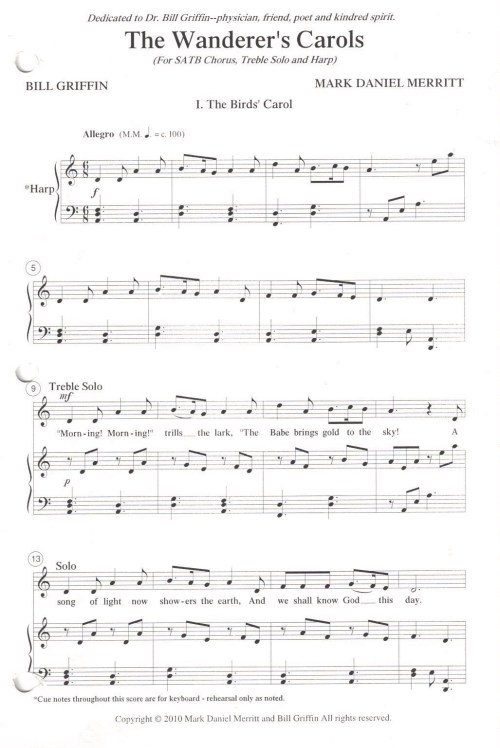
The Birds’ Carol
Lyrics: Bill Griffin . . . . . . . . . . Music: Mark Daniel Merritt

Elkin Community Chorus
51st Annual Christ Concert / December 4, 2011
Director: David L. McCollum / Piano and Organ: Amy Tayloe and Amy Johnson

.     .     .     .     .     .     .

By 2010 Linda and I had been singing for several years with VOCE, Surry County’s invitational chorale, directed by Sandy Beam and assisted later by Mark Merritt. Mark is a talented composer and had asked me before for lyrics. That spring VOCE had been invited to perform at Bilmore House in Asheville, NC, during the Christmas season and Mark wanted to create a suite we could debut there. The Birds’ Carol is the first of three movements in The Wanderer’s Carols. The following year David McCollum selected The Bird’s Carol for Elkin Community Chorus’s 51st Annual Christmas Concert.

.     .     .     .     .     .     .

The Birds’ Carol

“Morning! Morning!” trills the lark, “The Babe brings gold to the sky!
A song of light now showers the earth, And we shall know God this day.

Now is the dawn of our new life,
And we shall know God this day.”

“This coat I wear,” caws the rook, “So black, so heavy, so grim.
Only One knows the way to make it bright – The Child who reclaims us from sin.

He lifts our burden upon himself,
The Child who reclaims us from sin.”

“Come rest with me,” coos the dove, “In this humble stable take ease.
Kings and shepherds together embrace The Prince who unites us in peace.

You make us one in all the earth,
O Prince who unites us in peace!”

“I . . . Thou, I . . . Thou,” vow the geese From dark earth to heaven above –
“May we join with Thee in a world made new; May we fly forever in love.

Give us wings of Your perfect light,
And we’ll fly forever in love.”


.     .     .     .     .     .     .

.     .     .     .     .     .     .

VOCE of Mount Airy performing The Birds’ Carol, November 14, 2010, Winston-Salem First Presbyterian Church:
http://www.youtube.com/watch?v=JDPm6MYvacA&feature=related

Discussion of the symbolism of Lark, Rook, Dove, Goose:
https://griffinpoetry.com/2011/12/17/joy-hope-peace-love/

.     .     .     .     .     .     .


.     .     .     .     .     .     .

2020-09-08b Doughton Park Tree

Read Full Post »

« Newer Posts - Older Posts »