Feeds:
Posts
Comments

Posts Tagged ‘nature poetry’


[poetry by Catherine Pierce, Noel Crook, Jenny Bates,
Nikolai Kantchev, Sam Love]

Planet

This morning this planet is covered by winds and blue.
This morning this planet glows with dustless perfect light,
enough that I can see one million sharp leaves
from where I stand. I walk on this planet, its hard-packed

dirt and prickling grass, and I don’t fall off. I come down
soft if I choose, hard if I choose. I never float away.
Sometimes I want to be weightless on this planet, and so

I wade into a brown river or dive through a wave
and for a while feel nothing under my feet. Sometimes
I want to hear what it was like before the air, and so I duck
under the water and listen to the muted hums. I’m ashamed

to say that most days I forget this planet. That most days
I think about dentist appointments and plagiarists
and the various ways I can try to protect my body from itself.

Last weekend I saw Jupiter through a giant telescope,
its storm stripes, four of its sixty-seven moons, and was filled
with fierce longing, bitter that instead of Ganymede or Europa,
I had only one moon floating in my sky, the moon

called Moon, its face familiar and stale. But this morning
I stepped outside and the wind nearly knocked me down.
This morning I stepped outside and the blue nearly

crushed me. This morning this planet is so loud with itself—
its winds, its insects, its grackles and mourning doves—
that I can hardly hear my own lamentations. This planet.
All its grooved bark, all its sand of quartz and bones

and volcanic glass, all its creeping thistle lacing the yards
with spiny purple. I’m trying to come down soft today.
I’m trying to see this place even as I’m walking through it.

Catherine Pierce
© 2017 Catherine Pierce. This poem originally appeared in The Southern Review, Spring 2017. https://poets.org/poem/planet

Selected by Jeanne Julian

❦ ❦ ❦

I’ve just returned from a morning’s hike and it’s time to write. My desk looks out a window past the holly bush to profligate red azaleas of glory. The window to the right is dark with dense crowding boxwood; window to left glows with every shade of new leaf green, unfurling dogwood, maple, tuliptree. I can even see a little sky. Thank you, Planet, for all colors and for colorless crisp bright breath.

Earlier this morning at Isaac’s trail head before I’d even shrugged into my pack I heard a Parula. Not sixty feet up in some obscurantist oak but right above my head in the lowest breezy branches of a black cherry. Glean – sing – glean. Fattening up after his flight from Belize. Blue and yellow! You never get to see these little buggers without 8X field glass, if then. Thank you, Planet, for all creatures that move of themselves or that allow the air to move them.

Swept the back porch when I got home from hiking. Our “yard” slopes steeply away from the house, slowly maturing third-growth beech-oak. These past two weeks Linda and I have measured each day by the rise of green up from the creek, first brassy gold, then lime chiffon, now encroaching emerald. And of course the fecund kelly milt from each of a trillion anthers that has powdered the world in extravagant hope of seeds. Sweep – sneeze – sweep. Thank you, Planet of wombs, womb of a Planet, for all life.

Thank you, Planet, and may my reverence, my gratitude, and whatever other small parts of my life I can give you be worthy of what you give to all, life without ceasing.

nature tadpole Amphibian

❦ ❦ ❦

Big Sky

Little sky in these Carolina woods,
more greens than you can number,
above us crooked rafters of washed-out

blue. Here are ten kinds of birds all hollering
at once, ten songs of secret nest and sifted
light. Here we are hemmed in by tendrils,

socked in, loblolly so high and thick
even the pasture’s a cracked sarcophagus

where you have to look quick to locate the moon.

I want the western sky
of my girlhood, purple as lupines
and longing. Unligatured wind

that will hollow your bones
like the kiss of a boy at sixteen
who flattened me over the hot hood

of his Ram truck. Give me sun-stunted
scrub oaks rooted in rock and shaped like
bad hearts; the summer a mountain lion

ambushed an appaloosa colt by the barn
and two bottle-fed backyard deer, their bones
dragged to the dump to be picked clean

and sun-whitened. Give me found flint
arrowheads the color of lost rivers,
the barbed-wire fact that Comanche girls

liked burning the captured fawn slowly
to death before breakfast; scorched
earth, nights rampant with stars,

the Pleiades fleeing, an orange skiff of moon going
down fast into black swells of hills. Sunrise
the colors of cataclysm, the singular

solace of the canyon wrens, their strafed
ululations, and, in a cartwheel of azure,
the lone buzzard wheeling and waiting.

Noel Crook
from Salt Moon (2015), Southern Illinois University Press. This poem first appeared in One.

Selected by Richard Allen Taylor, who writes: I had the privilege of reviewing Noel Crook’s book Salt Moon for The Main Street Rag several years ago and fell in love with this poem, which reminds us that ecology is not just a just a polite society of sweet little animals getting along with Mother Nature and each other. Ecology runs on violence and the brutality of food chains, varies from place to place, and interacts with humans—us!

❦ ❦ ❦

Clouded Leopard

How does it feel returning from extinction?

Climbing head first down
my Anthropocene spine

I break, with each twist of
wrist, incision of claw.

Divergent several million years
reduced to eleven in captivity.

Under your limber bones
I squall, choke and pitch
tipping into your patient wound.

Wind your tail round my neck
hero of revenge, and ossified
purr.

Your long tooth guilt-piercing.
We won’t say anything to anyone
perilous beauty kills,

Shroud me in your cloud.

Jenny Bates

Published (online) by Self Educating Poets Network in 2021. The Self-Educating Poets Network is an education group providing resources and meeting space to poets, writers and artists. It was founded on principles of grassroots activism as well as the free spirit of poets who met from the Cantab Poetry Lounge and Boston Poetry Slam.

❦ ❦ ❦

Autumn Resurrections

The autumnal equinox is uneasy,

restless with the pain of the lonely stork.
Time has paused along the way for a visit
and won’t raise its voice in defense.
Unworldly, I accept the world
surviving its deadly silence by the skin of my teeth.

After the summer swarms have stopped their buzzing,
see how time droops amidst the bickering clocks.
Nothing will remain of their springs.
Instead the journal of eternity will endure
and a calm tear will glaze its eye.

Look, the sky has its blue-jeans on
and the chimney smokes its millionth cigarette.
The city lifts up its multitude of windows,
while it puts out fires in the dreams of the burnt.
Somnambulists look out in a riot of joy, wondering,
will the blaze of their lust seduce the moon.

There’s such a fine female smell about the meadow.
The fog has dropped its handkerchief there
and we long to pick it up as a token
but our trembling betrays our cowardice.
The breath of resurrection wakes the silence.
Let all the crowns of thorns burst into blossom!

The farmer stands calling for his cart
loaded with dried out lightnings and sets off.
Don’t weep poor one, for while you wring your hands
the wheat spins its golden fleece
and the wind-rose will bloom at dawn.
Paradise is just this world with an other-worldly climate.

Nikolai Kantchev
Translated from the Bulgarian by Pamela Perry, with B. R. Strahan

Selected by Bradley Strahan

❦ ❦ ❦

The Ecology Symbol

Once upon an Earth Day millions
marched to Ron Cobb’s creation
melding the E for environment
and the O for organism
to create the ecology symbol

Such a simple graphic,
just a circle and slash to symbolize
care for the planet,
respect for nature,
and the nurturing of a legacy
for generations unborn

Today I didn’t see the ecology symbol
at the Climate March
But it’s co-conspirator the peace symbol
seems to be everywhere
At Wal-mart you can buy it
on underwear and day glow T shirts

The vanishing ecology symbol
with its pesky admonitions
to reduce consumption,
reuse materials, and respect nature
must be too threatening
to the dollar sign worshippers

It must be too threatening
to the comfort of North Americans
who consume 60 percent
of the Earth’s resources
just to support our obese life style

It must be too threatening
to the 80 million new mouths
birthed on the planet each year
babies who will aspire to America’s life style
Babies who will be in for a surprise

If everyone lived like Americans
we would need a planet three times
the size of Mother Earth
and the last time I looked
she’s not gaining weight

Sam Love
from Earth Resonance: Poetry for a Viable Future, The Poetry Box, Portland, Oregon, © 2022

❦ ❦ ❦


Early April I asked readers to share a favorite poem that celebrates
the interdependence and interconnection of all life on earth.
I am including their offerings in three posts before, on, and after Earth Day, April 22. Thank you to all those who responded, and thanks to all of you
who read this page and share in the celebration of life on earth.

❦ Bill Griffin ❦
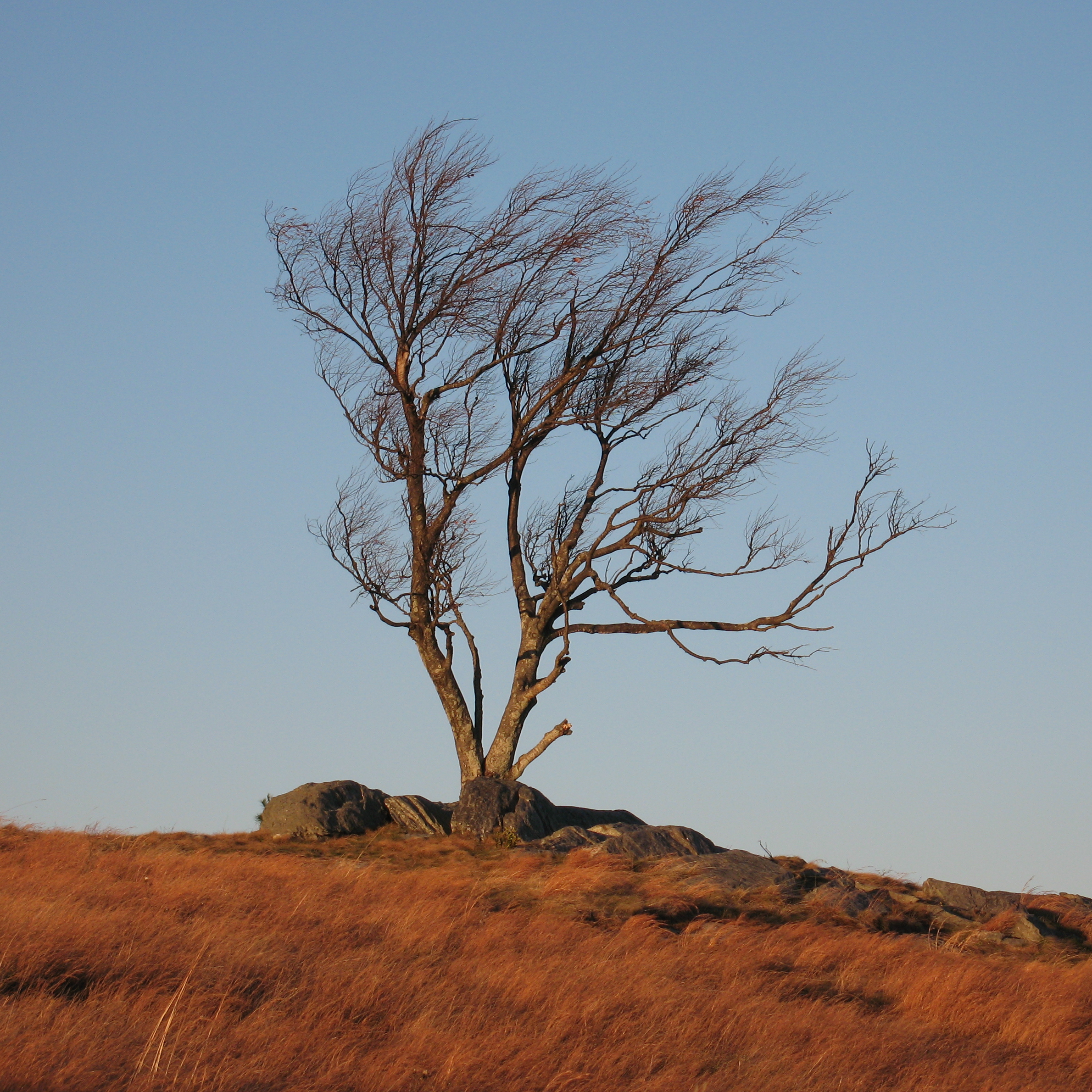
2014-06-30a Doughton Park Tree

Read Full Post »

[poetry by Liz Garton Scanlon, Alice Walker,
John Hoppenthaler, Catherine Carter, David Poston]

All the World

Rock, stone, pebble, sand
Body, shoulder, arm, hand
A moat to dig, a shell to keep
All the world is wide and deep

Hive, bee, wings, hum
Husk, cob, corn, yum!
Tomato blossom, fruit so red
All the world’s a garden bed

Tree, trunk, branch, crown
Climbing up and sitting down
Morning sun becomes noon-blue
All the world is old and new

Road, street, track, path
Ship, boat, wooden raft
Nest, bird, feather, fly
All the world has got its sky

Slip, trip, stumble, fall
Tip the bucket, spill it all
Better luck another day
All the world goes round this way

Table, bowl, cup, spoon
Hungry tummy, supper’s soon
Butter, flour, big black pot
All the world is cold and hot

Spreading shadows, setting sun
Crickets, curtains, day is done
A fire takes away the chill
All the world can hold quite still

Nanas, papas, cousins, kin
Piano, harp, and violin
Babies passed from neck to knee
All the world is you and me

Everything you hear, smell, see
All the world is everything
Everything is you and me
Hope and peace and love and trust
All the world is all of us

written by Liz Garton Scanlon
illustrated by Marla Frazee
All the World, Little Simon, an imprint of Simon & Schuster, New York NY, © 2009

❦ ❦ ❦

I love this children’s book by Elizabeth Scanlon – the whirl and dance of the poetry, the absolutely beguiling illustrations by Marla Frazee. It is elemental and compelling, it is joyous and inclusive. It is all of us.

But I had to think long about whether to lead us to Earth Day with this poem. Is it Ecopoetry? Is it a little too much centered on one particular species? How do we celebrate the earth? How do we revere the one blue dot in the universe upon which we can live and thrive?

All the world is all of us. Dogwoods still blooming, warblers arriving, golden ragwort masquerading as weeds, rockfish spawning in Roanoke River, hellbender ugly as sin. Dandelions in the lawn, princess tree crowding out the basswood, wisteria strangling another neglected back lot. Celebrate us all – even while hacking the invaders – but don’t leave out the most aggressive, invasive, threatening species of all. You guessed it – you and me.

One might argue that there are far more pressing needs in our one world than environmentalism. Reminds me of a t-shirt my friend Evan brought me back from a trip to Yellowstone: along with illustrations of various animal scat and the label “Endangered Feces” is the tagline, No Species, No Feces. Which makes the other side of this argument: “No Environment, No World Problems.”

Poverty, politics of hate, racism, homophobia, nationalism, war – how can we make a place in our hearts to worry about our environment when these and so many other worries take priority? Perhaps these things are as intrinsic to our nature as the jillion seeds of princess tree and the invincible roots of wisteria. Are they?

Here’s my thesis – begin reading All the World to every kid at age 2 and by the time they can read it for themselves they may have planted a seed of love within their hearts. They might love themselves no matter what they look like. They might accept a whirling dance of neighbors as their kin. They might have room in their hearts to care about weeds and warblers and ugly giant salamanders.

Think so? Do you think that if we are going to preserve all the world as a place for all to thrive we are going to have to address the aggression, invasiveness, and threat within each one of us? For all the world is all of us . . .

❦ ❦ ❦

We Have a Beautiful Mother

We have a beautiful
mother
Her hills
are buffaloes
Her buffaloes
hills.

We have a beautiful
mother
Her oceans
are wombs
Her wombs
oceans.

We have a beautiful
mother
Her teeth
the white stones
at the edge
of the water
the summer
grasses
her plentiful
hair.

We have a beautiful
mother
Her green lap
immense
Her brown embrace
eternal
Her blue body
everything we know.

Alice Walker

Selected by Becky French (my sister), who writes: I especially like this poem by Alice Walker from her book of meditations titled We Are the Ones We Have Been Waiting For. The prose that follows the poem in the book is quite poetic as well: The earth mother, who stands behind the Human Mother, can be known by lying on her breast. She can be known by swimming in her oceans, or even by looking at them. She can be known by eating her collard greens and carrots. Savoring her fruits, walking through her wheat fields. She is everywhere, our Mother Earth; … (p. 129).

❦ ❦ ❦

The Whale Gospel

Whales have run aground off Cape Cod again.
What if God created them for us as metaphor?

How like us they are, beached and prostrate,
sand shifting under them with every wave

from heaven. Bloated and murder to move,
they slowly rot in the blurry sunshine, victims

of distress we can’t fathom. All we can think
to say is beware the giant squid, the seaquake,

beware sickness in your leaders. Beware the dark-
eyed shark, sonar’s ping and Japan’s traditional hunger.

The rusty bows of ghost ships
++++++++++++++++++ are singing through the water.

John Hoppenthaler
online in “Two Meditations on Ecology

❦ ❦ ❦

Lactobacilli

Invisible and everywhere,
on your hands,
on your shoes,
in your nose, lining
your ells of bowel,
we lay down scraps
of chromosomes
and pick them up
like screwdrivers
or cards, if half the cards
are wild as sauerkraut-
e. coli, listeria,
seaweed, straight flush.

Nor are you you,
some single entity
cruising the lonely black
star-seas like a whale:
you are a ship, a host,
the poker table.
We are crew
and players and spirit,
your spirit, the one many-
bodied soul you can know
for sure. Genius loci.
Spirits of place.
Full house.

Catherine Carter
Southern Humanities Review, Spring 2020

❦ ❦ ❦

The Garden Takes over Itself

the world is sacred++++ it cannot be improved
snow is shadow++++ ice is light
we breathe++++ and wildness comes in
bit by bit++++ the garden takes over itself

snow is shadow++++ ice is light
the moon not only full++++ but beautiful
bit by bit++++ the garden takes over itself
after we leave it++++ we dream of falling

the moon not only full++++ but beautiful
descending and ascending++++ all our lives
after we leave it++++ we dream of falling
the space within us++++ is not our own

ascending and descending++++ all our lives
the world is sacred++++ it cannot be improved
the space within us++++ is not our own
we breathe++++ and wildness comes in

David E. Poston
from Iodine Poetry Journal XVII (2016): 105.
Reprinted as POETRY IN PLAIN SIGHT poster. NC Poetry Society, 2021.

“the world is sacred…” from Lao Tzu, quoted by Jack Turner interviewed by Leath Tonino (The Sun Aug. 2014)
“we breathe…” also from Jack Turner
“snow is shadow…” is Barbara Sjoholm in The Palace of the Snow Queen
“the moon not only full…” is from Aldous Huxley’s Meditation on the Moon
“…the garden takes over itself” is from Sandra Cisneros, in The House on Mango Street

❦ ❦ ❦

Early in April I asked readers to share a favorite poem that celebrates the interdependence and interconnection of all life on earth. I am including their offerings in three posts before, on, and after Earth Day, April 22. Thank you to those who responded, and thanks to all of you who read this page and share in the celebration.
❦ Bill Griffin ❦

Read Full Post »

Hepatica americana (Buttercup family), last year’s foliage and new barely opened blossoms

[with 3 poems by Sam Love]

On March 15 I walked an Elkin trail I hadn’t visited in months. The Elkin & Allegheny Nature Trail includes a couple of miles of restored railway grade and many more miles of side trails, loops, and spurs, plus 5-6 miles of intermediate level bike trail. I hiked most of those miles on the 15th but only partially for the exercise – I was walking mostly for ephemera.

Note the date. Looking back at my photos and notes I uncover Hepatica blooming as early as January 27, a single plant in a protected hollow, but usually here in Elkin, elevation around 1000 feet, the earliest Hepatica and Trout Lily emerge toward the middle or end of February. So who’ll be showing themselves mid-March? I ask myself, and how long will they last?

The study of cyclical biological phenomena is phenology. When do migrating warblers arrive from Central America? We saw our first Ovenbird March 19; I heard a Northern Parula out back on April 3. When do Wood Frogs lay eggs? When do Midges and Mayflies hatch out and Eastern Bluebirds build their nests? Sometimes local weather affects a given year’s record but longer term trends are linked to climate change. Can’t help worrying about those Parulas if the hatching of their chicks is out of sync with the juicy bugs. Phenology is a leading indicator of climate change impact, especially on vulnerable species.

For today, my phenology project is discovering tiny blooms just making their appearance.

And if that weren’t enough, as I walk a section of bike trail beside Elkin Creek a pair of wood ducks skitter up from the water and the male flashes his phenomenal colors before they veer around a bend.

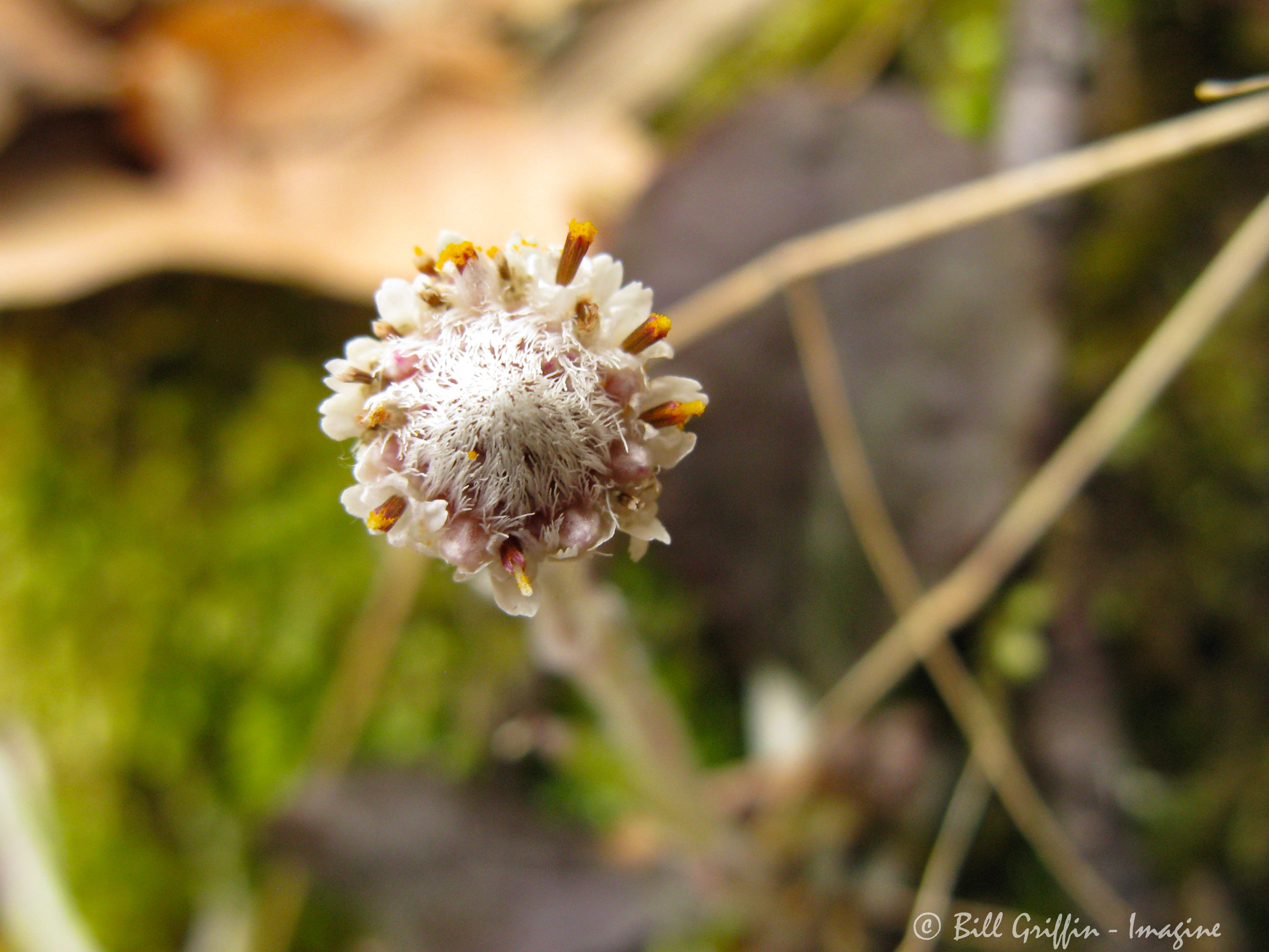
Solitary Pussytoes, Antennaria solitaria (Aster Family), flowers less than 10 mm in diameter

.     .     .     .     .     .     .

A Monument to Another Time

A winding rutted road
rambles through scattered rocks
to an abandoned homestead
that traces time backwards.

In the overgrown clearing
a hand laid stone chimney
pokes above winding vines
and gnarled tree limbs.

The fireplace stands as
tribute to an unknown mason
whose calloused hands
meticulously stacked the stones.

With the charred house gone
front porch music
no longer blesses the mountain
with notes and harmonies
that surf the Appalachian wind.

In spring wild flowers
scatter sun dappled beauty
among the crannies of this dream
of a simpler life, an abundant garden
and a small homestead taming nature.

Through winter the chimney
stands alone among
a palette of brown hues
that wait for spring shoots
to burst forth and repaint
the landscape.

Sam Love
Earth Resonance – Poems for a Viable Future, The Poetry Box, Portland, Oregon, © 2022

.     .     .     .     .     .     .


Bloodroot, Sanguinaria canadensis (Poppy family, Order Ranunculales), flower barely unfurling


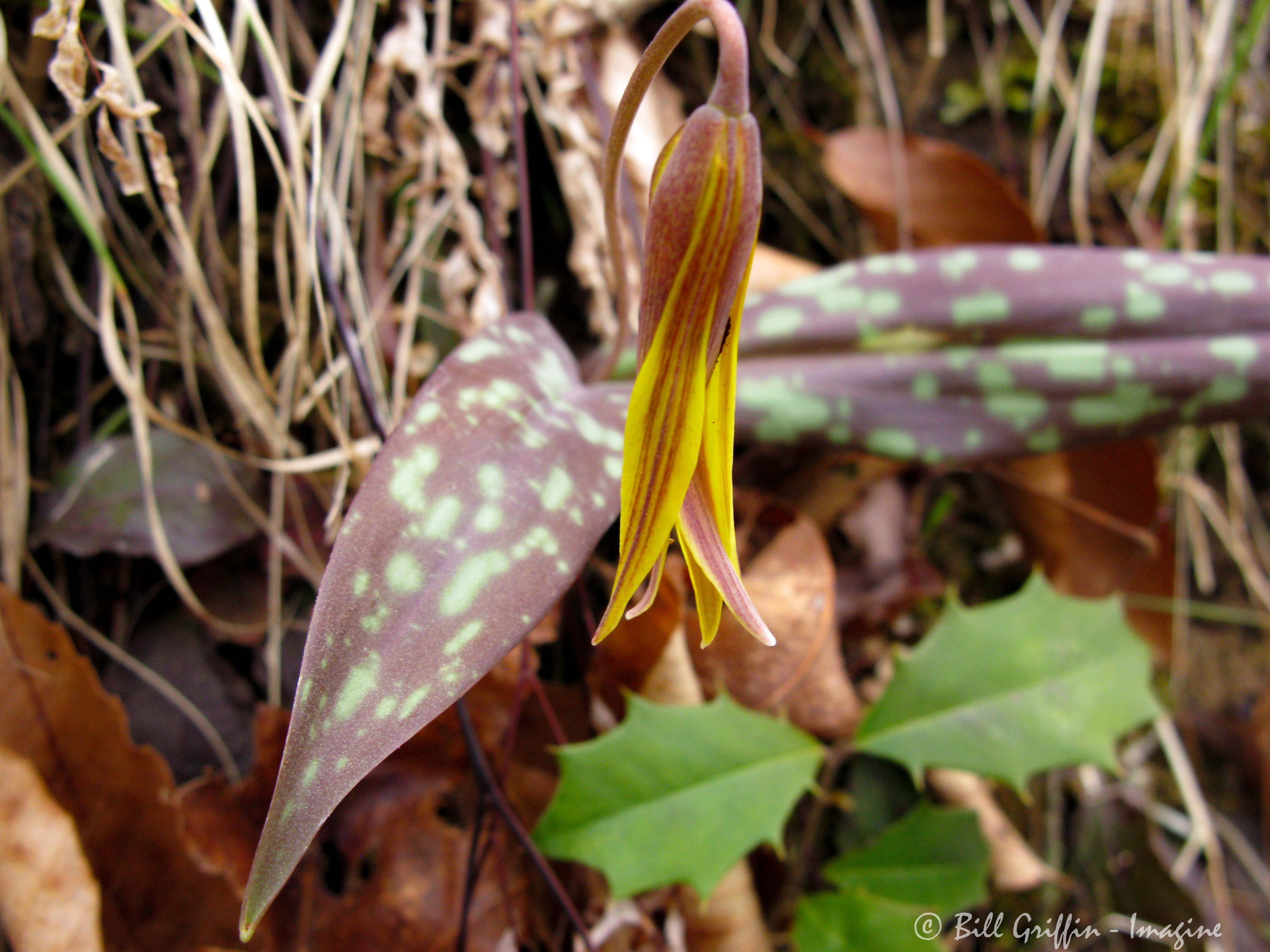
Yellow Trout Lily (Adder’s Tongue, Dogtooth Violet, Erythronium americanum (Lily family)


.     .     .     .     .     .     .

Thanks to Sam Love for alerting me to his new book of poetry about ecology and the environment: Earth Resonance – Poems for a Viable Future. Such an edgy relationship we humans have with all the other creatures in our biosphere. Mostly we ignore them except when they’re on our dinner plates. Any surprise that we have so much trouble getting along with things that creep and crawl and skitter and pounce (much less the ones that just stand there being green) when we can hardly get along with they guy whose yard sign doesn’t match ours?

And thanks to the Town of Elkin Recreation Department and the Elkin Valley Trails Association for all the great places to walk!

.     .     .     .     .     .     .

Visiting Khatyn
+++Peace Memorial in Minsk Region, Belarus

At sunset each step up the earthen berm
slowly reveals stone chimneys standing
as monuments to an unimagined darkness
that reduced hundreds of villages
to stone rubble and ashen timbers.

Across the field masonry memorializes
thousands of villagers burned alive
as Fascists sought revenge
for partisan guerilla attacks
launched from surrounding forests.

On hearths reaching to the horizon
urns rest filled with ashes and soil
scooped from the 628 flamed hamlets.
Each now lovingly stands as
a spiritual reminder of war’s insanity.

Three solitary birch trees and an eternal flame
symbolize the one quarter of Belarusians killed
in the world war that targeted their villages.
On this site twenty-six bells toll every hour
to remember the homes that once stood here.

The wind that whipped the flames
and charred the flesh, now cleanses the earth
leaving only spirits to haunt the memorial
and remind us of the horrors of war.

Sam Love

.     .     .     .     .     .     .


Virginia Pennywort, Obolaria virginica (Gentian family), flowers just about to open


.     .     .     .     .     .     .

Turtle Earth

In the Lenape creation story—Nanapush asks,
“Who will let me put cedar branches on top of you
so that all the animals can live on you?”
And the turtle says, “You can put them on me
and I’ll float on the water.”

In a vision the Native American holy man
sees the animals bringing earth
from under the water to make land
on the back of the turtle
to create a verdant Eden
where plants and animals flourish.

In another dream the Indian shaman
sleeps a long sleep and
sees a barren turtle
with writhing serpents
thrashing rattlers through portals
in its armor-plated shell.

This hollow eerie sound
resonates with a dry rattle
of primordial notes memorializing
the emerging death of nature.

Sam Love

Virginia Heartleaf, Hexastylis virginica, tiny brown jugs are the flowers just emerging

.     .     .     .     .     .     .


IMG_1948

Read Full Post »

« Newer Posts - Older Posts »