Feeds:
Posts
Comments

Posts Tagged ‘nature photography’

 . 
[with 3 poems by Les Brown]
 . 
Pause
 . 
I placed my hand on the moon
++++ to keep it from its course,
to stop time in the comfort of night
++++ when sleep subdues sounds
of machines and urgent voices.
++++ Starlight and still moon
are enough to guide my stroll.
++++ I cross the meadow
among sparse trees,
++++ where snowy crickets cry fast
with time kept by heat
++++ of past day’s searing sun.
I lie down and listen
++++ for the whippoorwill
whose call is rare now,
++++ watch fireflies wink love calls.
I will hold the moon until
++++ the world stirs and wonders
why the night endures,
++++ with dreams of Earth
where fires do not rage,
++++ floods do not drown,
spiraling winds cease,
++++ oceans retreat from shores
and the cricket cries slow
++++ once again.
 . 
Les M. Brown
from A Coming of Storms, Main Street Rag Publishing, Charlotte, NC; © 2024
 . 
❦ ❦ ❦
 . 
Light rain in the woods, droplets coalesce and cascade through the upper canopy, tuliptree, oak, & hickory, until they freefall onto our heads and shoulders. A fat drop flicks a browned leaf or blinks in the duff. We imagine small creatures leaping up from the earth and then they do! Angel-winged insects are bobbing up and down to touch the fresh damp with the tips of their abdomens, animated by moisture. Linda watches one female Cranefly, notices nearby a delicate floral spike with angel-winged florets, and says,  “Look, it’s planting orchids!”
 . 
Cranefly Orchid and Cranefly, so like each other, elongated nectar tube of the flower resembling the long abdomen of the insect ending in its ovipositor, but so unlike! Except in our visual imagination they’re not related at all . . . or are they? Both favor moist woodlands with a nice layer of decomposing vegetation. Both reproduce in midsummer, by bloom and seed or egg and larvae. Both look a little creepy if you’re not fond of long spindly legs.
 . 
Altogether unrelated, entirely different Kingdoms – Animalia and Plantae – and yet these two are related ecologically, if simply by the places in which they thrive and by the company they keep. They live in community. But mightn’t  the relationship go deeper? All living creatures on this planet are genetically related; we share many of the same genes for  basic functions like metabolism, DNA replication, and protein synthesis, share them with every bacteria, archaea, fungus, protist, and plant. Compare the genome of any plant – Cranefly Orchid – and any animal – Cranefly – and you’ll discover hundreds of identical genes. It’s one big family tree, this Kingdom Earth, with some pretty twisted and winding branches, and yet all connected to the same trunk.
 . 
 . 
Alas, the Cranefly is not planting orchids. She’s laying eggs in the moist duff; they’ll hatch into larvae called leatherjackets. She doesn’t care a whit for her namesake orchid, which is pollinated by Owlet Moths (Noctuidae). The Cranefly Orchid’s tiny flowers twist either left or right as they progress up the stalk (raceme), so that as the moth’s long proboscis probes the nectar tube she gets a dusting of pollen on one or the other of her large compound eyes. And carries it with her to the next flower.
 . 
 . 
 . 
❦ ❦ ❦
 . 
Mayfly Swarm
 . 
Night on the Pearl River, steaming warm –
our small boat pierces the tunnel of blackness.
Beams of head-bound lights play
across the dark slow current.
 . 
We tease out an occasional moccasin,
quiescent in boughs of bald cypress.
Lock on bright-lit eyes of river frogs,
the hungry raccoon eating a mussel.
 . 
The motor pusher our johnboat upstream –
Suddenly, a blinding blizzard
of white-winged snow rises.
Shimmering mayflies fill the blackness.
 . 
They are in our eyes, nostrils, mouths, ears,
and hair, an erupting silent lace-winged storm.
Millions rise in singular ecstasy, then die.
Their gossamer bodies blanket the river.
 . 
Fertile eggs drift into black depths.
Frog, fish, and bird devour the dead,
a one-night feast, a gift, a magic cycle
of lovers, death, and satiated flesh.
 . 
Les M. Brown
from A Coming of Storms, Main Street Rag Publishing, Charlotte, NC; © 2024
 . 
 . 
❦ ❦ ❦
 . 
Les Brown’s new book, A Coming of Storms, has plenty of vivid and hair-raising (literally) descriptions of black cumulonimbus monsters plowing down the mountainside to batter us with hail and impale us with jagged barbs of lightning. The storm he’s really warning us of, however, is metaphorical and of our own making: the devastation of Planet Earth by that most destructive invasive species, Us. Among these poems are Lamentations for the now diminished towns and farms where our lives were once so rich, Jeremiads proclaiming the dire future we’re creating for ourselves, and the Psalmist’s tender recollection of family homestead, tender sojourns in nature, and all the smells and tastes and feel of our fertile world at its best.
 . 
Les has all the necessary credentials of a prophet. He grew up in the rural mountainscape of North Carolina; his poetry is most poignant when populated by his grandparents, uncles, neighbors. He earned a Ph.D. in Biology and taught ecology to college students all his working life. He himself feels most personally and pointedly our loss of unspoiled fields and forests, our disconnection from the earth that sustains us. I wish he were here beside me this afternoon so we could both get our knees dirty investigating Cranefly Orchids and Rattlesnake Plantain. I’ll be looking forward to his next observation, and holding my breath for a cooling breeze of hope.
 . 
 . 
A Coming of Storms is available from Main Street Rag Publishing.
 . 
❦ ❦ ❦
 . 
Think seeds, not bullets
 . 
++++ melons instead of bombs.
Drink wine, rest a while
++++ instead of scorching earth.
Rip off epaulets
++++ and but on bedroom shoes.
Call mothers. Tell them
++++ their children are safe
Revere the earth,
++++ cool it.
Grow chanterelles,
++++ not mushroom clouds.
Bend barrels
++++ and weld triggers
into metallic art.
++++ Read a different Good Book.
Let only birds tweet.
++++ Read only magazines
instead of loading them.
++++ What is beneath the skin
of an apple?
++++ It is a simple question.
 . 
Les M. Brown
from A Coming of Storms, Main Street Rag Publishing, Charlotte, NC; © 2024
 . 
❦ ❦ ❦
 . 
 . 
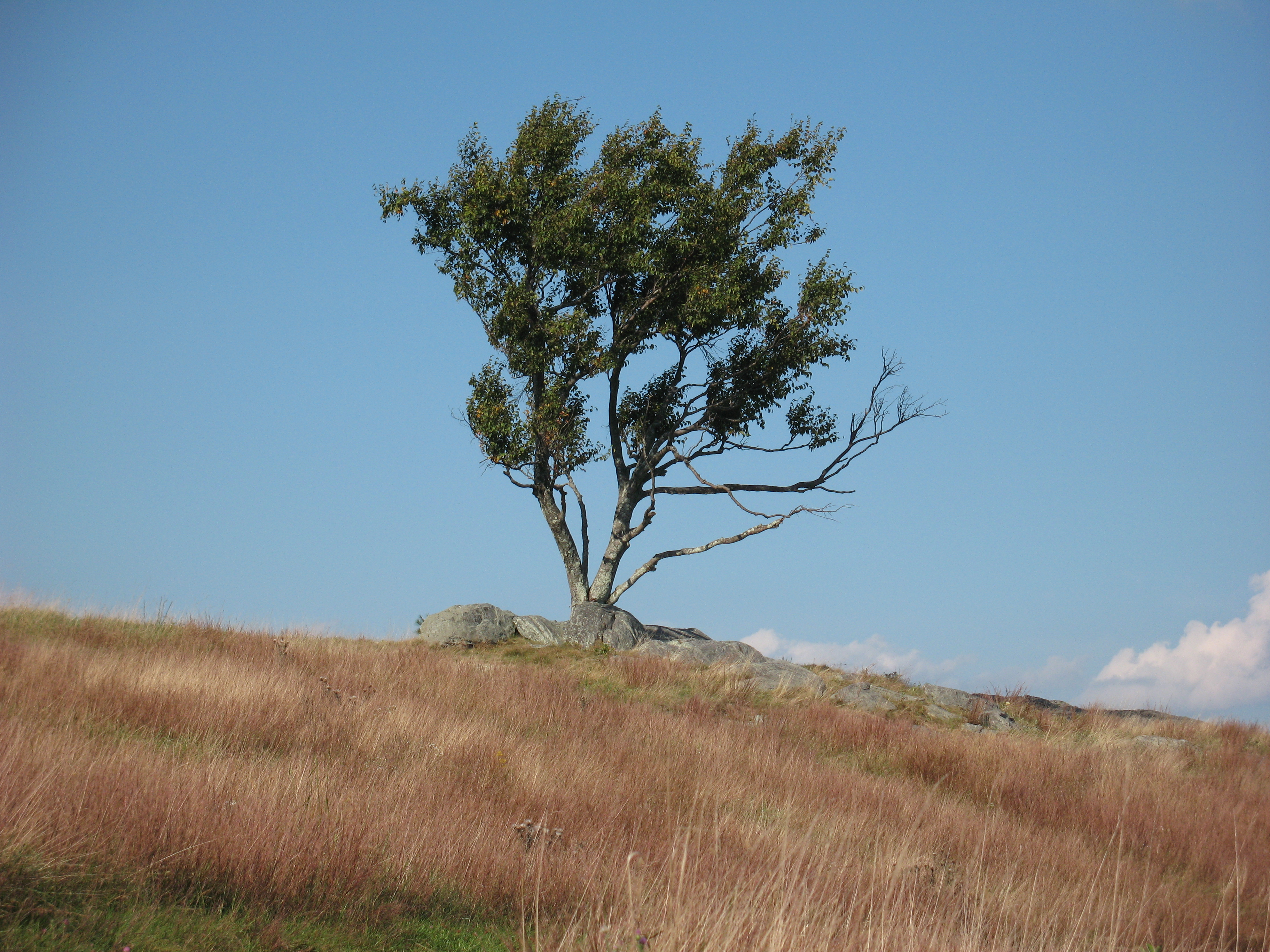
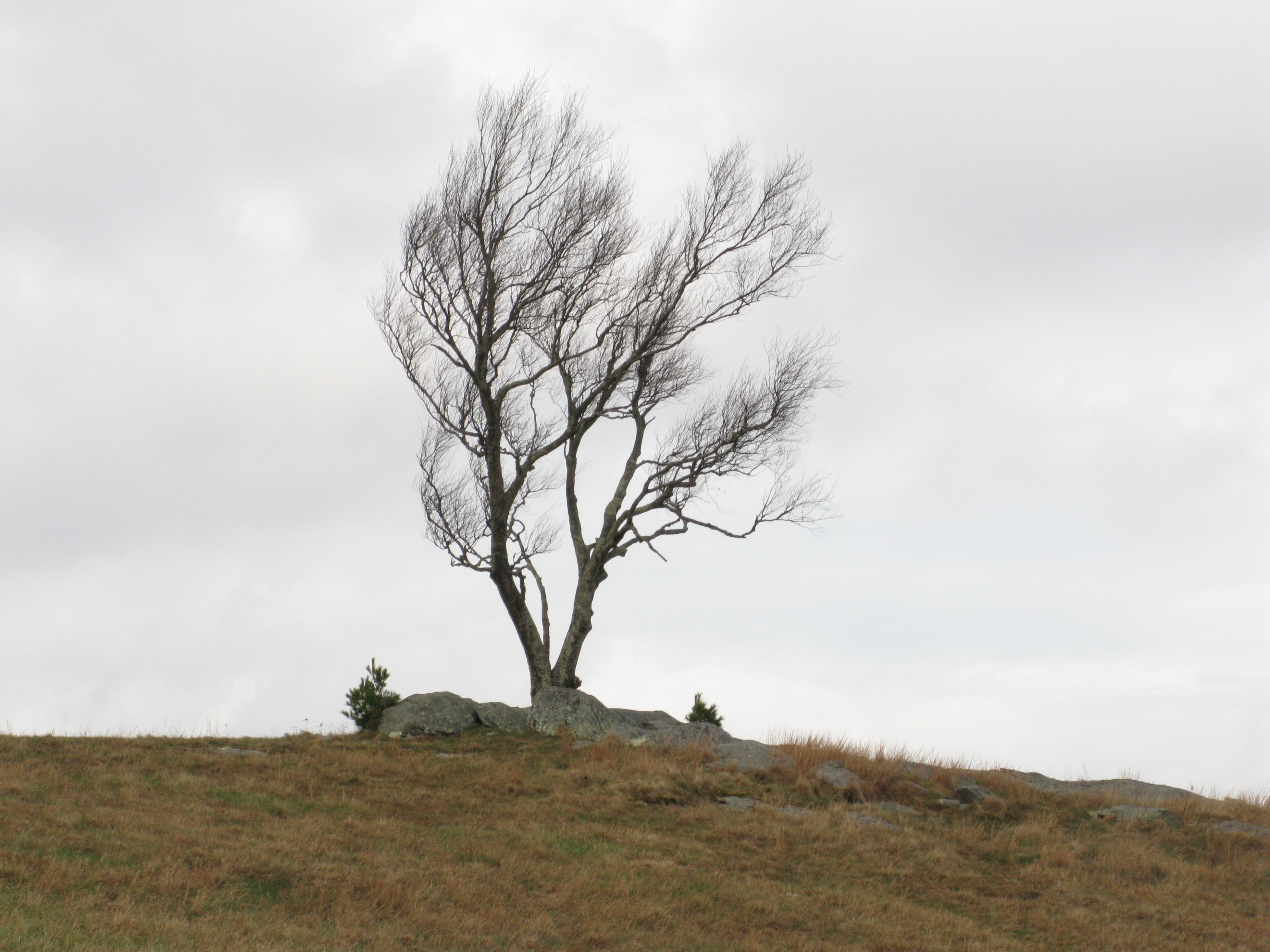
Doughton Park Tree 2014-07-13

Read Full Post »

 . 
[with 3 poems by Mark Smith-Soto]
 . 
Sunroom Twilight
 . 
Another thunk against the window glass,
another broken wing or neck, as like as not,
another muted spill of feathers on the grass –
I love this space, but it’s been dearly bought.
 . 
Of course, the same might well be said
of the lamb we grilled last night, honoring
its sacrifice with salad and good bread.
The whole-grain loaf, the baby kale, everything
 . 
sundered from daylight for my sake,
floods the mind in unforgiving surge,
sweeps me into the sobering give / take
 . 
that underpins life / death. In the sun’s wake,
birdsong dapples the gold air with its dirge.
Or rather, hymn of wonder; my mistake.
 . 
Mark Smith-Soto
from Daybreak, Unicorn Press, Greensboro, NC; © 2024
 . 
❦ ❦ ❦
 . 
Passenger side floorboard there’s a Mason jar of flowers, black-eyed susan and zinnia, marigold and mint. I cut them from our garden this morning for Mom’s bedside table. On I-77 South just past Jonesville there’s a field of sunflowers blooming, another field near the coverleaf with 421, all looking southeast right now because it is still morning. I’m driving to Winston to visit Mom and Dad in Kate B. Reynold’s Hospice Home. Life surely does suck. Life surely is exalted.
 . 
This is a respite care admission, scheduled so we can upgrade their bathroom and bedroom. Make their home more liveable while dying. Their dates of death are not clearly visible to us over the horizon, certainly not etched in stone, but how distant can they be? Is this what people mean when they say live one day at a time? Mom can still laugh when we joke around, although each day a bit more of her releases into airy nothingness. Dad’s crash has been more sudden, broken neck, delirium, bedfast, but he still seems to add a few more good minutes to each ensuing day. All three of their children will be under the same roof today, now that’s red-letter. We’ll be helping them with lunch, sitting with Mom in the flower garden for a half hour, logrolling Dad in bed to rub ointment on his back. And while the two nap, we three will have a long conversation in another room about next week, and the weeks after.
 . 
Yesterday afternoon my son called after he returned from a few hours visit with his grandparents. Josh took Granddaddy grits and collards and says he spent most of their visit eating. Yeah! Josh has been afraid to see the changes in the two up close and had put been putting this day off for months. I told him I know he still hurts from Jonathan, his best friend all through school, right after graduation the cancer. But then at the end of talking, Josh says to me, “So how are you doing, Dad?”
 . 
Don’t get that question a lot and even less often do I say anything more than, “Fine.” I hear the sincerity when Josh asks. All the drive down today and all the drive back what I’m really thinking about is how to continue the conversation. I’ll stop at his house before I get home to drop off a cooler he left at Granddaddy’s house. I’ll begin by taking him outside and telling him how much I appreciate what he said. I’ll ask how he’s doing. And then I’ll ask another – rehearsed in my head for days, weeks, months: “And how are you doing on your path to quit drinking?” Life can surely do its best to convince you it sucks. But I have a feeling the two of us standing in the driveway for a half hour talking is going to show life it doesn’t have to.
 . 
 . 
❦ ❦ ❦
 . 
Segue
 . 
Now that you mention it: death,
the cherry outside the kitchen
in full bloom, the novel I left
open on my bed, the stitch in
 . 
my side riding a rib, the small
hole at the center of my retina
where nothing registers at all,
the rip in the screen letting in a
 . 
gnat adrift on the whiff of daphne
blooming along the broken driveway,
the sudden abandon of your laugh, me
forgetting what I was going to say,
 . 
closing my eyes, holding my breath,
and now that you mention it, death.
 . 
Mark Smith-Soto
from Daybreak, Unicorn Press, Greensboro, NC; © 2024
 . 
❦ ❦ ❦
 . 
The poet notices a little something, a little nothing, really: breakfast, a chess board, chalk dust; light across a woman’s profile, flowers that shouldn’t be there, a word that carries on its back two meanings. Common things, every day things. The poet notices and his smile as he points out what he has noticed is almost sly; the pointing is all about what he’s not quite saying. Then all at once you notice, too. And you smile.
 . 
In Mark Smith-Soto’s world you might discover wonder in commonplace, joy in commonalities, mystery in what we share and have always shared without noticing that we do. You might join him in memories that make you cry, realizations that lift from within you a deep sigh, possibilities that sober you right down before they exalt you. In Mark’s ultimate collection, Daybreak, every single one of the 56 sonnets has touched me, gently but insistently, until I admit I’m relieved: I am / a human being. I’m pretty sure of that. [Biology Lesson]. After reading these poems, I begin to notice the flowers in the cracks of my walkway with new eyes; they implore me that death [is] a lifetime of hours away [Aria da Capo].
 . 
During the years of this twenty-first century, my orbit and Mark’s intersected only a handful of times, for only a handful of hours. But what gravity and what luminosity! In life I knew Mark only a little; I am glad to know him much more in poetry.
 . 
 . 
Mark Smith-Soto (1948-2023) was born in Washington, DC, and lived in Costa Rica until the age of 10, when his bilingual family returned to Washington, his father’s native city. Mark’s awards include a fellowship in creative writing from the National Endowment for the Arts and the NC Writers Network’s Persephone Competition for his chapbook Green Mango Collage, among many others. Daybreak is his seventh poetry collection and is available from Unicorn Press in Greensboro, NC.
 . 
Thank you, Michael Gaspeny, for sending me Mark’s book as a gift. A treasure.
 . 
❦ ❦ ❦
 . 
There You Are
 . 
I do feel somehow exiled here, outside
the frame – just what is it about a woman
at an open window, seen from the side,
an opalescent half light on her hands
 . 
holding the curtains apart, head tilted,
questioning? Maybe her gaze has stranded
on the naked lady half-hidden by the shed,
a blossom she knows she never planted,
 . 
her wondering, These small, random gifts,
why do they touch one so? But of course,
I can’t begin to guess her mind, it’s
 . 
me trespassing here, I should go before
she sees me, leave her to her thoughts –
“Oh, there you are, amor. Come look at this.”
 . 
Mark Smith-Soto
from Daybreak, Unicorn Press, Greensboro, NC; © 2024
 . 
 . 
❦ ❦ ❦
 . 
Doughton Park Tree 2016-10-17a
 . 

Read Full Post »

 . 
[with 3 poems by Hilde Weisert, plus Wilfred Owen]
 . 
Imagination Itself
 . 
++++ To the eyes of a man of imagination,
++++ Nature is imagination itself.
++++ ++++ — William Blake
 . 
Who needs half a million unpronounceable forms of life
Half a world away? Ah, you do, they say,
And enumerate the ways:
++++ Glues, dyes, inks,
++++ Peanuts, melons, tea,
++++ Golf balls, paint, and gum,
++++ Mung beans, lemons, rice,
++++ And a fourth of all the medicines you take,
++++ And a fifth of all the oxygen you breathe,
++++ And countless life-prolonging secrets their wild cousins know
++++ to tell the Iowa corn and the garden tomato.
++++ And if that’s not enough, think of rubber —
++++ and where we’d all be, rattling down the interstate
++++ on wooden wheels.
 . 
And that’s only the stuff we know how to use,
And that’s only the half-million species we know how to name.
 . 
And in the time it took to tell you this
Five thousand acres more are gone.
And by the time that this year’s kindergarten class
is thirty-five, most of what is now alive —
 . 
But wait. What if — what if this deluge of mind-boggling
statistical connectedness were, true as it is,
only the least of it? What if the real necessity
were of another kind, the connection
 . 
Not with what you consume, or do, but who you are?
 . 
With your own imagination, the necessity there
of places that have not been cleared to till,
of the luxury of all that buzzing in the deep,
of a glimpse of feather or translucent insect wing
a color that’s so new it tells you light and sound
are, indeed, just matters of degree, and makes your vision hum
 . 
And makes you think the universe could hum
in something like the wild, teeming equilibrium
of the rain forest.
 . 
Hilde Weisert
from The Scheme of Things, David Robert Books, Cincinnati OH, © 2015
++++ originally published in THE SUN, Chapel Hill, NC
 . 
❦ ❦ ❦
 . 
Semi trailer in the right lane, speed almost matched, I can’t see green flashing past its far shoulder and the close cropped median is no consolation. Another morning driving to Winston to care for my parents, often a highway hour of calm & reflection, but today none of that. The hugeness of the truck, how much steel and rubber son to squat corroding and stinking in a back lot; the miles of asphalt and concrete, how much of the world we have eaten and smothered; myself no better than any, spewing carbon, cranking high this premature heat of summer – what is this world we have so mangled?
 . 
Linda and I caught a whiff of dead thing two days ago. Cool morning leaving for church then on to Duke Gardens for an outing, just a faint premonition of amines and putrefaction. Pre-stench. That night stronger when we returned too tired to seek its source near the driveway. Yesterday pungent but impossible to pinpoint. I didn’t want to find it. The bluebirds all weekend had been fretful and flighty around the birdhouse, bringing insects less frequently although chirping still audible inside. No chirping yesterday morning. Had the fledglings flown? Or . . .? I didn’t want to see what I feared in the nest.
 . 
This morning the dead scent is a shroud of grief. I need to leave for Winston right now but first I walk the drive’s margin sniffing like a reluctant hound. It comes from everywhere. The compost heap? Down the hill, a dead rabbit or squirrel? I’m avoiding the birdhouse. When I reach it, though, I suddenly know. We couldn’t see from the porch but at the back of the post in webbing I tacked up to deter snakes is one. A large black rat snake.
 . 
So to save the eggs, the nestlings, I’ve killed a beneficial serpent. One just like all those I’ve swerved to avoid running over, one that no doubt has contributed to the absence of copperheads on our property. One I should thank, not destroy. The bluebird parents we saw were mightily upset by him even though he could never reach them. No feathered visitations this morning, no chirping. Have the young ones flown? Or for fear of the snake did the parents abandon the nest?
 . 
I will know when I clean out the birdhouse. But I can’t make myself do it this morning.
 . 
 . 
❦ ❦ ❦
 . 
Ars Poetica
 . 
“I learned to talk from my mother,” I said,
and was startled: Doesn’t everyone?
But “learned from” –
as if it were playing the piano,
or making the sylsalat at Christmas?
But it was: Her speech,
invented for me, her patience
letting my mouth and tongue
work the vowels, open
and open, then clench consonants
hard in my teeth, all nibbled edge,
and me still making of it a gibberish,
a babble; a glottal soup,
a drool;
 . 
My answering nothing but a rhythmic rumination
of nonsense syllables. But she kept on,
now a whisper, now a song, and in a while
the words became words: Epitome
and punctilio, modicum
and masterly; plenty of slang
like vamoose and delish, and play
in the “Ditto” that either one
could say, and smile, (our secret).
 . 
This language of the days
of our small world, dangled from,
rolled in, colored and toddled,
and finally slept on , a pillow,
the sun,
 . 
Is now so many vocabularies ago, fields
of cultivated speech –
 . 
But with this odd sentence I remember
what came first,
the ravishing world she made
me take, word by hungry word,
and how much more there is to tell
in our original language.
 . 
Hilde Weisert
from The Scheme of Things, David Robert Books, Cincinnati OH, © 2015
 . 
❦ ❦ ❦
 . 
As Hilde Weisert read from The Scheme of Things recently at McIntyre’s Books near Chapel Hill, I was captured in the net of imagining that she cast over her audience. For those few minutes I lived in new places and thought new ideas. Now reading her book straight through has expanded and reinforced that experience. I find it remarkable that poems that criss-cross so many years and so much distance can feel entirely local and present.
 . 
Each of the five sections – Three Stars; The Truth of Art; Skylark; Away; Where We Were and What We Were Doing – is a book unto itself. Each section weaves threads to create an entirety. Three stars: New York, Paris, Budapest, and the family relations that occupy them. The truth of art: language, science, learning to speak. Skylark: jazz, baby, jazz! Away: youth and age, what we lose, whom we lose. Where? This earth, this world, this stumbling life and all we might miss and all we might claim.
 . 
Hilde has lived many lives, it seems. Thanks to writers of books, thanks to poetry, you and I may live many lives as well.
 . 
 . 
More about David Robert Books and The Scheme of Things HERE
 . 
 . 
❦ ❦ ❦
 . 
Finding Wilfred Owen Again
 . 
Our college love affair was doomed
like all the romance I outgrew at twenty;
trench warfare’s mad embrace be damned
along with Buffy Sainte-Marie and Nietzsche.
++++ And anyway, the war in Vietnam was ending.
 . 
For decades he lay silent in a book,
moved from Brooklyn to St Louis and LA
with curling snapshots, silver rings turned black
the mildewed albums I will never play.
++++ I left him to his war; our war had ended –
 . 
Until I call, the offhand way you do old flames
(as if you hadn’t kept their trail of numbers)
when something big has changed, or Armageddon looms.
(Shamed moment: Was it Rupert I remembered?
++++ Romance imagined?) Not now: War has descended –
 . 
distant and mine. I”m dazed, feckless, as lost
as my lost country. So I come here,
to find myself standing on shattered ground he blessed
with full eyes ninety years ago and hear
++++ him tell another time how war must end
 . 
in this fell field, on this dark page. The night
opens, closes, opens, a swinging sulphur rhythm in the flare
igniting each line end, the faces lit
and then eclipsed,
but always bright the names.
 . 
Hilde Weisert
from The Scheme of Things, David Robert Books, Cincinnati OH, © 2015
 . 
❦ ❦ ❦
 . 
Anthem for Doomed Youth
 . 
What passing-bells for these who die as cattle?
++++ — Only the monstrous anger of the guns.
++++ Only the stuttering rifles’ rapid rattle
Can patter out their hasty orisons.
No mockeries now for them; no prayers nor bells;
++++ Nor any voice of mourning save the choirs,—
The shrill, demented choirs of wailing shells;
++++ And bugles calling for them from sad shires.
 . 
What candles may be held to speed them all?
++++ Not in the hands of boys, but in their eyes
Shall shine the holy glimmers of goodbyes.
++++ The pallor of girls’ brows shall be their pall;
Their flowers the tenderness of patient minds,
And each slow dusk a drawing-down of blinds.
 . 
Wilfred Owen (1893-1918)
 . 
❦ ❦ ❦
 . 
Doughton Park Tree 4/30/2022
 . 

Read Full Post »

« Newer Posts - Older Posts »