Feeds:
Posts
Comments

Posts Tagged ‘Julie Suk’

 . 
[with 3 poems by Julie Suk]
 . 
We’re Small on the Rim
 . 
of comprehension, but that shouldn’t distract
us from the fig tree
 . 
bent by fleshy globes on the verge of fall,
seed exposed where the fruit splits.
 . 
And there are the aunts
leaning over a cast-iron kettle filled
with sugar, spices, and a curl of lemon zest –
 . 
figs stewing, jars lined up, the ladle lifted
for a sample sip –
++++ never mind the times my lips were burned
++++ by a sweetness giving more than I gave back.
 . 
Hold out your hand for the unseen
my grandfather said.
 . 
There, the universe,
a potpourri of energy lit by colorful fires
that sparked me to life,
 . 
++++ accident though it was,
 . 
limb of the fig tree scratching the house,
on the table, a spoon.
 . 
Julie Suk
from Astonished to Wake, Jacar Press, Durham NC; © 2016
 . 
❦ ❦ ❦
 . 
I am crying for the beauty of these trees. An upwelling of emotion? A brain response slung through limbic system from temporal lobe because of certain inverted images on my retina? No, a watery reaction to pollen. Hazel catkins stirring in the breeze. An itch, a sneeze. But still I am crying for the beauty of these little trees.
 . 
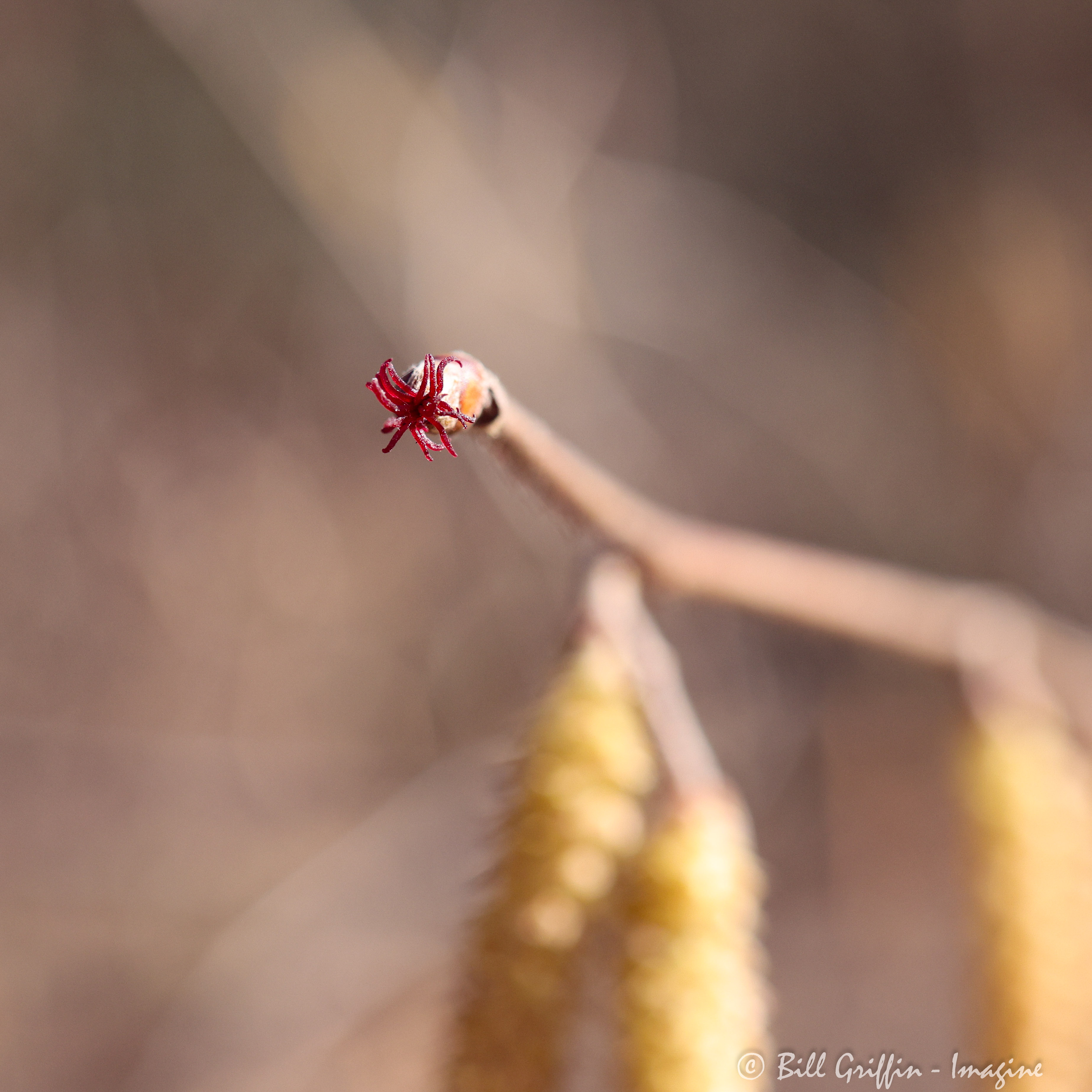
How one says a thing is more important that what one says. We stop along the nature trail to notice this unequivocal manifestation of Spring – drooping yellow pollen catkins on American Hazelnut, full and fertile long before any leaves appear. These are the male flowers. Where are the female? Solitary at the tips of limbs and buds, discover a few spidery red florets no bigger than your little fingernail. From these tiny nubs the nuts will form and we can eat them in September if we beat the squirrels. As I point out the female flowers, how they point mostly outward and upward away from the catkins, I catch myself before blurting this explanation: “They’re designed to prevent self pollination.”
 . 
Designed? The Hazels worked out this arrangement of their own volition? Or had it planned for them de novo on some cosmic drawing board? Oh Evolution, how you embrace the random and non-linear, and how we struggle to grasp such a universe. I gulp and begin a different tack. “Self pollination increases the risk of recessive traits and may weaken the line. Over many, many generations, the Hazel trees that happen to grow with their little red flowers poised to catch pollen blown in from a neighbor tree are more likely to have strong offspring that can pass that trait along.”
 . 
And does that explain why I cry for the beauty of these trees? All these trees? The red maples are already dropping their polleniferous bundles as winged seeds unspool from female flowers. Stony hickory nuts are still discoverable beside the trail from last fall’s excellent mast season. The green furze we spy at the ridgeline’s crown is tuliptrees’ earliest budbreak. The trees speak their names in the space they fill. They give their promises almost silently but always sure. There seems no end to the means my own species can devise to make the world harsh, hateful, ugly. There is no end to the beauty of these trees. I cry.
 . 
 . 
❦ ❦ ❦
 . 
The Dream It Was
 . 
Gone, the apples left last night for the deer –
 . 
shadows lighter than the night they passed through,
rune-like hoof marks carving the frosted lawn.
 . 
Like a dream,
but touch is my familiar.
 . 
May you and I morph into other bodies that meet
once this one goes
 . 
on and on into the blue heights – old trails
like those deer use around the girth of a mountain.
 . 
And after breath evaporates
may the words left without a tongue
fall into the pool where we swam,
 . 
the cold waters rushing back warm.
 . 
Julie Suk
from Astonished to Wake, Jacar Press, Durham NC; © 2016
 . 
❦ ❦ ❦
 . 
Hold out your heart for the unseen. When there are no longer lips, a mouth, to hold our words may they pool in the places we loved. May we meet again on the blue heights, on some new trail, on a very old trail. What voice would you choose in your next life? Listen for me, a song of wind thin in the high branches.
 . 
 . 
What would the new day hold for us if each morning we were astonished to wake? Dogwood scratches the window as wind picks up. Throaty testosterone rumbles as the teenager across the street starts his pickup to head to school. What could urge me out of bed instead of surrendering to warmth and pulling the covers higher? But this is a new day, the vernal equinox in fact. I confess I have reached the time of life when I can see the days ticking on ahead of me are finite in number.
 . 
Turning each page in Julie Suk’s Astonished to Wake is a reminder that new days are in short supply. Perhaps this one will weave its meaning from days treasured in their remembering. Perhaps this one would prefer to eat me raw. Perhaps this is the day I really will wake up and notice every person that has made my life, and even tell them so. A good book of poetry compels one to turn each page, then the next. A great book of poetry compels one to set the book aside and enter the newness of this day.
 . 
 . 
From Charlotte, NC, and former managing editor of Southern Poetry Review, Julie Suk has been a beacon in the world for poetry for decades. R. T. Smith writes, “The poetry of Julie Suk is at once deceptively spare and metaphorically rich, and the sensual mystery of her perfectly pitched and etched lines is haunting, elemental, and wild.” Her many awards include the Brockman-Campbell Award of the North Carolina Poetry Society. Astonished to Wake is Julie’s sixth collection, published by Jacar Press.
 . 
 . 
❦ ❦ ❦
 . 
The Music
 . 
When my father was young, he played the violin,
his mother, the rosewood Grand.
 . 
She also had a voice clear and sweet,
 . 
also had tuberculosis and died
when my father was thirteen.
 . 
He never played again, but loved music,
 . 
the Victrola making its rounds,
or the two of us listening to opera on the radio.
 . 
No noise allowed in the house when Rosa Ponselle sang.
 . 
In my next life I want the voice of a violin.
 . 
Tell me what you’d like played
and I’ll speak from the key of love and pain,
 . 
how the living are echoes of the past,
 . 
my grandmother staring into the darkness – as I do now,
thinking of those I must leave.
 . 
Talking into the night,
we’ll hold sorrow up close and let it weep.
 . 
Julie Suk
from Astonished to Wake, Jacar Press, Durham NC; © 2016
 . 
❦ ❦ ❦
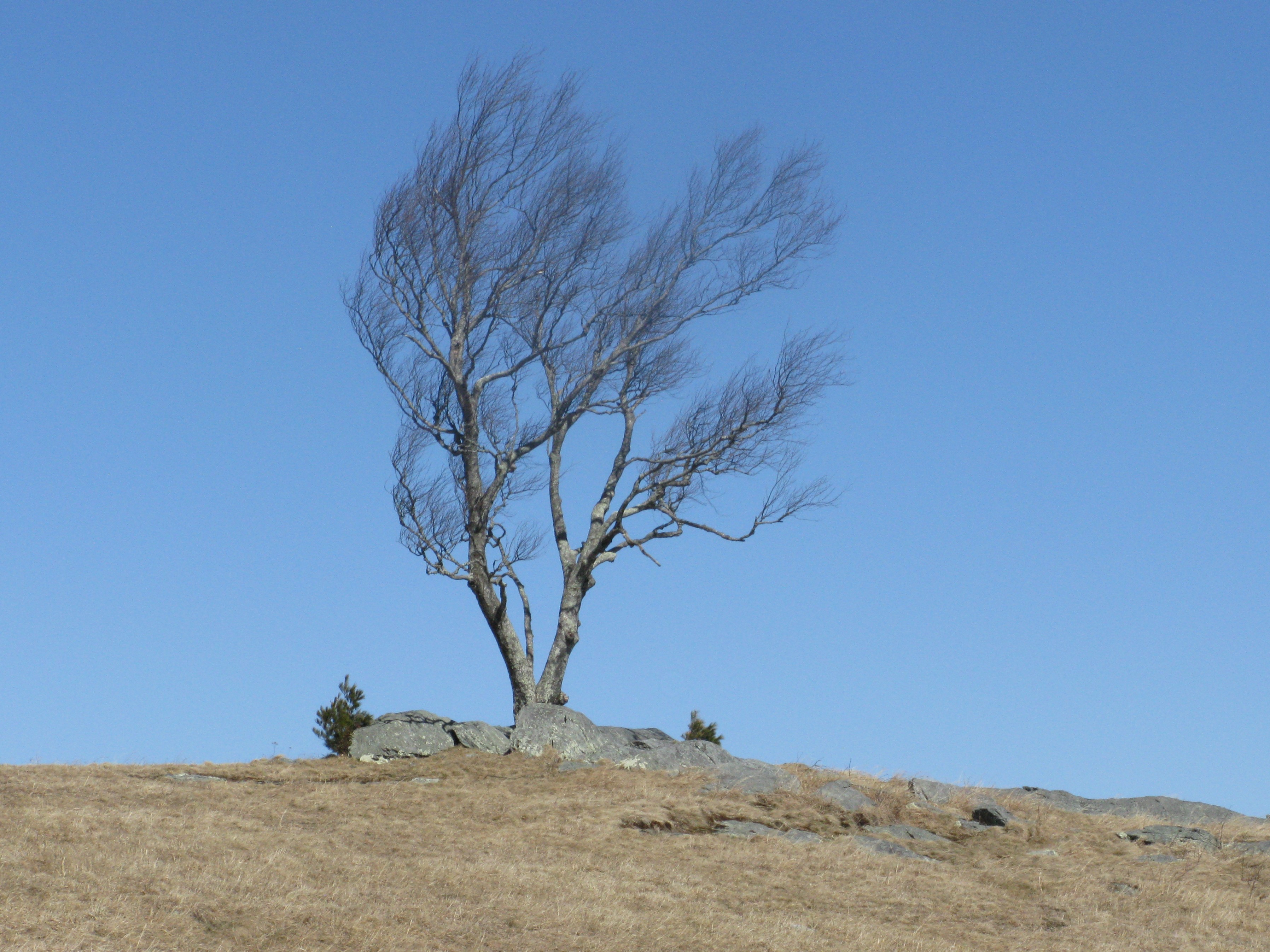
 .Doughton Park Tree 2021-02-23 
 . 

Read Full Post »

[poems from Word and Witness: A. R. Ammons, Julie Suk, Peter Makuck]

Carnage ensues at the table while I make coffee. As all the other animals look on in abject silence, large plush Starfish (carnivore, you know) has captured Baby Chick and is eating him with authentic suck-the-juice-right-out-of-you sound effects.

I remark that I’m going to be sad to miss little yellow Chicky. My grandson looks up, all innocence, and simply reminds me, “That’s just the way the food chain works.”

So it must be. Nine years before the publication of Darwin’s The Origin of Species, Alfred Lord Tennyson had already warned us (“she” being Nature, “types” being species):

. . .
She cries, ‘A thousand types are gone:
I care for nothing, all shall go.

‘Thou makest thine appeal to me:
I bring to life, I bring to death:
The spirit does but mean the breath:
I know no more.’ And he, shall he,

Man, her last work, who seem’d so fair,
Such splendid purpose in his eyes,
Who roll’d the psalm to wintry skies,
Who built him fanes of fruitless prayer,

Who trusted God was love indeed
And love Creation’s final law–
Tho’ Nature, red in tooth and claw
With ravine, shriek’d against his creed –

Who loved, who suffer’d countless ills,
Who battled for the True, the Just,
Be blown about the desert dust,
Or seal’d within the iron hills?

+++++ from In Memoriam A. H. H. (1850)

Shall we weep for Baby Chick? For the extinctions accelerating around us? For ourselves, our loss? A few years back I was leading a group of Junior Highs on a nature walk when we spotted a marvelously large spider shuffling along the path ahead of us. When we reached it, though, we found it was not the legs of the spider that were walking but the legs of the pint-sized wasp that had stung and paralyzed it and now dragged it to a favorable spot for egg laying. In an instant the spider transformed from an object of fear and loathing to a spike of compassion in our hearts.

This week a very talkative red shouldered hawk is haunting the woods out back. No coincidence: that’s where the bird feeders hang. We hope he’s eyeing the squirrels – there are more than enough squirrels, eat all you want Sir Hawk. And the mice that come for the seeds dropped to the ground from the feeders, and then store them in our basement, yes, eat them, too. But please, not the cute chipmunk who hides in the ivy or the finches we love. Alas, I guess we don’t get to choose. That’s just how the food chain works.

But wait – do all our choices come to nothing? Our love, our suffering of countless ills, our battles for the True and Just – is the end of all these to be blown to desert dust? Can’t we choose to engage with embattled Nature? Can we reduce our relentless consumption of the planet, choose leaders of vision and intelligence, make peace with our brothers and sisters? How lengthy shall I extend this list? Shall we abandon hope and just accept our place in the food chain while the warming earth devours us?

If a spider can inspire a moment of compassion in a 13-year old, I will have to accede that there may yet be hope for our species.

❦ ❦ ❦

The Yucca Moth

++ The yucca clump
is blooming,
++ tall sturdy spears
spangling into bells of light,
++ green
in the white blooms
++ faint as a memory of mint.

I raid
++ a bloom,
spread the hung petals out,
++ and, surprised he is not
a bloom-part, find
++ a moth inside, the exact color,
the bloom his daylight port or cove:

though time comes
++ and goes and troubles
are unlessened,
++ the yucca is lifting temples
of bloom: from the night
++ of our dark flights, can
we go in to heal, live
++ out in white-green shade
the radiant, white, hanging day?

A. R. Ammons
collected in Word and Witness: 100 years of North Carolina Poetry, Carolina Academic Press, © 1999 North Carolina Poetry Society

❦ ❦ ❦

This week a friend asked me to send him the table of contents of Word and Witness for a project on biodiversity he’s considering The book was published by the North Carolina Poetry Society in 1999 and edited by Sally Buckner with an afterword by Fred Chappell, who was NC Poet Laureate at the time. It spans the full 20th Century of North Carolina poetry and poets, and as I was scanning the TOC to email my friend a PDF, I re-discovered the names of so many folks who have inspired and befriended me over the last two decades.

Poetry continues to thrive in “the writingest state.” Word and Witness is 261 pages; it would be a real challenge to prepare Volume II for just the first quarter of the 21st Century and limit it to that length. I believe it is still possible to purchase a copy from Carolina Academic Press. You need to get yourself one.

❦ ❦ ❦

Waiting for the Storyteller

Once more we wait for the storyteller
to step into the margin and reveal intentions:
why the first letter flowered,
spiraling down the page with intricate designs,
the hand translating what the tongue began.

Clues drop, mostly forgotten,
so on and so on stacked like bricks,
crumbling when we look back,
a voice once close now a stranger.

All through the book we wild-guess the villain,
so deceived by this one or that
we look for reprieve, a surprise ending,
the page turning to a house in the woods,
dogs locked up, gun put a way.

In the still forest of words,
where the hidden appears in its season,
hills darken and move in.
Like lean horses that have rocked a long way home,
they circle the pool of our hands.
A deer riffles through leaves, then a bird
sings begin again, begin again.

Julie Suk
collected in Word and Witness: 100 years of North Carolina Poetry, Carolina Academic Press, © 1999 North Carolina Poetry Society

❦ ❦ ❦

Dogwood Again

Home from college, I’d leave my reading,
climb the hill through trees behind the house,
listen to a rough wind suffer through
new leaves and, too aware of myself, ask why?

The answer could have been stone wall,
wind or some other words. In April, our house
lived in the light of those first white petals
and now I think more about hows than whys –

How, whenever we fished at Pond Meadow,
my father dug a small one up, carefully
wrapped the rootball in burlap, and trucked it
home until our hard blazed white all around,

and how, at Easter, those nighttime blossoms
seemed like hundred of fluttering white wings.
Again that tree goes into the dark loaded
with envy, those leaves full of light not fading.

And this morning, a fogbright air presses
against the blank white pane and would have us
see the way mist burns from within, shimmers,
slowly parts, and flares upon an even whiter tree,

tinged now with orange, and how a soft fire
runs to the farthest cluster of cross-like petals,
each haloed with clear air, finely revealed.

Peter Makuck
collected in Word and Witness: 100 years of North Carolina Poetry, Carolina Academic Press, © 1999 North Carolina Poetry Society

❦ ❦ ❦

Bios adapted in part from Word and Witness:

After growing up on a tobacco farm near Whiteville, A. R. Ammons (1926-2001) received a degree from Wake Forest College, and served as an elementary school principal, but he lived most of his adult life outside his native state. His interest in writing developed during long hours aboard ship when he served a term of duty with the Navy. In 1964 he joined the faculty at Cornell University, where he was ultimately Goldwin Smith Professor of English. Among his many honors are the Bollingen Prize, the national Book award (twice), the MacArthur Fellowship, and the 1998 Tanning Prize from the Academy of American Poets.

A native of Alabama, Julie Suk (b. 1924) has lived for many years in Charlotte, where she worked in a nature museum. In addition to authoring six volumes of her own poetry, she has co-edited (with Anne Newman) Bear Crossings: An Anthology of North American Poets. Her collection The Angel of Obsession won the 1991 University of Arkansas national poetry competition, and in 1993 she won the Bess Hokin Prize given by Poetry magazine. In 2004 Julie received the Irene Blair Honeycutt Lifetime Achievement Award from Central Piedmont Community College; her book The Dark Takes Aim won the 2003 North Carolina Poetry Society’s Brockman-Campbell Book Award and The Oscar Arnold Young Award from The Poetry Council of North Carolina.

Among previous occupations, Peter Makuck (b. 1940) lists, “truck driver, painter, mechanic,” but he is best known as writer and as Distinguished Professor of Arts and Sciences at East Carolina University. Pilgrims won the Zoe Kincaid Brockman Award for the best book of poems by a North Carolinian in 1989. In 2010 Long Lens: New & Selected Poems was nominated for a Pulitzer Prize. In addition to his eight collections of poetry, he has published numerous short stories and essays. Peter has received the International Poetry Forum’s Charity Randall Citation; a Connecticut native, he has been a Fulbright Lecturer at the Universite de Soavoie, Chambery, France. He founded Tar River Poetry in 1978 and served as editor until 2006.

❦ ❦ ❦

Doughton Park Tree 2021-10-23

Read Full Post »

[with two poems by Julie Suk]

Silence does not exist for me. I’ve had my tinnitus mapped by an audiologist: four different frequencies in each ear, one or two dominant (louder!). One tone (on the left) is pitched so low that the only time I’ve heard it was before sunrise in Shining Rock Wilderness (near Mt. Pisgah) – no wind, no birdsong, no people, no machines. The other tones are high pitched, constant whining needles of sound, minor chords that never resolve.

I’ve heard that some people are driven insane by tinnitus. Perhaps you’d better be extra vigilant when you’re around me. Somehow, though, I’ve been blessed with the gift of mostly ignoring it, not caring. I can’t remember a life before I heard this daily continuous ringing screech. Where did it come from? All that target practice earning Marksmanship Merit Badge in Boy Scouts? All those lawns mowed as a kid? All those Grateful Dead and J. Geils Band concerts?

Intrusive noise. Which of us in 2021 doesn’t suffer from such? Thank you, iPhone, for telling me my screen time increased 23% last week. Add to that I’m a terrible meditator. If I try to empty my mind what immediately creeps in to fill the vacuum is regret and guilt for every screwup I’ve ever committed in my entire life. What works better for me is poetry. Feet flat on floor. Deep breaths, in and out. Open the book. Read a page. Stare unfocused into space. What tinnitus?

.     .     .     .     .     .     .

At first I’m tempted to apologize for introducing Julie Suk with an essay that endeavors to wring a smile, but no, the light touch is not inappropriate. The poems in Astonished to Wake, Julie Suk’s sixth book published in 2016 when she was 92, are often about loss and all of them are about her own impermanence – they are solemn but they are never grim. The poems are simply perfectly human.

We all share one thing on this earth – our own mortality. Admitting that, we may be open to discover that we share much more: grief that we must live through and live beyond; loves that are no longer present but which still warm us like the dying fire’s embers; moments of joy, however brief.

As I sit down for a couple of hours to re-read this book in its entirety I become thoughtful, reflective, connected, grave, but not sad. And the only ringing I hear is Julie’s words.

.     .     .     .     .     .     .

Migrations

A stretto of rain on the windowpane,
a swirl of bees caught in the creek’s overflow,
the yard going under.

Remember how replete our lives once were,
brimming over, the future a muted thunder
drawing us close.

Hold me, hold me

meaning I was fearful the same as you.

Drowning in sweet addictions,
we paused in a childlike daze –

no way to foresee
how and when we’d be swept away,

our bones washed up long after –
perhaps a fragment carved into a flute,

breath,
once again, floating through the wilderness.

.     .     .     .     .     .     .

Between Lives

And what if it’s true that the life we’ve lived
flashes by at the moment of death?

Not even for an instant would I want repeated
the boring drone of guilt,
nor the shabby aftermaths of desire.

The black tunnel lit with epiphanies
would be my take –

sighs of contentment, laughter, a wild calling out –

and at the end,
a brief flaring of the one we’d hoped to become
escorting us into the light.

Julie Suk, from Astonished to Wake, © 2016 Jacar Press

.     .     .     .     .     .     .

.     .     .     .     .     .     .

Julie Suk (born Julie Madison Gaillard; 1924) is a prize-winning American poet and writer from Charlotte, North Carolina. She is the author of six volumes of poetry – The Medicine Woman (St. Andrews Press, 1980), Heartwood (Briarpatch Press, 1991), The Angel of Obsession (The University of Arkansas Press, 1992), The Dark Takes Aim (Autumn House Press, 2003), Lie Down With Me (Autumn House Press, 2011), and Astonished To Wake (Jacar Press, 2016), and co-editor of Bear Crossings: an Anthology of North American Poets. She is included in The Autumn House Anthology of Contemporary American Poetry. Her poems have appeared in many literary journals including The Georgia Review, Great River Review, The Laurel Review, Ploughshares, Poetry, Shenandoah, and TriQuarterly.

[Bio from Wikipedia]

.     .     .     .     .     .     .

IMG_6944

Read Full Post »